
 April 1, 2008
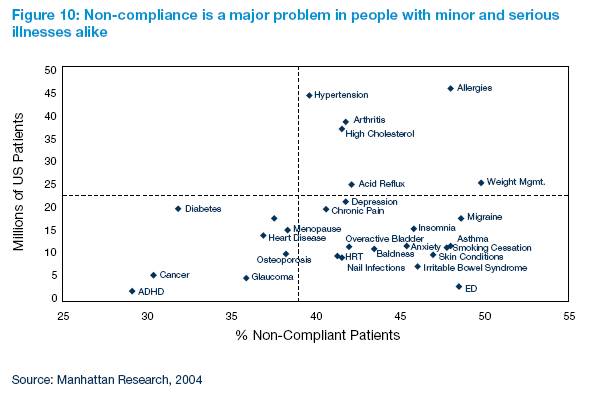
Non-compliance is a significant issue in healthcare. You have the issue of whether people fill the prescriptions that their physician writes; whether they use them once they pick them up; and whether they continue to refill them and stay compliance over time.
You will hear several terms used:
- Compliance is “the extent to which a patient acts in accordance with the prescribed interval and dose of a dosing regimen”. (source)
- Medication Possession Ratio is the days supply of medication divided by the days between refills.
- Persistence or length of therapy (LOT) is the number of days elapsed between the date of the first claim and the date when the days supply of the last claim is depleted.
- Medication Possession Ratio (MPR) is the days supply of all fills minus days supply of last fill / days elapsed between first and last fill.
- Adherence to therapy can be defined as being both compliant and persistant.
- The medication ownership ratio (MOR) is calculated as the proportion
of patients on each initial prescription on a given day. It was
used to describe the percentage of patients within a treatment cohort
who had the medication in their possession on any given day.
Here are a few good sources for information:
- Poster on Persistence and Adherence to Statin Therapy (source for several definitions above)
- Harris Interactive Compliance Survey
- Wilson Health Survey
- Terminology in literature review
I found the following chart in PWC’s publication Pharma 2020: The Vision a good graphic.


 Enabling Healthy Decisions
Trackbacks/Pingbacks
[…] good facts and there are several good comments on there about defining the terms in this area (see my old post) and whether these are reasonable rates of compliance. There is also a patient commenting about […]