
 May 20, 2008
Although this new index was released in a story a few weeks ago, the official press release should be out this morning. It has been interesting to watch this transform from a concept to an initial survey with some data.
What is it? The Healthcomm Behavior Index is a quarterly survey of 1,000+ commercially insured adults in the US that measures the effectiveness of healthcare communications. It focuses on three areas – personalization, satisfaction, and action.
What are some of the key findings?
- Effective healthcare communications (i.e., targeted and personalized) have the potential to build member affinity, loyalty and trust, and significantly drive behavior change.
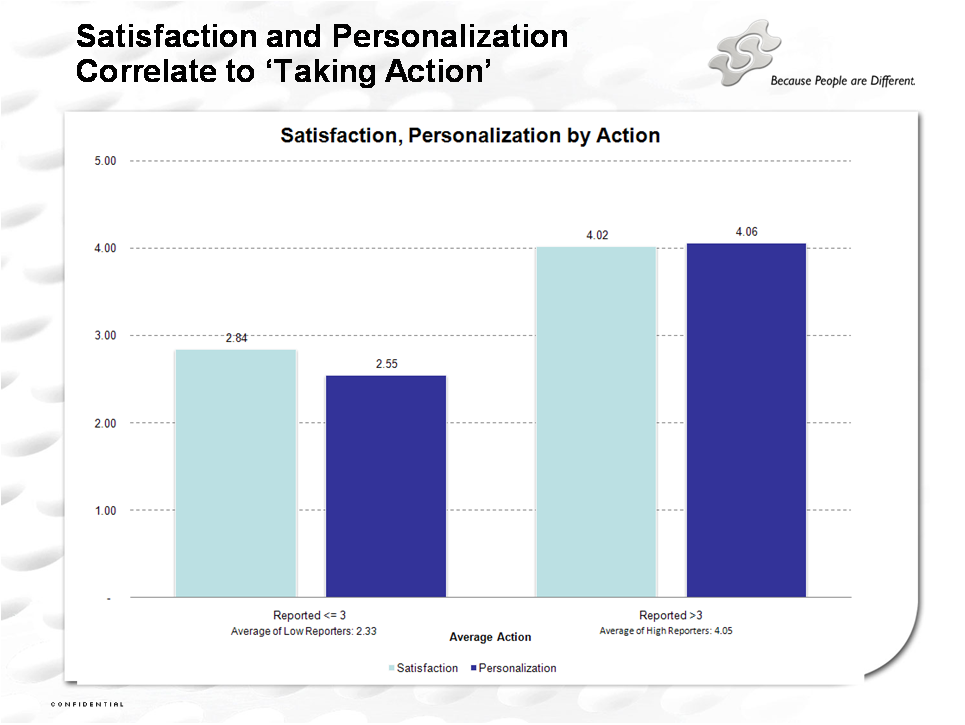
- There is a direct relationship between healthcare behavior change (the willingness to take action) and how personalized and satisfied members are with their healthcare communications.
- Respondents are generally lukewarm on healthcare communications and there is significant opportunity for health plans to improve the effectiveness of their communications programs.
- Unlike other consumer industries, demographics are not as predictive
of healthcare behaviors. - The single most consistent
determinant of healthcare behaviors is health status. - Unhealthy members (those who arguably use health benefits more actively) are the least satisfied and the least likely to take action. These are the members who are the most costly to the health plans so if the plans improve the effectiveness of their communications, they will be able to drive behaviors within this segment and thus have the opportunity to significantly reduce healthcare costs.
- Seniors are more satisfied and take more action relative to other age groups. This was a counter-intuitive finding as it was assumed that seniors as a whole would have a higher percentage of ‘unhealthy’ members. However, we found that people tend to rate their health status relative to their age.
What are the conclusions? Personalized healthcare communications leads to better satisfaction which leads to a higher likelihood that a healthcare consumer will take action relative to their healthcare behaviors. To most effectively drive member behavior, health plans should micro-segment their populations and deliver extremely targeted and personalized communications programs.
I found the most interesting fact to be that those who took action were the most satisfied with their healthcare communications and felt that they were personalized to them. Digging in a little on the research process, those terms were based on questions that addressed the following:
- Took action = acted on information + adopted a healthier lifestyle + improved my health
- Satisfaction = got the right amount of communications + easy to understand + timely + useful
- Personalization = trust the communications + specific to my needs + treat me like an individual
It will be interesting to see how we can use these results with clients to create a benchmark, compare them to a national average, and then look at how self-reported data correlates to claims data. Ultimately, this could prove to be a defining moment in creating the business case for why healthcare communications are so important beyond the obvious – patient satisfaction, lowering inbound call volume, driving behavior, improved profits, etc.


 Enabling Healthy Decisions
Interesting study, yet education by health care providers about prevention should occur more than it does, and this perhaps is due in large part to detrimental patient volume a health care provider has to address due to factors such as requirements from thier employers. Treatment, of course, is good. But in many cases, if the focus was on prevention, health overall would be improved by others.