Archive | September, 2007

Customer Event

What a great week. I have been so busy that I haven’t had time to blog, but I will try to catch up over the next few days.

I always love to mingle with customers and talk to them about their experiences with a company. As a former client, a current consultant, and a future employee of Silverlink, I got to join their customer event this week where 40 customers talked about how they use the technology and services to lower costs, increase efficiency, and grow revenue. Talk about empowering.

Some of the key content / discussions revolved around the following:

  • JD Powers study on healthcare company satisfaction including a great non-healthcare example.
    • It showed how satisfaction with auto insurance actually went up and was higher when the company raised rates but pro-actively told the consumer versus when they lowered rates. Talk about the power of communications.
  • Lots of talk about how marketing and data analytics are going to drive healthcare and how non-healthcare companies are setting the expectations for patients very high compared to the current state.
  • How disjointed healthcare communications are – provider, pharmacy, PBM, MCO, DM companies. No consistency.
  • A great presentation by Liz Boehm from Forrester research which made a few key points:
    • She reinforced the loss avoidance point I blogged about the other day stating that savings is equal to one unit of happiness while loss is equal to two units of unhappiness. So, for many, losing money is a bigger factor than saving money.
    • She pointed out the fact that any healthcare site that quotes a price always has some disclaimer about the accuracy. Why can’t we simply guarantee a price (like any other industry)?
    • She showed that member services (IVR, web) are the 3 most important factor in chosing a carrier after price and network.
    • She showed research that consumers are generally dissatisfied with contacts across all channels from their health plan.
    • She talked about using a persona to design programs and prioritize efforts.
    • She compared channels across cost, reach, engagement, and immediacy.
    • It was obvious that we have a long way to go.
  • Heard from a few customers that talked about how they allow Customer Service Representatives (CSRs) to go “off the clock” to help patients so that they can still track average call time but allow for flexibility.
  • I talked about process innovation and how to apply that to your communication process. I also talked about business process outsourcing.
  • We heard about best practices in driving response rates. Everyone always seems so amazed when they hear about response rates of 50, 60, or 70%. Very difficult to get and/or measure that in other channels.
  • Talked about how MCOs are using the automated call technology – ANOC (Annual Notification of Change) for Medicare, Collections, Lead Management, COB, Missing Information, Wellness Program Recruitment, Reminders, Surveys, and many others.
  • We heard about calculating the ROI with a detailed methodology.
  • We talked a lot about models from other industries that could apply.
  • We talked about data mining and analytics.
  • We talked about member satisfaction, loyalty, and how to survey and capture that information.
  • An outside consultant talked about experience based branding and how sounds can be your brand – Harley‘s engine, Sprint‘s pin drop, Ford‘s door chime, AOL‘s “You’ve Got Mail”.
  • Had several clients talk about how they use Silverlink‘s technology to enhance their product suite

All of the conversations and presentations reinforced how critical successful communications are to healthcare and how big of a hill we have to climb. It was great to see how effective, timely, and personalized the Silverlink technology could make the process. It is worth looking into if you are a managed care company, a device supplier, a PBM, a pharmacy, or even a provider.

Other Blog Posts

Here are a few other posts of interest.

On InsureBlog, there is a good entry about the clinics popping up all over the country.  There is debate from physicians, and he cuts to the chase saying their claims are ridiculous.  I for one hear about all the inducement issues and steerage issues, but what is the prevalence.  How many docs own establishments that they push or get kickbacks?  Probably not something we will ever know, but something we should.

On Managed Care Matters, there is a debate about using claims data to evaluate physicians.  I haven’t studied the literature, but we need something to evaluate their behavior and successes.  If not this, what.

This is an older entry on Health Literacy, but it is a critical issue.  If those that most need information don’t use traditional sources, how do we reach them?

In another blog, I found the suggestion of using YouTube to post patient stories a good one.   It is a powerful tool to have people talk to people and share their ideas and experiences.  This would be great in healthcare.  I value that information.

I was also intrigued to see so many sites about pharmacy and most of them angry about the PBMs or large chains or customers.  Here are a few:

Accenture Top Issues for Payors

Peter Kongstvedt is a partner at Accenture (and former colleague of mine from E&Y). He has always produced great articles and publications on healthcare. I was happy to have someone send me a link to one of his more recent publications on the Top Issues for Payors in 2007 and 2008.  It is certainly more interesting if you are a payor or consultant, but here were two things that I thought most people would find interesting.

Here is a quote which I think is really one of the core issues.  How to make data driven decisions versus experience to drive healthcare.  Not easy in a splintered industry with disparate data.

Promoting medical practice that is based on current scientific data rather than on habit or outdated information remains a top goal for every payer.

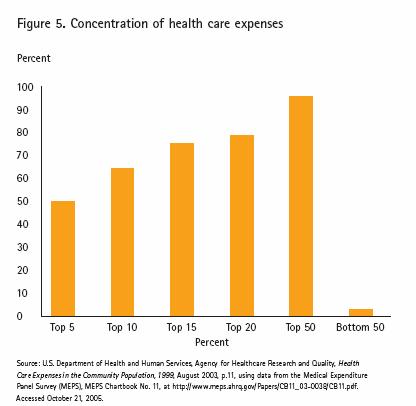
Another fact which I have always found very interesting is the chart below on the concentration of health care expenses.  Almost 80% of all healthcare expenses are from 15% of the population.  Amazing concentration.  Great from a marketing perspective but tough from a risk management perspective.

Healthcare costs concentrated

Healthy Behavior

I was reading a blog by the CEO of Harvard Pilgrim earlier and found the point below pretty interesting:

50% of health status is determined by healthy behavior. 4% of health care spending supports healthy behavior.

I think it leads to a critical issue which we all face (patients, providers, insurers) in healthcare which is how to drive healthy behavior.  Ideally, we would want to understand and have visibility to actions that could lead down the wrong path.

Not all very realistic, but imagine:

  • Buying groceries that aren’t good for you triggering a message.
  • Stopping at a fast food restaurant for drive-thru triggering a message using RFID or Bluetooth technology.
  • A reminder in your car before you leave for work that you need to take your prescription.
  • Exercise reminders pushed into your Outlook and linked to an online analysis tool.
  • Genetic based testing suggestions linked to a home based device which tracks blood pressure, blood sugar, and other key metrics.

I am sure there are a lot of innovative ideas, but the point here is that we need to think about how to create opt-in communication options or online tools or devices that integrate non-claims data with health suggestions to figure out how to prevent treatment.

Loss Aversion vs. Reward

I have had a note to write on this for a while and then read an entry on the Medical Connectivity Consulting blog about this.   It is a key point in understanding how to drive patient behavior.

Some people respond to rewards or positive motivation.  For example, this will save you money or this activity will make you healthier and extend your life.  Other people respond to negatives (i.e., loss aversion).  For example, you just wasted $20 by choosing this prescription or don’t forget to get your annual checkup.

This is where the real difficulties of communications occur.  How do you segment and target individuals to address messaging, medium, timing, frequency, etc.?  It isn’t easy and mostly comes through experimentation.

Consumer Reports on Drugs

This has been around for a few years, but if you don’t know it exists, then you would find it valuable.  Consumer Reports launched a website which offers you good, independent information on prescriptions (Consumer Reports Best Buy Drugs).  Medco was smart to partner up with them early on and make the content available to their members.
You get basic disease information, drug information, cost information, and some cost savings ideas (i.e., take generics). 

A good clinical site which is a partnership of Express Scripts and the St. Louis College of Pharmacy is called Drug Digest.  I have used it many times and know the pharmacists that create the collateral.

BCBS of MI also has a great site on generic drugs (or unadvertised brands as they call them) which allows you to calculate cost savings and learn more.

Healthcare IT – Gartner

I am listening to a Gartner webinar on Healthcare IT which is a pitch to vendors on sponsoring an upcoming event of theirs.  Here are a few comments which I thought were interesting and some of you might care about:

  • Innovation in IT is critical for healthcare.
  • Healthcare IT will be the fastest growing vertical through 2008.
  • Based on a live poll of the attendees on what companies are looking for in making technology decisions, the top 3 factors (which were my votes) were:
    • Ability to integrate w/ existing systems
    • Lowest total cost of ownership
    • High quality service
  • Healthcare providers buy based on references.  (more than others??)
  • Consumer confidence in online tools is very low.  Phone is #1 preferred mode of communication.  Relationship between payors and patients outside of phone is still limited with fear of lack of security.
  • Current pain points (insurers and providers):
    • Business intelligence – how to get quality information from all their data
    • Integration
    • Claims
    • Physicians – how to keep them happy
    • Agility
  • How to best engage prospects with an IT solution:
    • Case studies
    • Referrals
    • Demonstrate a good fit to them

Not too helpful for those of you that are consumers, but for those of you developing consumer solutions to address the market, this might be helpful.

Health 2.0 Conference

Are you going to the Health 2.0 Conference?  It has an impressive list of speakers and panelists from start-ups to established technology companies (e.g., Google) to big companies (e.g., McKesson).

If this is your space, this seems like the place to be in a few weeks.

Should FSA Use Tell Us Anything about CDHC

Flexible Spending Accounts (FSAs) have been around for several decades.  They let people set aside pre-tax dollars to pay for things such as daycare or healthcare.  An article in the Chicago Tribune says only about 20% of people use them, but only about 4% of dollars are forfeited per year.

It makes me wonder.  If I can save 30% on things that I spend money on, why wouldn’t I do it.  And, can I learn anything here that is relevant to how consumers view consumer driven healthcare?

Obviously, the use-it or lose-it concept scares people.  But, most of us should have access to data about our historical costs.  (Perhaps not easily, but what’s a hour of your time worth to research this.)  And, if only 4% of money is being lost then most people can plan appropriately (of those that use the benefit).

I think sometimes it could be cash flow for some people, but this is likely something that could be managed.  But, it is a real issue.  We saw it with mail-order pharmacy.  People couldn’t always manage to pay for a 90-day supply upfront.  Most of the executives that develop these benefits don’t think about cash flow issues from an average worker perspective.

Perhaps the plans are confusing or not being sold by HR to the employees.  I wouldn’t doubt this.  And, I am sure there are other reasons and a study out there somewhere that could give statistical data on this.

But, if employees can’t figure out and plan how to use their money in order to take advantage of pre-tax dollars, that tells me we need a lot more data, education, predictive tools, and general information to make CDHC successful.