Archive | PBM / Pharmacy RSS feed for this section

Physicians Vs PBMs?

I shared one of Toni’s quotes the other day and have some follow-up information that she sent me.  I will have to try and read it and share later today.  In the meantime, I saw this quote this morning from the same interview that she gave.

PBMs would love to move toward some standards that the physicians had access to.  That is the whole objective of electronic prescribing.  Every time the physician chose a drug, it would tell them if it was on formulary; if there were drug interactions; if there were coverage issues; and what the copay was.  I am not sure most physicians want this.  This would push a lot of work into their already abreviated office visits.

Additionally, I am not sure it is all the PBMs issue.  Everyone has different perspectives on cost, drug coverage, benefit design, etc.  I don’t think we will get to a common benefit design in this country that would simplify the PBM’s job.  Customization is the number one driver of cost within the PBM.  It causes huge IT issues.  It causes huge training issues.  It requires all kinds of inefficiency.

I am not sure that Toni and the PBMs are far off in what they want, but the reality of implementing it is a long way off.

“Physicians deal with too many health plans and numerous PBMs, and from our view they have no consistency. We have no way of knowing the various protocols and regulations they operate with, and new product designs make it impossible to keep up. Formularies are cumbersome and change all the time, and it is unclear who controls the formulary. It appears that formularies are based on [achieving] optimal revenue, not evidence-based. The goal should be to reduce hassles for primary care physicians and lower costs to patients and purchasers of health care. Health plans and PBMs are seen as the problem, not the solution.”

— Toni Brayer, M.D., who has practiced internal medicine in San Francisco for more than 20 years, has served as president of the S.F. Medical Society, and is chief of staff at California Pacific Medical Center, told AIS’s Drug Benefit News.

An Example of Being Overmedicated

We all know that people have a lot of prescriptions.  Here is an interesting story about one individual and the process that her family went through to do essentially Medication Therapy Management (MTM) and find out the right mix of drugs.  I don’t know the person recommended in the story, but I certainly recommend making sure your physician and especially your pharmacist know all your drugs and talk with you to see about potentially having too many prescriptions (especially once you are above 10 different medications).

Each added prescription increases the likelihood not only of a problematic interaction but also of misuse. Studies show that half of older people sometimes fail to follow their Rx instructions. It’s no wonder. Consider my mom’s regimen: She took 32 pills a day, at five different times—some once a day, some twice, some three times, and some as needed. One pill had to be split in half for the morning dose but not for the evening dose. Some were taken with food, others on an empty stomach. She also used three different asthma inhalers plus a nebulizer, all on different schedules. I’m half her age, and I couldn’t keep that straight.

Changing Behavior – Examples

On the Express Scripts Consumerology Blog, I noticed a new entry this morning from Bob Nease (Chief Scientist) about changing behavior.  It points to two things – motivation and self-efficacy.  (What’s in it for me and do I believe I can be successful.)

There is an interesting study from the University of Michigan that he discusses, and he also provides some detail on one of their web pilots.  What the web study showed is that a simpler message led to more “click throughs”.  This is very similar to what we see in the voice channel of communications.

If I call you and tell you there is an opportunity to save money with your health benefit, you are likely to go to the next step or transfer to hear more.  On the other hand, if I tell you a lot in the message, I might get a much lower click-through (or continuation or transfer) rate.

Since ultimately, I care about conversion in the claims data (i.e., did the patient really change behavior) these metrics are nice proxies but don’t mean much.  I care about did the patient and their physician actually act on the recommendation or the opportunity to save money.  I posted that as a comment on the blog so hopefully Bob can add that detail.

We have clearly seen this in some of our programs where we would rather qualify them on the phone and then transfer them leading to a higher close rate than simply drive up transfers.

November Adler’s Drug Store Counter

From this month’s publication of Adler’s Drug Store Counter by Meredith Adler from Barclays Capital, I found two telling things.

She highlights the drug trend and generic fill rate numbers from the big PBMs (as I have done before). What it made me think about is that with Medco and CVS Caremark having lower generic fill rates, they actually have a better opportunity for lower trend in subsequent years (with the right programs to close the gap).

In another chart, she shows how different areas of the healthcare market are increasing in cost. Pharmacy is increasing at the fastest rate (as it has several of the past few years). Fortunately, it typically only represents about 15% of the healthcare costs, AND it is the easiest to influence. Patients have a lot more opportunity to research and talk with their physician about prescriptions than discussing whether a particular blood test is appropriate.

cost-increases-in-hc

Physicians As Victims Of System?

I was reading this quote from Dr. Toni Brayer who writes a good blog called EverythingHealth which seems to paint the physician and patients as irrelevant in today’s market.  I am not sure it’s that bad, and certainly this will change with individual insurance products and more people having Medicare.

I guess the question is how much of a industry structure can be set by individuals versus the market.  Maybe, I need to ask her what the operations are that she wants to improve.

“Physicians are at the bottom of the food chain and do not have the ability to improve [the operation of the pharmacy benefit]. As I see it, PBM customers are the health plans and the pharmaceutical industry. Health plan customers are the employers or purchasers. Employer customers are the stockholders or company owners. Physician customers are the patient. Physicians and patients are out of the loop except as the user of the services. Since we are no one’s customer, in a free market we are irrelevant.”

— Toni Brayer, M.D., who has practiced internal medicine in San Francisco for more than 20 years, has served as president of the S.F. Medical Society, and is chief of staff at California Pacific Medical Center, told AIS’s Drug Benefit News.

More On The Economic Impact On Healthcare

Deloitte just published the results of a survey they did which continues to hammer home the issue of how today’s economic times are affecting people’s health behaviors.  I am just getting ready to do my webinar on this.

Here are some of the results from Deloitte:

  • Only 6 percent of Americans surveyed believe their family is completely prepared to handle future health care costs.
  • More than half of respondents surveyed said that reducing costs (67 percent), increasing access (56 percent) and improving quality (57 percent) of health care are issues that are important to them in selecting a president.
  • Of the survey respondents who reported delaying or skipping care in the past 12 months, 27 percent said they did so because they could not afford the cost.
  • Nearly half (47 percent) said their household’s spending on health care products and services has increased during the past 12 months, and 63 percent said it limits their spending on other essentials.
  • Twenty-two percent said they have an outstanding medical bill that is more than 90 days past due.

So, I guess the question is “What are you doing for your members?”:

  • Are you helping them understand how to save money?
  • Are you encouraging them to stay compliant with their medications to avoid complications?
  • Are you encouraging them to be preventative (e.g., flu shot) to avoid ER visits?
  • Are you providing them with timely guidance on when to use Over-the-Counter (OTC) medications versus prescriptions?
  • Are you helping them split medications?
  • Are you moving them to mail order?
  • Are you encouraging 90-day prescriptions?
  • Are you offering them incentives for being healthy or managing their health – coupons, points?

We are seeing a lot more interest from members in this information.  They don’t know what they can do, but they want to do something.

Of course, the challenge is setting up these programs, personalizing the messaging, and getting results.  For those of you interested in these programs, contact me.  We have had some great results offering these as a turnkey service and driving the success rates up dramatically.  [2-5x improvement in 5 weeks]

No More “Robo-Calls”

This is a phrase you have probably heard several times this election period.  Somedays I think the same thing when I get 5-6 a day mostly from the Obama campaign.  It reminds me of some education I do with a lot of companies on the technology evolution around outbound calling.  Let me hit a few key points here.

First, everyone across industries is trying to figure out how to improve their access to customers (members).  How do they keep them up to date with relevant information in a timely, efficient, and effective manner.  Direct mail is a dying strategy.  E-mail is good sometimes, but you can’t push sensitive health information out via e-mail.  Text messaging has a role, but it’s not relevant for everyone.  So, automated calling has become a first-line solution rather than using call center representatives which are expensive (or more often as a complement to the call center representative making them more efficient).

Historically, call center representatives would “smile and dial” just trying to catch someone at home.  You might get lucky, but in most cases, you call 5-10 times just to get a person on the phone to talk with.  It’s not a good use of resources and time.

The next evolution was the dialer technology which calls out to people and once it hears a voice, it transfers the respondent to a call center agent.  But, the voice could be an answering machine in some cases or in many cases it might not be the right person.  These are the annoying calls you get where there is a delay after you say hello and before the person at the other end responds.  The technology is searching for an agent that’s not on the phone to connect you with.

People realized that using agents to call out wasn’t always necessary so they moved to “blast” or “robo-calls”.  These are non-intelligent calls that simply push a message out to someone.  As soon as you say hello, they start playing a recorded message and likely repeat it at the end in case it’s an answering machine they are “talking” to.  There is no interaction and no personalization.

But, that technology too has evolved.  You can now place highly personalized and interactive calls that leverage speech recognition technology.  The calls use your name and ask you to confirm that they are speaking with the right person.  The calls use the name of the company calling and potentially your employer.  The calls can also provide personalized information such as the drug you are taking or the health condition you have.  The voice is a recorded voice not a text-to-speech (TTS) solution.

The calls respond differently based on how you answer certain questions – i.e., different paths are dynamically generated.  And, the calls start to interact with other modes of communication – would you like to transfer to an agent to talk further?, would you like a copy of this offer sent to you in a letter or e-mail?, would you like a reminder sent to you as a text message?, or would you like us to fax your physician to get a new prescription for you?

The technology focuses on the interaction with the consumer and making it a pleasant experience.  In healthcare, people respond to this technology because of several factors:

  • It’s highly personalized to them.
  • It’s coming from a company they trust – their health insurer or pharmacy.
  • It’s interactive and conversational.
  • It’s important information – refill reminder, savings information, benefit change.
  • They have to authenticate themselves in order to receive sensitive information.
  • It adapts to them (e.g., please call me for future calls in the morning).
  • It offers them an opportunity to talk to an agent by transferring.

Now, I would say most companies are evolving from individual campaigns using different modes of communication (letter vs. calls) to an integrated communication strategy which has common messaging and is based on consumer preferences.  This approach allows for even better results and continues to drive personalization and customization based on historical learning and experiences with the individual.

But, mass customization does require technology and analysis.  Pulling in different data elements and looking at how to best deliver a message and get someone to listen and take action is complex work.  But, it’s a lot of fun watching success and outcomes improve as you move across the continuum.

Complementary Webinar – Cost Savings Programs

If interested, I am going to host a webinar for managed care companies and PBMs.  (Sorry, but this is limited to clients and prospects only.)

Proactive Cost Savings Programs for Your Members

In these economic times, members are looking for all the opportunities they can find to save money and reduce their out-of-pocket spending.  This is a great time to drive loyalty by proactively interacting with your members and helping them understand how to save money.

Some of the timely communication programs that will make an impact include:

  • Movement to generics (i.e., therapeutic interchange)
  • Movement to mail or 90-day retail
  • Pill splitting or dose consolidation

This is true for your commercial members as well as your Medicare members who are in the “donut hole”.  Don’t let your members struggle and end up skipping doses or not taking their medication.  This can lead to much bigger issues downstream.

Join Silverlink Communications for this interactive webinar and learn how you can design communication programs that help your members save money while improving your bottom line.

Register Here.

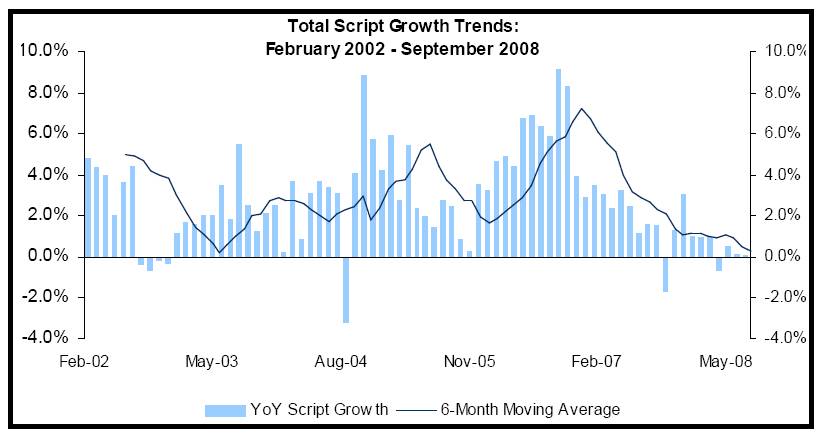
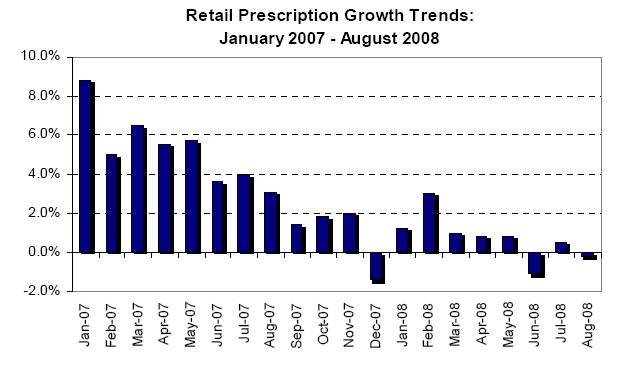
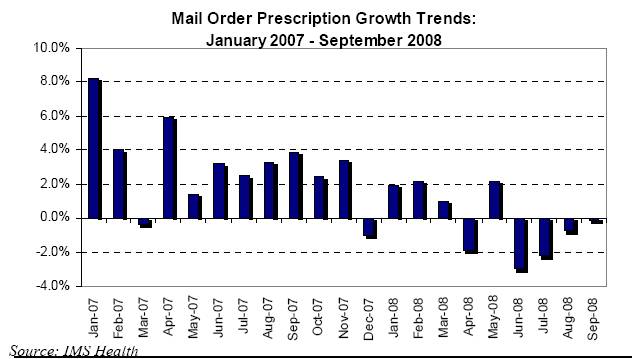
Prescription Growth Trends

I am on the plane reading the Adler’s Drug Store Counter which Meredith Adler and team put out for Barclay’s Capital. This is a monthly report which focuses primarily on the large chains – Walgreens, CVS, Rite-Aid, and Longs. It has some nice snapshots of historical prescription growth trends that I included below which are based on data from IMS and their analysis.

Prescribing Placebos

I found this entry on the WSJ Health Blog and all the comments very interesting.  At the core, the issue is that if a physician prescribes a placebo (sugar pill, vitamin, OTC, antibiotic) to make the patient feel better even though it medically won’t (but may mentally)…is there something wrong with that.

Obviously, if it drives a financial burden for the patient, that would be wrong, but I don’t see physicians doing that.

If it prescribed a medication that had serious side effects, that would be wrong, but I don’t see physicians doing that.

If it was a simple remedy (e.g., take B12), that doesn’t seem harmful.  There have been plenty of arguements about medications like antidepressants and whether they work, but they still get prescribed quite a bit.

Pharmacy Musical Chairs

Remember back in the 90s when AT&T, Sprint, and all the other companies kept offering you incentives to move to their service?  I had an uncle who just kept moving around and getting $50-$100 checks.  I thought he was crazy, but he never had an issue.

Given the economy and the incentives being offered in pharmacy, I wonder why a consumer wouldn’t do the same.  I saw a $25 gift card offer at Walgreens yesterday.  I know Target has had a $10 gift card offer for a while.  Some of the mail pharmacies occassionally offer coupons or copay waivers.

So, if I was a consumer with a maintenance drug that I have used for a while and don’t need consultation on, why wouldn’t I move my prescription every month to a different pharmacy and get these gift cards.  I think I would.  I don’t know all the terms, but if I had a generic, I might actually make money on my prescription.

I am sure this will be a short-term phenomena.

Drug Prices Go Up

A recent report by AARP which is talked about on the WSJ Health Blog reveals the following:

“Last year, the wholesale price of specialty drugs rose 8.7%, three times the rate of inflation. The price of non-specialty, branded drugs rose 7.4%, while the price of generic drugs fell by 9.6%.”

Are we surprised?  Generics have tons of competition so prices will go down over time unless they get too low and people jump out of the market.  Brand drug utilization keeps going down so they are going to raise prices.  And, specialty drugs have a limited market so their prices are going to continue to go up.

Is this right?  I could debate this forever.  But, it is a free market.  This is what happens with supply and demand.  We all want the drugs to extend our lives and make us feel better even when we have chronic illnesses.  But, it isn’t cheap to do research and trial and error to find out what works (at least it’s not cheap without testing on humans in an uncontrolled environment…which I don’t think we want).

Gambling With Your Health

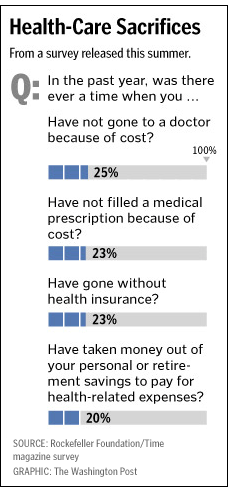
It’s a continuous message these days…people are avoiding care (preventative and necessary) due to cost.  Here is an article in the Washington Post about it.

Though the burden is especially heavy for uninsured Americans, even those who have coverage are feeling the pinch as employers shift higher deductibles and co-payments onto employees.

“The reason why health care was immune [to recessions] in the past was because most people were covered under good insurance plans,” said Jean Mitchell, a professor of public policy at Georgetown University. Now, “people are realizing, ‘Oh my gosh, I have to pay for this out of pocket.’ ”

Article On Silverlink Communications

The October 2008 issue of ADVANCE for Health Information Executives contains a nice article about Silverlink Communications by Robert Mitchell. Here are a few items from the article:

  • It focuses on our Adaptive HealthComm Science approach which brings decision sciences to the area of driving healthcare behaviors. [This is what leading consumer companies, credit card companies, and gaming companies use to understand consumers.]
    • “Adaptive HealthComm Science looks at microsegments of the member population to try different interventions with different populations — all standing against control groups and measurements of what works best. It then adapts, learns and tries again. “The communication system continually learns and automates its processes so that it is capturing new data and learning along the way from those interactions. It is consistent and can be measured.”
      • It is amazing to see how much programs can be improved over relatively short periods of time by rapidly testing isolated variables to find the right solution for each microsegment of the population.
    • One of my favorite examples from my past was simply using stamps turned at an angle on a letter to improve the rate at which direct mail was opened. It looked more like a human had hand licked each stamp rather than a machine which put the stamp on perfectly each time.
  • It talks about the ability to do on the call calculations and dynamic pathing on the core automated calling platform.
    • On-the-call calculations: If you have 3 drugs to refill, but you only choose two of them then it can tell you what your copay is. Or, if you tell the caller your weight, it can calculate the difference from a prior weight it had collected.
    • Dynamic pathing: Based on answers you give, the call is intelligent enough to serve up different content to the member and/or route you to a different group of live agents based on rules.

“We’ve invested heavily in people, technology, processes and a methodology that continuously improves to maximize the effectiveness of health care communications,” Stan Nowak, CEO and co-founder of Silverlink, said. “Over the next few years, changes in the way health care stakeholders communicate with patients and health plan members will be one of the keys to lowering health care costs while driving consumer affinity.”

“To the consumer, health plan products are largely undifferentiated on the basis of benefits or network, and consumers experience their health plan almost exclusively through the communications they receive from the plan,” Nowak continued. “Health care organizations have an opportunity to clearly differentiate themselves through proactive and personalized communications, improving their members’ experiences with each interaction, and earning consumer trust and affinity. In essence, for health plans, communications is their product.”

Tight Rx Market

I am sitting at the airport doing some blogging on my blackberry. Here is a quote about the prescription market:

“We are facing a continuation of the slowest-growing prescription drug market in 47 years, according to IMS Health. We believe the biggest impact has been the very tough economy.”

— Jeff Rein, chairman and CEO of Walgreen Co., where prescription sales actually climbed 7.9% in the latest quarter. Rein was addressing a Sept. 30 investors’ conference call on the company’s financial results for the quarter that ended August 31.

Where’s Your Raise…It’s In Your HC Benefits

According to Hewitt Associates, healthcare premiums and out-of-pocket costs will go up 8.9% next year.  This is at the same time as many people are hurting from the economy and seeing gas and food prices go up.  I can guess that the average raise next year won’t be near enough to make up for this with most people.

In an article by Sandra Block at The USA Today, she suggests several things on controlling costs.  None of them are new, but perhaps they are worth reiterating:

  • Use generic drugs whenever possible.  [You should ask your physician or pharmacist if there is a generic alternative available.  You should also not be afraid to ask for samples for new prescriptions from your physician.]
  • Sign up for mail-order.

“Unless you have a crush on your pharmacist, there’s really no reason to go to the drugstore every 30 days to pick up your blood pressure pills.”

  • Contribute to a flexible spending account so you use pre-tax dollars to pay for out-of-pocket costs [but be aware of the use-it-or-lose-it rules].

With more and more companies pushing more cost to the employee or even dropping benefits, you might have to start recognizing the value of having a good coverage plan as part of your total compensation.

Proof Communication Matters

The reason we communicate with patients and members in healthcare is that we want to drive them to action or inform them of information.  Whichever party you like, I think the TV commercials and the debate make this point very clear.

  • You either like scare tactics or not.  Some portion of the population will respond to those.  (I personally see this as desparate and don’t care…especially when some of them are such a stretch.)
    • Should you point out to people that they should stay adherent or risk serious side effects or hospitalization?
  • People want clear messaging.  I thought Obama was the one being too high level early on.  In the debate, John McCain was the one that didn’t seem to answer the question.  At least Palin said she was going to talk about another topic not give a glossy answer in the VP debate.
    • We got this feedback from MDs at Express Scripts that said just to tell them what we needed and stop with lots of general messaging.

Think about how you motivate your kids or your employees.  It’s all the same.  This is what you want from your health provider or your insurer.

(I must admit to being frustrated with the politicians as I am sure anyone who works in communications is.  To have Palin (the relative newcomer) being the best presenter (not so great in interviews) is surprising.)

60% Think We Are Headed To A Depression

You wonder how bad it is economically or where we are headed…look no further than the CNN poll out this morning showing that 60% of Americans think it is likely that we will go into a depression.  Not a recession, but a depression like many of us read about in the history book or saw in the movies.

Do people really know what the depression meant – 25% unemployment (for example).  So, if that’s the perception out there, imagine the impact on health behavior.  People will continue to look for savings opportunities – skipping pills, splitting pills, moving to generics, trying over-the-counter medications, moving to mail order.  They will likely be less likely to act preventatively – e.g., getting a flu shot.  They may be more willing to ride out bad symptoms at home rather than rush to the clinic.

This makes me think about an article I saw the other day that said that people don’t have any solutions to manage trend.  I think that’s BS.  The fact is people are afraid of the solutions to manage trend.  They don’t want to tell employees what to do or limit their choice.  In a tight labor market, companies want to keep the employees happy.  So, as the labor market opens up (i.e., higher unemployment) and healthcare costs go up, will companies finally embrace some of these tools.

For example, on the pharmacy side, we used to see a spike in call center volume of 1,000%+ on some of the aggressive programs – mandatory mail, step therapy, limited formulary, limited retail network.  That scared a lot of clients.  Maybe that attitude will change.  Granted pharmacy is 10% of medical spend so the bigger problem is on that side, but maybe companies will finally be willing to link out-of-pocket costs to controllable medical activities – weight, exercise, blood sugar, cholesterol, preventative testing.

If I were a insurer or a PBM, I would be focused on showing my value right now.  I would be delivering cost savings messages to all my members and help them understand how to minimize their out-of-pocket spend in this economy.

The Tough Economy is Impacting Health (and Potentially HEDIS)

A WSJ article of last week provides a glimpse into the many ways our strained economy is adversely impacting the healthcare-seeking behavior of individuals (see article here). It cites a D2Hawkeye analysis of medical service and pharmaceutical utilization (in a study performed before the most recent Wall Street and Main Street turmoil) and shows widespread impact across many healthcare categories. Consumers are cutting back on everything from mammograms to drugs to physician visits.

These findings should be a big stimulus for health plans, population health companies and PBMs to work more creatively on plan designs and communications strategies to support prevention and medication adherence.

Certainly, many individuals are feeling the pinch of health care costs to a greater extent than ever—with higher co-pays, bigger deductibles and for some Medicare members, the “coverage gap,” all contributing to choices people making. The D2 Hawkeye analysis of several Mid-Atlantic health plans looked at preventive and non-acute health services received between March 2007 and March 2008…

It shows pap smears are down 6% and antidepresssant medication fills declined by 19%

…despite the fact that for most of these members (in the study population) the cost-sharing changes year-to-year were minimal. So, the broader economic reality appears to be forcing consumers into making hard choices – trading off health care for other goods and services, whose prices are simultaneously rising.

NCQA is about to release its 2008 State of Healthcare Quality Report (tomorrow, October 2nd) which is its comprehensive summary of how plans across the nation are performing across the full range of HEDIS indicators . The data will reflect the healthcare services received by members in 2007, levels which from the D2Hawkeye study and other industry sources suggest we’ve declined. ….the time is now for innovation that spurs positive member behavior –in areas ranging from diabetes care to flu shots to colon cancer screening—to take center stage as an antidote to all the negatives the economy is now inflicting.

Healthcare Effectiveness Data and Information Set (HEDIS) is a tool used by more than 90 percent of America’s health plans to measure performance on important dimensions of care and service. (source)

This posting was written by Margot Walthall, Population Health Market Leader for Silverlink Communications. Margot has previously worked in director level roles in strategy, member communications and product management/marketing for three health plans and also in product marketing for a population health software and services company.

Margot’s work for Silverlink is focused on multi-channel communications solutions that enable campaigns in the areas of health engagement, health risk appraisals, health education in support of gaps in care/HEDIS, adherence programs, virtual coaching and health program satisfaction measurement. Margot has a master’s degree in health administration, as well as an MBA in marketing.

If you like this post and are interested in the topics here, don’t forget to sign up for my e-mail updates or add the RSS feed from the blog to your reader.

Drug Not Covered – What To Do?

As I was doing this for my son, I realized that most people probably don’t know that the option exists.  It’s something called a Formulary Override.  If you are prescribed a medication that is not covered (meaning you pay full price), you can get it covered at a 3rd tier copay (less than full cost) if your physician requests it and has a legitimate medical reason for it.

So…what do you do:

  1. Call your health plan and select the IVR option for pharmacy.
  2. When you talk to a call center agent, ask them about your drug.  They will confirm that it isn’t covered.
  3. Ask them what you need to do to get it covered (or ask them specifically for a formulary override form that your physician can fill out).
  4. Get the form (or download it from their website).
  5. Ask your physician to fax it into their prior authorization department.
  6. They should quickly run on it for you and have you set up in the system within a few days (if approved).

Just a quick inside hint for you.

I Get A Different Conclusion

In the same Express Scripts’ investor deck, I have to disagree with the slide below which is supposedly proof that the Consumerology efforts are working.

Showing me that the trend for a client who was above their norm last year (see drug trend comparisons), went down to 3% (year-over-year) increase (which is over both Medco’s and Prime Therapeutics’ average trend) doesn’t seem that impressive.  In the years when I worked on the drug trend publication, we showed that the average client with two or more plan design changes had negative trend, on average.

And, further complicating this example is the fact that this shows a client implementing mandatory mail, mandatory generics, and step therapy.  These are a series of proven, reject oriented solutions that force the member to make changes or pay much more.  Anyone can drive trend with these.  If you show me that non-reject oriented programs work to the same degree due to targeting and personalization using consumerology, then I am impressed.  Obviously, I am not there anymore, but I don’t think this is a compelling case study for consumerology.  Maybe there is more to the story like no impact on the call center or no impact on member satisfaction or less members hitting a reject at the point-of-sale (POS).

Express Scripts Patient Segmentation

In a recent investor deck, Express Scripts laid out some of their segmentation from their Consumerology program.  This is similar to some of the work we do with clients at Silverlink Communications to help them develop segmentation models through a test and control approach.

What they have come up with are 5 segments of their members – “Movers and Shakers”, “Rock Solid”, “Getting By”, “Rising Stars”, and “Here and Now”. They describe some of the attributes of each segment on the first slide below and then show how messaging on driving mail order utilization was applied for each segment over the web.  The final slide below shows the results when the targeted messaging is used on the web.

It will be interesting to see how that messaging plays out via other channels (i.e., letter or outbound call) and when pushed to the member versus a situation where the member is on the portal and looking for information (a fairly engaged member).

Drug Trend Comparisons

Here are a few comparisons from the Drug Trend Reports published by some of the largest PBMs. There is no industry standard on definitions and what is included so I did my best to pick a couple of comparative metrics. (Note: In case you are unfamiliar with these reports, they are summaries of 2007.)

Overall Trend

Specialty Trend

Managed Trend

Generic Dispensing Rate

Mail Order (90-day)

CVS / Caremark

4.8%

13.2%

2.1%

59.9%

28.2%

Express Scripts

4.7%

14%

63.7%

24.1%

Medco

2.0%

12.3%

59.7%

38.0%

Prime Therapeutics

2.0%

8.9%

56.7%

Walgreens

4.8%

(0.07%)

61.2%

35.9%

    • They break out their best in class as having a 3.4% trend and say that clients who used proactive trend management were at 2.1% on average.
    • Best in class generic dispensing rate was 65.6% (employers) and 66.7% (health plans).
    • Mail order rate as reported in press release for close of 2007. (Not sure how to compare this to the 12.8% reported in their TrendsRx report.)
    • Overall trend was 5.5% when specialty drugs are included.
    • Had to find the generic fill rate in their 4th quarter financial press release. Either I missed it in the trend report or it was strangely missing.
    • Mail order rate was derived from the same 4th quarter release which showed 40.8M mail Rxs and 507M adjusted Rxs. Multiplying 40.8 by 3 to adjust from 90-days to 30-days and dividing that by 507 gave me the 24.1%.
    • Deriving the mail order rate from the 2007 full year press release gave me 94.8M mail order Rxs which I multiplied by 3 to get to adjusted Rxs and then divided by 748.3M to get 38.0%.
  • Prime Therapeutics trend report (Drug Trend Insights)
    • Their trend was 2.9% if specialty drugs are included. Trend ranged from (1.3%) to 7.5% across their blues clients/owners.
    • Overall trend was 5.66%. The 4.8% excludes specialty trend.
    • GDR was 69.6% if you include Medicare.
    • The 35.9% mail order rate includes their Advantage90 offering for 90-days at retail.

Broken Processes

Sometimes the best processes just don’t work…typically because of human error.  When I returned my rental car today, they told me that it wasn’t my car.  Apparently, I had somehow left the lot with the wrong car.  Which means they parked the car in the wrong spot or told me the wrong spot to go to.  On the way off the lot, they checked my paperwork across the barcode so I don’t see how that happens.

That made me think about an incident the other day at my pharmacy.  When I was tracking down my paper receipts for my old prescriptions, I went to my pharmacy and asked for a prescription history.  The pharmacy technician printed out all my prescriptions from the past 18 months after asking my name.  But, he never checked my identification.  I am not sure, but that seemed a little too easy especially since it was a tech at a chain pharmacy that had never seen me before and where I hadn’t been for months.  Given privacy issues, that can’t be the official process.

Battle to Buy Long’s Drugs

Not a big surprise for CVS Caremark to make a play for Long’s.  They have been a much more acquisition oriented company.  But, Friday, Walgreens came out with a slightly larger bid which is much more unusual.  Walgreens until a few years ago had grown almost entirely through organic growth.  (WSJ Blog on this)

With Long’s, either company will get 500 stores in the West – CA, AZ, HI, and NV.  They will also get RxAmerica which is a PBM with 8 million lives.  This would be a big jump for Walgreen’s PBM, and a nice bump for the CVS Caremark PBM.

The CVS Caremark deal was essentially done at $2.7B before Friday’s public bid of $2.8B by Walgreens.

Tom Ryan, Chairman, President and CEO of CVS Caremark, commented, “Our offer represents a full and fair price for Longs shares, and we stand firm on our price. Furthermore, the CVS Caremark’s offer has cleared all regulatory hurdles and provides certainty of completion to Longs shareholders.”

So far, it doesn’t seem like CVS Caremark is going to up their bid.  Tom Ryan should be used to this.  When they bought Caremark, Express Scripts made a late bid in the process.  I am not sure what will happen here, but I would expect that seeing Walgreens as the bigger will certainly make them think hard about how to get this deal done.

Disease Management Evaluation – Care Scientific

My former boss, Brenda Motheral, from Express Scripts spent a year at Healthways running their research group and has now decided to go out and do some consulting (new company is Care Scientific).  Her evaluation of the Disease Management industry was just published in the Journal of Managed Care Pharmacy.  It is a pretty critical view of the state of the industry.  Here are a few highlights:

  • There have been several articles published questioning the value of these programs this year.
  • There are five reasons for dissatisfaction:
    • Desire for better alignment of vendor and client interests
    • Desire for greater transparency in business arrangements
    • Desire for improved plausibility in reports of financial and clinical outcomes
    • Desire for more rigorous evaluation methodology
    • Desire for more convincing evidence of outcomes improvement
  • There is misalignment today…For example, if I get paid per member, how hard should I try to contact them when all that will do is drive up my costs.
  • Lack of alignment can be addressed through contractual requirements and pay per engagement.
  • There is a lack of data available on how many members are contacted.  [Not for companies that use Silverlink for their automated outreach who have real-time data available with detailed call information.]
  • There are calculation questions in comparing vendors.  [Something I have talked about several times here.]
  • She compares the move to transparency in this industry to what happened to the PBM industry earlier this decade which created new competition and changed several business models.
  • She advocates for really looking critically at the ROIs claimed by these vendors and talks about NND (number needed to decrease) which is the model that the DMAA (Disease Management Association of America) adopted as part of their outcomes guidelines.
  • She also raises concern about DM companies moving into wellness which is another area “fraught with numerous new methodological issues that warrant close attention”.
  • She talks about an industry push (from buyers) to demand new expectations from vendors.
  • She talks about the fact that the focus on ROI may not make sense since “literature suggests that less than 20% of treatments for existing conditions are cost-saving.”

“Plan sponsors also bear responsibility for the current situation.  As long as they demand a short-term ROI in the current model and inconsistently require comparison groups, they are more likely to promote methodological creativity than they are to inspire true innovation.”

As with the dozens of publications she has had over the years, this one is well written with a well referenced set of facts.  She presents a challenge to the industry in how to approach.

The challenges are interesting to reflect on given the overall industry focus on improving healthy behavior, being more proactive, more actively managing patients, and other activities that a DM company should be well positioned to do.  But, a high touch model is certainly challenged given lower cost options.  Creative solutions that leverage technology to identify gaps in care, create data segments, personalize interactions based on preferences, and use motivational interviewing to drive behavior exist and should be able to create value.  It will be an interesting 12-18 months for the industry.

Managing Antibiotics in Hospitals

I got this story from PharmacyOneSource the other day and thought I would share it.

“Between one-third and a half of all hospital patients receive antimicrobial drugs, and antibiotic prescriptions can account for 30-50 percent of many hospitals’ total drug budgets. Researchers estimate up to half of these are unnecessary, and this excess also contributes to the problem of drug-resistant bacteria.”

They gave two case examples:

  • Johns Hopkins implemented a web-based approval system for more than 30 antimicrobial drugs on a “restricted” list. The system forces orders to be approved by an infectious disease specialist before they are sent to the pharmacy. They found it saved $370,000 in the first year of its use.
  • University of Virginia found that switching between two antibiotics, linezolid and vancomycin, every three months in the surgical ICU decreased the MRSA infection rate from 1.9 to 1.4 patients per 100 admissions.

Medco’s CEO on National Healthcare Reform

David Snow, the Medco CEO, presented his blueprint for healthcare reform today. You can read it here. My notes from reviewing it are:

  • We’re paying twice as much per person (~$7,000) as other countries with little incremental value. To get back in balance, we need to reduce costs by 50% or $1 trillion per year.
  • 3 rules for reform:
    • “First, keep it simple – in business, complex solutions always fail.” [good advice…difficult to do with politics and government involved]
    • Incremental, evolutionary change is more accepted than revolutionary change. [yes…but it will take a lot longer]
    • Government and private sector’s roles have to be clear:
      • Government – promulgate and regulate.
      • Private – operate and innovate.
  • “Setting policy around life-and-death decisions is, and should remain, the province of the public sector.” [what politician or elected official wants to determine the value of a life]
  • Five suggestions (which create $1 trillion in savings per year):
    • Wiring healthcare
    • Fixing Medicare’s financial fundamentals
    • Eliminating medical liability and defensive medicine
    • Increasing compliance and reducing errors
    • Promoting healthy lifestyles
  • “In an era when preschoolers use the Internet to chat with friends half a world away, it is inexcusable that doctors write prescriptions – in Latin – that patients need to take to another professional in a process fraught with countless opportunities for error.”
  • “30% of Medicare spending today, roughly $130 billion, relates to healthcare costs incurred by patients in their last year of life – often where there is no hope for recovery or improvement in quality of life.”
  • He makes some good points about the need for government involvement in changing attitudes around wellness comparing it to the changes around forest fires and seatbelt safety.
  • “When our political discourse is limited to ‘who pays the bill’ instead of ‘the bill is too high,’ and fails to address root-cause problems, that isn’t health care reform.”

Don’t You Want To Live

Apparently, the Walgreen‘s CEO told the WSJ that not only is this a tough year, but they are taking a tough love approach with their patients.  In their blog earlier today, they said that Jeffrey Rein said “Walgreen pharmacists try to persuade patients to take their pills by asking them whether they want to be alive to see their children grow up.”

As they talk about, there have been several studies showing that patients are skipping pills and doing other things to stretch their prescriptions.  But based on what I saw in the Lehman Brothers research yesterday about Walgreens, I wouldn’t have thought things were that desparate.  They reported August same-store stales of 3% which is low compared to their historical results but still positive in this economy.

Interestingly, the report commented that they were increasing promotional activity which would negatively impact front end margins while CVS had recently said that it’s promotional spending (as a percentage of sales) was lower.

[In full disclosure, I do not own any of these stocks as individual stocks.  They may be held in mutual funds that I own.]