Archive | February, 2009

Are You A Registered Organ Donor?

According to one article, there are about 70M registered organ donors which is a number that has increased as 31 states now allow people to register online.  Considering the wait list for donations – just over 100,000 today according to The Organ Procurement and Transplantation Network – this is an important thing to consider.

Here is some of their data:

Marketing In A Recession

Most healthcare people hate the word marketing.  Well, you know what…that is a big piece of what healthcare is about especially with the rise of consumerism.  Individual marketing.  Medicare.  Getting people to make better choices.  It’s all about marketing.

One of the things I liked in the attached presentation is that it talks about tightening up your funnel.  One of the things I notice with lots of companies is that they don’t always take a rigorous process framework for thinking about members and communications.  Process matters.  You have to think about an integrated approach and how you optimize that process.

The Easiest $400+ You Can Save In Healthcare

In today’s economy, we are all looking for ways to save. And, it should be no surprise that pharmacy is the most frequently used benefit since, on average, people get fourteen 30-day prescriptions per year.

That being said, there are still hundreds of dollars that millions of us can save. Let’s take an easy example – Lipitor. Lipitor still has about $8B in sales here in the US. If you assume the monthly cost is $125 per 30-day supply and everyone on the drug filled it 12 times per year (which doesn’t happen but is a topic for another day), that means that each consumer on Lipitor represents $1,500 in revenue to Pfizer per year. Dividing the $8B by $1,500 tells me that there are about 5.3M consumers using Lipitor in the US.

On most formularies (or preferred drug lists), Lipitor is a 3rd tier drug meaning that consumers are paying $40-$50 per month for this drug. Considering the fact that Lipitor has a generic alternative which is called simvastatin (aka generic Zocor), consumers can often talk to their physician and use this drug as a lower cost alternative. Additionally, both of these drugs are maintenance drugs that can be filled at mail order which often represents a 30% savings to a consumer (based on average plan designs). And, finally, simvastatin is a drug which can be split according to many different companies.

Here is the math, but a consumer on Lipitor could talk to their physician to get started on simvastatin, split the pills, and after a few months move to mail. That would save them $400+ in many cases.

  • Assuming Lipitor is a 3rd tier drug with a $40-$50 monthly copay and the consumer fills the drug every month for a year, they would spend $480-$600 out-of-pocket.
  • Assuming they moved to simvastatin (with their MD’s approval) with a $10 copay, they would immediately drop their costs to $120.
  • Assuming they split their pills (i.e., got a higher dose of the medication and used a pill splitter to use ½ the pill each day), they would typically reduce their copays by 50% or drop their costs to $60 a year.
  • And, if they then moved the prescription to mail where they reduced a 90-day supply for the same price as a 60-day supply at retail, they would drop their out-of-pocket costs to $40 a year.

I don’t know about you, but that seems pretty easy. It’s clinically appropriate for most patients. The PBMs will typically help you with these programs by reaching out to your physician to get the new prescription.

Hopefully, you’ll be hearing from your PBM or managed care company about these savings. At Silverlink Communications, we are working with lots of them to design and execute these types of programs. It is always very rewarding to get in touch with consumers and bring them a message about how to save money.

If you are a health plan whose premiums are going up, this is a great way to reach out to your membership and provide them with a positive message about how you care and are responding to them in these tough economic times.

Government Takeover Of Healthcare

Since I very much believe in our capitalist society (even with all the mistakes that have taken us down this recession / depression path), I was a more than a little surprised that in a survey in yesterday’s USA Today 59% of the people surveyed thought government would do the same or better job than private health insurance companies.

Coupoing Back in Vogue

I don’t know what the statistics were before, but these statistics published this morning in the USA Today seem high.

    65% of people 18-39 examined mail more carefully for coupons versus six months earlier

    73% of people 40-49

    And, 57% of people 50+.

coupon

With unemployment expected to come out today at 7.5% (the highest in 17 years), we shouldn’t be expected, but it certainly puts new focus on using incentives to drive healthy behaviors.

Cooking With Google

This is an interesting thing that someone told me about a few weeks ago. They said that they come up with recipes by simply typing some ingredients into Google and then seeing what it produces. I tried it with a few random lists of items and came up with long lists of ideas.

Now, if we could just blend a personal coach, a personal chef, and an automated kitchen that tracked all my products by barcode, I would have a very cool “smart house” type of feature for helping me eat healthy.

cooking

Healthcare…The Growth Area In The Economy?

I keep reading that the growth in employment in the US is coming in healthcare. Since I have heard that Aetna, Cigna, and BCBSMI have all let go 1,000+ people, that seems hard to believe. Combine that with multiple large healthcare companies that have said they won’t pay bonuses this year and the fact that pharma has let go about 30,000 people.

My take is that we are seeing a shift from large companies to smaller companies in the healthcare industry much like I could argue has happened in manufacturing and other services. This plays to the concept of the Starbuck’s Economy and driving to subsegments of the population.

I also think you are going to get all these people with big company experience that go on to become entrepreneurial (as long as capital frees up).

Excess Healthcare Spending

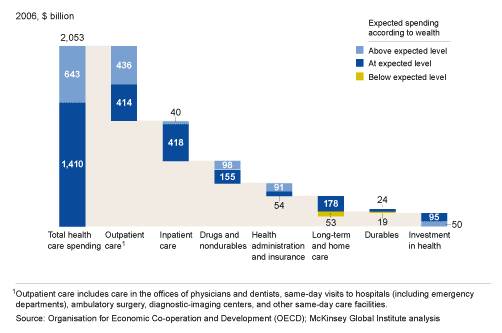
According to McKinsey

McKinsey research shows that the United States spends about $650 billion more than might be expected given its level of wealth and the experience of similar countries.

Here is a chart that breaks this down in a typically McKinsey framework (which I love BTW):

mckinsey-on-excess-hc-spending1

Will Plans Cover Genetic Testing?

I came across this fact the other day from Systemed Group, a division of Medco. According to the 300 health plans they surveyed, 38% of them said they will definitely (3%) or probably (35%) cover genetic testing within five years.

Interesting. What will this mean? What will these test consist of? What will they cost? How will they be used? Will they cover the drugs that are personalized based on genetic makeup?