Archive | Research RSS feed for this section

Changing Behavior – Examples

On the Express Scripts Consumerology Blog, I noticed a new entry this morning from Bob Nease (Chief Scientist) about changing behavior.  It points to two things – motivation and self-efficacy.  (What’s in it for me and do I believe I can be successful.)

There is an interesting study from the University of Michigan that he discusses, and he also provides some detail on one of their web pilots.  What the web study showed is that a simpler message led to more “click throughs”.  This is very similar to what we see in the voice channel of communications.

If I call you and tell you there is an opportunity to save money with your health benefit, you are likely to go to the next step or transfer to hear more.  On the other hand, if I tell you a lot in the message, I might get a much lower click-through (or continuation or transfer) rate.

Since ultimately, I care about conversion in the claims data (i.e., did the patient really change behavior) these metrics are nice proxies but don’t mean much.  I care about did the patient and their physician actually act on the recommendation or the opportunity to save money.  I posted that as a comment on the blog so hopefully Bob can add that detail.

We have clearly seen this in some of our programs where we would rather qualify them on the phone and then transfer them leading to a higher close rate than simply drive up transfers.

November Adler’s Drug Store Counter

From this month’s publication of Adler’s Drug Store Counter by Meredith Adler from Barclays Capital, I found two telling things.

She highlights the drug trend and generic fill rate numbers from the big PBMs (as I have done before). What it made me think about is that with Medco and CVS Caremark having lower generic fill rates, they actually have a better opportunity for lower trend in subsequent years (with the right programs to close the gap).

In another chart, she shows how different areas of the healthcare market are increasing in cost. Pharmacy is increasing at the fastest rate (as it has several of the past few years). Fortunately, it typically only represents about 15% of the healthcare costs, AND it is the easiest to influence. Patients have a lot more opportunity to research and talk with their physician about prescriptions than discussing whether a particular blood test is appropriate.

cost-increases-in-hc

Would You Pay More Taxes To Cover The Uninsured

Here my democrat tendencies come out.

The Council for Excellence in Government did a Gallup Poll of 1,000 adults in June to see who would be willing to pay more in taxes to cover the uninsured. I was surprised by the results:

  • 50% age 18-36 would be willing to pay more
  • 45% age 40-64 would be willing to pay more
  • 31% age 65 and older would be willing to pay more

Maybe I know something different, but I believe there is research that shows that if the uninsured were covered that would reduce the healthcare costs paid by the insurers today.

For example…If someone is uninsured and goes to the hospital today, they are treated and the bill is never paid. Those costs are “peanut buttered” across the hospitals billable events to keep them whole. So, in most cases, we (consumers) are either paying directly or indirectly (through the insurance companies) a higher cost per incident to cover the uninsured. And, since they are uninsured, they are less likely to take preventative action (which is less expensive) and more likely to end up in higher cost events (e.g., the emergency room).

So, would I pay more in taxes to improve the general health of the country and cover the uninsured knowing that I would basically get that money back (perhaps with some time lag) through lower healthcare premiums? YES. Happily.

The Nocebo Effect

If you ever read the label on your prescription drugs (or more likely the PI (Product Insert)), you will learn about all kinds of potential side effects ranging from mild things like headaches to much more serious but rarer conditions. The WSJ had an article earlier this week called “Power of Suggestion: When Drug Labels Make You Sick” which talks about the “nocebo effect” where knowing about potential risks makes you more likely to experience them.

“Women in the multi-decade Framingham Heart study who thought they were at risk for heart attacks were 3.7 times as likely to die of coronary conditions as women who didn’t have such fears – regardless of whether they smoked or had other risk factors.”

“In a 1960s test, when hospital patients were given sugar water and told it would make them vomit, 80% of them did.”

Richard Kradin, author of “The Placebo Response and the Power of Unconscious Healing” says that about 25% of people who get placebos (i.e., a sugar pill) complain about side effects in clinical trials.

The article tees up the question of what to do with this information. Should the information be for the physician only? [I don’t think so.] Should the physician walk the patient through the information and the key side effects? [I think they should for any serious effects or have some type of follow-up mechanism to see how the patient feels on any chronic medication.]

I guess part of the challenge is talking with the patient about normal symptoms they are having before taking the drug. Are you drowsy? Do you have frequent headaches? Then at least they might be able to understand if they are side effects or the “nocebo effect”.

Health 3.0 Conference

I guess we shouldn’t be surprised.  The Health 2.0 movement has gotten lots of press and had great attendance at the conferences.  Now there is a Health 3.0 LinkedIn group and conference

I am not sure I know the difference yet.  I speculated on Health 3.0 after my first Health 2.0 conference to get a stake in the ground.  The one big thing that I notice is that the speakers are established companies talking about what they are doing which was one thing missing in the Spring Health 2.0 conference, but which seemed to have changed slightly in the more recent Health 2.0 conference in October.

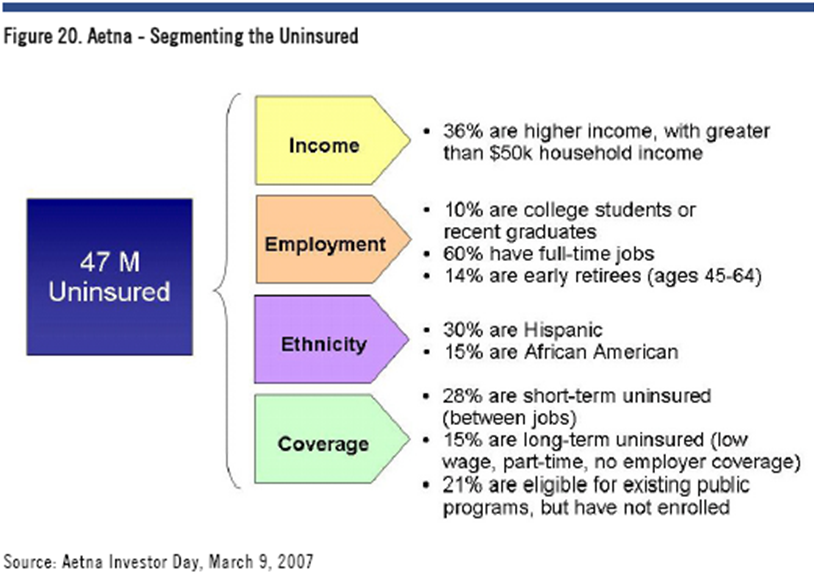
Race And The Uninsured

It has been talked about in different research, but race appears to play a role in healthcare.

I thought this graphic did a good job of showing how this plays out relative to the percentage of people that are uninsured.

race-and-health-insurance

More On The Economic Impact On Healthcare

Deloitte just published the results of a survey they did which continues to hammer home the issue of how today’s economic times are affecting people’s health behaviors.  I am just getting ready to do my webinar on this.

Here are some of the results from Deloitte:

  • Only 6 percent of Americans surveyed believe their family is completely prepared to handle future health care costs.
  • More than half of respondents surveyed said that reducing costs (67 percent), increasing access (56 percent) and improving quality (57 percent) of health care are issues that are important to them in selecting a president.
  • Of the survey respondents who reported delaying or skipping care in the past 12 months, 27 percent said they did so because they could not afford the cost.
  • Nearly half (47 percent) said their household’s spending on health care products and services has increased during the past 12 months, and 63 percent said it limits their spending on other essentials.
  • Twenty-two percent said they have an outstanding medical bill that is more than 90 days past due.

So, I guess the question is “What are you doing for your members?”:

  • Are you helping them understand how to save money?
  • Are you encouraging them to stay compliant with their medications to avoid complications?
  • Are you encouraging them to be preventative (e.g., flu shot) to avoid ER visits?
  • Are you providing them with timely guidance on when to use Over-the-Counter (OTC) medications versus prescriptions?
  • Are you helping them split medications?
  • Are you moving them to mail order?
  • Are you encouraging 90-day prescriptions?
  • Are you offering them incentives for being healthy or managing their health – coupons, points?

We are seeing a lot more interest from members in this information.  They don’t know what they can do, but they want to do something.

Of course, the challenge is setting up these programs, personalizing the messaging, and getting results.  For those of you interested in these programs, contact me.  We have had some great results offering these as a turnkey service and driving the success rates up dramatically.  [2-5x improvement in 5 weeks]

Prescribing Placebos

I found this entry on the WSJ Health Blog and all the comments very interesting.  At the core, the issue is that if a physician prescribes a placebo (sugar pill, vitamin, OTC, antibiotic) to make the patient feel better even though it medically won’t (but may mentally)…is there something wrong with that.

Obviously, if it drives a financial burden for the patient, that would be wrong, but I don’t see physicians doing that.

If it prescribed a medication that had serious side effects, that would be wrong, but I don’t see physicians doing that.

If it was a simple remedy (e.g., take B12), that doesn’t seem harmful.  There have been plenty of arguements about medications like antidepressants and whether they work, but they still get prescribed quite a bit.

Tough Times To Start A Company

After trying my own venture a few years ago, I have greater empathy for this challenge. I have watched a few friends and neighbors doing this. I have the ultimate respect for them.

Even so, most business experts conform to a theory of “thirds”: Of all the new business startups, 1/3 eventually turn a profit, 1/3 break even, and 1/3 never leave a negative earnings scenario. According to a study by the U.S. Small Business Association, only 2/3 of all small business startups survive the first two years and less than half make it to four years.  (source)

A few comments I have heard from friends:

  • A physician who wanted to go out on his own to open his practice (a time honored tradition) could not get a loan and even putting up his house didn’t work since the house was worth less than he owed.
  • A friend who does small business loans told me that the criteria to approve loans made it difficult for her to give small companies money.
  • I talked to a VC on my plane this morning who said they can’t raise funds in this economy and that valuations are down since there is less money chasing deals.

Then in USA Today, they had an article about venture capitalists losing their nerve.

  • US venture capital for the 3rd quarter dropped to $7.4B (down 7% from last year).
  • There were only 270 information technology deals done in the 3rd quarter which is the lowest quarterly amount since 1st quarter of 1996.
  • The Silicon Valley venture capitalist confidence index hit 2.9 (lowest in 5-year history of the index).
  • Tesla Motors, Redfin, Zillow, and AdBrite (promising start-ups) have all announced layoffs.
  • People are looking to sell their holdings in venture funds to companies like Industry Ventures that buys holdings at a discount.
  • The exceptions are biotech and clean tech which continue to grow funds.

The Treadmill Desk

I think this is one of the coolest ideas that I have seen in a long time.  Attaching a desk to a treadmill and walking while you work.  It has lots of benefits including losing weight.  I also agree with a comment from one company doing it that it would help people think differently.

The company featured on CNN has treadmills that go up to 2 miles per hour and even has a conference room with treadmills around the table.

In doing some research on the topic, I found the following:

Gambling With Your Health

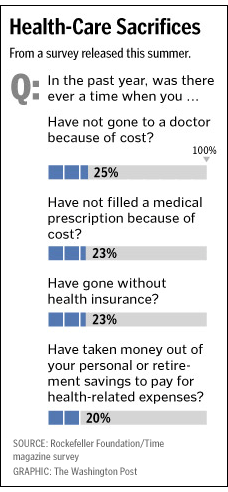
It’s a continuous message these days…people are avoiding care (preventative and necessary) due to cost.  Here is an article in the Washington Post about it.

Though the burden is especially heavy for uninsured Americans, even those who have coverage are feeling the pinch as employers shift higher deductibles and co-payments onto employees.

“The reason why health care was immune [to recessions] in the past was because most people were covered under good insurance plans,” said Jean Mitchell, a professor of public policy at Georgetown University. Now, “people are realizing, ‘Oh my gosh, I have to pay for this out of pocket.’ ”

Median US Income – $32,000

As we talk about the economy and its effects on healthcare, it begs the question of what the average US family makes per year.  Averages are what we typically see versus median.  Median means that 1/2 of the families make more and 1/2 of the families make less.  The averages are often skewed by populations at the ends of the spectrum (i.e., the people making millions). This article says that according to IRS data that 50% of the US makes below $32,000.

New statistics from the Internal Revenue Service show that the highest-earning 1% of taxpayers in America make 22.06% of all income reported to the government. That’s almost twice the 12.51% of total income earned collectively by the lowest-earning 50% of workers. Yes, 1.4 million taxpayers claim 22% of income earned while 68 million share just 12.5%.

But get this: When it comes to taxes paid, an even wider discrepancy shows itself, in reverse. Those earners in the top 1% pay 39.89% of all federal individual income taxes. The bottom 50% of earners pay just 2.99% of those taxes. (Source article)

Tight Rx Market

I am sitting at the airport doing some blogging on my blackberry. Here is a quote about the prescription market:

“We are facing a continuation of the slowest-growing prescription drug market in 47 years, according to IMS Health. We believe the biggest impact has been the very tough economy.”

— Jeff Rein, chairman and CEO of Walgreen Co., where prescription sales actually climbed 7.9% in the latest quarter. Rein was addressing a Sept. 30 investors’ conference call on the company’s financial results for the quarter that ended August 31.

Stress Up: Health Down

I would have loved to have the time to do this research myself, but fortunately it was nicely bundled up The USA Today in a piece by Marc Siegel who is an associate professor of medicine at New York University School of Medicine.  Here are a few of the facts from his article:

  • A survey by the American Psychological Association indicated that financial concerns “topped the list of stressors for at least 80% of those surveyed”.  More than half reported the most common symptoms being anger, fatigue, and an inability to sleep.  Close to half reported over-eating or eating poorly.
  • After the 1929 Wall Street crash, millions turned to drinking and smoking which led to heart attacks, strokes, bleeding ulcers, and clinical depression.
  • Research on people laid off from a plant in Pennsylvania over 17 years shows that they were 15% more likely to die of any cause.
  • In NY, calls to the Hopeline network for people with depression or suicidal thoughts increased 75% in the 11 months ending July (before the worse of the economic situation).
  • UnitedHealth Group reports that hospital admissions for psychiatric services are up 10% this year.
  • A 1% increase in unemployment is projected to cause as many as 47,000 more deaths over the next two years – 1,200 suicides and 26,000 additional heart attacks.
  • Cumulative stress causes depression, suicide, heart disease, stroke, predisposition to infection, and certain kinds of cancer.

He does offer a few pieces of advice that are always hard to focus on when you think about all the negatives:

  • Eat healthy food
  • Sleep right
  • Do yoga, meditate or exercise regularly
  • Touch in the form of massage, hugging, and kissing decreases stress hormones

Where’s Your Raise…It’s In Your HC Benefits

According to Hewitt Associates, healthcare premiums and out-of-pocket costs will go up 8.9% next year.  This is at the same time as many people are hurting from the economy and seeing gas and food prices go up.  I can guess that the average raise next year won’t be near enough to make up for this with most people.

In an article by Sandra Block at The USA Today, she suggests several things on controlling costs.  None of them are new, but perhaps they are worth reiterating:

  • Use generic drugs whenever possible.  [You should ask your physician or pharmacist if there is a generic alternative available.  You should also not be afraid to ask for samples for new prescriptions from your physician.]
  • Sign up for mail-order.

“Unless you have a crush on your pharmacist, there’s really no reason to go to the drugstore every 30 days to pick up your blood pressure pills.”

  • Contribute to a flexible spending account so you use pre-tax dollars to pay for out-of-pocket costs [but be aware of the use-it-or-lose-it rules].

With more and more companies pushing more cost to the employee or even dropping benefits, you might have to start recognizing the value of having a good coverage plan as part of your total compensation.

HRA Feedback Request

In one of my LinkedIn groups, a company (HealthSphere) is asking for feedback on their Predictive Health Analysis tool which is an HRA (Health Risk Assessment).  I figure from the website that they are open to general consumer feedback.  The LinkedIn group will likely just get them people in the industry which have a certain bias. My observations:

  1. First section is a questionaire on lots of personal traits – body type, dreams, physical characteristics.  It was a fairly easy to use system, but I didn’t understand a lot of the answers and was skeptical of why I was giving them all this information.  It made me go back to ready the disclosure statement beofre continuing.
  2. From those questions, it gives you a report.  The report talks about:
  • Primary physical systems
  • Primary emotional systems
  • Potential Risks / Weaknesses
  • Dietary recommendations
  • Dietary supplements
  • Herbal supplements
  • Homeopathic remedies

It was interesting, but way too much information.  And, it seemed hard for me to believe that my answers would lead to this much information.  I also become skeptical when I see things like supplements and remedies which make me think that this is a funded site just to drive product sales (which it may or may not be).  Anyways, interested in your thoughts…

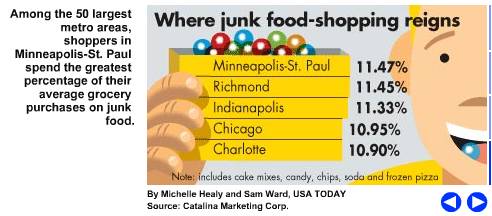
11.5% of Budget on Junk Food

Given that Minneapolis is both a health city and has a large amount of healthcare companies, I found it very interesting that they spend almost 11.5% of their income on junk food according to Catalina Marketing.

60% Think We Are Headed To A Depression

You wonder how bad it is economically or where we are headed…look no further than the CNN poll out this morning showing that 60% of Americans think it is likely that we will go into a depression.  Not a recession, but a depression like many of us read about in the history book or saw in the movies.

Do people really know what the depression meant – 25% unemployment (for example).  So, if that’s the perception out there, imagine the impact on health behavior.  People will continue to look for savings opportunities – skipping pills, splitting pills, moving to generics, trying over-the-counter medications, moving to mail order.  They will likely be less likely to act preventatively – e.g., getting a flu shot.  They may be more willing to ride out bad symptoms at home rather than rush to the clinic.

This makes me think about an article I saw the other day that said that people don’t have any solutions to manage trend.  I think that’s BS.  The fact is people are afraid of the solutions to manage trend.  They don’t want to tell employees what to do or limit their choice.  In a tight labor market, companies want to keep the employees happy.  So, as the labor market opens up (i.e., higher unemployment) and healthcare costs go up, will companies finally embrace some of these tools.

For example, on the pharmacy side, we used to see a spike in call center volume of 1,000%+ on some of the aggressive programs – mandatory mail, step therapy, limited formulary, limited retail network.  That scared a lot of clients.  Maybe that attitude will change.  Granted pharmacy is 10% of medical spend so the bigger problem is on that side, but maybe companies will finally be willing to link out-of-pocket costs to controllable medical activities – weight, exercise, blood sugar, cholesterol, preventative testing.

If I were a insurer or a PBM, I would be focused on showing my value right now.  I would be delivering cost savings messages to all my members and help them understand how to minimize their out-of-pocket spend in this economy.

Kaiser Family Foundation on Healthcare

The Kaiser Family Foundation has two things relative to the election that you might find interesting:

  1. A side-by-side comparison of policies for the two candidates; and
  2. Lots of videos and podcasts on healthcare.

Since this is the number two topic (after the economy) that people care about, it is important to know how they feel.

The Tough Economy is Impacting Health (and Potentially HEDIS)

A WSJ article of last week provides a glimpse into the many ways our strained economy is adversely impacting the healthcare-seeking behavior of individuals (see article here). It cites a D2Hawkeye analysis of medical service and pharmaceutical utilization (in a study performed before the most recent Wall Street and Main Street turmoil) and shows widespread impact across many healthcare categories. Consumers are cutting back on everything from mammograms to drugs to physician visits.

These findings should be a big stimulus for health plans, population health companies and PBMs to work more creatively on plan designs and communications strategies to support prevention and medication adherence.

Certainly, many individuals are feeling the pinch of health care costs to a greater extent than ever—with higher co-pays, bigger deductibles and for some Medicare members, the “coverage gap,” all contributing to choices people making. The D2 Hawkeye analysis of several Mid-Atlantic health plans looked at preventive and non-acute health services received between March 2007 and March 2008…

It shows pap smears are down 6% and antidepresssant medication fills declined by 19%

…despite the fact that for most of these members (in the study population) the cost-sharing changes year-to-year were minimal. So, the broader economic reality appears to be forcing consumers into making hard choices – trading off health care for other goods and services, whose prices are simultaneously rising.

NCQA is about to release its 2008 State of Healthcare Quality Report (tomorrow, October 2nd) which is its comprehensive summary of how plans across the nation are performing across the full range of HEDIS indicators . The data will reflect the healthcare services received by members in 2007, levels which from the D2Hawkeye study and other industry sources suggest we’ve declined. ….the time is now for innovation that spurs positive member behavior –in areas ranging from diabetes care to flu shots to colon cancer screening—to take center stage as an antidote to all the negatives the economy is now inflicting.

Healthcare Effectiveness Data and Information Set (HEDIS) is a tool used by more than 90 percent of America’s health plans to measure performance on important dimensions of care and service. (source)

This posting was written by Margot Walthall, Population Health Market Leader for Silverlink Communications. Margot has previously worked in director level roles in strategy, member communications and product management/marketing for three health plans and also in product marketing for a population health software and services company.

Margot’s work for Silverlink is focused on multi-channel communications solutions that enable campaigns in the areas of health engagement, health risk appraisals, health education in support of gaps in care/HEDIS, adherence programs, virtual coaching and health program satisfaction measurement. Margot has a master’s degree in health administration, as well as an MBA in marketing.

If you like this post and are interested in the topics here, don’t forget to sign up for my e-mail updates or add the RSS feed from the blog to your reader.

How Are You Classified?

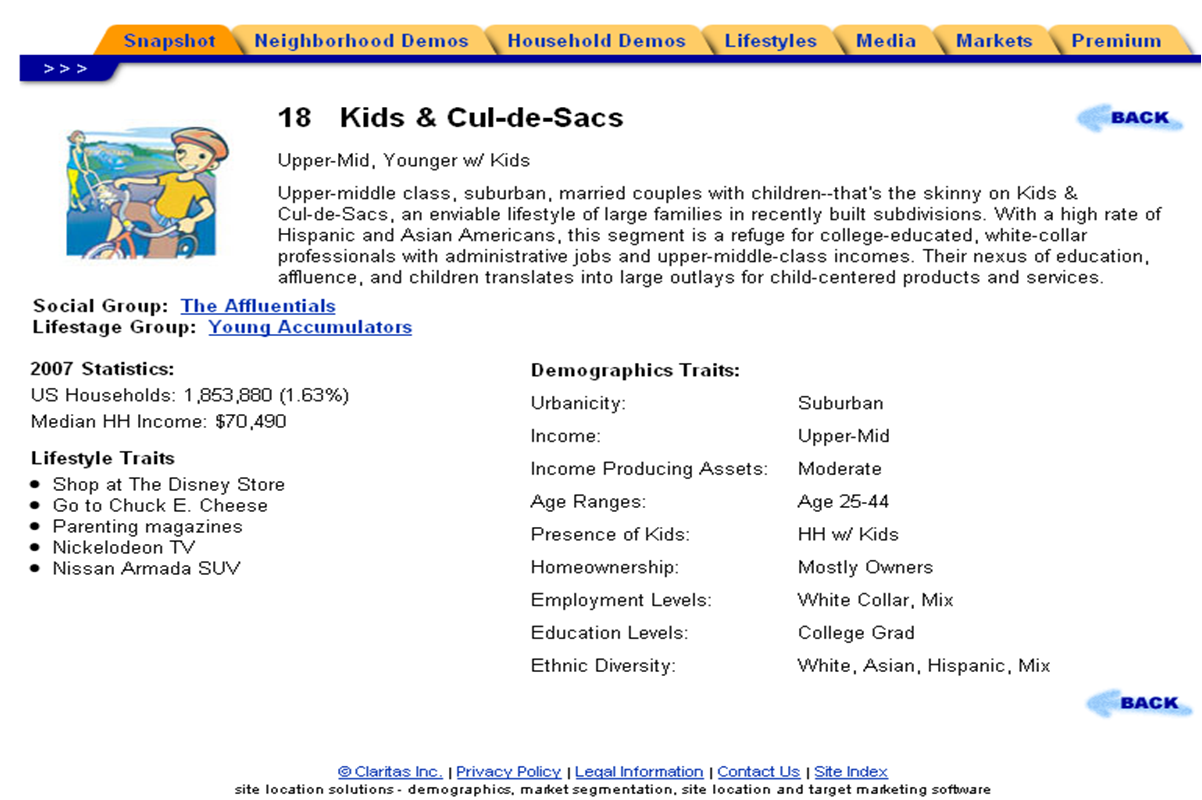
One of the typical models used by consumer marketers is the Prizm model by Claritas.  If you’re interested in whether you’re a “Pools & Patios”, “Home Sweet Home” or “Empty Nest”, go here and put in your zipcode.  In my case, it gave me five possible classifications – Blue Blood Estates, Exec Suites, Kids & Cul-de-Sacs, Movers & Shakers, and Winner’s Circle.  After looking at them, I could quickly see myself being classified as the Kids & Cul-de-Sacs one (see below).

They start with 66 different categories which can be used.  Of course, this is primarily driven by zipcode and a few other attributes and misses things around your attitude towards health that you might find in other health segmentation models, but it is an important marketing fundamental to understand.

Express Scripts Patient Segmentation

In a recent investor deck, Express Scripts laid out some of their segmentation from their Consumerology program.  This is similar to some of the work we do with clients at Silverlink Communications to help them develop segmentation models through a test and control approach.

What they have come up with are 5 segments of their members – “Movers and Shakers”, “Rock Solid”, “Getting By”, “Rising Stars”, and “Here and Now”. They describe some of the attributes of each segment on the first slide below and then show how messaging on driving mail order utilization was applied for each segment over the web.  The final slide below shows the results when the targeted messaging is used on the web.

It will be interesting to see how that messaging plays out via other channels (i.e., letter or outbound call) and when pushed to the member versus a situation where the member is on the portal and looking for information (a fairly engaged member).

Drug Trend Comparisons

Here are a few comparisons from the Drug Trend Reports published by some of the largest PBMs. There is no industry standard on definitions and what is included so I did my best to pick a couple of comparative metrics. (Note: In case you are unfamiliar with these reports, they are summaries of 2007.)

Overall Trend

Specialty Trend

Managed Trend

Generic Dispensing Rate

Mail Order (90-day)

CVS / Caremark

4.8%

13.2%

2.1%

59.9%

28.2%

Express Scripts

4.7%

14%

63.7%

24.1%

Medco

2.0%

12.3%

59.7%

38.0%

Prime Therapeutics

2.0%

8.9%

56.7%

Walgreens

4.8%

(0.07%)

61.2%

35.9%

    • They break out their best in class as having a 3.4% trend and say that clients who used proactive trend management were at 2.1% on average.
    • Best in class generic dispensing rate was 65.6% (employers) and 66.7% (health plans).
    • Mail order rate as reported in press release for close of 2007. (Not sure how to compare this to the 12.8% reported in their TrendsRx report.)
    • Overall trend was 5.5% when specialty drugs are included.
    • Had to find the generic fill rate in their 4th quarter financial press release. Either I missed it in the trend report or it was strangely missing.
    • Mail order rate was derived from the same 4th quarter release which showed 40.8M mail Rxs and 507M adjusted Rxs. Multiplying 40.8 by 3 to adjust from 90-days to 30-days and dividing that by 507 gave me the 24.1%.
    • Deriving the mail order rate from the 2007 full year press release gave me 94.8M mail order Rxs which I multiplied by 3 to get to adjusted Rxs and then divided by 748.3M to get 38.0%.
  • Prime Therapeutics trend report (Drug Trend Insights)
    • Their trend was 2.9% if specialty drugs are included. Trend ranged from (1.3%) to 7.5% across their blues clients/owners.
    • Overall trend was 5.66%. The 4.8% excludes specialty trend.
    • GDR was 69.6% if you include Medicare.
    • The 35.9% mail order rate includes their Advantage90 offering for 90-days at retail.

Disease Management Evaluation – Care Scientific

My former boss, Brenda Motheral, from Express Scripts spent a year at Healthways running their research group and has now decided to go out and do some consulting (new company is Care Scientific).  Her evaluation of the Disease Management industry was just published in the Journal of Managed Care Pharmacy.  It is a pretty critical view of the state of the industry.  Here are a few highlights:

  • There have been several articles published questioning the value of these programs this year.
  • There are five reasons for dissatisfaction:
    • Desire for better alignment of vendor and client interests
    • Desire for greater transparency in business arrangements
    • Desire for improved plausibility in reports of financial and clinical outcomes
    • Desire for more rigorous evaluation methodology
    • Desire for more convincing evidence of outcomes improvement
  • There is misalignment today…For example, if I get paid per member, how hard should I try to contact them when all that will do is drive up my costs.
  • Lack of alignment can be addressed through contractual requirements and pay per engagement.
  • There is a lack of data available on how many members are contacted.  [Not for companies that use Silverlink for their automated outreach who have real-time data available with detailed call information.]
  • There are calculation questions in comparing vendors.  [Something I have talked about several times here.]
  • She compares the move to transparency in this industry to what happened to the PBM industry earlier this decade which created new competition and changed several business models.
  • She advocates for really looking critically at the ROIs claimed by these vendors and talks about NND (number needed to decrease) which is the model that the DMAA (Disease Management Association of America) adopted as part of their outcomes guidelines.
  • She also raises concern about DM companies moving into wellness which is another area “fraught with numerous new methodological issues that warrant close attention”.
  • She talks about an industry push (from buyers) to demand new expectations from vendors.
  • She talks about the fact that the focus on ROI may not make sense since “literature suggests that less than 20% of treatments for existing conditions are cost-saving.”

“Plan sponsors also bear responsibility for the current situation.  As long as they demand a short-term ROI in the current model and inconsistently require comparison groups, they are more likely to promote methodological creativity than they are to inspire true innovation.”

As with the dozens of publications she has had over the years, this one is well written with a well referenced set of facts.  She presents a challenge to the industry in how to approach.

The challenges are interesting to reflect on given the overall industry focus on improving healthy behavior, being more proactive, more actively managing patients, and other activities that a DM company should be well positioned to do.  But, a high touch model is certainly challenged given lower cost options.  Creative solutions that leverage technology to identify gaps in care, create data segments, personalize interactions based on preferences, and use motivational interviewing to drive behavior exist and should be able to create value.  It will be an interesting 12-18 months for the industry.

Managing Antibiotics in Hospitals

I got this story from PharmacyOneSource the other day and thought I would share it.

“Between one-third and a half of all hospital patients receive antimicrobial drugs, and antibiotic prescriptions can account for 30-50 percent of many hospitals’ total drug budgets. Researchers estimate up to half of these are unnecessary, and this excess also contributes to the problem of drug-resistant bacteria.”

They gave two case examples:

  • Johns Hopkins implemented a web-based approval system for more than 30 antimicrobial drugs on a “restricted” list. The system forces orders to be approved by an infectious disease specialist before they are sent to the pharmacy. They found it saved $370,000 in the first year of its use.
  • University of Virginia found that switching between two antibiotics, linezolid and vancomycin, every three months in the surgical ICU decreased the MRSA infection rate from 1.9 to 1.4 patients per 100 admissions.

Don’t You Want To Live

Apparently, the Walgreen‘s CEO told the WSJ that not only is this a tough year, but they are taking a tough love approach with their patients.  In their blog earlier today, they said that Jeffrey Rein said “Walgreen pharmacists try to persuade patients to take their pills by asking them whether they want to be alive to see their children grow up.”

As they talk about, there have been several studies showing that patients are skipping pills and doing other things to stretch their prescriptions.  But based on what I saw in the Lehman Brothers research yesterday about Walgreens, I wouldn’t have thought things were that desparate.  They reported August same-store stales of 3% which is low compared to their historical results but still positive in this economy.

Interestingly, the report commented that they were increasing promotional activity which would negatively impact front end margins while CVS had recently said that it’s promotional spending (as a percentage of sales) was lower.

[In full disclosure, I do not own any of these stocks as individual stocks.  They may be held in mutual funds that I own.]

Payers Spending On BI and Information Delivery

“Healthcare payer spending on business intelligence, information delivery and transparency is the fastest growing spending category in 2008 for healthcare payers,” said Janice Young, IDC Program Director, Payer IT Strategies.

This quote was in our press release this morning around the growth at Silverlink.  You can read about the company in the release, but I wanted to focus on this quote from IDC.

On the one hand, I think consumers should be saying “Amen!” that payers are focusing on business intelligence (BI) although that can mean a lot of things.  On the other hand, they would shocked to know how new this is to the healthcare space compared with the consumer packaged goods industry.  BI can help identify gaps in care and identify how to help patients become better.  BI can help personalize the messaging that you receive from your health plan so you don’t have these huge legal caveats about all savings and other specifics being based on your exact plan design and deductible.

Information delivery can also mean a lot of things.  Is this reporting to the employer?  Is this online analysis for the consumer?  Is this communications?

And, I am not sure what transparency means, but I hope it means things like letting consumers actually understand the price of goods and services and how to make tradeoffs between different options with all the data (e.g., quality, price, outcomes, patient experience).

Overall, for those of us in the healthcare communications space, this is a rising tide that helps.  It means the payers who support all of you consumers are raising the bar and looking at how to use their information to improve the experience and outcomes (ideally).  It could also allow them to better focus their efforts on the riskiest patients and discover the best way to drive behavior.

The data is there and has been there so figuring out how to use it and what to use it for is critical.  Mapping this against the patient expectations and desired activities can be a great positive for the consumerism movement.  Integrated data.  Accessible data.  Digestible data. Sounds great.