Archive | Research RSS feed for this section

PBM / Pharmacy Benefits Data (Takeda)

Takeda publishes The Prescription Drug Benefit Cost and Plan Design Survey Report (free to order here). I read the 2006 edition last night. It is full of great data that I would want if I were a consultant, a HR representative, or responsible for my companies PBM relationship.

The document also points you to the American College of Occupational And Environmental Medicine for other information.

Here are some of the facts (based on respondents to their survey):

  • 69% of employers less that 5,000 employees are self-insured
  • 97% of plan sponsors chose to be self-insured so that they had the ability to customize their health plan to meet workforce needs
  • 68% of employers use separate vendors for medical and pharmacy of which 53% use a PBM
  • Average pricing was:
    • $1.88 in retail brand dispensing fees
    • 84.7% AWP reimbursement for retail brands (or AWP – 15.3%)
    • $0.24 in mail brand dispensing fees
    • 78.1% AWP reimbursement for mail brands (or AWP – 21.9%)
  • Formularies were used by almost everyone – 92%
  • Mail copayments were roughly 2x the retail copayment (for 3x the supply of medication)
  • Employer size appeared to matter for price negotiations (no kidding) and they showed that employers w/ over 20,000 members achieved a retail rate of 0.8% less that employers with less than 2,000 members
  • Sponsors who use mandatory mail got a lower reimbursement rate (77.1%) than those without mandatory mail (78.4%)
  • Only 2% of sponsors use a closed formulary where drugs not listed are not covered and the patient pays the cash price
  • It cites research on adherence (The Importance of Medication Adherence, Stambaugh, April 2006) which showed the following reasons for poor medication adherence:
    • 1% don’t know how to use the drug
    • 10% can’t get the Rx filled, picked up or delivered
    • 14% don’t think they need the drug
    • 17% said the drug costs too much
    • 20% don’t want the side effects
    • 24% sometimes forget to use or refill the prescription
    • 10% cited other reasons
  • 40% of employers who design their own plans use co-insurance as opposed to 13% of people who use other parties (i.e., consultant or managed care)
  • Mail service utilization ranged from 0.2% to 62% with 18.3% being the average
  • If a company had mandatory mail, their mail use was 32% versus 14% if voluntary mail
  • Generic dispensing rates ranged from 33% to 71% (51% average) at retail and 12% to 65% (39% average) at mail – which is due to the different mix of acute versus maintenance drugs typically
  • Talked about specialty drugs quoting cost to treat MS at $12K per year and hemophilia at $120K per year (Rx only)

Lots of good information to have.
Treating Depression – ROI

JAMA just published a study on treating depression and its impact.  Here is the summary from the Associated Press which hits the highlights.  With 6% of the population having depression and estimates that this costs our economy $30B a year, this is a big deal.

“Investing in depressed employees _ quickly getting them treatment and even offering telephone psychotherapy _ can cut absenteeism while improving workers’ health, a study suggests.”

  • Employees who got the aggressive intervention worked on average about two weeks more during the yearlong study than those who got the usual care.

  • More workers in the intervention group were still employed by year’s end _ 93 percent vs. 88 percent _ savings that helped employers avoid hiring and training costs.

  • Intervention employees were almost 40 percent more likely to recover from depression during the yearlong study.

  • Initial results indicate a savings of $1800 per employee from more hours worked versus $100-$400 in cost per employee.

What did they study:

  • Used an online questionaire to identify people with signs of depression.

  • 1/2 of the people got a letter suggesting they talk with their PCP or call their plan for a referral.  1/2 got repeat phone calls from case managers urging them to get treatment and check in on them.  A phone consult was offered if they resisted seeing a mental health expert.

  • About 40 percent of workers in both groups got antidepressants. Intervention group workers were 60 percent more likely to get treatment from a mental health specialist.

This seems like an obvious one.  There are lots of therapy specific instances where we can take a more aggressive outreach to impact health and bottom line.  The best way to get a program launched is have a value prop that addresses both issues.  

Information Therapy Blog

I was looking at the Healthwise website and The Center for Information Therapy and came across a blog by the team there with some good discussion topics. It is definitely worth your read. Here were a few things that caught my eye:

  • Can we more effectively engage consumers in better managing their own health by learning from Hollywood or video games about how to draw people in through entertainment? By doing so, can we make health care “fun” or at least truly engaging? (entry)
  • Since research shows that 40%-80% of everything a doctor tells a patient in the office is forgotten, taking along a patient advocate is a great strategy. Unfortunately, it is not always an option or sufficient. In order to ensure effective communication, every patient should leave the doctor’s office with an information prescription (Ix). (entry)

Small Business Impact of Health Coverage

Wells Fargo and Gallup put out the results of a poll of small business owners last week that underscores just how challenging it is for them to provide healthcare coverage for their employees even though they clearly know this is an important benefit in attracting the right type of talent.

A few of the key facts from the study are:

  • 9 of 10 say the healthcare system needs to change
  • 6 of 10 say a complete overhaul is necessary
  • 81% said health insurance improves employee loyalty
  • 55% do not offer health insurance with 45% of those citing cost as the issue

Here is a good quote from a Wells Fargo executive:

“The majority of small business owners recognize the benefits of offering affordable healthcare coverage to their employees, but many feel they cannot afford to do so,” said Rebecca Macieira-Kaufmann, executive vice president and head of Wells Fargo’s small business segment. “A third of small business owners are cutting back on non-capital investments so they can provide healthcare for their employees. For several years health insurance has been a major concern for small business owners, and its impact is significant.”

Since small business is where much of our job growth has been over the past decade, this should raise flags for us.  I think it is critical that we find a solution that creates easily accessible healthcare for everyone, but I think it is ridiculous that working families can’t afford care or aren’t provided care.

Customer Event

What a great week. I have been so busy that I haven’t had time to blog, but I will try to catch up over the next few days.

I always love to mingle with customers and talk to them about their experiences with a company. As a former client, a current consultant, and a future employee of Silverlink, I got to join their customer event this week where 40 customers talked about how they use the technology and services to lower costs, increase efficiency, and grow revenue. Talk about empowering.

Some of the key content / discussions revolved around the following:

  • JD Powers study on healthcare company satisfaction including a great non-healthcare example.
    • It showed how satisfaction with auto insurance actually went up and was higher when the company raised rates but pro-actively told the consumer versus when they lowered rates. Talk about the power of communications.
  • Lots of talk about how marketing and data analytics are going to drive healthcare and how non-healthcare companies are setting the expectations for patients very high compared to the current state.
  • How disjointed healthcare communications are – provider, pharmacy, PBM, MCO, DM companies. No consistency.
  • A great presentation by Liz Boehm from Forrester research which made a few key points:
    • She reinforced the loss avoidance point I blogged about the other day stating that savings is equal to one unit of happiness while loss is equal to two units of unhappiness. So, for many, losing money is a bigger factor than saving money.
    • She pointed out the fact that any healthcare site that quotes a price always has some disclaimer about the accuracy. Why can’t we simply guarantee a price (like any other industry)?
    • She showed that member services (IVR, web) are the 3 most important factor in chosing a carrier after price and network.
    • She showed research that consumers are generally dissatisfied with contacts across all channels from their health plan.
    • She talked about using a persona to design programs and prioritize efforts.
    • She compared channels across cost, reach, engagement, and immediacy.
    • It was obvious that we have a long way to go.
  • Heard from a few customers that talked about how they allow Customer Service Representatives (CSRs) to go “off the clock” to help patients so that they can still track average call time but allow for flexibility.
  • I talked about process innovation and how to apply that to your communication process. I also talked about business process outsourcing.
  • We heard about best practices in driving response rates. Everyone always seems so amazed when they hear about response rates of 50, 60, or 70%. Very difficult to get and/or measure that in other channels.
  • Talked about how MCOs are using the automated call technology – ANOC (Annual Notification of Change) for Medicare, Collections, Lead Management, COB, Missing Information, Wellness Program Recruitment, Reminders, Surveys, and many others.
  • We heard about calculating the ROI with a detailed methodology.
  • We talked a lot about models from other industries that could apply.
  • We talked about data mining and analytics.
  • We talked about member satisfaction, loyalty, and how to survey and capture that information.
  • An outside consultant talked about experience based branding and how sounds can be your brand – Harley‘s engine, Sprint‘s pin drop, Ford‘s door chime, AOL‘s “You’ve Got Mail”.
  • Had several clients talk about how they use Silverlink‘s technology to enhance their product suite

All of the conversations and presentations reinforced how critical successful communications are to healthcare and how big of a hill we have to climb. It was great to see how effective, timely, and personalized the Silverlink technology could make the process. It is worth looking into if you are a managed care company, a device supplier, a PBM, a pharmacy, or even a provider.

Accenture Top Issues for Payors

Peter Kongstvedt is a partner at Accenture (and former colleague of mine from E&Y). He has always produced great articles and publications on healthcare. I was happy to have someone send me a link to one of his more recent publications on the Top Issues for Payors in 2007 and 2008.  It is certainly more interesting if you are a payor or consultant, but here were two things that I thought most people would find interesting.

Here is a quote which I think is really one of the core issues.  How to make data driven decisions versus experience to drive healthcare.  Not easy in a splintered industry with disparate data.

Promoting medical practice that is based on current scientific data rather than on habit or outdated information remains a top goal for every payer.

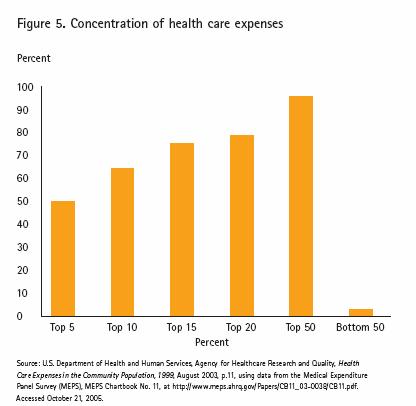
Another fact which I have always found very interesting is the chart below on the concentration of health care expenses.  Almost 80% of all healthcare expenses are from 15% of the population.  Amazing concentration.  Great from a marketing perspective but tough from a risk management perspective.

Healthcare costs concentrated

Healthcare IT – Gartner

I am listening to a Gartner webinar on Healthcare IT which is a pitch to vendors on sponsoring an upcoming event of theirs.  Here are a few comments which I thought were interesting and some of you might care about:

  • Innovation in IT is critical for healthcare.
  • Healthcare IT will be the fastest growing vertical through 2008.
  • Based on a live poll of the attendees on what companies are looking for in making technology decisions, the top 3 factors (which were my votes) were:
    • Ability to integrate w/ existing systems
    • Lowest total cost of ownership
    • High quality service
  • Healthcare providers buy based on references.  (more than others??)
  • Consumer confidence in online tools is very low.  Phone is #1 preferred mode of communication.  Relationship between payors and patients outside of phone is still limited with fear of lack of security.
  • Current pain points (insurers and providers):
    • Business intelligence – how to get quality information from all their data
    • Integration
    • Claims
    • Physicians – how to keep them happy
    • Agility
  • How to best engage prospects with an IT solution:
    • Case studies
    • Referrals
    • Demonstrate a good fit to them

Not too helpful for those of you that are consumers, but for those of you developing consumer solutions to address the market, this might be helpful.