Archive | Software RSS feed for this section

Geekipedia

Sure…a little off topic, but understanding technology is one of the critical components (in my humble opinion) to driving innovation and change in healthcare. Healthcare is not an early adopter of solutions. There is too much fear about change (and litigation).

So, when Wired but out this magazine supplement called Geekipedia, I knew it was a must read. As it says on the cover “149 people, places, ideas and trends you need to know now”.

Here are a few that jumped out at me:

  • AJAX – a suite of web-development technologies which produce squeaky clean surfaces. This allows web designers to build web sites that act like applications and accept user input and computing results without fetching entirely new pages from a server. I have worked with developers to use this before. Very cool. You see it on a lot more sites now, but anytime you enter data and the site changes without refreshing it…they built the site using AJAX.
  • APIs – application programming interfaces are sets of rules that govern how apps exchange information. These have been around for years and typically only mattered to the programmers and your engineering staff…but today APIs allow you to create custom applications using desktop widgets and mashups to have personalized sites that do all types of cool things.
  • Collaborative Filtering – this is the recommendation algorithm you see on Amazon or Netflix or many other sites. I can see healthcare one day embracing this in patient centric forums – patients with your similar benefits and genes were most likely to respond to this form of treatment.
  • Distributed Computing – most of you should know about this as the use of our computers to solve problems has been part of the news (good and bad) for years, but the point is to leverage the memory of individual computers in a network design to create a virtual supercomputer to solve complex problems that look at lots of data over years – e.g., SETI@Home that looks for extraterrestrial intelligence or FightAids@Home which looks for new AIDS treatments.
  • Mashup – these are sites / applications that are combinations of existing offerings that are cut and pasted together. For example:
  • Meganiche – with the Internet’s utilization now, it is possible to have a niche within a niche. For rare diseases, this could have some value.
  • Neurologism – all of the new areas of research driven by the breakthroughs in understanding the brain.
    • Neurofitness
    • Neuroceuticals
    • Neuroinformatics
    • Neuromarketing
    • Neuroergonomics
    • Neurosemantics
  • RNAi or Ribonucleic Acid Interference – “the silent assassin of cell biology”. It protects against viruses by tearing up the viral RNA and preventing it from making copies of itself.
  • RSS or Really Simple Syndication – you see this everywhere – on my blog, on websites, even in the new Outlook. This allows you to stream information to your reader (e.g., Google Reader) to see new information without having to go to all the individual sites. I wonder how many managed care companies and PBMs offer this on their websites today. It would be nice to get this pushed right to my personal Google page.
  • SEO or Search Engine Optimization – this is the use of tags and other links to maximize how your website shows up in a search.
  • Ultrahigh-throughput gene sequencing – this is all about the speed at which genes are sequenced which is obviously a big driver of personalized medicine and genomics. I am not sure I buy the prediction of “it won’t be long before a stall at the local shopping center will work up your genome ‘while u wait'”.
  • Widgets – these are small applications which can typically be embedded in a website using reusable code (e.g., a BMI calculator or mortgage calculator)
  • Wikipedia – this is a site that provides the modern encyclopedia full of links and information that is created by the net community – are you out there? Is your company or product?

It makes you wonder. As healthcare moves to more consumer centric and sales to commercial patients mimics Medicare Part D, will you see a United Healthcare avatar in Second Life or a Medco Facebook page. And, when will be see YouTube and Flickr being used to paint positive pictures of our healthcare system for the many people that it does work for. If politicians can begin to use these sites and big corporations encourage personal advertising of their brands, healthcare should give it some consideration.

ConnectYourCare Acquired by Express Scripts

connectyourcare.jpg

I was glad to see my former employer – Express Scripts – jump into the CDHC space with an acquisition.  They bought ConnectYourCare which is a fairly new company that had jumped into the market over the past few years with money from RevolutionHealth.  It provides online tools and a card for managing your HSA / FSA type funds.  It will be interesting to see how this plays out.  It may be a little late in the selling season to affect 2008 but it could play prominently in the spring for renewals or new business.

As an aside, ConnectYourCare provides a nice glossary of terms you might here around consumerism and benefits.

You can also get access to some of the Forrester research through their site – here.

Medco Tour of Champions

I was surprised to see a full-page advertisement yesterday by Medco in USA Today about their Tour of Champions.  I knew they were focusing on therapeutic resource centers (i.e., pharmacies dedicated to specific disease states like diabetes).  It seems like a great idea.

tourofchampions.png

It was interesting to go to the website – www.tourofchampions.com.  One of my biggest surprises was the fact that they have made their therapeutic alternative tool called My Rx Choices (i.e., telling you lower cost options based on your current drugs) available to the general public.  Now, obviously, it can’t tell you your copay savings, but it may help you identify options.  For example, I put in Lipitor to see what it would offer me.  (see below)

myrxchoices-lipitor.png

From the website, this is what it says the specialist pharmacists do:

  • Cross-check your current medications with your health history and available lab work to help you stay safe.
  • Understand your overall health, not just treat your condition.
  • Let your doctor’s office know how your pharmacy program works so your doctor can help you save.

Microsoft’s HealthVault

health-vault-microsoft.jpghealth-vault-microsoft.jpg

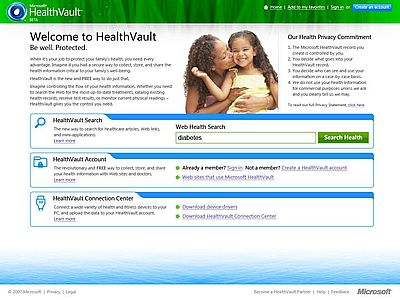
Microsoft has their new healthcare tool out – HealthVault.  It does three primary things – search, collect / store / share (i.e., PHR), and connect with devices.  The “connect with devices” concept seems pretty interesting especially as we get more intelligent home care devices that track blood pressure and other key metrics. 

Connect your HealthVault-compatible home health monitoring devices from partners, such as sport watches, blood glucose monitors, peak flow meters and blood pressure monitors to HealthVault Connection Center, and let our software copy your device data to your HealthVault record.

Given issues with Internet Explorer, will people worry about security – probably.  Given the challenge of connecting with numerous systems and devices, will Microsoft have a leg up – probably.  Will patients use these tools – definitely over the next 5 years.  Who will win – I don’t have a clue.

Here is their blog for developers.

There is lots of talk about this on blog sites:

Companies from Health 2.0

I thought it was interesting to catalog the companies that were at Matthew Holt’s Health 2.0 conference. Many of which I was not familiar with.

MedHelp.org (interesting site which offers Q&A by disease topic with MDs and nurses)

ThinkHealth (medical management software)

Health Evolution Partners (a private equity firm)

Medstory (intelligent search for health)

Healia (health search engine)

Healthline Networks (health search engine)

WeGoHealth (disease specific communities)

Patients Like Me (patients sharing information with other patients)

Daily Strength (support groups)

Organized Wisdom (MD handcrafted search results)

Inspire (health and wellnes support networks)

DiabetesMine (site all about diabetes)

Enhanced Medical Decisions (uses natural language to look at drug interactions)

HealthEquity (health savings account software)

DNADirect (source for genetic testing)

Within3 (social networking tool for physicians)

Vimo (comparison shopping for healthcare)

Careseek (sharing information about physicians)

Health Hero – home health monitoring device

Additionally, John Sharp mentions a few other companies in his blog including:

Silverlink – My New Employer

After trying a few entrepreneurial things, I am excited to have accepted a job working with a consulting client of mine – Silverlink Communications. [I am also a former client of theirs from my time at Express Scripts.] The role is a good mix of entreprenerial and stability since they are a high growth, VC backed company. And, one of the most impressive things is their track record of delivery and impressive clients including lots of the big MCOs and PBMs (examples).

As I was getting ready to do an e-mail blast out to a 1,000+ people in my Outlook database, I figured that linking them to the blog and answering their predicted questions here might be a good solution. I could go with the micro-segmentation of my audience (i.e., my healthcare friends want to know something different than my consulting friends) that I started to do, but it’s turning out to be more time consuming than I would like.

So here goes. Here is more information about what I am doing and why. If you are in the healthcare space, I would encourage you to look at Silverlink and give me a call. We can leverage our technology and services to help you cut costs, grow revenue, and inprove patient satisfaction and outcomes.

Q&A:

  • Who is Silverlink and what do they do? Silverlink is a healthcare technology company that provides HIPAA compliant, targeted communications to patients [consumers] primarily using a automated voice-centric technology. This allows them [us] to push information (e.g., reminder call), collect data (e.g., surveys, COB, HRA), and qualify leads for transfer to a live agent (e.g., retail-to-mail, brand-to-generic, 30-day to 90-day). They provide consulting support, data mining, and great reporting. [and now outsourcing]

[Official PR Text] Silverlink is the leader in automated voice solutions for healthcare enterprises. Silverlink’s services enable customers to design, deploy and manage HIPAA compliant automated call programs to educate, collect information from and drive behavior of thousands of patients and members at a time. Serving six of the top ten health plans and with a customer base that collectively represents over 150 million covered lives, Silverlink drastically reduces the cost of communicating with customers while improving financial results and customer care.

  • Why did you join Silverlink? (A) Proven Value Proposition and Technology. (B) Great Team. (C) Very Impressed by Client Feedback. (D) Good Investors. (E) Great Market Demand.

We saw great results at Express Scripts. In one controlled study we ran through research, we saw our success rates improve by 30% by blending letters and calls. Additionally, access to data and flexibility were critical. We launched one new call program in under a day (either for Katrina or for a new drug warning).

Everybody is talking about consumerism and Health 2.0. Silverlink plays right into that strategy. Delivering timely information to patients. Blend their core technology with multi-modal, data mining, and experience based branding, and you have a unique opportunity to change the paradigm.

  • What are you going to do for them? I am going to be responsible for building out a business process outsourcing (BPO) and professional services group. As with any process oriented change, technology often enables step improvements. Their core technology has allowed companies to radically reduce key metrics (cycle time, response rates, collection ratios). By helping drive more of the process, introducing some new services, and leveraging our industry experts, we will help clients drive market differentiation.
  • Should I look at them as a solution provider for my business? If you are a PBM, mail order pharmacy, specialty pharmacy, medical device fulfillment company, or managed care company, they have many proven solutions to help you with. If you are a retailer, disease management company, or provider, there are numerous ways to use the technology. And, if you are a technology or services company, there are ways of embedding their technology into your solution.
  • Do consumers really like automated calls? You would be surprised. Using good voice talent with the right caller ID with the right sonic branding will get people to answer the phone. People throw away mail. We get too many e-mails. We still answer the phone and listen to voicemails. The response rates are great. On some programs, a reach rate in the 80-90% rate is not unusual.
  • (For my VC friends) Who backed them? There are several angels along with HLM (big healthcare VC firm), Kaiser Ventures, and Sigma Partners ($1.5B technology VC firm).
  • What happened to the other things you tried over the past year? Neither took off. Learned a lot about being an entrepreneur. I put a lot of my lessons learned here. No regrets since I believe everything happens for a reason.
  • Are you relocating? Not for now. We are going to try commuting. Since I will be spending time with clients and in other meetings, we are going to see how this works. Plus, the housing market is no good (at least for selling).

I am sure I could go on. But, while you are here, I would encourage you to look at the Silverlink website (PBM, MCO, Medicare, Medicaid, DM, Specialty/DME) and also at rest of my blog. If interested, register to get updates to the blog via e-mail by clicking here.

Managing Medical Bills – Free Trial

As anyone who has done anything outside normal knows, getting and managing your medical claims can be very confusing.  When should you pay?  When should you resubmit?  When is it simply an error?

I was encouraged to learn about a new company MedBillManager which has recently secured some funding.  They have a blog where you can read some thoughts and you can read about them in a WSJ article.  The WSJ points out other companies such as WebMD, RevolutionHealth, and Intuit that provide tools to help get you organized and/or provide information.

Here is a screenshot.  The team there offered my readers a free one year subscription ($24.95 savings).  Go to  https://prod.medbillmanager.com/account/signup  and click on the “Got a free plan code? Claim it” link… enter in gvareader1.  I think they would welcome the feedback.

Much like the OutofPocket.com that I blogged about the other day, this is heavily dependent upon adoption to drive value.  Being able to compare costs by treatment, geography, insurer, and physician is valuable long-term in a consumer driven world, but it needs participation to have enough detail at at specific segment.

The other key for success will be integration of data directly from the payors.  I don’t mind entering a few EOBs and bills to see some data, but eventually, I want them to be pre-populated and then use the application for reporting and analysis.   Blend this with a technology such as that from ActiveHealth and a PHR and you have an integrated data selection that tracks costs, compares data, and pushes suggestions to you about wellness and health management.

This is probably what RevolutionHealth is doing.  I am sure we will see some more rollups over the next few years to pull all these solutions together.MedBillManager

Google – Thoughts from another blogger

Anyone working in healthcare IT knows it is difficult to drive change – legacy systems, lots of constituents, no standards or years of trying to get one, regulatory issues, etc.

I liked Scott Shreeve’s letter to Marissa Mayer who is apparently taking over Google Health with Adam leaving.  As one might expect, Google‘s presence in healthcare leads to lots of rumors.  I saw one earlier today talking about them buying WebMD (rumor).

Scott hits on several things:

  1. Get ready to rumble (this won’t be easy)
  2. Get transparent (don’t get caught hiding something)
  3. Get a product out (act don’t simply plan – see what the patient’s say)
  4. Throw your weight around (we need big players to drive change)
  5. Start small then throw your weight around (I would have called it KISS – keep it simple stupid)

Patients Sharing HC Experiences & Cost

Obviously, a big part of true consumerism will be patients sharing information about their healthcare experiences (e.g., this doctor is great, you wait too long here, this drug gave me hives) and their costs (aka transparency).  There are several locations moving towards this especially around disease specific discussion groups.

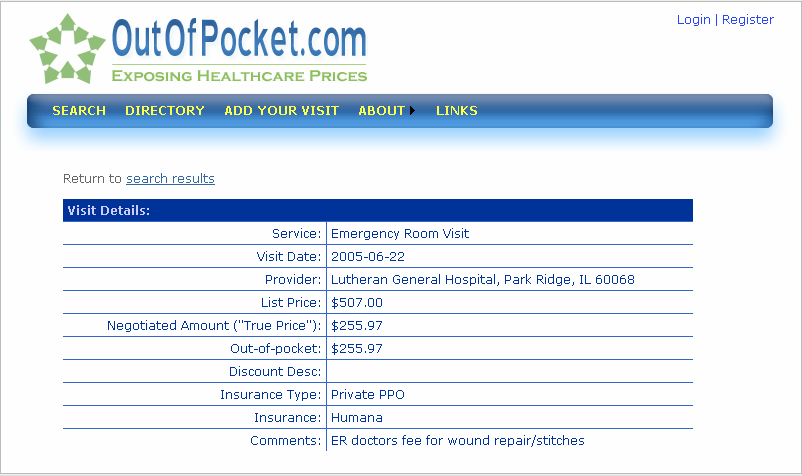
One new site that contacted me is OutOfPocket.com.  It is still very early stage, but it has the right concept.  You can go online and look up the comparative costs of a treatment or office visit in your area.  Below are two examples.  I like the second one where the patient cuts to the chase in the comments area.  The company also has started a blog recently which I look forward to being cutting edge and aggressively laying out cost data.

outofpocket-site1.png

outofpocket-site2.png

MN to require eRx by 2011

I was a little surprised to see that the state of Minnesota is leading the pack in requiring that physicians use electronic prescribing by 2011 if they contract with the state employees. In theory, using an eRx software product like Purkinje, Allscripts, or Prematics, should reduce errors and save patients money (more generics, more mail).

The key question that I always had is that the big value here is by driving edits that today happen at the pharmacy to the point of care (POC). Will a physician want to deal with step therapy, drug-drug interactions, drug not covered, and other messages in the middle of their patient visit? On the one hand, they deal with it regardless since they get called by the pharmacy…but it changes their workflow.

And, how do patients feel about physicians with their face in a PDA or a laptop? Not that all doctors have great bedside manners anyways. Wouldn’t it be great if physicians could just dictate prescriptions by voice and enable pharmacists to move patients to therapeutic alternatives that were clinically appropriate and saved patients money. A few states allow this, but we are a long way away.

Very few prescriptions get written with software solutions today. Adoption has been hampered by failed products and failed companies. Even physicians with the technology often stop using it quickly.

Automated Calling Technology

I have had the chance to work with one of my previous vendors on their PBM strategy.  I find it to be a fascinating space – automated call technology.  They are at the heart of the consumerism push and work for 45 healthcare companies today.

Since a call center is often too expensive and often the turnover a killer for quality, that can be a difficult strategy for communications.  Letters are great from the fact that they can be perfectly scripted.  But, letters aren’t dynamic and aren’t real-time.  E-mail is good, but with HIPAA restrictions and other privacy issues, it can be constrained.

Everyone has a phone.  Using push technology with personalization and a dynamic engine for changing messaging has great potential.  We used this technology to drive brand to generic switching when Zocor was losing patent.  We used this to help people who got rejected at the Point-of-Sale understand their plan design (call avoidance).  And, we used this as a complement to our letters trying to move people from retail pharmacy to mail order.  It works.

I am working on the numbers now, but I suspect there is a few billion dollars worth of opportunity sitting on the table if healthcare fully embraces this technology.  By reducing inbound calls and using intelligent messaging to predict events and push information to patients, you can drive changes in behavior and make a difference.

Much more to come here…

BPM Lessons Learned

So…many of you thought I was going to offer some BPM lessons learned the other day.  Here they are:

  1. If you jump right to technology, you will go backwards and have to do process mapping and/or reengineering.  Additionally, your project will take longer because you don’t understand your metrics and the business side.
  2. BPM done right will cause organizational pushback.  Your adoption strategy is important.  This is traditionally overlooked in most technology implementations but here (whether you do this on paper or in a system) you are telling people how to do things that may have been fairly unstructured before.  You need to think through this.
  3. Don’t throw out the baby with the bathwater.  What I mean by this is don’t abandon what has worked for you in the past.  If you have application development, project management, release management, or change management practices that work, don’t ignore them just because BPM is new.
  4. Real-time ongoing JAD doesn’t work.  I have seen a few companies try to do real-time application development where the users are looking over the shoulders of the developers and trying to make changes.  Just because you can do this – don’t.
  5. Take action and divide your objectives into bite-size chunks of work.  Don’t take on an end-to-end process that spans the globe and touches 5,000 people.  Understand the big picture and fix the key pain points in the process.
  6. BPM technology will make you think about SOA (Service Oriented Architecture).  And, having SOA will make BPM easier.
  7. Just because there is a better way is not a reason to change.  Focus on the business case…document the current state…and capture the actual results.
  8. Find an internal evangelist at a high enough level to support your efforts.  (always a good thing)
  9. No one (vendor or consultant) can provide everything you need.
  10. Simulation doesn’t exist (that I have seen demonstrated to show value).

The Art of Ware

I was just skimming a story from Guy Kawasaki’s blog about The Art of ‘Ware by Bruce Webster.  I was a little skeptic, but Guy always has great instincts.  I read a few of the chapters in the book and think you would enjoy it.  Especially if you work with or at a software company.

Here is some text from the home page about The Art of ‘Ware…

Back in the early 1990s, I [Bruce Webster] wrote and published The Art of ‘Ware (M&T Books, 1995), a reinterpretation of Sun Tzu’s The Art of War, a 6th century BC treatise on conflict and warfare. My reinterpretation of Sun Tzu’s maxims applied to developing and marketing information technology products, most particularly software. Here’s an example:

  • Sun Tzu (Chapter 2, ‘Waging War’, 1910 Lionel Giles translation): Now, when your weapons are dulled, your ardor damped, your strength exhausted and your treasure spent, other chieftains will spring up to take advantage of your extremity. Then no man, however wise, will be able to avert the consequences that must ensue.
  • The Art of ‘Ware (Chapter 2, ‘Supporting Development’, 1995 edition): When your developers are burned out, your technology aging, your resources diminished, and your advantages gone, then others will take advantage of your weaknesses and cut into your market. Even expensive consultants and new CEOs won’t be able to turn things around.