Archive | Technology RSS feed for this section

iGuard Offering and Drug Safety Webcast

West Glen logo

I always enjoy getting e-mails from readers promoting new ideas or suggesting sites or events to look at.  I received an e-mail the other day about iGuard which is a new company which is focused on delivering patient information about drugs as new information is identified. 

It is interesting although I am not sure how much new information is discovered that is material, but when it is, I agree that I would want to know.  Now, reading the website reveals that they have several concepts:

  1. Alert you and your doctor (if you choose) about important safety information for the drugs you are taking.  [Could be interesting depending on frequency of material new information.  Of course, most generic drugs which are tried and true will have little updates.  New drugs may have a lot of updates in the initial years.]
  2. Distribute risk ratings that help you understand drug risk today, and in the future as new safety information emerges. [You should get this today with any prescription although you probably don’t read it.]
  3. Facilitate communication between you and your physician about medication risks and monitoring.  [Interesting.  Not sure how this will be done.  Helping capture side effects and track them would be good data for MDs, pharma companies, and patient communities.]
  4. Provide an easily accessible summary of your medicines and conditions for your own records and to use in coordinating care across all your physicians.  [Ok, but this is another site for this.  Plugging this offering into a PHR or EMR probably is the long-term opportunity.]
  5. Help researchers identify safety problems faster.  [Interesting]
  6. Support family members and caregivers who are responsible for dependents in monitoring safety.  [Helping capture new drugs, side effects, new research, etc. and sharing that with the care team is an opportunity.]

Now, it is important to blend this with a multi-modal delivery strategy which allows the patient to integrate this data into other systems they use and allows them to chose the channel for delivery – e-mail, SMS, fax, live call, automated call, letter, etc. 

So, if interested, visit the website (www.iguard.org) and/or listen in to the webcast (see below):

iGuard
Live Webcast
POWER TO THE PATIENTS!
The Most Up-to-Date Drug Safety Information
Sent Directly to You When You Need It
Thursday, October 4, 2007 2:00 PM Eastern
Register Here!

Silverlink – My New Employer

After trying a few entrepreneurial things, I am excited to have accepted a job working with a consulting client of mine – Silverlink Communications. [I am also a former client of theirs from my time at Express Scripts.] The role is a good mix of entreprenerial and stability since they are a high growth, VC backed company. And, one of the most impressive things is their track record of delivery and impressive clients including lots of the big MCOs and PBMs (examples).

As I was getting ready to do an e-mail blast out to a 1,000+ people in my Outlook database, I figured that linking them to the blog and answering their predicted questions here might be a good solution. I could go with the micro-segmentation of my audience (i.e., my healthcare friends want to know something different than my consulting friends) that I started to do, but it’s turning out to be more time consuming than I would like.

So here goes. Here is more information about what I am doing and why. If you are in the healthcare space, I would encourage you to look at Silverlink and give me a call. We can leverage our technology and services to help you cut costs, grow revenue, and inprove patient satisfaction and outcomes.

Q&A:

  • Who is Silverlink and what do they do? Silverlink is a healthcare technology company that provides HIPAA compliant, targeted communications to patients [consumers] primarily using a automated voice-centric technology. This allows them [us] to push information (e.g., reminder call), collect data (e.g., surveys, COB, HRA), and qualify leads for transfer to a live agent (e.g., retail-to-mail, brand-to-generic, 30-day to 90-day). They provide consulting support, data mining, and great reporting. [and now outsourcing]

[Official PR Text] Silverlink is the leader in automated voice solutions for healthcare enterprises. Silverlink’s services enable customers to design, deploy and manage HIPAA compliant automated call programs to educate, collect information from and drive behavior of thousands of patients and members at a time. Serving six of the top ten health plans and with a customer base that collectively represents over 150 million covered lives, Silverlink drastically reduces the cost of communicating with customers while improving financial results and customer care.

  • Why did you join Silverlink? (A) Proven Value Proposition and Technology. (B) Great Team. (C) Very Impressed by Client Feedback. (D) Good Investors. (E) Great Market Demand.

We saw great results at Express Scripts. In one controlled study we ran through research, we saw our success rates improve by 30% by blending letters and calls. Additionally, access to data and flexibility were critical. We launched one new call program in under a day (either for Katrina or for a new drug warning).

Everybody is talking about consumerism and Health 2.0. Silverlink plays right into that strategy. Delivering timely information to patients. Blend their core technology with multi-modal, data mining, and experience based branding, and you have a unique opportunity to change the paradigm.

  • What are you going to do for them? I am going to be responsible for building out a business process outsourcing (BPO) and professional services group. As with any process oriented change, technology often enables step improvements. Their core technology has allowed companies to radically reduce key metrics (cycle time, response rates, collection ratios). By helping drive more of the process, introducing some new services, and leveraging our industry experts, we will help clients drive market differentiation.
  • Should I look at them as a solution provider for my business? If you are a PBM, mail order pharmacy, specialty pharmacy, medical device fulfillment company, or managed care company, they have many proven solutions to help you with. If you are a retailer, disease management company, or provider, there are numerous ways to use the technology. And, if you are a technology or services company, there are ways of embedding their technology into your solution.
  • Do consumers really like automated calls? You would be surprised. Using good voice talent with the right caller ID with the right sonic branding will get people to answer the phone. People throw away mail. We get too many e-mails. We still answer the phone and listen to voicemails. The response rates are great. On some programs, a reach rate in the 80-90% rate is not unusual.
  • (For my VC friends) Who backed them? There are several angels along with HLM (big healthcare VC firm), Kaiser Ventures, and Sigma Partners ($1.5B technology VC firm).
  • What happened to the other things you tried over the past year? Neither took off. Learned a lot about being an entrepreneur. I put a lot of my lessons learned here. No regrets since I believe everything happens for a reason.
  • Are you relocating? Not for now. We are going to try commuting. Since I will be spending time with clients and in other meetings, we are going to see how this works. Plus, the housing market is no good (at least for selling).

I am sure I could go on. But, while you are here, I would encourage you to look at the Silverlink website (PBM, MCO, Medicare, Medicaid, DM, Specialty/DME) and also at rest of my blog. If interested, register to get updates to the blog via e-mail by clicking here.

Alternative Dispensing

There are several models for dispensing drugs. I talked about kiosks the other day. Obviously, there is a physician dispensing also. In this case, the physician stocks and fills drugs for patients and collects cash payments. They can make good money, but it can represent a (perceived) conflict of interest and present some challenges (e.g., space, cash management, drug-drug interactions). Several companies that help this model are Allscripts, Dispensing Solutions, and Purkinje.

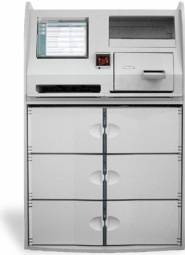
Another model which is very interesting, but it hasn’t taken off is generic sampling using physician kiosks like MedVantx. It is a cool technology. And, since generic manufacturers don’t provide samples, it is a good way of starting therapy on a generic drug. (The reason for pharma using samples is to get the patient started on their drug.)

medvantx.jpg

Some scary data and a good discussion on this topic can be found on the Medinnovationblog.

Each pharmacy call back costs physicians’ practices $5-$7. With the average physician writing 30 prescriptions a day and handling another 30 requests for refills, the costs escalate rapidly. The estimated 20 pharmacy related phone calls per day costs $20,000-$28,000 annually. In general, physicians are oblivious to this cost center. By moving dispensing into the physician’s office, this overhead can be cost shifted to better serve patients as well as create additional income.

Information Therapy Blog

I was looking at the Healthwise website and The Center for Information Therapy and came across a blog by the team there with some good discussion topics. It is definitely worth your read. Here were a few things that caught my eye:

  • Can we more effectively engage consumers in better managing their own health by learning from Hollywood or video games about how to draw people in through entertainment? By doing so, can we make health care “fun” or at least truly engaging? (entry)
  • Since research shows that 40%-80% of everything a doctor tells a patient in the office is forgotten, taking along a patient advocate is a great strategy. Unfortunately, it is not always an option or sufficient. In order to ensure effective communication, every patient should leave the doctor’s office with an information prescription (Ix). (entry)

Managing Medical Bills – Free Trial

As anyone who has done anything outside normal knows, getting and managing your medical claims can be very confusing.  When should you pay?  When should you resubmit?  When is it simply an error?

I was encouraged to learn about a new company MedBillManager which has recently secured some funding.  They have a blog where you can read some thoughts and you can read about them in a WSJ article.  The WSJ points out other companies such as WebMD, RevolutionHealth, and Intuit that provide tools to help get you organized and/or provide information.

Here is a screenshot.  The team there offered my readers a free one year subscription ($24.95 savings).  Go to  https://prod.medbillmanager.com/account/signup  and click on the “Got a free plan code? Claim it” link… enter in gvareader1.  I think they would welcome the feedback.

Much like the OutofPocket.com that I blogged about the other day, this is heavily dependent upon adoption to drive value.  Being able to compare costs by treatment, geography, insurer, and physician is valuable long-term in a consumer driven world, but it needs participation to have enough detail at at specific segment.

The other key for success will be integration of data directly from the payors.  I don’t mind entering a few EOBs and bills to see some data, but eventually, I want them to be pre-populated and then use the application for reporting and analysis.   Blend this with a technology such as that from ActiveHealth and a PHR and you have an integrated data selection that tracks costs, compares data, and pushes suggestions to you about wellness and health management.

This is probably what RevolutionHealth is doing.  I am sure we will see some more rollups over the next few years to pull all these solutions together.MedBillManager

Are Patients Ready for Kiosks?

Everyone is moving to self-service. Quicker. Cheaper. Privacy. Automated. Etc.

There are lots of benefits. Think about all the information which is needed in healthcare along with all the linked processes. If this can be simplified and some of the burden pushed to patients that is great.

Now, this will vary by age and demographic. Typically older people will be more hesitant to use automated technology. Just look at your self-service grocery lines. Additionally, you have to watch interpretation of questions. I will never forget the doctor asking my grandfather if he smoked and him saying yes. I asked for a point of clarification and found out he had smoked 35 years ago.

I couldn’t find all the examples, but I have talked with vendors using kiosks for checking in to an office or hospital, providing translation services, helping match basic needs with over-the-counter medications, simplifying basic services (e.g., picking up a refill prescription), or for pushing information to the patient.

Kiosks blend challenges with physical design (height, location, screen size) with application challenges (number of screens, simplicity, data entry) with business model challenges (costs, advertising (Y/N), patient utilization). But, done right, I clearly see this as key to the future of healthcare. It will help address staffing shortages, address data quality, and help patients take on more responsibility.

Imagine walking up to a kiosk and using biometrics (i.e., retinal scanner, fingerprints) to log-in. Once you log-in, your history (Rx, lab, medical) is all available via your personal health record. You register for your appointment and get pushed health and wellness information that you can print real-time. You can then chose to print information for discussion with your physician based on monitoring of your cholesterol, weight, and blood pressure for your home system. Finally, because you log-in, the system automatically queues up other events for the staff to initiate pending your visit with the doctor.

Here are a few examples of kiosks in healthcare:

And, if you’re really interested in kiosks, you could read Bill Gerba’s blog on kiosks.

Customer Event

What a great week. I have been so busy that I haven’t had time to blog, but I will try to catch up over the next few days.

I always love to mingle with customers and talk to them about their experiences with a company. As a former client, a current consultant, and a future employee of Silverlink, I got to join their customer event this week where 40 customers talked about how they use the technology and services to lower costs, increase efficiency, and grow revenue. Talk about empowering.

Some of the key content / discussions revolved around the following:

  • JD Powers study on healthcare company satisfaction including a great non-healthcare example.
    • It showed how satisfaction with auto insurance actually went up and was higher when the company raised rates but pro-actively told the consumer versus when they lowered rates. Talk about the power of communications.
  • Lots of talk about how marketing and data analytics are going to drive healthcare and how non-healthcare companies are setting the expectations for patients very high compared to the current state.
  • How disjointed healthcare communications are – provider, pharmacy, PBM, MCO, DM companies. No consistency.
  • A great presentation by Liz Boehm from Forrester research which made a few key points:
    • She reinforced the loss avoidance point I blogged about the other day stating that savings is equal to one unit of happiness while loss is equal to two units of unhappiness. So, for many, losing money is a bigger factor than saving money.
    • She pointed out the fact that any healthcare site that quotes a price always has some disclaimer about the accuracy. Why can’t we simply guarantee a price (like any other industry)?
    • She showed that member services (IVR, web) are the 3 most important factor in chosing a carrier after price and network.
    • She showed research that consumers are generally dissatisfied with contacts across all channels from their health plan.
    • She talked about using a persona to design programs and prioritize efforts.
    • She compared channels across cost, reach, engagement, and immediacy.
    • It was obvious that we have a long way to go.
  • Heard from a few customers that talked about how they allow Customer Service Representatives (CSRs) to go “off the clock” to help patients so that they can still track average call time but allow for flexibility.
  • I talked about process innovation and how to apply that to your communication process. I also talked about business process outsourcing.
  • We heard about best practices in driving response rates. Everyone always seems so amazed when they hear about response rates of 50, 60, or 70%. Very difficult to get and/or measure that in other channels.
  • Talked about how MCOs are using the automated call technology – ANOC (Annual Notification of Change) for Medicare, Collections, Lead Management, COB, Missing Information, Wellness Program Recruitment, Reminders, Surveys, and many others.
  • We heard about calculating the ROI with a detailed methodology.
  • We talked a lot about models from other industries that could apply.
  • We talked about data mining and analytics.
  • We talked about member satisfaction, loyalty, and how to survey and capture that information.
  • An outside consultant talked about experience based branding and how sounds can be your brand – Harley‘s engine, Sprint‘s pin drop, Ford‘s door chime, AOL‘s “You’ve Got Mail”.
  • Had several clients talk about how they use Silverlink‘s technology to enhance their product suite

All of the conversations and presentations reinforced how critical successful communications are to healthcare and how big of a hill we have to climb. It was great to see how effective, timely, and personalized the Silverlink technology could make the process. It is worth looking into if you are a managed care company, a device supplier, a PBM, a pharmacy, or even a provider.

Healthcare IT – Gartner

I am listening to a Gartner webinar on Healthcare IT which is a pitch to vendors on sponsoring an upcoming event of theirs.  Here are a few comments which I thought were interesting and some of you might care about:

  • Innovation in IT is critical for healthcare.
  • Healthcare IT will be the fastest growing vertical through 2008.
  • Based on a live poll of the attendees on what companies are looking for in making technology decisions, the top 3 factors (which were my votes) were:
    • Ability to integrate w/ existing systems
    • Lowest total cost of ownership
    • High quality service
  • Healthcare providers buy based on references.  (more than others??)
  • Consumer confidence in online tools is very low.  Phone is #1 preferred mode of communication.  Relationship between payors and patients outside of phone is still limited with fear of lack of security.
  • Current pain points (insurers and providers):
    • Business intelligence – how to get quality information from all their data
    • Integration
    • Claims
    • Physicians – how to keep them happy
    • Agility
  • How to best engage prospects with an IT solution:
    • Case studies
    • Referrals
    • Demonstrate a good fit to them

Not too helpful for those of you that are consumers, but for those of you developing consumer solutions to address the market, this might be helpful.