Archive | Value Propositions RSS feed for this section

Complementary Webinar – Cost Savings Programs

If interested, I am going to host a webinar for managed care companies and PBMs.  (Sorry, but this is limited to clients and prospects only.)

Proactive Cost Savings Programs for Your Members

In these economic times, members are looking for all the opportunities they can find to save money and reduce their out-of-pocket spending.  This is a great time to drive loyalty by proactively interacting with your members and helping them understand how to save money.

Some of the timely communication programs that will make an impact include:

  • Movement to generics (i.e., therapeutic interchange)
  • Movement to mail or 90-day retail
  • Pill splitting or dose consolidation

This is true for your commercial members as well as your Medicare members who are in the “donut hole”.  Don’t let your members struggle and end up skipping doses or not taking their medication.  This can lead to much bigger issues downstream.

Join Silverlink Communications for this interactive webinar and learn how you can design communication programs that help your members save money while improving your bottom line.
Register Here.

Prescribing Placebos

I found this entry on the WSJ Health Blog and all the comments very interesting.  At the core, the issue is that if a physician prescribes a placebo (sugar pill, vitamin, OTC, antibiotic) to make the patient feel better even though it medically won’t (but may mentally)…is there something wrong with that.

Obviously, if it drives a financial burden for the patient, that would be wrong, but I don’t see physicians doing that.

If it prescribed a medication that had serious side effects, that would be wrong, but I don’t see physicians doing that.

If it was a simple remedy (e.g., take B12), that doesn’t seem harmful.  There have been plenty of arguements about medications like antidepressants and whether they work, but they still get prescribed quite a bit.

Pharmacy Musical Chairs

Remember back in the 90s when AT&T, Sprint, and all the other companies kept offering you incentives to move to their service?  I had an uncle who just kept moving around and getting $50-$100 checks.  I thought he was crazy, but he never had an issue.

Given the economy and the incentives being offered in pharmacy, I wonder why a consumer wouldn’t do the same.  I saw a $25 gift card offer at Walgreens yesterday.  I know Target has had a $10 gift card offer for a while.  Some of the mail pharmacies occassionally offer coupons or copay waivers.

So, if I was a consumer with a maintenance drug that I have used for a while and don’t need consultation on, why wouldn’t I move my prescription every month to a different pharmacy and get these gift cards.  I think I would.  I don’t know all the terms, but if I had a generic, I might actually make money on my prescription.

I am sure this will be a short-term phenomena.

Gambling With Your Health

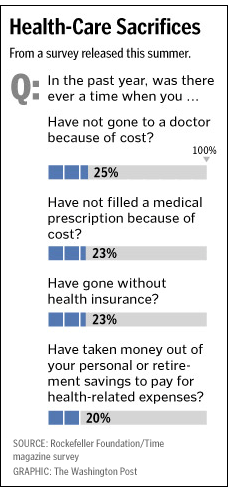
It’s a continuous message these days…people are avoiding care (preventative and necessary) due to cost.  Here is an article in the Washington Post about it.

Though the burden is especially heavy for uninsured Americans, even those who have coverage are feeling the pinch as employers shift higher deductibles and co-payments onto employees.

“The reason why health care was immune [to recessions] in the past was because most people were covered under good insurance plans,” said Jean Mitchell, a professor of public policy at Georgetown University. Now, “people are realizing, ‘Oh my gosh, I have to pay for this out of pocket.’ ”

Article On Silverlink Communications

The October 2008 issue of ADVANCE for Health Information Executives contains a nice article about Silverlink Communications by Robert Mitchell. Here are a few items from the article:

  • It focuses on our Adaptive HealthComm Science approach which brings decision sciences to the area of driving healthcare behaviors. [This is what leading consumer companies, credit card companies, and gaming companies use to understand consumers.]
    • “Adaptive HealthComm Science looks at microsegments of the member population to try different interventions with different populations — all standing against control groups and measurements of what works best. It then adapts, learns and tries again. “The communication system continually learns and automates its processes so that it is capturing new data and learning along the way from those interactions. It is consistent and can be measured.”
      • It is amazing to see how much programs can be improved over relatively short periods of time by rapidly testing isolated variables to find the right solution for each microsegment of the population.
    • One of my favorite examples from my past was simply using stamps turned at an angle on a letter to improve the rate at which direct mail was opened. It looked more like a human had hand licked each stamp rather than a machine which put the stamp on perfectly each time.
  • It talks about the ability to do on the call calculations and dynamic pathing on the core automated calling platform.
    • On-the-call calculations: If you have 3 drugs to refill, but you only choose two of them then it can tell you what your copay is. Or, if you tell the caller your weight, it can calculate the difference from a prior weight it had collected.
    • Dynamic pathing: Based on answers you give, the call is intelligent enough to serve up different content to the member and/or route you to a different group of live agents based on rules.

“We’ve invested heavily in people, technology, processes and a methodology that continuously improves to maximize the effectiveness of health care communications,” Stan Nowak, CEO and co-founder of Silverlink, said. “Over the next few years, changes in the way health care stakeholders communicate with patients and health plan members will be one of the keys to lowering health care costs while driving consumer affinity.”

“To the consumer, health plan products are largely undifferentiated on the basis of benefits or network, and consumers experience their health plan almost exclusively through the communications they receive from the plan,” Nowak continued. “Health care organizations have an opportunity to clearly differentiate themselves through proactive and personalized communications, improving their members’ experiences with each interaction, and earning consumer trust and affinity. In essence, for health plans, communications is their product.”

Stress Up: Health Down

I would have loved to have the time to do this research myself, but fortunately it was nicely bundled up The USA Today in a piece by Marc Siegel who is an associate professor of medicine at New York University School of Medicine.  Here are a few of the facts from his article:

  • A survey by the American Psychological Association indicated that financial concerns “topped the list of stressors for at least 80% of those surveyed”.  More than half reported the most common symptoms being anger, fatigue, and an inability to sleep.  Close to half reported over-eating or eating poorly.
  • After the 1929 Wall Street crash, millions turned to drinking and smoking which led to heart attacks, strokes, bleeding ulcers, and clinical depression.
  • Research on people laid off from a plant in Pennsylvania over 17 years shows that they were 15% more likely to die of any cause.
  • In NY, calls to the Hopeline network for people with depression or suicidal thoughts increased 75% in the 11 months ending July (before the worse of the economic situation).
  • UnitedHealth Group reports that hospital admissions for psychiatric services are up 10% this year.
  • A 1% increase in unemployment is projected to cause as many as 47,000 more deaths over the next two years – 1,200 suicides and 26,000 additional heart attacks.
  • Cumulative stress causes depression, suicide, heart disease, stroke, predisposition to infection, and certain kinds of cancer.

He does offer a few pieces of advice that are always hard to focus on when you think about all the negatives:

  • Eat healthy food
  • Sleep right
  • Do yoga, meditate or exercise regularly
  • Touch in the form of massage, hugging, and kissing decreases stress hormones

Proof Communication Matters

The reason we communicate with patients and members in healthcare is that we want to drive them to action or inform them of information.  Whichever party you like, I think the TV commercials and the debate make this point very clear.

  • You either like scare tactics or not.  Some portion of the population will respond to those.  (I personally see this as desparate and don’t care…especially when some of them are such a stretch.)
    • Should you point out to people that they should stay adherent or risk serious side effects or hospitalization?
  • People want clear messaging.  I thought Obama was the one being too high level early on.  In the debate, John McCain was the one that didn’t seem to answer the question.  At least Palin said she was going to talk about another topic not give a glossy answer in the VP debate.
    • We got this feedback from MDs at Express Scripts that said just to tell them what we needed and stop with lots of general messaging.

Think about how you motivate your kids or your employees.  It’s all the same.  This is what you want from your health provider or your insurer.

(I must admit to being frustrated with the politicians as I am sure anyone who works in communications is.  To have Palin (the relative newcomer) being the best presenter (not so great in interviews) is surprising.)

60% Think We Are Headed To A Depression

You wonder how bad it is economically or where we are headed…look no further than the CNN poll out this morning showing that 60% of Americans think it is likely that we will go into a depression.  Not a recession, but a depression like many of us read about in the history book or saw in the movies.

Do people really know what the depression meant – 25% unemployment (for example).  So, if that’s the perception out there, imagine the impact on health behavior.  People will continue to look for savings opportunities – skipping pills, splitting pills, moving to generics, trying over-the-counter medications, moving to mail order.  They will likely be less likely to act preventatively – e.g., getting a flu shot.  They may be more willing to ride out bad symptoms at home rather than rush to the clinic.

This makes me think about an article I saw the other day that said that people don’t have any solutions to manage trend.  I think that’s BS.  The fact is people are afraid of the solutions to manage trend.  They don’t want to tell employees what to do or limit their choice.  In a tight labor market, companies want to keep the employees happy.  So, as the labor market opens up (i.e., higher unemployment) and healthcare costs go up, will companies finally embrace some of these tools.

For example, on the pharmacy side, we used to see a spike in call center volume of 1,000%+ on some of the aggressive programs – mandatory mail, step therapy, limited formulary, limited retail network.  That scared a lot of clients.  Maybe that attitude will change.  Granted pharmacy is 10% of medical spend so the bigger problem is on that side, but maybe companies will finally be willing to link out-of-pocket costs to controllable medical activities – weight, exercise, blood sugar, cholesterol, preventative testing.

If I were a insurer or a PBM, I would be focused on showing my value right now.  I would be delivering cost savings messages to all my members and help them understand how to minimize their out-of-pocket spend in this economy.

I Get A Different Conclusion

In the same Express Scripts’ investor deck, I have to disagree with the slide below which is supposedly proof that the Consumerology efforts are working.

Showing me that the trend for a client who was above their norm last year (see drug trend comparisons), went down to 3% (year-over-year) increase (which is over both Medco’s and Prime Therapeutics’ average trend) doesn’t seem that impressive.  In the years when I worked on the drug trend publication, we showed that the average client with two or more plan design changes had negative trend, on average.

And, further complicating this example is the fact that this shows a client implementing mandatory mail, mandatory generics, and step therapy.  These are a series of proven, reject oriented solutions that force the member to make changes or pay much more.  Anyone can drive trend with these.  If you show me that non-reject oriented programs work to the same degree due to targeting and personalization using consumerology, then I am impressed.  Obviously, I am not there anymore, but I don’t think this is a compelling case study for consumerology.  Maybe there is more to the story like no impact on the call center or no impact on member satisfaction or less members hitting a reject at the point-of-sale (POS).

Express Scripts Patient Segmentation

In a recent investor deck, Express Scripts laid out some of their segmentation from their Consumerology program.  This is similar to some of the work we do with clients at Silverlink Communications to help them develop segmentation models through a test and control approach.

What they have come up with are 5 segments of their members – “Movers and Shakers”, “Rock Solid”, “Getting By”, “Rising Stars”, and “Here and Now”. They describe some of the attributes of each segment on the first slide below and then show how messaging on driving mail order utilization was applied for each segment over the web.  The final slide below shows the results when the targeted messaging is used on the web.

It will be interesting to see how that messaging plays out via other channels (i.e., letter or outbound call) and when pushed to the member versus a situation where the member is on the portal and looking for information (a fairly engaged member).

Drug Trend Comparisons

Here are a few comparisons from the Drug Trend Reports published by some of the largest PBMs. There is no industry standard on definitions and what is included so I did my best to pick a couple of comparative metrics. (Note: In case you are unfamiliar with these reports, they are summaries of 2007.)

Overall Trend

Specialty Trend

Managed Trend

Generic Dispensing Rate

Mail Order (90-day)

CVS / Caremark

4.8%

13.2%

2.1%

59.9%

28.2%

Express Scripts

4.7%

14%

63.7%

24.1%

Medco

2.0%

12.3%

59.7%

38.0%

Prime Therapeutics

2.0%

8.9%

56.7%

Walgreens

4.8%

(0.07%)

61.2%

35.9%

    • They break out their best in class as having a 3.4% trend and say that clients who used proactive trend management were at 2.1% on average.
    • Best in class generic dispensing rate was 65.6% (employers) and 66.7% (health plans).
    • Mail order rate as reported in press release for close of 2007. (Not sure how to compare this to the 12.8% reported in their TrendsRx report.)
    • Overall trend was 5.5% when specialty drugs are included.
    • Had to find the generic fill rate in their 4th quarter financial press release. Either I missed it in the trend report or it was strangely missing.
    • Mail order rate was derived from the same 4th quarter release which showed 40.8M mail Rxs and 507M adjusted Rxs. Multiplying 40.8 by 3 to adjust from 90-days to 30-days and dividing that by 507 gave me the 24.1%.
    • Deriving the mail order rate from the 2007 full year press release gave me 94.8M mail order Rxs which I multiplied by 3 to get to adjusted Rxs and then divided by 748.3M to get 38.0%.
  • Prime Therapeutics trend report (Drug Trend Insights)
    • Their trend was 2.9% if specialty drugs are included. Trend ranged from (1.3%) to 7.5% across their blues clients/owners.
    • Overall trend was 5.66%. The 4.8% excludes specialty trend.
    • GDR was 69.6% if you include Medicare.
    • The 35.9% mail order rate includes their Advantage90 offering for 90-days at retail.

Revolution Health For Sale

I was a little surprised to find out that Revolution Health is up for sale.  On the one hand, they pursued a WebMD type strategy when we all know tons of companies have died going down this path.  But, they had lots of money and lots of smart people.  Does that mean success?  Not necessarily?  We have all seen the teams full of stars that can’t outperform the true team of average players.

On the flip side, it seems so early to go up in a space that is obviously destined to grow.  It just goes to show how undefined it is and how hard it is to make money.

Disease Management Evaluation – Care Scientific

My former boss, Brenda Motheral, from Express Scripts spent a year at Healthways running their research group and has now decided to go out and do some consulting (new company is Care Scientific).  Her evaluation of the Disease Management industry was just published in the Journal of Managed Care Pharmacy.  It is a pretty critical view of the state of the industry.  Here are a few highlights:

  • There have been several articles published questioning the value of these programs this year.
  • There are five reasons for dissatisfaction:
    • Desire for better alignment of vendor and client interests
    • Desire for greater transparency in business arrangements
    • Desire for improved plausibility in reports of financial and clinical outcomes
    • Desire for more rigorous evaluation methodology
    • Desire for more convincing evidence of outcomes improvement
  • There is misalignment today…For example, if I get paid per member, how hard should I try to contact them when all that will do is drive up my costs.
  • Lack of alignment can be addressed through contractual requirements and pay per engagement.
  • There is a lack of data available on how many members are contacted.  [Not for companies that use Silverlink for their automated outreach who have real-time data available with detailed call information.]
  • There are calculation questions in comparing vendors.  [Something I have talked about several times here.]
  • She compares the move to transparency in this industry to what happened to the PBM industry earlier this decade which created new competition and changed several business models.
  • She advocates for really looking critically at the ROIs claimed by these vendors and talks about NND (number needed to decrease) which is the model that the DMAA (Disease Management Association of America) adopted as part of their outcomes guidelines.
  • She also raises concern about DM companies moving into wellness which is another area “fraught with numerous new methodological issues that warrant close attention”.
  • She talks about an industry push (from buyers) to demand new expectations from vendors.
  • She talks about the fact that the focus on ROI may not make sense since “literature suggests that less than 20% of treatments for existing conditions are cost-saving.”

“Plan sponsors also bear responsibility for the current situation.  As long as they demand a short-term ROI in the current model and inconsistently require comparison groups, they are more likely to promote methodological creativity than they are to inspire true innovation.”

As with the dozens of publications she has had over the years, this one is well written with a well referenced set of facts.  She presents a challenge to the industry in how to approach.

The challenges are interesting to reflect on given the overall industry focus on improving healthy behavior, being more proactive, more actively managing patients, and other activities that a DM company should be well positioned to do.  But, a high touch model is certainly challenged given lower cost options.  Creative solutions that leverage technology to identify gaps in care, create data segments, personalize interactions based on preferences, and use motivational interviewing to drive behavior exist and should be able to create value.  It will be an interesting 12-18 months for the industry.

Managing Antibiotics in Hospitals

I got this story from PharmacyOneSource the other day and thought I would share it.

“Between one-third and a half of all hospital patients receive antimicrobial drugs, and antibiotic prescriptions can account for 30-50 percent of many hospitals’ total drug budgets. Researchers estimate up to half of these are unnecessary, and this excess also contributes to the problem of drug-resistant bacteria.”

They gave two case examples:

  • Johns Hopkins implemented a web-based approval system for more than 30 antimicrobial drugs on a “restricted” list. The system forces orders to be approved by an infectious disease specialist before they are sent to the pharmacy. They found it saved $370,000 in the first year of its use.
  • University of Virginia found that switching between two antibiotics, linezolid and vancomycin, every three months in the surgical ICU decreased the MRSA infection rate from 1.9 to 1.4 patients per 100 admissions.

Medco’s CEO on National Healthcare Reform

David Snow, the Medco CEO, presented his blueprint for healthcare reform today. You can read it here. My notes from reviewing it are:

  • We’re paying twice as much per person (~$7,000) as other countries with little incremental value. To get back in balance, we need to reduce costs by 50% or $1 trillion per year.
  • 3 rules for reform:
    • “First, keep it simple – in business, complex solutions always fail.” [good advice…difficult to do with politics and government involved]
    • Incremental, evolutionary change is more accepted than revolutionary change. [yes…but it will take a lot longer]
    • Government and private sector’s roles have to be clear:
      • Government – promulgate and regulate.
      • Private – operate and innovate.
  • “Setting policy around life-and-death decisions is, and should remain, the province of the public sector.” [what politician or elected official wants to determine the value of a life]
  • Five suggestions (which create $1 trillion in savings per year):
    • Wiring healthcare
    • Fixing Medicare’s financial fundamentals
    • Eliminating medical liability and defensive medicine
    • Increasing compliance and reducing errors
    • Promoting healthy lifestyles
  • “In an era when preschoolers use the Internet to chat with friends half a world away, it is inexcusable that doctors write prescriptions – in Latin – that patients need to take to another professional in a process fraught with countless opportunities for error.”
  • “30% of Medicare spending today, roughly $130 billion, relates to healthcare costs incurred by patients in their last year of life – often where there is no hope for recovery or improvement in quality of life.”
  • He makes some good points about the need for government involvement in changing attitudes around wellness comparing it to the changes around forest fires and seatbelt safety.
  • “When our political discourse is limited to ‘who pays the bill’ instead of ‘the bill is too high,’ and fails to address root-cause problems, that isn’t health care reform.”

Health Plan Week on Retention

I had an opportunity to get interviewed a few weeks ago by one of the contributors to Health Plan Week about retention within health plans.  With growth in the group market stagnant and ultra-competitive, the individual market offers lots of upside, but makes satisfaction and retention a much bigger issue.

You can read the article here where it discusses things like the “top box”, the importance of personalized communications, and champion / challenger processes to determine the best approach.

McKinsey On Automated Calling Technology

McKinsey and Company published a report called “Using IT To Boost Call Center Performance” in the Spring of 2006 which had a few relevant comments for those of you looking at how to leverage automated communications in the healthcare space. Here are the two primary quotes that I took away:

Customers are getting used to automated transactions – in fact, some prefer them. Our research suggests that more than 60 percent of customers favor an automated option for many types of simple interactions (for example, balance inquiries or payments); the rest said they didn’t mind being presented with an automated option as long as they could connect with a live agent if they wanted one.

Investments in new VR (voice recognition) and IVR (interactive voice recognition) technologies can help automate an additional 5 to 30 percent of incoming calls while maintaining or even enhancing customer satisfaction and revenue.

I always love finding those 3rd party verifications of the value propositions that we see at clients.

IDC – Healthcare Communications

Janice Young at IDC just put out a new report titled “Too Much Information? The Irony of the Coming Information Glut and New Technologies that Help Target Communications” which focuses on several fast-follower announcements about what we have been doing at Silverlink Communications. Here are a couple of quotes from the report.

The final mile of the current healthcare information blitz is not just getting at or to the information, though in the very fragmented, silo’d U.S. healthcare system, that is hard enough. But the real solution provides targeted and event-triggered information based on consumer interactions or events, rather than relying on the consumers to search and seek.

These two announcements join Silverlink’s earlier announcement in March 2008 of their new Adaptive HealthComm Science Platform. The Silverlink platform integrates decision support and analytics to create personalized customer communications. Unique to the Silverlink solution are behavior analytics to communications success and affect on customer behavior and outcomes.

Beating The Patient Over The Head

Something that I don’t normally do, but I am going to edit this after the fact to stress what the story really is supposed to be about since someone told me the original text might be offensive to a competitor that I respect.  The point is whether being pushy is worth it in some cases.

The other day a patient asked one of our people about a mail order order pharmacy where they had gotten a call every other day for the past 12 days about refilling their medication. Each message was slightly different – your supply of medication is about to run out, you need to refill your medication, your prescription has run out, etc.  The patient didn’t like the call program.

I found this an interesting debate…how pushy is good if you drive a desired outcome?  Also, we all obviously know that vendors and consultants don’t always make the decision so if a client tells you to do this even if it makes no sense, what do you do?

I think it makes for a good debate and had it with several clinical people:

  • At what cost is a better refill rate okay…especially since this doesn’t mean that they are compliant? Are you willing to drop your patient satisfaction by several points?  (We often used to give clients a report that showed savings per disrupted member or per drop in satisfaction at my prior employer.)
  • If the company is just driving up refills and can they do that without creating more waste?  This was a constant debate at mail.  One trick here is whether you base it on refill dates or days supply.
  • With this frequency of calls is there a chance that you actually get people that would have refilled to just wait for the calls to come and say yes?
  • If people take the call because they know you will keep calling them, is this actually better acceptance of calls or just being an “obnoxious salesperson”?
  • Are you calling people that have refilled at retail due to data latency issues?
  • Do you drive people back to retail?
  • Have you dulled them to future calls by upsetting them on this program?

Now, on a more clinical program, my opinion here might be different. If you could successfully get an overweight individual to diet by constantly reminding them. This might be okay. It’s an interesting debate.

One Year Blogging “Anniversary”

It was last July that I started this new blog originally called The Patient Advocate and now Patient Centric Healthcare. I pulled in some of the content from my old blog on Business Process Management (my focus during my non-compete days). I thought I would spend a minute and capture some statistics from this first year.

It has been interesting to hear from and meet some of the readers. Additionally, I have enjoyed some of the opportunities it has created. I had a chance just the other day to do an analyst briefing on PBMs to one of the big investment firms on Wall Street.

And, one of my favorite things was that I got a signed book from George Halvorson the other day with a personal note about my comments on his book on my blog.

But, for all those that ask…it is a lot of work. I do it primarily because I enjoy it. I am not sure if these stats are just stats or indicate that it has been a successful effort.

What is a Mail Order Pharmacy (Home Delivery Pharmacy)?

My most popular post ever is “What is a PBM?” which made me think that this is probably a relevant post for the average healthcare consumer.  And, given the historical push to mail combined with the current economy, you can expect mail order pharmacy (or home delivery pharmacy) along with 90-day retail pharmacy to be a hotter topic.

At Silverlink Communications, we work with a lot of companies on their retail-to-mail (RTM) communications strategy and execution.  One of the first things I point out to all of them is that over 50% of people don’t usually know what mail order pharmacy is.  So, you have to address awareness at the same time as recruiting new patients.

So, for all of you that receive a letter or call talking to you about moving your prescription to mail order, let me answer a few of your basic questions:

  • Mail order pharmacies are also called home delivery pharmacies since they deliver your medications through the mail and directly to your home (or other address provided).
  • The mail order pharmacy is typically owned by either your managed care company (aka health insurer) or by a pharmacy benefit management company that your insurer contracts with directly to provide this service.
  • There is typically only one mail order pharmacy that you can use (i.e., is considered “in-network”).
  • The service is typically the fulfillment of 90-day prescriptions of medications which you will take on a long term basis (aka maintenance medications).  This is not true for controlled substances which typically only allow a 30-day prescription and for some specialty and injectable drugs.
  • You often have a financial incentive to choose mail order where you will get a 90-day supply for less than it would cost you to buy three 30-day prescriptions at your local pharmacy.  This discount is due to the buying power of the mail pharmacy, the automation which reduces the costs of dispensing the drugs, and the lower distribution costs (i.e., no need to move the drug to all 5,000 retail locations).
  • The drugs are the same drugs you buy at your local pharmacy.
  • You have the same access to a pharmacist but it is over the phone not face to face (which I personally prefer and think is more confidential).
  • You can do your refills over the IVR (interactive voice response) line and over the Internet along with traditional means of live agents and using snail mail.
  • These mail order pharmacies use robotics and other highly sophisticated solutions to dispense the drugs accurately and quickly.
  • Many of the mail order pharmacies that we work with offer services around calling your physician to get new prescriptions and also use our automated outbound calls to provide you with order status (WISMO calls – what is the status of my order) and refill reminders.
  • You shouldn’t typically start a new drug at mail order.  You want to wait until you have had two fills locally to make sure you are titrated to the right strength (i.e., your MD might switch your dosage initially so you don’t want to buy too much supply of a drug you might not use).

Would You Pay $100 To Be Told To Take Your Rx?

We know adherence is a serious issue that drives healthcare costs.  And, as I have talked about a little here and a lot with many of our pharmacy clients, it’s not a simple issue.  People aren’t adherent for a variety of reasons – cost, side effects, health literacy, or simply just forgetting (among others).

There are lots of tools out there to help you organize your medications and manage them.  Whose job is it to help you – yours, your physicians, your managed care company, your pharmacy, your pharmacy benefit manager?  Obviously, you (the patient) have the primary responsibility.  After that, your pharmacy is best positioned to help you with this.  But, the managed care company stands to benefit the most by preventing serious medical conditions associated with non-compliance.

So, I was a little surprised to see a new company come up that offers to send you calls, e-mails, or text messages to remind you to take your medications.  And, you can even talk to a pharmacist.

Let’s break this down:

  • Whatever pharmacy you use (mail, retail, specialty) will offer you consultation with a pharmacist for free.
  • I believe most pharmacy benefit management (PBM) companies offer automated e-mail reminders that you set up yourself off their website for free.

I don’t know why I as a consumer would pay for this.  And, it seems pretty high for a managed care charge.  If I went to a client of ours and told them I would send messages to patients for $100 PMPY (per member per year), I think they would choke on that price tag.

So, will it work??  Who knows?  I have been surprised by business models before.

Tier Zero

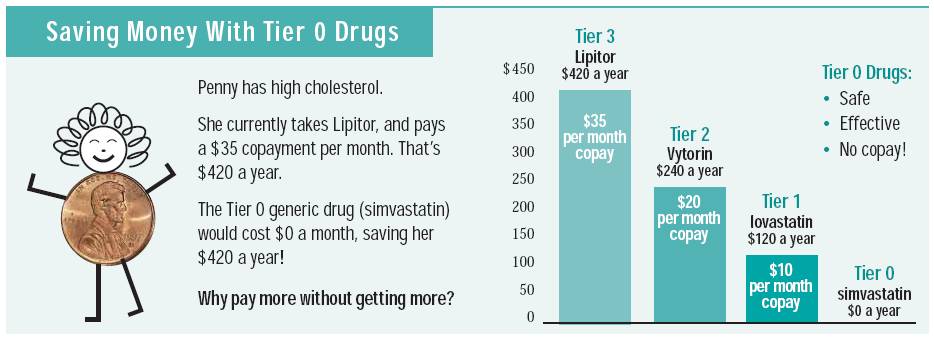
Frank Koronkiewicz, the Director of Pharmacy, at Blue Cross of Northeastern Pennsylvania (BCNEPA) just launched a new plan where people can get 65 different generics focused on chronic diseases at no copay AND without any premium.  It’s called Tier Zero.

Frank has always been a progressive Director of Pharmacy.  We worked on several programs together at Express Scripts.   You can also find some of their collateral and videos on generics on their website – click here.

It would be interesting to look at the overlap between these drugs and the Wal-Mart list of drugs, but I think you would find that an individual could have a pretty comprehensive benefit of generic drugs between these two solutions with low out-of-pocket (OOP) costs and no increase to their medical premium.  A compelling story to many.

Why People Choose Mail Order Pharmacy?

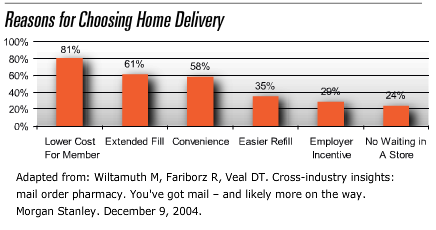
I was looking for something else in the Express Scripts Drug Trend Report 2005 when I came across this study referenced on page 209. I should have remembered since I wrote this section (yes I was a contributor see page 332). This is a Morgan Stanley study which talks about why people choose mail order pharmacy. Of course, the primary reason here is savings. The more savings the higher the likelihood of a person moving to mail order. This is a factor of savings per Rx multiplied by the number of maintenance drugs that an individual has that can be filled at mail order (or home delivery). This study shows the frequency of the response. If you focus on the weighted scores, you would see a dramatic cliff after savings. (I.e., 61% of people may choose mail for convenience, but they are much less likely to do it than someone with significant savings) So, why don’t all PBMs communicate exact patient savings to each individual? It’s hard. Given minimums and maximums; deductibles; percentage copays; and other benefit plan designs, the systems are stressed to produce this.

Sell Your Captive PBM – Why?

I was a little surprised by the quote from Lisa Gill from JPMorgan Chase about why health plans should sell their in-house PBMs (Pharmacy Benefit Management):

“I think it makes a lot of sense for PBMs [pharmacy benefit managers] to be sold or spun off as a stand-alone business. The only time it will make sense for a managed care company to actually own a PBM is after they move to real-time [medical] claims processing. And that’s not going to happen near term.”

Maybe I am missing some context here, but I don’t understand.  Why would you have a “captive” PBM (i.e., owned by a managed care company)?

  • Able to align total healthcare interests (e.g., drive Rx usage up to manage ER visits)
  • No conflicts of interest (real or perceived)
  • Able to keep margins of the PBMs (look at the stocks of Medco, Express Scripts, and CVS Caremark)
  • Manage the customer service experience

What does any of this have to do with real-time claims access?

Why would you use a standalone PBM?  (Again an easy decision)

  • Economies of scale on rebates
  • Mail order pharmacy efficiencies
  • Manage capital outlays
  • Get a dedicated focus on pharmacy which as only 10% of the total healthcare spend will be a stepchild under a managed care plan no matter what
  • Best practices being leveraged across companies

And, we all know from bidding on RFPs that managed care companies use this service to win business talking about the integrated solution and underwriting pharmacy with medical.

If you understand the rationale here, help me out.

Express Scripts Jumps Into Worker’s Compensation

Express Scripts has been in the Worker’s Compensation space for years now.  As I suggested several months ago (see #2), buying a worker’s compensation PBM makes some sense.  The margins are good, but it does require a different service model.

That being said, they jumped in last week with the announcement to buy the worker’s compensation PBM business from MSC down in Florida.  It would have been intriguing to see them buy the other ancillary business that MSC has to get their footprint a little bigger.  Now, this can go from being someone of a stepchild for Express Scripts to a major business unit.  As Joe Paduda points out in his blog post, they have good teams at both organizations so they should be able to make some things happen in the market with a focused team, financial resources, and some efficiencies.

Given that fact that PMSI has been on the block, this may create a reason for a Coventry or a CypressCare to step in and buy them to gain more marketshare to take on Express Scripts.

George Paz (Express Scripts) on Adherence

Paul Levy who is the CEO of a hospital has a blog called Running A Hospital.  He posted a summary the other day of a presentation by George Paz who is the CEO of Express Scripts.  It has some good facts and there are several good comments on there about defining the terms in this area (see my old post) and whether these are reasonable rates of compliance.  There is also a patient commenting about getting nurse calls and reminder e-mails which sounds great but puts them in the 1% of the population for which this happens.

The numbers do seem understated to me – 85% compliance with cholesterol lowering drugs.  That might be the amount of people that get a paper prescription and then fill the drug or it might be the amount of people that get one refill, but I believe by month 6 or certainly by month 12 most compliance rates are closer to 50%.

There is clear value in adherence.  Everyone should (in key therapeutic categories and using evidence-based standards) want to increase adherence to reduce total medical costs.

What surprised me most recently around this was what Kaiser had observed when looking at how doctors shared information with patients (Archives of Internal Medicine, Sept 2006):

  • Only 74% of the time did the physician tell the patient the name of the prescription drug
  • Only 35% of the time did the physician discuss adverse events with the patient
  • Only 58% of the time did the physician explain the frequency and timing of dosing

More On Silverlink’s Think Different Event

I am now up in Minneapolis at our 4th Think Different event on how to engage the healthcare consumer.  I talked about the first few speakers the other day, and I finally had a chance to hear the other speakers present.  This week, I had the chance to listen to  James Taylor (of Smart (enough) Systems fame not music) and Fred Jubitz (American Express).  Here are a couple of my takeaways.

[Again, if you are coming to the upcoming events, this might be a little bit of a spoiler.]

A few notes from James’ presentation:

  • He gave a great example of a program they did at Fair Isaac where they compared the standard, baseline program with one that was highly personalized.  What was the improvement – 2,000%!!
  • He gave a good real-life example of the need for channel coordination talking about buying tickets for the Chunnel and how he got different prices on the web and phone which were also different from the prices his father in England got using the same channels.
  • The Chunnel example reminded me of something that someone told me the other day.  They were using the Dell self-service example and pointed out that Dell now uses real-time chat right before you buy.  They have found that this increases the average sale by 15%.
  • The Chunnel example also made me think about how web technology allows us to do a lot of customization by visit, but most companies don’t do this.  At the simplest level, I remember a competitor of Firepond (previous employer) where if I visited their website from work it looked one way and from home looked different.
  • James talked about ATM customization as an easy example.  How much money do you normally take out.  Only showing you services that you have access to.  Some of this is starting to happen, but not much.
  • He also talked about rules creation and how that varies.  I think it is always interesting to trace the evolution of rules and policies within a company.  Are they there because of regulatory issues?  Is it because someone coded the legacy systems that way?  Is it based on a personal interpretation?  Or are they dynamic and regularly reviewed?  One of the worse examples that I have ever seen was a large healthcare company that believed that HIPAA required them to re-code everything as it moved from development to production.  (A very costly error in interpretation.)
  • He also talked about the evolution of interactions:
    • Automate decisions
    • Apply rules
    • Segment customers
    • Predict risk and value
    • Optimize
  • James hammered home the point of never stopping to try to optimize since as the environment and your customer base change the optimal solution might change.

Fred who ran the gold and green cards at AMEX talked about:

  • American Express really wanted to be a lifestyle enabler not a payments company.
  • He talked about the Centurian Card (black AMEX card) which apparently is able to charge $5,000 initiation fee plus a $2,500 annual fee.  (Surprising that people still pay it, but I have heard examples of people buying a plane with their black card so I guess that level of service requires something.)
  • He gave examples of how companies think about cards and showed a lot of affinity cards which made me think about groups and how people like to affiliate with others (e.g., by diseases).
  • He talked about the importance of several things:
    • Know your audience
    • Key metrics
    • Segmentation
    • Personalize
    • Continuous improvement
  • He showed the standard framework for segmentation looking at size of wallet (i.e., how much you charge / spend per year) versus their share of wallet (i.e., how much of that is with AMEX).  Each box on the grid then had a strategy – invest, retain, focus, divest, etc.
  • He showed a lot about how the financial services companies can personalize the web experience, but he pointed out that this took months to develop as they built up your profile.
  • I think a key point he made relative to healthcare is that a lot of a new member’s behavior was determined in the initial months which led to how they used their card.  He gave an example of his blackberry.  The first couple features he learned are all he uses.
    • What are you doing in the initial months to “train” your members or be trained by your healthplan to use the website and leverage other ancillary services (e.g., gym membership) that they might offer?
  • He stressed evolving your segments but not starting over each year or you will lose some of the lessons you have developed.
  • Finally, as you always want to stress, he said to keep it simple.

Additionally, you can see some of Matthew Holt’s comments about the event at The Health Care Blog (here and here) and Les Masterson’s comments in The Health Plan Insider.

GINA – A Good First Step For Personalized Medicine

Whether you are a patient or a health care company, I think you should be happy about this. GINA is the Genetic Information Nondiscrimination Act of 2008 which was signed into law on May 21st. It is a good step in encouraging individuals to participate in genetic testing without worrying about that information being used against them by an employer or health plan/insurer. It also bans companies from requiring genetic testing.

Based on an e-mail I got from Fulbright (a law firm where a friend practices), they offered the following definitions:

A. Genetic Information = includes the individual’s genetic tests, the genetic tests of family members of the individual, and the individual’s family medical history. Any information related to the individual’s or any family member’s participation in clinical research offering genetic services is included as is the genetic information of any fetus and embryo of an individual or family member of an individual who is pregnant. The sex or age of the individual is not considered genetic information, however.

B. Genetic Test = any analysis of DNA, RNA, chromosomes, proteins, or metabolites that detects genotypes, mutations, or chromosomal changes.

The use of genetic information (i.e., genomics) is a key step in creating personalized medicine. We know people are different and their bodies react differently to different drugs and different treatments. Some (much) of that can be attributed to their genetic make-up and likely to environmental factors.

The future holds a lot of promise once we can delivered personalized therapy that is specific to an individual. But, no one is going to get these tests if they distrust or worry about how the information is used. I have talked about this issue before when looking at companies like 23andme.

NCPA Survey on Adherence

I have been talking a lot about adherence lately (or lack of). A friend sent me the results of a survey of 1,000 adults by NCPA (National Community Pharmacy Association) from October 2006. This is now the 3rd study I have read this week with different results. Of course, they all used different channels – web, mail, and phone. And, I am sure that the questions asked were slightly different.

  • While most consumers believe they are highly compliant when it comes to taking their prescription medications (64% said they follow their physician’s instructions “extremely closely”), the survey found they are not as compliant as they believe.
  • Nearly three-fourths (74%) of respondents admitted to non-adherent behaviors in the past.
  • Nearly half (49%) said they had forgotten to take a prescribed medication.
  • Nearly one-third (31%) had not filled a prescription they were given.
  • More than one in 10 (13%) had taken someone else’s prescription medicine.
  • Nearly one-quarter (24%) had taken less than the recommended dosage.
  • Nearly three out of 10 (29%) had stopped taking a medication before the supply ran out.
  • More than one in 10 (11%) substituted an over-the-counter medication instead of filling the prescription they were given.
  • Nearly four out of 10 (38%) had forgotten whether they had taken a medication.
  • Less than half of respondents (48%) said they had consulted their doctor or pharmacist before making these changes.
  • An overwhelming 90% of respondents saw non-adherence as a serious problem.
  • More than eight out of 10 (83%) respondents agree that pharmacists can play a role in improving adherence by helping to make sure patients are taking their prescription medications correctly.
  • More than two-thirds (68%) believe pharmacists are more knowledgeable than other health care professionals when it comes to information about prescription medications.
  • Two-thirds (66%) go to one pharmacy for their prescription medications, which presents an opportunity for pharmacists to advise patients how to take their medications properly.
  • Nearly nine out of 10 (86%) say they would be likely to talk to their pharmacist about their medications.