Archive | April, 2008

Blogger’s Block

I never really knew what it was like to have writer’s block.  I didn’t have pressure to write or some big manuscript.  I occasionally suffer from block in being creative, but that is usually worked through by focusing on something else or going for a good run.

This week has been so busy with several big meetings that it has been hard to free up my mind to write.  I have posted a few basic posts, but nothing significantly thought provoking.  I often get asked about blogging and how I manage to come up with content every day.  Usually, it is so easy since I am watching TV, reading the news, and reviewing news clippings.  I don’t think I have done any of the three all week.

Here’s to clearing my mind and trying to share some thoughts.

Health and Wealth

There have been several articles about the potential convergence of healthcare and financial services.  Can a Fidelity become a one-stop shop where you invest your money and also get your insurance (health, auto, home)?  If consumerism really transfers the healthcare spend to the individual, are they in the best position to manage that money and help you plan for the future?

It is both a scary and interesting question.  Do they understand healthcare?  Would they focus on outcomes or just return?  [Is that different from most payors today?]  Would we make different decisions if we were evaluating our out-of-pocket costs for healthcare versus buying a few more shares of a stock?  I think it would certainly drive a different view of the patient as the consumer and push all their lessons learned around behavior and customer service into healthcare which would be good.

You have the Blue Healthcare Bank and OptumHealth Financial Services (previously Exante) as two examples of historical healthcare companies (BCBS and United) who have expanded into this converged area.

Going back to a McKinsey article on this topic from June 2005 called “The coming convergence of US health care and financial services”, they laid out several opportunities:

  1. Savings oriented health care products (e.g., HSAs).  They estimated there could be 25M HSAs by 2013 generating $55-$75B in revenues.  (Big market)  They quoted a statistic that as many as 80% of consumers don’t reach their plan deductibles which creates an opportunity for financial services companies to make money managing their deductible dollars.
  2. Consumer health care payments and financing.  They estimate that there is $375B in out-of-pocket expenses that could be managed and $60B in consumer bad debt related to healthcare.  These create opportunities around debit cards or credit cards.
  3. Supplemental risk products.  I think this is a clear opportunity to provide the safety net for consumers around long-term care and major accidents.  They estimated this to be a $3-$5B in net profit opportunity.
  4. Benefits administration.  They estimated this to be a $50B space growing at 15% but with lots of established players (Accenture, Hewitt).
  5. Payment assurance and transaction processing.  They estimated that streamlined operations here could save as much as $4B in operating costs.

Obviously, this forecast and many of these opportunities have led to dozens of acquisitions and investments since the report came out.  But, we still haven’t seen any major sea change.  I predict that once the election is over and the future direction from the government is set that we will see some additional energy here.

Blogging Next Week – WorldHealthcareBlog

Next week, I will be posting my blogs to this site and to the WorldHealthcareBlog as part of my press efforts at the conference in DC.  I look forward to meeting lots of industry people there and have set up a bunch of interviews to talk about topics such as:

  • Gaining mindshare with the patient / member / consumer / customer
  • Mass personalization
  • PHR adoption
  • Consumerism
  • Patient segmentation
  • Getting ready for the individual market
  • Building trust with patients

More On Sound And HealthCare

Noel Franus at Sonic ID posted a follow-up entry on his blog to my comment about sonic (or audio) branding.

I like the description on his blog about what and why:

Sound has an immediate, direct link to both the rational and emotional parts of our brain. Sound shapes our thoughts, our feelings, our behaviors, our lives.

Yet most brands lack an awareness of the power of sound; many spend millions each year on music, sound and voice…but very little of that is influenced by strategy. Those touchpoints are disconnected dots, and for customers, that’s a disconnected brand and a poor investment.

Our goals are to change that — to strengthen connections between people and brands through the use of sound, and to provide economic value in doing so.

The reality is that there is so many multi-media opportunities for us to build branding and awareness using sounds.

Medco’s Customer Event 2008

Medco doesn’t host their event and release their drug trend report until mid-May. [You can see some of the highlights from the past few years online.] But, I think it is interesting to look at the agenda and topics to understand what they are talking about with their clients. As you would expect, consumerism, the election, and healthcare communications are present in both agendas.

  • The Predictions Conference: Five insights that will shape healthcare by David Snow, Medco’s Chairman and CEO
  • Emerging trends in the science of healthcare by Dr. Robert Epstein, SVP, Medical and Analytical Affairs and Chief Medical Officer, Medco
  • Wiring healthcare: Bringing personalized healthcare technology to consumers by Steve Case, founder of Revolution Health and co-founder of AOL
  • Politics of change: Preparing for a new administration’s impact on healthcare by TBD
  • Future shock: The economics of the uninsured by Former US Senate Majority Leader Bill Frist, MD and Uwe Reinhardt, PhD, James Madison Professor of Political Economy and Professor of Economics and Public Affairs at the Woodrow Wilson School at Princeton University
  • Prescription for savings: Using health literacy principles in your communications (breakout session)


2008 Outcomes Conference

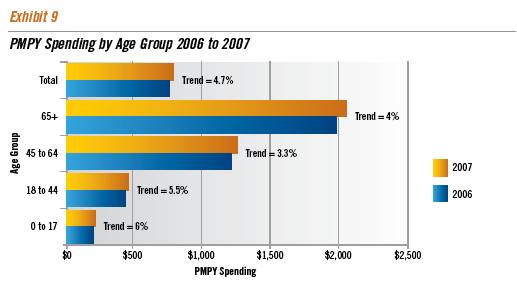
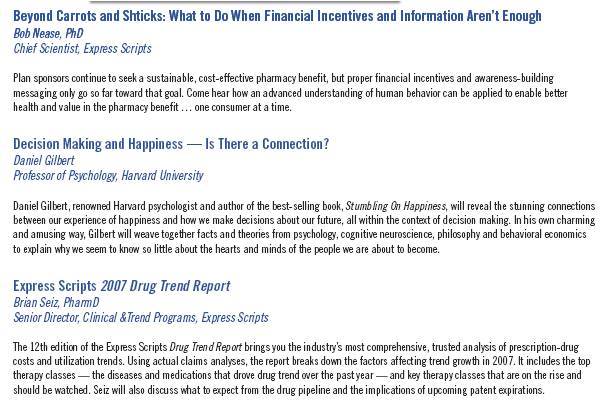
As a follow-up to my last post, I thought I would share some of the agenda items and the new Drug Trend Report from Express Scripts‘ Outcomes conference 2008 which is happening right now.  Unfortunately, they don’t let many external people in (even on my own dime) to hear the presentations.  I have to get it off the website and talk about it 3rd hand.

I will have to read the report and will have more to share.  Here are a few things that caught my eye:

As you can see from the agenda, several topics around consumerism which is a hot topic there.

Words Matter – Bitter and “Hope Bong”

If you ever needed proof that communications matter, here are a few recent examples:

1 – Look at all the “flap” that Obama is taking over the use of the word bitter. It may cost him the nomination.

2 – In another example, look at Colbert on Larry King Live last night (go to 5:20 on this YouTube video) where he talks about Obama passing around his “Hope Bong” to the young people of America.

3 – And back in healthcare, Express Scripts finally announced their Center for Cost-Effective Consumerism in the WSJ today.

“Express Scripts’ experiment with incentives is rooted in a discipline called behavioral economics, which draws heavily from principles of social and cognitive psychology. The field attempts to understand why people make economic decisions that aren’t based solely on saving or making money.”

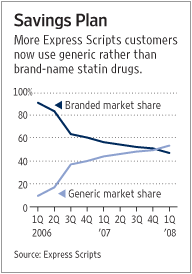
I have talked about this HMG (or cholesteral lowering drugs) program before on the blog, but they have some results revealed in the article. The article goes on to talk about the research done and some of the findings:

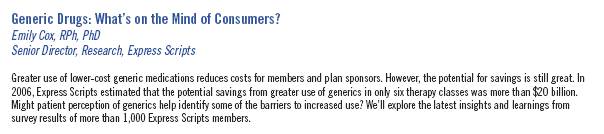
“So Express Scripts surveyed thousands of customers to understand better their concerns about generics. It learned some were uncomfortable with how to tell their doctors they wanted to switch, or felt it wasn’t their role as patients to bring up the topic. Others found the whole topic too complicated to bother with.

With those concerns in mind, Express Scripts made several changes to how customers were informed about simvastatin, such as shortening the text in its literature and changing its color and including a letter that patients could just hand to their doctor requesting a switch.

The company also framed the message to focus not merely on cost savings, but on how generics can be the better value — explaining that drugs that cost more but don’t do more aren’t a better value. People often believe branded or costlier drugs simply are better, says Dr. Nease, whereas Express Scripts’ new message stated that the “best buys” are drugs that cost less and do the same thing.”

This is important. Driving personalization through multi-modal messaging that helps simply complex messages into digestible information that links the constituents in healthcare isn’t easy.

As the article points out, Medco and Caremark are going down similar paths as are many of the managed care plans. Communications is becoming the key area of differentiation in healthcare as it has been in other industries for years.

Developing Policy Through Social Networking Tools

I was looking for something else early this morning and was surprised to see that Senator McCain (or someone on his staff) had posted the following question on LinkedIn.  So far, there are well over 2,000 answers.  I think this is a healthy use of a tool like this to get feedback.

What is the biggest challenge our country faces?

Our country is faced with challenges as we enter into the 21st century. I am prepared to effectively deal with these challenges and lead our country as President on Day 1. Please let me know what you view as the biggest challenge America faces and how you would like your President to address this challenge.

My response was that there wasn’t one, but three:

  • How to reskill the country to continue to be competitive without impacting a generation?
  • How to create a universal healthcare system while rewarding the entrepreneurial and capitalist beliefs of the country?
  • How to contribute to the global economy and political stability without missing opportunities within the country for development?

Medicare Part D Market Penetration

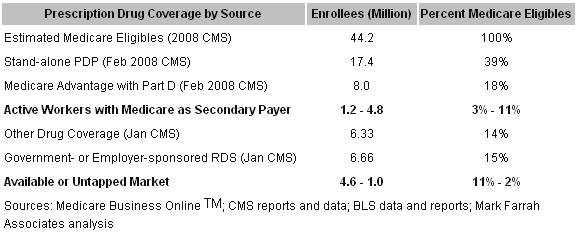
Mark Farrah Associates recently published a study through AHIP around Medicare Part D.  Here were a few of the takeaways:

  • 80 companies offer stand-alone prescription drug plans (PDP).
  • 17,409,974 people in PDP plans in 2008 (2.8% year-over-year increase).
  • Medicare Advantage (MA) plans with drug coverage had a 15% year-over-year gain.
  • Total Medicare population is 44.2M.

One of the key questions they were trying to answer is what is the untapped market size.  Their estimates put the market at 1M-4.6M.  But, I also found it interesting that they estimate that 3-11% of the eligible Medicare patients have Medicare as a secondary payor – a coordination of benefits (COB) opportunity?

Transient Insurance

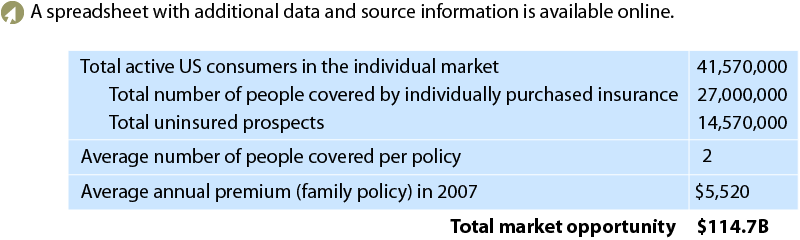
According to an article in the Detroit News, 1 in 6 Americans lack insurance for some part of the year. They could be chronically uninsured or simply in transition between jobs. Today, the individual health care market is certainly one of the fastest growing (if not the fastest growing) market for managed care companies.

Forrester estimates that this is a $115B market today.

With an average annual premium of $5,520 per family (or $2,400 per person assuming 2.3 people per family), that means the average premium per day is $6.58. Will we ever get to a point where you can buy short-term (i.e., less than 30-day) health insurance? And, if we did, can you set it up so that people don’t go on and off just as they feel ill?

The Forrester article talks about a Prudential model in Europe that is pay-as-you-go around health insurance.

Several Good Entries On Other Blogs

I was doing some blog surfing this morning and found a few entries worth going out and reviewing:

On EverythingHealth:

On HealthCareReformNow!:

On e-patients:

On The Sentinel Effect:

On Running a Hospital:

And to wrap up, on the Forrester Marketing Blog, you can get links to all the information being captured at their event on Engagement.

Medco on Future of Pharmacy

Medco has introduced a new publication called Perspectives. The one I just read was by Dr. Robert Epstein who is their Chief Medical Officer and is about how pharmacy will become personalized, specialized, and consumer driven. It is a well written piece with some good and interesting facts. Here are a facts and takeaways:

  • “Over the past five years we’ve seen a 60 percent increase in adult ailments diagnosed in children and treated with adult medicines.”
  • “The use of proton pump inhibitors (PPIs), drugs for heartburn and acid-reflux disease, increased by 60 percent in children between the ages of 1 and 4. This is despite studies revealing that as many as 95 percent of young children who present with symptoms of reflux self-correct for the condition in 12 to 16 months. Furthermore, some recent research suggests the long-term use of these products – particularly in the early years of life – can lead to infections, pneumonia or gastroenteritis.”
  • “Blockbuster medicines in three new major therapeutic categories – Fosamax® for osteoporosis, Risperdal®, an antipsychotic, and Imitrex® for migraines – soon lose patent protection.” [He then suggests that payors begin to look at strategies for driving Fosamax and Imitrex marketshare now, especially for new patients, so that when they go generic they are positioned to take advantage of the savings.]
  • He talks about the changing guidelines for hypertension, asthma, and cholesterol and points out that “It’s estimated that 25 percent of Americans have hypertension, and another 25 percent have “pre-hypertension” – which means half of the U.S. population will become candidates for treatment.”
  • He talks about nano-technology and gives the following example:

“One company, based in Houston, has taken nano-sized particles of gold, which are injected into the bloodstream and leach from the leaky blood vessels associated with rapidly growing tumors. When exposed to infrared light – these gold particles literally absorb the heat and destroy the tumor. Called AuroLaseTM Therapy, within 10 days of a single treatment this therapy caused, laboratory rats with prostate cancer to attain a 90-percent survival rate.”

  • “More than one in five people placed on Coumadin® are hospitalized by side effects, many of which could be averted by genetic tests to more accurately guide proper dosing”

Stop Sweating With Botox

I was just listening to the local news out here in Phoenix and was surprised to hear them talk about the increased use of Botox by people to stop sweating in their armpits. Apparently, stars have used this for a while but now average people are doing it. The report said that one set of injections lasts 6-9 months which for the people with overactive armpit sweating.

I am not sure I believe it, but the news reporter said that these are usually covered by insurance.

CBS News Story

Running Shoes Cheaper Than Medicine

When I was running the St. Louis half-marathon this past weekend, I kept thinking about something I saw recently which was a story about a patient arguing that it was cheaper for them to buy running shoes and exercise than to pay for medication. It’s an interesting point. If a patient would be willing to exercise outside (low cost), all they need is a good pair of running shoes. You probably have to replace them every 3-4 months so at $80-$100 per pair you are talking about $240 – $400 per year. It would probably be a wash for 12 copays for a brand drug on formulary, but cheaper if you had multiple drugs.

It would be a lot cheaper for the payor to provide the running shoes in return for the commitment to workout. How would you measure it? Easy. You could use a GPS and as long as the patient walked or ran X miles per month then they got the benefit of free shoes. Not likely to happen, but I think the point is that there are many creative ways to incentivize patients to be healthy which create a clear win-win.

For example, why not provide them with free (or heavily discounted) Prilosec or Zyrtec as over-the-counter (OTC) drugs? The reaction is always that this is opening Pandora’s Box to coverage of OTC (e.g., vitamins and aspirin). It doesn’t have to be. It can be controlled by requiring the patient to get a prescription for the OTC from their physician. Once they get the Rx, they fax it in as a sort of prior authorization for the drug. If the PA is on file, they can either pick it up at the pharmacy for the $0 (or discounted) copay or get reimbursed after they purchase it.

Going to WHCC

I am excited that I get the opportunity to go to the World Healthcare Congress in DC later this month. This looks to be a great conference, and I am going to blog from the event. If you’re there, look me up. I will be sitting at the bloggers table at the front of the event.

Maternal-Fetal Surgery: Trade-off Examples

One of the key parts of healthcare is the need to make tradeoffs especially when it comes to treatment plans. Exercise requires a commitment and can make you sore. Some drugs have side effects that may impact other parts of the patient’s life. Surgeries carry risk.

With that in mind, I found an article in the American Way magazine interesting in its discussion of maternal-fetal surgery. This is a technique where a doctor uses a fetoscope (telescope with a small camera at the end) to go into the uterus through a tiny incision (0.15 inches wide) to stabilize life-threatening blood-supply imbalances (e.g., twin-twin transfusion syndrome) and through larger incisions to remove rapidly growing and life threatening tumor masses. As you can imagine, this is controversial. There are risks for the mother and no guarantees that it will be successful.

There were less than 1,000 surgeries between 2005 and 2006, and it sounds like it is used for extreme cases today (i.e., less than 10-20% chance of the fetus living). A clear example of why transparent information is necessary and clear communications make a difference. Patients need to understand their options, the risks, the tradeoffs, and the implications.

73-Page PDL – Simplicity?

I hate to pick on a friend of mine, but I was looking at the PDL (Preferred Drug List) (aka Formulary) that his company puts out. It was 73-pages long. Not likely to be carried by many patients to their appointments. In today’s world of simplicity, it would seem like there must be a better answer.

Pharmacists to Prescribe?

Someone asked me if I thought pharmacists would be allowed to prescribe medication to patients. I’m not familiar with any legislation on this topic (although there well might be some).

My opinion is that the better model is that physicians are responsible for diagnosing and basically writing a prescription for the type of drug (e.g., statin). I think the pharmacist is in the best position to talk with the patient about which drug within that category they should use looking at drug-drug interactions, form of the medication, formulary status, costs, side-effects, and other things that usually result in a follow-up call to the physician. Given that 40% of scripts written today hit some type of edit as an exception, I can’t imagine pushing that responsibility to the physician.

One of the most creative scripts I saw at Express Scripts around this was a physician that had just written all the PPIs (e.g., Prilosec, Nexium, Protonix) on the script and said pick one. I don’t know if it was legal, but I thought it made the point that they didn’t want the call back.

Communications As Trend Mgmt Tool for Pharmacy: Cliff Notes

Here are a few points from my recent webinar on this topic. If you are interested and a potential client, I would be happy to share the detailed content with you offline.

[Since all our competitors tried to sign up to listen in, I won’t give away everything here.]

  1. Talked about all the value sitting on the table that could be captured (>$30B per year).
  2. Talked about how communications can both be the trend management tool and enable utilization of other trend management tools (e.g., utilization management).
  3. Talked about things like loss aversion versus cost savings, the placebo / price correlation, and the transition from the Ford framework to the Starbucks framework in the healthcare industry.
  4. Talked about how people are different and the need for a systemic approach to dynamically optimizing program success using a scalable model.
  5. Talked about some frameworks for retail-to-mail and brand-to-generic along with the importance of asking the right questions in program design and measuring ROI.
  6. Finally, we talked about some results and the different levers to play with to impact results.

Example of Misalignment

One of the points in George Halvorson’s book Health Care Reform Now! is about misalignment of incentives.  Providers are not paid for better outcomes.  They are paid per activity (i.e., to keep people coming back).  It’s a key point which deserves a much longer discussion.  That being said, I couldn’t help but think of this when reading yesterday’s WSJ article “Flu Economy Takes Unexpected Turn“.  A few quotes that it mentions include:

  • CEO of Walgreens at shareholder meeting – “If attendees of the meeting needed to cough, he joked, they should leave the room and ‘go to a movie theater or on a bus’ to spread their germs. ‘We’re really hoping for a very strong flu season’.”
  • “Unfortunately, people have not been getting sick at a rate that we would all like yet.” P&G CEO
  • “On the pediatric side, young kids coming into the hospital, that’s a nice margin for us, as well.” CFO of LifePoint Hospitals

Now, the easy discussion here would be to criticize these executives for being insensitive, but that’s not the problem.  The problem is that we have incented our healthcare system so that people make money when people are sick.  To my earlier post, this doesn’t mean people shouldn’t make money, but it means we should find a way to incent them to make people better.  We have decades of benchmark data (somewhere).

Questions On Health Care Policy For McCain

Elizabeth Edwards (wife of former presidential candidate John Edwards) provides some thoughts on John McCain’s healthcare plan on the The Wonk Room blog.  It will be interesting to see if his team engages in the conversation and provides a response.  Regardless, I think the key points are good ones for any candidate to answer:

  1. How are we going to address pre-existing conditions?  We can’t exclude or gouge people that have chronic diseases.  On the other hand, it is often the fact that they don’t manage these diseases that drive up costs.  Would it be reasonable to charge them more if they didn’t take responsibility for their disease?
  2. What is the long-term market mechanism to make sure that the solution doesn’t increase costs?
  3. Will this really be cheaper for everyone in America?  Does the estimate include all the patient’s out-of-pocket costs for healthcare – copays and deductibles?  If the plans being proposed talk about shifting away from employer sponsored, do you really think that those dollars are going to be shifted to higher wages?   

These are my generalizations of her questions.  The Kaiser Family Foundation has put out a PDF which compares the plans of the three candidates – Clinton, Obama, and McCain.

Healthcare As A Non-Profit Industry

I am a big believer in the fact that our healthcare system needs to be more focused on outcomes, but I am not ready to jump on the bandwagon of making healthcare a non-profit industry. I had to throw in my comments on one of the entries on The Health Care Blog to talk about this.

A couple of the key points that I think are worth repeating are:

We need to address healthcare as a profession. We are facing a shortage of PCPs, RNs, and RPhs over the next decade.

I don’t think it’s a bad thing to see more business school people getting into healthcare. This new perspective can only help. It doesn’t mean that the industry will become less health focused.

I think ROI is an important metric even in healthcare. The reality is we don’t have good data to look at ROI in any holistic way in healthcare. We don’t know outcomes. We don’t know the impact of outcomes on absenteeism and other metrics. We don’t have an activity-based costing system to understand the costs of treatment.

The author says that “by law, a corporation’s first obligation is to make a profit for its shareholders. Its customers come second.” I am not sure that A makes B true. There is lots of proof out there in the business world that shows that a focus on customers sometimes at the short-term expense of profits will drive a sustainable business model.

I think we just need a different system with passionate leadership (from whatever background) who understand the long-term management model and are committed to impacting outcomes through financially aligned incentives. This likely may need to be a combination of public and private especially when you realize that 1% of the population drives 35% of the cost meaning that a small focus can make a big difference.

Next Webinar – Retention

The webinar I did last month on using patient communications to drive pharmacy trend went very well. We are continuing our educational series. I also have the honor of giving the next one on a topic I have discussed here a little, but one which I feel very strongly about. Here it is below. [I will try to post some notes that give some of the highlights without disclosing any “secret sauce”.]

If you are a pharmacy, PBM, managed care company, PDP, disease management company, or other provider of care to a group of patients, I would encourage you to sign up.

How Communications Can Influence Member Satisfaction, Loyalty, and Ultimately Retention

When: April 15th & 24th, 1:00 PM EST

We’ve all been told for years that it costs five times as much to win a new member as it does to retain an existing one. With the big focus on consumerism in healthcare, the continuing evolution in Medicare Part D and new growth and innovation happening in support of individual markets, it is time for the science of member communications to take center stage within healthcare companies.

Join Silverlink as we discuss ways of addressing this opportunity through comprehensive communications solutions that connect with your members and increase their advocacy for your insurance product.

We’ll look at some non-healthcare examples and some leading edge ideas in healthcare, while grounding it all with short-term actions that you can implement to achieve measurably better results.

Register now >

Patient Ping-Pong: Cholesterol

As if it’s not already difficult for patients to navigate their benefits, DTC advertising, and all the healthcare information on the web, it seems we are structurally trying to make it more difficult. With the recent news around Vytorin and Zetia, the drugs used to treat high cholesterol have gone through some dramatic changes over the past few years. (Here is the formal study.)

In an editorial by the New England Journal of Medicine:

“Until such data are available, it seems prudent to encourage
patients whose LDL cholesterol levels remain elevated despite
treatment with an optimal dose of a statin to redouble their
efforts at dietary control and regular exercise. Niacin, fibrates,
and resins should be considered when diet, exercise, and a statin
have failed to achieve the target, with ezetimibe [Vytorin] reserved for
patients who cannot tolerate these agents.”

For several years, Lipitor was clearly the market leader with Zocor as a close second. Even with one drug (Mevacor) available generically, most plans (other than Kaiser) had single digit utilization. Kaiser was able to drive significant use of generic Mevacor as a first-line agent. When Zocor was going to lose it’s patent protection in 2006, most plans began moving Lipitor to the 3rd tier and introducing programs to move Lipitor patients to Zocor (generic name simvastatin). These included step therapy programs along with simple copay incentives by having a large copay differential between the 1st or 2nd tier and the 3rd tier.

Then, last year, Pfizer, which makes Lipitor, began to offer aggressive discounting to encourage some plans to actually encourage Lipitor utilization over generic Zocor. All the while, Vytorin and Zetia were gaining marketshare to capture a $5B piece of the market. Now, with the recent study, the authors are suggesting that these patients should be on generic Zocor or another drug in the statin class. I am sure there are some clinical nuances here, but the quote above seems to limit them.

And, of course, patients should discuss this with their physicians. They shouldn’t stop taking their drugs. And, generally, when you switch drugs, you want to get lab work done in this class. So, are we asking patients to change drugs again? Do they incur an office visit copay? Do they need to pay for the lab test?

Talk about confusing. And, at the same time, the Improve-It study around Vytorin and Zetia is enrolling more patients. Seems counterintuitive to the data just released.

I’m not a pharmacist, but after working in the industry, if I can’t figure out what to do, how can your average patient. At this rate, healthcare will be as confusing as our taxes.

Note: There are a handful of entries on this out at the WSJ Health Blog.

Convergence: The White Space Between Ford and Starbucks

I recently read a great book called Microtrends. If you haven’t seen it, I highly recommend it for its interesting analysis of trends and the way it makes you think. For example, it talks about how people are drinking more water and more caffeine drinks. It talks about how people have much shorter attention spans yet there is a rise in knitting and books are getting longer. It talks about obesity and young vegans. It plays on the power to see small trends (i.e., 1% of the population) and how they can impact the overall framework. (You can read my detailed notes here.)

One of the frameworks that the authors use is to compare the world as moving from a Ford economy (one choice) to a Starbucks economy (personalization). As healthcare typically lags other industries, I think we this analogy works to show where healthcare was and where we are going over time. Historically (at least in the modern era), we had one choice for healthcare coverage which was offered through our employer. Over time, that has changed to where most people have more than one option for healthcare coverage from their employer. And now, more and more people are losing coverage and the fastest growing segment is individual health insurance.

We have evolved to personal healthcare, but we aren’t yet to personalized healthcare which I think will be largely driven by genomics and some radical change to our healthcare system. Unfortunately, I think we are stuck somewhere in between right now where to personalize your healthcare you need to go to a series of providers or tools which aren’t integrated. There are a few scenarios out there where there is some integration of medical, pharmacy, lab, and other data (Kaiser jumps to mind). But, even in an integrated environment, they haven’t yet fully digitized the offering and created a seamless patient experience (to the best of my knowledge).

As George Halvorson says in his latest book, Health Care Reform Now!, “We have an expensive plethora of uncoordinated, unlinked, economically segregated, operationally limited Microsystems, each performing in ways that too often create suboptimal performance both for the overall health care infrastructure and for individual patients.”

In a likely scenario, you have the following for a sick patient who is actively managing their health:

  • A primary care physician and their staff to interact with
  • A specialist and their staff to interact with
  • A pharmacist (or likely multiple pharmacists)
  • A specialty pharmacy and their nurse
  • A managed care company (and possibly Medicare) which offers a member portal and tools
  • A PBM which offers a member portal and tools
  • A disease management company and their health coach
  • Health portals or information sites (e.g., WebMD, RevolutionHealth)
  • A gym and potentially a trainer
  • A series of vitamins and OTCs that no one has visibility to (other than maybe their grocery frequent buyer card program)
  • One or more disease specific communities that they participate in (i.e., some of the Health 2.0 companies)
  • Blogs and news feeds they subscribe to for information on their disease

The reality is that they have to go out and build a series of interactions to create this semi-personalized offering with no hope of the data being integrated, getting consistent messages, or any true learnings being generated. Each party has a 1:1 relationship with them (best case) and knows a piece of the puzzle. Without an integrated infrastructure, aligned incentives, and a mechanism to engage each patient according to their preferences, we have a very difficult challenge (as an industry) and each patient bears the brunt of this.

Until we can create physical or virtual convergence (i.e., integration of data and tools into one framework), we won’t be able to move from buying coffee at one store and skim milk at another store and our muffin at another store to a Starbucks world where we have one interface to select and personalize our healthcare experience. I wish I had the answer. Unfortunately, as more and more people are talking about, it seems like we have to make a radical change to be successful. Evolution from the status quo will likely not work. Much like GE had a program in the dotcom days called DestroyYourBusiness.com where they encouraged their leadership to figure out how to develop a new model, that is what healthcare needs with the support to initiate the skunkworks organization which might eventually become the norm.

Compliance / Persistency / MPR

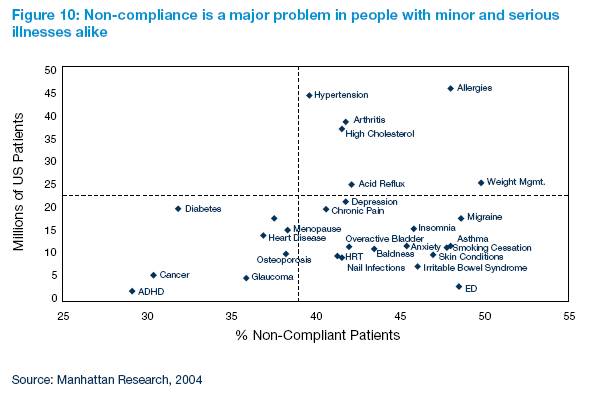
Non-compliance is a significant issue in healthcare.  You have the issue of whether people fill the prescriptions that their physician writes; whether they use them once they pick them up; and whether they continue to refill them and stay compliance over time.

You will hear several terms used:

  • Compliance is “the extent to which a patient acts in accordance with the prescribed interval and dose of a dosing regimen”. (source)
  • Medication Possession Ratio is the days supply of medication divided by the days between refills.
  • Persistence or length of therapy (LOT) is the number of days elapsed between the date of the first claim and the date when the days supply of the last claim is depleted.
  • Medication Possession Ratio (MPR) is the days supply of all fills minus days supply of last fill / days elapsed between first and last fill.
  • Adherence to therapy can be defined as being both compliant and persistant.
  • The medication ownership ratio (MOR) is calculated as the proportion
    of patients on each initial prescription on a given day. It was
    used to describe the percentage of patients within a treatment cohort
    who had the medication in their possession on any given day.

Here are a few good sources for information:

I found the following chart in PWC’s publication Pharma 2020: The Vision a good graphic.

noncompliance-pwc2020.jpg

Another Health Blog Ranking System

I have followed and used the eDrugSearch.com ranking system for healthcare blogs for the past few months as a way of identifying new blogs.  [Side note…My rankings move dramatically week to week.  Last week, I was 121 (my personal best).  This week, I dropped to 249.]  It is a good tool to see an objective rating system.

I recently stumbled upon another blog ranking site at http://www.wikio.com/blogs/top/health.  I haven’t studied it as well, but it is another good tool to see a list of healthcare blogs.

BTW – If you are a fellow blogger, I have started a healthcare bloggers group in LinkedIn.   

International Opportunities

The other day, Medco announced that they were going to work with Apoteket to develop a drug safety system for Sweden.  Apoteket currently manages all the pharmacies there, but they are going to be deregulated in 2009.

It’s not likely to make a financial difference for Medco, but I think it’s an interesting step.  US healthcare is often looking for ways to grow in a fairly mature US market.  Going abroad has always been attractive, but a challenge given the different models.  It made me think of some of the other moves over the past few years.

I am sure there are a lot more, but those are the ones that I am familiar with.