Archive | Books / Articles RSS feed for this section

Spend Time With Your Positive Friends

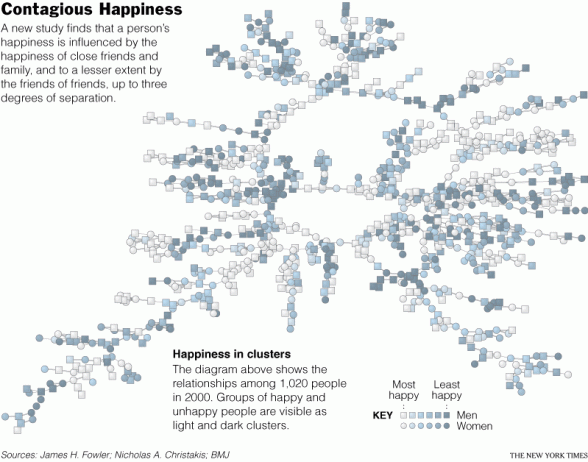
Earlier in the year, there was a study that showed how your friends and social network can affect your weight loss.  I blogged about this and quiting smoking as part of your network earlier.  Now, in Penelope Trunk’s blog, she talks about how your friends can make you happy and that happiness is linked to better health.  Interesting, she also says that if you say you are happy then you get the same benefits.

“optimism, a trait shown to be associated with good physical health, less depression and mental illness, longer life and, yes, greater happiness”  Time Magazine article

It brings me to two thoughts:

  1. You should tell yourself that you are happy and you’ll feel better.
  2. Member communications should stress happiness and help people understand how they can be happy by taking certain actions.

happy

Black Is The New Pink

I am stealing this line from a tee shirt I saw the other day, but it immediately came to mind when reading an article about colors in the US Today. I was amazed when it talked about people buying new iPods (for example) since they wanted a new color. Just because I get tired of my green iPod…do I really go back and buy the red one (especially in today’s economy)?

“Bleak 2008 also happens to be the holiday season when shoppers may want their gifts to be colorful. Or at least, a different color from last year’s model.”

“When you add color to a product, you stimulate the consumer’s awareness that the version they already have is obselete.”

Some of the favorite colors were:

  • Blue, dark blue, dark green, and red (tomato) for men
  • Purple, blue, red (tomato), and blue-purple for women

It just makes me think about healthcare communications and what is the color switch that we need. Companies have talked about obesity, diabetes, preventative care, adherence, and many other actions for years. What is it that becomes different? How do we compel the consumer to act?

  • Is it a change in mode – direct mail to automated call?
  • Is it a change in tone of the message – caring to pushy?
  • Is it a change in message – qualitative to quantitative?
  • Is it a change in source – health plan to provider?

To manage healthcare costs in the US, we have to get individuals engaged in their care. The magic bullet is how to do this.

Great Presentation – Mktg in Recession

I came across this presentation and loved its simplicity.  It delivers a crisp message using few words and a lot of visuals.  Given the challenges in the economy (and more on topic with communicating efficiently), I thought I would share this.

Express Scripts Data Breach

By now, many people have heard about the data breach that happened at Express Scripts.  They have now set up a website to provide people with information about their investigation with the FBI and are also offering support for people whose identity has been stolen.  Given their focus (like all other healthcare companies) on keeping this data secure, I can only imagine how difficult this is for them.  I know that George Paz and the executive team will be doing everything they can to try to find the root cause and help any affected clients or members.

To find out more, visit www.esisupports.com.

Off Label Drug Use

Once a drug is approved, it can be prescribed by physicians for any reason.  Those reasons can include conditions that were not studied by the manufacturer in the clinical trials.  And, those off-label uses are not things that can be marketed to the physican.

Some of this is controlled by prior authorizations (PAs) which require a physician to call into the managed care company or the pharmacy benefit management (PBM) company to justify the use of the medication.  This is often used on high cost medications with a high percentage of off-label prescribing.

For example, it is estimated that 76% of the prescriptions writen for Seroquel are for off-lable purposes.  (See article on this and other information here.)  This article also lays out the top drugs that are used off-label.

  • Bupropion (Wellbutrin) approved for depression, commonly used off-label for bipolar diaorder.
  • Sertraline (Zoloft) approved for depression, commonly used off-label for bipolar disorder.
  • Venlafaxine (Effexor) approved for depression, commonly used off-label for bipolar disorder.
  • Celecoxib (Celebrex) approved for joint sprain/strain, used off-label for fibromatosis — soft tissue tumors.
  • Lisinopril (Prinivil, Zestril) approved to treat high blood pressure, used off-label for coronary artery disease.
  • Duloxetine (Cymbalta) approved to treat depression, used off-label for anxiety.
  • Trazodone (Desyrel) approved to treat depression, used off-label for sleep disturbance.
  • Olanzapine (Zyprexa) approved to treat schizophrenia, used off-label for depression.
  • Epoetin alfa (Procrit, Epogen) approved to treat chronic renal failure, used off-label for anemia from chronic disease.

MD Rating Sites

(Getting a few things out here and off my desk)

This is a question I often wonder about.  I was glad to see that e-patients put a report online.  I haven’t read it yet, but I think it is something that many of you would want to know.

I think that the main issue Given hit upon in the report (but I’m not sure she recognizes as the primary challenge of doctor rating sites) is the numbers issue. With over 700,000 physicians in the U.S., a ratings database of 10,000 or even 20,000 is pitifully and woefully small.

Do I Pay The Mortgage Or Chemo Bill?

15% of Freddie Mac’s deliquencies this year were due to illness.  I am sure this is a combination of medical bills and lack of ability to work, but this is a real issue.  As one of the comments on the WSJ Blog about this said, it’s the “perfect storm”.

Obama and his team have a real challenge (or opportunity) to figure out how to help us out of this market that we are in.

Physicians Vs PBMs?

I shared one of Toni’s quotes the other day and have some follow-up information that she sent me.  I will have to try and read it and share later today.  In the meantime, I saw this quote this morning from the same interview that she gave.

PBMs would love to move toward some standards that the physicians had access to.  That is the whole objective of electronic prescribing.  Every time the physician chose a drug, it would tell them if it was on formulary; if there were drug interactions; if there were coverage issues; and what the copay was.  I am not sure most physicians want this.  This would push a lot of work into their already abreviated office visits.

Additionally, I am not sure it is all the PBMs issue.  Everyone has different perspectives on cost, drug coverage, benefit design, etc.  I don’t think we will get to a common benefit design in this country that would simplify the PBM’s job.  Customization is the number one driver of cost within the PBM.  It causes huge IT issues.  It causes huge training issues.  It requires all kinds of inefficiency.

I am not sure that Toni and the PBMs are far off in what they want, but the reality of implementing it is a long way off.

“Physicians deal with too many health plans and numerous PBMs, and from our view they have no consistency. We have no way of knowing the various protocols and regulations they operate with, and new product designs make it impossible to keep up. Formularies are cumbersome and change all the time, and it is unclear who controls the formulary. It appears that formularies are based on [achieving] optimal revenue, not evidence-based. The goal should be to reduce hassles for primary care physicians and lower costs to patients and purchasers of health care. Health plans and PBMs are seen as the problem, not the solution.”

— Toni Brayer, M.D., who has practiced internal medicine in San Francisco for more than 20 years, has served as president of the S.F. Medical Society, and is chief of staff at California Pacific Medical Center, told AIS’s Drug Benefit News.

An Example of Being Overmedicated

We all know that people have a lot of prescriptions.  Here is an interesting story about one individual and the process that her family went through to do essentially Medication Therapy Management (MTM) and find out the right mix of drugs.  I don’t know the person recommended in the story, but I certainly recommend making sure your physician and especially your pharmacist know all your drugs and talk with you to see about potentially having too many prescriptions (especially once you are above 10 different medications).

Each added prescription increases the likelihood not only of a problematic interaction but also of misuse. Studies show that half of older people sometimes fail to follow their Rx instructions. It’s no wonder. Consider my mom’s regimen: She took 32 pills a day, at five different times—some once a day, some twice, some three times, and some as needed. One pill had to be split in half for the morning dose but not for the evening dose. Some were taken with food, others on an empty stomach. She also used three different asthma inhalers plus a nebulizer, all on different schedules. I’m half her age, and I couldn’t keep that straight.

Drug Prices Go Up

A recent report by AARP which is talked about on the WSJ Health Blog reveals the following:

“Last year, the wholesale price of specialty drugs rose 8.7%, three times the rate of inflation. The price of non-specialty, branded drugs rose 7.4%, while the price of generic drugs fell by 9.6%.”

Are we surprised?  Generics have tons of competition so prices will go down over time unless they get too low and people jump out of the market.  Brand drug utilization keeps going down so they are going to raise prices.  And, specialty drugs have a limited market so their prices are going to continue to go up.

Is this right?  I could debate this forever.  But, it is a free market.  This is what happens with supply and demand.  We all want the drugs to extend our lives and make us feel better even when we have chronic illnesses.  But, it isn’t cheap to do research and trial and error to find out what works (at least it’s not cheap without testing on humans in an uncontrolled environment…which I don’t think we want).

Tough Times To Start A Company

After trying my own venture a few years ago, I have greater empathy for this challenge. I have watched a few friends and neighbors doing this. I have the ultimate respect for them.

Even so, most business experts conform to a theory of “thirds”: Of all the new business startups, 1/3 eventually turn a profit, 1/3 break even, and 1/3 never leave a negative earnings scenario. According to a study by the U.S. Small Business Association, only 2/3 of all small business startups survive the first two years and less than half make it to four years.  (source)

A few comments I have heard from friends:

  • A physician who wanted to go out on his own to open his practice (a time honored tradition) could not get a loan and even putting up his house didn’t work since the house was worth less than he owed.
  • A friend who does small business loans told me that the criteria to approve loans made it difficult for her to give small companies money.
  • I talked to a VC on my plane this morning who said they can’t raise funds in this economy and that valuations are down since there is less money chasing deals.

Then in USA Today, they had an article about venture capitalists losing their nerve.

  • US venture capital for the 3rd quarter dropped to $7.4B (down 7% from last year).
  • There were only 270 information technology deals done in the 3rd quarter which is the lowest quarterly amount since 1st quarter of 1996.
  • The Silicon Valley venture capitalist confidence index hit 2.9 (lowest in 5-year history of the index).
  • Tesla Motors, Redfin, Zillow, and AdBrite (promising start-ups) have all announced layoffs.
  • People are looking to sell their holdings in venture funds to companies like Industry Ventures that buys holdings at a discount.
  • The exceptions are biotech and clean tech which continue to grow funds.

The Treadmill Desk

I think this is one of the coolest ideas that I have seen in a long time.  Attaching a desk to a treadmill and walking while you work.  It has lots of benefits including losing weight.  I also agree with a comment from one company doing it that it would help people think differently.

The company featured on CNN has treadmills that go up to 2 miles per hour and even has a conference room with treadmills around the table.

In doing some research on the topic, I found the following:

Gambling With Your Health

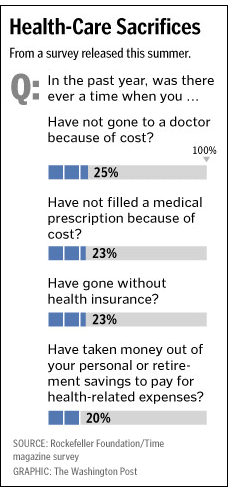
It’s a continuous message these days…people are avoiding care (preventative and necessary) due to cost.  Here is an article in the Washington Post about it.

Though the burden is especially heavy for uninsured Americans, even those who have coverage are feeling the pinch as employers shift higher deductibles and co-payments onto employees.

“The reason why health care was immune [to recessions] in the past was because most people were covered under good insurance plans,” said Jean Mitchell, a professor of public policy at Georgetown University. Now, “people are realizing, ‘Oh my gosh, I have to pay for this out of pocket.’ ”

Median US Income – $32,000

As we talk about the economy and its effects on healthcare, it begs the question of what the average US family makes per year.  Averages are what we typically see versus median.  Median means that 1/2 of the families make more and 1/2 of the families make less.  The averages are often skewed by populations at the ends of the spectrum (i.e., the people making millions). This article says that according to IRS data that 50% of the US makes below $32,000.

New statistics from the Internal Revenue Service show that the highest-earning 1% of taxpayers in America make 22.06% of all income reported to the government. That’s almost twice the 12.51% of total income earned collectively by the lowest-earning 50% of workers. Yes, 1.4 million taxpayers claim 22% of income earned while 68 million share just 12.5%.

But get this: When it comes to taxes paid, an even wider discrepancy shows itself, in reverse. Those earners in the top 1% pay 39.89% of all federal individual income taxes. The bottom 50% of earners pay just 2.99% of those taxes. (Source article)

Article On Silverlink Communications

The October 2008 issue of ADVANCE for Health Information Executives contains a nice article about Silverlink Communications by Robert Mitchell. Here are a few items from the article:

  • It focuses on our Adaptive HealthComm Science approach which brings decision sciences to the area of driving healthcare behaviors. [This is what leading consumer companies, credit card companies, and gaming companies use to understand consumers.]
    • “Adaptive HealthComm Science looks at microsegments of the member population to try different interventions with different populations — all standing against control groups and measurements of what works best. It then adapts, learns and tries again. “The communication system continually learns and automates its processes so that it is capturing new data and learning along the way from those interactions. It is consistent and can be measured.”
      • It is amazing to see how much programs can be improved over relatively short periods of time by rapidly testing isolated variables to find the right solution for each microsegment of the population.
    • One of my favorite examples from my past was simply using stamps turned at an angle on a letter to improve the rate at which direct mail was opened. It looked more like a human had hand licked each stamp rather than a machine which put the stamp on perfectly each time.
  • It talks about the ability to do on the call calculations and dynamic pathing on the core automated calling platform.
    • On-the-call calculations: If you have 3 drugs to refill, but you only choose two of them then it can tell you what your copay is. Or, if you tell the caller your weight, it can calculate the difference from a prior weight it had collected.
    • Dynamic pathing: Based on answers you give, the call is intelligent enough to serve up different content to the member and/or route you to a different group of live agents based on rules.

“We’ve invested heavily in people, technology, processes and a methodology that continuously improves to maximize the effectiveness of health care communications,” Stan Nowak, CEO and co-founder of Silverlink, said. “Over the next few years, changes in the way health care stakeholders communicate with patients and health plan members will be one of the keys to lowering health care costs while driving consumer affinity.”

“To the consumer, health plan products are largely undifferentiated on the basis of benefits or network, and consumers experience their health plan almost exclusively through the communications they receive from the plan,” Nowak continued. “Health care organizations have an opportunity to clearly differentiate themselves through proactive and personalized communications, improving their members’ experiences with each interaction, and earning consumer trust and affinity. In essence, for health plans, communications is their product.”

Tight Rx Market

I am sitting at the airport doing some blogging on my blackberry. Here is a quote about the prescription market:

“We are facing a continuation of the slowest-growing prescription drug market in 47 years, according to IMS Health. We believe the biggest impact has been the very tough economy.”

— Jeff Rein, chairman and CEO of Walgreen Co., where prescription sales actually climbed 7.9% in the latest quarter. Rein was addressing a Sept. 30 investors’ conference call on the company’s financial results for the quarter that ended August 31.

Stress Up: Health Down

I would have loved to have the time to do this research myself, but fortunately it was nicely bundled up The USA Today in a piece by Marc Siegel who is an associate professor of medicine at New York University School of Medicine.  Here are a few of the facts from his article:

  • A survey by the American Psychological Association indicated that financial concerns “topped the list of stressors for at least 80% of those surveyed”.  More than half reported the most common symptoms being anger, fatigue, and an inability to sleep.  Close to half reported over-eating or eating poorly.
  • After the 1929 Wall Street crash, millions turned to drinking and smoking which led to heart attacks, strokes, bleeding ulcers, and clinical depression.
  • Research on people laid off from a plant in Pennsylvania over 17 years shows that they were 15% more likely to die of any cause.
  • In NY, calls to the Hopeline network for people with depression or suicidal thoughts increased 75% in the 11 months ending July (before the worse of the economic situation).
  • UnitedHealth Group reports that hospital admissions for psychiatric services are up 10% this year.
  • A 1% increase in unemployment is projected to cause as many as 47,000 more deaths over the next two years – 1,200 suicides and 26,000 additional heart attacks.
  • Cumulative stress causes depression, suicide, heart disease, stroke, predisposition to infection, and certain kinds of cancer.

He does offer a few pieces of advice that are always hard to focus on when you think about all the negatives:

  • Eat healthy food
  • Sleep right
  • Do yoga, meditate or exercise regularly
  • Touch in the form of massage, hugging, and kissing decreases stress hormones

Where’s Your Raise…It’s In Your HC Benefits

According to Hewitt Associates, healthcare premiums and out-of-pocket costs will go up 8.9% next year.  This is at the same time as many people are hurting from the economy and seeing gas and food prices go up.  I can guess that the average raise next year won’t be near enough to make up for this with most people.

In an article by Sandra Block at The USA Today, she suggests several things on controlling costs.  None of them are new, but perhaps they are worth reiterating:

  • Use generic drugs whenever possible.  [You should ask your physician or pharmacist if there is a generic alternative available.  You should also not be afraid to ask for samples for new prescriptions from your physician.]
  • Sign up for mail-order.

“Unless you have a crush on your pharmacist, there’s really no reason to go to the drugstore every 30 days to pick up your blood pressure pills.”

  • Contribute to a flexible spending account so you use pre-tax dollars to pay for out-of-pocket costs [but be aware of the use-it-or-lose-it rules].

With more and more companies pushing more cost to the employee or even dropping benefits, you might have to start recognizing the value of having a good coverage plan as part of your total compensation.

HRA Feedback Request

In one of my LinkedIn groups, a company (HealthSphere) is asking for feedback on their Predictive Health Analysis tool which is an HRA (Health Risk Assessment).  I figure from the website that they are open to general consumer feedback.  The LinkedIn group will likely just get them people in the industry which have a certain bias. My observations:

  1. First section is a questionaire on lots of personal traits – body type, dreams, physical characteristics.  It was a fairly easy to use system, but I didn’t understand a lot of the answers and was skeptical of why I was giving them all this information.  It made me go back to ready the disclosure statement beofre continuing.
  2. From those questions, it gives you a report.  The report talks about:
  • Primary physical systems
  • Primary emotional systems
  • Potential Risks / Weaknesses
  • Dietary recommendations
  • Dietary supplements
  • Herbal supplements
  • Homeopathic remedies

It was interesting, but way too much information.  And, it seemed hard for me to believe that my answers would lead to this much information.  I also become skeptical when I see things like supplements and remedies which make me think that this is a funded site just to drive product sales (which it may or may not be).  Anyways, interested in your thoughts…

Kaiser Family Foundation on Healthcare

The Kaiser Family Foundation has two things relative to the election that you might find interesting:

  1. A side-by-side comparison of policies for the two candidates; and
  2. Lots of videos and podcasts on healthcare.

Since this is the number two topic (after the economy) that people care about, it is important to know how they feel.

The Tough Economy is Impacting Health (and Potentially HEDIS)

A WSJ article of last week provides a glimpse into the many ways our strained economy is adversely impacting the healthcare-seeking behavior of individuals (see article here). It cites a D2Hawkeye analysis of medical service and pharmaceutical utilization (in a study performed before the most recent Wall Street and Main Street turmoil) and shows widespread impact across many healthcare categories. Consumers are cutting back on everything from mammograms to drugs to physician visits.

These findings should be a big stimulus for health plans, population health companies and PBMs to work more creatively on plan designs and communications strategies to support prevention and medication adherence.

Certainly, many individuals are feeling the pinch of health care costs to a greater extent than ever—with higher co-pays, bigger deductibles and for some Medicare members, the “coverage gap,” all contributing to choices people making. The D2 Hawkeye analysis of several Mid-Atlantic health plans looked at preventive and non-acute health services received between March 2007 and March 2008…

It shows pap smears are down 6% and antidepresssant medication fills declined by 19%

…despite the fact that for most of these members (in the study population) the cost-sharing changes year-to-year were minimal. So, the broader economic reality appears to be forcing consumers into making hard choices – trading off health care for other goods and services, whose prices are simultaneously rising.

NCQA is about to release its 2008 State of Healthcare Quality Report (tomorrow, October 2nd) which is its comprehensive summary of how plans across the nation are performing across the full range of HEDIS indicators . The data will reflect the healthcare services received by members in 2007, levels which from the D2Hawkeye study and other industry sources suggest we’ve declined. ….the time is now for innovation that spurs positive member behavior –in areas ranging from diabetes care to flu shots to colon cancer screening—to take center stage as an antidote to all the negatives the economy is now inflicting.

Healthcare Effectiveness Data and Information Set (HEDIS) is a tool used by more than 90 percent of America’s health plans to measure performance on important dimensions of care and service. (source)

This posting was written by Margot Walthall, Population Health Market Leader for Silverlink Communications. Margot has previously worked in director level roles in strategy, member communications and product management/marketing for three health plans and also in product marketing for a population health software and services company.

Margot’s work for Silverlink is focused on multi-channel communications solutions that enable campaigns in the areas of health engagement, health risk appraisals, health education in support of gaps in care/HEDIS, adherence programs, virtual coaching and health program satisfaction measurement. Margot has a master’s degree in health administration, as well as an MBA in marketing.

If you like this post and are interested in the topics here, don’t forget to sign up for my e-mail updates or add the RSS feed from the blog to your reader.

Express Scripts Patient Segmentation

In a recent investor deck, Express Scripts laid out some of their segmentation from their Consumerology program.  This is similar to some of the work we do with clients at Silverlink Communications to help them develop segmentation models through a test and control approach.

What they have come up with are 5 segments of their members – “Movers and Shakers”, “Rock Solid”, “Getting By”, “Rising Stars”, and “Here and Now”. They describe some of the attributes of each segment on the first slide below and then show how messaging on driving mail order utilization was applied for each segment over the web.  The final slide below shows the results when the targeted messaging is used on the web.

It will be interesting to see how that messaging plays out via other channels (i.e., letter or outbound call) and when pushed to the member versus a situation where the member is on the portal and looking for information (a fairly engaged member).

Drug Trend Comparisons

Here are a few comparisons from the Drug Trend Reports published by some of the largest PBMs. There is no industry standard on definitions and what is included so I did my best to pick a couple of comparative metrics. (Note: In case you are unfamiliar with these reports, they are summaries of 2007.)

Overall Trend

Specialty Trend

Managed Trend

Generic Dispensing Rate

Mail Order (90-day)

CVS / Caremark

4.8%

13.2%

2.1%

59.9%

28.2%

Express Scripts

4.7%

14%

63.7%

24.1%

Medco

2.0%

12.3%

59.7%

38.0%

Prime Therapeutics

2.0%

8.9%

56.7%

Walgreens

4.8%

(0.07%)

61.2%

35.9%

    • They break out their best in class as having a 3.4% trend and say that clients who used proactive trend management were at 2.1% on average.
    • Best in class generic dispensing rate was 65.6% (employers) and 66.7% (health plans).
    • Mail order rate as reported in press release for close of 2007. (Not sure how to compare this to the 12.8% reported in their TrendsRx report.)
    • Overall trend was 5.5% when specialty drugs are included.
    • Had to find the generic fill rate in their 4th quarter financial press release. Either I missed it in the trend report or it was strangely missing.
    • Mail order rate was derived from the same 4th quarter release which showed 40.8M mail Rxs and 507M adjusted Rxs. Multiplying 40.8 by 3 to adjust from 90-days to 30-days and dividing that by 507 gave me the 24.1%.
    • Deriving the mail order rate from the 2007 full year press release gave me 94.8M mail order Rxs which I multiplied by 3 to get to adjusted Rxs and then divided by 748.3M to get 38.0%.
  • Prime Therapeutics trend report (Drug Trend Insights)
    • Their trend was 2.9% if specialty drugs are included. Trend ranged from (1.3%) to 7.5% across their blues clients/owners.
    • Overall trend was 5.66%. The 4.8% excludes specialty trend.
    • GDR was 69.6% if you include Medicare.
    • The 35.9% mail order rate includes their Advantage90 offering for 90-days at retail.

Predicting Sickness

Wouldn’t it make the job of wellness a lot easier if we could predict who will get sick. There might be some indicators, but then you need to act and convinve them to take action. A little bit of the Holy Grail.

“We know that 59% of individuals [who seek services] are newly sick, and would have fallen into the ‘healthy’ category 12 or 18 months ago. We want to find these people before they get sick to see if we can reduce the risk or help them retain their health and vitality.”

— Jodi Prohofsky, senior VP of operations for CIGNA Corp.’s Health Solutions unit, telling AIS’s Health Plan Week about CIGNA’s new “It’s Time to Feel Better” outreach program.

WSJ on Personal Home Pages

An article that I found of interest was in the Wall Street Journal back on the 14th of July…it is about whether people have or will have their own personal website – Facebook, LinkedIn, blog, etc.  I think it’s a good discussion topic especially given all the discussions around Health 2.0 and doctors and patients blogging about events.

Disease Management Evaluation – Care Scientific

My former boss, Brenda Motheral, from Express Scripts spent a year at Healthways running their research group and has now decided to go out and do some consulting (new company is Care Scientific).  Her evaluation of the Disease Management industry was just published in the Journal of Managed Care Pharmacy.  It is a pretty critical view of the state of the industry.  Here are a few highlights:

  • There have been several articles published questioning the value of these programs this year.
  • There are five reasons for dissatisfaction:
    • Desire for better alignment of vendor and client interests
    • Desire for greater transparency in business arrangements
    • Desire for improved plausibility in reports of financial and clinical outcomes
    • Desire for more rigorous evaluation methodology
    • Desire for more convincing evidence of outcomes improvement
  • There is misalignment today…For example, if I get paid per member, how hard should I try to contact them when all that will do is drive up my costs.
  • Lack of alignment can be addressed through contractual requirements and pay per engagement.
  • There is a lack of data available on how many members are contacted.  [Not for companies that use Silverlink for their automated outreach who have real-time data available with detailed call information.]
  • There are calculation questions in comparing vendors.  [Something I have talked about several times here.]
  • She compares the move to transparency in this industry to what happened to the PBM industry earlier this decade which created new competition and changed several business models.
  • She advocates for really looking critically at the ROIs claimed by these vendors and talks about NND (number needed to decrease) which is the model that the DMAA (Disease Management Association of America) adopted as part of their outcomes guidelines.
  • She also raises concern about DM companies moving into wellness which is another area “fraught with numerous new methodological issues that warrant close attention”.
  • She talks about an industry push (from buyers) to demand new expectations from vendors.
  • She talks about the fact that the focus on ROI may not make sense since “literature suggests that less than 20% of treatments for existing conditions are cost-saving.”

“Plan sponsors also bear responsibility for the current situation.  As long as they demand a short-term ROI in the current model and inconsistently require comparison groups, they are more likely to promote methodological creativity than they are to inspire true innovation.”

As with the dozens of publications she has had over the years, this one is well written with a well referenced set of facts.  She presents a challenge to the industry in how to approach.

The challenges are interesting to reflect on given the overall industry focus on improving healthy behavior, being more proactive, more actively managing patients, and other activities that a DM company should be well positioned to do.  But, a high touch model is certainly challenged given lower cost options.  Creative solutions that leverage technology to identify gaps in care, create data segments, personalize interactions based on preferences, and use motivational interviewing to drive behavior exist and should be able to create value.  It will be an interesting 12-18 months for the industry.

Managing Antibiotics in Hospitals

I got this story from PharmacyOneSource the other day and thought I would share it.

“Between one-third and a half of all hospital patients receive antimicrobial drugs, and antibiotic prescriptions can account for 30-50 percent of many hospitals’ total drug budgets. Researchers estimate up to half of these are unnecessary, and this excess also contributes to the problem of drug-resistant bacteria.”

They gave two case examples:

  • Johns Hopkins implemented a web-based approval system for more than 30 antimicrobial drugs on a “restricted” list. The system forces orders to be approved by an infectious disease specialist before they are sent to the pharmacy. They found it saved $370,000 in the first year of its use.
  • University of Virginia found that switching between two antibiotics, linezolid and vancomycin, every three months in the surgical ICU decreased the MRSA infection rate from 1.9 to 1.4 patients per 100 admissions.

Medco’s CEO on National Healthcare Reform

David Snow, the Medco CEO, presented his blueprint for healthcare reform today. You can read it here. My notes from reviewing it are:

  • We’re paying twice as much per person (~$7,000) as other countries with little incremental value. To get back in balance, we need to reduce costs by 50% or $1 trillion per year.
  • 3 rules for reform:
    • “First, keep it simple – in business, complex solutions always fail.” [good advice…difficult to do with politics and government involved]
    • Incremental, evolutionary change is more accepted than revolutionary change. [yes…but it will take a lot longer]
    • Government and private sector’s roles have to be clear:
      • Government – promulgate and regulate.
      • Private – operate and innovate.
  • “Setting policy around life-and-death decisions is, and should remain, the province of the public sector.” [what politician or elected official wants to determine the value of a life]
  • Five suggestions (which create $1 trillion in savings per year):
    • Wiring healthcare
    • Fixing Medicare’s financial fundamentals
    • Eliminating medical liability and defensive medicine
    • Increasing compliance and reducing errors
    • Promoting healthy lifestyles
  • “In an era when preschoolers use the Internet to chat with friends half a world away, it is inexcusable that doctors write prescriptions – in Latin – that patients need to take to another professional in a process fraught with countless opportunities for error.”
  • “30% of Medicare spending today, roughly $130 billion, relates to healthcare costs incurred by patients in their last year of life – often where there is no hope for recovery or improvement in quality of life.”
  • He makes some good points about the need for government involvement in changing attitudes around wellness comparing it to the changes around forest fires and seatbelt safety.
  • “When our political discourse is limited to ‘who pays the bill’ instead of ‘the bill is too high,’ and fails to address root-cause problems, that isn’t health care reform.”