Archive | Books / Articles RSS feed for this section

Forrester on Individual Health Market

It is a few months old, but Forrester put out a report called “The $115 Billion Individual Health Insurance Opportunity” back in October of this year that is packed with facts and a few interesting concepts. The key point is that established companies need to maintain success in the B2B world that we live in today while aggressively migrating processes, collateral, skills, and products to work in the B2C market.

I was definitely surprised by their statistic that 9% of today’s market is made up of individuals purchasing their own insurance and that 20% of the population is either in a high deductible or CDHC plan. Their data also says that 31% of the uninsured are actively investigating insurance. Obviously, this means a lot of people looking for health information and taking more responsibility for their care.

They offer 3 recommendations:

  1. Get ahead of the legislative curve. I would agree. Companies should be out testing models right now with the early adopters. [One of my favorite quotes from one of the founders of IDEO goes something like ‘fail early to succeed sooner’.]
  2. Develop and launch innovative plan designs. They talk about Prudential’s “pay-as-you-go” model in Europe and American Community Mutual Insurance in Michigan that has a buy-up plan that you can buy after you get sick. WOW!! I am not sure how you underwrite this, but it sounds very interesting.
  3. Invest in low cost distribution channels. They talk about Tonik which I mentioned before and the building of online presence. They also talk about outsourcing.

One of the big things that this will all require is some rebuilding of infrastructure to support different sales processes, personalization, claims set-up, and customer support. Companies should also be looking at data and how they can better use and mine data to learn and improve.

Phone Still Dominant Channel With Today’s Teens

I woke up this morning and was reading the USA Today and was surprised by an article on communication channels by today’s teenagers.  I was sure text messaging or instant messaging would top the list, but instead, it was the good old POTS (Plain Old Telephone Service).  Not cell phones, but land lines.  Surprising to me.

From the article and survey, the percentage of teens who communicate with friends every day via these methods:

  • Landline  39%
  • Cellphone  35%
  • In person  31%
  • Instant message  28%
  • Text message  27%
  • Social networking site  21%
  • E-mail  14%  [probably the biggest surprise to me]

The article goes on to provide more details, but the key point was that they just communicate more.  They don’t drop old media as the core technology, but they augment it.  Something to learn perhaps.

My most interesting learning with the younger generation(s) has been their lack of interest in using voicemail.  I remember reading about it on Brazen Careerist (an interesting blog on work/life and generational issues) and have validated it with several people.  They all say that they just look at caller ID and call you back versus actually listening to voicemail.

Applying Technology Trends to Healthcare

McKinsey recently put out their 8 technology trends article (access available with free registration). I thought I would translate those to the topic of healthcare communications. Hopefully, we don’t have to be hit by a bolt of lightning to change, but we realize and can document the ROI of acting now and improving our system by involving and reacting out to patients.

  1. Distributing Cocreation – This is the trend which is happening in many industries where consumers (patients) and suppliers (providers) are taking more involvement in product design and even advertising. New media and technology have enabled this to happen. This is a big opportunity for healthcare. In general, I see companies doing focus groups, but not letting product design be driven by the consumer. I don’t see competitions to design the next advertisement for a managed care company happening today.

“By distributing innovation through the value chain, companies may reduce their costs and usher new products to market faster by eliminating the bottlenecks that come with total control.”

  1. Using Consumers as Innovators – This conceptually seems similar to the first trend although there are likely more differences than semantics, but the value remains in letting consumers push healthcare. How do we capture what they want and the value associated with it? How do we create business models that allow companies to exist to provide that offering? It’s not easy for individuals to drive innovation since we are often tied to what we know.
  2. Tapping Into A World Of Talent – For the past few decades, many other industries have focused on getting their executives to gain multi-cultural experiences by working globally. There have also been studies that link innovation to diversity. With the exception of pharma, most healthcare companies aren’t global. Sure, all the big companies look outside the US for models and occasionally to sell to the government entities, but not much has taken off. The primary expansion in leadership that I have seen over the past five years is a lot more healthcare companies recruiting in executives from non-healthcare companies which will create some diversity and bring a new perspective to the table. Interestingly, I think this also is an issue in the patient outreach process. Are your communications taking into account the diversity of your patient population – e.g., language, messaging, channel, speed of voice?
  3. Extracting More Value From Interactions – This is very true for healthcare. I would bet that the majority of communications in healthcare are either reactive (you call them) or required by regulatory issues (e.g., explanation of benefits or annual notification of change). These programs were originally designed to cost as little as possible so that someone could check the box. Well, guess what. Over the past few years, companies are realizing that these communications are their best ability to influence patients. So, what are the “golden moments” that exist where an interaction can drive loyalty, satisfaction, wellness, etc. Companies need to figure out what the potential value is and how to capture it.
  4. Expanding The Frontiers Of Automation – Automation has been a focus for years. Healthcare is not an exception expect people struggle with how to provide care and a personalized experience while leveraging automation and technology. And, now with technologies such as web services, companies can be interlinked and automated which (when done right) can improve the consumer’s experience. Of course, the second challenge is that automation is best when it enables a process and people don’t often think, manage, or operate from a process perspective.
  5. Unbundling Production From Delivery – I think the whole concept of unbundling could be very interesting given consumerism. Unbundling has already happened for the corporate buyer…they can buy health insurance separate from pharmacy. So, could I (the consumer) one day buy long term insurance separate from prescription coverage separate from my provider network separate from customer support. Could I choose my disease management company? What would that mean for group discounts, bulk purchasing, underwriting models, etc.?
  6. Putting More Science Into Management – We are a lucky generation in that we have access to reams of data and information. Of course, the challenge is how to turn this into intelligence and use it. It is easy to get overwhelmed and frozen. But as managers, using information applying algorithms, linguistics, and neurosciences to it to create personalized communications that apply to each micro-segment of your population is a great opportunity. It translates success from luck to predictable outcomes.

“From “ideagoras” (eBay-like marketplaces for ideas) to predictive markets to performance-management approaches, ubiquitous standards-based technologies promote aggregation, processing, and decision making based on the use of growing pools of rich data.”

  1. Making Businesses From Information – Healthcare has long embraced this trend. There are numerous companies (e.g., IMS) which are built around information. There are clinical companies that produce drug monographs for use by clinicians. There are aggregators of information (e.g., ePocrates). The point is that companies not only create data exhaust, but as they apply decision sciences, they become consumers of more and more data.

“Creative leaders can use a broad spectrum of new, technology-enabled options to craft their strategies. These trends are best seen as emerging patterns that can be applied in a wide variety of businesses. Executives should reflect on which patterns may start to reshape their markets and industries next—and on whether they have opportunities to catalyze change and shape the outcome rather than merely react to it.”

These seem like reasonable trend predictions that are applicable generally and make a lot of sense form a healthcare perspective.

Medco on CDHC – Support Programs Are Important

In Managed Healthcare Executive (12/1/07), there is a CDHC (Consumer Driven Healthcare) article by Medco which I found very interesting.

  • A survey by the Employee Benefit Research Institute found that 70% of those in consumer driven healthcare plans consider costs when deciding to see a doctor or fill a prescription (versus 40% in a comprehensive plan). [This seems like the premise of consumer driven healthcare…you will be more careful with the costs of healthcare when they come out of your pocket.]
  • The study also found that people were twice as likely (35% vs. 17%) to avoid, skip, or delay healthcare services. [I’m feeling better so I don’t need to finish taking that prescription or no reason to go for my screening until my cash flow is better…here is the problem.]
  • The problem is compounded as an employer. Not only can your costs go up but you could lose productivity of an employee.
  • The author talks about a 2005 Medco study which showed the medication adherence is associated with significant medical savings (e.g., $1 spent on Rxs for diabetes leads to $7 in medical savings)
  • The article says that the average number of Rxs per household was just more than 21 in 2003. [I have never seen it presented this way. I always use the number of 13.1 Rxs PMPY which is from 2005.]
  • The article talks about RationalMed which is Medco’s patient safety system that looks at integrated data (pharmacy, medical, lab, and patient self-reported). [I think that this type of data integration is critical to healthcare. The challenge is integration of the data and taking action on it. I would also like to know the predictive value of the system compared to other tools such as ActiveHealth.]
  • It points to some data on generic drugs that is great and which was new to me.

“Generic drugs not only cost substantially less, but they also promote drug compliance. A recent study in The Archives of Internal Medicine found that patients who took a generic drug had close to a 13% increase in drug therapy adherence, compared with patients who took brand name third-tier drugs covered by their plan.”

  • The author goes on to talk about the need to provide patients with information and use tools to drive change. Here were a couple of the points being made:
    • People who used Savings Advisor (an online tool that compares costs) were 60% more likely to switch to a generic.
    • ¾ of people who discussed generics with their MD or pharmacist got a suggestion to use a generic. [I would like to see it for the percentage of people for which a generic was clinically appropriate. Was this 100% of the opportunities or 75% of the opportunities as implied?]
    • Direct mail about generics increased generic conversion by 22% at a savings of $88 per switch per year. [This seems low.]

CDHC will only be successful when companies have figured out how to empower patients with information rather than simply shifting the burden of financial management to them.

Missouri Healthcare Discussion

Last month, there was an article in the St. Louis Business Journal where several industry leaders commented on the future of healthcare for Missourians.  I thought several of the comments were universally relevant.

The participants were:

Facts / Comments from the article:

  • If you are living under 300% of the FPL (federal poverty level) and don’t have insurance, you are twice as likely to be admitted to the hospital for an avoidable condition
  • Government is the biggest payor – 10M lives covered as an employer, 40M Medicare lives, 51M Medicaid lives, and 47M uninsured.

“The tragedy in St. Louis right now is that within the city and parts of the county, we still have third world outcomes.”  [Ron Levy]

  •  70-80% of everything the doctor says isn’t understood by the patient
  • Dr. Lipstein mentioned a few of the BJC websites for the public – helpforyourhealth.org and myhealthfolders.com.  I scanned the helpforyourhealth site which has some nice features like a ask the pharmacist button where the Q&A is posted for everyone to see.  On the other hand, the myhealthfolders appears to be their own PHR but mostly self-reported information.
  • Dr. Lipstein also talks about the fact that they have evidence that investing in health literacy and promotion, screenings for blood sugar, cholesterol, blood pressure, and BMI, and getting people into programs to manage diseases or risks can lower the costs of healthcare.
  • Dr. Lipstein also says that the Cleveland Clinic won’t hire anyone who smokes anymore and Scott’s gives you six months to quit smoking or you get fired.  (Based on the fact that it costs about $3,400 more per year to employ someone who smokes.)
  • They talk a little about the Danish model of healthcare where primary care physicians are actually paid more than specialists.
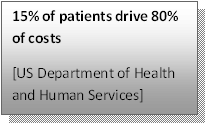
  • Dr. Peck talks about the fact that 75% of healthcare costs are from people with chronic disease and many of those could be identified early through risk factors.
  • Ron Levy talks about how 1/3 of the Medicare costs are spent in the last 3-6 months of life.

It was a good piece.  Healthcare as always is complicated with lots of factors.  The only way to fix things is to understand the correlations, isolate a few factors, and improve them.  I think a lot of solutions get discounted because their is always some reason why they can fail.

My big takeaway from the discussion was prevention.  We need more education, more screenings, and more wellness activities.  The question is aligning incentives at the patient and payor level to invest in these.

Generic Biologics

injection.jpgI mentioned this yesterday in a blog entry about The Right Prescription.  But I found a few things in an AHIP article today:

  •  Biologics are expensive, cutting-edge medical treatments made from living cells
  • $52.7B industry today; projected to grow to $90B by 2009

“We must focus our efforts on properly managing the costs of biotech drugs to ensure the pharmacy benefit is protected and preserved for the future.”  (Steve Miller, MD, Chief Medical Officer at Express Scripts)

  •  The  say that the top two anemia drugs accounted for 17% of all Medicare Part B carrier spending in 2005.  Two other biologics for cancer and rheumatoid arthritis made up another 3% of Medicare spending.
  • There is lots of discussion going on here at the legislative level to create a pathway for generic biologics to come to market.
  • PCMA estimated $14B in savings over the next 10 years if a pathway is created and Express Scripts estimated $71B in savings.

A Few Slides on Specialty

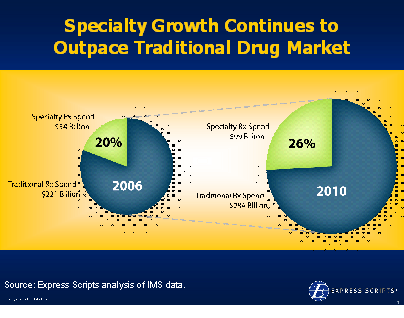
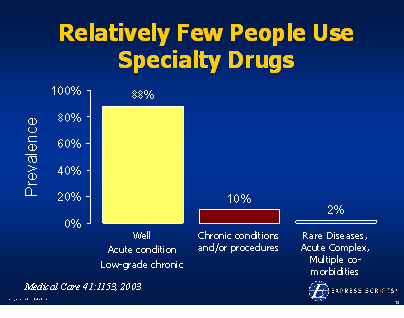
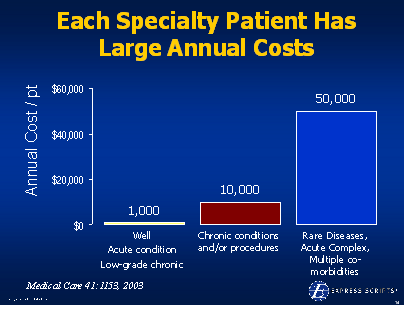
I only have one more post queued up on content from the Outcomes conference. Here is some data on specialty drugs that shows the growth, their percentage of the market, the prevalence, and the cost per patient.

More From ESI Outcomes

Continuing to pull some facts from the prior Outcomes conferences

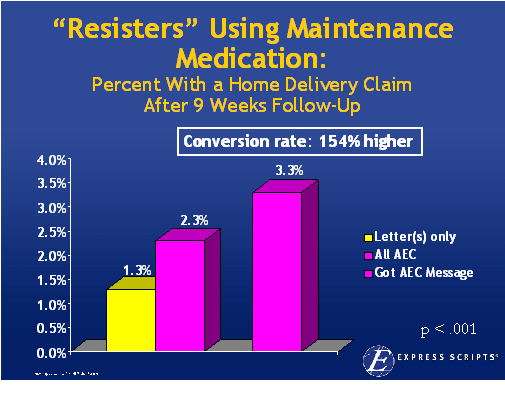
When we first began using what we called AEC (Automated Educational Calls), we did a couple of quick pilots with control groups to see how they worked and if they increased lift in our existing programs. For one of my programs (retail-to-mail), we saw a boost on top of our direct mail program not only from those people that received a generic message but especially from those people who listened to the call. Here was a quick snapshot since over the course of multiple attempts we had a 5% success rate with direct mail and in certain programs had gotten our success rate as high as 16% in direct mail while still seeing additional “lift” in the success rate by coupling calls and letters together.

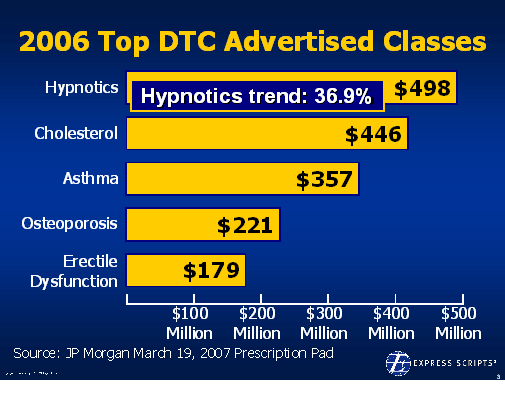
Another question answered was whether DTC (direct-to-consumer) advertising worked. Here you see that the most heavily advertised space had significant trend. In other studies, we showed that although DTC may not grow the specific drug in a 1:1 correlation it did grow the total pie for that therapy class.

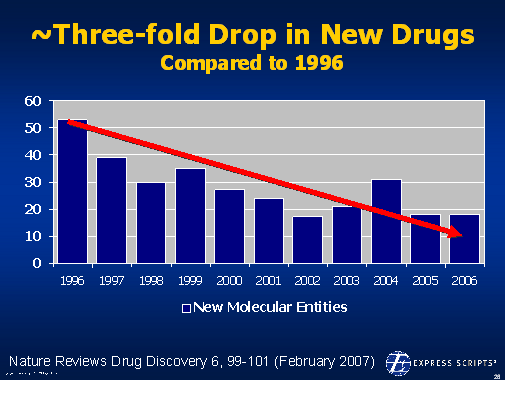
As I mentioned yesterday in the entry about big pharma, the discovery of new products has dropped dramatically as shown here.

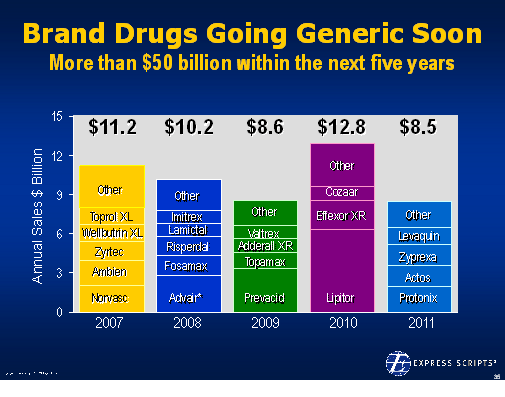
If you are focused on what’s happening from a generic drug perspective, this chart is a good picture of what’s expected over the next few years.

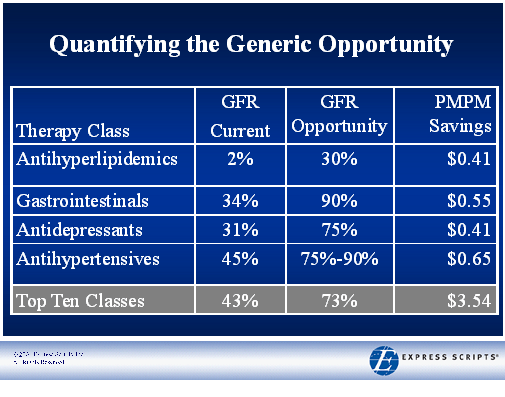
This is a little old (2004), but based on order of magnitude, it is relevant. The question is what is a theoretical maximum generic fill rate for some of the high cost therapy classes and what is this worth to a plan sponsor in terms of savings.

Another set of data that I always found interesting was the variation in use of generics by state.

The ESI Outcomes Conference

It was always fun to prepare for our annual Outcomes conference at Express Scripts. What research did we have? Who would it surprise? How would it impact us or clients? Anyways, all of these presentations and even some audio are on the website (2004, 2005, 2006, 2007). I pulled a few slides / graphs with some key points below.

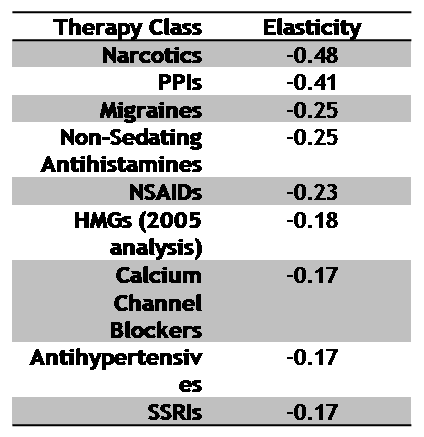
Is there compliance elasticity with prescription drugs? Of course. The research team replicated a published study and found results that were much less dramatic and echoed prior research supporting the following. (elasticity in this case meant that for each 100% increase in the cost of the drug what was the decrease in utilization of the drug)
elasticity-esi.png

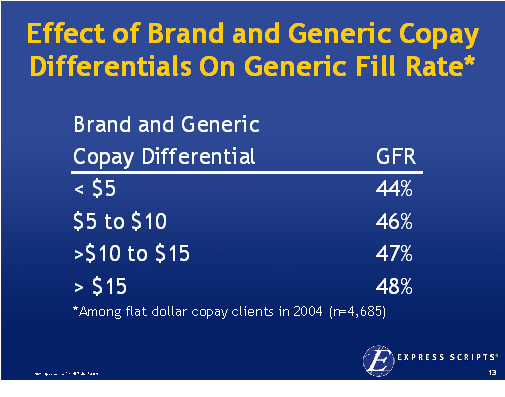
The differential between your brand and generic copays makes a difference in your generic fill rate (GFR). The data supports the null hypothesis that would say that the greater the difference (i.e., the more the patient saves) the higher the use of generic drugs.

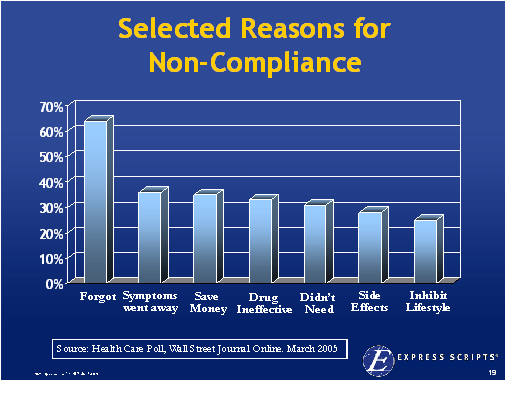
Why are people non-compliant (actually from the WSJ)?

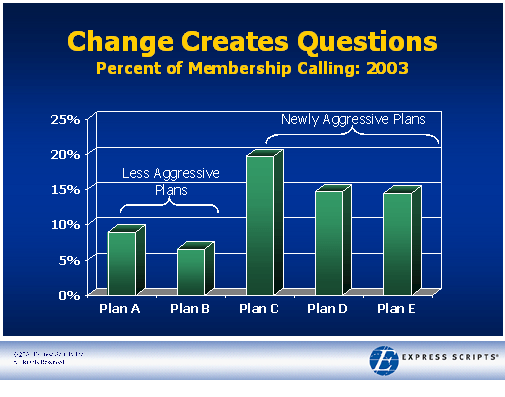
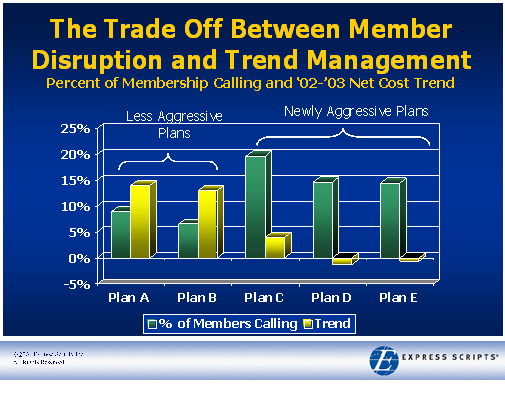
A question I often hear is what percentage of people call into the call center. Obviously this varies by population, but as shown below, it also greatly matters by how aggressive the plan design is and how many changes they are making.

The next question should be whether disruption (measured by the proxy of inbound call volume) is worth it. So, the slides show the trend versus the call volume.

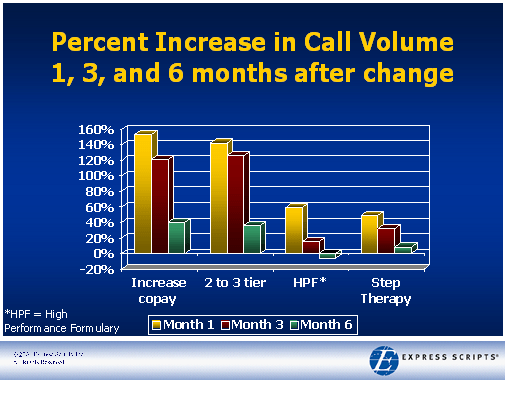
Sticking with the theme, the question is how long does the disruption last. Not too long.

It is never easy to get information out to patients in a timely and effective manner, but the question that also had to be asked is whether they wanted the information. From a 2002 Express Scripts survey:

  • 74% “feel more valued” when they understand the rationale behind their benefit design.
  • 85% “want information” about how to save money on their prescription drugs.
  • 80% feel “more in charge” when they understand choices

IBM HC 2015 – Win-Win or Lose-Lose

I skimmed another IBM publication today which I thought was a great piece – IBM Healthcare 2015: Win-win or lose-lose?. (A little long at ~70 pages, but good with concise charts.) It talks about what healthcare has to do to survive and create a win-win model. It looks at it from multiple perspectives – payor, provider, consumer, and supplier. They also do a good job of describing several unique models around the world and talking about several trends here in the US.

Here are a few quotes, facts, and charts from the publication which should tempt you to go read it…(note: I am not going to show all their sources, but you can get them from their publication.)

“The United States spends 22 percent more than second-ranked Luxembourg, 49 percent more than third-ranked Switzerland on healthcare per capita, and 2.4 times the average of the other OECD countries. Yet, the World Health Organization ranks it 37th in overall health system performance.

In Ontario, Canada’s most populous province, healthcare will account for 50 percent of governmental spending by 2011, two-thirds by 2017, and 100 percent by 2026.

In China, 39 percent of the rural population and 36 percent of urban population cannot afford professional medical treatment despite the success of the country’s economic and social reforms over the past 25 years.

Approximately 80 percent of coronary heart disease, up to 90 percent of type 2 diabetes, and more than half of cancers could be prevented through lifestyle changes, such as proper diet and exercise.

Preventable medical errors kill the equivalent of more than a jumbo jet full of people every day in the US and about 25 people per day in Australia.”

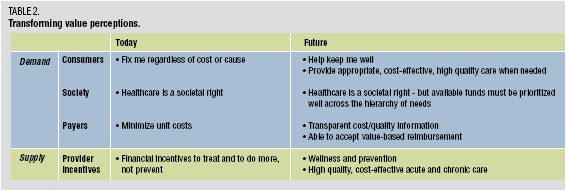
Table on IBM’s recommendations by stakeholder for what has to happen to transform to a value-based healthcare system (win-win).

ibm-table-1-on-change.png

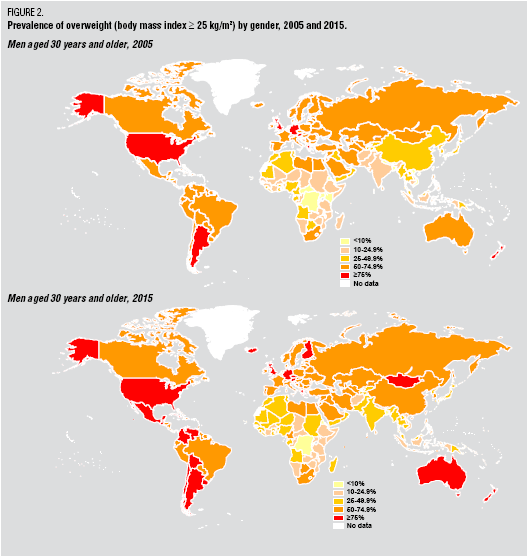
IBM chart pointing out the obesity issue’s growth

ibm-on-obesity-trend.png

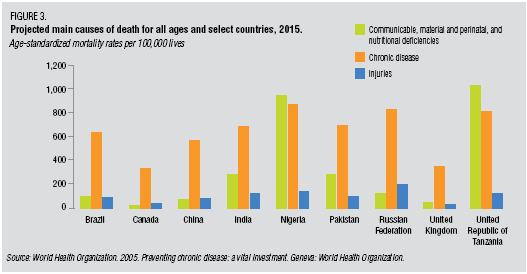
They talk a lot about the current system’s focus on episodic care while the problem is chronic disease.

ibm-3-chronic-disease.png

You will see lots of the buzzwords we hear today (transparency, empowerment, consumerism, infomediary, value-based) throughout the article, but they are delivered with facts and anecdotes to support their perspective.

ibm-4-transforming-health.png

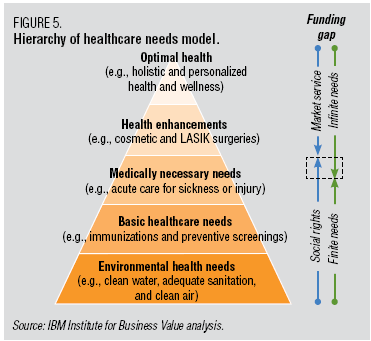
I could go on, but I will leave it with a nice adaptation of Maslow’s Hierarchy of Needs which they present around healthcare.

ibm-healthcare-hierarchy-of-needs.png

You will find information in here around telemedicine, retail medicine, health tourism, and they tee up some of the hard discussions about when is it too much. How much should we spend (individually or as a society)? What expectations should we have? A lot of it requires a different mindset for all the constituents. This would be a good read for the presidential candidates.

WSJ on the Future of Pharma

On 12/6/07, the WSJ had an article “Big Pharma Faces Grim Prognosis”. The manufacturers have been a good punching bag for a few years here as their creativity has slowed down (regardless of reality this is clearly the perception) and healthcare costs have become a front page issue. It is much easier to understand and compare drug prices than it is to look at provider costs. Now, with all the cost cutting at pharma, we will enter a new era.
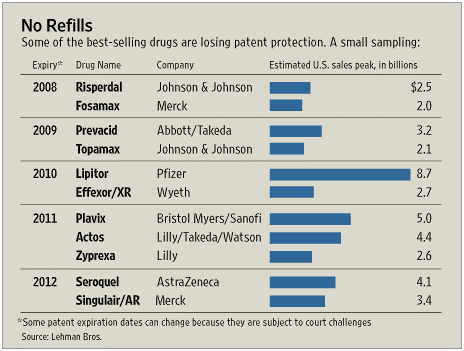
In the article, the authors (Barbara Martinez and Jacob Goldstein) predict that “over the next few years, the pharmaceutical business will hit a wall”. Their statistics on the movement to generics is even bigger than I remember. They say that roughly half of the manufacturer’s US sales are scheduled to lose patent between 2007 and 2012 (or more than 36 drugs representing $67B in annual US sales). (See charts from the article)

“The rise of generics wouldn’t matter so much if research labs were creating a stream of new hits. But that isn’t happening. During the five years from 2002 through 2006, the industry brought to market 43% fewer new chemical-based drugs than in the last five years of the 1990s, despite more than doubling research-and-development spending.”

“It has never been easy to take a drug from the lab, through animal testing and into human trials. The industry estimates only one out of every 5,000 to 10,000 candidates makes it to human trials. And many drugs that work beautifully in animals fail miserably in people.”

The article goes on to talk about regulation and the FDA and whether the lack of new products is their issue or some other issue such as the R&D organizational model. It also talks about the fact that not much has changed since the 1800s in terms of the framework for developing drugs. Obviously, this has been the driver for biotech where the drugs are made of proteins and there is no generic competition.
Of course, targeting niche patient groups with biogenerics creates very expensive drugs such as the $200,000 a year that Genzyme charges for Cerezyme to treat Gaucher disease. [If you’re total market size is smaller but your costs to develop and bring a product to market stay the same, prices have to go up or no one will develop the products. It is a problem.]
Given the focus on generics in the market and by the payors along with the battle between brands and generics, I always find it interesting that some of the big companies own generic companies (e.g., Novartis owns Sandoz and Pfizer owns Greenstone). I guess if you can’t beat them…join them.
It will be interesting to see how the companies react. As I have talked about with friends for years, it is relatively easy to be a successful executive in a wildly growing company and industry. It is hard to be a successful executive and leader in a cost oriented industry that is contracting and where the competitive pressures are great. Can these guys make the transition?

Cariten Article on Silverlink

There was a nice article in today’s Knoxville News Sentinel about a program that one of our clients did. The client is Cariten Healthcare, the insurance arm of Covenant Health. They used Silverlink to get a flu shot reminder out to their patients. The article includes several comments from Linda Lyle, VP of Operations.

“The words may be recorded, but real thought went into the message.”

“An effective way to get the message out in a timely manner.”

She points out that it would have taken their live agents 100 days to get out the message which Silverlink did in six days. (contacting 44,000 people)

The article also talks about the tweaking that they went through in trying to find the right voice. They are now using automated calls to seniors for other purposes (e.g., reminders for mammograms, cholesterol screenings and colonoscopies; brief information about diabetes and osteoporosis; a customer-satisfaction survey; and reminding patients with dual coverage to let them know).

“There’s not currently a way to track how many members follow the messages’ advice, but numbers from another national company indicate Cariten is having a 73 percent “reach rate” among seniors, compared to a national average reach rate of around 40 percent.”

Stanford Study: Automated Calls

Stanford just published a report called “Computer calls can talk couch potatoes into walking” which is a great valuation of the automated call technology. The study compared calls by real people to automated calls encouraging sedentary adults to exercise.

It is interesting since it is conceptually similar to the technology which we provide at Silverlink Communications. They used Text to Speech (TTS) which can sound a little “computer-like” while we record our calls with voice talent. In their study, participants had to respond using the dial pad (e.g., press “1” if you have exercised today) while our calls respond to voice (e.g., say “one” if you have exercised today). We have studied the improvements in success rates on calls simply from using all recorded voice versus some TTS and seen a very positive lift. [It is obviously hard to record variable fields such as first and last name, but we have done some of that to improve results.] Additionally, given all the variables you can play with in a more sophisticated system – different voices, different speed of the message, dynamic paths, etc., it would be interesting to do that head to head comparison.

A couple of key takeaways from the article:

  • Many of the participants in the program were over 55. [Which are your primary users of healthcare services.]
  • Initially 80-85% of those in the program said that they preferred or needed a human after listening to the computer program. [What you hear from lots of people until they use it a few times.]
  • Participants who lacked confidence in their abilities to be successful and who were less comfortable interacting with people did better with the computer voice. [A client of ours in the specialty pharmacy space was emphasizing this for certain therapy classes recently.]
  • The computer voice was just as helpful for men and women.

“The goal was to get participants out walking at a brisk pace for 30 minutes most days of the week, or some other form of medium-intensity physical activity, for about 150 minutes a week, as recommended by the U.S. Surgeon General. They were divided into three groups: a control group that didn’t get calls, a group called by trained health educators and a group called by a computer delivering an interactive, individualized program similar to that being delivered by the health educators. Exercise levels were measured with the use of an accelerometer, which provides an estimate of physical activity amount as well as intensity.”

Access, Price, Service…The Next Phase for MCOs

It seems a logical evolution of the marketplace. Have we moved to a point where MCOs can really differentiate themselves based on their service? (The indicator for me on this would be whether consumers are willing to pay more out-of-pocket to have one plan versus another simply because of service.) It will certainly happen. Web tools. Pro-active communications. Personalized messaging. Educational programs. Friendly call center reps. Consumers care about these things.

Coverage, the AHIP magazine, had a recent article called “Creating a Culture of Service” which is about this topic. It talks about a health plan where the average call is picked up in 12 seconds, the call abandonment rate is 2%, and 88% of questions are resolved on the first call. I am not sure this is a sustainable model of differentiation since there is a floor to improvement. It is similar to the Kano Model which is used in Six Sigma. This model points out that there are different curves of expectations. Initially, you can delight a customer with something new, but it quickly becomes a standard expectation in the marketplace.

The article does point out a key point which is that patients expectations of service are not based on healthcare companies. They look at Starbucks, Nordstrom’s, Amazon, Dell, Disney, and other companies for what they expect in terms of online presence, response time, and service culture. In many companies, the call center agent is the first (and potentially only) point of contact for a patient (or member). They are not highly paid and often take the brunt of complaints all day long. Finding a way to make them happy and patient centric is essential.

Another challenge which exists in any human centric function like customer service is consistency. As benefits get more complex and companies have huge turnover issues at their call center, getting the same answer every time is difficult. Which is massively frustrating as a consumer. We used to have to do “secret shopper” calls constantly to determine what parts needed more training. This is of course one area where automated voice solutions are being used both inbound (reactively) and outbound (proactively) to address consistency and timeliness. In many cases, you can predict events that will drive a call and see a patient’s history to understand their probability of calling (versus using the web). Why not launch a call to them before the call which is less expensive?

One hiring model we saw work very well in specialty pharmacy was hiring people who had a family member with a chronic condition. They were empathetic. They understood the patient’s frustrations. And, they could project their family member’s experience. They were great.

BTW – The article has a great sub-story about what Connecticare has done in their call center to address recruiting and turnover.

Other things I have seen work are empowering the end agent to resolve an issue up to a certain level. If a person is complaining about a $5 copay change, it may be worth waiving it one time and sending them some information rather than taking 3 calls from them at $5 per call. Or, it may be worth providing a one-time override rather than spending 8 hours trying to resolve it.

Incentives along with metrics are also another obvious tactic. Definitely don’t incent them to get off the phone quickly. That always creates issues. Look at ways of turning them into “sales agents” for the company and reward them for getting patients to change behavior or based on satisfaction scores.

And, one thing to avoid that drives patients crazy is having different information on the web than at the call center. And, even worse is not letting the call center agents have Internet access so they can’t see what the patient sees.

There are a few words on technology such as CRM (customer relationship management) and voice recognition software (e.g., routing to a different agent based on an angry voice). This surprises me a little since I think using data to segment and address different patients differently. Are they a frequent caller that we should route to a live agent without IVR (interactive voice response)? Do we know why they might be calling and have an answer?

As I have talked about before, I believe MCOs and other healthcare companies will be differentiated based on communications. How do they use their data and a permission based marketing approach to understand the patient, push information to them at the right time using the right medium, and support their needs? That is what I am focused on building with clients.

Physician Double Standard (What’s Ours)

There was an article out yesterday summarizing a survey of physicians.  The key point it made was that “up to 96 percent of those surveyed said they should report all instances of significant incompetence or medical errors to the hospital clinic or to authorities.”  [It was only 45% among cardiologists and surgeons??]  BUT, 46% of those surveyed knew of a serious medical error that had been made and did not report it.

Given all the focus on quality and error rates over the past few years, this seems concerning.  Although I am equally as concerned that the surgeons didn’t feel it was necessary to report issues. 

At the same time, I believe we can’t expect different standards from others that we wouldn’t be willing to be held to.  So, if you knew a collegue did something wrong, would you report them?  If they acted inappropriately at a client social event.  If they presented poorly and lost a sale.  If they made a mistake in their financial model.  If they had a spelling error in a marketing piece. 

Of course, not all of these are life and death, but I could certainly argue that rejecting a claim that pushed undue financial stress to a patient would be a serious issue.  Or, simply telling them a service wouldn’t be covered might discourage them from getting needed work performed. 

“There is a measurable disconnect between what physicians say they think is the right thing to do and what they actually do,” said Eric Campbell of Massachusetts General Hospital and Harvard Medical School in Boston, who led the survey.

Some of the other findings included:

  • Doctors are willing to order unnecessary — and often expensive — tests.  [How many of us don’t always take the least expensive path?]

  • Only 25% consciously tried to avoid gender or racial bias in how they treat people.  [How many of us consciously do this in our job?]

  • 93% of doctors said they should provide care regardless of a patient’s ability to pay but only 69% actually accepted uninsured patients who cannot pay.  [How many of us would be willing to provide our services for free to someone that needed them?]

URL:

IBM on HC 2015 – Part II

I think the entry got too long.  I got a system error that made me think I should split this up.  So, continuing on my review of the IBM publication on the future of healthcare, here are some additional notes I took:

  • They envision the growth of a “health infomediary” that helps people navigate their benefits and options within the healthcare marketplace:
    • A “health coach” – expert in lifestyle and behavioral change
    • A “value coach” – expert in benefits, pricing options, and cost-quality tradeoffs
    • A “wealth coach” – expert in financial planning for health related needs
  • They say that health plans as well as physicians could step into this role (along with new players).
    • 80% say hospitals are “doing a good job”
    • 60% say health plans are “doing a bad job” [which may challenge them in some of these future roles]

“Today, healthcare delivery is overly focused on the episodic treatment of acute care.  However, the emphasis of the healthcare system will contine to expand from episodic acute care services to include prevention, chronic condition management and better care coordination.”

value-based-ibm.png

  • There is good discussion about the needed change in the healthcare system to be more focused on wellness and greater alignment of incentives.  They say “today, there is more variability at the point of contact with the consumer (that is, the point of care) than in virtually any other industry.”
  • If you read the report, figure 8 summaries the current state versus future state that they envision along numerous dimensions – sponsorship, competition, innovation, revenues, networks, etc.  The things that captured my eye were:
    • Competition being based on information access [and in my opinion…easy of use of these tools across multiple channels]
    • Competition being drives by targeted products and services [one of my favorite topics…microsegmentation]
    • A wellness ROI
    • Value-based reimbursement [which I am sure is much more than P4P]
  • They talk about the blending of product and service (i.e., the offering as I would call it).  This has been a topic in other industries for years.  [Look at the book Blur from 1999.]
  • They layout four different roles for health plans:
    1. Health / Wealth Service Advisors – personal health concierges
    2. Health Services Optimizers – guide individuals to wellness and through healthcare maze
    3. Applied Research Advisors – aggregate knowledge to help patients
    4. Transaction Processors – clearinghouse
  • I didn’t know that the top 6 healthplans cover 60% of all insured Americans while their are another 500 plans.
  • They go on to propose some questions and sample indicators of readiness for the new healthcare environment.  Here are a few indicators:
    • single view of the member across products and business partners
    • proactive contact center
    • real-time analytics regarding wellness calls
    • member loyalty
    • value-based arrangement with providers
    • consistent answers across multiple channels

Hopefully, this is a helpful summary and enough for you to read the document.  Is a quick 18 pages with good facts and realistic proposals for the future.

IBM on HC 2015 – Part I

I had a chance to catch up on a bunch of reading on the plane including an IBM brochure I picked up the other day on “Healthcare 2015 and US Health Plans“. I found it to be a good piece with several good frameworks although it doesn’t take any radical views on the future (which I would have liked to see).

Here were a few of the facts / takeaways from the brochure:

  • US healthcare expenditures per capita are 2.3 times higher than other developed countries and projected to increase 83% over the next 10 years
  • Medical errors cause between 48,000 and 98,000 patient deaths per year
  • Medication errors cost the US over $3.5B per year
  • On top of the 47M uninsured, there are 15.6M underinsured
  • There are five issues that will make change difficult for healthcare:
    • Funding constraints
    • Societal expectations and norms
    • Lack of aligned incentives
    • Inability to balance ST and LT perspectives
    • Inability to access and share information

    “We believe that the U.S. healthcare system will not achieve a comprehensive “win-win” transformation by 2015 because of political gridlock and inability of key stakeholders to work collaboratively to reach solutions for the ‘greater good’.”

  • They do predict that some form of universal coverage will be enacted by 2015 and will be focused on the individual not the employer to address the “job lock” challenge.
  • They see a key role for health plans and call upon them to lead the transformation to a “more patient-centric, value-based, accountable, affordable and sustainable U.S. healthcare system”.
  • They predict that employer-sponsored health benefits for family coverage will increase from $8,167 in 2005 to $17,362 in 2015.
  • In 2006, PPOs (preferred provider organizations) accounted for 60% of private insurance enrollees (up from 41% in 2000).
  • Employers offering coverage has dropped from 69% in 2000 to 61% in 2006 and is predicted to go below 50% by 2015.
  • They talked about employers putting a lifetime cap on retiree benefits which was a new concept to me, but they said that 49% of employers polled in 2005 had a cap (of which 59% of those on the plan had already hit the cap).
  • They talk about lifestyle choices impacting premiums which would lead to increased wellness and preventative programs.
  • There is some scary data about money needed post retirement. They say that half of all bankruptcies are in part due to medical expense. They also say that “a couple retiring in 2016 at 65 years of age would need US$560,000 if they lived an average lifespan. They would need US$1.05 million if they lived to 95 years.” This is specific savings for healthcare costs in addition to Medicare. WOW!! And, they say that 40% of people over 55 have $50,000 or less saved.

ibm-retirement-health-savings.png


“The health–wealth intersection is already taking shape. Players from each sector are experimenting with offerings that cross the boundary between the two, such as reverse mortgages to finance nursing-home costs and arrangements that let individuals tap into their life insurance policies to cover medical costs. But the new health–wealth business will evolve and change shape for at least the next couple of decades, as the retail health-care market coalesces and consumers take on more responsibility for their medical needs.”

HBR Health Consumer Segmentation

Harvard Business Review has an article “What Health Consumers Want” by Caroline Calkins and John Sviokla (both from Diamond Consultants) in the December 2007 issue.  I think they sum up one of the problems that I talk about with a couple of quick comments in the beginning:

“Yet the idea that companies might profit by segmenting customers to address their varied needs seems almost foreign to the health industry.”

“Companies can uncover areas of untapped value by analyzing patterns in demand for health products and services.”

They point out that looking at people from a health and wealth perspective at the same time is very revealing.  Which certainly makes sense as many people are predicting that these two markets will come together at some future stage.  Their research pulled out four consumer groups [with my summary of their text]:

  1. Healthy Worriers – receptive to new things, willing to change, look at dynamic between wage inflation and healthcare costs, look to employers for information, overwhelmed by choices
  2. Healthy, Wealthy, and Wise – fit, health conscious, financially confident, want choices, not scared of complexity, self-service tools important, service focused
  3. Unfit and Happy – manage own money but overconfident on health issues, don’t trust MDs, need tools and incentives to drive action
  4. Hapless Heavyweights – not particularly health or financially oriented, typically overweight, need support groups and penalties

Personally, I find it nice that they point out the fact that some groups want incentives and some need penalties.  I have blogged about this a couple times as one of the simplest examples of why segmentation and message flexibility is so key.  I think the first two have a nice opposite with simplicity versus choice.

More Clinic Information

checkup.jpgThe AHIP magazine Coverage (Sep + Oct 2007) also has an article about retail clinics. There were a few takeaways here:

  • Someone is finally going to try and offer an airport based clinic (AeroClinic). This seems to make sense as some airports are basically shopping malls in disguise.
  • 5% of consumers know about retail clinics and have used them. Maybe I am too close to the space, but it seems like this is all I hear about.
  • 90% of consumers say they are satisfied with the quality of care…85% with the quality of staff…83% with the convenience. [Harris Interactive survey of 2,441 adults in March 2007 for the WSJ]
  • 42% of those that visited clinics were covered by insurance for some or all of the services provided.
  • Co-pays ranged from $15-$35.
  • 22% of those that visited clinics were uninsured. (which is a little more than the % of the general population that is uninsured – if my back of the envelope math is right)
  • The forecasted growth of clinics – 700 (2007); 1,500 (2008); 4,000 (2010). I am a little skeptical here, but I wouldn’t think you could have 3 Starbucks at one intersection or 6 pharmacies within a 3 mile stretch of one street. (both real examples)
  • There are some challenges around the model including from the AMA (American Medical Association) around conflicts of interest (i.e., clinics being owned by pharmacy chains) or the erosion of the “medical home” for the patient. Ultimately, there should be some health outcomes metric which is used – better compliance, more prevention, lower cost per disease state, etc.
  • BCBSMN found that members who were part of a consumer directed healthplan were twice as likely to use a retail clinic. They have been very closely involved with MinuteClinic from the beginning.
  • An individual from HealthPartners raises an interesting risk around provider capacity pointing out that if use of retail clinics increases provider capacity then it might actually increase total healthcare costs for the system. I guess this implies that the physician or hospital could charge more if they weren’t as busy. Not sure I buy the logic, but my micro-economics could be off.

Several groups have come out with standards or guidelines including:

PHR – Key for Improving Senior Care???

In the AHIP (America’s Health Insurance Plans) magazine Coverage (Sept+Oct 2007), there is an article on using Personal Health Records to improve healthcare for seniors. I am reading it as I type my commentary here, but I start with some skepticism.

  • Apparently CMS (Centers for Medicare & Medicaid Services) commissioned a 18-month pilot to help design a user-friendly PHR for Medicare beneficiaries.
  • The article gives a good, simple definition of PHR as being “designed for use by individual consumers and contain a core set of medical information that includes physician office visits, medications, lab results, and general health information.”
  • It talks about advance PHRs having a care alert which is a signal to consumers that they are due for a treatment of test. [I have talked with a few PHR vendors about this. I can’t agree more. It is great to have the data, but the systems need a proactive communication mechanism to push timely content to consumers so that they take action. (shameless plug…what a great opportunity for someone like Silverlink to offer an automated call program that takes automated triggers from the PHR and launches a pre-defined, personalized call to the consumer)]
  • It offers an interesting statistic that I haven’t seen before – 100M people (of the 249M insured) have at least one chronic disease.
  • CMS previously rolled out a bare-bones PHR at www.MyMedicare.gov which had 2M of the 42M Medicare beneficiaries register. [Of course, registration means nothing. How many actively log-in, update information, and use the information?]
  • Plans participating in the pilot include HIP of NY, Arkansas BCBS, BCBSLA, Humana, Kaiser Permanente, UPMC Health Plan, Aetna, and Medcore Health Plan.

“Health information technology will improve health outcomes and contain costs and help provide meaningful dialogue between members and providers so tests are not conducted unnecessarily.” (Laura Landry, Director of IT, BCBS Louisiana)

  • It talks about AHIP and the BCBSA (Blue Cross Blue Shield Association) collaborating to make PHRs transferable across plans which is vital for success.
  • Apparently, the groups have also collaborated to define a model PHR which would include physician encounters, names of clinicians and facilities, medications, lab results, family history, immunizations, health risk factors, advance directives, allergies, alerts, and physician directed plans of care.
  • The article also highlights another issue which is true for many solutions which is density of utilization by provider. For example, if the physician is expected to use a tool but only 5% of their patient base uses it, it will be hard to get them to change their workflow. If 90% of their patients use the same tool or a tool that provides a common interface to the physician, then they will be more likely to interact using the technology.
  • A representative from Humana says that seniors are using the data to enhance their dialogue with physicians. [I think this is a key point. I spearheaded the rollout of a “physician kit” at Express Scripts which was a set of forms that the patient could download to take to the physician’s office to discuss generics, mail order, and their condition. The key was that us communicating with either party was only so effective. We had to drive the two parties most involved in care to talk together with the facts in front of them.]
    • The article later talks about several of the demonstration projects that offer printouts for discussion or putting in the patient’s chart.
  • Humana members can also give access to family members and providers through their user names and eventually direct access.
  • Kaiser’s PHR allows the member to see when a lab was done, the results, and send questions to the physician directly through the tool.
  • It talks about one of the PHRs which automatically hides certain information from the provider but can be unhidden by the patient.
  • I thought the article was going to skip the subject of whether this population would adopt this technology, but towards the end it points out that according the US Census Bureau only 35% of people over age 65 have computers and only 29% have access to the Internet. [Of course, this will change as the Baby Boomers move into this phase of their life.]

senior-w-computer.jpgThe other critical component in my mind is that these things have to be automatically populated. The patient can contribute family history, allergies, and OTC utilization, but why should I have to type in my physician visits or prescriptions. That should all come directly into a system. There is a lot to prove here. The concepts are sound and rationale, but it’s a complex system with limited historical adoption of consistent technologies. People won’t stand for having to rebuild a new PHR every year as vendors and companies cycle through trying to settle on a few core products.

Pharmacy Satisfaction Is Declining

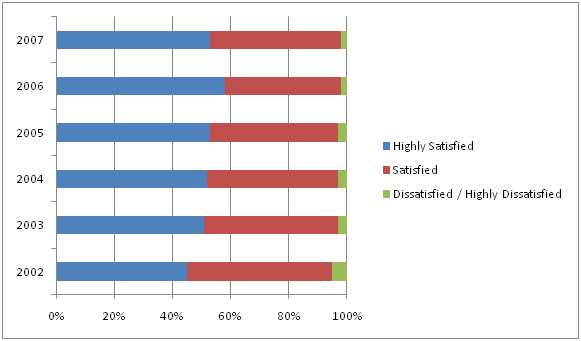
According to a WilsonRx survey that was published in the same Retail Clinician magazine (Winter 2007), “customers express a decline in overall satisfaction with their pharmacy in 2006, probably due to difficulties with Medicare Part D and rising copays.” The highly satisfied percentage dropped from 58% to 53%. I still think many industries would be happy with a 3% dissatisfied population. (see www.pharmacysatisfaction.com for more information)

I find it difficult to believe that people would blame the pharmacy for rising copayments or the complexities of Medicare Part D. But, everyone looks for a scapegoat for their problems. I think a more interesting question or survey would be how people judge satisfaction with their pharmacy. Is it wait time? Is it friendliness of the staff? Is it access to the pharmacist? Is it price when they pay cash? Is it willingness to call their physician or insurance company to resolve issues?

I was pleasantly surprised recently when I was at a Walgreens and saw the pharmacist come out from behind the counter to great an older patient, ask them about their wife, and spend time trying to see what she could do to help the couple. Usually, you think of the bigger chains as being so focused on production that you interface with the pharmacy technicians.

Retail Clinician Survey

Back when I visited a retail clinic (i.e., MinuteClinic, RediClinic, TakeCare), I grabbed a copy of the Retail Clinician magazine that they had. Finally, I am getting to the bottom of that reading pile to browse through it. It had a survey of 150 nurse practitioners that work in the clinics which revealed the following:

  • 57.2% of them work in clinics that are in chain drug stores
  • 63.7% of them came from a physician’s office or hospital / ER
  • 58.1% of them see more than 10 patients per day
  • Their busiest days are Mondays and Saturdays
  • 57.2% said that they write prescriptions for more than 70% of the patients they see
  • 53% said that they give OTC recommendations to less than 40% of their patients
  • 56.2% said that more than 40% of the patients they see don’t have a medical home (i.e., a primary care physician)
  • 21.2% of them saw their challenge as health care claims adjudication and 24.6% of them saw their challenge as public awareness
  • 79% said they would be receptive to handing out patient education materials
  • 67% said they would be willing to hand out product samples
  • 50% of them said that they consult the pharmacist 1-5 times per day for questions

I don’t have the data right now to compare this to physician’s practices, but it would be an interesting comparison in terms of percentage of times Rxs are written, etc. As I mentioned the first time I went to a clinic (I have been back since), I agree that this is a great avenue for information distribution. It is much less rushed than the physician’s office.


The Express Scripts Outcomes Conference

In my time at Express Scripts, one of the most interesting events was our Outcomes conference. We invited about 700 clients to come to beautiful St. Louis for 3 days to hear from our research group on trends and new programs to manage pharmacy benefits. All the large PBMs (Medco, Caremark, Express Scripts) put out annual publications on their research.

Express Scripts puts the publication along with the slides and audio out on the Internet. Here is a quick summary from 2007 which I took from the website.

  • Brand prices rose 6.9% in 2006, while generic prices fell 5.7%, which shows how generics continue to play a major role in managing prescription-drug trend.
  • 2006 drug trend of 5.9% – lowest in a decade.
  • More than $50 billion worth of brand drugs are scheduled to lose patent during the next five years. Important examples include Prevacid® in 2009 and Lipitor® in 2010.
  • Twenty percent of drug spend comes from specialty medications, but relatively few people use these types of drugs. This portion is projected to grow to 26% by 2010.
  • There are over 600 biopharmaceuticals products in the pipeline. This trend is being driven by the Human Genome Project, breakthroughs in the field of biopharmaceuticals, and a philosophical change in the pharmacy industry.
  • A growing number of members are becoming engaged in their decisions about prescription drugs, seeking information on drug-therapy alternatives and the prices of these alternatives. For example, 21% of the users on Express Scripts’ website used the Price Check feature during Q4 2006.
  • What Patients Don’t Know About Their Prescription-Drug Benefit
    • 64% could not correctly identify the type of pharmacy benefit plan they enrolled in.
    • 60% could not correctly identify the amount of their generic copayment.
    • 50% indicated their physician or pharmacist never or seldom talked to them about generics.
  • Several active ingredients work to influence the effectiveness of the information that plan sponsors provide to members:
    • Opportunity – Making sure you provide the information at the time in which the member is most engaged in the decision-making process.
    • Incentive – Members sometimes need an additional short-time incentive to choose the lower-cost option.
    • Assistance – Changing medications requires considerable assistance, which provides a barrier in making this adjustment.
  • The hypothesis was that Part D beneficiaries would take advantage of lower-cost generics to avoid hitting the donut hole. However, the reality is that many beneficiaries are hitting the donut hole unnecessarily and could take advantage of lower-cost generics.
  • Express Scripts’ research has shown that there is a direct correlation between a higher generic fill rate and the lower percentage of members reaching the donut hole.
  • The hypothesis from Wal-Mart was that low prices on selected generics would result in more volume of other generics and brands as well as increased nonpharmacy store sales. However, their market share increased by just 1% overall, which lead to a minimal market impact on prescription-drug use. Three reasons for this minor effect:
    • Members didn’t always save as much as advertised, and the payment was closer to $6 due to program limitations.
    • Members did not want to unbundle their prescriptions and use multiple pharmacies.
    • Many patients do not consider Wal-Mart a convenient choice.

Empty Every Chair

It takes a lot for an advertisement to catch my eye, but “empty every chair” made me think.  Especially, when I see the word health in the text.  The text goes on…

“Whose idea was it to build a room to house inefficiency?  The less time patients spend in the waiting room, the happier everyone will be.”

It’s an interesting view.  I couldn’t agree more.  The advertisement ends up being for PWC (PriceWaterhouseCoopers) and their healthcare consulting practice.  A link takes you to their site with publications on P4P, presidential plans for healthcare, wellness, and lots of other topics.

Do We Know What We Want?

In the November 2007 issue of Harvard Business Review, there is an article called Mapping Your Competitive Position by Richard A. D’Aveni.  From a general business perspective, it’s a good article which presents an interesting case about how you could have predicted that Apple would have dropped the price on the iPhone.  (Hint: Look at their behavior around the iPod and where the competition was and was predicted to go with the Razr.)

It made me wonder what the competitive map for healthcare would look like.  What are the market groupings for pharmacies, providers, PBMs, MCOs?  What is the price line and what would people pay for or not pay for?

“Most customers are unable to identify the features that determine the prices they are willing to pay for products or services, according to a 2004 survey by Strativity, a global research and consulting firm.  Worse, 50% of salespeople don’t know what attributes justify the prices of the products and services they sell.”

The article points out that most people involved in the process don’t know or fully understand the value proposition.  So…if we are going to try and redesign and improve healthcare, how can we do that?  Do consumers understand what matters?  Do the politicians?  Will we citizens understand who to vote for?

CVS / Caremark / MinuteClinic Article and Comments

I will stick with Drug Store News (Nov. 12, 2007) for now.  They had a good long story on the CVS Caremark acquisition building momentum.  They also talk about MinuteClinic which was a separate acquisition by CVS.  As I have said for a while, I think this was a good move.  It creates a lot of opportunity.  The combined entity now has touch points at several stops along the care continuum.  The question (of course) is how to capitalize on this without compromising the core businesses and without making people feel to “controlled” along the path.

From a top down view, the biggest things that jump out at me are:

  • How to expand the care model at the retail pharmacy using MinuteClinic.
  • How to get patient’s to grant access to share data across business units (PBM, retail pharmacy, MinuteClinic).
  • How to provide Medicare Part D type services like MTM (medication therapy management) through MinuteClinic facilities (even if the pharmacist were coming over to use them).
  • How to “value” each patient and determine the optimal mix of services and facilities for them.  For example, if they don’t impulse buy, you might as well get them to use mail.  Or, if they have a lot of maintenance medications that are generic, but they tend to buy a lot of other goods at retail, you might want to pre-fill their prescriptions at mail and ship them to the retail store for pick-up.  Or, if they have kids, you may want to encourage them to use the CVS that is an extra 2 miles away because it has a clinic.

Here are a few things from the article:

  • “So far, the moves are paying off as the company already has realized $660 million of cost savings and continues to anticipate about $1 billion of revenue synergies to be achieved by the end of 2008, with the later coming primarily as it rolls out new PBM offerings” (from Lehman Brothers analyst Meredith Adler in a research note)
  • Chris Bodine was named president of CVS Health Services earlier this year which is where the PBM and MinuteClinic business report up through [by the name of the group it would imply that there are more things to come once they digest these deals].
  • There hasn’t been much about what these new PBM offerings will be, but Tom Ryan (President and CEO) talked about them actively working and trying things that are “integrating our PBM capabilities with our strong consumer connections through our retail business”.  A few opportunities mentioned in the article are:
    • Therapeutic Interchange[If the retail POS (point-of-sale) system can deliver formulary alternatives to the pharmacists, CVS should be able to help their PBM customers make different decisions to drive formulary compliance (rebated brands and generics) while lowering patient’s copayments.  This would be a big deal to plan sponsors and patients.]
    • Flexible Fulfillment – They talk about allowing traveling patients that use mail to get short fills at retail.  [I think some retail-at-mail solution here will be more creative.  They could do central fill which is a concept where scripts are filled at a mail order facility and delivered to the retail pharmacy for pick-up.  They could split scripts to fill a 7-day at retail and the remaining 83-days at mail (depending on their cost structure).  There are lots of trade-offs here around whether they want foot traffic (for cross-sell) or not.]
    • Specialty at Pharmacy – CVS retail stores fill about $3B worth of specialty prescriptions (think about injectible drugs and drugs that are very expensive).  But, most people want more support and move to a dedicated specialty pharmacy.  [I am not sure of the economics and logistics of storing specialty medications across a broad retail base versus simply using retail as a referal source for their specialty pharmacy.  Now, some specialty drugs are still shipped directly to MDs and billed under a different fee schedule on the medical side.  If they could use MinuteClinic as a dispensing location for specialty drugs, they could offer a convenient service to patients, lower costs for their clients, and gain visibility into drugs being coded as medical services.]
    • MinuteClinic is in the process of creating a pilot program to monitor health assessments and screen for illness just for PBM clients.  [If they could figure out a way to offer preventative care, they might be able to figure out how to take risk.  It would be a powerful story to offer clients a service that bore risk around spending, trend management, and overall care / outcomes.  With a few other acquisitions or partnerships, they could begin to look very different.]
    • Corporate Clinics are briefly mentioned.  [This is another interesting pitch for me.  If you put a MinuteClinic on-site at many of their large corporate clients and/or in areas where they have a dense population, they could provide health services and use the clinic to “steer” (as legally allowed) patients to CVS, mail-order, or their specialty pharmacy.  For companies, this increases their stickiness to CVS on the PBM side while reducing time away from work for their patients.]
    • One-third of their PBM business is up for renewal in 2009 [so they have about 6-months to demonstrate the uniqueness of this story to those clients to easily renew them without major price concession.  As I sure their competitors will be focused on conflicts of interest, too much turmoil, and other FUD (fear, uncertainty, and doubt).]
    • On a fairly different note, another article about CVS talks about their new advertising campaign focused on women as caregivers including a new website for people to share personal stories.  (www.ForAllTheWaysYouCare.com)   The initiative seems to have an impressive group of panelists.

 forallthewaysyoucare.png

Highest Spending at Independents

In the November 12, 2007 issue of Drug Store News, they have a Pharmacy Facts section.  This month’s fact is about how much pharmacy customers spend on prescription medicines per month at the different types of pharmacies.  This is based on a survey done by WilsonRx.

  1. Independent – $87
  2. Mass Merchant – $82 (e.g., Target)
  3. Food – $78
  4. Chain Drug Store – $75 (e.g., CVS or Walgreens)
  5. Mail / Online – $69
  6. Clinic – $40

Even being close to the data, I am not sure what this tells me:

  • Older patients (who have more Rxs and therefore higher spend) go to the independents?
  • People without insurance and who pay full-price go to the independents?
  • The independents aren’t as able to drive formulary compliance and/or generic utilization to help lower out-of-pocket costs for their patients?
  • That people that go to independents are less likely to divide their spending between multiple pharmacies (i.e., use retail and mail order)?

It is an interesting data point, but without context, I am not sure how anyone can do anything with it.  But, that is how data gets manipulated.  I could use it to support any theory above.

BAH on Demographic Changes

BAH (Booz Allen Hamilton) has a business publication called Strategy and Business which has some great research.  I found this recent article on the changing demographics worldwide to be interesting and relevant to what we see in the US (which has a big implication on healthcare).

Here are a couple of quotes and facts from the article:

“To prepare for the implications of aging populations, individuals, organizations, and society as a whole must confront assumptions that are no longer valid.”

  • According to United Nations projections, the proportion of the global population over 65 years old will triple between now and 2100, from 7 percent to 21 percent.
  • Assumption 1: We’ll work long enough to pay for our retirement. …But suveys show that, until the age of 75 or so, people consistently underestimate the length of their retirement and under-provide for it financially.
  • Assumption 2: As our society gets richer, we can afford to retire earlier. The basic flaw in this is that people are not taking into account increasing longevity and its associated higher costs.

  • Assumption 3: It is useful to retire people early, because there are not enough jobs for everyone.

  • Assumption 4: Income and status at work rise linearly, and people retire at their most senior position.

  • Assumption 5: We accumulate assets while working and spend them during retirement.

  • Assumption 6: During retirement we won’t change residences more than once.

  • Assumption 7: The state will provide social and health-care services for us in our later years, allowing our children to inherit a significant portion of our estate.

  • For a couple who reach the age of 65, there is a 50 percent chance one of them will survive to the age of 90, and a 17 percent chance that one will reach 100.

“Restricting compulsory retirement will foster — or force — changes in work culture and minimize ageism. Our mental model is already changing from one of a ‘cliff edge,’ with an abrupt change from work to retirement, to more of a ‘plateau.’ “

All of this will have big implications on how we pay for healthcare, what types of services are needed, how we interact with these groups, etc. 

Patient as Googler

This story seems almost unbelievable to me, but I am sure it is true.  Time Magazine published this story “When the Patient is a Googler” on November 8th.

It is basically a physician’s perspective on an aggressive patient that uses the Internet to find out lots of information about him.  The patient treats the physician with total disregard (which is unacceptable in any situation).  The physician on the other hand rants about patients and doesn’t grab control of the situation but simply “punts” her to another doctor.

“A seasoned doc gets good at sizing up what kind of patient he’s got and how to adjust his communicative style accordingly. Some patients are non-compliant Bozos who won’t read anything longer than a headline. They don’t want to know what’s wrong with them, they don’t know what medicines they’re taking, they don’t even seem to care what kind of operation you’re planning to do on them. “Just get me better, doc,” is all they say.

At the other end of our spectrum are patients like Susan: They’re often suspicious and distrustful, their pressured sentences burst with misused, mispronounced words and half-baked ideas. Unfortunately, both types of patients get sick with roughly the same frequency.”

In my opinion, they are both wrong.  Patients should certainly do their research before and after meeting with a physician.  They also need to give the physician a chance to use their training and experience to help the patient.  Physicians need to be open to patients doing research and asking questions.  They should be willing to suggest sites to patients for research.  This is not a subject that will go away.

There are several other discussion streams out there about this article if interested:

WSJ on Texting in Healthcare

Obviously my entries about texting in healthcare are timely. Today’s WSJ includes an article (pg D1) by Rachel Zimmerman called “don’t 4get ur pills: Text messaging for Health”.

She points out several compliance type programs where this is being used (outside the US)…birth control pills (England), AIDS (Australia), psychological support for bulimics (Germany), and smoking cessation (New Zealand).

Apparently, the American Telemedicine Association is developing guidelines for the appropriate use of text messaging in healthcare (along with other new media). The executive director, Jonathan Linkous, was quoted as saying “There are obviously times when telemedicine is inappropriate. Texting someone to tell them they have cancer is one of them.” [I think we can all agree.]

Of course, with health costs being concentrated in a small percentage of the population which is typically older, can texting make a difference? It isn’t easy to type on those small mobile phones with arthritis. Lots of seniors don’t even carry mobile phones. Plus texting is a whole different message as the article points out. My kids will probably get it much better than me.

Plus, using condense information can be risky. We had this problem in sending messages to pharmacies where we had a finite amount of characters to say “Drug A is not covered but the following drugs are covered but if medically required then the physician has to call 800-xxx-xxxx to request a prior authorization”. Other than reminders or pushing them to a very specific action it may be a challenge.

I think sending links or phone numbers via text message could be helpful. For example, using co-browsing, a company could trigger a message a message suggesting the patient call-in for more information or also go to another site. [What is co-browsing…this is when a company (typically a call center agent) can see where an individual is on the web and what they are looking at to help them.]

She mentions a few companies:

There certainly is a need for something that is quick and ubiquitous around healthcare. For someone under 40, I think texting could work great. For people over 40 (an arbitrary line), I think automated voice is better. It is just as quick. It is ubiquitous. And, it can be personalized and change during the call versus going back and forth via text messages.