Archive | Books / Articles RSS feed for this section

Emotional Intelligence (EQ)

I will admit that I have a lot to learn around EQ which is firmly grounded in neuroscience, but I wonder why I don’t hear a lot about this from a communication perspective. Obviously, our reaction to information varies based on where we are emotionally. At the simplest level, I think EQ is why guerilla marketing or grass roots marketing can sometimes be so effective. For many people, group interaction and group perceptions drive their behavior.


Daniel Goleman is the author who popularized the EQ term with his book “Emotional Intelligence” published in 1995.

He has identified Five Dimensions of Emotional Intelligence. The first three are personal and the final two are social.

  1. Self-Awareness – Knowing one’s internal states, preferences, and intuitions
  2. Self-Regulation – Managing one’s internal states, impulses and resources
  3. Motivation – Emotional tendencies that guide or facilitate reaching goals
  4. Empathy – Awareness of other’s feelings, needs and concerns
  5. Social Skills – Adeptness at inducing desirable responses in others

After typing these out, I wonder if we could get an EQ score for companies. That would be an interesting ranking to see how aware and empathetic companies really are.

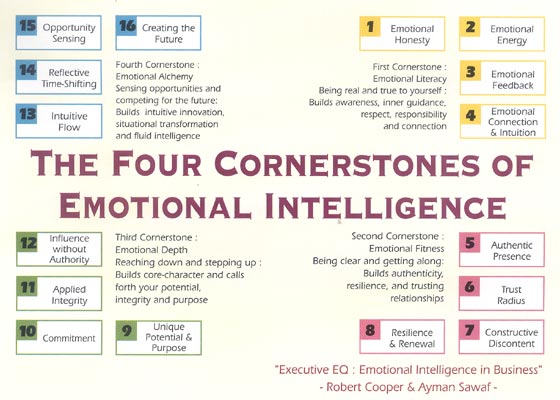
I liked this image I found that represents Executive EQ or EQ for Business.

eq-for-business.jpg

So, I think the key question here is how could we capture an individual’s EQ (or a proxy for it) and use that in our targeting and messaging to them about healthcare.

Leadership in 60 Seconds

I have always been fascinated by two topics – leadership and innovation.  They have driven me to read many things and try different roles.  I also believe my pursuit of both architecture and business as a combination of right and left brain challenges was a way for me to try to learn both.

I found this presentation on leadership which is a quick summary of many points.  In the end, it is a little more of a teaser deck for a book, but it is a good reminder of many things about leading.  Since I believe healthcare companies have a chance to lead the market right now before government leads them, it is a topic to think about.

Permission Marketing – This is What I [patient] Want

Permission Marketing is certainly not my concept. Seth Godin invented the term and wrote the book on this several years ago. But, I think it is a concept way behind it’s time in healthcare.

“Permission Marketing cuts through the clutter and allows a marketer to speak to prospects as friends, not strangers”

The concept (in my words) is that you ask the consumer (aka patient) what they want.

  • What information do you want from us?
    • Opportunities to save money
    • Alternative therapies
    • News about your drug
    • Benefit information
    • Compliance reminders (Rx, lab visit, tests)
  • How do you want that information delivered to you?
    • Phone
    • Voicemail
    • Cell phone
    • SMS / Text message
    • E-mail
    • Fax
    • Letter
  • Does the channel you want the message delivered through vary by the message?
    • Deliver savings information within 24 hours to me via my cell phone
    • Send benefit information via PDF using my home e-mail address
  • When do you want that information delivered to you?
    • Pro-actively
    • Reactively
    • Bundled (i.e., send me one “package” of information monthly)

Wouldn’t that be nice? Most of us don’t even know what the options are. We just get bombarded with information from our employer, managed care company, pharmacy, PBM, disease management company, wellness programs, HSA / HRA account manager, etc. Different messages. Different information.

In reality, one of the biggest problems is that our healthcare companies just can’t manage these type of personal rules today. Managing do not call lists are difficult enough. This should change over the next 5 years, but it will be a combination of patient generated preferences along with data mining to develop algorithms that predict what channel and message is most effective at driving behavior for certain patient segments.

Understanding Healthcare (Wurman)

Richard Saul Wurman has been publishing for years and done many interesting things.  I just stumbled upon his Understanding Healthcare site today.  It is worth a visit.  You could get lost in it, but it has lots of great examples about how to frame healthcare issues visually.  I took a few screenshots below to get you interested.

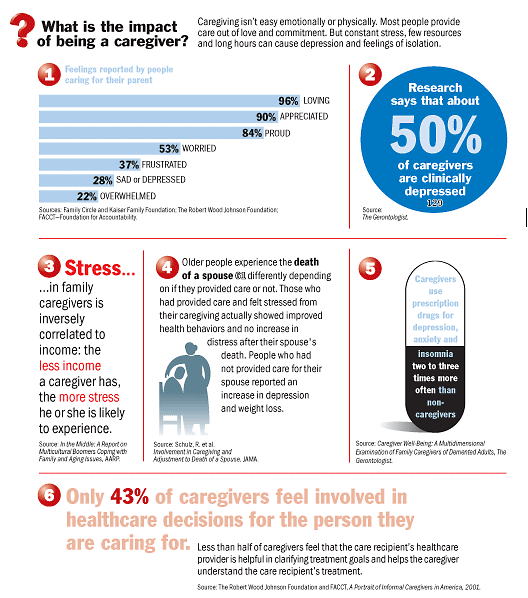
One shows the top 10 causes of death in the US (note all this is a few years old) by age.  Very easy to understand the data this way.  One shows the tests that you need by age.  (I could use this now.)  The other is just representation of some data around caregivers.

wurman-causes-of-death-by-age.png

wurman-timeline.png

wurman-caregiver.png

PBM / Pharmacy Benefits Data (Takeda)

Takeda publishes The Prescription Drug Benefit Cost and Plan Design Survey Report (free to order here). I read the 2006 edition last night. It is full of great data that I would want if I were a consultant, a HR representative, or responsible for my companies PBM relationship.

The document also points you to the American College of Occupational And Environmental Medicine for other information.

Here are some of the facts (based on respondents to their survey):

  • 69% of employers less that 5,000 employees are self-insured
  • 97% of plan sponsors chose to be self-insured so that they had the ability to customize their health plan to meet workforce needs
  • 68% of employers use separate vendors for medical and pharmacy of which 53% use a PBM
  • Average pricing was:
    • $1.88 in retail brand dispensing fees
    • 84.7% AWP reimbursement for retail brands (or AWP – 15.3%)
    • $0.24 in mail brand dispensing fees
    • 78.1% AWP reimbursement for mail brands (or AWP – 21.9%)
  • Formularies were used by almost everyone – 92%
  • Mail copayments were roughly 2x the retail copayment (for 3x the supply of medication)
  • Employer size appeared to matter for price negotiations (no kidding) and they showed that employers w/ over 20,000 members achieved a retail rate of 0.8% less that employers with less than 2,000 members
  • Sponsors who use mandatory mail got a lower reimbursement rate (77.1%) than those without mandatory mail (78.4%)
  • Only 2% of sponsors use a closed formulary where drugs not listed are not covered and the patient pays the cash price
  • It cites research on adherence (The Importance of Medication Adherence, Stambaugh, April 2006) which showed the following reasons for poor medication adherence:
    • 1% don’t know how to use the drug
    • 10% can’t get the Rx filled, picked up or delivered
    • 14% don’t think they need the drug
    • 17% said the drug costs too much
    • 20% don’t want the side effects
    • 24% sometimes forget to use or refill the prescription
    • 10% cited other reasons
  • 40% of employers who design their own plans use co-insurance as opposed to 13% of people who use other parties (i.e., consultant or managed care)
  • Mail service utilization ranged from 0.2% to 62% with 18.3% being the average
  • If a company had mandatory mail, their mail use was 32% versus 14% if voluntary mail
  • Generic dispensing rates ranged from 33% to 71% (51% average) at retail and 12% to 65% (39% average) at mail – which is due to the different mix of acute versus maintenance drugs typically
  • Talked about specialty drugs quoting cost to treat MS at $12K per year and hemophilia at $120K per year (Rx only)

Lots of good information to have.

Experience Based Differentiation

I must admit that I haven’t read the book yet, but it has been recommended to me by several people.  (Married to the BrandMarried to the Brand

Instead [of volume or profit], companies should focus on an objective that merits the diligent, even obsessive attention of the company’s managers: customer engagement, and healthy brand marriages. Every manager should be laser-focused on building and protecting the company’s most precious assets — its powerful and passionate customer relationships. These brand relationship assets determine the continued health and future success of the company.  (see more on the book content)

The reason I mention it is that in talking with an experiential branding expert I found their example of Starbucks very comparative to healthcare.   It has died down a little in the past few years, but I have often heard people talk about how hard it is to differentiate a healthcare offering.  I think Starbucks is the perfect example of a different way of thinking about this.

Coffee is coffee (with some slight modifications in taste).  People go to Starbucks and one of their sustainable differentiations is the experience.  It is difficult to replicate the experience that people have.  That should be the focus in healthcare.  How they experience the office lobby, the staff, check-in, admissions, enrollment, the call center, member materials, outbound communications, etc.?  This is what will make you different.

It is never easy to quantify loyalty and correlate that with experience.  But, let me use a simple example.  I bet that price being relatively equal no company will switch health plans, PBMs, etc. if the CEO and/or their spouse has had a great experience with the company.  There are too few great experiences.  This is your chance to step-up.

Sicko – Good Food For Thought

Have you seen Sicko? I got the management team from a healthcare client of mine to go see it with me last week in Boston. I thought it was great. If you know nothing about healthcare, you will think our system is the worse system in the world and be appalled. If you work in healthcare, you realize Michael found and did a great job of pointing out many of the weaknesses.

He also did a good job of identifying some interesting facts and showing us how healthcare works abroad. Without being a spoiler, here are some observations:

  • People without health insurance that get hurt face some very tough challenges. We need some type of care system that supports them.
  • Our processes should not interfere with care. Dropping people off in hospital gowns since they can’t pay their hospital bills is wrong.
  • Drugs are a lot cheaper outside the US.
  • The hypothesis that you wait for care outside the US seems to be a myth.
  • Running a company based on denial of care versus managing risk through wellness is a problem. This ties to bigger problems we have with the system design.

Before I go off as a liberal republican (or conservative democrat), my only recommendation is see the movie.

Sicko

Myths of Innovation

Guy Kawasaki has another great interview on his blog.  This is an interview with Scott Berkun, author of “The Myths of Innovation”.  If you are fascinated with innovation, this is a good read.  I have tried innovation internally and externally.  These last few start-ups which I have worked on have been great.  This article addresses some of the things I have learned the hard way. 

“Innovators are born and made
Innovators face lots of challenges outside the creative process – support
Get out of the ivory tower and “tinker”

Problem definition (i.e., asking the right questions) is key  (At HOK, we used to use a book called Problem Seeking for architectural requirements which is a helpful framework here.)

There is a lot more here.  I think companies often miss the importance of “sponsoring” innovation through several actions:

  • Encouraging people to try things and having a culture that allows risk
  • Capturing ideas and having people who look across ideas for new combinations of things
  • Having funds allocated to try things…if VCs who get their pick of ideas only expect 2 of 10 to flush out, why do companies look for 10 of 10
  • Bringing in people with diversity (background, culture, education, industry)

Innovation is a critical process for companies.  Thinking about how you create it, capture ideas, and manage your portfolio is important.  In this blog, I have talked about P-TRIZ and Return on Time (ROT) which are both relevant here. 

Medical Devices and the 10 Faces of Innovation

Today, I unsuccessfully searched for a smart consumer device that would link process and medical monitoring.  I am sure it is out there, but I couldn’t find it.  The opportunities are numerous.

Imagine having a device that monitored your blood sugar levels and sent off messages based on your current levels.  The messages could be to home to make something different for dinner.  It could be a note to yourself to remember to snack earlier in the day.  It could be a note to your physician keeping them aware of your situation.  I think that the opportunities for consumer centric medical devices that have embedded intelligence and plug into some type of BPM or process centric model are great.

Art_of_innovation This made me think of one of my favorite companies – IDEO.  If you don’t know them, you should.  They have been involved in all types of innovation and product design.  The Art of Innovation by Tom Kelley is a great book about their process.  You should also read the article about the different types of innovators in Fast Company.

This article categorizes them into Learning, Organizing, and Building personas.  Which are you?  I am either a Cross-Pollinator or a Collaborator (in my mind anyways).

Continue reading

The Art of Ware

I was just skimming a story from Guy Kawasaki’s blog about The Art of ‘Ware by Bruce Webster.  I was a little skeptic, but Guy always has great instincts.  I read a few of the chapters in the book and think you would enjoy it.  Especially if you work with or at a software company.

Here is some text from the home page about The Art of ‘Ware…

Back in the early 1990s, I [Bruce Webster] wrote and published The Art of ‘Ware (M&T Books, 1995), a reinterpretation of Sun Tzu’s The Art of War, a 6th century BC treatise on conflict and warfare. My reinterpretation of Sun Tzu’s maxims applied to developing and marketing information technology products, most particularly software. Here’s an example:

  • Sun Tzu (Chapter 2, ‘Waging War’, 1910 Lionel Giles translation): Now, when your weapons are dulled, your ardor damped, your strength exhausted and your treasure spent, other chieftains will spring up to take advantage of your extremity. Then no man, however wise, will be able to avert the consequences that must ensue.
  • The Art of ‘Ware (Chapter 2, ‘Supporting Development’, 1995 edition): When your developers are burned out, your technology aging, your resources diminished, and your advantages gone, then others will take advantage of your weaknesses and cut into your market. Even expensive consultants and new CEOs won’t be able to turn things around.

The McKinsey Way

You can certainly never go wrong looking at McKinsey. Their consultants are usually very top notch and their process of thinking and root cause analysis is great. Although this post is more about how you analyze a problem (i.e., business process innovation), it also makes a point about how important process and methodology is. The only way of delivering consistent, high-quality advice worldwide is to have a process of training and consulting that leverages smart people and delivers them to clients.

(Never mind the fact that McKinsey once told me that they only interview people with a 4.0 or people with a 3.8 and above from a top 5 business school. I didn’t fit the bill, but I have several good friends who were there. I have lots of respect for them.)

The McKinsey Way is actually a book so you can see some insight into the company. I have read the book and recommend it. Rather than re-type all my notes, I found comments about the book at MeansBusiness and on blog called Brian Groth’s Life at Microsoft and looked at notes on MECE (mutually exclusive, collectively exhaustive) from a book review on The McKinsey Mind.

My old boss who worked for McKinsey was a genius at asking the probing questions. She knew how to get to root cause better than anyone I worked for. This is essential in diagnosing any problem not least of which are process problems. (Since I assume you only look at BPM to drive value where you have some type of problem.)

So MECE, as Brian states in his blog, it suggests you should do the following:

  1. Identify the problem using a mutually exclusive, collectively exhaustive framework and then map the problem out using some type of logic tree (see example).
  2. Create a hypothesis (or hypotheses) about the solution…this drives your analysis.
  3. Analyze the data…remember that the only thing that is right is data (assuming some data integrity).
  4. Repeat steps 3 & 4 until you find a fact-based solution that makes sense.

From the book, some of the other key points are:

  1. “The most brilliant solution, backed up by libraries of data and promising billions in extra profits, is useless if your client or business can’t implement it.”
  2. “Most business problems resemble each other more than they differ.”
  3. “If you get your facts together and do you analyses, the solution will come to you.”
  4. “If you keep your eyes peeled for examples of 80/20 in your business, you will come up with ways to improve it.”
  5. “Know your solution so thoroughly that you can explain it clearly and precisely to your client in 30 seconds.”
  6. “It’s much better to get to first base consistently than to try to hit a home run and strike out 9 times out of 10.”
  7. “Just as you shouldn’t accept I have no idea from others, so you shouldn’t accept it from yourself, or expect others to accept it from you. This is the flip side of I don’t know.”
  8. “When you’re picking people’s brains, ask questions and then let them do the talking. Keep the interview on track by breaking in when necessary.”

5 Patterns of Extraordinary Careers

At Express Scripts, all of us on the leadership team (top 1.5%) were given the book The 5 Patterns of Extraordinary Careers.  It was a good book with several relevant tips especially for someone in the BPM space that is likely playing the role of change agent or somone whose career might include an objective of becoming the Chief Process Officer or Chief Innovation Officer.

From the website, I have pulled in the 5 Patterns.  They also have an online quiz which gives you feedback on whether you are on your way to an extraordinary career.

1. Understand the Value of You
People with extraordinary careers understand how value is created in the workplace, and translate that knowledge into action, building their personal value over each phase of their careers.

2. Practice Benevolent Leadership
People with extraordinary careers do not claw their way to the top, they are carried there.

3. Overcome the Permission Paradox
People with extraordinary careers overcome one of the great Catch-22s of business: you can’t get the job without experience and you can’t get the experience without the job.

4. Differentiate Using the 20/80 Principle of Performance
People with extraordinary careers do their defined jobs exceptionally well but don’t stop there. They storm past pre-determined objectives to create breakthrough ideas and deliver unexpected impact.

5. Find the Right Fit (Strengths, Passions & People)
People with extraordinary careers make decisions with the long-term in mind.  They willfully migrate towards positions that fit their natural strengths and passions and where they can work with people they like and respect.

Best Advice

I am not really sure of the best advice I have ever received.  Most of the things that jump to mind as good advice are: 

  • Be yourself.  
  • Everyone has something to add – treat them with respect. 
  • Travel the world. 
  • Keep a journal of what you learn each day.   
  • No one remembers you for how hard you work…your family is your memory.
  • Just act…don’t overanalyze.
  • Nothing will be perfect.

Here is advice from some well known names from a Fortune article titled “The Best Advice I Ever Got” (March 21, 2005 – page 90).

  • Warren Buffett “You’re right not because others agree with you, but because your facts are right.”
  • Richard Branson “Make a fool of yourself.  Otherwise you won’t survive.”
  • Howard Schultz “Recognize the skills and traits you don’t possess, and hire people who have them.”
  • A.G. Lafley “Have the courage to stick with a tough job.”
  • Sumner Redstone “Follow your own instincts, not those of people who see the world differently.”
  • Meg Whitman “Be nice, do your best – and most important, keep it in perspective.”
  • Jack Welch “Be yourself.”
  • Sallie Krawcheck “Don’t listen to the naysayers.”
  • Vivek Paul “Don’t limit yourself by past expectations.”
  • Dick Parsons “When you negotiate, leave a little something on the table.”
  • Andy Grove “When ‘everyone knows’ something to be true, nobody knows nothin’.”
  • Anne Mulcahy “Remember the parable of the cow in the ditch.” [First, get the cow out of the ditch.  Second, find out how the cow got in the ditch.  Third, make sure you do whatever it takes so the cow doesn’t go into the ditch again.]
  • Brian Grazer “All you really own are ideas and the confidence to write them down.”
  • Rick Warren “Regularly sit at the feet of Peter Drucker.”  [You need mentors.]
  • Jim Collins “The real discipline comes in saying no to the wrong opportunities.”
  • Peter Drucker “Get good – or get out.”
  • Ted Turner “Start young.”
  • David Neeleman “Balance your work with your family.”
  • Mickey Drexler “Bail out a business that isn’t growing.”
  • Brian Roberts “Let others take the credit.”
  • Marc Benioff “Incorporate philanthropy into your corporate structure.”
  • Hector Ruiz “Surround yourself with people of integrity, and get out of their way.”
  • Donny Deutsch “If you love something, the money will come.”
  • Klaus Kleinfeld “Keenly visualize the future.”
  • Ann Fudge “Don’t chart your career path too soon.”
  • Herb Kelleher “Respect people for who they are, not for what their titles are.”
  • Clayton Christensen “You can learn from anyone.”
  • Ted Koppel “Do what you love.”

The Power of Process

It has been a few days without blogs while I was on vacation.  But, it gave me a chance to sit down and read The Power of Process by Kiran Garimella  from cover to cover.  Kiran follows the story style of The Goal (Goldratt and Cox) and The Choice (Russell Roberts).

In this story, a mythical consultant helps a management team (primarily CEO, CIO, and CFO) understand BPM, SOA, and many other TLAs (Three Letter Acroynms) related to process.  It is a good and quick read that addresses many of the questions that I get from clients – isn’t this a technology issue, does this compete with Six Sigma, how does this relate to other projects, where should this be located within a company, how to start, etc.

Let me highlight a few of my favorite parts:

  • “Lean takes the fat out of processes.  BPM keeps it out.”

  • “Process Management offers a disciplined, sustainable meta-process for controllership and compliance.”

  • He emphasizes a lot the opportunity for BPM to automate the repetitive tasks and create a greater “Return on Time” that frees up the opportunity for innovation.  (more on this in another blog)

  • He provides great discussion on Six Sigma and BPM which I have seen to be a point of confusion for many people.

Paul Harmon of BPTrends  did a good review of this book.