Archive | Consumerism RSS feed for this section

Complementary Webinar – Cost Savings Programs

If interested, I am going to host a webinar for managed care companies and PBMs.  (Sorry, but this is limited to clients and prospects only.)

Proactive Cost Savings Programs for Your Members

In these economic times, members are looking for all the opportunities they can find to save money and reduce their out-of-pocket spending.  This is a great time to drive loyalty by proactively interacting with your members and helping them understand how to save money.

Some of the timely communication programs that will make an impact include:

  • Movement to generics (i.e., therapeutic interchange)
  • Movement to mail or 90-day retail
  • Pill splitting or dose consolidation

This is true for your commercial members as well as your Medicare members who are in the “donut hole”.  Don’t let your members struggle and end up skipping doses or not taking their medication.  This can lead to much bigger issues downstream.

Join Silverlink Communications for this interactive webinar and learn how you can design communication programs that help your members save money while improving your bottom line.

Register Here.

Prescribing Placebos

I found this entry on the WSJ Health Blog and all the comments very interesting.  At the core, the issue is that if a physician prescribes a placebo (sugar pill, vitamin, OTC, antibiotic) to make the patient feel better even though it medically won’t (but may mentally)…is there something wrong with that.

Obviously, if it drives a financial burden for the patient, that would be wrong, but I don’t see physicians doing that.

If it prescribed a medication that had serious side effects, that would be wrong, but I don’t see physicians doing that.

If it was a simple remedy (e.g., take B12), that doesn’t seem harmful.  There have been plenty of arguements about medications like antidepressants and whether they work, but they still get prescribed quite a bit.

Pharmacy Musical Chairs

Remember back in the 90s when AT&T, Sprint, and all the other companies kept offering you incentives to move to their service?  I had an uncle who just kept moving around and getting $50-$100 checks.  I thought he was crazy, but he never had an issue.

Given the economy and the incentives being offered in pharmacy, I wonder why a consumer wouldn’t do the same.  I saw a $25 gift card offer at Walgreens yesterday.  I know Target has had a $10 gift card offer for a while.  Some of the mail pharmacies occassionally offer coupons or copay waivers.

So, if I was a consumer with a maintenance drug that I have used for a while and don’t need consultation on, why wouldn’t I move my prescription every month to a different pharmacy and get these gift cards.  I think I would.  I don’t know all the terms, but if I had a generic, I might actually make money on my prescription.

I am sure this will be a short-term phenomena.

Health 2.0 Conference

From the outside looking in, it looks like the Health 2.0 Conference is going to be a big hit this week with almost 900 people attending.  Rather than going to back-to-back conferences, I opted to go to a pharmacy conference over this one which has several of our executives attending.

It promises to be an interesting session, and it looks like the press coverage of the event continues to go up.

To learn more about the conference – click here.

To official conference blog is here, but I expect there will be lots of bloggers adding their notes.  They also pointed to Twitter for information (use #health2con or #health 2.0).

Some of the companies sponsoring the conference include:

Kaiser Permanente

Johnson and Johnson

Cisco

A.D.A.M.

American Well

Connextions Health

Community for Connected Health

Destination Rx

Edelman

ICW

ICW

Sage Software

Sermo

Eliza

Microsoft HealthVault

Myca

PhysiciansWellnessNetwork

RightHealth

Silverlink

TelaDoc

Athena Health

Physic Ventures

Safe-Med

Cisco

Locate-A-Doc

OptumHealth

SharpBrains

PrivateAccess

BeWell

BodyMaps

Invest Northern Ireland

healthcare

phreesia

olive tech

gene ed

Conecto

Within3

Navigenics

Praxeon

Relay Health

PharmaSurveyor

icyou

Medical Marketing and Media

MHS

MHS

The Treadmill Desk

I think this is one of the coolest ideas that I have seen in a long time.  Attaching a desk to a treadmill and walking while you work.  It has lots of benefits including losing weight.  I also agree with a comment from one company doing it that it would help people think differently.

The company featured on CNN has treadmills that go up to 2 miles per hour and even has a conference room with treadmills around the table.

In doing some research on the topic, I found the following:

Gambling With Your Health

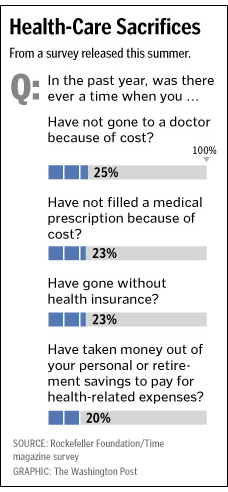
It’s a continuous message these days…people are avoiding care (preventative and necessary) due to cost.  Here is an article in the Washington Post about it.

Though the burden is especially heavy for uninsured Americans, even those who have coverage are feeling the pinch as employers shift higher deductibles and co-payments onto employees.

“The reason why health care was immune [to recessions] in the past was because most people were covered under good insurance plans,” said Jean Mitchell, a professor of public policy at Georgetown University. Now, “people are realizing, ‘Oh my gosh, I have to pay for this out of pocket.’ ”

Median US Income – $32,000

As we talk about the economy and its effects on healthcare, it begs the question of what the average US family makes per year.  Averages are what we typically see versus median.  Median means that 1/2 of the families make more and 1/2 of the families make less.  The averages are often skewed by populations at the ends of the spectrum (i.e., the people making millions). This article says that according to IRS data that 50% of the US makes below $32,000.

New statistics from the Internal Revenue Service show that the highest-earning 1% of taxpayers in America make 22.06% of all income reported to the government. That’s almost twice the 12.51% of total income earned collectively by the lowest-earning 50% of workers. Yes, 1.4 million taxpayers claim 22% of income earned while 68 million share just 12.5%.

But get this: When it comes to taxes paid, an even wider discrepancy shows itself, in reverse. Those earners in the top 1% pay 39.89% of all federal individual income taxes. The bottom 50% of earners pay just 2.99% of those taxes. (Source article)

Article On Silverlink Communications

The October 2008 issue of ADVANCE for Health Information Executives contains a nice article about Silverlink Communications by Robert Mitchell. Here are a few items from the article:

  • It focuses on our Adaptive HealthComm Science approach which brings decision sciences to the area of driving healthcare behaviors. [This is what leading consumer companies, credit card companies, and gaming companies use to understand consumers.]
    • “Adaptive HealthComm Science looks at microsegments of the member population to try different interventions with different populations — all standing against control groups and measurements of what works best. It then adapts, learns and tries again. “The communication system continually learns and automates its processes so that it is capturing new data and learning along the way from those interactions. It is consistent and can be measured.”
      • It is amazing to see how much programs can be improved over relatively short periods of time by rapidly testing isolated variables to find the right solution for each microsegment of the population.
    • One of my favorite examples from my past was simply using stamps turned at an angle on a letter to improve the rate at which direct mail was opened. It looked more like a human had hand licked each stamp rather than a machine which put the stamp on perfectly each time.
  • It talks about the ability to do on the call calculations and dynamic pathing on the core automated calling platform.
    • On-the-call calculations: If you have 3 drugs to refill, but you only choose two of them then it can tell you what your copay is. Or, if you tell the caller your weight, it can calculate the difference from a prior weight it had collected.
    • Dynamic pathing: Based on answers you give, the call is intelligent enough to serve up different content to the member and/or route you to a different group of live agents based on rules.

“We’ve invested heavily in people, technology, processes and a methodology that continuously improves to maximize the effectiveness of health care communications,” Stan Nowak, CEO and co-founder of Silverlink, said. “Over the next few years, changes in the way health care stakeholders communicate with patients and health plan members will be one of the keys to lowering health care costs while driving consumer affinity.”

“To the consumer, health plan products are largely undifferentiated on the basis of benefits or network, and consumers experience their health plan almost exclusively through the communications they receive from the plan,” Nowak continued. “Health care organizations have an opportunity to clearly differentiate themselves through proactive and personalized communications, improving their members’ experiences with each interaction, and earning consumer trust and affinity. In essence, for health plans, communications is their product.”

Tight Rx Market

I am sitting at the airport doing some blogging on my blackberry. Here is a quote about the prescription market:

“We are facing a continuation of the slowest-growing prescription drug market in 47 years, according to IMS Health. We believe the biggest impact has been the very tough economy.”

— Jeff Rein, chairman and CEO of Walgreen Co., where prescription sales actually climbed 7.9% in the latest quarter. Rein was addressing a Sept. 30 investors’ conference call on the company’s financial results for the quarter that ended August 31.

Stress Up: Health Down

I would have loved to have the time to do this research myself, but fortunately it was nicely bundled up The USA Today in a piece by Marc Siegel who is an associate professor of medicine at New York University School of Medicine.  Here are a few of the facts from his article:

  • A survey by the American Psychological Association indicated that financial concerns “topped the list of stressors for at least 80% of those surveyed”.  More than half reported the most common symptoms being anger, fatigue, and an inability to sleep.  Close to half reported over-eating or eating poorly.
  • After the 1929 Wall Street crash, millions turned to drinking and smoking which led to heart attacks, strokes, bleeding ulcers, and clinical depression.
  • Research on people laid off from a plant in Pennsylvania over 17 years shows that they were 15% more likely to die of any cause.
  • In NY, calls to the Hopeline network for people with depression or suicidal thoughts increased 75% in the 11 months ending July (before the worse of the economic situation).
  • UnitedHealth Group reports that hospital admissions for psychiatric services are up 10% this year.
  • A 1% increase in unemployment is projected to cause as many as 47,000 more deaths over the next two years – 1,200 suicides and 26,000 additional heart attacks.
  • Cumulative stress causes depression, suicide, heart disease, stroke, predisposition to infection, and certain kinds of cancer.

He does offer a few pieces of advice that are always hard to focus on when you think about all the negatives:

  • Eat healthy food
  • Sleep right
  • Do yoga, meditate or exercise regularly
  • Touch in the form of massage, hugging, and kissing decreases stress hormones

Where’s Your Raise…It’s In Your HC Benefits

According to Hewitt Associates, healthcare premiums and out-of-pocket costs will go up 8.9% next year.  This is at the same time as many people are hurting from the economy and seeing gas and food prices go up.  I can guess that the average raise next year won’t be near enough to make up for this with most people.

In an article by Sandra Block at The USA Today, she suggests several things on controlling costs.  None of them are new, but perhaps they are worth reiterating:

  • Use generic drugs whenever possible.  [You should ask your physician or pharmacist if there is a generic alternative available.  You should also not be afraid to ask for samples for new prescriptions from your physician.]
  • Sign up for mail-order.

“Unless you have a crush on your pharmacist, there’s really no reason to go to the drugstore every 30 days to pick up your blood pressure pills.”

  • Contribute to a flexible spending account so you use pre-tax dollars to pay for out-of-pocket costs [but be aware of the use-it-or-lose-it rules].

With more and more companies pushing more cost to the employee or even dropping benefits, you might have to start recognizing the value of having a good coverage plan as part of your total compensation.

Proof Communication Matters

The reason we communicate with patients and members in healthcare is that we want to drive them to action or inform them of information.  Whichever party you like, I think the TV commercials and the debate make this point very clear.

  • You either like scare tactics or not.  Some portion of the population will respond to those.  (I personally see this as desparate and don’t care…especially when some of them are such a stretch.)
    • Should you point out to people that they should stay adherent or risk serious side effects or hospitalization?
  • People want clear messaging.  I thought Obama was the one being too high level early on.  In the debate, John McCain was the one that didn’t seem to answer the question.  At least Palin said she was going to talk about another topic not give a glossy answer in the VP debate.
    • We got this feedback from MDs at Express Scripts that said just to tell them what we needed and stop with lots of general messaging.

Think about how you motivate your kids or your employees.  It’s all the same.  This is what you want from your health provider or your insurer.

(I must admit to being frustrated with the politicians as I am sure anyone who works in communications is.  To have Palin (the relative newcomer) being the best presenter (not so great in interviews) is surprising.)

60% Think We Are Headed To A Depression

You wonder how bad it is economically or where we are headed…look no further than the CNN poll out this morning showing that 60% of Americans think it is likely that we will go into a depression.  Not a recession, but a depression like many of us read about in the history book or saw in the movies.

Do people really know what the depression meant – 25% unemployment (for example).  So, if that’s the perception out there, imagine the impact on health behavior.  People will continue to look for savings opportunities – skipping pills, splitting pills, moving to generics, trying over-the-counter medications, moving to mail order.  They will likely be less likely to act preventatively – e.g., getting a flu shot.  They may be more willing to ride out bad symptoms at home rather than rush to the clinic.

This makes me think about an article I saw the other day that said that people don’t have any solutions to manage trend.  I think that’s BS.  The fact is people are afraid of the solutions to manage trend.  They don’t want to tell employees what to do or limit their choice.  In a tight labor market, companies want to keep the employees happy.  So, as the labor market opens up (i.e., higher unemployment) and healthcare costs go up, will companies finally embrace some of these tools.

For example, on the pharmacy side, we used to see a spike in call center volume of 1,000%+ on some of the aggressive programs – mandatory mail, step therapy, limited formulary, limited retail network.  That scared a lot of clients.  Maybe that attitude will change.  Granted pharmacy is 10% of medical spend so the bigger problem is on that side, but maybe companies will finally be willing to link out-of-pocket costs to controllable medical activities – weight, exercise, blood sugar, cholesterol, preventative testing.

If I were a insurer or a PBM, I would be focused on showing my value right now.  I would be delivering cost savings messages to all my members and help them understand how to minimize their out-of-pocket spend in this economy.

Ranting: Do We Know What We Want?

This is a little bit of a rant set off by the current market / political situation.  First, I know we all think of this as a bailout…apparently the messaging is 20:1 in DC from their constituents.  I wonder how many of those people are the same people that wanted loose credit standards so that more people could afford houses and people could get bigger houses.

Blaming the banks is like blaming the auto companies for making SUVs.  They are giving the consumers what they want.  If consumers are willing to buy it, someone is going to make it.

But, this has lots of application in healthcare.  We are critical of the fast food companies for contributing to our obesity epidemic, but we don’t want government regulation and we don’t self-regulate.  We want to stay compliant with our medications, but we forget and don’t want to be told what to do.  We want to have unlimited access to care, but we don’t take preventative steps…we wait until it’s an emergency.  We don’t want prices to go up, but we want to have every possible test done using the latest technology.

So…why do we shift blame around?  We need to understand the long-term implications of our decisions from wanting the bigger house to driving the SUV to eating whatever we want.

How Are You Classified?

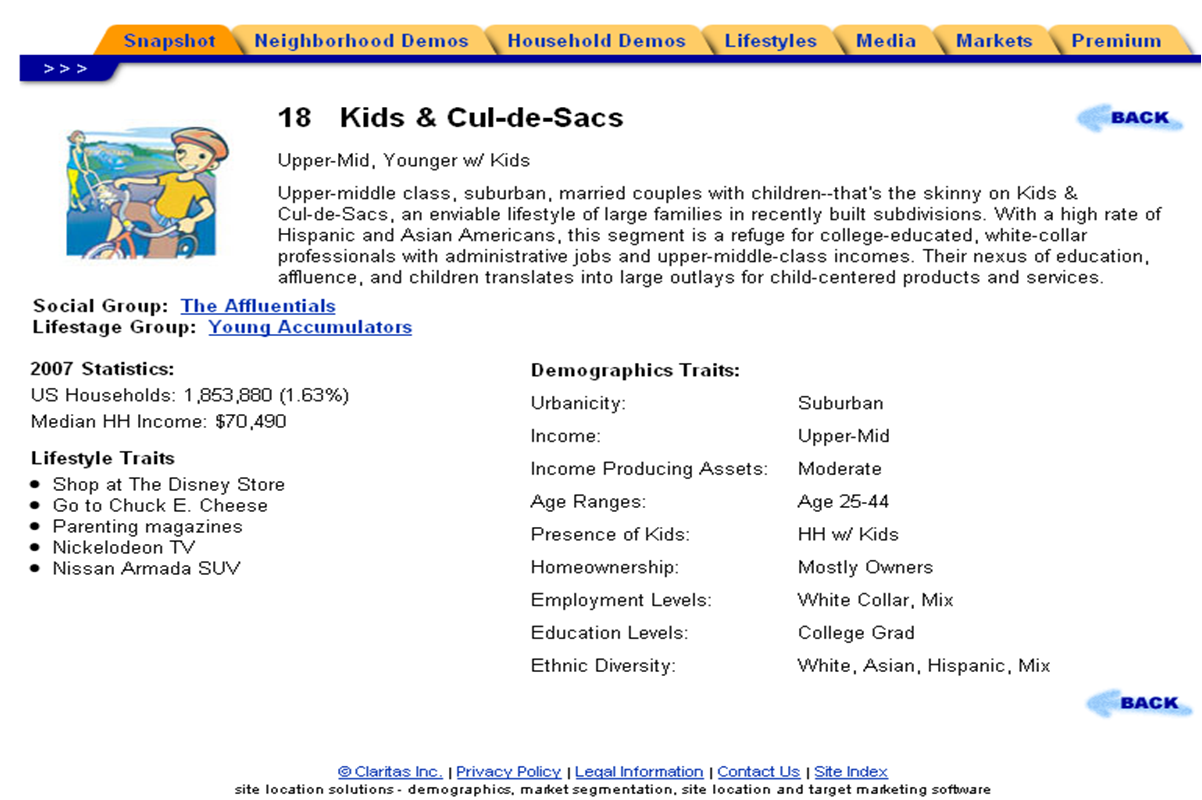
One of the typical models used by consumer marketers is the Prizm model by Claritas.  If you’re interested in whether you’re a “Pools & Patios”, “Home Sweet Home” or “Empty Nest”, go here and put in your zipcode.  In my case, it gave me five possible classifications – Blue Blood Estates, Exec Suites, Kids & Cul-de-Sacs, Movers & Shakers, and Winner’s Circle.  After looking at them, I could quickly see myself being classified as the Kids & Cul-de-Sacs one (see below).

They start with 66 different categories which can be used.  Of course, this is primarily driven by zipcode and a few other attributes and misses things around your attitude towards health that you might find in other health segmentation models, but it is an important marketing fundamental to understand.

Drug Not Covered – What To Do?

As I was doing this for my son, I realized that most people probably don’t know that the option exists.  It’s something called a Formulary Override.  If you are prescribed a medication that is not covered (meaning you pay full price), you can get it covered at a 3rd tier copay (less than full cost) if your physician requests it and has a legitimate medical reason for it.

So…what do you do:

  1. Call your health plan and select the IVR option for pharmacy.
  2. When you talk to a call center agent, ask them about your drug.  They will confirm that it isn’t covered.
  3. Ask them what you need to do to get it covered (or ask them specifically for a formulary override form that your physician can fill out).
  4. Get the form (or download it from their website).
  5. Ask your physician to fax it into their prior authorization department.
  6. They should quickly run on it for you and have you set up in the system within a few days (if approved).

Just a quick inside hint for you.

Flu Shots Coming

With the recommendation that 86% of the population needs a flu shot this year, will you get one? I will. So the question is what will employers and insurers do to encourage this.

It seems like a great opportunity for them to communicate a positive message. Wouldn’t you like to receive a call telling you that you need to get a shot and where to go? It will be even more important as supplies get limited.

This is one of those low cost opportunities to build good will and potentially avoid some real costs of urgent car and ER visits as the elderly and kids get the flu.

I Get A Different Conclusion

In the same Express Scripts’ investor deck, I have to disagree with the slide below which is supposedly proof that the Consumerology efforts are working.

Showing me that the trend for a client who was above their norm last year (see drug trend comparisons), went down to 3% (year-over-year) increase (which is over both Medco’s and Prime Therapeutics’ average trend) doesn’t seem that impressive.  In the years when I worked on the drug trend publication, we showed that the average client with two or more plan design changes had negative trend, on average.

And, further complicating this example is the fact that this shows a client implementing mandatory mail, mandatory generics, and step therapy.  These are a series of proven, reject oriented solutions that force the member to make changes or pay much more.  Anyone can drive trend with these.  If you show me that non-reject oriented programs work to the same degree due to targeting and personalization using consumerology, then I am impressed.  Obviously, I am not there anymore, but I don’t think this is a compelling case study for consumerology.  Maybe there is more to the story like no impact on the call center or no impact on member satisfaction or less members hitting a reject at the point-of-sale (POS).

Express Scripts Patient Segmentation

In a recent investor deck, Express Scripts laid out some of their segmentation from their Consumerology program.  This is similar to some of the work we do with clients at Silverlink Communications to help them develop segmentation models through a test and control approach.

What they have come up with are 5 segments of their members – “Movers and Shakers”, “Rock Solid”, “Getting By”, “Rising Stars”, and “Here and Now”. They describe some of the attributes of each segment on the first slide below and then show how messaging on driving mail order utilization was applied for each segment over the web.  The final slide below shows the results when the targeted messaging is used on the web.

It will be interesting to see how that messaging plays out via other channels (i.e., letter or outbound call) and when pushed to the member versus a situation where the member is on the portal and looking for information (a fairly engaged member).

Revolution Health For Sale

I was a little surprised to find out that Revolution Health is up for sale.  On the one hand, they pursued a WebMD type strategy when we all know tons of companies have died going down this path.  But, they had lots of money and lots of smart people.  Does that mean success?  Not necessarily?  We have all seen the teams full of stars that can’t outperform the true team of average players.

On the flip side, it seems so early to go up in a space that is obviously destined to grow.  It just goes to show how undefined it is and how hard it is to make money.

Texting for Deductibles and Copays

I often get a lot of ideas from financial services.  I was watching a banking advertisement yesterday where the customer could text their bank to get a real-time balance.  It made me think what a great service that would be in healthcare.

Imagine texting your plan for an immediate response on:

  • Your deductible
  • Your FSA balance
  • Your copay on a specific drug
  • Whether a provider is in network
  • The status of your prior authorization
  • A list of formulary alternatives

Since a lot of the logic exists, the question becomes one of using this medium and designing a secure mechanism for accessing the system and providing information.  Patients would have to register their mobile phone and approve it for PHI.  (There may be more to this, but it seems like it must be doable.)

Predicting Sickness

Wouldn’t it make the job of wellness a lot easier if we could predict who will get sick. There might be some indicators, but then you need to act and convinve them to take action. A little bit of the Holy Grail.

“We know that 59% of individuals [who seek services] are newly sick, and would have fallen into the ‘healthy’ category 12 or 18 months ago. We want to find these people before they get sick to see if we can reduce the risk or help them retain their health and vitality.”

— Jodi Prohofsky, senior VP of operations for CIGNA Corp.’s Health Solutions unit, telling AIS’s Health Plan Week about CIGNA’s new “It’s Time to Feel Better” outreach program.

WSJ on Personal Home Pages

An article that I found of interest was in the Wall Street Journal back on the 14th of July…it is about whether people have or will have their own personal website – Facebook, LinkedIn, blog, etc.  I think it’s a good discussion topic especially given all the discussions around Health 2.0 and doctors and patients blogging about events.

Disease Management Evaluation – Care Scientific

My former boss, Brenda Motheral, from Express Scripts spent a year at Healthways running their research group and has now decided to go out and do some consulting (new company is Care Scientific).  Her evaluation of the Disease Management industry was just published in the Journal of Managed Care Pharmacy.  It is a pretty critical view of the state of the industry.  Here are a few highlights:

  • There have been several articles published questioning the value of these programs this year.
  • There are five reasons for dissatisfaction:
    • Desire for better alignment of vendor and client interests
    • Desire for greater transparency in business arrangements
    • Desire for improved plausibility in reports of financial and clinical outcomes
    • Desire for more rigorous evaluation methodology
    • Desire for more convincing evidence of outcomes improvement
  • There is misalignment today…For example, if I get paid per member, how hard should I try to contact them when all that will do is drive up my costs.
  • Lack of alignment can be addressed through contractual requirements and pay per engagement.
  • There is a lack of data available on how many members are contacted.  [Not for companies that use Silverlink for their automated outreach who have real-time data available with detailed call information.]
  • There are calculation questions in comparing vendors.  [Something I have talked about several times here.]
  • She compares the move to transparency in this industry to what happened to the PBM industry earlier this decade which created new competition and changed several business models.
  • She advocates for really looking critically at the ROIs claimed by these vendors and talks about NND (number needed to decrease) which is the model that the DMAA (Disease Management Association of America) adopted as part of their outcomes guidelines.
  • She also raises concern about DM companies moving into wellness which is another area “fraught with numerous new methodological issues that warrant close attention”.
  • She talks about an industry push (from buyers) to demand new expectations from vendors.
  • She talks about the fact that the focus on ROI may not make sense since “literature suggests that less than 20% of treatments for existing conditions are cost-saving.”

“Plan sponsors also bear responsibility for the current situation.  As long as they demand a short-term ROI in the current model and inconsistently require comparison groups, they are more likely to promote methodological creativity than they are to inspire true innovation.”

As with the dozens of publications she has had over the years, this one is well written with a well referenced set of facts.  She presents a challenge to the industry in how to approach.

The challenges are interesting to reflect on given the overall industry focus on improving healthy behavior, being more proactive, more actively managing patients, and other activities that a DM company should be well positioned to do.  But, a high touch model is certainly challenged given lower cost options.  Creative solutions that leverage technology to identify gaps in care, create data segments, personalize interactions based on preferences, and use motivational interviewing to drive behavior exist and should be able to create value.  It will be an interesting 12-18 months for the industry.

S.A.D., ADD, OCD – Are we all affected?

A friend from Europe pinged me a few months ago to see if I wanted to connect him with someone who could distribute SAD lighting here in the US.  (SAD apparently means Seasonal Affective Disorder.)  Before even responding, I talked to a chief medical officer I know to validate the condition and the effect of lighting.

But, it made me wonder…are there some diseases that many people have to a lesser degree that we rationalize in different ways.  If people with SAD are depressed and have less energy in the winter due to lack of lighting, is this what many others simply refer to as the winter blues and just take for granted?  I can think of lots of people who are different in the dark winter months when they are inside.

For that matter, for people with ADD (Attention Deficit Disorder), focus is a challenge, but many of our most creative and innovative people are people who thrive in some chaotic form and come up with new ideas (e.g., story about CEO with ADD).  Do they all have ADD or some mild form of ADD?  (CBS article)

I could go on, but let’s look at one more – OCD (Obsessive Compulsive Disorder).  People with this condition can’t help themselves with certain actions – e.g., washing their hands until they bleed.  But, there are lots of people who are considered meticulous or anal retentive who get rewarded for their focus on detail and ability to do mundane tasks repeditively with little error.  Do these people have a mild form of OCD?

Don’t You Want To Live

Apparently, the Walgreen‘s CEO told the WSJ that not only is this a tough year, but they are taking a tough love approach with their patients.  In their blog earlier today, they said that Jeffrey Rein said “Walgreen pharmacists try to persuade patients to take their pills by asking them whether they want to be alive to see their children grow up.”

As they talk about, there have been several studies showing that patients are skipping pills and doing other things to stretch their prescriptions.  But based on what I saw in the Lehman Brothers research yesterday about Walgreens, I wouldn’t have thought things were that desparate.  They reported August same-store stales of 3% which is low compared to their historical results but still positive in this economy.

Interestingly, the report commented that they were increasing promotional activity which would negatively impact front end margins while CVS had recently said that it’s promotional spending (as a percentage of sales) was lower.

[In full disclosure, I do not own any of these stocks as individual stocks.  They may be held in mutual funds that I own.]