Archive | Consumerism RSS feed for this section

Payers Spending On BI and Information Delivery

“Healthcare payer spending on business intelligence, information delivery and transparency is the fastest growing spending category in 2008 for healthcare payers,” said Janice Young, IDC Program Director, Payer IT Strategies.

This quote was in our press release this morning around the growth at Silverlink.  You can read about the company in the release, but I wanted to focus on this quote from IDC.

On the one hand, I think consumers should be saying “Amen!” that payers are focusing on business intelligence (BI) although that can mean a lot of things.  On the other hand, they would shocked to know how new this is to the healthcare space compared with the consumer packaged goods industry.  BI can help identify gaps in care and identify how to help patients become better.  BI can help personalize the messaging that you receive from your health plan so you don’t have these huge legal caveats about all savings and other specifics being based on your exact plan design and deductible.

Information delivery can also mean a lot of things.  Is this reporting to the employer?  Is this online analysis for the consumer?  Is this communications?

And, I am not sure what transparency means, but I hope it means things like letting consumers actually understand the price of goods and services and how to make tradeoffs between different options with all the data (e.g., quality, price, outcomes, patient experience).

Overall, for those of us in the healthcare communications space, this is a rising tide that helps.  It means the payers who support all of you consumers are raising the bar and looking at how to use their information to improve the experience and outcomes (ideally).  It could also allow them to better focus their efforts on the riskiest patients and discover the best way to drive behavior.

The data is there and has been there so figuring out how to use it and what to use it for is critical.  Mapping this against the patient expectations and desired activities can be a great positive for the consumerism movement.  Integrated data.  Accessible data.  Digestible data. Sounds great.

They Charged The Wrong Insurance

Only a year late, I just got a notice from an insurance company telling me that we had several prescription claims processed under the wrong insurance card.  Apparently, they allowed our pharmacy to process claims for over 2 months after we had switched insurance.

Why is this my problem to deal with?  Shouldn’t the insurance company have responsibility for maintaining the eligibility file?  Shouldn’t the pharmacy have made sure my insurance was current?  Now, I have to either pay $300 or go back to the pharmacy and ask them to reverse out claims that are over a year old.

What a pain!  Of course, I am going to the pharmacy.  I had coverage so why would I pay out-of-pocket.

Communicating With Michelle Obama

First, congratulations to Barack Obama on getting the nomination.  He is a great orator and regardless of who I vote for I think he will be an exciting candidate.

From a healthcare communications perspective, I found an NBC Today Show interview with Michelle Obama very interesting yesterday.  She talked about three things that seem to be telling about her personality:

  • She said she was more of a fatalist than an optimist meaning that if Barack is meant to be president than he will be.
  • She said she was superstitious.
  • She talked about not believing that living in the White House will change their family dynamic.

So, I would suspect that trying to get her to change behavior would be very difficult as a fatalist.  If she believes that becoming sick is inevitable, why would you change your diet or habits.

If she is superstitious, I would suspect that there are actions, phrases, colors, or other queues that could encourage her to take action.  What those are…who knows?

And, if she doesn’t believe that the White House will change the family, it makes me think that she is very inwardly focused.  She admitted not watching TV or reading the paper.  But, as an ivy-league lawyer, I have to believe she does those things and reads aggressively.  So, I am confused as to why she wouldn’t believe history.  I haven’t read the history of presidential families, but I am pretty sure kids raised in the White House are very different.

My take would be that she would be a hard candidate to motivate to change and successfully communicate with.

Healthcare Reform Won’t Be That Easy Mr. Obama

Election campaigns typically feature pontificating politicians flashing silver bullets to painlessly slay the nation’s problems.

Just move some money from here to there, cut some government waste no one apparently ever noticed, and then fund an unattainable promise with an outlandish price tag.

Barack Obama’s healthcare reforms fit this model nicely. He bundles three evergreen feel-good concepts — electronic medical records (EMR), disease prevention and chronic-disease management — and totes up dubious savings to fund his ultimate goal of making health insurance affordable to everyone. (Article in Fort Worth Star-Telegram)

It sounds like Barack’s advisors read George Halvorson’s book on the healthcare system.  Maybe they skipped the sections on the difficulty of aligning incentives and driving change.  If he thinks he can make major changes in 4 years, good luck to him.  Maybe that is a sign of his inexperience.  I think we all want change, but we definitely need a person who understands how to make change happen given the fixed constraints that we have.

He reminds me of the new consultant who comes in fresh out of business school and sees all the changes the company should make.  They are so obvious.  But, without all the history and the ability to manipulate the political landscape and knowledge of what it takes to get things done, it just becomes the flavor of the month that no one takes seriously while they wait for the consultant to move on to their next project.

Great ideas (not that this is one) don’t by themselves guarantee success.  A good idea implemented well is a lot better than a great idea implemented poorly.

Less Sketchy: More Scary

When you think about identity theft you think of your credit card information being compromised and someone ringing up $1,000s of dollars worth of charges that ruin your credit history.  If I say medical identity theft, you probably think about your information being stolen and used to ring up fraudulent bills by crooked providers.

But, in an article on the topic in the Chicago Tribune, they introduce a much scarier concept.  What happens if someone who can’t afford care, steals your identity to get free care provided to them.  During that process what happens if information is added to your permanent health record which subsequently impacts your future care (e.g., a note saying you are not allergic to something, a pre-existing condition which impacts coverage).

No Pharmacy Coverage – I Doubt It

In the AIS e-mail on Friday, it had the following quote:

“If the economy remains weak over the long term, we could certainly see employers and government agencies looking to investigate cutbacks on the type of pharmacy benefit they are offering, or eliminate pharmacy as a benefit altogether [in commercial plans]….The problem with [this] is that if an individual is unable to obtain their necessary drug therapy, you will typically see an increase in the overall health care costs associated with an individual.”

— Mesfin Tegenu, president of PerformRx, the pharmacy benefit manager division of the AmeriHealth Mercy Family of Companies, told AIS’s Drug Benefit News.

I must admit that I am more than a little skeptical of this.  The pharmacy benefit is the most used part of a benefit plan (average of 14 times per year).  Don’t you think there would be lots of other things cut back first?  Heck…I even see them cutting out 401K matching before they cut out prescription drug coverage.

Sure, it might get scaled back in terms of cost sharing or # of drugs covered, but that’s been happening for years.  But, elimination seems unlikely in a society that is very prescription drug focused.

Health Plan Week on Retention

I had an opportunity to get interviewed a few weeks ago by one of the contributors to Health Plan Week about retention within health plans.  With growth in the group market stagnant and ultra-competitive, the individual market offers lots of upside, but makes satisfaction and retention a much bigger issue.

You can read the article here where it discusses things like the “top box”, the importance of personalized communications, and champion / challenger processes to determine the best approach.

Compliance is complicated

I am going to try a posting from my blackberry.

I just read this in the AIS newsletter and was surprised that this was news.

“Personally, I believe the reasons people take prescription medications are quite complex. There are a lot of motivations and issues in that, and copays may not, in and of themselves, be enough to change adherence and compliance.”
— Keith Bruhnsen, manager of the University of Michigan, Ann Arbor, prescription drug program, told AIS’s Drug Benefit News when discussing the need for research and data to support the idea that lower copays for essential services actually remove barriers to their use.

Gas Prices Helping PBMs

Unfortunately, the WSJ Health Blog beat me to it, but I think it’s an interesting perspective that apparently David Snow (CEO of Medco) talked about.  High gas prices cause people to reconsider things…like driving to the pharmacy or paying for brand drugs.  That would mean that mail order penetration should go up and people should use more generics.

It seems logical, but I am trying to reconcile it with two other economic realities…people not filling their prescriptions or skipping doses to save money and the fact that mail order requires upfront payment for the longer supply.  I have always struggled with why someone doesn’t offer a credit card for their mail order pharmacy so that you can save money and spread the payment over three months.  In tough economic times, that cash flow can be an issue.

And, for the first time in over a decade, it appears that the growth in prescriptions actually fell as reported on the 16th in the WSJ.

The burden on consumers has increased sharply. The average copay for a preferred drug on an insurance company’s tiered system rose 67% to $25 in 2007 from $15 in 2000, according to the Kaiser Family Foundation. Out-of-pocket costs to cover family insurance premiums were $3,281 per employee last year, up nearly 84% from 2001.

Consumers appear to be skimping on medicines as a result. An April poll from the Kaiser foundation showed 23% of patients who responded didn’t fill a prescription in the last year because of cost, up from 20% in 2005; 19% split pills or skipped doses, up from 16% in 2005. A report last month from the nonpartisan Center for Studying Health System Change in Washington, D.C., said 20% of respondents in a 2007 survey of 18,000 people had put off or gone without medical treatment in the previous year, compared to 14% in 2003.

Data from IMS Health show growth in prescription volume for the first five months of this year slowed to 1.5%, the lowest rate at least since 1996. From 2003 to 2007, annual volume growth averaged 3%. In December 2007, total prescriptions dipped by 2.1%. The decline was 0.2% in April and 0.1% in May.

Keep The Change

I was listening to an advertisement for Bank of America’s Keep the Change program this afternoon and found it to be very interesting.  Essentially, every purchase you make with your debit card gets rounded up and the difference put into savings.  For example, if you spend $3.43, they bill you $4.00 and put $0.57 in your savings account.  Forced savings (post opt-in of course).  And, they even having a matching program.

So, this accomplishes several things:

  • Creates an easy way for the consumer to save
  • Increases the money saved at Bank of America

It’s certainly in the bank’s best interest and good for the consumer.  It gets me back to my question from the other day.  If you are driving a positive result but you have to force the consumer there, is that okay?

What’s the healthcare model of this?

  • If you implement (or do) all your preventative care recommendations, your prescriptions are free (or some type of incentive system like this)?  Which is good for the payor, insurer, and patient.
  • How about a bundled copayment for certain events which included the office visit, hospital charges, and the prescriptions?  (Oh…sorry we couldn’t do that since we don’t know the prices in advance.)

Avoiding Calls Then Texting

CNet has an interesting article about teens avoiding live calls only to text back the person immediately so they can continue their current activity.  I do it all the time when I am in meetings or on conference calls.

They provide some interesting statistics on text messaging (see below) for this young group.  Not a prime focus for healthcare, but it will be interesting to see how this use of technology applies as they grow older.

More broadly, nearly one out of every two U.S. tweens (or kids between 10 and 13 years old) and 83 percent of teens own a cell phone, according to new research from Chicago-based C&R Research. And with that many kids using mobile devices, the text messages are flying.

The average teen, according to C&R, generates between 50 and 70 text messages a day, or as many as 18,000 a year.

What Driving Teaches Us About Wellness

We all understand the challenges in getting people to take their healthcare seriously which manifests itself most prominently in a obese society which leads to numerous other conditions – heart disease, diabetes, high blood pressure.

I was reading an article earlier today about driving slower to maximize your fuel usage and thought what a great example of how people don’t do what’s best for them. You can reduce your fuel needs by driving slower, but most of us are too hurried to do that. We don’t follow practical, fact-based suggestions. It’s just like the challenges of eating well. It is much easier to go to the fast-food restaurant than to plan your lunch, buy healthy foods, pack a lunch and bring it to work.

Another good link is between using a phone when driving and wellness. Again, we know that people being distracted by their conversations (voice and text) while driving can lead to accidents. Certainly, headsets and voice technology should reduce those distractions (although the data doesn’t support that). For example, when I am driving, I simply press the button on my Bluetooth headset, speak the person’s name, and then the phone calls them. Much less distracting for my eyes on the road…but I am still talking to someone and multi-tasking. So, again, why don’t we do what’s best for us and stay off the phone? It’s generally not efficient…we are pressed for time…we have become a country of multi-taskers. A similar reason to why lots of people don’t exercise…too busy.

“There are limits to how much we can multi-task, and that combination of cellphone and driving exceeds the limits,” says David Strayer, a University of Utah psychologist who has found that by many measures, drivers yakking on cellphones are more dangerous behind the wheel than those who are drunk, whether the conversation is carried on by handset or headset.

Medical Home

I just changed PCPs (primary care physicians) to find a new one who was easier to access and more personable. (Not that I had been to my other PCP in 5 years.) I was very pleased that this new individual has adopted the medical home concept. He wants to be my central point of contact, and he is a big prescriber of Ix (information therapy). It was interesting. Here are a few highlights from my introductory visit.

  • His paperwork asks you to call him before going to the emergency room (ER) or urgent care.
  • He does in-office dispensing using a company I know called Purkinje.
  • He asks you to sign off on leaving you messages and/or who else he can talk to about your care if needed.
  • Every time we talked about something, he would reach over and grab an article from a library on the office wall and give it to me to read.
  • He gives you his e-mail for contact and talks about responding within 30 minutes.

Now, hopefully I don’t need much care, but I feel like I have found a good advocate and involved MD to work with. (He also came highly recommended by several people.)

IDC – Healthcare Communications

Janice Young at IDC just put out a new report titled “Too Much Information? The Irony of the Coming Information Glut and New Technologies that Help Target Communications” which focuses on several fast-follower announcements about what we have been doing at Silverlink Communications. Here are a couple of quotes from the report.

The final mile of the current healthcare information blitz is not just getting at or to the information, though in the very fragmented, silo’d U.S. healthcare system, that is hard enough. But the real solution provides targeted and event-triggered information based on consumer interactions or events, rather than relying on the consumers to search and seek.

These two announcements join Silverlink’s earlier announcement in March 2008 of their new Adaptive HealthComm Science Platform. The Silverlink platform integrates decision support and analytics to create personalized customer communications. Unique to the Silverlink solution are behavior analytics to communications success and affect on customer behavior and outcomes.

Beating The Patient Over The Head

Something that I don’t normally do, but I am going to edit this after the fact to stress what the story really is supposed to be about since someone told me the original text might be offensive to a competitor that I respect.  The point is whether being pushy is worth it in some cases.

The other day a patient asked one of our people about a mail order order pharmacy where they had gotten a call every other day for the past 12 days about refilling their medication. Each message was slightly different – your supply of medication is about to run out, you need to refill your medication, your prescription has run out, etc.  The patient didn’t like the call program.

I found this an interesting debate…how pushy is good if you drive a desired outcome?  Also, we all obviously know that vendors and consultants don’t always make the decision so if a client tells you to do this even if it makes no sense, what do you do?

I think it makes for a good debate and had it with several clinical people:

  • At what cost is a better refill rate okay…especially since this doesn’t mean that they are compliant? Are you willing to drop your patient satisfaction by several points?  (We often used to give clients a report that showed savings per disrupted member or per drop in satisfaction at my prior employer.)
  • If the company is just driving up refills and can they do that without creating more waste?  This was a constant debate at mail.  One trick here is whether you base it on refill dates or days supply.
  • With this frequency of calls is there a chance that you actually get people that would have refilled to just wait for the calls to come and say yes?
  • If people take the call because they know you will keep calling them, is this actually better acceptance of calls or just being an “obnoxious salesperson”?
  • Are you calling people that have refilled at retail due to data latency issues?
  • Do you drive people back to retail?
  • Have you dulled them to future calls by upsetting them on this program?

Now, on a more clinical program, my opinion here might be different. If you could successfully get an overweight individual to diet by constantly reminding them. This might be okay. It’s an interesting debate.

Communication Chicken And Egg

You hear a lot these days about preference based marketing.  The idea is that consumers (or members or patients) select how you interact with them.  In healthcare, this means things like:

  • What types of communications do you want to receive?
  • How do you like to be communicated with – letter, web, live person, automated call, text message?
  • When do you like to be communicated with – day, time?

Of course, companies then have to figure out what rules to use in terms of when to trigger communications.  The next question is how to personalize the communication.

So an interesting question is…does the company have a responsibility to their members to use their data to drive them to actions that are in the member’s best interest?

Do companies always do what’s right…probably not, but I do believe that they want to do the right thing.  They want to drive successful outcomes.  They want patients to be healthy.  They want patients to save money.

Now, my chicken and egg analogy is which comes first the selection of what my preferences are or experiencing the communication.  How do I know whether I want a refill reminder if I have never received one?  How do I know which channel I prefer if I haven’t experienced each of them?  And, since each communication can vary based on messaging and many other variables, can one good or bad experience bias my selection?

Medical Bankruptcies

I will give credit to the Health Care Reform Now blog for leading me to this article in The Indianapolis Star, but I think it is a sad reality.

“More and more of the middle class is finding out that even if they have jobs and insurance, they can be wiped out by medical events that are not even catastrophic,” says Dr. Christopher Stack, a retired orthopedist and co-founder of Hoosiers for a Commonsense Health Plan, the state’s chapter of Physicians for a National Health Program. “You can run up a high five-figure bill real easily.”

A Harvard study published in 2005 estimated that about half of all bankruptcies filed in the U.S. have their origins in medical costs, a ratio that jibes with Silver’s and other bankruptcy veterans’ observations here in Indianapolis. While the rest of the world’s industrialized nations provide health coverage to all or nearly all of their populations, the U.S. mass-produces the distinctly American phenomenon of medical bankruptcies.

I am not a big fan of the donut hole in Medicare, but perhaps we need a donut hole type concept for health insurance where people have a maximum out-of-pocket in any one year.  Although I am sure that would beg the question of what was optional versus required surgeries and treatments.  It just seems a shame that we can bankruptcy hard working people with insurance over their medical bills.

What is a Mail Order Pharmacy (Home Delivery Pharmacy)?

My most popular post ever is “What is a PBM?” which made me think that this is probably a relevant post for the average healthcare consumer.  And, given the historical push to mail combined with the current economy, you can expect mail order pharmacy (or home delivery pharmacy) along with 90-day retail pharmacy to be a hotter topic.

At Silverlink Communications, we work with a lot of companies on their retail-to-mail (RTM) communications strategy and execution.  One of the first things I point out to all of them is that over 50% of people don’t usually know what mail order pharmacy is.  So, you have to address awareness at the same time as recruiting new patients.

So, for all of you that receive a letter or call talking to you about moving your prescription to mail order, let me answer a few of your basic questions:

  • Mail order pharmacies are also called home delivery pharmacies since they deliver your medications through the mail and directly to your home (or other address provided).
  • The mail order pharmacy is typically owned by either your managed care company (aka health insurer) or by a pharmacy benefit management company that your insurer contracts with directly to provide this service.
  • There is typically only one mail order pharmacy that you can use (i.e., is considered “in-network”).
  • The service is typically the fulfillment of 90-day prescriptions of medications which you will take on a long term basis (aka maintenance medications).  This is not true for controlled substances which typically only allow a 30-day prescription and for some specialty and injectable drugs.
  • You often have a financial incentive to choose mail order where you will get a 90-day supply for less than it would cost you to buy three 30-day prescriptions at your local pharmacy.  This discount is due to the buying power of the mail pharmacy, the automation which reduces the costs of dispensing the drugs, and the lower distribution costs (i.e., no need to move the drug to all 5,000 retail locations).
  • The drugs are the same drugs you buy at your local pharmacy.
  • You have the same access to a pharmacist but it is over the phone not face to face (which I personally prefer and think is more confidential).
  • You can do your refills over the IVR (interactive voice response) line and over the Internet along with traditional means of live agents and using snail mail.
  • These mail order pharmacies use robotics and other highly sophisticated solutions to dispense the drugs accurately and quickly.
  • Many of the mail order pharmacies that we work with offer services around calling your physician to get new prescriptions and also use our automated outbound calls to provide you with order status (WISMO calls – what is the status of my order) and refill reminders.
  • You shouldn’t typically start a new drug at mail order.  You want to wait until you have had two fills locally to make sure you are titrated to the right strength (i.e., your MD might switch your dosage initially so you don’t want to buy too much supply of a drug you might not use).

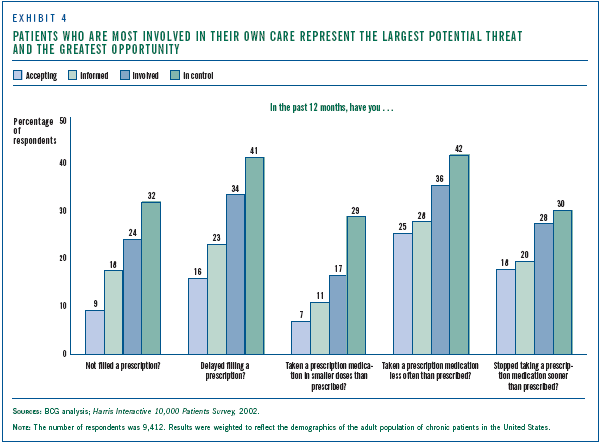
Are Involved Patients More Compliant?

This is a study from a few years ago from Harris Interactive and BCG that I found on the BioPlus website.  If I am interpreting it right, it would imply that those that are most involved in their healthcare are most likely to be non-compliant.  It doesn’t seem logical, but perhaps those are the people that want to play doctor and are most likely to think they know better.

Why Can’t I Go To Any Physician?

In pharmacy, there is a rarely used benefit structure called Therapeutic MAC (Maximum Allowable Cost).  What this does is say that in any class of drugs (e.g., cholesterol lowering drugs) there is a maximum amount of money that will be paid by the plan.  But the individual can get any drug.

That can be controversial since a patient could end up being required to take a more expensive drug by their physician costing them a lot of money.  (Although most pharmacy plans allow for a clinical prior authorization in cases like this where they might pay less.)

My thought is why not do the same thing at least for physician visits.  If my health plan simply published statistics that said they will pay $100 for any visit to a physician’s office.  I could then go to any physician and that physician would know they were going to get $100 for my visit plus whatever they charge me.  It would eliminate a whole process of constantly managing the network and focus patients on the price that their physician charged.

I am sure there is something that I am oversimplifying, but it seems logical.

Would You Pay $100 To Be Told To Take Your Rx?

We know adherence is a serious issue that drives healthcare costs.  And, as I have talked about a little here and a lot with many of our pharmacy clients, it’s not a simple issue.  People aren’t adherent for a variety of reasons – cost, side effects, health literacy, or simply just forgetting (among others).

There are lots of tools out there to help you organize your medications and manage them.  Whose job is it to help you – yours, your physicians, your managed care company, your pharmacy, your pharmacy benefit manager?  Obviously, you (the patient) have the primary responsibility.  After that, your pharmacy is best positioned to help you with this.  But, the managed care company stands to benefit the most by preventing serious medical conditions associated with non-compliance.

So, I was a little surprised to see a new company come up that offers to send you calls, e-mails, or text messages to remind you to take your medications.  And, you can even talk to a pharmacist.

Let’s break this down:

  • Whatever pharmacy you use (mail, retail, specialty) will offer you consultation with a pharmacist for free.
  • I believe most pharmacy benefit management (PBM) companies offer automated e-mail reminders that you set up yourself off their website for free.

I don’t know why I as a consumer would pay for this.  And, it seems pretty high for a managed care charge.  If I went to a client of ours and told them I would send messages to patients for $100 PMPY (per member per year), I think they would choke on that price tag.

So, will it work??  Who knows?  I have been surprised by business models before.

Dental Experience

I am a big believer in the fact that the experience matters for healthcare.  From my architecture days, this means physical space, sequence of events, bedside manner of the staff, clarity of communications, and processing of the claim (at the simplest level).  Everything that the patient experiences as associated with an event drives their satisfaction.

So, I was pleasantly surprised taking my daughter to the dentist a few weeks ago.  We had gone to a “kid’s dentist” before which was an hour away that I thought did a good job (although the kids hated going).  But, this one was over the top.

When you walk in, the entire room is covered with art (e.g., there is a giant Spiderman climbing on the ceiling).  There are video game stations in the corner.  There is a large flatscreen TV playing a slide show of pictures of the kids coming to visit that day.

And, it doesn’t stop there.  Each room is decorated.  The staff talks to the kids (more than the parent).  Every tool and process is explained to the kids in simple terms.  They sometimes give out balloons.

Just something to think about when you try to look at things from an outside-in perspective.  How is the patient experiencing your service?

Genetic Art

I was reading about this company DNA 11 the other day, and I found it a pretty cool concept. They take your DNA and make it into art focusing on the 1% that is unique. According to the article in American Way magazine, prices ranged from $390 to $1,200 with 25 color options or the ability to request a custom color (to match your sofa perhaps).

They can do pets, fingerprints, and lip prints.

LinkedIn Question On HealthComm

I think it was earlier this year when LinkedIn rolled out a new feature called questions which allows you to pose questions to LinkedIn users and get answers. I continue to like this tool, and it has been interesting to watch it evolve from a “startup” (when I joined there were less than 2M members) to a tool that well over 10M people use and has gotten lots of press.

I finally decided to pose a question:

Do you have any good (or bad) examples of healthcare communications? I am looking for how your healthplan, disease management company, pharmacy, or PBM communicates with you. What worked or isn’t working? This could include letters, websites, phone calls, social media, etc. Examples might include communications around moving you to a 90-day prescription, moving you to a generic drug, improving your awareness of a disease, addressing compliance and adherence, reducing your out-of-pocket costs, etc.

I received four answers:

Answer One: I had some great success marketing to Medicare members by conducting health and fitness seminars as well as bring in experts to discuss retirement and other topics of interest. Initially, I’d obtain a 3% response through postcards and an additional 1.0% through phone calls. Conducting a series of seminars in one area can also bring in additional attendees (0.5%), through word-of-mouth buzz.

I found seminars to work well because the attendees were getting something of true value for their time (information and a social event with their peers) and I had a captive audience to market. A win, win situation.

Answer Two: My experiences with Blue Cross have been pretty good, there’s the health mag they send out with information articles, etc. I’ve never been able to access the website services though, something to do with the number that CS can never work out though I’ve tried on several occasions. I love my primary doctor and feel she and her partner give excellent care and plenty of information to their patients. They’re the only ones who’ve ever given me a reading list and web printouts! It was just a general question I had, not a condition I suffer from.

In addition to other tasks, I handle the health documents for the children enrolled with us and find that often the doctors have done a very poor job in informing the parents of what to watch for, what a result means, etc. Their offfice staff often do a shoddy job of filling out the forms correctly. Last month I recieved paperwork for a child, the physical form stated passed 20/20 for vision, it was accompanied by a referral from the doctor for a full eye exam as the child had failed the eye test miserably! I once received a normal hearing result for a child we knew was deaf as a door nail. When trying to get an insurance company to cover a needed service or therapy for such is incredibly difficult with that kind of paperwork.

Thanks for the opportunity to raise awareness!

Answer Three:

Aetna sent me a letter suggesting several plan options that may be cheaper than the one I currently have. That was a positive. I wish that I could compare the plans side by side on the website. It is difficult to remember the details of each one as you look at them individually.

Answer Four: As a health promotion practitioner, we are at a time when the national consciousness of health has never been higher. The most important thing we can do at a workplace is create individuals and systems that are health literate. We spend enormous amounts of money in our wrongly terms “health care” system. What we actually have is a “sick care” system, and what is truly missing are incentives and action by companies to recognize the billions of dollars we could save and then return to economy by protecting our workforce with sound health promotion. Our children are contracting early onset adult diabetes and we commonly refer to our bleak situation of the obesity epidemic. Our “health care” system, and thus the traditional “disease management” is from a biomedical chronic disease model.

It is time to work at reducing costs related to health care and absenteeism from a proactive rather than reactive approach. Many companies and organizations provide services that have yielded significant economic returns from building well companies.

According to the the NIH, most people are unhappy with our current system, and unable to continue to straddle the costs of ever increasing health care. We can avoid chronic disease by acknowledging new paradigms of business operations that include well companies. For information, contact www.positivepurposeinc.com

Tier Zero

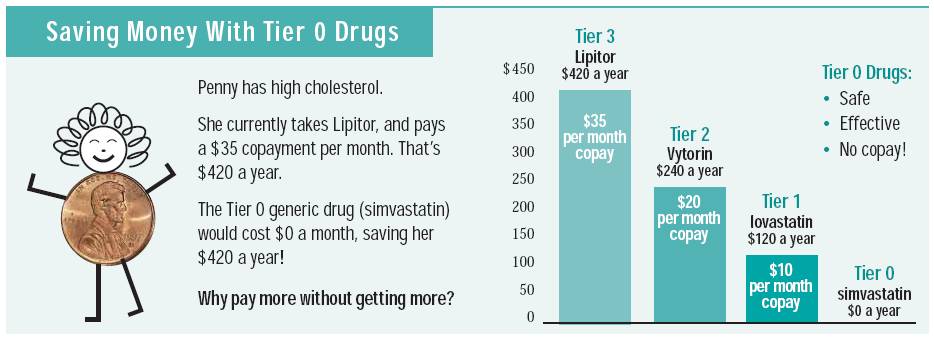
Frank Koronkiewicz, the Director of Pharmacy, at Blue Cross of Northeastern Pennsylvania (BCNEPA) just launched a new plan where people can get 65 different generics focused on chronic diseases at no copay AND without any premium.  It’s called Tier Zero.

Frank has always been a progressive Director of Pharmacy.  We worked on several programs together at Express Scripts.   You can also find some of their collateral and videos on generics on their website – click here.

It would be interesting to look at the overlap between these drugs and the Wal-Mart list of drugs, but I think you would find that an individual could have a pretty comprehensive benefit of generic drugs between these two solutions with low out-of-pocket (OOP) costs and no increase to their medical premium.  A compelling story to many.

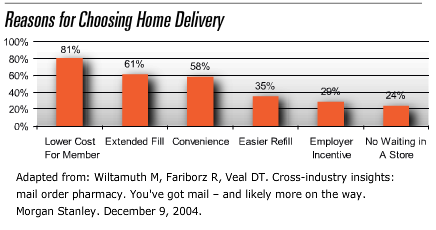
Why People Choose Mail Order Pharmacy?

I was looking for something else in the Express Scripts Drug Trend Report 2005 when I came across this study referenced on page 209. I should have remembered since I wrote this section (yes I was a contributor see page 332). This is a Morgan Stanley study which talks about why people choose mail order pharmacy. Of course, the primary reason here is savings. The more savings the higher the likelihood of a person moving to mail order. This is a factor of savings per Rx multiplied by the number of maintenance drugs that an individual has that can be filled at mail order (or home delivery). This study shows the frequency of the response. If you focus on the weighted scores, you would see a dramatic cliff after savings. (I.e., 61% of people may choose mail for convenience, but they are much less likely to do it than someone with significant savings) So, why don’t all PBMs communicate exact patient savings to each individual? It’s hard. Given minimums and maximums; deductibles; percentage copays; and other benefit plan designs, the systems are stressed to produce this.

A Few Blog Entries About The Think Different Event

We wrapped up the road show this week in Hartford and NY.  I missed both events to be at client meetings on the west coast (and now down south).  But, one of the presenters and someone who was in the audience posted entries on their blogs about the event:

The Automated Sprint Reply

As a reply to my e-mail (see my last posting), here is what I got.  Now let’s see how long it takes to get a real reply.

Thank you for taking the time to write.  To truly revolutionize wireless, we need your input. It’s people like you who are using our services everyday that can provide the best perspective. We’ll be looking through all the ideas and feedback we receive.

This will, of course, take some time. I appreciate your patience until we can get you a response. A representative from my office will be contacting you in about a week.

In the meantime, if you are interested in learning more about our new Simply Everything plan, you can find the details at www.sprint.com/everything.

Once again, from all of us at Sprint, thank you.

Dan Hesse

President and CEO – Sprint

Giving Out Your CEO’s E-mail

From the perspective of soliciting feedback, how many companies post their CEO’s or anybody’s real e-mail these days? Sometimes you can’t even find a number to call on the website. You simply get some generic form to fill out and get feedback. You sent it into the black hole and wonder if you’ll ever hear.

So, given Sprint’s challenges over the years, I think it was (is) a bold move to post the new CEO’s (Dan Hesse) e-mail (dan@sprint.com) at the end of some of their television commercials. I have been using Sprint as a great example of a company building loyalty because they reached out to me recently to move me to a better plan which reduced their revenue in ½. So, to test this e-mail address, I just sent the following. I will let you know what happens.

Dan (or whoever answers these for you):

I have been a loyal customer for 15 years now with Sprint PCS. I am not sure if that puts me in a minority, but I bet it does.

I was recently impressed when you guys called me to make sure I knew about the all inclusive plan (not sure of the actual name) which was something like $99 per month. Especially, since I was spending about $200 per month before. I work for a healthcare technology company and have been using that as an example about how to build loyalty.

I would be very interested (if you can share) how you guys made the decision to “down-sell” people and whether it has had the desired effect (which I assume is less churn).

The NY Times had an article about this on 6/9/08. Apparently, the initial response is an automated reply from Sprint, but most people then hear from someone on his staff (or likely a group of dedicated customer service agents) to address their questions.

“Yeah, we were worried,” said Mike Goff, vice president of advertising and marketing communications for Sprint. The company had a reputation for poor customer service, and soliciting critiques for the new chief to read was a risk. But, Mr. Goff said, Sprint wanted to “show we were serious about our intent to improve our customer service. We knew this was happening at a time when the perception of our customer service in the market was poor, so this is a chance for Dan to hear back from the market.”

The question is whether bold tactics like this can work to help change their image. If so, maybe health plans and PBMs should start posting their Chief Medical Officer, SVP of Customer Service, and CEO’s e-mails and see what happens. I can only image the look on some of their faces of doing something like this. Even though I am sure the reality is that he has a confidential e-mail address that gets used for internal purposes and personal purposes. As the Times article says, I am sure shareholders don’t want to think that the CEO sits in front of his PC all day answering questions.