Archive | Healthcare RSS feed for this section

Payers Spending On BI and Information Delivery

“Healthcare payer spending on business intelligence, information delivery and transparency is the fastest growing spending category in 2008 for healthcare payers,” said Janice Young, IDC Program Director, Payer IT Strategies.

This quote was in our press release this morning around the growth at Silverlink.  You can read about the company in the release, but I wanted to focus on this quote from IDC.

On the one hand, I think consumers should be saying “Amen!” that payers are focusing on business intelligence (BI) although that can mean a lot of things.  On the other hand, they would shocked to know how new this is to the healthcare space compared with the consumer packaged goods industry.  BI can help identify gaps in care and identify how to help patients become better.  BI can help personalize the messaging that you receive from your health plan so you don’t have these huge legal caveats about all savings and other specifics being based on your exact plan design and deductible.

Information delivery can also mean a lot of things.  Is this reporting to the employer?  Is this online analysis for the consumer?  Is this communications?

And, I am not sure what transparency means, but I hope it means things like letting consumers actually understand the price of goods and services and how to make tradeoffs between different options with all the data (e.g., quality, price, outcomes, patient experience).

Overall, for those of us in the healthcare communications space, this is a rising tide that helps.  It means the payers who support all of you consumers are raising the bar and looking at how to use their information to improve the experience and outcomes (ideally).  It could also allow them to better focus their efforts on the riskiest patients and discover the best way to drive behavior.

The data is there and has been there so figuring out how to use it and what to use it for is critical.  Mapping this against the patient expectations and desired activities can be a great positive for the consumerism movement.  Integrated data.  Accessible data.  Digestible data. Sounds great.

Retail Rxs By State

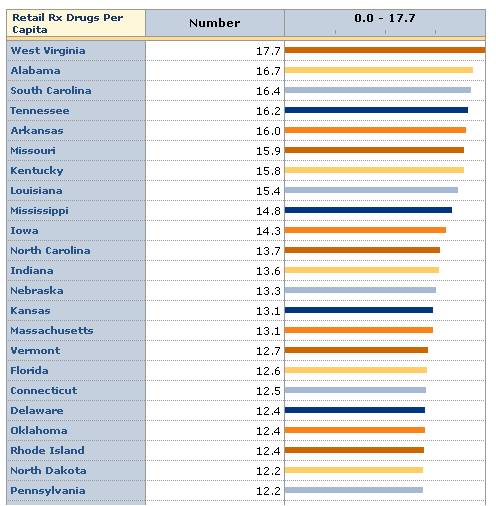
The Kaiser Family Foundation recently published an interactive chart that lets you look at the number of retail prescriptions filled in each state based on Verispan data.

This is interesting, but it doesn’t tell you much until tied to population or compared by disease state or some other metric.  So, here is their view by retail Rxs per capita.

There are lots of other data point out there by state for you to look at.

[BTW – Since I heard from one “ex-fan”, I will apologize for some distraction with the political process.  It is hard not to comment on timely events that will affect healthcare such as the US presidential race.  I appreciate readers interest in focus, but that’s not always possible.  Thank you for reading!]

Palin – Genius or Foolish

I would have predicted that John McCain would have chosen Mitt Romney even though they don’t appear to like each other.  So, I have yet to figure out whether choosing Sarah Palin was genius or foolishness on his part. (more on Sarah at Wikipedia)

Let’s look at a few characteristics that seem important in this race (at least for the presidential candidate):

  • Leadership – From what I have seen, she seems to have leadership qualities.  She even wrote a book.
  • Motivation – I haven’t seen her speak, but this evaluation seems to say she is a better communicator than Obama.
  • Age – young to complement McCain’s age
  • Energy – Seems to have a strong, positive vibe
  • Challenging the status quo – If elected, this would be a first woman VP.
  • Experience – no Washington experience…mostly local and a little state

She brings with her some interesting personal characteristics:

  • Runs marathons – shows determination and hard work; able to stick to a goal; values fitness
  • Husband works on the Alaskan oil slopes – good link to the blue collar world that might not have lined up with McCain
  • Pregnant daughter – could upset some of the conservatives, but shows she is human and by sticking by her kid shows her allegiance and compassion
  • Son in the army – shows family values and willingness to put her kids at risk to protect our country
  • Outdoors – husband has won the Iron Dog (snowmobile race) four times; she hunts; she fishes

Then again.  It matters who the VP candidate is, but does anyone change their vote on this?

They Charged The Wrong Insurance

Only a year late, I just got a notice from an insurance company telling me that we had several prescription claims processed under the wrong insurance card.  Apparently, they allowed our pharmacy to process claims for over 2 months after we had switched insurance.

Why is this my problem to deal with?  Shouldn’t the insurance company have responsibility for maintaining the eligibility file?  Shouldn’t the pharmacy have made sure my insurance was current?  Now, I have to either pay $300 or go back to the pharmacy and ask them to reverse out claims that are over a year old.

What a pain!  Of course, I am going to the pharmacy.  I had coverage so why would I pay out-of-pocket.

Communicating With Michelle Obama

First, congratulations to Barack Obama on getting the nomination.  He is a great orator and regardless of who I vote for I think he will be an exciting candidate.

From a healthcare communications perspective, I found an NBC Today Show interview with Michelle Obama very interesting yesterday.  She talked about three things that seem to be telling about her personality:

  • She said she was more of a fatalist than an optimist meaning that if Barack is meant to be president than he will be.
  • She said she was superstitious.
  • She talked about not believing that living in the White House will change their family dynamic.

So, I would suspect that trying to get her to change behavior would be very difficult as a fatalist.  If she believes that becoming sick is inevitable, why would you change your diet or habits.

If she is superstitious, I would suspect that there are actions, phrases, colors, or other queues that could encourage her to take action.  What those are…who knows?

And, if she doesn’t believe that the White House will change the family, it makes me think that she is very inwardly focused.  She admitted not watching TV or reading the paper.  But, as an ivy-league lawyer, I have to believe she does those things and reads aggressively.  So, I am confused as to why she wouldn’t believe history.  I haven’t read the history of presidential families, but I am pretty sure kids raised in the White House are very different.

My take would be that she would be a hard candidate to motivate to change and successfully communicate with.

Smoking Among Healthcare Workers

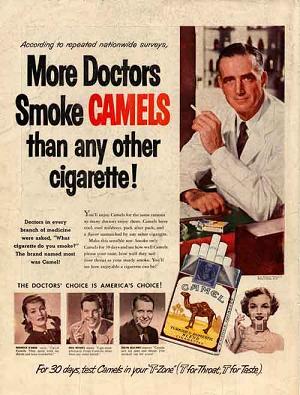
I was driving past a hospital this morning and saw several workers outside smoking.  They both looked like physicians, but I could be wrong.  Given all we know about smoking, I wondered if the prevalence of smoking is higher or lower within employees of the healthcare industry. From a quick Google search, it didn’t reveal much.

Healthcare Reform Won’t Be That Easy Mr. Obama

Election campaigns typically feature pontificating politicians flashing silver bullets to painlessly slay the nation’s problems.

Just move some money from here to there, cut some government waste no one apparently ever noticed, and then fund an unattainable promise with an outlandish price tag.

Barack Obama’s healthcare reforms fit this model nicely. He bundles three evergreen feel-good concepts — electronic medical records (EMR), disease prevention and chronic-disease management — and totes up dubious savings to fund his ultimate goal of making health insurance affordable to everyone. (Article in Fort Worth Star-Telegram)

It sounds like Barack’s advisors read George Halvorson’s book on the healthcare system.  Maybe they skipped the sections on the difficulty of aligning incentives and driving change.  If he thinks he can make major changes in 4 years, good luck to him.  Maybe that is a sign of his inexperience.  I think we all want change, but we definitely need a person who understands how to make change happen given the fixed constraints that we have.

He reminds me of the new consultant who comes in fresh out of business school and sees all the changes the company should make.  They are so obvious.  But, without all the history and the ability to manipulate the political landscape and knowledge of what it takes to get things done, it just becomes the flavor of the month that no one takes seriously while they wait for the consultant to move on to their next project.

Great ideas (not that this is one) don’t by themselves guarantee success.  A good idea implemented well is a lot better than a great idea implemented poorly.

Less Sketchy: More Scary

When you think about identity theft you think of your credit card information being compromised and someone ringing up $1,000s of dollars worth of charges that ruin your credit history.  If I say medical identity theft, you probably think about your information being stolen and used to ring up fraudulent bills by crooked providers.

But, in an article on the topic in the Chicago Tribune, they introduce a much scarier concept.  What happens if someone who can’t afford care, steals your identity to get free care provided to them.  During that process what happens if information is added to your permanent health record which subsequently impacts your future care (e.g., a note saying you are not allergic to something, a pre-existing condition which impacts coverage).

No Pharmacy Coverage – I Doubt It

In the AIS e-mail on Friday, it had the following quote:

“If the economy remains weak over the long term, we could certainly see employers and government agencies looking to investigate cutbacks on the type of pharmacy benefit they are offering, or eliminate pharmacy as a benefit altogether [in commercial plans]….The problem with [this] is that if an individual is unable to obtain their necessary drug therapy, you will typically see an increase in the overall health care costs associated with an individual.”

— Mesfin Tegenu, president of PerformRx, the pharmacy benefit manager division of the AmeriHealth Mercy Family of Companies, told AIS’s Drug Benefit News.

I must admit that I am more than a little skeptical of this.  The pharmacy benefit is the most used part of a benefit plan (average of 14 times per year).  Don’t you think there would be lots of other things cut back first?  Heck…I even see them cutting out 401K matching before they cut out prescription drug coverage.

Sure, it might get scaled back in terms of cost sharing or # of drugs covered, but that’s been happening for years.  But, elimination seems unlikely in a society that is very prescription drug focused.

E-Prescribing…Here to Stay?

About a month ago, an analyst was asking me about the e-prescribing legislation and trends and how that would impact the financials of the PBMs. I told her that I remained a little bit of a skeptic for several reasons:

[Basically e-prescribing is the use of a handheld device or personal computer to automate the generation of prescriptions to eliminate hand writing errors and streamline the process which is a great concept.]

  1. E-prescribing generally requires the use and adoption of new technology into a physician’s practice. The highest prescribers (due to their high patient load) are typically the older and more established physicians. They have the least likelihood of adopting the new technology.
  2. While safety is very important to the physician, the benefit to the PBM is if they can use the technology to push plan design edits to the physician. I don’t know any physicians who want to get into a conversation about plan design with their patients during their very brief office visit. They don’t want to compare copay levels. They don’t typically want to look at step therapy, prior authorization, quantity level limits, and other edits. This would require them to educate the patient and debate their options real-time with no financial benefit to them.
  3. The prescriptions could be sent electronically into the fulfillment systems for the retail and mail pharmacies, but that requires integration that doesn’t exist in many cases today and certainly doesn’t exist across the myriad of software vendors that provide this technology.
  4. The technology companies have had high turnover requiring physicians to learn new systems and leaving lots of equipment sitting in closets somewhere.
  5. There are funding issues of what (if any) hardware and software is needed and how that is financed. Why would a physician pay for this?

So, yes. E-prescribing is a great idea. It will come to fruition as the younger generation of doctors age. For them, technology is part of life not a new task. The first phase I see is physicians telling their staff what to enter into a web-based system or using a real basic handheld solution that cleans up the writing issues and has some basic clinical logic. I don’t see them doing much real-time integration with benefits information meaning that the 40% of new Rxs which have an edit still require work at the pharmacy.

Practice Makes Better

I am playing in a golf tournament this weekend and was talking with a couple of golf pros about handicaps and rules. They were talking about people “sandbagging” their handicaps which to me implies directly trying to influence their handicaps by not recording good scores or intentionally scoring poorly. (Your handicap is basically how many strokes on average you score above par.) Since I only play 9-holes a week on average, my handicap hasn’t moved in the 3 years I have been tracking it although I have scored anywhere from an 86 to a 116 on the same course that I play. My average is 103.

I told the pro that my plan was to play two months worth of golf in the 10 days before the tournament with a hope of playing well below my handicap. He said that I would clearly get ridiculed for sandbagging if I came in 10 strokes below my handicap or something similar. It made me wonder. I don’t score well, but I play pretty well. For example, in my last round (adding two 9-hole days together), I shot +8 for 13 holes and +17 for the remaining 6 holes. (Which should play well to match play not stroke play.)

Let me compare my typical golf to my preparation this week for the tournament.


Typical

This Week

Practice

No

Two times

Arrive before my tee time to warm up

Rarely

Yes

Holes per week

9 (weather permitting)

63+

Time of day

1:00 (in St. Louis heat)

8:00 am

Other

Usually eat while playing and play after doing my long run

Plan to run on other days and eat before warm up


To me, this seems perfectly legitimate. I know what messes me up mentally and physically when playing golf, but between work, kids, and other activities, I usually can’t control those factors. So, is it really sandbagging if I optimize the scenario to play well.

It made me think about the whole concept of practice makes perfect (as if perfect is achievable). I have seen this several times before:

  • When I went to Europe as an architecture student, I sketched all day long for 3-months. The initial drawing were horrible, but by the end, I had developed a much better eye and had improved my use of materials and colors. [Maybe I can find and post a few sketches.]
  • Running is very much the same for me. If I don’t have my warm-up and get mentally in the zone, it is hard to do well. For races, I plan everything out…what I eat, what I wear, when I want to get there, drinking stops, etc.

8 in 8: Michael Phelps Wins The Gold

What great motivation for a generation of people. First, you have Dara Torres winning 3 silver medals at the young age of 41. She shows us all how you can be a semi-normal person with a family and still compete at this level. (I say semi-normal since I don’t know if she has a nanny and other staff helping her or is independently wealthy and doesn’t need to work and can train all day…but I don’t think she is.)

Next, you have Michael Phelps winning 8 gold medals to increase his total and become the first one to win 8 golds in an single competition. (Not to mention the fact that he is a University of Michigan alumni like me.) I am sure a few people will be thrown off by the 12,000 calories he eats per day…don’t try this at home.

I think it’s also interesting that Michael has ADD/ADHD.  (Here’s a site that lists several famous people with ADD/ADHD.)  I think there is one good article which talks about his Hyper Focusing on swimming which is a common ability of people with this disease.  In this case, he has harnessed it very positively.

There are several motivations that people can take from the Olympics not least of which should be to get up and be active at any age.

Express Scripts Chief Medical Officer

My old boss and someone for whom I have great personal and professional respect is Steve Miller, MD who is the Chief Medical Officer at Express Scripts. I still remember the day I heard he was coming to the company and desperately trying to Google him to find out something about him. I couldn’t find anything. That has changed in the past few years. Now, you can find lots of information on him via Google as he is often interviewed and very active in Washington. (By the way (BTW), you should Google yourself and see what you find.)

As I sit her flying back to St. Louis from a meeting down South, I caught up and read an article where he was widely quoted as part of a panel. It has some good information for those of you interested in the pharmaceutical market.

  • He talks about the electronic prescribing market with a few interesting facts:
    • 4% of the prescriptions in the US are prescribed electronically compared to 95% in the Netherlands.
    • If we increased the generic fill rate to the theoretical maximum, we would save $40B a year which is enough to pay for all the charity hospital care.
    • In his time at the hospital, they observed that in 25% of heart failure cases the diagnosis and treatment was different if they had the patient history at their fingertips…A great example being that the patient says they are on a drug but the physician seeing that they haven’t refilled it for 6 months.
  • He talks about what happens after a drug gets approved by the FDA and how companies look at access, cost, and safety.
  • He talks about drug pricing and the fear that people mistakenly have about generics being produced in other countries.
    • “By and large, generics, no matter if their source is in the United States or foreign, have proved to be extraordinarily safe.”
  • He talks about reimportation of drugs from Canada.
  • He talks about reference-based pricing that allows other countries to have lower costs for pharmaceuticals and about how manufacturers provide low cost access to patients through Patient Assistance Programs (PAPs).
  • He also talks about the point at which cost can affect compliance with prescriptions – $150 for specialty drugs (which cost $1,500 a month on average) and $10 for oral solids. He also points out several of the other issues and points to the fact that price elasticity varies by class.
    • “It turns out people are most price sensitive to narcotics because narcotics are more of a discretionary drug, so if I am feeling economic pressure, I can forgo that pain pill.”

Prescriptions: Office Visits (4:1 ratio)

Often I talk about prescriptions as a driver of consumer awareness of healthcare costs. Since prescriptions really only represent 10% of total healthcare costs, this could be misleading. Certainly, it is important to focus on programs to reduce total medical costs. Ultimately, of course, we need to focus on prevention before either prescriptions or hospitalization is important, but for many reasons, that model isn’t one that aligns with our current healthcare system.

One of the reasons that prescriptions drive so much awareness is that we fill 4 billion prescriptions a year in the US and “only” visit the physician’s office, emergency room, or outpatient facility 1 billion times per year. Of course, all of these numbers clearly follow your 80/20 rule meaning that costs, prescriptions, visits, hospitalizations, etc. are really focused in a very narrow percentage of patients.

Another reason that my old boss recently talked about in an article is the fact that patients pay a greater percentage of costs (22%) for their prescriptions than they do for other healthcare costs.

Health Plan Week on Retention

I had an opportunity to get interviewed a few weeks ago by one of the contributors to Health Plan Week about retention within health plans.  With growth in the group market stagnant and ultra-competitive, the individual market offers lots of upside, but makes satisfaction and retention a much bigger issue.

You can read the article here where it discusses things like the “top box”, the importance of personalized communications, and champion / challenger processes to determine the best approach.

Skip The Patch…Send Them To Church

“Overall, 21% of Americans interviewed in our Gallup Daily tracking program this year say that they smoke.  (By the way, that’s down from an all-time high of 45% back in 1954).

But the percentage of smokers is only 12% among those who attend church once a week.  Smoking rises to 15% among those who attend almost every week.  Then 22% for those who attend once a month, 26% for those who seldom attend church, and finally 31% among those who never attend church.” (see 7/31 entry on USA Today Gallup blog)

I am always fascinated by correlations such as this.  Who thinks of the null hypothesis to look at this?  (Null hypothesis being that people who go to church smoke less which is what they collected the data to prove or disprove.)

With smoking being a huge health driver, what can you do with this information?  It’s hard to believe your employer or health plan could drive church attendance.  Perhaps this gets us back to social networking and your peer group.  Groups of friends or others coordinating and talking about quiting smoking may be more successful if someone active in a church was part of the team helping them.  (I am grasping at straws here.)

Smart People Doing Stupid Things

I was reading a post on the Foghound blog which made me think of an article I saw this morning on medical administrators using homeless people to defraud the government.  Lois points out eight things that smart people do that are stupid – impulsiveness, indulgence, and tempting fate (for example).

Why is it that seemingly intelligent people so easily and frequently seem to skirt the law to try to make money.  Do they think they are above the law?  Are they that greedy?  Do they believe (like the common criminal) that they won’t get caught?

It’s cases like this one with the homeless that cause distrust in the system.

Median US Age Now 37.9

The USA Today reports this morning on the shifting demographics of the US.  I found the map of the US showing the different variances from the median interesting.  (Note: Median means that half the people are below that age and half are above that age.)

It appears that some of the states like North Dakota, South Dakota, and Kansas are increasing their median age quicker than other states. (Source: Census Bureau, analysis by Paul Overberg, USA TODAY)

MMA for kids – wow

While I wait for my meting, let me try one more blackberry post. I was shocked to see a story the other day about kids as young as 6 doing mixed martial arts fighting.

This is a brutal enough sport for adults but teaching your kids to fight like this and be ultra-aggressive seems a little extreme to me.

Maybe, I am too sensitive but the pictures looked like a good way for kids to get hurt and teach them to pummel and drive submission versus compete and defend.

Compliance is complicated

I am going to try a posting from my blackberry.

I just read this in the AIS newsletter and was surprised that this was news.

“Personally, I believe the reasons people take prescription medications are quite complex. There are a lot of motivations and issues in that, and copays may not, in and of themselves, be enough to change adherence and compliance.”
— Keith Bruhnsen, manager of the University of Michigan, Ann Arbor, prescription drug program, told AIS’s Drug Benefit News when discussing the need for research and data to support the idea that lower copays for essential services actually remove barriers to their use.

Other Contributors

I have had a few guest posts over the past year, but I have now invited my team at Silverlink to contribute to the blog so don’t be surprised if you see a few other contributors in the near future.  Each of them owns a market area within healthcare (Medicare, Medicaid, Loyalty, Payor, Population Health, Clinical, Individual) and has great experience and ideas.

Lawns and Health

Whenever I take the dog for a walk in my neighborhood, I am always amazed at the difference in lawns and upkeep.  Some people have immaculate lawns while others have lawns full of weeds.  This seems to be consistent regardless of neighborhoods.

So, it made me start to wonder if there is some correlation between the attention people pay to their lawns and the attention they pay to their health.  Are the people who spend the time caring for their lawn more or less likely to be healthy?

I don’t know the answer to it, but I have to believe there are some attributes that are consistent.

Gas Prices Helping PBMs

Unfortunately, the WSJ Health Blog beat me to it, but I think it’s an interesting perspective that apparently David Snow (CEO of Medco) talked about.  High gas prices cause people to reconsider things…like driving to the pharmacy or paying for brand drugs.  That would mean that mail order penetration should go up and people should use more generics.

It seems logical, but I am trying to reconcile it with two other economic realities…people not filling their prescriptions or skipping doses to save money and the fact that mail order requires upfront payment for the longer supply.  I have always struggled with why someone doesn’t offer a credit card for their mail order pharmacy so that you can save money and spread the payment over three months.  In tough economic times, that cash flow can be an issue.

And, for the first time in over a decade, it appears that the growth in prescriptions actually fell as reported on the 16th in the WSJ.

The burden on consumers has increased sharply. The average copay for a preferred drug on an insurance company’s tiered system rose 67% to $25 in 2007 from $15 in 2000, according to the Kaiser Family Foundation. Out-of-pocket costs to cover family insurance premiums were $3,281 per employee last year, up nearly 84% from 2001.

Consumers appear to be skimping on medicines as a result. An April poll from the Kaiser foundation showed 23% of patients who responded didn’t fill a prescription in the last year because of cost, up from 20% in 2005; 19% split pills or skipped doses, up from 16% in 2005. A report last month from the nonpartisan Center for Studying Health System Change in Washington, D.C., said 20% of respondents in a 2007 survey of 18,000 people had put off or gone without medical treatment in the previous year, compared to 14% in 2003.

Data from IMS Health show growth in prescription volume for the first five months of this year slowed to 1.5%, the lowest rate at least since 1996. From 2003 to 2007, annual volume growth averaged 3%. In December 2007, total prescriptions dipped by 2.1%. The decline was 0.2% in April and 0.1% in May.

Traveling With Autistic Kids

After the incident a few weeks ago when a mother was kicked off a plane since her autistic child was uncontrollably upset, I was glad to see the article in USA Today about this challenge. It has some helpful information such as the fact that 1 in 150 kids have autism and 1 in 94 boys have autism.

The recommend the following:

  • The Autism Society of America sells wallet cards, left, that describe common characteristics of autism and tips for interacting with autistic children that parents can give to airline personnel.
  • Visit the Department of Transportation website to read the Air Carrier Access Act, which outlines the rights of disabled passengers.
  • Prepare for the trip by showing your child pictures of the airplane, the terminal and the destination.
  • Alert the airline that you will be traveling with an autistic child. Many airlines will allow you to board first.
  • Choose a vacation destination that will accommodate your needs. Many parents recommend Disney World, which is known for its disabilities services.

Since some of their reactions (to what most of us adults hate also) can look like misbehavior by children, I can only imagine the looks that the parents get.  As the article suggests, look and think about how you can help…don’t judge.

Cell Phones and Cancer…Cautious?

In another confusing story to us the public, everyone has picked up the story about the head of a prominent cancer research agency telling the employees to limit their mobile phone usage.

“Really at the heart of my concern is that we shouldn’t wait for a definitive study to come out, but err on the side of being safe rather than sorry later,” Herberman said.  [Dr. Ronald B. Herberman, director of the University of Pittsburgh Cancer Institute]

The suggestion is to limit use for children to emergencies, use hands-free devices, and use speaker phones.  The article cites several studies and the FDA saying that there are no issues.

Of course, this makes me think of autism and vaccines.  Is it an issue or not?  It also begs the question and the social responsibility of the health care system on whether to encourage us to be cautious or wait the decades for definitive research.

Love What You Do

We had an annual company event today, and I must admit that all day long I kept thinking about when can I get back to my hotel to work on several ideas that I have and get a couple of deliverables out the door.  Not that I wasn’t having fun since it was one of the best company events I have been to.  But, I love what I do.  And, since I have had the chance to work several places and even more as a consultant, I think being happy at work and enjoying your corporate culture is very important.

I love that fact that the company takes the time to celebrate and discuss the future.  And, it is great to be at a company that is still of a size that everyone can interact with each other, but big enough that you can make investments in the future.  Anyways, working on a few things for some of you clients and enjoying every minute of it.

But making it relevant for the rest of you…it made me think of the correlation between job satisfaction and health.  We all know the problems with stress and the impacts on health, but I found what looks like a good meta-study that shows the correlations.  Here is the abstract fromOccupational and Environmental Medicine 2005;62:105-112.

The relationship between job satisfaction and health: a meta-analysis

E B Faragher, M Cass, C L Cooper

Background: A vast number of published studies have suggested a link between job satisfaction levels and health. The sizes of the relationships reported vary widely. Narrative overviews of this relationship have been published, but no systematic meta-analysis review has been conducted.

Methods: A systematic review and meta-analysis of 485 studies with a combined sample size of 267 995 individuals was conducted, evaluating the research evidence linking self-report measures of job satisfaction to measures of physical and mental wellbeing.

Results: The overall correlation combined across all health measures was r = 0.312 (0.370 after Schmidt-Hunter adjustment). Job satisfaction was most strongly associated with mental/psychological problems; strongest relationships were found for burnout (corrected r = 0.478), self-esteem(r = 0.429), depression (r = 0.428), and anxiety(r = 0.420). The correlation with subjective physical illness was more modest (r = 0.287).

Conclusions: Correlations in excess of 0.3 are rare in this context. The relationships found suggest that job satisfaction level is an important factor influencing the health of workers. Organisations should include the development of stress management policies to identify and eradicate work practices that cause most job dissatisfaction as part of any exercise aimed at improving employee health. Occupational health clinicians should consider counselling employees diagnosed as having psychological problems to critically evaluate their work—and help them to explore ways of gaining greater satisfaction from this important aspect of their life.

Keep The Change

I was listening to an advertisement for Bank of America’s Keep the Change program this afternoon and found it to be very interesting.  Essentially, every purchase you make with your debit card gets rounded up and the difference put into savings.  For example, if you spend $3.43, they bill you $4.00 and put $0.57 in your savings account.  Forced savings (post opt-in of course).  And, they even having a matching program.

So, this accomplishes several things:

  • Creates an easy way for the consumer to save
  • Increases the money saved at Bank of America

It’s certainly in the bank’s best interest and good for the consumer.  It gets me back to my question from the other day.  If you are driving a positive result but you have to force the consumer there, is that okay?

What’s the healthcare model of this?

  • If you implement (or do) all your preventative care recommendations, your prescriptions are free (or some type of incentive system like this)?  Which is good for the payor, insurer, and patient.
  • How about a bundled copayment for certain events which included the office visit, hospital charges, and the prescriptions?  (Oh…sorry we couldn’t do that since we don’t know the prices in advance.)

New Drug Trend Blog

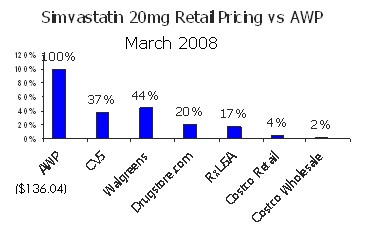
In a new blog called DrugTrendsToday by DestinationRx, you can find some good initial posts and some good data such as the following on generic Zocor (aka simvastatin).  What this shows you (that I have blogged about before) is the massive difference between AWP and actual cost for a generic.  In this case, the AWP is $136, but Costco pays 2% (or $2.72) for the drug.  This huge difference is only true on generics, but unfortunately, the industry has come to depend on generic pricing as the profit engine to subsidize the brand pricing which is some cases is a loss leader.