Archive | Leadership RSS feed for this section

US News and World Report Health Links

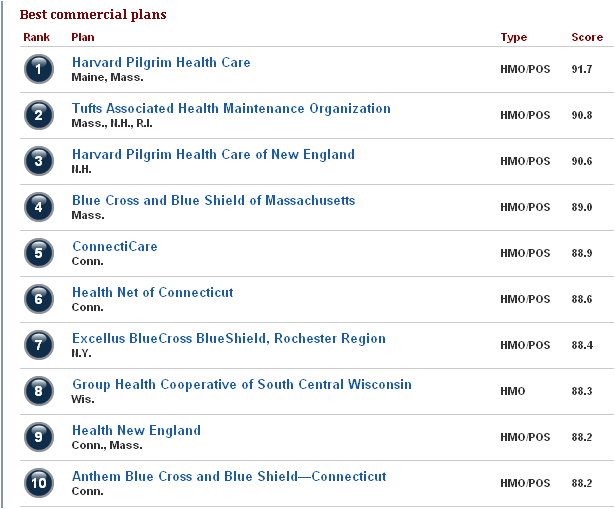
If you haven’t been there, US News and World Report has a good site for healthcare rankings and other information. Here are a few of the things you will find there:

  1. A link to Healthline where you can get help with Medicare Part D
  2. A list of the top plans according to rankings by NCQA (National Committee for Quality Assurance)
  3. Risk assessment tools on things like heart disease
  4. Links to health centers on topics like Asthma

Of course, the ranking are the most unique feature since the other health information is probably available on lots of other sites.  You can see some of the things that NCQA looked at in the rankings on the site also.

us-news-rankings-of-plans.png

Sticky Messaging

We used to talk a lot about stickiness of websites and eyeballs back in the late 1990s. The word still has some attraction and is a key point in the recent McKinsey interview with Chip Heath. Chip is a professor of Organizational Behavior at Stanford University’s Graduate School of Business.

“The key to effective communication: make it simple, make it concrete, and make it surprising.”

Although the article is primarily around what executives need to do to make their messaging and ideas stick with diverse audiences, it has a lot of relevance for healthcare.

“A sticky idea is one that people understand when they hear it, that they remember later on, and that changes something about the way they think or act.”

Think about all the things you want to tell your patients or members or employees (or vice-versa all the things you patients want your healthcare companies to tell you):

  • There has been a change to your X (copay, formulary, network).
  • You have an opportunity to save money by doing X.
  • We are missing X data that will delay your coverage.
  • We see that X happened and wanted to gather data on your experience or proactively address your question.
  • Welcome to our plan. Have you registered on the website? Have you received your ID card?
  • Please take this Health Risk Assessment.
  • Your credit card has expired. Would you like to update it?
  • Your order is delayed. If this is an emergency, please do X?
  • We see you were on the website. Did you find what you needed?
  • Do you need a copy of your X (formulary, provider directory)?
  • You have not yet picked a Primary Care Physician. Would you like to do that now?
  • Did you receive the information that we sent you?
  • Are you following your physicians orders? Did you do X? Why or why not?
  • Our records show us that you are due for a X. (Flu shot, screening)
  • Are you using any over-the-counter products that we should have in our database to identify drug-drug interactions?
  • Please remember to refill your medication?
  • Are you having any side effects or complications associated with your recent medication or procedure?
  • Have you enrolled yet in our disease management (or incentive) program? Would you like more information?
  • Welcome to the plan.
  • We know it is time for open enrollment. We hope you will renew with us. We are offering a local meeting to help you learn more about your benefits. Would you like to attend?
  • X has changed with your drug, condition, etc. There is new information available at Y.
     

    Getting back to the article…He offers several good examples of sticky messages which are primarily what I would call rallying calls for organizations. In healthcare, the key is to find these simple messages that compel people to act. So, bottom lining it, he gives six basic traits:

  1. Simplicity – short and deep
  2. Unexpectedness – uncommon sense messages generate interest and curiosity
  3. Concreteness – his example is don’t say “seize leadership in the space race” but say “get an American on the moon in this decade”
  4. Credibility – this should be so easy in healthcare if you leverage all the people and stories out there
  5. Emotions
  6. Stories

He has a few great stories such as:

  • A Nordstrom’s person wrapping something bought at Macy’s just to make the customer happy. [And probably without point it out.]
  • A FedEx driver who forgot the key to a box simply unbolting the box from the ground and throwing it in the truck so they weren’t late.

These things reinforce the message while becoming a type of urban legend that stay with people. They evoke emotion in a simple way.

One good example I have from Express Scripts was around trying to motivate people to change from one drug to another. When Zocor was going generic, we decided to launch a huge multi-modal campaign to drive down Lipitor marketshare and move people to Zocor so that when it went generic everyone would win. [Clients would save; patients would save; and we would make more money.] It worked. But, prior to the program, we worked with linguists and others to design and test a set of messages. The one that resided best was “we have a secret that can save you money”. People were intrigued and listened. They felt like they were being let in on something that was important. We ended up positioning it similar to a Consumer Reports Best Buy. It worked.

Looking for an Acquisition – Speculation

With the stock market handsomely rewarding the PBMs especially Medco and Express Scripts, they have cash and stock value to go on the acquisition path. Express Scripts has grown through acquisition over the years leading up to its acquisition of several specialty pharmacy companies a few years ago. In the St. Louis Business Journal, David Myers (VP, Investor Relations) is quoted as saying “Acquisitions are Express Scripts ‘No. 1 priority for our strong cash flow'”.

[By the way, as I have previously disclosed, I own no ESRX stock or other stocks individually. I only invest in mutual funds…and do very well with it.]

Although it’s been out for a week, I just read it this morning so before I run into anyone there I want to have fun guessing what Express Scripts might acquire. Usually, all I hear about is speculation of who might buy them. It typically is either a retailer like Walgreens or Wal-Mart or occasionally a managed care company. I don’t see them getting bought with the valuation so high. And, there are very few payor other than United Healthcare (which is tied to Medco) or WellPoint that could swallow such an acquisition. And, I am sure Walgreen’s won’t do anything until they see what the CVS/Caremark deal looks like, but if it works, they would have to make a bid for Medco or Express Scripts to compete.

  1. Buy one of the many regional PBMs that exist. This would be the easy play. It could be integrated. There is lots of synergy. But, people still go to the regional players for a reason, and you may lose a lot of the lives. Now, buying Walgreen’s PBM might be an interesting play and create a sticky relationship with them to align against CVS/Caremark.
  2. Buy a niche PBM in an area such as Worker’s Compensation. Not a bad strategy. They used to have about 20% marketshare in this space. They could also go after the Third Party Billers here although I think that market space may collapse.
  3. Buy another specialty PBM. I hope not. They have the assets already to be successful here. All you would be doing here is buying lives for people committed to one particular pharmacy. I think the premium would be too high.
  4. Go into a related space like dental or vision, but they tried vision before and it never really took off.
  5. Go into the data (e.g., IMS) or IT space (e.g., Ingenix), but they have also tried this and it never took off.
  6. Continue to acquire in the consumerism space. They recently bought ConnectYourCare. There are lots of companies out there doing interesting things in this space and with the projected growth here there are lots of opportunities. The problem is valuation of these companies, maturity of the business model, their risk in going into this business, and their focus on the traditional PBM model.
  7. Buy a technology company like an e-prescribing company (e.g., Prematics where Barrett Toan (founder of ESI) is an advisor) or a Physician Practice Management company (e.g., Pat McNamee the Chief Administrative Officer came from Misys which I believe was for sale) or healthcare IT company like Cerner or a pharmacy automation vendor like ScriptPro or a Personal Health Record company (like Aetna bought ActiveHealth).
  8. Buy a disease management company. Medco has a 10-year (I think) deal with Healthways which I would assume is a “try and buy” type relationship (i.e., let’s try this out and if it works we will buy you at a pre-determined price). ESI has worked with LifeMasters in the past, but I assume there are lots of players out there with interesting models.
  9. Follow Medco and buy in the disease space and DME (durable medical equipment) space. Medco bought PolyMedica earlier this year as part of their strategy to develop disease specific pharmacies called Therapeutic Resource Centers. This would probably be the most logical extension. It seems to be working for Medco.
  10. Buy into the international health
    space
    . This would probably be the most adventuresome with the biggest upside (if it could work). There is a lot of opportunity outside the US, but with limited investment, no managed care companies or PBMs have ventured too far. Express Scripts has a company in Canada. I know a few others have explored and/or tried small ventures.
  11. Buy into the generic manufacturer or distribution space. This would probably be the most lucrative. They have a huge distribution channel. Why not buy a portion of an existing generic manufacturer, open a distribution company (like McKesson, Cardinal, or AmerisourceBergen), and create a single source relationship with the Express Scripts pharmacy and give the retail pharmacies a different reimbursement rate if they used them.
  12. They could always try to become a retailer or go into the clinic business. There is something here, but it is a very different model and given the “training” they have done with the street over the past decade to focus on ROIC (return on invested capital), I don’t think they could do this.

Now, the two things I would suggest if I were still there would be:

  1. Invest in IT. Look at how to automate more workflow activities. Look at technologies that drive patient self-service. Look at things that drive patient behavior (online tools, educational programs, incentive systems). Build out mass customization and personalization based on integrated data – medical and lab – so that no one can catch them. (But, if you are waiting to sell, don’t spend the money to overhaul the system.)
  2. Create some mad money in a Venture Capital type relationship with someone like Google or Microsoft that are trying so hard to get into the healthcare space and would welcome the relationship to jumpstart.

Who knows? I certainly don’t know what they will do, but it is a fun position to be in. You have money. The market is at an inflection point. You want to be a catalyst. You have driven incredible results for a decade. What next?

Is Healthcare Missing a Generational Opportunity?

I think a lot about some of the new marketing tactics being used by consumer product companies – sponsorship (e.g., McDonalds Holiday Lights at the Beach Presented by Verizon Wireless), advertisements or product placement in video games, corporate tattoos, YouTube videos, MySpace personas, and Second Life avatars. Logically, who cares about most of these for healthcare. The primary users of healthcare are the senior population…and they aren’t being influenced by these channels. The corporate buyers are the HR or benefit professionals…many of whom have professional consultants (e.g., Hewitt, Mercer). Branding is often an afterthought within healthcare.  [Can you image a company working with the reality show Survivor to make sure that one of their competitions earned the winner a personal healthcare coach sponsored by Cigna (for example) for a year?]

BUT, we all know that health insurance (or any insurance) company is not typically viewed as a trusted entity looking out for your best interest. (As one of my old bosses used to say…how many times are you going out to dinner with your health care broker each year?) I guess my point is why are some of the key players thinking out 20 years and trying to figure out how to influence the younger generation and show healthcare as an entity that works to make their life better (e.g., have a video game where buying health insurance makes your character recover faster from injuries).

For example, I believe most people have a great impression of architects as humane people based on The Brady Bunch’s depiction of the father figure who was an architect. The lead character in Spike Lee‘s movie, Jungle Fever, was an architect. Have you ever seen a movie where the lead character was the VP of claims at a managed care company or the CEO of a PBM? There needs to be someone out there thinking big picture and looking at what it will take over time to change the perception of healthcare because perception is ultimately reality so we have to address both. Fix the problem and get people to believe that we fixed the problem.

Bat Phones, Blue Phones, and On-Star

I was listening to a GM commercial for their OnStar service earlier today, and it made me wonder.  If GM can design a service, staff a call center, and make money in the highly competitive car market, why can’t healthcare?

Conceptually, it seems like such a great service.  No interactive voice response (IVR)…you actually get to a live agent right away.  You press a button and you are connected…no remembering numbers or having to find the right time to call.  They help you with any issue…rather than route you to some other person for follow-up.

bat-phone.jpgMany of you will remember the “Bat Phone” from Batman where (if memory serves me) the Commissioner could pick up the phone and be instantly connected with Batman to ask for his help.  We tried a few programs to get at this at Express Scripts.  We worked with BCBS of Massachusetts to pilot the “Blue Phone” which was placed at certain high volume pharmacies and allowed patients to pick up the phone and talk directly to an agent that could address questions about their claim (i.e., why has my copay changed?  why isn’t this drug covered?  the claim got rejected, why?).

“Customers seem to be willing to use the Blue Phone more each day,” said Jon Hersey, pharmacist at Stop & Shop. “The response from BCBSMA is routinely quick and customers don’t spend a lot of time waiting on the phone. This saves time for us and keeps the customers happy, because we can spend more time filling prescriptions and less time answering questions.”

The other thing we tried was setting up a tiered customer service model where high utilizers of prescriptions were given a direct dial that took them directly to a group of skilled agents.  Patients loved both the Blue Phone and the tier service model.  The challenge of course is staffing appropriately and managing costs.  BUT, if companies were more proactive in call obviation, they could employ solutions like this.  If companies mined their data to identify when patients would call and reached out to them before they called to address their questions, then inbound call volume would drop dramatically and would be more the exception than the rule.

Missouri Healthcare Discussion

Last month, there was an article in the St. Louis Business Journal where several industry leaders commented on the future of healthcare for Missourians.  I thought several of the comments were universally relevant.

The participants were:

Facts / Comments from the article:

  • If you are living under 300% of the FPL (federal poverty level) and don’t have insurance, you are twice as likely to be admitted to the hospital for an avoidable condition
  • Government is the biggest payor – 10M lives covered as an employer, 40M Medicare lives, 51M Medicaid lives, and 47M uninsured.

“The tragedy in St. Louis right now is that within the city and parts of the county, we still have third world outcomes.”  [Ron Levy]

  •  70-80% of everything the doctor says isn’t understood by the patient
  • Dr. Lipstein mentioned a few of the BJC websites for the public – helpforyourhealth.org and myhealthfolders.com.  I scanned the helpforyourhealth site which has some nice features like a ask the pharmacist button where the Q&A is posted for everyone to see.  On the other hand, the myhealthfolders appears to be their own PHR but mostly self-reported information.
  • Dr. Lipstein also talks about the fact that they have evidence that investing in health literacy and promotion, screenings for blood sugar, cholesterol, blood pressure, and BMI, and getting people into programs to manage diseases or risks can lower the costs of healthcare.
  • Dr. Lipstein also says that the Cleveland Clinic won’t hire anyone who smokes anymore and Scott’s gives you six months to quit smoking or you get fired.  (Based on the fact that it costs about $3,400 more per year to employ someone who smokes.)
  • They talk a little about the Danish model of healthcare where primary care physicians are actually paid more than specialists.
  • Dr. Peck talks about the fact that 75% of healthcare costs are from people with chronic disease and many of those could be identified early through risk factors.
  • Ron Levy talks about how 1/3 of the Medicare costs are spent in the last 3-6 months of life.

It was a good piece.  Healthcare as always is complicated with lots of factors.  The only way to fix things is to understand the correlations, isolate a few factors, and improve them.  I think a lot of solutions get discounted because their is always some reason why they can fail.

My big takeaway from the discussion was prevention.  We need more education, more screenings, and more wellness activities.  The question is aligning incentives at the patient and payor level to invest in these.

IBM HC 2015 – Win-Win or Lose-Lose

I skimmed another IBM publication today which I thought was a great piece – IBM Healthcare 2015: Win-win or lose-lose?. (A little long at ~70 pages, but good with concise charts.) It talks about what healthcare has to do to survive and create a win-win model. It looks at it from multiple perspectives – payor, provider, consumer, and supplier. They also do a good job of describing several unique models around the world and talking about several trends here in the US.

Here are a few quotes, facts, and charts from the publication which should tempt you to go read it…(note: I am not going to show all their sources, but you can get them from their publication.)

“The United States spends 22 percent more than second-ranked Luxembourg, 49 percent more than third-ranked Switzerland on healthcare per capita, and 2.4 times the average of the other OECD countries. Yet, the World Health Organization ranks it 37th in overall health system performance.

In Ontario, Canada’s most populous province, healthcare will account for 50 percent of governmental spending by 2011, two-thirds by 2017, and 100 percent by 2026.

In China, 39 percent of the rural population and 36 percent of urban population cannot afford professional medical treatment despite the success of the country’s economic and social reforms over the past 25 years.

Approximately 80 percent of coronary heart disease, up to 90 percent of type 2 diabetes, and more than half of cancers could be prevented through lifestyle changes, such as proper diet and exercise.

Preventable medical errors kill the equivalent of more than a jumbo jet full of people every day in the US and about 25 people per day in Australia.”

Table on IBM’s recommendations by stakeholder for what has to happen to transform to a value-based healthcare system (win-win).
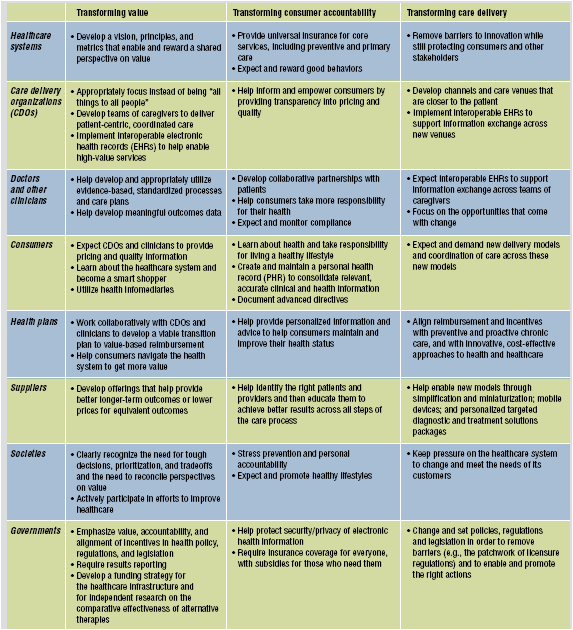
ibm-table-1-on-change.png

IBM chart pointing out the obesity issue’s growth
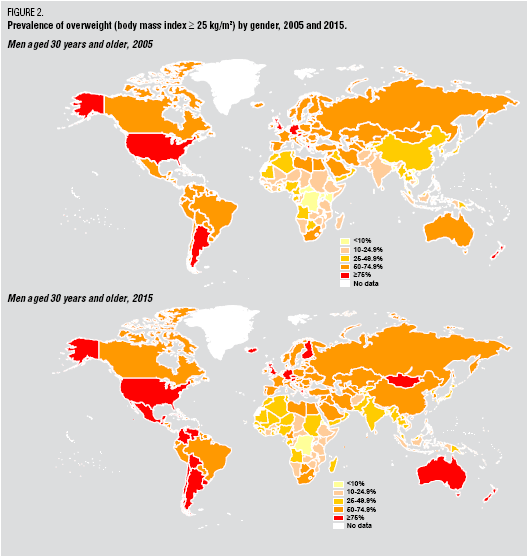
ibm-on-obesity-trend.png

They talk a lot about the current system’s focus on episodic care while the problem is chronic disease.
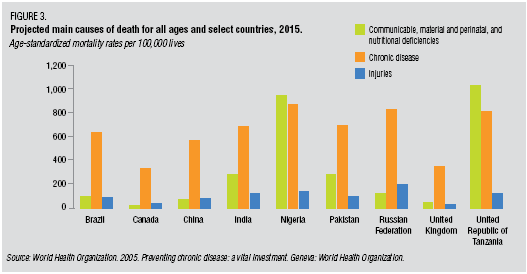
ibm-3-chronic-disease.png

You will see lots of the buzzwords we hear today (transparency, empowerment, consumerism, infomediary, value-based) throughout the article, but they are delivered with facts and anecdotes to support their perspective.

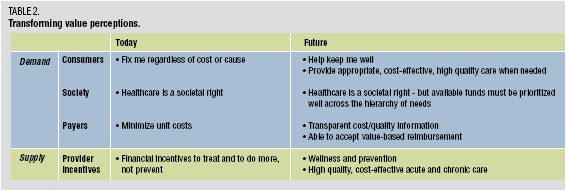
ibm-4-transforming-health.png

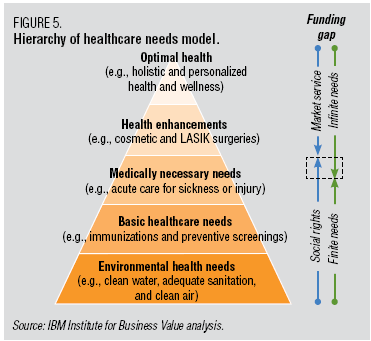
I could go on, but I will leave it with a nice adaptation of Maslow’s Hierarchy of Needs which they present around healthcare.

ibm-healthcare-hierarchy-of-needs.png

You will find information in here around telemedicine, retail medicine, health tourism, and they tee up some of the hard discussions about when is it too much. How much should we spend (individually or as a society)? What expectations should we have? A lot of it requires a different mindset for all the constituents. This would be a good read for the presidential candidates.

Physician Double Standard (What’s Ours)

There was an article out yesterday summarizing a survey of physicians.  The key point it made was that “up to 96 percent of those surveyed said they should report all instances of significant incompetence or medical errors to the hospital clinic or to authorities.”  [It was only 45% among cardiologists and surgeons??]  BUT, 46% of those surveyed knew of a serious medical error that had been made and did not report it.

Given all the focus on quality and error rates over the past few years, this seems concerning.  Although I am equally as concerned that the surgeons didn’t feel it was necessary to report issues. 

At the same time, I believe we can’t expect different standards from others that we wouldn’t be willing to be held to.  So, if you knew a collegue did something wrong, would you report them?  If they acted inappropriately at a client social event.  If they presented poorly and lost a sale.  If they made a mistake in their financial model.  If they had a spelling error in a marketing piece. 

Of course, not all of these are life and death, but I could certainly argue that rejecting a claim that pushed undue financial stress to a patient would be a serious issue.  Or, simply telling them a service wouldn’t be covered might discourage them from getting needed work performed. 

“There is a measurable disconnect between what physicians say they think is the right thing to do and what they actually do,” said Eric Campbell of Massachusetts General Hospital and Harvard Medical School in Boston, who led the survey.

Some of the other findings included:

  • Doctors are willing to order unnecessary — and often expensive — tests.  [How many of us don’t always take the least expensive path?]

  • Only 25% consciously tried to avoid gender or racial bias in how they treat people.  [How many of us consciously do this in our job?]

  • 93% of doctors said they should provide care regardless of a patient’s ability to pay but only 69% actually accepted uninsured patients who cannot pay.  [How many of us would be willing to provide our services for free to someone that needed them?]

URL:

IBM on HC 2015 – Part I

I had a chance to catch up on a bunch of reading on the plane including an IBM brochure I picked up the other day on “Healthcare 2015 and US Health Plans“. I found it to be a good piece with several good frameworks although it doesn’t take any radical views on the future (which I would have liked to see).

Here were a few of the facts / takeaways from the brochure:

  • US healthcare expenditures per capita are 2.3 times higher than other developed countries and projected to increase 83% over the next 10 years
  • Medical errors cause between 48,000 and 98,000 patient deaths per year
  • Medication errors cost the US over $3.5B per year
  • On top of the 47M uninsured, there are 15.6M underinsured
  • There are five issues that will make change difficult for healthcare:
    • Funding constraints
    • Societal expectations and norms
    • Lack of aligned incentives
    • Inability to balance ST and LT perspectives
    • Inability to access and share information

    “We believe that the U.S. healthcare system will not achieve a comprehensive “win-win” transformation by 2015 because of political gridlock and inability of key stakeholders to work collaboratively to reach solutions for the ‘greater good’.”

  • They do predict that some form of universal coverage will be enacted by 2015 and will be focused on the individual not the employer to address the “job lock” challenge.
  • They see a key role for health plans and call upon them to lead the transformation to a “more patient-centric, value-based, accountable, affordable and sustainable U.S. healthcare system”.
  • They predict that employer-sponsored health benefits for family coverage will increase from $8,167 in 2005 to $17,362 in 2015.
  • In 2006, PPOs (preferred provider organizations) accounted for 60% of private insurance enrollees (up from 41% in 2000).
  • Employers offering coverage has dropped from 69% in 2000 to 61% in 2006 and is predicted to go below 50% by 2015.
  • They talked about employers putting a lifetime cap on retiree benefits which was a new concept to me, but they said that 49% of employers polled in 2005 had a cap (of which 59% of those on the plan had already hit the cap).
  • They talk about lifestyle choices impacting premiums which would lead to increased wellness and preventative programs.
  • There is some scary data about money needed post retirement. They say that half of all bankruptcies are in part due to medical expense. They also say that “a couple retiring in 2016 at 65 years of age would need US$560,000 if they lived an average lifespan. They would need US$1.05 million if they lived to 95 years.” This is specific savings for healthcare costs in addition to Medicare. WOW!! And, they say that 40% of people over 55 have $50,000 or less saved.

ibm-retirement-health-savings.png


“The health–wealth intersection is already taking shape. Players from each sector are experimenting with offerings that cross the boundary between the two, such as reverse mortgages to finance nursing-home costs and arrangements that let individuals tap into their life insurance policies to cover medical costs. But the new health–wealth business will evolve and change shape for at least the next couple of decades, as the retail health-care market coalesces and consumers take on more responsibility for their medical needs.”

Empty Every Chair

It takes a lot for an advertisement to catch my eye, but “empty every chair” made me think.  Especially, when I see the word health in the text.  The text goes on…

“Whose idea was it to build a room to house inefficiency?  The less time patients spend in the waiting room, the happier everyone will be.”

It’s an interesting view.  I couldn’t agree more.  The advertisement ends up being for PWC (PriceWaterhouseCoopers) and their healthcare consulting practice.  A link takes you to their site with publications on P4P, presidential plans for healthcare, wellness, and lots of other topics.

What Have You Failed At Today?

I caught this story on ABC last night about entrepreuners.  It made an interesting point about the need to fail and learn from your failure.  In summary, it was basically saying that people who took risks, failed, and spent the time to learn from their failures ended up more successful.

I think that is very relevant to the world of healthcare communications.  Any program should have a test plan of ideas that are constantly being varied to see what works best.  Each micro-niche of the population is going to respond differently.  If you aren’t out there trying different things, you won’t optimize the success of your programs.

Of course, this is easier said than done. You need a culture that believes in failure.  You need a way to learn from your mistakes.  You need people that are willing to admit they were wrong.  You need a measurement tool to document the success of one attempt versus the other.  And, you need to understand what can be varied to drive change.

Let’s take a simple example here.  In the world of automated voice communications, you can vary dozens of things:

  • Which voice should you use – gender, age, accent?
  • How should the voice speak – casually, formally, authoritarian, consultative?
  • What speed should the voice be at – normal pace, fast, slow?
  • What time of day should you call?
  • What day of the week should you call?
  • Should you leave a message or call back?
  • How many times should you attempt to reach the patient?  Within what window?
  • How long should the call be?
  • Should the call be complemented by letters or other outreach?
  • Should the call offer to connect them to a live agent?

I could go on, but I think you see the point.  Experimentation is key and makes a difference.  I am not even getting into the thousands of variables in the messages. 

So, go out and fail at some new program to communicate and engage with your patients.  Learning faster is your best way to succeed. 

Companion Global Healthcare

BCBS of South Carolina has been a progressive Blues plan for years.  Under Ed Sellers’ leadership, they have tried new services and built new businesses.  It was surprising, but not shocking, to see that they had opened a new company called Companion Global Healthcare which is a medical tourism company to help people get costly surgeries and care outside the US.

medical-tourism.jpgI talked about this whole business a few months ago (old entry).   But, seeing BCBS-SC and HealthNet of CA [who has been working with a Mexican healthplan for 6 years] focus on this and take advantage of these services is an interesting development and says a lot about the status of our system.

Here is another article in the Providence Journal.

Patient Centric Healthcare

I changed the name of the blog last week. (I am still debating changing the URL since I don’t want to lose too much of the traffic I get today.)  It fits what I want to talk about (with the exception of some of my ramblings about technology, leadership, innovation, etc).

I was trying to describe this concept of patient centric healthcare to someone the other day when I realized that I have a deck I used over the summer that was a perfect fit.  When I was debating moving from a consultant back into a corporate role, I needed to tell people what I wanted to do and how I could help them.  So, I created a slide deck that I used with executives and recruiters.  It worked well.  I trimmed out the “why George” section, but the rest of this is a good summary of how I see the market evolving.

It is also exactly why I joined Silverlink Communications.  We share the same vision and dedication to process excellence.   Their technology already does what I think is critical:

  • Create personalized communications that target patients based on data driven models.
    • Push information
    • Collect information
    • Drive behavior
  • Use dynamic call algorithms that respond to patients words to take them down different paths is key.
  • Using technology to automate processes and augment your human capital based on proven value propositions.

Leadership in 60 Seconds

I have always been fascinated by two topics – leadership and innovation.  They have driven me to read many things and try different roles.  I also believe my pursuit of both architecture and business as a combination of right and left brain challenges was a way for me to try to learn both.

I found this presentation on leadership which is a quick summary of many points.  In the end, it is a little more of a teaser deck for a book, but it is a good reminder of many things about leading.  Since I believe healthcare companies have a chance to lead the market right now before government leads them, it is a topic to think about.

Permission Marketing – This is What I [patient] Want

Permission Marketing is certainly not my concept. Seth Godin invented the term and wrote the book on this several years ago. But, I think it is a concept way behind it’s time in healthcare.

“Permission Marketing cuts through the clutter and allows a marketer to speak to prospects as friends, not strangers”

The concept (in my words) is that you ask the consumer (aka patient) what they want.

  • What information do you want from us?
    • Opportunities to save money
    • Alternative therapies
    • News about your drug
    • Benefit information
    • Compliance reminders (Rx, lab visit, tests)
  • How do you want that information delivered to you?
    • Phone
    • Voicemail
    • Cell phone
    • SMS / Text message
    • E-mail
    • Fax
    • Letter
  • Does the channel you want the message delivered through vary by the message?
    • Deliver savings information within 24 hours to me via my cell phone
    • Send benefit information via PDF using my home e-mail address
  • When do you want that information delivered to you?
    • Pro-actively
    • Reactively
    • Bundled (i.e., send me one “package” of information monthly)

Wouldn’t that be nice? Most of us don’t even know what the options are. We just get bombarded with information from our employer, managed care company, pharmacy, PBM, disease management company, wellness programs, HSA / HRA account manager, etc. Different messages. Different information.

In reality, one of the biggest problems is that our healthcare companies just can’t manage these type of personal rules today. Managing do not call lists are difficult enough. This should change over the next 5 years, but it will be a combination of patient generated preferences along with data mining to develop algorithms that predict what channel and message is most effective at driving behavior for certain patient segments.

Encouraging Healthy Behavior (example)

Wellness is a big topic at employers these days.  (And, it would be bigger if retention issues were fixed and companies knew how to retain their people.)  The right programs can make people more motivated, healthier, and more productive and dedicated employees.

I found an example from eBay to be very innovative.  They have launched a program called YourDinner.com which allows employees to spend a couple of hours per week (on the clock) with the company’s chefs assembling a week’s worth of dinners to take home.  What a great idea!  I get to save time and eat healthier and give my kids a good home cooked meal.  (Not to mention it is probably a stress release.)

Consumer Voices for Coverage

The Robert Wood Johnson Foundation has funded something called the Consumer Voices for Coverage which begins in 2008. 

The need from the project comes from the publication of Consumer Health Advocacy: A View from 16 States by Community Catalyst in October of 2006.  This calls for consumers to be active in protecting and expanding healthc are access.  In order to be effective, consumers need to organize into  state advocacy networks with the ability to:

  1. analyze complex legal and policy issues in order to develop achievable policy alternatives;
  2. build a strong grassroots base of support;
  3. design and implement communications strategies to build timely public and political support for reform;
  4. build and sustain strong broad-based coalitions and maintain strategic alliances with other stakeholders;
  5. develop and implement strategic health policy campaigns; and
  6. generate resources from diverse sources to build organizational infrastructure.

I must admit to never being much of an activist, but I certainly support the concept of people being active to support their cause.  And, of the many causes out there, access and care for people is a good one.  In a wealthy country like the US, it is a shame to see people dying and in pain for simple reasons like lack of access. 

Unfortunately, many Americans probably don’t realize how good we have it here.  Even those without have TVs and clothes.  Go to a 3rd world country and spend some time with the poor.  It will radically change your opinion. 

Cultural Communications

In the spirit of advocating for the patient, I think one of the key things missing at many companies is culturally specific communications.  The simplest solution here is multi-lingual.  Now that nearly 1 in 10 counties in the US have a majority of minorities, this is important (USA Today 8/9/07).

Of course, I always hear the question back of how do I track this.  Will people self-identify into a cultural group?  It depends.  Do you have anything to offer them?  Can you articulate value to them?

If I speak a different language as my primary language and you offer me communications in my native tongue, I would likely be happy to request it.  Can you track it when I request it?  Aquent appears to be a company focused on this within the healthcare space.

This can also manifest itself in color selection.  For different cultures, a certain color can mean different things which might affect your brochure creation.  (see article)   Of course, you need to be able to do mass customization of your brochure rather than print 7M in one run.

With hispanics expected to represent 21% of the US population by 2020, it will be important to understand this segment and how to communicate with them.  Here is a good article on this.  I have seen studies that show they respond at a higher rate than other segments to both letters and direct calls.  Shouldn’t that be important?

The point here is that if you really care about the patient and their health wouldn’t you want to push information to them in a language they care about; using colors that evoke action and emotion; and using words and frameworks that they understand.

The Art of Ware

I was just skimming a story from Guy Kawasaki’s blog about The Art of ‘Ware by Bruce Webster.  I was a little skeptic, but Guy always has great instincts.  I read a few of the chapters in the book and think you would enjoy it.  Especially if you work with or at a software company.

Here is some text from the home page about The Art of ‘Ware…

Back in the early 1990s, I [Bruce Webster] wrote and published The Art of ‘Ware (M&T Books, 1995), a reinterpretation of Sun Tzu’s The Art of War, a 6th century BC treatise on conflict and warfare. My reinterpretation of Sun Tzu’s maxims applied to developing and marketing information technology products, most particularly software. Here’s an example:

  • Sun Tzu (Chapter 2, ‘Waging War’, 1910 Lionel Giles translation): Now, when your weapons are dulled, your ardor damped, your strength exhausted and your treasure spent, other chieftains will spring up to take advantage of your extremity. Then no man, however wise, will be able to avert the consequences that must ensue.
  • The Art of ‘Ware (Chapter 2, ‘Supporting Development’, 1995 edition): When your developers are burned out, your technology aging, your resources diminished, and your advantages gone, then others will take advantage of your weaknesses and cut into your market. Even expensive consultants and new CEOs won’t be able to turn things around.

The McKinsey Way

You can certainly never go wrong looking at McKinsey. Their consultants are usually very top notch and their process of thinking and root cause analysis is great. Although this post is more about how you analyze a problem (i.e., business process innovation), it also makes a point about how important process and methodology is. The only way of delivering consistent, high-quality advice worldwide is to have a process of training and consulting that leverages smart people and delivers them to clients.

(Never mind the fact that McKinsey once told me that they only interview people with a 4.0 or people with a 3.8 and above from a top 5 business school. I didn’t fit the bill, but I have several good friends who were there. I have lots of respect for them.)

The McKinsey Way is actually a book so you can see some insight into the company. I have read the book and recommend it. Rather than re-type all my notes, I found comments about the book at MeansBusiness and on blog called Brian Groth’s Life at Microsoft and looked at notes on MECE (mutually exclusive, collectively exhaustive) from a book review on The McKinsey Mind.

My old boss who worked for McKinsey was a genius at asking the probing questions. She knew how to get to root cause better than anyone I worked for. This is essential in diagnosing any problem not least of which are process problems. (Since I assume you only look at BPM to drive value where you have some type of problem.)

So MECE, as Brian states in his blog, it suggests you should do the following:

  1. Identify the problem using a mutually exclusive, collectively exhaustive framework and then map the problem out using some type of logic tree (see example).
  2. Create a hypothesis (or hypotheses) about the solution…this drives your analysis.
  3. Analyze the data…remember that the only thing that is right is data (assuming some data integrity).
  4. Repeat steps 3 & 4 until you find a fact-based solution that makes sense.

From the book, some of the other key points are:

  1. “The most brilliant solution, backed up by libraries of data and promising billions in extra profits, is useless if your client or business can’t implement it.”
  2. “Most business problems resemble each other more than they differ.”
  3. “If you get your facts together and do you analyses, the solution will come to you.”
  4. “If you keep your eyes peeled for examples of 80/20 in your business, you will come up with ways to improve it.”
  5. “Know your solution so thoroughly that you can explain it clearly and precisely to your client in 30 seconds.”
  6. “It’s much better to get to first base consistently than to try to hit a home run and strike out 9 times out of 10.”
  7. “Just as you shouldn’t accept I have no idea from others, so you shouldn’t accept it from yourself, or expect others to accept it from you. This is the flip side of I don’t know.”
  8. “When you’re picking people’s brains, ask questions and then let them do the talking. Keep the interview on track by breaking in when necessary.”

5 Patterns of Extraordinary Careers

At Express Scripts, all of us on the leadership team (top 1.5%) were given the book The 5 Patterns of Extraordinary Careers.  It was a good book with several relevant tips especially for someone in the BPM space that is likely playing the role of change agent or somone whose career might include an objective of becoming the Chief Process Officer or Chief Innovation Officer.

From the website, I have pulled in the 5 Patterns.  They also have an online quiz which gives you feedback on whether you are on your way to an extraordinary career.

1. Understand the Value of You
People with extraordinary careers understand how value is created in the workplace, and translate that knowledge into action, building their personal value over each phase of their careers.

2. Practice Benevolent Leadership
People with extraordinary careers do not claw their way to the top, they are carried there.

3. Overcome the Permission Paradox
People with extraordinary careers overcome one of the great Catch-22s of business: you can’t get the job without experience and you can’t get the experience without the job.

4. Differentiate Using the 20/80 Principle of Performance
People with extraordinary careers do their defined jobs exceptionally well but don’t stop there. They storm past pre-determined objectives to create breakthrough ideas and deliver unexpected impact.

5. Find the Right Fit (Strengths, Passions & People)
People with extraordinary careers make decisions with the long-term in mind.  They willfully migrate towards positions that fit their natural strengths and passions and where they can work with people they like and respect.

Best Advice

I am not really sure of the best advice I have ever received.  Most of the things that jump to mind as good advice are: 

  • Be yourself.  
  • Everyone has something to add – treat them with respect. 
  • Travel the world. 
  • Keep a journal of what you learn each day.   
  • No one remembers you for how hard you work…your family is your memory.
  • Just act…don’t overanalyze.
  • Nothing will be perfect.

Here is advice from some well known names from a Fortune article titled “The Best Advice I Ever Got” (March 21, 2005 – page 90).

  • Warren Buffett “You’re right not because others agree with you, but because your facts are right.”
  • Richard Branson “Make a fool of yourself.  Otherwise you won’t survive.”
  • Howard Schultz “Recognize the skills and traits you don’t possess, and hire people who have them.”
  • A.G. Lafley “Have the courage to stick with a tough job.”
  • Sumner Redstone “Follow your own instincts, not those of people who see the world differently.”
  • Meg Whitman “Be nice, do your best – and most important, keep it in perspective.”
  • Jack Welch “Be yourself.”
  • Sallie Krawcheck “Don’t listen to the naysayers.”
  • Vivek Paul “Don’t limit yourself by past expectations.”
  • Dick Parsons “When you negotiate, leave a little something on the table.”
  • Andy Grove “When ‘everyone knows’ something to be true, nobody knows nothin’.”
  • Anne Mulcahy “Remember the parable of the cow in the ditch.” [First, get the cow out of the ditch.  Second, find out how the cow got in the ditch.  Third, make sure you do whatever it takes so the cow doesn’t go into the ditch again.]
  • Brian Grazer “All you really own are ideas and the confidence to write them down.”
  • Rick Warren “Regularly sit at the feet of Peter Drucker.”  [You need mentors.]
  • Jim Collins “The real discipline comes in saying no to the wrong opportunities.”
  • Peter Drucker “Get good – or get out.”
  • Ted Turner “Start young.”
  • David Neeleman “Balance your work with your family.”
  • Mickey Drexler “Bail out a business that isn’t growing.”
  • Brian Roberts “Let others take the credit.”
  • Marc Benioff “Incorporate philanthropy into your corporate structure.”
  • Hector Ruiz “Surround yourself with people of integrity, and get out of their way.”
  • Donny Deutsch “If you love something, the money will come.”
  • Klaus Kleinfeld “Keenly visualize the future.”
  • Ann Fudge “Don’t chart your career path too soon.”
  • Herb Kelleher “Respect people for who they are, not for what their titles are.”
  • Clayton Christensen “You can learn from anyone.”
  • Ted Koppel “Do what you love.”