Archive | Marketing / Communications RSS feed for this section

60% Think We Are Headed To A Depression

You wonder how bad it is economically or where we are headed…look no further than the CNN poll out this morning showing that 60% of Americans think it is likely that we will go into a depression.  Not a recession, but a depression like many of us read about in the history book or saw in the movies.

Do people really know what the depression meant – 25% unemployment (for example).  So, if that’s the perception out there, imagine the impact on health behavior.  People will continue to look for savings opportunities – skipping pills, splitting pills, moving to generics, trying over-the-counter medications, moving to mail order.  They will likely be less likely to act preventatively – e.g., getting a flu shot.  They may be more willing to ride out bad symptoms at home rather than rush to the clinic.

This makes me think about an article I saw the other day that said that people don’t have any solutions to manage trend.  I think that’s BS.  The fact is people are afraid of the solutions to manage trend.  They don’t want to tell employees what to do or limit their choice.  In a tight labor market, companies want to keep the employees happy.  So, as the labor market opens up (i.e., higher unemployment) and healthcare costs go up, will companies finally embrace some of these tools.

For example, on the pharmacy side, we used to see a spike in call center volume of 1,000%+ on some of the aggressive programs – mandatory mail, step therapy, limited formulary, limited retail network.  That scared a lot of clients.  Maybe that attitude will change.  Granted pharmacy is 10% of medical spend so the bigger problem is on that side, but maybe companies will finally be willing to link out-of-pocket costs to controllable medical activities – weight, exercise, blood sugar, cholesterol, preventative testing.

If I were a insurer or a PBM, I would be focused on showing my value right now.  I would be delivering cost savings messages to all my members and help them understand how to minimize their out-of-pocket spend in this economy.

The Tough Economy is Impacting Health (and Potentially HEDIS)

A WSJ article of last week provides a glimpse into the many ways our strained economy is adversely impacting the healthcare-seeking behavior of individuals (see article here). It cites a D2Hawkeye analysis of medical service and pharmaceutical utilization (in a study performed before the most recent Wall Street and Main Street turmoil) and shows widespread impact across many healthcare categories. Consumers are cutting back on everything from mammograms to drugs to physician visits.

These findings should be a big stimulus for health plans, population health companies and PBMs to work more creatively on plan designs and communications strategies to support prevention and medication adherence.

Certainly, many individuals are feeling the pinch of health care costs to a greater extent than ever—with higher co-pays, bigger deductibles and for some Medicare members, the “coverage gap,” all contributing to choices people making. The D2 Hawkeye analysis of several Mid-Atlantic health plans looked at preventive and non-acute health services received between March 2007 and March 2008…

It shows pap smears are down 6% and antidepresssant medication fills declined by 19%

…despite the fact that for most of these members (in the study population) the cost-sharing changes year-to-year were minimal. So, the broader economic reality appears to be forcing consumers into making hard choices – trading off health care for other goods and services, whose prices are simultaneously rising.

NCQA is about to release its 2008 State of Healthcare Quality Report (tomorrow, October 2nd) which is its comprehensive summary of how plans across the nation are performing across the full range of HEDIS indicators . The data will reflect the healthcare services received by members in 2007, levels which from the D2Hawkeye study and other industry sources suggest we’ve declined. ….the time is now for innovation that spurs positive member behavior –in areas ranging from diabetes care to flu shots to colon cancer screening—to take center stage as an antidote to all the negatives the economy is now inflicting.

Healthcare Effectiveness Data and Information Set (HEDIS) is a tool used by more than 90 percent of America’s health plans to measure performance on important dimensions of care and service. (source)

This posting was written by Margot Walthall, Population Health Market Leader for Silverlink Communications. Margot has previously worked in director level roles in strategy, member communications and product management/marketing for three health plans and also in product marketing for a population health software and services company.

Margot’s work for Silverlink is focused on multi-channel communications solutions that enable campaigns in the areas of health engagement, health risk appraisals, health education in support of gaps in care/HEDIS, adherence programs, virtual coaching and health program satisfaction measurement. Margot has a master’s degree in health administration, as well as an MBA in marketing.

If you like this post and are interested in the topics here, don’t forget to sign up for my e-mail updates or add the RSS feed from the blog to your reader.

Bailout vs. Relief

This is not on politics, but on communications.  Look at the power of a word.  Will this change things – maybe?  Does it change the framework – certainly?  As we work to craft communications for consumers / patients / members, think about some of the key words used and how they create an emotional response.  It is often these little things that can make a difference.

The politician season gives us lots of examples of how an issue can be reframed.

How Are You Classified?

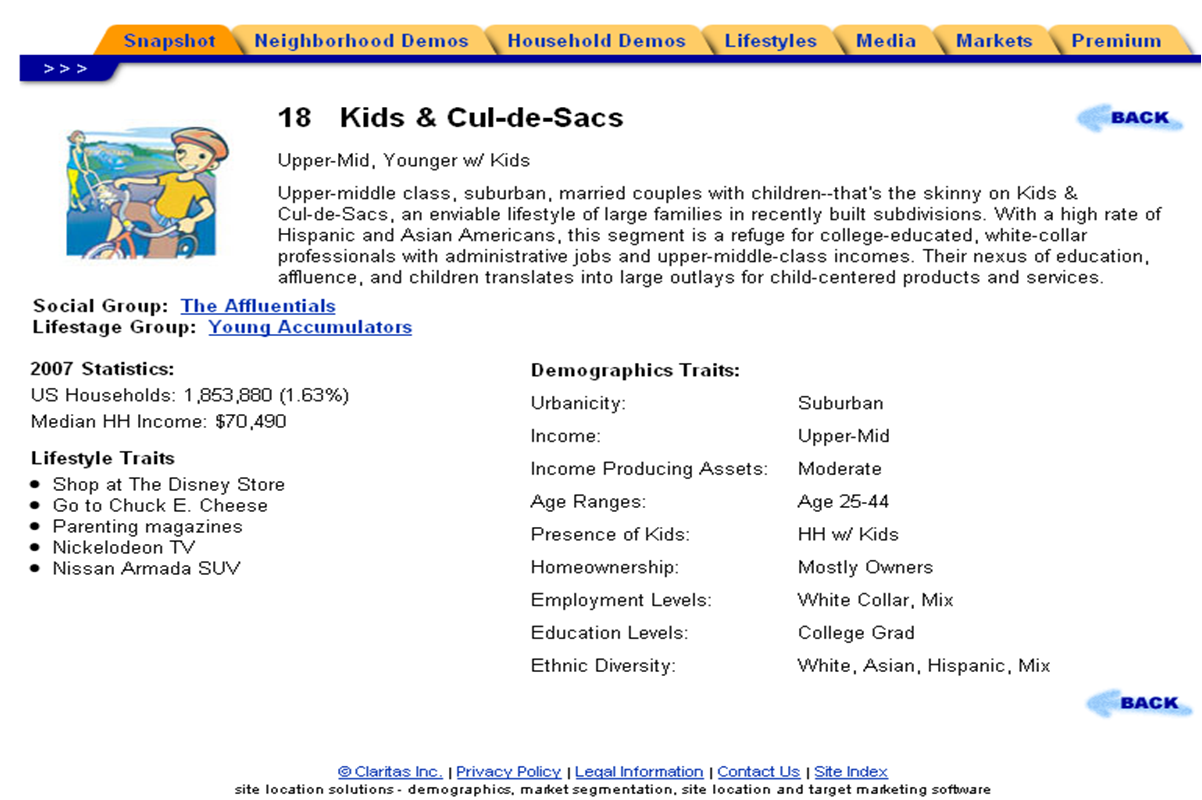
One of the typical models used by consumer marketers is the Prizm model by Claritas.  If you’re interested in whether you’re a “Pools & Patios”, “Home Sweet Home” or “Empty Nest”, go here and put in your zipcode.  In my case, it gave me five possible classifications – Blue Blood Estates, Exec Suites, Kids & Cul-de-Sacs, Movers & Shakers, and Winner’s Circle.  After looking at them, I could quickly see myself being classified as the Kids & Cul-de-Sacs one (see below).

They start with 66 different categories which can be used.  Of course, this is primarily driven by zipcode and a few other attributes and misses things around your attitude towards health that you might find in other health segmentation models, but it is an important marketing fundamental to understand.

Flu Shots Coming

With the recommendation that 86% of the population needs a flu shot this year, will you get one? I will. So the question is what will employers and insurers do to encourage this.

It seems like a great opportunity for them to communicate a positive message. Wouldn’t you like to receive a call telling you that you need to get a shot and where to go? It will be even more important as supplies get limited.

This is one of those low cost opportunities to build good will and potentially avoid some real costs of urgent car and ER visits as the elderly and kids get the flu.

I Get A Different Conclusion

In the same Express Scripts’ investor deck, I have to disagree with the slide below which is supposedly proof that the Consumerology efforts are working.

Showing me that the trend for a client who was above their norm last year (see drug trend comparisons), went down to 3% (year-over-year) increase (which is over both Medco’s and Prime Therapeutics’ average trend) doesn’t seem that impressive.  In the years when I worked on the drug trend publication, we showed that the average client with two or more plan design changes had negative trend, on average.

And, further complicating this example is the fact that this shows a client implementing mandatory mail, mandatory generics, and step therapy.  These are a series of proven, reject oriented solutions that force the member to make changes or pay much more.  Anyone can drive trend with these.  If you show me that non-reject oriented programs work to the same degree due to targeting and personalization using consumerology, then I am impressed.  Obviously, I am not there anymore, but I don’t think this is a compelling case study for consumerology.  Maybe there is more to the story like no impact on the call center or no impact on member satisfaction or less members hitting a reject at the point-of-sale (POS).

Express Scripts Patient Segmentation

In a recent investor deck, Express Scripts laid out some of their segmentation from their Consumerology program.  This is similar to some of the work we do with clients at Silverlink Communications to help them develop segmentation models through a test and control approach.

What they have come up with are 5 segments of their members – “Movers and Shakers”, “Rock Solid”, “Getting By”, “Rising Stars”, and “Here and Now”. They describe some of the attributes of each segment on the first slide below and then show how messaging on driving mail order utilization was applied for each segment over the web.  The final slide below shows the results when the targeted messaging is used on the web.

It will be interesting to see how that messaging plays out via other channels (i.e., letter or outbound call) and when pushed to the member versus a situation where the member is on the portal and looking for information (a fairly engaged member).

Texting for Deductibles and Copays

I often get a lot of ideas from financial services.  I was watching a banking advertisement yesterday where the customer could text their bank to get a real-time balance.  It made me think what a great service that would be in healthcare.

Imagine texting your plan for an immediate response on:

  • Your deductible
  • Your FSA balance
  • Your copay on a specific drug
  • Whether a provider is in network
  • The status of your prior authorization
  • A list of formulary alternatives

Since a lot of the logic exists, the question becomes one of using this medium and designing a secure mechanism for accessing the system and providing information.  Patients would have to register their mobile phone and approve it for PHI.  (There may be more to this, but it seems like it must be doable.)

Predicting Sickness

Wouldn’t it make the job of wellness a lot easier if we could predict who will get sick. There might be some indicators, but then you need to act and convinve them to take action. A little bit of the Holy Grail.

“We know that 59% of individuals [who seek services] are newly sick, and would have fallen into the ‘healthy’ category 12 or 18 months ago. We want to find these people before they get sick to see if we can reduce the risk or help them retain their health and vitality.”

— Jodi Prohofsky, senior VP of operations for CIGNA Corp.’s Health Solutions unit, telling AIS’s Health Plan Week about CIGNA’s new “It’s Time to Feel Better” outreach program.

WSJ on Personal Home Pages

An article that I found of interest was in the Wall Street Journal back on the 14th of July…it is about whether people have or will have their own personal website – Facebook, LinkedIn, blog, etc.  I think it’s a good discussion topic especially given all the discussions around Health 2.0 and doctors and patients blogging about events.

Disease Management Evaluation – Care Scientific

My former boss, Brenda Motheral, from Express Scripts spent a year at Healthways running their research group and has now decided to go out and do some consulting (new company is Care Scientific).  Her evaluation of the Disease Management industry was just published in the Journal of Managed Care Pharmacy.  It is a pretty critical view of the state of the industry.  Here are a few highlights:

  • There have been several articles published questioning the value of these programs this year.
  • There are five reasons for dissatisfaction:
    • Desire for better alignment of vendor and client interests
    • Desire for greater transparency in business arrangements
    • Desire for improved plausibility in reports of financial and clinical outcomes
    • Desire for more rigorous evaluation methodology
    • Desire for more convincing evidence of outcomes improvement
  • There is misalignment today…For example, if I get paid per member, how hard should I try to contact them when all that will do is drive up my costs.
  • Lack of alignment can be addressed through contractual requirements and pay per engagement.
  • There is a lack of data available on how many members are contacted.  [Not for companies that use Silverlink for their automated outreach who have real-time data available with detailed call information.]
  • There are calculation questions in comparing vendors.  [Something I have talked about several times here.]
  • She compares the move to transparency in this industry to what happened to the PBM industry earlier this decade which created new competition and changed several business models.
  • She advocates for really looking critically at the ROIs claimed by these vendors and talks about NND (number needed to decrease) which is the model that the DMAA (Disease Management Association of America) adopted as part of their outcomes guidelines.
  • She also raises concern about DM companies moving into wellness which is another area “fraught with numerous new methodological issues that warrant close attention”.
  • She talks about an industry push (from buyers) to demand new expectations from vendors.
  • She talks about the fact that the focus on ROI may not make sense since “literature suggests that less than 20% of treatments for existing conditions are cost-saving.”

“Plan sponsors also bear responsibility for the current situation.  As long as they demand a short-term ROI in the current model and inconsistently require comparison groups, they are more likely to promote methodological creativity than they are to inspire true innovation.”

As with the dozens of publications she has had over the years, this one is well written with a well referenced set of facts.  She presents a challenge to the industry in how to approach.

The challenges are interesting to reflect on given the overall industry focus on improving healthy behavior, being more proactive, more actively managing patients, and other activities that a DM company should be well positioned to do.  But, a high touch model is certainly challenged given lower cost options.  Creative solutions that leverage technology to identify gaps in care, create data segments, personalize interactions based on preferences, and use motivational interviewing to drive behavior exist and should be able to create value.  It will be an interesting 12-18 months for the industry.

S.A.D., ADD, OCD – Are we all affected?

A friend from Europe pinged me a few months ago to see if I wanted to connect him with someone who could distribute SAD lighting here in the US.  (SAD apparently means Seasonal Affective Disorder.)  Before even responding, I talked to a chief medical officer I know to validate the condition and the effect of lighting.

But, it made me wonder…are there some diseases that many people have to a lesser degree that we rationalize in different ways.  If people with SAD are depressed and have less energy in the winter due to lack of lighting, is this what many others simply refer to as the winter blues and just take for granted?  I can think of lots of people who are different in the dark winter months when they are inside.

For that matter, for people with ADD (Attention Deficit Disorder), focus is a challenge, but many of our most creative and innovative people are people who thrive in some chaotic form and come up with new ideas (e.g., story about CEO with ADD).  Do they all have ADD or some mild form of ADD?  (CBS article)

I could go on, but let’s look at one more – OCD (Obsessive Compulsive Disorder).  People with this condition can’t help themselves with certain actions – e.g., washing their hands until they bleed.  But, there are lots of people who are considered meticulous or anal retentive who get rewarded for their focus on detail and ability to do mundane tasks repeditively with little error.  Do these people have a mild form of OCD?

Don’t You Want To Live

Apparently, the Walgreen‘s CEO told the WSJ that not only is this a tough year, but they are taking a tough love approach with their patients.  In their blog earlier today, they said that Jeffrey Rein said “Walgreen pharmacists try to persuade patients to take their pills by asking them whether they want to be alive to see their children grow up.”

As they talk about, there have been several studies showing that patients are skipping pills and doing other things to stretch their prescriptions.  But based on what I saw in the Lehman Brothers research yesterday about Walgreens, I wouldn’t have thought things were that desparate.  They reported August same-store stales of 3% which is low compared to their historical results but still positive in this economy.

Interestingly, the report commented that they were increasing promotional activity which would negatively impact front end margins while CVS had recently said that it’s promotional spending (as a percentage of sales) was lower.

[In full disclosure, I do not own any of these stocks as individual stocks.  They may be held in mutual funds that I own.]

Payers Spending On BI and Information Delivery

“Healthcare payer spending on business intelligence, information delivery and transparency is the fastest growing spending category in 2008 for healthcare payers,” said Janice Young, IDC Program Director, Payer IT Strategies.

This quote was in our press release this morning around the growth at Silverlink.  You can read about the company in the release, but I wanted to focus on this quote from IDC.

On the one hand, I think consumers should be saying “Amen!” that payers are focusing on business intelligence (BI) although that can mean a lot of things.  On the other hand, they would shocked to know how new this is to the healthcare space compared with the consumer packaged goods industry.  BI can help identify gaps in care and identify how to help patients become better.  BI can help personalize the messaging that you receive from your health plan so you don’t have these huge legal caveats about all savings and other specifics being based on your exact plan design and deductible.

Information delivery can also mean a lot of things.  Is this reporting to the employer?  Is this online analysis for the consumer?  Is this communications?

And, I am not sure what transparency means, but I hope it means things like letting consumers actually understand the price of goods and services and how to make tradeoffs between different options with all the data (e.g., quality, price, outcomes, patient experience).

Overall, for those of us in the healthcare communications space, this is a rising tide that helps.  It means the payers who support all of you consumers are raising the bar and looking at how to use their information to improve the experience and outcomes (ideally).  It could also allow them to better focus their efforts on the riskiest patients and discover the best way to drive behavior.

The data is there and has been there so figuring out how to use it and what to use it for is critical.  Mapping this against the patient expectations and desired activities can be a great positive for the consumerism movement.  Integrated data.  Accessible data.  Digestible data. Sounds great.

They Charged The Wrong Insurance

Only a year late, I just got a notice from an insurance company telling me that we had several prescription claims processed under the wrong insurance card.  Apparently, they allowed our pharmacy to process claims for over 2 months after we had switched insurance.

Why is this my problem to deal with?  Shouldn’t the insurance company have responsibility for maintaining the eligibility file?  Shouldn’t the pharmacy have made sure my insurance was current?  Now, I have to either pay $300 or go back to the pharmacy and ask them to reverse out claims that are over a year old.

What a pain!  Of course, I am going to the pharmacy.  I had coverage so why would I pay out-of-pocket.

Communicating With Michelle Obama

First, congratulations to Barack Obama on getting the nomination.  He is a great orator and regardless of who I vote for I think he will be an exciting candidate.

From a healthcare communications perspective, I found an NBC Today Show interview with Michelle Obama very interesting yesterday.  She talked about three things that seem to be telling about her personality:

  • She said she was more of a fatalist than an optimist meaning that if Barack is meant to be president than he will be.
  • She said she was superstitious.
  • She talked about not believing that living in the White House will change their family dynamic.

So, I would suspect that trying to get her to change behavior would be very difficult as a fatalist.  If she believes that becoming sick is inevitable, why would you change your diet or habits.

If she is superstitious, I would suspect that there are actions, phrases, colors, or other queues that could encourage her to take action.  What those are…who knows?

And, if she doesn’t believe that the White House will change the family, it makes me think that she is very inwardly focused.  She admitted not watching TV or reading the paper.  But, as an ivy-league lawyer, I have to believe she does those things and reads aggressively.  So, I am confused as to why she wouldn’t believe history.  I haven’t read the history of presidential families, but I am pretty sure kids raised in the White House are very different.

My take would be that she would be a hard candidate to motivate to change and successfully communicate with.

Selling Hope

I will admit that I have been a closet democrat for years although that may finally be changing.  I have watched about 15 minutes of the Democratic National Convention (DNC) this year and can’t seem to get motivated.  I get so turned off by selling “hope”.  Are you kidding?

Working in the communication field, I find that a desperation play.  Imagine calling sick patients and telling them that they don’t like being sick so they should try doing something different that you “hope” will make them better.  Just because the economy is bad and people are unhappy doesn’t mean that any path will make things better.  People want a defined path with data to support it being better.

Otherwise, would this be like the Sports Illustrated cover effect where the athlete that is featured on the cover under-performs in subsequent months.  In business speak, we would call this regression to the mean meaning that over time people perform at the mean value and can’t always over-perform.  (I am sure someone will correct my use of statistical terms here.)

There are lots of things we can fix in this country, but simply a message about them being broken so trying something different isn’t enough…for me at least.

Healthcare Reform Won’t Be That Easy Mr. Obama

Election campaigns typically feature pontificating politicians flashing silver bullets to painlessly slay the nation’s problems.

Just move some money from here to there, cut some government waste no one apparently ever noticed, and then fund an unattainable promise with an outlandish price tag.

Barack Obama’s healthcare reforms fit this model nicely. He bundles three evergreen feel-good concepts — electronic medical records (EMR), disease prevention and chronic-disease management — and totes up dubious savings to fund his ultimate goal of making health insurance affordable to everyone. (Article in Fort Worth Star-Telegram)

It sounds like Barack’s advisors read George Halvorson’s book on the healthcare system.  Maybe they skipped the sections on the difficulty of aligning incentives and driving change.  If he thinks he can make major changes in 4 years, good luck to him.  Maybe that is a sign of his inexperience.  I think we all want change, but we definitely need a person who understands how to make change happen given the fixed constraints that we have.

He reminds me of the new consultant who comes in fresh out of business school and sees all the changes the company should make.  They are so obvious.  But, without all the history and the ability to manipulate the political landscape and knowledge of what it takes to get things done, it just becomes the flavor of the month that no one takes seriously while they wait for the consultant to move on to their next project.

Great ideas (not that this is one) don’t by themselves guarantee success.  A good idea implemented well is a lot better than a great idea implemented poorly.

Health Plan Week on Retention

I had an opportunity to get interviewed a few weeks ago by one of the contributors to Health Plan Week about retention within health plans.  With growth in the group market stagnant and ultra-competitive, the individual market offers lots of upside, but makes satisfaction and retention a much bigger issue.

You can read the article here where it discusses things like the “top box”, the importance of personalized communications, and champion / challenger processes to determine the best approach.

Skip The Patch…Send Them To Church

“Overall, 21% of Americans interviewed in our Gallup Daily tracking program this year say that they smoke.  (By the way, that’s down from an all-time high of 45% back in 1954).

But the percentage of smokers is only 12% among those who attend church once a week.  Smoking rises to 15% among those who attend almost every week.  Then 22% for those who attend once a month, 26% for those who seldom attend church, and finally 31% among those who never attend church.” (see 7/31 entry on USA Today Gallup blog)

I am always fascinated by correlations such as this.  Who thinks of the null hypothesis to look at this?  (Null hypothesis being that people who go to church smoke less which is what they collected the data to prove or disprove.)

With smoking being a huge health driver, what can you do with this information?  It’s hard to believe your employer or health plan could drive church attendance.  Perhaps this gets us back to social networking and your peer group.  Groups of friends or others coordinating and talking about quiting smoking may be more successful if someone active in a church was part of the team helping them.  (I am grasping at straws here.)

Compliance is complicated

I am going to try a posting from my blackberry.

I just read this in the AIS newsletter and was surprised that this was news.

“Personally, I believe the reasons people take prescription medications are quite complex. There are a lot of motivations and issues in that, and copays may not, in and of themselves, be enough to change adherence and compliance.”
— Keith Bruhnsen, manager of the University of Michigan, Ann Arbor, prescription drug program, told AIS’s Drug Benefit News when discussing the need for research and data to support the idea that lower copays for essential services actually remove barriers to their use.

Cell Phones and Cancer…Cautious?

In another confusing story to us the public, everyone has picked up the story about the head of a prominent cancer research agency telling the employees to limit their mobile phone usage.

“Really at the heart of my concern is that we shouldn’t wait for a definitive study to come out, but err on the side of being safe rather than sorry later,” Herberman said.  [Dr. Ronald B. Herberman, director of the University of Pittsburgh Cancer Institute]

The suggestion is to limit use for children to emergencies, use hands-free devices, and use speaker phones.  The article cites several studies and the FDA saying that there are no issues.

Of course, this makes me think of autism and vaccines.  Is it an issue or not?  It also begs the question and the social responsibility of the health care system on whether to encourage us to be cautious or wait the decades for definitive research.

Keep The Change

I was listening to an advertisement for Bank of America’s Keep the Change program this afternoon and found it to be very interesting.  Essentially, every purchase you make with your debit card gets rounded up and the difference put into savings.  For example, if you spend $3.43, they bill you $4.00 and put $0.57 in your savings account.  Forced savings (post opt-in of course).  And, they even having a matching program.

So, this accomplishes several things:

  • Creates an easy way for the consumer to save
  • Increases the money saved at Bank of America

It’s certainly in the bank’s best interest and good for the consumer.  It gets me back to my question from the other day.  If you are driving a positive result but you have to force the consumer there, is that okay?

What’s the healthcare model of this?

  • If you implement (or do) all your preventative care recommendations, your prescriptions are free (or some type of incentive system like this)?  Which is good for the payor, insurer, and patient.
  • How about a bundled copayment for certain events which included the office visit, hospital charges, and the prescriptions?  (Oh…sorry we couldn’t do that since we don’t know the prices in advance.)

Call Center Agent vs. Automated Calls

The other day I called some service provider to ask some questions about their product.  It was painfully obvious that the person at the call center was reading from a script.  This made me realize that there are reasons (beyond simply cost) for using automated, speech-recognition technology for calling people versus humans.

It would have been more conversational for me to have talked with an automated phone call where I could answer questions with certain hotwords that dynamically moved me through the path of the call.  Depending on content, I think it is often nice to have the option to transfer out to a call center agent since that role will never disappear.  Some people prefer a human (look at all the grocery store lines) and some exceptions don’t fit into a rules-based decision tree.

But, quality is a huge issue with complex plan designs in healthcare.  How do you teach each call center agent (especially when you have high turnover) to respond and explain things exactly the same?  You can’t unless you force them to read a script which is a bad experience for the member / patient.  We used to have to do lots of secret shopper calls to work with our agents to get them to the right place and meet minimum expectations.  Again, this is something that a computerized system can address.

The thing I always hear about calls is aren’t they like those election calls I get where the voice sounds a little computer-like (aka text-to-speech) or there is a big pause between the person answering the phone and saying hello and the actual recording kicking in or the live person talking.  With the top vendors out there, those are old issues.  There is no pause.  The messages are recorded in human voice.  Ideally, the variable text (e.g., patient’s name or drug name) are part of a custom audio library which is in the same voice.

Avoiding Calls Then Texting

CNet has an interesting article about teens avoiding live calls only to text back the person immediately so they can continue their current activity.  I do it all the time when I am in meetings or on conference calls.

They provide some interesting statistics on text messaging (see below) for this young group.  Not a prime focus for healthcare, but it will be interesting to see how this use of technology applies as they grow older.

More broadly, nearly one out of every two U.S. tweens (or kids between 10 and 13 years old) and 83 percent of teens own a cell phone, according to new research from Chicago-based C&R Research. And with that many kids using mobile devices, the text messages are flying.

The average teen, according to C&R, generates between 50 and 70 text messages a day, or as many as 18,000 a year.

IDC – Healthcare Communications

Janice Young at IDC just put out a new report titled “Too Much Information? The Irony of the Coming Information Glut and New Technologies that Help Target Communications” which focuses on several fast-follower announcements about what we have been doing at Silverlink Communications. Here are a couple of quotes from the report.

The final mile of the current healthcare information blitz is not just getting at or to the information, though in the very fragmented, silo’d U.S. healthcare system, that is hard enough. But the real solution provides targeted and event-triggered information based on consumer interactions or events, rather than relying on the consumers to search and seek.

These two announcements join Silverlink’s earlier announcement in March 2008 of their new Adaptive HealthComm Science Platform. The Silverlink platform integrates decision support and analytics to create personalized customer communications. Unique to the Silverlink solution are behavior analytics to communications success and affect on customer behavior and outcomes.