Archive | Marketing / Communications RSS feed for this section

Beating The Patient Over The Head

Something that I don’t normally do, but I am going to edit this after the fact to stress what the story really is supposed to be about since someone told me the original text might be offensive to a competitor that I respect.  The point is whether being pushy is worth it in some cases.

The other day a patient asked one of our people about a mail order order pharmacy where they had gotten a call every other day for the past 12 days about refilling their medication. Each message was slightly different – your supply of medication is about to run out, you need to refill your medication, your prescription has run out, etc.  The patient didn’t like the call program.

I found this an interesting debate…how pushy is good if you drive a desired outcome?  Also, we all obviously know that vendors and consultants don’t always make the decision so if a client tells you to do this even if it makes no sense, what do you do?

I think it makes for a good debate and had it with several clinical people:

  • At what cost is a better refill rate okay…especially since this doesn’t mean that they are compliant? Are you willing to drop your patient satisfaction by several points?  (We often used to give clients a report that showed savings per disrupted member or per drop in satisfaction at my prior employer.)
  • If the company is just driving up refills and can they do that without creating more waste?  This was a constant debate at mail.  One trick here is whether you base it on refill dates or days supply.
  • With this frequency of calls is there a chance that you actually get people that would have refilled to just wait for the calls to come and say yes?
  • If people take the call because they know you will keep calling them, is this actually better acceptance of calls or just being an “obnoxious salesperson”?
  • Are you calling people that have refilled at retail due to data latency issues?
  • Do you drive people back to retail?
  • Have you dulled them to future calls by upsetting them on this program?

Now, on a more clinical program, my opinion here might be different. If you could successfully get an overweight individual to diet by constantly reminding them. This might be okay. It’s an interesting debate.

Communication Chicken And Egg

You hear a lot these days about preference based marketing.  The idea is that consumers (or members or patients) select how you interact with them.  In healthcare, this means things like:

  • What types of communications do you want to receive?
  • How do you like to be communicated with – letter, web, live person, automated call, text message?
  • When do you like to be communicated with – day, time?

Of course, companies then have to figure out what rules to use in terms of when to trigger communications.  The next question is how to personalize the communication.

So an interesting question is…does the company have a responsibility to their members to use their data to drive them to actions that are in the member’s best interest?

Do companies always do what’s right…probably not, but I do believe that they want to do the right thing.  They want to drive successful outcomes.  They want patients to be healthy.  They want patients to save money.

Now, my chicken and egg analogy is which comes first the selection of what my preferences are or experiencing the communication.  How do I know whether I want a refill reminder if I have never received one?  How do I know which channel I prefer if I haven’t experienced each of them?  And, since each communication can vary based on messaging and many other variables, can one good or bad experience bias my selection?

What is a Mail Order Pharmacy (Home Delivery Pharmacy)?

My most popular post ever is “What is a PBM?” which made me think that this is probably a relevant post for the average healthcare consumer.  And, given the historical push to mail combined with the current economy, you can expect mail order pharmacy (or home delivery pharmacy) along with 90-day retail pharmacy to be a hotter topic.

At Silverlink Communications, we work with a lot of companies on their retail-to-mail (RTM) communications strategy and execution.  One of the first things I point out to all of them is that over 50% of people don’t usually know what mail order pharmacy is.  So, you have to address awareness at the same time as recruiting new patients.

So, for all of you that receive a letter or call talking to you about moving your prescription to mail order, let me answer a few of your basic questions:

  • Mail order pharmacies are also called home delivery pharmacies since they deliver your medications through the mail and directly to your home (or other address provided).
  • The mail order pharmacy is typically owned by either your managed care company (aka health insurer) or by a pharmacy benefit management company that your insurer contracts with directly to provide this service.
  • There is typically only one mail order pharmacy that you can use (i.e., is considered “in-network”).
  • The service is typically the fulfillment of 90-day prescriptions of medications which you will take on a long term basis (aka maintenance medications).  This is not true for controlled substances which typically only allow a 30-day prescription and for some specialty and injectable drugs.
  • You often have a financial incentive to choose mail order where you will get a 90-day supply for less than it would cost you to buy three 30-day prescriptions at your local pharmacy.  This discount is due to the buying power of the mail pharmacy, the automation which reduces the costs of dispensing the drugs, and the lower distribution costs (i.e., no need to move the drug to all 5,000 retail locations).
  • The drugs are the same drugs you buy at your local pharmacy.
  • You have the same access to a pharmacist but it is over the phone not face to face (which I personally prefer and think is more confidential).
  • You can do your refills over the IVR (interactive voice response) line and over the Internet along with traditional means of live agents and using snail mail.
  • These mail order pharmacies use robotics and other highly sophisticated solutions to dispense the drugs accurately and quickly.
  • Many of the mail order pharmacies that we work with offer services around calling your physician to get new prescriptions and also use our automated outbound calls to provide you with order status (WISMO calls – what is the status of my order) and refill reminders.
  • You shouldn’t typically start a new drug at mail order.  You want to wait until you have had two fills locally to make sure you are titrated to the right strength (i.e., your MD might switch your dosage initially so you don’t want to buy too much supply of a drug you might not use).

Are Involved Patients More Compliant?

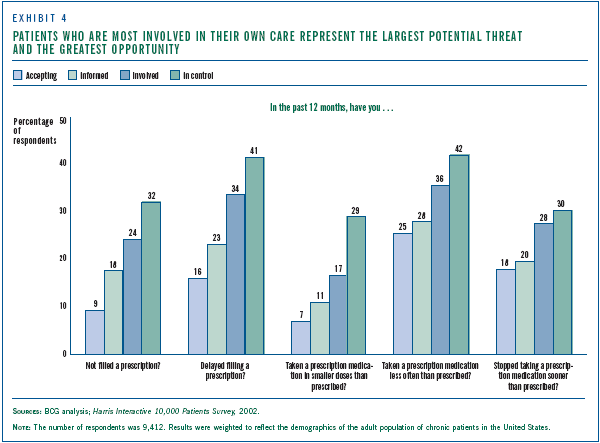
This is a study from a few years ago from Harris Interactive and BCG that I found on the BioPlus website.  If I am interpreting it right, it would imply that those that are most involved in their healthcare are most likely to be non-compliant.  It doesn’t seem logical, but perhaps those are the people that want to play doctor and are most likely to think they know better.

Would You Pay $100 To Be Told To Take Your Rx?

We know adherence is a serious issue that drives healthcare costs.  And, as I have talked about a little here and a lot with many of our pharmacy clients, it’s not a simple issue.  People aren’t adherent for a variety of reasons – cost, side effects, health literacy, or simply just forgetting (among others).

There are lots of tools out there to help you organize your medications and manage them.  Whose job is it to help you – yours, your physicians, your managed care company, your pharmacy, your pharmacy benefit manager?  Obviously, you (the patient) have the primary responsibility.  After that, your pharmacy is best positioned to help you with this.  But, the managed care company stands to benefit the most by preventing serious medical conditions associated with non-compliance.

So, I was a little surprised to see a new company come up that offers to send you calls, e-mails, or text messages to remind you to take your medications.  And, you can even talk to a pharmacist.

Let’s break this down:

  • Whatever pharmacy you use (mail, retail, specialty) will offer you consultation with a pharmacist for free.
  • I believe most pharmacy benefit management (PBM) companies offer automated e-mail reminders that you set up yourself off their website for free.

I don’t know why I as a consumer would pay for this.  And, it seems pretty high for a managed care charge.  If I went to a client of ours and told them I would send messages to patients for $100 PMPY (per member per year), I think they would choke on that price tag.

So, will it work??  Who knows?  I have been surprised by business models before.

Dental Experience

I am a big believer in the fact that the experience matters for healthcare.  From my architecture days, this means physical space, sequence of events, bedside manner of the staff, clarity of communications, and processing of the claim (at the simplest level).  Everything that the patient experiences as associated with an event drives their satisfaction.

So, I was pleasantly surprised taking my daughter to the dentist a few weeks ago.  We had gone to a “kid’s dentist” before which was an hour away that I thought did a good job (although the kids hated going).  But, this one was over the top.

When you walk in, the entire room is covered with art (e.g., there is a giant Spiderman climbing on the ceiling).  There are video game stations in the corner.  There is a large flatscreen TV playing a slide show of pictures of the kids coming to visit that day.

And, it doesn’t stop there.  Each room is decorated.  The staff talks to the kids (more than the parent).  Every tool and process is explained to the kids in simple terms.  They sometimes give out balloons.

Just something to think about when you try to look at things from an outside-in perspective.  How is the patient experiencing your service?

Genetic Art

I was reading about this company DNA 11 the other day, and I found it a pretty cool concept. They take your DNA and make it into art focusing on the 1% that is unique. According to the article in American Way magazine, prices ranged from $390 to $1,200 with 25 color options or the ability to request a custom color (to match your sofa perhaps).

They can do pets, fingerprints, and lip prints.

LinkedIn Question On HealthComm

I think it was earlier this year when LinkedIn rolled out a new feature called questions which allows you to pose questions to LinkedIn users and get answers. I continue to like this tool, and it has been interesting to watch it evolve from a “startup” (when I joined there were less than 2M members) to a tool that well over 10M people use and has gotten lots of press.

I finally decided to pose a question:

Do you have any good (or bad) examples of healthcare communications? I am looking for how your healthplan, disease management company, pharmacy, or PBM communicates with you. What worked or isn’t working? This could include letters, websites, phone calls, social media, etc. Examples might include communications around moving you to a 90-day prescription, moving you to a generic drug, improving your awareness of a disease, addressing compliance and adherence, reducing your out-of-pocket costs, etc.

I received four answers:

Answer One: I had some great success marketing to Medicare members by conducting health and fitness seminars as well as bring in experts to discuss retirement and other topics of interest. Initially, I’d obtain a 3% response through postcards and an additional 1.0% through phone calls. Conducting a series of seminars in one area can also bring in additional attendees (0.5%), through word-of-mouth buzz.

I found seminars to work well because the attendees were getting something of true value for their time (information and a social event with their peers) and I had a captive audience to market. A win, win situation.

Answer Two: My experiences with Blue Cross have been pretty good, there’s the health mag they send out with information articles, etc. I’ve never been able to access the website services though, something to do with the number that CS can never work out though I’ve tried on several occasions. I love my primary doctor and feel she and her partner give excellent care and plenty of information to their patients. They’re the only ones who’ve ever given me a reading list and web printouts! It was just a general question I had, not a condition I suffer from.

In addition to other tasks, I handle the health documents for the children enrolled with us and find that often the doctors have done a very poor job in informing the parents of what to watch for, what a result means, etc. Their offfice staff often do a shoddy job of filling out the forms correctly. Last month I recieved paperwork for a child, the physical form stated passed 20/20 for vision, it was accompanied by a referral from the doctor for a full eye exam as the child had failed the eye test miserably! I once received a normal hearing result for a child we knew was deaf as a door nail. When trying to get an insurance company to cover a needed service or therapy for such is incredibly difficult with that kind of paperwork.

Thanks for the opportunity to raise awareness!

Answer Three:

Aetna sent me a letter suggesting several plan options that may be cheaper than the one I currently have. That was a positive. I wish that I could compare the plans side by side on the website. It is difficult to remember the details of each one as you look at them individually.

Answer Four: As a health promotion practitioner, we are at a time when the national consciousness of health has never been higher. The most important thing we can do at a workplace is create individuals and systems that are health literate. We spend enormous amounts of money in our wrongly terms “health care” system. What we actually have is a “sick care” system, and what is truly missing are incentives and action by companies to recognize the billions of dollars we could save and then return to economy by protecting our workforce with sound health promotion. Our children are contracting early onset adult diabetes and we commonly refer to our bleak situation of the obesity epidemic. Our “health care” system, and thus the traditional “disease management” is from a biomedical chronic disease model.

It is time to work at reducing costs related to health care and absenteeism from a proactive rather than reactive approach. Many companies and organizations provide services that have yielded significant economic returns from building well companies.

According to the the NIH, most people are unhappy with our current system, and unable to continue to straddle the costs of ever increasing health care. We can avoid chronic disease by acknowledging new paradigms of business operations that include well companies. For information, contact www.positivepurposeinc.com

Tier Zero

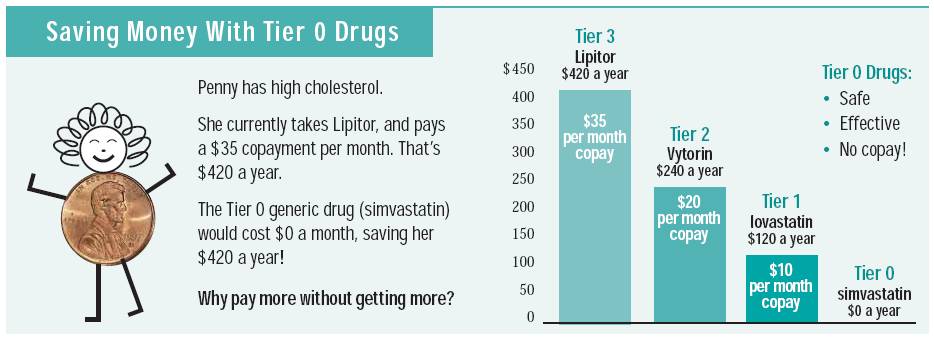
Frank Koronkiewicz, the Director of Pharmacy, at Blue Cross of Northeastern Pennsylvania (BCNEPA) just launched a new plan where people can get 65 different generics focused on chronic diseases at no copay AND without any premium.  It’s called Tier Zero.

Frank has always been a progressive Director of Pharmacy.  We worked on several programs together at Express Scripts.   You can also find some of their collateral and videos on generics on their website – click here.

It would be interesting to look at the overlap between these drugs and the Wal-Mart list of drugs, but I think you would find that an individual could have a pretty comprehensive benefit of generic drugs between these two solutions with low out-of-pocket (OOP) costs and no increase to their medical premium.  A compelling story to many.

Three Sad Healthcare Stories

First, I think this is a very disappointing article about workplace violence in the healthcare industry.  I certainly could believe (unfortunately) in the verbal violence since people are very emotional about their healthcare and often stressed over the financial implications and unintuitive processes.  But, this story has some scary statistics which are an issue at a time when we need more healthcare service workers.  [Ask your friends in the industry.  I plan to.]

  • Health care workers are 16 times more like to face violence at their job that workers in any other service-oriented profession.
  • More than 50 percent of reports of aggression in the workplace come from the health care sector.
  • Over 9,000 nurses and other health care workers are verbally or physically assaulted on the job every day, according to the National Institute of Occupational Safety and Health.
  • A 5-year survey of 170 university hospitals showed that over half of all emergency room employees had been threatened by weapons.
  • Almost 90 percent of nurses in every specialty said they were verbally assaulted during the past year and almost 75 percent claimed they were physically attacked, according to a study published in The Journal of Emergency Nursing, which related reports of 100 percent verbal and 80 percent physical assault rates for emergency room nurses.
  • Almost half of all psychiatric physician residents reported an assault during their career and other medical residents in the hospital setting reported a 16 percent assault incidence.

The second article which I read which I think is also sad is about the rise in seniors filing bankruptcy. Sometimes, seniors don’t even have enough resources to install stairlifts in their homes. Not only is it disappointing to see people reach retirement only to have their dreams dashed away from them with crashing house prices, rising food prices, rising gas prices, and lower return on their investments, but they are facing huge healthcare costs that are pushing them over the brink.  22.3% of the bankruptcy filings in 2007 were from seniors.  We also know that even without filing this stress can get people to skip medications or not take care of themselves only worsening their health.

The third story which I saw on CNN this morning was about a group of high school girls making a pregnancy pact.  Talk about a need for sex education and health literacy.  It’s one thing to happen by accident and quite another to intentionally put yourself in that challenging situation of getting a high school diploma and raising a child.

Why People Choose Mail Order Pharmacy?

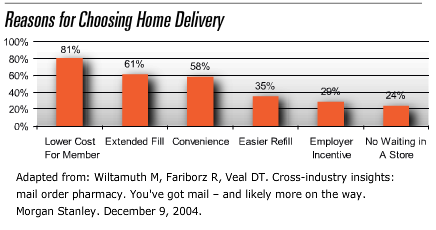
I was looking for something else in the Express Scripts Drug Trend Report 2005 when I came across this study referenced on page 209. I should have remembered since I wrote this section (yes I was a contributor see page 332). This is a Morgan Stanley study which talks about why people choose mail order pharmacy. Of course, the primary reason here is savings. The more savings the higher the likelihood of a person moving to mail order. This is a factor of savings per Rx multiplied by the number of maintenance drugs that an individual has that can be filled at mail order (or home delivery). This study shows the frequency of the response. If you focus on the weighted scores, you would see a dramatic cliff after savings. (I.e., 61% of people may choose mail for convenience, but they are much less likely to do it than someone with significant savings) So, why don’t all PBMs communicate exact patient savings to each individual? It’s hard. Given minimums and maximums; deductibles; percentage copays; and other benefit plan designs, the systems are stressed to produce this.

Sell Your Captive PBM – Why?

I was a little surprised by the quote from Lisa Gill from JPMorgan Chase about why health plans should sell their in-house PBMs (Pharmacy Benefit Management):

“I think it makes a lot of sense for PBMs [pharmacy benefit managers] to be sold or spun off as a stand-alone business. The only time it will make sense for a managed care company to actually own a PBM is after they move to real-time [medical] claims processing. And that’s not going to happen near term.”

Maybe I am missing some context here, but I don’t understand.  Why would you have a “captive” PBM (i.e., owned by a managed care company)?

  • Able to align total healthcare interests (e.g., drive Rx usage up to manage ER visits)
  • No conflicts of interest (real or perceived)
  • Able to keep margins of the PBMs (look at the stocks of Medco, Express Scripts, and CVS Caremark)
  • Manage the customer service experience

What does any of this have to do with real-time claims access?

Why would you use a standalone PBM?  (Again an easy decision)

  • Economies of scale on rebates
  • Mail order pharmacy efficiencies
  • Manage capital outlays
  • Get a dedicated focus on pharmacy which as only 10% of the total healthcare spend will be a stepchild under a managed care plan no matter what
  • Best practices being leveraged across companies

And, we all know from bidding on RFPs that managed care companies use this service to win business talking about the integrated solution and underwriting pharmacy with medical.

If you understand the rationale here, help me out.

A Few Blog Entries About The Think Different Event

We wrapped up the road show this week in Hartford and NY.  I missed both events to be at client meetings on the west coast (and now down south).  But, one of the presenters and someone who was in the audience posted entries on their blogs about the event:

The Automated Sprint Reply

As a reply to my e-mail (see my last posting), here is what I got.  Now let’s see how long it takes to get a real reply.

Thank you for taking the time to write.  To truly revolutionize wireless, we need your input. It’s people like you who are using our services everyday that can provide the best perspective. We’ll be looking through all the ideas and feedback we receive.

This will, of course, take some time. I appreciate your patience until we can get you a response. A representative from my office will be contacting you in about a week.

In the meantime, if you are interested in learning more about our new Simply Everything plan, you can find the details at www.sprint.com/everything.

Once again, from all of us at Sprint, thank you.

Dan Hesse

President and CEO – Sprint

Giving Out Your CEO’s E-mail

From the perspective of soliciting feedback, how many companies post their CEO’s or anybody’s real e-mail these days? Sometimes you can’t even find a number to call on the website. You simply get some generic form to fill out and get feedback. You sent it into the black hole and wonder if you’ll ever hear.

So, given Sprint’s challenges over the years, I think it was (is) a bold move to post the new CEO’s (Dan Hesse) e-mail (dan@sprint.com) at the end of some of their television commercials. I have been using Sprint as a great example of a company building loyalty because they reached out to me recently to move me to a better plan which reduced their revenue in ½. So, to test this e-mail address, I just sent the following. I will let you know what happens.

Dan (or whoever answers these for you):

I have been a loyal customer for 15 years now with Sprint PCS. I am not sure if that puts me in a minority, but I bet it does.

I was recently impressed when you guys called me to make sure I knew about the all inclusive plan (not sure of the actual name) which was something like $99 per month. Especially, since I was spending about $200 per month before. I work for a healthcare technology company and have been using that as an example about how to build loyalty.

I would be very interested (if you can share) how you guys made the decision to “down-sell” people and whether it has had the desired effect (which I assume is less churn).

The NY Times had an article about this on 6/9/08. Apparently, the initial response is an automated reply from Sprint, but most people then hear from someone on his staff (or likely a group of dedicated customer service agents) to address their questions.

“Yeah, we were worried,” said Mike Goff, vice president of advertising and marketing communications for Sprint. The company had a reputation for poor customer service, and soliciting critiques for the new chief to read was a risk. But, Mr. Goff said, Sprint wanted to “show we were serious about our intent to improve our customer service. We knew this was happening at a time when the perception of our customer service in the market was poor, so this is a chance for Dan to hear back from the market.”

The question is whether bold tactics like this can work to help change their image. If so, maybe health plans and PBMs should start posting their Chief Medical Officer, SVP of Customer Service, and CEO’s e-mails and see what happens. I can only image the look on some of their faces of doing something like this. Even though I am sure the reality is that he has a confidential e-mail address that gets used for internal purposes and personal purposes. As the Times article says, I am sure shareholders don’t want to think that the CEO sits in front of his PC all day answering questions.

More On Silverlink’s Think Different Event

I am now up in Minneapolis at our 4th Think Different event on how to engage the healthcare consumer.  I talked about the first few speakers the other day, and I finally had a chance to hear the other speakers present.  This week, I had the chance to listen to  James Taylor (of Smart (enough) Systems fame not music) and Fred Jubitz (American Express).  Here are a couple of my takeaways.

[Again, if you are coming to the upcoming events, this might be a little bit of a spoiler.]

A few notes from James’ presentation:

  • He gave a great example of a program they did at Fair Isaac where they compared the standard, baseline program with one that was highly personalized.  What was the improvement – 2,000%!!
  • He gave a good real-life example of the need for channel coordination talking about buying tickets for the Chunnel and how he got different prices on the web and phone which were also different from the prices his father in England got using the same channels.
  • The Chunnel example reminded me of something that someone told me the other day.  They were using the Dell self-service example and pointed out that Dell now uses real-time chat right before you buy.  They have found that this increases the average sale by 15%.
  • The Chunnel example also made me think about how web technology allows us to do a lot of customization by visit, but most companies don’t do this.  At the simplest level, I remember a competitor of Firepond (previous employer) where if I visited their website from work it looked one way and from home looked different.
  • James talked about ATM customization as an easy example.  How much money do you normally take out.  Only showing you services that you have access to.  Some of this is starting to happen, but not much.
  • He also talked about rules creation and how that varies.  I think it is always interesting to trace the evolution of rules and policies within a company.  Are they there because of regulatory issues?  Is it because someone coded the legacy systems that way?  Is it based on a personal interpretation?  Or are they dynamic and regularly reviewed?  One of the worse examples that I have ever seen was a large healthcare company that believed that HIPAA required them to re-code everything as it moved from development to production.  (A very costly error in interpretation.)
  • He also talked about the evolution of interactions:
    • Automate decisions
    • Apply rules
    • Segment customers
    • Predict risk and value
    • Optimize
  • James hammered home the point of never stopping to try to optimize since as the environment and your customer base change the optimal solution might change.

Fred who ran the gold and green cards at AMEX talked about:

  • American Express really wanted to be a lifestyle enabler not a payments company.
  • He talked about the Centurian Card (black AMEX card) which apparently is able to charge $5,000 initiation fee plus a $2,500 annual fee.  (Surprising that people still pay it, but I have heard examples of people buying a plane with their black card so I guess that level of service requires something.)
  • He gave examples of how companies think about cards and showed a lot of affinity cards which made me think about groups and how people like to affiliate with others (e.g., by diseases).
  • He talked about the importance of several things:
    • Know your audience
    • Key metrics
    • Segmentation
    • Personalize
    • Continuous improvement
  • He showed the standard framework for segmentation looking at size of wallet (i.e., how much you charge / spend per year) versus their share of wallet (i.e., how much of that is with AMEX).  Each box on the grid then had a strategy – invest, retain, focus, divest, etc.
  • He showed a lot about how the financial services companies can personalize the web experience, but he pointed out that this took months to develop as they built up your profile.
  • I think a key point he made relative to healthcare is that a lot of a new member’s behavior was determined in the initial months which led to how they used their card.  He gave an example of his blackberry.  The first couple features he learned are all he uses.
    • What are you doing in the initial months to “train” your members or be trained by your healthplan to use the website and leverage other ancillary services (e.g., gym membership) that they might offer?
  • He stressed evolving your segments but not starting over each year or you will lose some of the lessons you have developed.
  • Finally, as you always want to stress, he said to keep it simple.

Additionally, you can see some of Matthew Holt’s comments about the event at The Health Care Blog (here and here) and Les Masterson’s comments in The Health Plan Insider.

Wisdom Of The Crowd – Socializing Wellness

You probably caught the articles last year about how obesity seemed to spread throughout social networks. Now, in an article in the Washington Post (5/27/08), they talk about another example of research showing that smoking is similarly affected by social networks. Theoretically, this research could have significant implications for using social media (i.e., Facebook, MySpace, SecondLife). I can easily imagine blogs out there following people’s efforts to lose weight or quit smoking. I can see a Facebook “badge” or “sticker” congratulating someone for not smoking.

In a study published last week in the New England Journal of Medicine, the team [Nicholas A. Christakis, a medical sociologist at the Harvard Medical School, and James H. Fowler, a political scientist at the University of California at San Diego] found that a person’s decision to kick the habit is strongly affected by whether other people in their social network quit — even people they do not know. And, surprisingly, entire networks of smokers appear to quit virtually simultaneously.

Some of the observations that they found which seem interesting included the way non-smoking spread throughout a interrelated but not always directly related group. I don’t find that too surprising. If everyone quits and it is no longer “cool” or accepted you are marginalized and likely to feel pressure to quit. This was a concern that they noted which might lead to other negative health outcomes for the group that doesn’t change.

In a small group of my friends, I have seen one person’s efforts to lose weight (which included drinking less) impact the broader group. Others lost weight. Less beer is consumed when we get together. And, there is more discussion about the gym and running and other activities. For those who aren’t interested in those topics, they miss out on part of that dynamic.

  • A person whose spouse quit was 67 percent more likely to kick the habit.
  • If a friend gave it up, a person was 36 percent more likely to do so.
  • If a sibling quit, the chances increased by 25 percent.
  • A co-worker had an influence — 34 percent — only if the smoker worked at a small firm.

“It could be your co-worker’s spouse’s friend or your brother’s spouse’s co-worker or a friend of a friend of a friend. The point is, your behavior depends on people you don’t even know,” Christakis said. “Your actions are partially affected by the actions of people who are beyond your social horizon” — but in the broader network.

“People quit in droves — whole groups of people quit together at roughly the same time,” Christakis said. “You can see it ripple through a network. It’s sort of like an ant colony or a flock of birds. A single bird doesn’t decide to turn to the right or the left; the whole flock has mind of its own.”

From a employer, health plan, or even individual perspective, the question is how do we capitalize on this? How can we create wellness programs that leverage this “viral marketing” approach to drive behavior across the “colony or flock” to quickly and efficiently drive change. Certainly, this is where I see an opportunity for some of the Health 2.0 type of companies to play a role in creating communities and enhancing dialogues on key topics to enable this process faster and make the reach broader.

NCPA Survey on Adherence

I have been talking a lot about adherence lately (or lack of). A friend sent me the results of a survey of 1,000 adults by NCPA (National Community Pharmacy Association) from October 2006. This is now the 3rd study I have read this week with different results. Of course, they all used different channels – web, mail, and phone. And, I am sure that the questions asked were slightly different.

  • While most consumers believe they are highly compliant when it comes to taking their prescription medications (64% said they follow their physician’s instructions “extremely closely”), the survey found they are not as compliant as they believe.
  • Nearly three-fourths (74%) of respondents admitted to non-adherent behaviors in the past.
  • Nearly half (49%) said they had forgotten to take a prescribed medication.
  • Nearly one-third (31%) had not filled a prescription they were given.
  • More than one in 10 (13%) had taken someone else’s prescription medicine.
  • Nearly one-quarter (24%) had taken less than the recommended dosage.
  • Nearly three out of 10 (29%) had stopped taking a medication before the supply ran out.
  • More than one in 10 (11%) substituted an over-the-counter medication instead of filling the prescription they were given.
  • Nearly four out of 10 (38%) had forgotten whether they had taken a medication.
  • Less than half of respondents (48%) said they had consulted their doctor or pharmacist before making these changes.
  • An overwhelming 90% of respondents saw non-adherence as a serious problem.
  • More than eight out of 10 (83%) respondents agree that pharmacists can play a role in improving adherence by helping to make sure patients are taking their prescription medications correctly.
  • More than two-thirds (68%) believe pharmacists are more knowledgeable than other health care professionals when it comes to information about prescription medications.
  • Two-thirds (66%) go to one pharmacy for their prescription medications, which presents an opportunity for pharmacists to advise patients how to take their medications properly.
  • Nearly nine out of 10 (86%) say they would be likely to talk to their pharmacist about their medications.

PBM Satisfaction Survey

It should be out soon, and it will be interesting to see the data. The WilsonRx PBM Satisfaction Survey is the only (I think) independent survey done of the industry. [Although I never remember paying attention to it at Express Scripts.] From what I know, they seem to get a good sample of more than 25,000 responses rating 18 PBMs (Pharmacy Benefit Managers).

Some of the new factors they are including:

  • Overall Medicare costs and availability
  • Annual increases in premiums or costs
  • Overall delivery of pharmacy benefit services
  • Courteousness and helpfulness of PBM plan representatives
  • Ease and timeliness regarding conversations with a PBM representative
  • Ease and ability to access prescription records and order refills
  • Resolution of denied drug claims or appeals
  • Overall quality of care
  • Adequate coverage of treatment medication needs
  • Personalized care for Rx needs

They seem like logical factors, but some of them aren’t controlled by the PBM but by either the self-insured employer or the managed care company (1, 2, 9). Depending on the service model, several others may be done by the managed care company (4, 5, 6, 7). And, I have no idea of how they are going to gauge things like overall delivery (3); quality of care (8); or personalized care (10). I hope they at least look at how responses vary by high utilizers versus low utilizers (of drugs) along with the type of coverage (which I doubt the individual knows whether their pharmacy coverage is through Aetna’s PBM or Medco (for example)).

Walgreens Health Initiatives (WHI) won the award last year and is certainly building a very competitive offering:

  • A goal of 10,000 retail locations
  • Mail pharmacy
  • Specialty pharmacy
  • 90-day at retail
  • On-site (or worksite) pharmacy
  • PBM

“While we already knew from our own surveys that members are highly satisfied with the wide selection of innovative products and services we offer, it was gratifying to have it confirmed by an independent third-party,” according to Richard Ashworth, Pharm.D., MBA, executive vice president for WHI, a wholly owned subsidiary of drugstore giant Walgreen Co.

He believes member satisfaction ultimately boils down to choice and convenience, noting how a 90-day medication option at the retail level serves as an important mail-order alternative for those who prefer face-to-face consultations with a pharmacy team they know and trust. Of WHI’s national retail network of more than 62,000 pharmacies, more than 39,000 offer this option and the number continues to grow.

Walgreens also offers worksite pharmacies on many corporate campuses across the U.S., which encourages employees to be more proactive about their health and, in turn, helps reduce absenteeism and the overall health care spend. Serving just one employer allows pharmacists to focus solely on that particular patient population, maximizing plan design and wellness strategies as part of a tailor-made approach to comprehensive care.

Pharmacists can help engage, educate and empower employees, as well as provide informed feedback on clinical prior authorizations, therapy-specific programs or the impact of formulary changes on medication options. There’s also room for leveraging a company’s core cost-containment strategies by promoting generic utilization, formulary efficiency and other key clinical programs whether or not WHI is the plan’s PBM. (Text from article by Employee Benefit News)

The Doctor Will See You…IF You Promised Not To Critique Them

It takes a lot for me to get offended, but I find this offensive.  The WSJ Blog mentioned it this morning, and when I clicked through the links, it seems like a total disconnect with the technology world.

Medical Justice Inc. has put together a contract physicians can ask their patients to sign. In it, patients promise not to post anything about their experience, good or bad, without your prior approval. The organization calls it a “vaccine against libel.” (AMA article)

This seems ridiculous to me.  Don’t we all have reputations that we work and go to school to create and protect.  Doesn’t every business have a brand equity that they work to protect.  This is nothing new.  So trying to create a fascist environment where public comment about your services is not allowed is ridiculous.

What’s next?  Hotels that won’t let you stay there unless you don’t rate them.  eBay not allowing feedback on buyers and sellers.  Architects not letting you visit their buildings unless you promise to like them and not comment about them.

This is a new economy which is driven by consumers.  Healthcare is going to be part of that like it or not.  Patients should have choice and should have transparent access to how physicians and other providers perform.  I am not against establishing some standards in terms of how the experience is evaluated, but censoring speech seems like the WRONG way to accomplish this.

Why don’t they focus on helping the physician create a positive experience, be responsive to criticism, and get patients that like them to post their comments.  We all realize that one or two people can be negative about a person or company, but that can be outweighed by a hundred positive reviews.

Pavlovian Response To Sound

We recently got a new dog (a Tibetan Terrier), and we decided to start training the dog using the clicker method.  I kiddingly commented that it would be great to have something like this to train people.  Apparently there already is such a method, and it can be used as a teaching method for autistic children (for example) along with sports training.

Basically, clicker training is an audio reinforcement for positive behavior…think whistle with dolphins.  TAG Teach is a website where you can learn more.

What I found interesting is how to link this in with sonic branding and the Pavlovian response concept.  Could I create an audio sound that drove behavior?  For example, I have my dry cleaning dropped off and picked up at my house.  They use an automated call to remind me to set it out.  All I have to do is pick up the phone and hear the voice.  Once that happens, I know what to do and hang up on the call.

TAG stands for Teaching with Acoustical Guidance and uses a sound marker to indicate correct performance.

The TAG refers to the distinctive sound made to mark or “TAG” a moment in time. This sound becomes an acoustical binary message, a sort of “snapshot” that is quickly processed by the brain.

A TAG means “yes.” Absence of a TAG means “try again.”

The student no longer has to perform a time-consuming language analysis while attempting complicated movements. The immediacy and clarity of the feedback allows the student to form a mental picture of the movement or position.

TAG points are the individual pieces of a desired response action or position. Students receive a TAG (the click sound) when the points are correctly performed.

The set up for a golf swing may have TAG points for grip, body position, foot placement, and club placement. The swing component may have TAG points for hand, arm, and club position at the top and end of the swing, TAG points for leg position, arm position, and weight transfer during the swing. With a beginning golfer a limited set of key TAG points are defined and executed individually. With an experienced golfer a diagnosis is performed and TAG points are identified based on technique errors requiring correction.

Hall of Shame – Customer Service

On the positive side, there were no healthcare companies that “won” this “competition”.  Winning being that you were rated as having poor customer service the highest percentage of times.  (On the flipside, very few were included.)  [full rankings here]

“We’ve seen a fall in customer service as we’ve gone into a recession,” said Richard D. Hanks, the president of Mindshare Technologies, a customer-service consulting company. “As the cost cutting occurs . . . they start to cut the wrong things.” (Article)

Not surprisingly, the people surveyed said that being knowledgeable, available, and friendly were very important.  As we all know, the key attribute is knowledge and with the complexity of benefits, multiple systems that healthcare reps need to access, and turnover, this is a challenge. 

It’s no wonder that everyone is trying to move people to self-service.  In a related article, some of the benefits of self-service were clearly articulated:

“What better customer service is there than self-service?” ask the marketers. “It’s fast!” “It’s accurate!” “It’s convenient!” “It’s confidential!” (No more bystanders overhearing that triple-cheese, extra-mayo order.)


  • People buy more. Customers spend 39% more per order at fast-food kiosks and are twice as likely to upsize than if a person takes their orders. (Machines are programmed to ask every time, and no one can overhear.) Customers also buy more at deli kiosks in supermarkets.


  • More people buy. Good Web self-service allows for far more customers to be adequately served.


  • People remain loyal. “You mean I’m going to have to upload all my data into a new bank? And learn a new system? No way.”


  • People give the company high marks for customer service. Yes, funny but true. It’s hard to complain about a food order that you placed yourself, a transaction that you scripted or the way you pumped your own gas. When customer service is self-service, you have only yourself to blame.

Our First Think Different Event

Today was our first Think Different event in Boston. This is a road show we are doing around our new positioning and how health care companies need to get outside the box to improve the effectiveness of their communications. It has four external speakers plus our CEO.

[Spoiler Alert: If you are attending an upcoming session, I may reveal some of the content here.]

I missed ½ the session today due to a client call, but I will be at 3 of the other 5 events. In listening to the first two speakers, I jotted down a few thoughts.

From Kinney Zalesne:

  • She spoke about moving to the Starbucks economy and how we have much more choice today in what we do, who we love, religion, and our gender. Everyone immediately thinks of gender meaning sex change operations, but the point here is that there is a group of people who don’t want to be forced to select a gender identity. Before you discount it, you should know that 100 corporations, 75 colleges, and 8 states now ban discrimination based on gender identity. This was a bit of a surprise to me, but when I was talking with a large health plan about this, they informed me that their new EMR (electronic medical record) allowed for 5 possible gender options.
  • She talked about people basically starving themselves to focus on the theory that has been demonstrated in animals, but not yet in humans which says that by eating 30% less calories you can extend your life by 40%. (Not something I will be doing.)
  • She talked about the Do-It-Yourself (DIY) Doctors which are the people who use the Internet to self-diagnose and treat the MD as an ATM for drugs (i.e., I need a prescription for simvastatin can you please write it for me). I have heard a lot of talk recently about the changing perception of physicians. I haven’t seen the statistics, but one person said that they have lost the most respect over the past 20 years than any other profession. I think Kinney’s point is more about them moving from being a supervisor role (i.e., you should do this) to an advisor role (i.e., thanks for your opinion…I will take it into consideration).
  • Her statistics about 5M working retired (i.e., >65 years old) and 2M working teens (i.e., using the Internet to make money before they leave high school) says a lot about how benefit design will need to change. The implications on needs and flexibility (e.g., imagine two primary addresses for snowbirds) could be significant.
  • In her talk about micro-targeting, my mind drifted to a few thoughts:
    • How has gas prices changed our opinion of other costs? A $15 copay used to be equal to 7 gallons of gas. When it only equals 3 gallons of gas, do we view the $15 differently? [Have you caught yourself saying gas is only $3.75 at this one station near my house?]
    • Just like your segmentation can change in healthcare, it is important to consider the macro-economic and political environment when communicating. Have you listened to all the car advertisements lately…they all talk about gas mileage?
    • If you need a simple example of why personalization matters, think about buying a car. I am not a mechanical person so if I came in and someone talked to me about horsepower and cylinders then I would be turned off. I care about comfort and low maintenance.
    • Finally, getting back to health, I thought about how difficult it is to be successful. Let’s assume there were 10 primary reasons for non-adherence and 3 primary channels for delivering information (live, letter, automated call). In this case, you have 10% chance of hitting the right message and a 33% chance of using the right channel (i.e., a 3% chance to be successful).

From Liz Boehm:

  • She shared a lot of great facts about patient awareness of technology and how adherent they are.
  • She points out a scary fact that while our health care needs are going up with the boomers we simultaneously have an issue with health care workers retiring which will only make things worse in the short term.
  • She showed that 47% of people had visited their health plan’s website. [I will have to push her on this data since I believe they visited, but I think the percentage that log-in and use the site has to be very small. I would estimate 10-15%.]
  • She talked about use of social media and gave an example of a MySpace group on diabetes.
  • I found the discussion on wellness very interesting where she pointed out that things like chocolate, riding an elevator, or for some smoking gives you an immediate positive feeling while dropping your cholesterol by 10 points or even trying to lose 1 pound per week is pretty abstract.
  • I have talked about loss aversion several times, and she talks a lot about it. Using it to make a link to why incentives matter in health care.
  • Talking about motivation, I like her point that it isn’t a reasonable suggestion if you can’t achieve it. It may make good clinical sense to have a BMI of <25, but for someone with a BMI of 31, perhaps setting a goal of 28 is more reasonable and not as discouraging.
  • In her talk about trust, it made me wonder how many people that work for managed care companies and pharmacy benefit management companies reveal that fact at cocktail parties. I am not talking about professional networking events, but your neighborhood events. Do you say who you work for and address their comments about service and/or coverage issues?

I finished my client meeting in time to hear Stan Nowak, our CEO and co-founder, speak and tie together the different points of view with some potential actions that people could take. As he often does, he talked a lot about the power of data and the fact that what’s new to health care is often old in other industries. We are an industry with the most data about people, but the least ability to use it effectively.

It’s also interesting to hear him talk about some of the “data exhaust” that is created by the analysis that the team does. These are facts that get revealed which may be surprising and may be things you never even thought to look for. For example:

  • Patients with emphysema are 40% more likely to engage in a communications program related to additional coverage than patients with migraines.
  • Patients with uncommon names are 18% more likely to complete a healthcare survey than those with common names.
  • Males with depression are 83% less likely to do pill splitting than females with depression.

Groups And Microsegments

When I was listening to Kinney Zalesne (Microtrends author) present this morning at our Think Different event, there were several things that crossed my mind:

  1. Which micro-trends am I part of?
  2. How much micro-targeting is too much?
  3. Will consumers self-identify into groups?

Without going back to the whole book, I can think of several micro-trends with which I associate:

  • Marathoning
  • Stay-at-home worker and extreme commuter
  • 30-winker (don’t sleep a lot)
  • DIY Doctor (research my own care)
  • Pet Parent (pamper my dog)
  • Video Game Grown-ups (enjoy playing Wii w/ and w/o my kids)
  • Blogger

It has come up in the past two sessions where I have seen Kinney present. The question is how much is too much. Just because I know that you like cats, subscribe to Popular Mechanics and GQ, and have 3 siblings, should I use that information?

  • I certainly think that more targeting is better although I might not always want you to tell me how much you know about me.

  • You have to be flexible enough to allow for mistakes in interpretation and/or not too presumptuous. (For example, one of our co-founders is from Brazil but has been here for years. He recently started getting all of his communications from a few companies in Spanish. He didn’t opt-in, but they assumed his last name meant he spoke Spanish (which is not what they speak in Brazil BTW).)
  • You have some issues of parity which must be either addressed or are legally required (i.e., you may have to treat everyone in a similar way). I am sure we might all like to drive high satisfaction for healthy members to increase their retention, but this deliberate adverse selection would be an issue and abuse of information.

Finally, there is a lot of discussion about capturing preferences (i.e., I prefer calls over letters) and how to segment populations. I think there is an interesting trend in social media for people to self-identify into groups. For example, I pulled up my LinkedIn profile to look for a second at all the groups to which I belong. The same thing is happening in Facebook. Until recently, this was not a huge driver of activity, but over the past 6 months, I have noticed people forming and joining groups. We want to be associated with certain things. I think if I knew how the information was being used that I would spend a few minutes during enrollment filling out information about how and when to communicate and interact with me. I think I would even reveal my Myers-Briggs category (INTJ) if it helped someone better deliver information to me that would make me healthier.

The younger generation is rapidly becoming used to revealing lots of information about themselves. I don’t think that things are considered as private as they once were.

Express Scripts Settlement on Statin Switches

I don’t know the insider details, but I am certainly familiar with the original program in 2005/2006 which targeted users of 3rd tier branded cholesterol (statin) drugs to get them to move to a lower cost agent which could either be a brand or generic drug on formulary (obviously wanting it to be the generic).

Apparently Express Scripts settled with 28 states for $9.5M associated with their program.  I would guess there were several issues:

  • Switches within this class might require follow-up physician visits and/or lab work to be done.  That could increase copays for the patient and/or drive up plan costs.  How clearly that was explained could be an issue?
  • Depending on timing some of these switches might have occurred right when Lipitor was moved off formulary.  It would have then been more expensive for the plan sponsor, but I believe all the clients would have signed off on this knowing that they would save money over the initial 12-month period.
  • Depending on when this is from, they moved Lipitor back on formulary for 2008 which might mean some people were bounced around different formulary agents.  (But, I can’t imagine this was already identified and settled.)

It basically appears to be a communication issue.  Was the right information disclosed to the right person at the right time with the right amount of detail?  And, even if it was, is it worth fighting it?

From a patient perspective, I would hope that this doesn’t prevent my health plan / PBM from reaching out to me to tell me how to save money.  I spend a lot on health care each year and hate to believe that there aren’t ways to save money.

From a PBM / plan perspective, I wouldn’t be discouraged.  This just continues to clearly layout the rules about what needs to be done.  There are still plenty of opportunities, but they need to be designed the right way with the right information included in the communications.  There is nothing there that is not achievable or unreasonable.

Missing The First Step

When I saw Forrester’s data around Personal Health Records (PHRs), it reminded me of one of the facts we struggled with around increasing mail order utilization…most people didn’t know what it was or whether they had it as a benefit.  (From their Q2 – 2007 Social Technographics Online Healthcare Survey)

So, given all the buzz about PHRs and which one will work and what needs to be included, I wonder if we often miss the first step as people in the industry.

The first step in any “marketing” or communication approach has to be to build awareness.  Although it might sound great to say that I have 80% of chronic drug users that are aware of their mail order benefit using mail order, I am not maximizing the size of the pie.  (I.e., 50% have chronic medication x 50% aware of mail x 80% use mail = 20% penetration)

Silverlink HealthComm Behavioral Index

Although this new index was released in a story a few weeks ago, the official press release should be out this morning. It has been interesting to watch this transform from a concept to an initial survey with some data.

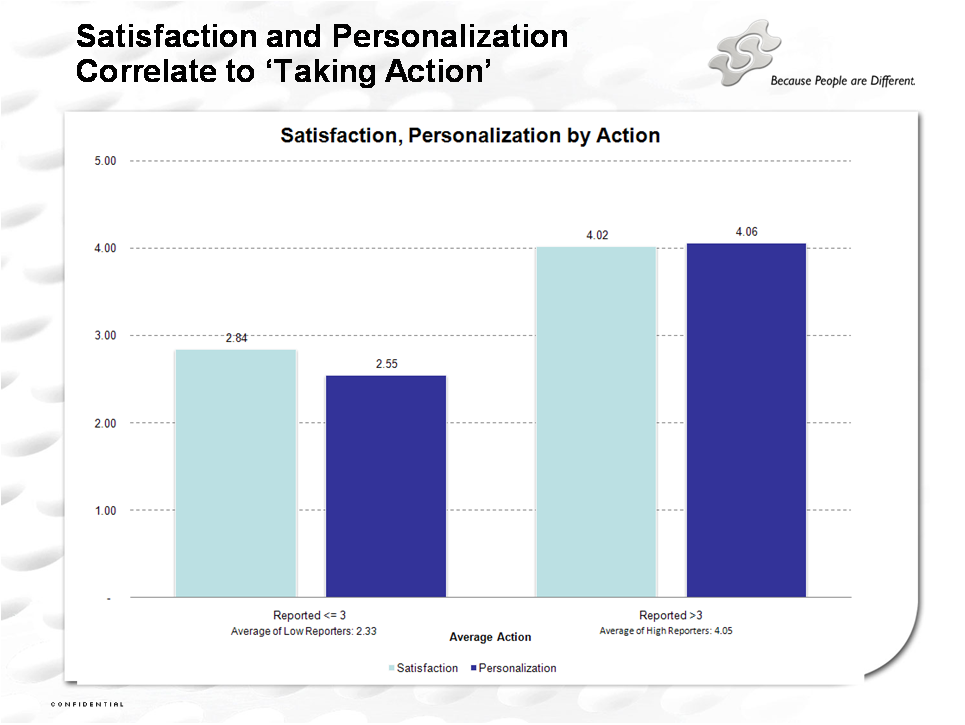
What is it? The Healthcomm Behavior Index is a quarterly survey of 1,000+ commercially insured adults in the US that measures the effectiveness of healthcare communications. It focuses on three areas – personalization, satisfaction, and action.

What are some of the key findings?

  • Effective healthcare communications (i.e., targeted and personalized) have the potential to build member affinity, loyalty and trust, and significantly drive behavior change.
  • There is a direct relationship between healthcare behavior change (the willingness to take action) and how personalized and satisfied members are with their healthcare communications.
  • Respondents are generally lukewarm on healthcare communications and there is significant opportunity for health plans to improve the effectiveness of their communications programs.
  • Unlike other consumer industries, demographics are not as predictive
    of healthcare behaviors.
  • The single most consistent
    determinant of healthcare behaviors is health status.
  • Unhealthy members (those who arguably use health benefits more actively) are the least satisfied and the least likely to take action. These are the members who are the most costly to the health plans so if the plans improve the effectiveness of their communications, they will be able to drive behaviors within this segment and thus have the opportunity to significantly reduce healthcare costs.
  • Seniors are more satisfied and take more action relative to other age groups. This was a counter-intuitive finding as it was assumed that seniors as a whole would have a higher percentage of ‘unhealthy’ members. However, we found that people tend to rate their health status relative to their age.

What are the conclusions? Personalized healthcare communications leads to better satisfaction which leads to a higher likelihood that a healthcare consumer will take action relative to their healthcare behaviors. To most effectively drive member behavior, health plans should micro-segment their populations and deliver extremely targeted and personalized communications programs.

I found the most interesting fact to be that those who took action were the most satisfied with their healthcare communications and felt that they were personalized to them. Digging in a little on the research process, those terms were based on questions that addressed the following:

  • Took action = acted on information + adopted a healthier lifestyle + improved my health
  • Satisfaction = got the right amount of communications + easy to understand + timely + useful
  • Personalization = trust the communications + specific to my needs + treat me like an individual

It will be interesting to see how we can use these results with clients to create a benchmark, compare them to a national average, and then look at how self-reported data correlates to claims data. Ultimately, this could prove to be a defining moment in creating the business case for why healthcare communications are so important beyond the obvious – patient satisfaction, lowering inbound call volume, driving behavior, improved profits, etc.

Literacy and Consumer Empowerment

A few of the highlights from external speakers at the Spring client event for Medco included:

Helen Osborne talking about the “Prescription for Savings: Using Health Literacy Principles in Your Communications.”

  • Finding the right words for the best reasons
  • Not about dumbing down but about smartening up
  • Health literacy is a shared responsibility between patients and providers and each must communicate in ways the other can understand.
  • Age, disability, language, cultural barriers, emotion, and literacy all come into play
  • Eight ways to improve health communications:
    • Know your audience
    • Tailor communications
    • Create a welcoming and supportive environment
    • Communicate in whatever ways work
    • Confirm understanding
    • Offer ways to learn more
    • Weigh the ethics of simplicity
    • Collaborate for good communication
  • Keep things clear, simple, and written for the end-user

“You need to develop an allergy to miscommunication and then turn that allergy into advocacy.”

Steve Case talking about streamlining healthcare by empowering consumers:

“I believe there is a degree of skepticism about managing one’s health, but we need to spend less time on the public policy debate and more time on how to change consumers’ thinking about health.”

  • It may take time for consumers to get fully invested in the notion of taking charge of their health
  • It took nine years for AOL to get its first million users and then rapidly jumped to 25M

“We want to engage people on the Internet and move them from a static situation, where they only go online when they have a problem, to a situation where they go back more habitually.”

  • Many employers are frustrated with their attempts to get employees involved
  • Revolution Health is working more with employers, hospitals and providers
  • Revolution Health is now the top visited site (passing WebMD in January)

Pharmacy Satisfaction Did You Knows

PharmacySatisfaction.com puts out a weekly factoid. They are very interesting and make some great points. I have talked about it before, but here is an updated list with the new factoids from 2008.

  • Independent drug stores continue to score highest in customer satisfaction, followed by food stores, clinics, and chain and mass merchandise pharmacies, in that order.
  • The number one concern across all pharmacy users is that their prescriptions are filled accurately.
  • Independent pharmacy customers are the most satisfied with the services their stores provide.
  • The most useful feature those Web sites offer to them, the survey found, is the ability to order refills online.
  • Nearly three in 10 order their refills online.
  • An average of 69.4% of customers own or use a computer.
  • Customers average three visits each month to their pharmacy.
  • Only about 1-in-5 pharmacy customers, overall, say that they use a loyalty card that provides points, discounts or other savings.
  • While the majority of loyalty card users are satisfied with the expected cost savings by using their card and with the ease of enrolling and understanding the benefits of their card, fewer than 1-in-4 card users are highly satisfied.
  • The drug store industry remains largely up for grabs, with nearly half of pharmacy customers saying they use more than one pharmacy to fill prescriptions.
  • Pharmacy use varies considerably by population. Chain pharmacies are most commonly used among residents of areas with more than 100,000 people. Independent pharmacies are most commonly used among rural respondents (areas with less than 100,000 people). Use of independent and mass merchant pharmacies decreases as population increases. Chain, food store, mail/online, and clinic pharmacy use tend to increase with population.
  • However, as pharmacy customers age, they are much less likely to use chains and considerably more likely to use mail/online and clinic pharmacies.
  • Seven-out-of-ten pharmacy customers indicate that they “definitely would” or “probably would” use their local pharmacy if they could receive the same amount of medication at the same price as their mail-order pharmacy.
  • The heaviest users of prescriptions are survey respondents in their 60s, averaging 5.4 new scripts and 29.2 refills per year.
  • The most preferred method for filling those prescriptions among respondents is to take them to the pharmacy and wait for them to be filled.
  • Indeed, physically handing a paper script to the pharmacist or tech in the store—or picking up a script phoned in by the doctor—remains the overwhelming choice among consumers. Most shun the use of drive-through windows.
  • How long patients have to wait for their scripts to be filled is a key component of customer satisfaction.
  • Fully 93 percent of those surveyed expressed satisfaction with the ability of pharmacies to dispense their new prescriptions in the time promised.
  • Pharmacy customers’ most commonly preferred method of refilling prescriptions (assuming prices and amounts of medication are the same) is calling an automated telephone system and picking up prescriptions at the store.
  • Independent customers are the most likely to receive prescription refills in less than 15 minutes, followed by food store, chain and mass merchant customers.
  • The average survey respondent is spending a considerable sum each month on drugs at their pharmacy—$82 on average (versus $57 a month on food and groceries at their pharmacy).
  • Customers who paid full retail price for their medications, paid an average of $81 for their most recent prescription.
  • Customers who paid the store discounted amount for their medications, paid an average of $75 for their most recent prescription.
  • Customers who paid a fixed-percent co-pay for their medications, paid an average of $56 for their most recent prescription.
  • Customers who paid a fixed-dollar co-pay for their medications, paid an average of $36 for their most recent prescription.
  • On average, respondents spend $82 a month at their pharmacy on prescription drugs, $57 on food/groceries, $18 on non-prescription (OTC) drugs and $14 on personal care/cosmetics.
  • An average of 85.9% of computer owners/users use the computer to improve their health by looking for information about diseases.
  • Much has been written about the value of closer pharmacist-patient relationships, but Americans seem to feel far more connected to their physicians, dentists and nurses than to their pharmacists. That’s clearly not all pharmacy’s fault; the same survey respondents agreed that they were usually given the opportunity to speak with their pharmacist when filling their last prescription. What’s more, pharmacists ranked a close second to doctors as sources of information about medications.
  • Only 16 percent of respondents describe their relationship with their pharmacist as “We are on a first-name basis and have known each other for a very long time.”
  • Walgreens’ “Dial-a-Pharmacist” initiative, launched in February 2006, allows non-English speaking patients to connect with pharmacists speaking 14 different languages.
  • Doctors (94%) are the most commonly referenced source of information on medications, followed by pharmacists (83%), nurses (57%), pharmacy brochures (50%) and the Internet (42%).
  • Doctors (77%) are the most trusted source of information on medications, followed by pharmacists (64%), nurses (43%) and pharmacy brochures (20%).
  • Independent pharmacy customers have the most trust in pharmacists, while mail/online customers have the least. Compared to last year, customers of all types of pharmacies place more trust in their pharmacist as a source of information.
  • More than one-third of pharmacy customers failed to fill all their prescriptions last year, and only 35 percent of all respondents said they were fully compliant on the medications they did take. Nevertheless, refill reminders from the pharmacy remain relatively rare, most patients profess.

2008 Factoids

  • In general, older patients tend to be more compliant than their younger counterparts.
  • The biggest reason for not taking all medications as directed was simply, “I forgot.”
  • Nearly 2-out-of-3 (65%) indicate that they missed a dose or took less medication than prescribed in the past year.
  • The most commonly cited reason for not filling all prescriptions is not needing (42%), followed by too costly (27%), changed by doctor (20%), side effects (17%) and insurance did not cover (16%).
  • Among the medical conditions displayed, those treated for HIV/AIDS and high blood pressure are the most likely to have filled all of their prescriptions in the past year. Those treated for RLS are the least likely to have filled all their prescriptions in the past year.
  • For competing pharmacy providers, satisfaction is a key measurement. Customers who say they are “highly satisfied” with their pharmacy are much more likely to return than those who are simply “satisfied.”
  • Pharmacy customers who are “highly satisfied” with their pharmacy overall are considerably more likely to have positive return intentions, compared to customers who are simply “satisfied” (97% definitely intending to return versus 65%). Survey results have also shown significant revenue differences between highly and poorly rated pharmacies, health plans, and PBMs.
  • Compared to last year, pharmacy customers place more importance on four of the six overall areas of pharmacy services—most notably professional services — followed by pricing and insurance, and overall convenience.
  • 31% of customers consider it “very important” that Pharmacists give advice on OTC/herbal products.
  • 38% of customers consider it “very important” that Pharmacists give advice on health conditions.
  • 57% of customers consider it “very important” that Pharmacists are friendly and courteous.
  • 65% of customers consider it “very important” that they are able to speak to a Pharmacists give clear instructions about Rxs.
  • 65% of customers consider it “very important” that they are able to speak to a Pharmacists about their concerns/questions.
  • 66% of customers consider it “very important” that their pharmacy protects the privacy of their health info.
  • The most common ailment that drives customers into your stores is high blood pressure, which afflicts nearly 50 percent of the respondents surveyed by WilsonRx. High cholesterol, allergies, ailments of the esophagus, arthritis and diabetes also are extremely common among patients.
  • When asked about their satisfaction levels, respondents who received birth control prescriptions were happiest with the medical treatment they’re getting, followed by those thyroid disorders, epilepsy/seizures and type I diabetes.
  • Among the pharmacy services customers say are most important to them is: Help untangling complicated insurance issues, and money-saving alternatives like generic drugs.
  • Consumers are generally satisfied with many of the services, medicines and health-oriented advice they find at their local pharmacy, but they’re also keenly aware of the high costs of pharmaceuticals and quick to shift outlets if they feel their needs aren’t being met.
  • Those who are covered by prescription plans—including nearly 39 million Medicare patients enrolled in some kind of coverage—often feel overwhelmed by the complexities and co-pay issues they encounter at the pharmacy counter.
  • Know your customer — whomever, wherever they are. Being able to identify different customer types is an important first step in anticipating customer needs and managing the expectations of each person.