Archive | PBM / Pharmacy RSS feed for this section

AHIP Panel

I am at the AHIP meeting here in Chicago. This morning, I had the opportunity to facilitate a panel which included three speakers on the topic of communicating with members:

It was a great discussion with strong attendance. I think we had 20 people standing in the hall outside the room listening for an hour. Here are some of the questions we discussed. Since I normally give my opinion (and couldn’t this morning), I will here. [And, since ½ the questions were ones that I thought of on the spot, the panel did great on their feet.]

  • How has Medicare Part D changed the way that healthcare companies interact with consumers?
    • It has forced them to think about members as consumers. They can vote 100% with their feet (within a window). And, this is the group with the most spend and highest utilization. They require segmentation and new services to drive behavior. All of this is new.
  • Healthcare is a front page topic in the news and the upcoming election. How has this changed consumer expectations for healthcare communications? And, what are the top 3 challenges for dealing with this consumer?
    • Consumers know what to expect and what to ask for. They want transparency (whatever that means to them). They want information. They expect companies to do more than simply react to claims. There is a proactive expectation and patients are comparing them not to healthcare companies but to retail companies like Nordstroms or Disney. (see blog entry on “If Disney Did Healthcare“)
    • The top challenges – understanding what is valuable to them, understanding how they digest and react to information, and providing them with a single face that isn’t disjoined across functional areas, business units, and external companies.
  • In most companies, there if no “patient ombudsman” that drives branding and message consistency. How can healthcare companies overcome this functional or process “silo” approach to communications?
    • Companies need to do a communication audit to understand how communications get out the door and how many communications a patient receives. They need to integrate their programs (inbound and outbound) and set a series of rules and triggers to manage communications across all medium. They also need to establish processes that are integrated cross-functionally to initiate communications but reference them back to a corporate set of rules.
  • Up until recently, much of the members experience with the plan was based on the service experience they got from the inbound call center. How has that changed and what are the elements in this new world that will drive satisfaction and loyalty?
    • I don’t think much has changed. The high utilizers of heathcare are still seniors. As someone else first said “pushing Health2.0 to a 1.0 population is difficult”.
    • But, I think that retention and loyalty are new and important. Most companies don’t understand satisfaction at an individual level. Nor have many health plans embraced loyalty type programs. Personalizing the value proposition, constant communications, and establishing incentives to drive healthy and cost effective behavior is essential.
  • Every company struggles with budget and ROI. The key is getting more for less. How are companies optimizing their communications and are they embracing a permission based approach as in the right message to the right person at the right time via the right channel?
    • Companies are aggressively looking at communication objectives and think through how to use multi-modal approaches. No one has really figured out permission based marketing (that I know of). Having a clear purpose for touching a patient and finding a metric to study the impact of that communication is essential to developing an ROI. Communications (and your vendors) have to have shared incentives that drive the right behavior which is focused on clear ROI.
  • Give me your craziest idea about how technology can change the healthcare communication framework over the next 5-10 years?
    • Integration of health, Rx, and lab data into a PHR that is embedded in a smartcard and which launches proactive communications to the health team using intelligent, learning algorithms which are personalized based on individual genetics
  • Since MDs, RPhs, and RNs are some of the front line contacts for patients, how do companies engage them to drive behavior?
    • This is still the problem. These people are so focused on care and so bombarded with information from multiple payors that unless there is a concentration from a single payor or technology that doesn’t impact their workflow it is hard to get them involved. And, in many cases, without P4P (pay for performance), there may not be much of an economic incentive for them to do things differently.
  • How will things like JD Powers and HEDIS focusing on communications and measuring satisfaction impact communications?
    • I think this is the key. Plans need to get scored, ranked, compared, and published relative to what they do, how they do it, effectiveness, cost per success, complaints, and patient satisfaction with the communications.

I am getting a little wordy here so let me move on. The point is that this is a great topic with lots of passionate people figuring it out. I have seen more consumer packaged goods people coming into healthcare over the past few years than anyone could have imagined a few years ago.

Patient Centric Healthcare

I changed the name of the blog last week. (I am still debating changing the URL since I don’t want to lose too much of the traffic I get today.)  It fits what I want to talk about (with the exception of some of my ramblings about technology, leadership, innovation, etc).

I was trying to describe this concept of patient centric healthcare to someone the other day when I realized that I have a deck I used over the summer that was a perfect fit.  When I was debating moving from a consultant back into a corporate role, I needed to tell people what I wanted to do and how I could help them.  So, I created a slide deck that I used with executives and recruiters.  It worked well.  I trimmed out the “why George” section, but the rest of this is a good summary of how I see the market evolving.

It is also exactly why I joined Silverlink Communications.  We share the same vision and dedication to process excellence.   Their technology already does what I think is critical:

  • Create personalized communications that target patients based on data driven models.
    • Push information
    • Collect information
    • Drive behavior
  • Use dynamic call algorithms that respond to patients words to take them down different paths is key.
  • Using technology to automate processes and augment your human capital based on proven value propositions.

Coverage Flip-Flop

I was talking with some friends at a PBM a few months ago and they were talking about putting Lipitor back on formulary (i.e., the covered drug list) that they took off two years ago.  It made me wonder about what a confusing message that is to consumers.

For years, you are taking Lipitor.  All of a sudden, Lipitor moves to the 3rd tier because Zocor goes generic.  You can stay with the drug and pay a lot more or try a new drug.  Now, 2 years later, Lipitor is back in favor because the manufacturer has offered enough rebates to make the branded drug cheaper than some of the generics.  Great for the manufacturer who extends the life of their drug and reaps economies of scale for a while longer.

But, for consumers, this means another visit or call to the MD.  It may mean more lab tests.  It means changing prescriptions again which could trigger drug-drug interactions or other issues.  It changes physician’s information and sets them up for more calls.

Obviously, changing for clinical reasons is one thing.  Trying to move marketshare and failing is another.  And, simply flip-flopping to save pennies is not logical (to me anyways).  Imagine if your provider was in network one year; out the next; and then back in.  I am sure it happens, but it is a pain.

Hopefully, the savings to the employer, consumer, and benefits to the PBM outweigh any disruption issues.

indecisive.gif

I guess the question here (as it often is) is alignment of incentives.  I had to wonder the other day when a friend at a large managed care company told me that their PBM wouldn’t implement certain programs for them since they were in the PBMs best interest.  BUT…they save the patients and the MCO (their client) money.  Wouldn’t you at least offer to do them for a fee that covered your lost profit?  (maybe I’m being too practical here)

Greedy – Your Friends or Your Managed Care Company

It is an interesting discussion to have with different people throughout the health value chain.  When I was 100% focused on driving generic utilization, I would hear questions about why do it.  Sure, I save a little on the copayment, but some consumers saw the copayment as a discount.

  • If I am paying $10 for a drug that cost $30, I am saving 66%.  Not bad.
  • If I am paying $25 for a drug that costs $125, I am saving 80%.  Great.   

People would say things like why should I save my employer or the managed care company (or the PBM) money.  I don’t get it back was their perception.  Unfortunately, that is sometimes true, but in general, in the long run, saving money on benefits should keep the costs down and reduce your premium increase year-to-year.  In a few cases, I worked with CFOs to look at how savings could be re-allocated to create shared incentives.  (For example, if we drive up generics 5 percentage points, we will save $10M.  We will use $3M of that to increase our 401K match by 10%.)

On the other hand, this is what one of the executives at Express Scripts termed The Diner’s Dilemna.  The concept is fairly simple.  If you go to dinner with 2 other couples and know you are going to split the bill, you probably order what everyone else orders so that their is some cost parity.  If you go to dinner with 10 other couples, there is always that person that gets the surf and turf and orders a bottle of really expensive wine.  When cost is divided equally, some people will abuse the system.  Just like health benefits.  Why should I get the generic if I only really pay a portion of the higher cost.  It is divided across the masses.  If you went to dinner with your whole company (especially if its big), you don’t know everyone and don’t mind using more then your fair share even if you only pay the same amount.

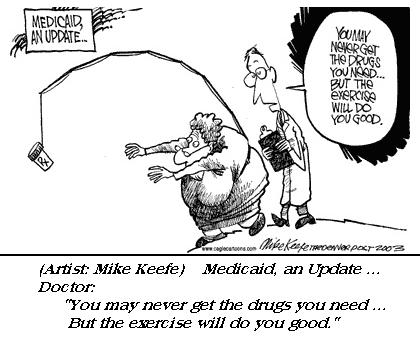
This overallocation is fine when needed (i.e., you are allergic to chicken and order beef) but simply for personal greed is wrong.  So, it puts us back to the premise…someone benefits from our actions to move to lower cost solutions.  Who?  And, how is that shared back so that we all have similar incentives to act in the greater good.

medicaredrugs.jpg

(Source)

Drive-thru Pharmacies – No Privacy

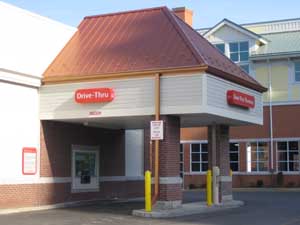
I had an opportunity to use a drive-through pharmacy today near my house.  It was a double laned Walgreens.  It wasn’t a big issue for me, but I realized that there is no opportunity for privacy.  The car next to me (which could have been my neighbor, co-worker, kid’s friend’s parent, etc.) was asked if they had any questions.  I could easily have learned what drugs they were on, their copayment, etc.

I am surprised that pharmacy privacy is not a bigger issue.  I know that there are certainly some drugs which people would prefer not to known as using.  We probably underplayed this benefit for mail order pharmacy.  Total privacy.  All your conversations are with a pharmacist or call center rep in whatever privacy you call from.

drive-through-pharmacy.jpg

Free (or low cost) generic drugs

My local pharmacist told me that they are now moving to free antibiotics.  I still haven’t figured out how I feel about this from a business perspective. 

From a patient perspective – great.  Less out of pocket (or so I hope).

From a business perspective, here are my questions:

  1. The reason to do this is to capture new market share.  Is it working?  Target gave away a $10 gift card if you brought a new prescription to them for a while.  I don’t think it is was a profitable deal for them, but I am not sure.
  2. In most cases (even WalMart), the discounted or free drugs are a minority of the total Rxs dispensed.  Assuming people are mindly happy with their current pharmacy, are they willing to move for one drug that saves them $4 or $8?
  3. For cash patients that move, are the other drugs they fill at the new pharmacy more expensive then their previous pharmacy?
  4. Has this strategy become a requirement at retail or is it still a differentiator?
  5. Why start doing this?  The right answer would be that you care about the patient.  I think the reality is the that pills cost almost nothing and your labor is a fixed cost so why not. 

Perhaps it makes sense.  It certainly gets a lot of marketing coverage.  It would be interesting to see the data at some point and see what market share moved, at what cost, and whether it was profitable marketshare. 

Your biggest risk as a pharmacy is opportunity cost.  As your staff becomes busier, do they have less time to counsel patients?  Does their error rate go up?

ConnectYourCare Acquired by Express Scripts

connectyourcare.jpg

I was glad to see my former employer – Express Scripts – jump into the CDHC space with an acquisition.  They bought ConnectYourCare which is a fairly new company that had jumped into the market over the past few years with money from RevolutionHealth.  It provides online tools and a card for managing your HSA / FSA type funds.  It will be interesting to see how this plays out.  It may be a little late in the selling season to affect 2008 but it could play prominently in the spring for renewals or new business.

As an aside, ConnectYourCare provides a nice glossary of terms you might here around consumerism and benefits.

You can also get access to some of the Forrester research through their site – here.

Medco Tour of Champions

I was surprised to see a full-page advertisement yesterday by Medco in USA Today about their Tour of Champions.  I knew they were focusing on therapeutic resource centers (i.e., pharmacies dedicated to specific disease states like diabetes).  It seems like a great idea.

tourofchampions.png

It was interesting to go to the website – www.tourofchampions.com.  One of my biggest surprises was the fact that they have made their therapeutic alternative tool called My Rx Choices (i.e., telling you lower cost options based on your current drugs) available to the general public.  Now, obviously, it can’t tell you your copay savings, but it may help you identify options.  For example, I put in Lipitor to see what it would offer me.  (see below)

myrxchoices-lipitor.png

From the website, this is what it says the specialist pharmacists do:

  • Cross-check your current medications with your health history and available lab work to help you stay safe.
  • Understand your overall health, not just treat your condition.
  • Let your doctor’s office know how your pharmacy program works so your doctor can help you save.

Learning about your pharmacy benefit or Medicare

I came across an interesting site today.  I went down a few paths and found good information so I thought I would mention it here.  The company is called Your Pharmacy Benefit and is available in Spanish and English.  Additionally, it directs people without coverage to the Partnership for Prescription Assistance which can help people get access to medications.

What is a PBM?

I realized yesterday that many consumers might not even know what a PBM is. PBM stands for pharmacy benefit manager. The market is dominated by 3 large players – Medco, Caremark, and Express Scripts. After that, you have several mid-sized players – Walgreens, Pharmacare (which is now being integrated into CVS/Caremark), Prime Therapeutics, MedImpact – and lots of captive (i.e., part of a managed care company) PBMs – Wellpoint, Aetna, Cigna. And, finally, you have PBMs like Argus that primarily process claims for companies like Humana. (Here is a directory of most of the PBMs.)

Typically, a PBM has the following functions:

  • Process pharmacy claims (i.e., when you go to your retail pharmacy, the pharmacist enters your prescription and electronically submits it for adjudication. The claim is routed to the PBM where it is checked for eligibility and then to see if it pays and what copayment you owe)
  • Set up pharmacy benefits (i.e., based on the plan selected by your employer or payor, the PBM codes what drugs are covered and the copayment structure)
  • Administer rebates…since large pharma companies (e.g., Pfizer) pay rebates for having their drugs on formulary (aka preferred drug list), someone has to manage the negotiations and billing of this.
  • Set up clinical programs (i.e., most PBMs have a clinical committee which evaluates new drugs and looks at market data to help employers choose coverage options)
  • Establish a retail pharmacy network (i.e., work with retailers to get them to agree to discounts on drugs)
  • Communicate with patients and physicians (i.e., look at pharmacy claims data and help find ways to save money or identify clinical issues to inform the patient or physician about)
  • Provide cross pharmacy data for drug-drug interactions…this is a critical function since many people use more than one pharmacy for claims
  • And, last but not least, most PBMs provide a mail order and often specialty pharmacy where they ship prescriptions to patients.

The PBM’s clients are employers who are self-insured, government entities (i.e., state employees, DoD), unions, TPAs (third party administrators), and managed care companies (i.e., BCBS of). Since healthcare has not traditionally been a consumer focused business especially in the PBM world, many of you might not know who your PBM is. In some cases, the managed care company may make it basically invisible to you.

The only people that likely have good awareness of their PBM are high utilizers who run into lots of claims questions and/or people who use the mail order service.

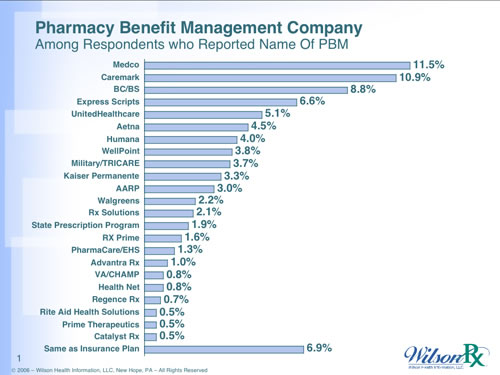
WilsonRx does surveys around PBMs Learn More. Here are two charts from their website about who people name as their PBM and satisfaction with their PBM.

2006pbm.jpg

impactofpharmacy.jpg

If you like this post and are interested in the topics here, don’t forget to sign up for my e-mail updates or add the RSS feed from the blog to your reader.

PBM / Pharmacy Benefits Data (Takeda)

Takeda publishes The Prescription Drug Benefit Cost and Plan Design Survey Report (free to order here). I read the 2006 edition last night. It is full of great data that I would want if I were a consultant, a HR representative, or responsible for my companies PBM relationship.

The document also points you to the American College of Occupational And Environmental Medicine for other information.

Here are some of the facts (based on respondents to their survey):

  • 69% of employers less that 5,000 employees are self-insured
  • 97% of plan sponsors chose to be self-insured so that they had the ability to customize their health plan to meet workforce needs
  • 68% of employers use separate vendors for medical and pharmacy of which 53% use a PBM
  • Average pricing was:
    • $1.88 in retail brand dispensing fees
    • 84.7% AWP reimbursement for retail brands (or AWP – 15.3%)
    • $0.24 in mail brand dispensing fees
    • 78.1% AWP reimbursement for mail brands (or AWP – 21.9%)
  • Formularies were used by almost everyone – 92%
  • Mail copayments were roughly 2x the retail copayment (for 3x the supply of medication)
  • Employer size appeared to matter for price negotiations (no kidding) and they showed that employers w/ over 20,000 members achieved a retail rate of 0.8% less that employers with less than 2,000 members
  • Sponsors who use mandatory mail got a lower reimbursement rate (77.1%) than those without mandatory mail (78.4%)
  • Only 2% of sponsors use a closed formulary where drugs not listed are not covered and the patient pays the cash price
  • It cites research on adherence (The Importance of Medication Adherence, Stambaugh, April 2006) which showed the following reasons for poor medication adherence:
    • 1% don’t know how to use the drug
    • 10% can’t get the Rx filled, picked up or delivered
    • 14% don’t think they need the drug
    • 17% said the drug costs too much
    • 20% don’t want the side effects
    • 24% sometimes forget to use or refill the prescription
    • 10% cited other reasons
  • 40% of employers who design their own plans use co-insurance as opposed to 13% of people who use other parties (i.e., consultant or managed care)
  • Mail service utilization ranged from 0.2% to 62% with 18.3% being the average
  • If a company had mandatory mail, their mail use was 32% versus 14% if voluntary mail
  • Generic dispensing rates ranged from 33% to 71% (51% average) at retail and 12% to 65% (39% average) at mail – which is due to the different mix of acute versus maintenance drugs typically
  • Talked about specialty drugs quoting cost to treat MS at $12K per year and hemophilia at $120K per year (Rx only)

Lots of good information to have.

Can You Answer These Questions (healthcare company)?

These are more company focused although you can think about whether your healthcare company knows this about you.  To be truly effective at education or marketing to patients to drive behavior and outcomes, these are important.  Interestingly, I am not sure I (or you) could answer all these questions about myself (or yourself).

  1. What is your preferred medium – letter, call, fax, e-mail, text message?  And, does this vary based on the content?
  2. When is the best time to reach you?
  3. Would you prefer to talk or hear information delivered in a female voice or male voice?  Would you react differently if they had an accent?
  4. What would compel you to act – saving money or losing money?  Is there a specific amount?
  5. What makes you open an envelope?  (For example, we used to places stamps on intentionally crooked since people were less likely to think they were from a company.)
  6. Does color matter in materials?
  7. How many times do you need to hear a message before you respond or do you make up your mind the first time?
  8. Do you want to be healthy or simply minimize out-of-pocket costs?
  9. Do you trust physicians, pharmacists, insurance companies, hospitals?
  10. What information do you want to receive that you don’t?

I could go on, but I think the point is that today we (healthcare) don’t really understand patients.  What information they want, how to get it to them, when to deliver it, what makes it more effective, and how to drive action.  On the other hand, we may not know ourselves until “experimented” on with different variables.

Confusing Stock Market Reaction

So, Walgreens announced that they were going to miss earnings because of generics (oh and higher expenses).   All of a sudden, the PBM stocks (e.g., Medco and Express Scripts) took a hit which makes no sense to me.  [BTW – I own none of these individual stocks although they may be in mutual funds that I own.]

Walgreen Co., one of the nation’s biggest drugstore chain operators, said Monday its fourth-quarter profit dropped nearly 4 percent because of lower reimbursements for some popular generic drugs and increased store and staff costs.  (See all)

“If Walgreen is receiving lower reimbursement for some generics, it means that PBMs are paying the company less for generic drugs,” Wachovia analyst Matt Perry surmised on Tuesday. “In other words, the PBMs’ drug purchasing costs have gone down. We think the selloff in shares of Medco and Express Scripts is unwarranted.” (see entire article)

At least one analyst understood.  But, why would the market response this way.  There are only a few reasons that these could be correlated positively.  My hypothesis would have been that if Walgreens is getting less than the PBMs are making more or are neutral.  This would make sense because if the PBMs paid Walgreens less they wouldn’t immediately pass that on to their clients assuming they make spread on those claims and have multi-year contracts with employers and managed care companies.  And, if they simply passed on the retail costs to their clients, it would have no impact on them.

How could it be true that Walgreens and the PBMs made less?

  1. The acquisition cost of generics could have gone up which would likely only happen if the wholesalers (e.g., McKesson or Cardinal) changed their prices dramatically or the generic manufacturers increased their prices (not likely).
  2. A significant number of PBM clients (or major managed care companies with their own PBMs like Aetna, Cigna, Wellpoint, Humana) requested price concessions on generics which forced the reimbursement rates down for the retail pharmacies and the mail order pharmacies.  (possible, but clearly not what you hear from the other players)
  3. Costs for a specific generic (with material marketshare) changed dramatically from what was forecasted (shame on the planner).  The worse case here would be if they struck a sweetheart deal (i.e., guaranteed supply at a lower than market price) and then saw the price drop out with a new manufacturer come to the table.

Generics are definitely a key profit driver for the pharmacy industry.  The average AWP (average wholesale price) is $40 (for a 30-day supply).  Companies pay less than 50% of this.  The actual costs are typically less than 80%.  And cash customers pay greater than 100%.  Lots of spread.

Now, of course, there are costs to fill each prescription so it is not that simple.

Unified Communications

Those of you that know me (or follow the blog) know that one of my key issues is how to improve healthcare communications.  I think this is where we (as an industry) missed the boat.  I used to tease our VP of Call Centers that Dominos knew more about me when I called in than we did.

I was glad to see a blog entry from earlier this year by the physician that leads Microsoft’s healthcare group on this topic.

“Healthcare is a communication intensive business.  Good communication has a profound effect on the quality and safety of patient care.  Communication also has a huge bearing on patient satisfaction.  Yet historically, the options for how we communicate with each other in the healthcare industry have been somewhat limited.” 

Obviously, we have a long way to go.  Many times companies simply give up due to regulatory issues or the challenges of changing behavior.  The reality is that communications are difficult.  It is both an art (i.e., messaging, branding, design) and a science (i.e., linguistics, data mining, targeting, personalization).

Technology will drive a step change in the relationship between patients and providers and insurance companies.  This is the time to jump on board and figure out how to improve.

Alternative Dispensing

There are several models for dispensing drugs. I talked about kiosks the other day. Obviously, there is a physician dispensing also. In this case, the physician stocks and fills drugs for patients and collects cash payments. They can make good money, but it can represent a (perceived) conflict of interest and present some challenges (e.g., space, cash management, drug-drug interactions). Several companies that help this model are Allscripts, Dispensing Solutions, and Purkinje.

Another model which is very interesting, but it hasn’t taken off is generic sampling using physician kiosks like MedVantx. It is a cool technology. And, since generic manufacturers don’t provide samples, it is a good way of starting therapy on a generic drug. (The reason for pharma using samples is to get the patient started on their drug.)

medvantx.jpg

Some scary data and a good discussion on this topic can be found on the Medinnovationblog.

Each pharmacy call back costs physicians’ practices $5-$7. With the average physician writing 30 prescriptions a day and handling another 30 requests for refills, the costs escalate rapidly. The estimated 20 pharmacy related phone calls per day costs $20,000-$28,000 annually. In general, physicians are oblivious to this cost center. By moving dispensing into the physician’s office, this overhead can be cost shifted to better serve patients as well as create additional income.

Healthcare – Financial or Service Oriented

I had an interesting discussion earlier this week.  The question was whether people view their healthcare companies as a financial company (i.e., cost is the dominant factor and/or the cost to value tradeoff) or as a service company (i.e., my experience at the doctor’s office, hospital, pharmacy, call center).

I am sure it is not universal, but it would be an important attribute to understand in driving communications with patients.  The easiest example I always use is the paper claims process.  Imagine getting rejected at the pharmacy and having to pay $200 for your prescription.  For some, $200 is a huge cash flow issue while for others it is simply a nuisance.  Where that person is coming from will vary their perception of that same experience dramatically.

For the person with the $200 cash flow issue, a reject forces them to either tradeoff medications versus food or heat.  Therefore, you are denying them care and possibly causing them harm.  For the other person, they pay the cash and are simply ticked off.  For them, it then becomes a customer service issue of how easy it is to submit a claim and how quickly they get reimbursed.