Archive | Books / Articles RSS feed for this section

Does Technology Make You More Efficient?

If you’re like me the answer is “of course”, but I realize that it isn’t always true for people.  Look at the people who get sucked into things like SecondLife or people who play games for hours on Facebook.  That certainly isn’t efficient time.

An article “The Internet Ruined My Life” by Pat Regnier in Money Magazine (Jan/Feb 2010) makes some good suggestions.

“When work got stressful – pretty often in this economy – it was all to easy to click over to Facebook.”

He points out that for Americans working over 50 hours per week:

  • 56% say technology has increased their job stress (27% by a lot).
  • 47% say technology has made it harder to focus at work (14% by a lot).
  • 66% say technology has made it harder to forget about work at home and on the weekends (37% by a lot).

I’d say what about the fact that it’s easier to multi-task and watch your kids soccer game during the week and stay in touch.

He makes a few suggestions (all relevant for getting into the new year):

  • Check out the 43folders.com blog.
  • Break the circuit – stop checking Facebook for a week and see if it’s still that important.
  • Be smarter about e-mail.  The more you send; the more you get.  Create better subject lines.  He suggests the book “The Tyranny of E-mail”.
  • Focus on your job (which isn’t to check e-mail…by the way).  He suggests checking e-mail just a few times a day [which is very hard but very efficient].
  • Stay offline in front of the kids [which is hard to do when you work from home].
H1N1 – Trying To Match Supply And Demand

When there was a large demand several months ago, there wasn’t any supply.  Now there is adequate supply, but the demand has gone down.  Will there be another spike in demand in the Spring? 

With all the retail pharmacies and clinics having supply, we are now going to see the competition for the consumer.  (See WSJ story)

Some Foods And Drugs Don’t Mix

Without getting into all the clinical rules, I’ve always looked for a cut-to-the-chase consumer list of when to avoid what specific foods if you take certain medications.

Finally, in Real Simple magazine (pg. 74, Jan 2010), I found one.  Here it is:

  • Avoid grapefruit [including juice] if you’re taking a cholesterol lowering drug or a prescription sleep aid.
  • Avoid chocolate if your using an MAO-inhibiting antidepressant.
  • Avoid black licorice if you’re on heart medication.

I’m not sure of the science here, but I’m assuming that it’s real.  I’ve heard the grapefruit advice before, but never the others.  Do physicians and/or pharmacists tell you this?

The story also goes on to recommend a few foods:

  • Shiitake Mushrooms – help boost the immune system and prevent the growth of cancer cells
  • Brazil Nuts – may ward off colon, lung, and prostate cancer
  • Horseradish – increase the liver’s ability to fight carcinogens and suppress growth of cancerous tumors…and may help avoid urinary tract infections.
  • Walnuts – help reduce cholesterol and inflamation that may lead to high blood pressure and heart disease
  • Black rasperries – may retard the growth of precancerous cells

So…watch what you eat!

Band-Aid To Monitor Your Heart

Let’s stick with today’s examples that can be extrapolated to the future.  [Good Sunday am thinking]

I was reading in Fast Company [Dec 09 / Jan 10] about Corventis’ PiiX monitor. 

It’s a “wireless, water-resistant sensor that sticks to a patient’s chest like a large Band-Aid and monitors heart rate, respiratory rate, bodily fluids, and overall activity.”

Interesting!   I see an immediate use for this in team sports like the Tour de France where it can be monitored by a team manager and used to push fluids or encourage a change in pattern.  But, as the company talks about, imagine the power of using predictive algorithms here to know when someone may be in danger of a heart attack or some other medical issue. 

As devices like this become standard and are used to monitor our key bodily statistics and used, will we become healthier?  Again, will companies be able to use these to help guide our decisions through incentives – lower health care costs, lower life insurance costs?

I think as the data from these get transmitted electronically and populate PHRs and EMRs and get used by clinicians it will be very interesting to see how they change outcomes.

Influencing Behavior Thru Smell?

We’re always taught as kids to think about all the senses, but that seems to go out the window at an early age. We start focusing on print or TV or some limited set of modes.

I’ve started to see more things lately around smell. I saw a simple one yesterday that I thought I would highlight.

“What we wondered was whether you could regulate ethical behavior through cleanliness.  We found that you could.”  [Katie Liljenquist, asst professor at Brigham Young University]

In an experiment, people who sat is a room with citrus-scented Windex were more likely to act fairly and charitably than those in an unscented room.  In an experiment from last year, the researchers showed that people were more judmental and critical about certain moral issues when exposed to fart-scented spray.  [I’m not sure how people come up with these studies.]

Anyways, I doubt we’re going to start using scratch-n-sniff stickers or seeing TVs with scent dispensers, but I think it’s an interesting question to think about when trying to influence health behavior.  How should a doctor’s office smell?  Would your workplace be healthier if it smelled different?  Would I choose different foods at the cafeteria if it had a different scent?

Diabetes Facts From The ADA

November is Diabetes Month from the American Diabetes Association. You can learn more at www.stopdiabetes.com.

From their fact sheet, here are some key facts.

Prevalence

  • Nearly 24 million people have type 1 or type 2 diabetes.
  • Another 57 million people have pre-diabetes and are at risk for developing type 2 diabetes.
  • One out of every 3 children will face a future with diabetes if current trends continue.

The Toll on Health

  • The death rate from diabetes continues to climb. Since 1987, the death rate due to diabetes has increased by 45%, while the death rates due to cancer, heart disease, and stroke have declined.
  • About 60-70% of people with diabetes have mild to severe forms of nerve damage that could result in pain in the feet or hands, slowed digestion, sexual dysfunction, and other nerve problems.
  • The rate of amputation for people with diabetes is 10 times higher than for people without diabetes.
  • Two out of three people with diabetes die from heart disease or stroke.
  • Diabetes is the leading cause of new cases of blindness among adults.
  • Diabetes is the leading cause of kidney failure.

Cost of Diabetes

  • The total national cost of diagnosed diabetes in the United States is $174 billion.
  • Direct medical costs reach $116 billion, and the average medical expenditure among people with diabetes is 2.3 times higher than those without the disease.
  • Indirect costs amount to $58 billion (disability, work loss, premature mortality).
  • The cost of caring for someone with diabetes is $1 out of every $5 in total healthcare costs.

Average Employee Healthcare Out-of-Pocket $1,938 (2010e)

In an article “It’s Health Enrollment Time” (10/6/09, USAToday), Hewitt is quoted as projecting that employee’s healthcare costs will increase by 10% in 2010 moving their costs up to $1,938.  The article also takes about 3 things you should expect:

  1. Continued movement to co-insurance versus co-payments. 
  2. More high-deductible plans.
  3. More dependent audits. (i.e., looking for kids that have graduated or others than can no longer be called dependents)

Top Drivers of Health Care Costs 2010

A recent Managed Healthcare Executive article (Oct 2009) provides survey data from 650 people at health plans, PBMs, disease management companies, and hospitals.  [As a side note, I was really surprised at how far off this group’s estimates were relative to the impact of prescription costs…which are generally in the 10-12% of total healthcare costs.]

Top Drivers of Cost 2010

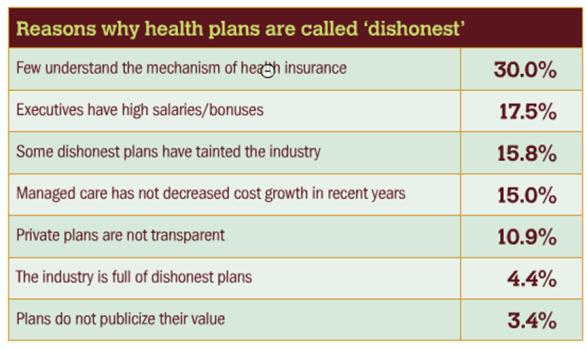
Another survey I found interesting in the article was why health plans are perceived as dishonest.

Why Healthplans Perceived DishonestAnother part of the survey had 7.8% of people saying that patients (consumers) are less interested in health and that the primary reasons for lack of engagement were:
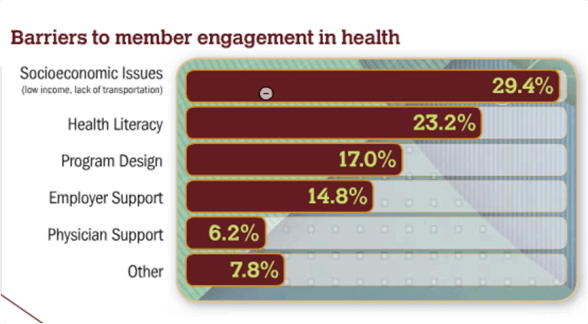

Barriers to mbr engagement

Americans Don’t Expect Healthcare Changes To Be Positive

In the latest poll by USA Today and Gallup, the majority of people expect health care legislation to either have no change or make things worse.  (A $1T for neutral would be a problem.)

Here are the results from four questions:

  1. Quality of health care you and your family receive.  [19% get better; 40% no change; 39% get worse]
  2. Health care coverage you and your family receive.  [20% get better; 40% no change; 37% get worse]
  3. Insurance company requirements you have to meet to get certain treatments covered.  [25% get better; 25% no change; 46% get worse]
  4. Cost you and your family pay for health care.  [22% get better; 27% no change; 49% get worse]

Oncology Specialty Spend Hits 5% (Medco)

A few weeks ago, Medco Health Solutions released some compelling (or scary) statistics on oncology spend:

  • Equals 5% of overall prescription costs
  • Grew at rate of 15.1% last year (trailing only autoimmune and multiple sclerosis within specialty drug spend)
  • Expected sales to be $80B by 2012
  • More than 800 drugs in the pipeline
  • 1.48M new diagnoses expected in 2009
  • Costs are typically more than $20,000 for a 12-week therapy and sometimes $10,000 per month

The good news is that people are living longer with the American Cancer Society saying that the 5-year survival rate is up to 66% for all cancers (1996-2004) versus 50% (1975-1977).

BUT, the treatments have lots of side effects which is creating an ancillary market around “supportive care therapies” to manage the side effects.  (Drugs to treat drugs…I understand it but it still seems wrong.)

13 of Top 50 Jobs in Healthcare

guy kicking

CNNMoney published a survey on the Top 50 Jobs.  It looks at median pay, top pay, 10-year growth rate, total current employment, flexibility, benefit to society, personal satisfaction, and stress.

Of those 50 jobs, 13 of them are health related:

2 – Physician Assistant

4 – Nurse Practitioner

7 – Physical Therapist

11 – Anesthesiologist

13 – Pharmacist

14 – Occupational Therapist

15 – Nurse Anesthetist

19 – Physician / General Practice

22 – Physician / Ob-Gyn

23 – Clinical Psychologist

24 – Psychiatrist

25 – Veternarian

44 – Pharmaceutical Sales Rep (I thought this job was disappearing)

1, 2, 3 of picking benefits

In the November 2009 Time magazine, they suggest three things you should do when picking benefits:

  1. Don’t just default to your current plan.  Spend the time to compare copays, premiums, deductibles, and estimate out-of-pocket costs.  [too bad most plans don’t give us an easy to use model of what you would have spent last year under the different plan options]  They also suggest opening a HSA (Health Savings Account) if you go with a high deductible plan.
  2. Fund your FSA (Flexible Spending Account).  They estimate that you save $350 for every $1,000 you deposit (and use).
  3. Test your wellness.  Many employers (and health plans) offer different forms or tools to test your wellness and health.  You should know the results and you may even get paid to do it.

Patient Choice in Health IT

If you don’t follow Susannah Fox‘s research and presentations, you should.  She works for the Pew Internet and American Life Project.  Here is a recent post about a recent presentation on Patient Choice in Health Information Technology (HIT).  Just pulling a few facts from it…

Our surveys find that the internet is increasingly helpful to American adults seeking health information.

  • 60% of e-patients (or 42% of all adults) say they or someone they know has been helped by following medical advice or health information found on the internet. That’s an increase from 2006 when 31% of e-patients (25% of all adults) said that.
  • 3% of e-patients say they or someone they know has been harmed by following medical advice or health information found on the internet, a number that has remained stable since 2006.

BUT, she also points out…

“There is no evidence that the internet is replacing health professionals, or Dr. Mom, but rather it is enabling a new way to connect to information and resources.”

“Insights” Gone Wrong

There is a great “cartoon” at the end of the recent Fast Company magazine that gives an example of how using information can lead you to a wrong decision.  It’s one of the reasons that I always point out the difference between someone who has provided services to an industry and someone who has worked in an industry.  It’s not the same.  Sometimes, you need to truly understand the nuances and how decisions are made.

It also made me think of a great Facebook example of how using social connections can lead to bad business decisions.  Given all the talk about making peer-to-peer recommendations based on your social network, this is a slippery slope to watch.  We are still new to this area and mistakes will happen.  One of the bigger ones that I have heard occurred in Facebook where they allowed advertisers to use member’s pictures.  Well, how do you think people felt when they saw the advertisements that say “Meet Singles In Your Neighborhood” with a picture of their spouse.  It didn’t go over well.

Great idea.  Interesting technology.  Bad application.

This will happen in healthcare.  The question is who will be first to stub their toe in the new world.

Mail Order Pharmacy – Good or Bad (Two Surveys)

I love when two parties (both with their own agenda) publish data that clearly shows that they are right.  Now, in this case, one quotes a 3rd party so I do give them more credibility.  And, the other (as I will show below) seems to not take the patient’s responsibility in mind.

First, PCMA (Pharmaceutical Care Management Association) publishes research from JD Power on pharmacy satisfaction.  It shows that insured and non-insured patients are generally satisfied with their pharmacy experience.  Mail order clearly came out on top of all types of pharmacies.  (Given that only 12% of people know the name of their pharmacist, I would expect them to be more closely clustered together.)

The J.D. Power and Associates study measured customer satisfaction with the pharmacy experience across major national retail drug store chains, mass merchandisers and supermarket stores, and mail-order channels. The study examines seven factors that contribute to consumer satisfaction with brick-and-mortar pharmacies and five factors that determine satisfaction with mail-order pharmacies. The average overall satisfaction index for each of the pharmacy distribution channels were:

  • Mail-order pharmacies: 834
  • Supermarket pharmacies: 820
  • Mass merchandiser pharmacies: 801
  • Retail chain pharmacies: 798

Then (no big surprise here) NCPA (National Community Pharmacy Association) puts out a survey of 400 patients showing how dissatisfied they are with mail order.

  • They are unhappy being forced to use a lower cost pharmacy.  (GVA – get used to it as part of healthcare reform)
  • They complain that their prescriptions don’t arrive on time (which could impact adherence).  (GVA – did they call in time or wait for the last minute…were they adherent to begin with)
  • They complain about their medications changing (i.e., titrating to a different strength).  (GVA – they shouldn’t move to mail until they’ve stabilized and any mandatory plan I’ve ever seen required at least 2 months as the same strength before requiring movement to mail)
  • They complain about getting different medications than what they ordered.  (GVA – I bet most of that was people getting the chemically equivalent generic.)

This isn’t something that will easily get solved.  The FUD (fear, uncertainty, and doubt) out there rules in many cases and statistical anomolies are what get discussed.  I would love to compare complaint rates, error rates, and satisfaction for patients that use both channels (retail and mail).

Mail Order Retention (or Churn)

It is fascinating how life comes full circle.  I remember when I worked on the Sprint Data Warehousing project back in the 90’s.  At the time, it was the first 1 terrabyte warehouse being built, and we were using some very cool technology from Microstrategy which offered the first web-based DSS (decision support system).  One of the key components of the reporting solution and business driver model we created was churn (or retention).  You can look at it either way.

But, this is a classic example of focusing on the right metric and that you have to measure what matters (to throw out a few oldies but goodies).  Retention is a pretty new concept within the pharmacy world especially within mail order pharmacy.  Growth has been pretty constant for the past decade until the past 18 months.  Now, everyone is trying to figure out what’s happening and why.

  • Are people going to Wal-Mart and paying cash?  (Or other similar card programs at Walgreen’s and CVS?)
  • Are people simply filling less prescriptions?
  • Are people skipping doses and doing other things to stretch out their prescriptions?
  • Are people trying over-the-counter medications or using samples?

There are lots of questions that matter here.  And, you have to think through the mail order process.  How do patients experience it?  Why do they leave?  There’s lot of research that’s been done by the different PBMs here.

I had a chance to talk with Drug Benefit News about this the other day.  You can read the story here.  Here’s a piece of what we discussed:

Depending on the payer, mail-order customer retention rates vary from 75% to 95%, according to Van Antwerp. “Very few people left because of service issues,” he explains. “The majority left because of refill issues. They got to the point where they forgot to refill an important medication and couldn’t get it within a 24-hour time period…or it was up for renewal and they needed to get the next prescription written.”

To address that, some PBMs are working to develop better refill-reminder programs, including moving some customers to auto-refill, Van Antwerp says. “When you look at refill patterns, some people chronically refill too early so they hit that ‘refill too soon’ reject ,” he explains. “Others chronically refill too late.”

“Secondarily, we look at the channel that they’re using to fill,” he adds. “Some people still mail in their refill via ‘snail mail.’ Others use IVR [i.e., an interactive voice-response system].” His firm is working with some PBMs to help them understand each enrollee’s historical behavior, and then customize a response that helps improve mail-order retention while moving the member to the lowest-cost channel for ordering refills — either IVR or the member portal, Van Antwerp says.

Why Wellness Matters

I’ve had an intense month so I’m hoping to catch up on my big pile of blogging ideas this week.  We’ll see.

Here’s one I pulled the other day.  I liked this graphic from MVP Healthcare in their corporate profile.

MVP Wellness Stats

It hammers home all the key points – regression to the mean, focus on the high cost individuals, and cost is avoidable if you focus on preventation and education and successfully engage the consumer.

Phone Calls Improve Quality of Life

“Asking nurses to reach out to people who have advanced cancer – even if only by phone – can improve patients’ mood and quality of life” – Study in Journal of the American Medical Association

This program used nurses trained in palliative care and compared people with regular follow-up care with those that received these phone based interventions.  The nurses discussed issues such as coping, communication with their MD, finding support, managing symptoms, and planning for the end-of-life.

Again, a great reinforcement of the value of communications in healthcare.

New Words For New Times – “Recession-ese”

I always find new words interesting so I found the article “Do You Speak Recession-ese?” by Jill Becker in the American Way (8/1/09) interesting.  Here’s a few of the words she introduces with their definitions (paraphrased):

  • Bankster – combined form of banker and gangster.
  • Boomeranger – adult child who’s been forced to move back in with their parents.
  • The Chewbacca – the hair style that results when you skip a haircut or two to save money.
  • Duppie – depressed urban professional or downwardly mobile urban professional.
  • Frugalista – someone that is frugal and fashionable.

Nature’s Rules For Healthcare

I found this article – Nature’s 10 Simple Rules for Survival – on biomechanics and biomimicry interesting (Fast Company article).  It looks at how nature has survived all these years and translates that to lessons for business.  This is worth more pondering, but my Saturday morning thoughts on applying this to healthcare are in brackets.

  1. Diversify across generations.  [We need different strategies for different segments.  One size will not fit all.]
  2. Adapt to the changing environment — and specialize.  [We need a US centric healthcare model not a model from Canada or the UK.]
  3. Celebrate transparency. Every species knows which species will eat it and which will not.  [Be clear on incentives and roles.  Set up a win-win not a win-lose.  Don’t try to get government to run an efficient business which it never has.]
  4. Plan and execute systematically, not compartmentally. Every part of a plant contributes to its growth.  [A technology infrastructure and shared decision making across a care continuum is important.  The medical home concept has merit.]
  5. Form groups and protect the young. Most animals travel in flocks, gaggles, and prides. Packs offer strength and efficacy.  [Social networking and leveraging peer-to-peer education and support will improve health outcomes.]
  6. Integrate metrics. Nature brings the right information to the right place at the right time. When a tree needs water, the leaves curl; when there is rain, the curled leaves move more water to the root system.  [We need home monitoring and predictive metrics for preventative care.  Using genomics and other measures should save lives by allowing us to act early.]
  7. Improve with each cycle. Evolution is a strategy for long-term survival.  [Big bang improvement to the system won’t work.  Pick one problem at a time – e.g., un-insured – and solve for it.]
  8. Right-size regularly, rather than downsize occasionally. If an organism grows too big to support itself, it collapses; if it withers, it is eaten.  [Healthcare is inherently local.]
  9. Foster longevity, not immediate gratification. Nature does not buy on credit and uses resources only to the level that they can be renewed.  [We need to address the issue of hyperbolic discounting.  People want immediate value, but lots of healthcare improvements take time personally and systemically.]
  10. Waste nothing, recycle everything. Some of the greatest opportunities in the 21st century will be turning waste — including inefficiency and underutilization — into profit.  [Don’t overcomplicate the solution.  Sometimes the obvious can improve the difficult.]

Electronic Device Evolution – What’s Next

The question of ubiquity around consumer electronics is an interesting one.  Will the Kindle replace the laptop?  Will home computers and TVs combine with gaming systems?

While you’re thinking about that, you might enjoy this evolutionary chart which was in the latest Fast Company (July/Aug 2009).  It’s a nice history reminder although you could add a lot more on any path and really have a very interesting discussion.  The funny thing is that I can remember most of these things, but I bet there are kids today that have no idea of a 8-track tape, a walkman, the Commodore 64 (or PC Jr), or the big mobile phone bags.

Jan Berger Co-Author Upcoming Book

Leveraging Health is the first book from the Center for Health Value Innovation! Using real-world case studies from public and private organizations — even small companies — this book illustrates 15 “levers” that can be used to motivate value-based changes in healthcare design.  The book will make its debut Sept. 30 at 8 a.m. at the National Press Club in Washington, D.C., with a book signing to follow at 5:30 p.m. at the Consumer Health Care Congress in Alexandria, Va. Author Cyndy Nayer will be presenting at the conference, and authors Jack Mahoney and Jan Berger will be on hand to sign the first copies! If you can’t make it to the congress, look for Leveraging Health this fall on Amazon.com.

Deloitte 2009 Survey of Health Care Consumers

This is based on a Deloitte web-survey of 4,001 Americans in October 2008.

  • 73% are confused about how the US healthcare system works
  • Over 1/2 believe that 50% or more of healthcare dollars are wasted
  • 7 of 8 Americans believe themselves to be in good health
  • 1 in 3 are interested in working with a health “coach” to help them create and stick to a plan
  • 68% are interested in home monitoring devices that would check their condition and send results to their MD
  • 3 in 5 say financial penalties would improve their adherence
  • Only 1 in 3 Rx users say they compared treatment options
  • 22% say they looked or asked for information about a health insurance plan in the last 12 months
  • 9% have a PHR
  • Physicians who are more prescriptive (paternal) were preferred by a ratio of 2:1
  • 8 in 10 say they would consider switching from a physician recommended Rx if a pharmacist (RPh) indicated a cheaper alternative was available
  • Only 12% said they understood the term – biologics (should they?)
  • 35% are willing to accept a smaller provider network for a reduced premium and lower copayments
  • Only 25% favor increasing taxes to help cover the uninsured

Their major conclusions were:

  1. Health care is a consumer market
  2. The health care market is not homogeneous
  3. Cost concerns are changing behaviors
  4. Consumers want holistic care and resources to pursue wellness and healthy living
  5. Consumers embrace innovations that enhance self-care, convenience, personalization, and control of their personal health information

Expanding the Role of the Clinic

I think the fact that Walgreen’s and CVS Caremark are expanding the role that the clinics can play in healthcare is a positive thing.  There will be lots of debates about how much can be handled at the clinics versus the physician’s office, but I think the key point should be that today’s model doesn’t work.  Chronic diseases are not managed.  We provide sick care not well care.

Launched over the last four years to care for such simple ailments as ear and sinus infections, strep throat or pinkeye, retail clinic operators now are training nurses to do specialized injections for such chronic conditions as osteoporosis and asthma.

In addition, they are offering treatments for advanced skin conditions that include removal of warts and skin tags or closing minor wounds. Care for minor “sprains and strains” also is being offered at some retailers, and pilot projects are underway for breathing treatments and special infusions of drugs derived from biotechnology.

We need to figure out how to lower the costs, make the system more accessible, get patients engaged, and drive people to preventative care.  I don’t know if the clinics can do this, but if they can, we should embrace them.  I think both companies are very well positioned to drive change with their breadth of services.  They touch the consumer on a regular basis and have the ability to use data, technology, and localized care to engage patients.

Introverts versus Extraverts

I thought this was a nice summary in the American Way magazine (5/1/09).  It also talks about Jennifer Kahnweiler’s book “The Introverted Leader: Building on Your Quiet Strength“.

Extravert-Introvert

I think understanding this about your team and peers is critical.  It’s also important just to understand that recepients of your messaging may analyze the information very differently.  From a quick scan on Google, I found that 25% of the overall population is considered introverted.

Medco 2009 Drug Trend Report

Here are my highlights from Medco Health’s 2009 Drug Trend Report:

  • Overall trend was 3.3%.  (1.3% excluding specialty drugs.)
  • Specialty trend was 15.8%.
  • Their generic fill rate was 64.1%.
  • Interestingly, they broke out trend to show that clients with over 40% mail use had a trend of -0.7% while those with less than 40% had a trend of 5.8%.
  • I do like the generic distribution chart below although it is for 2008 Q4 while their 64.1% number is for the average of 2008.

Medco GFR Distribution

  • They point out that utilization growth was negative 1.1% last year which was the first time in a decade.  What I was surprised at is that they didn’t “blame” the economy for this.  Most surveys I have seen say or imply that people are taking less medications because of the increasing cost burden while their overall wealth is decreasing.
  • Medicare costs increased 6.8% for their PDP (prescription drug plans).

Medco Medicare Spending 2009 Rpt

  • I think it’s interesting in helping companies focus their management efforts when they project that “in the next 3 years more than 85% of drug trend will be driven by drugs in six categories: cardiovascular, endocrine/
    diabetes, central nervous system, musculoskeletal/rheumatology, respiratory, and oncology”.
  • In a brief section about the unwired state of healthcare, they share some scary statistics:
    • A review involving the medical records of 41 million Medicare patients identified $8.8 billion in error-associated costs and 238,837 preventable deaths. Moreover, a large subset of these errors are medication errors.
    • An estimated 1.5 million preventable serious medication errors occur each year, with $217 billion (2006 dollars) in associated costs.
  • Since people are always asking for quantifiable value around adherence, I liked the chart below which showed the survival rates over years based on adherence vs. non-adherence.

Medco Statin Survival Rates by Adherence

  • They introduce a new metric – Generic Opportunity Score (GOS).  It takes into account both chemical and therapeutic opportunities for generics to be used.
  • They also provide some details on a brand-to-generic $0 copay waiver program which had a 14% success rate.  That’s pretty good from what I have seen.
  • Here is a breakout of the specialty pharmacy categories:

Medco Specialty 2009

  • Now, where they do credit the economy is with improving generic fill rate, mail order utilization, and client’s use of trend management programs.
  • They show trend by age group with the lower age groups growing faster.  They also showed a nice graph of utilization by state.

Medco Geo Distribution 2009

  • Below is their chart on where trend growth in the future is projected to occur (which should tell you where to focus preventative action).

Medco Top Therapy Classes Trend 2009

A Few Medco Updates

First, Medco published their Drug Trend Report for 2009 a few days ago.  I am just starting to read it and will post my comments in the next few days.  [BTW – I am the #1 Google hit if you query “drug trend report”.]

Second, they recently posted a video of Mark Spitz talking about Medco’s website and savings money on prescriptions.

Then, they also presented a few new studies at ISPOR this past week which showed:

  • Asthma patients taking a statin were less likely to have a asthma related hospital or ER visit.
  • Patients with MS (multiple sclerosis) were more adherent when using specialty.

I think I’m going to try to learn more about the MS study.  Did it vary by age, gender, plan design, pharmacy type, stage of disease, etc.

CareScientific: MythBusters

A few former co-workers and friends of mine (Brenda Motheral and Steve Melnick) have formed a new company called CareScientific.  This is a follow-up to Brenda’s paper a few months ago on Disease Management.  You can now go to their site and see more about what they are doing:

  • Custom program evaluation
  • Provide a proprietary algorithm for selecting cost-effective patients for intervention

They also offer a Disease Management (DM) plausability and VBID plausability calculator to help you assess whether the saving you need are rational expectations.

I had a chance to see them officially launch this a few months ago at a conference.  Here were a few of my notes and some of their slides from the event:

  • To reduce healthcare costs, you can look at pricing, disease management, and utilization management.  If you’re looking at DM, you need to focus on outcomes from both a quality and an ROI perspective.
  • The early models for DM were much more multi-disciplinary.
  • In a recent care coordination project, only 1 in 15 people showed a reduction in hospitalization…none showed an ROI.
  • Hewitt says that less than 40% of plan sponsors are satisfied with DM.
  • In 20 CMS studies, not one has shown an improvement in Rx adherence.
  • Most DM savings are simply regression to the mean.
  • Key things to focus on:
    • Behaviors that save money
    • Improving collaboration – where it matters
    • Rigorous evaluation
    • Determine savings plausability
  • There are 3 concentric circles of focus.  At the middle is cost savings then cost-effective and then clinically appropriate.  Most programs are clinically appropriate, but only 20% show cost savings.

Why Does WSJ Villanize CVS Caremark?

I was so annoyed when I read the WSJ this morning about CVS Caremark charging more for members that go outside the CVS store or mail order.  Come on guys.  This is a basic tiered network design.  It’s not unlike tiered formularies or preferred drug lists.

First, it’s a plan design that was created and offered to clients.  Some clients choose it.  That’s not CVS Caremark’s issue.  Anyone could do this and offer it.

Second, what’s different between this an mandatory mail or retail buy-up.  If you choose a higher cost location, you have to pay more.  You’re getting the same drug at a higher cost facility.

What frustrates me the most here is that we will never reform healthcare and drive out costs if people want to have their cake and eat it too.  You think you can have total flexibility and manage costs.  We have to make some hard decisions and push people to drugs, locations, treatments, etc. that offer similar quality at a lower cost.  That’s not going to be easy.

cake