Archive | General Thoughts RSS feed for this section

Single Answer or Multiple Answers

I was having an interesting discussion yesterday about how to solve a problem.  The two opinions were whether there is a best answer or whether there are multiple best answers.  It’s a great question.

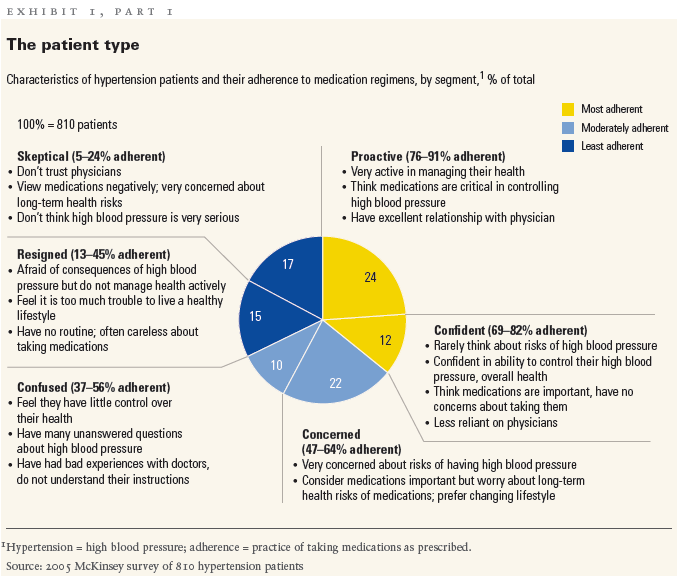
Let’s frame it this way.  Is there a message that is most likely to drive compliance for a group?  I gave them the benefit of the doubt that they aren’t crazy enough to suggest that one message works generally with no segmentation.  (McKinsey‘s article “Getting Patients To Take Their Medication” has some good research around creating segments and showing how some of the segments vary in what they want.)

The other person was presenting a case that they could do lots of research on linguistics and other topics and suggest one optimal message that would work across broad segments of the population.  I was of the opposite opinion that a personalized message that had certain core research but varied by geography, condition, age, income, benefit type, prior interactions, etc. was better.  And, that what is good today may change both generally and individually over time.

I would rather get all the micro-niches of people to their highest compliance and adherence level versus getting a better average across all group. 

Basically, my position is that there are multiple optimal solutions to the problem not just one.  It triggered a memory for me of when I first went to business school.  In architecture school, design is somewhat subjective.  (There are some logical rules such as the Fibonacci Sequence which serve as guiding principles of scale…for example.)   We were taught to always bring three solutions to our initial presentations to let the judges decide which one we should push to finalize.  We had to pick one for a deliverable, but it was always a tradeoff.  In business school and the hard sciences, there is often only one answer that is valid.  (1+1 always equals 2.)

But, for communications, marketing, and other things, it seems obvious to me that companies are best served by dynamic flexibility that allows them to bring multiple solutions to the market in parallel that adapt to different patients and change over time to respond to the market and the patient.

Here is a quick snapshot of the segmentation from the McKinsey report…
mckinsey-hypertension-segmentation.png

Excellent Versus Very Good Service

On my vacation, we took the kids on a Disney Cruise.  We also went last January.

For the first time, I think I can actually differentiate between very good and excellent on the survey.  I always struggle with that and tend to grade down.  In general, we love the Disney experience and the cruise is very well run.  We are already booked for next year and will be going with several other families.

Anyways, on the boat, you go to a different restaurant each night and your wait staff follow you.  This year, they were attentive.  No food was messed up.  They were polite.  They did magic for the kids each night at the table.  They engaged us in conversation.  It was very good service.  Better than almost any restaurant.

BUT, since we were there last year, we had a very high expectation.  Last year, the wait staff learned each day.  After day one, they knew what drinks my kids liked and had them waiting for them when we arrived for dinner.  By day three, they knew my son was a picky eater and had one of his favorite foods on the table.  And, they knew that my daughter wanted some snack other than the typical appetizers and they had that waiting.  Basically, they learned, adapted, personalized, and acted proactively.  The difference was amazingly clear within very tight parameters.

Of course, it took someone else to point out to me that this was an example to share since this is the key point for my healthcare companies.  You need to learn from your communications.  You need to adapt to today’s technology and your patient’s expectations.  The patient experience has to be personalized (in scale) to be in a message they respond to, in a channel they like, at a time that is convenient to them, and based on previous interactions.  And, you have to act proactively.  The patient doesn’t always know when to act.

Since traditional differentiators are basically null (i.e., network size, plan design), it becomes all about communications and service.  How do you drive the patient experience?   It is worth looking at the Forrester data on customer experience index.  Healthplans score incredibly low in terms of usefulness, ease of use, and being enjoyable.  The highest (that they looked at) was Kaiser at 63% with the lowest being Aetna at 49%.   [60-69% meant that the customer had an “okay” experience with the company.]

Handwriting Analysis

This has always been a topic that fascinates me.  Learning from someone’s handwriting.  So I liked seeing a cliff note summary of The Complete Idiot’s Guide to Handwriting Analysis by Sheila Lowe in Spirit Magazine.  I am not sure I would be ready for this to be part of an employment process although I have taken personality tests such as Myers-Briggs (test yourself here) before.

Here are a couple of the items on handwriting:

  • Balanced margins; clear spaces between words = ability to plan ahead
  • All the letters connected in every word = logical thinker who enjoys debating to the point of nitpicking
  • Abrupt breaks between letters = person who jumps to conclusions without the benefit of logic
  • Large letters = loves the spotlight
  • Small letters = finds more satisfaction in working then socializing
  • Lots of rounded letters = outgoing person
  • Straight lines and angles = aggressive person who pushes hard for what they want
  • Lots of loops and close spaces between words = big imagination and need for social contact
  • Few loops and wide spaces between words = intellectual loner
  • Thin writing with illegible words = creative genius OR slippery character
  • Hidden personality traits are seen in the lower loops of letters g, y, f, p, and z):
    • Moderately wide loop =  welcomes a variety of experiences
    • Skinny loop = sticky to what they know
    • Extremely wide loops = bragger who doesn’t follow through
  • The upper loop slant measures emotional responsiveness:
    • Extreme right slant = emotionally explosive
    • Moderate right slant = warm and responsive
    • Vertical = cool headed
    • Left slant = friendly on the surface but hard to get to know

Now, I know you are dying to go look at your writing and see what it says about you.

The Wii – Learning Tool / Real Exercise

After posting on Sunday about “embodied cognition” which talks about learning better while being active, I found it interesting to play a Wii that my kids had borrowed that night.  Initially, it simply made me think about what a great medium this could be to teach people especially people that learn through experience.

Then, I played the Wii boxing and actually broke a sweat.  I hadn’t believed friends of mine that told me this was true [and I certainly wasn’t going crazy playing the game].  I do think it is a very interesting technology, but this isn’t an advertisement for the product.  From a healthcare perspective, it seems like the technology could be exploited to get less active people to exercise and teach people.

Our beliefs about health are embodied in the way we live.  We need to leverage different media to drive that message home to all generations.

Types of Business Blogs

I was looking at something that someone sent me from Paul Gillin’s Social Media Report about different types of blogs. I found it pretty interesting especially some of the examples.

First, he talks about company blogs including the CEO blog and the group blog. They definitely can be interesting, but it really is a question of momentum and interest. I also think blogging has to be from top of mind not from some carefully scripted public relations process. (I.e., there will be times that the blogger gets someone upset and stirs some discussion…which ultimately is a positive)

For example, I was really disappointed to see that Unica was unable to continue their blog. Now, on the other hand, I do think there is a definite role for topical blogs that have numerous participants from several companies. I used to syndicate my old process management blog through one of these sites and found it worked great. (Not to mention that I got 7,000 readers overnight.)

Paul talks about three other types of blogs – Executive Blog; Advice Blog; and Advocacy Blog. Here are a couple of examples that he gives:

For more on corporate blogs, you can go to his website or BlogWrite.

I have talked about why I blog before, but I often think about it as a modern journal and an alternative to e-mailing people with articles that I read. If it helps business…great. The reality is that I am passionate about what I do and talk about it all the time. I choose the job to emulate my passion. I would think that is the only way a corporate blog will work and be genuine.

Physician Driving Revenue?

My friend had an interesting experience the other day.  She had a call from her primary care physician’s office asking her to come in for an appointment.  But, when she asked the staff why, they didn’t have an answer.  The woman that called simply said that the doctor had asked her to call and set up the appointment.  I told her that was pretty unusual.  My friend knew that it might simply be as a follow-up to a prescription that needed to be renewed, but it’s a thyroid medication that she has taken for a decade and had gotten blood work draw on it 2 months earlier.  So, it begs two questions – why couldn’t the staff answer the question and why would the physician need her to come in.

But, it made me think of a Chief Medical Officer that I know.  One day, he told me this story that although clearly logically has left an impression.  He said that doctors certainly have the ability to control some percentage of healthcare spend and some of their revenue stream.  He took the example of a patient falling off a bike and getting hurt.  They then go into their physician to get checked out.  He said that a busy physician would likely check the patient out and not seeing any major issues suggest that they go home, take some Motrin, and call them if they still feel any pain in 48 hours.  On the other hand, a physician that wasn’t very busy would check the patient out, ask them to go get some tests done, and schedule a follow-up visit.  I have always wondered if it really is true.  That would be a good “eyewitness news investigates” story.

Merry Christmas and Happy New Year

I hope you all are enjoying the holidays whether it is Hanukkah, Kwanzaa, Christmas or another holiday. As we move into a New Year, I find it is always a time to sit back and reflect. What did I accomplish this year? Am I on track for my personal or professional goals going forward? Have I made a difference this year?

In that spirit, I share a few things both serious and lighthearted:

  1. Regardless of how you feel about the war in Iraq and Afghanistan, the reality is that we have real people working on behalf of us to defend our country. These soldiers are away from their families and loved ones sacrificing to do what they believe will keep us safe. In that spirit, I recently adopted a soldier so that I could hopefully let them know that we are thinking about them. Here is a good local site for that –http://cornbread.wil92.com/adoptsoldier.
  2. And, here is a great story about a bank that gave their employees $1,000 to “pay-it-forward” and do something good for someone else. They received video cameras to record the event and to share with their colleagues. What a great, creative idea for the holidays. One company and 500+ people making a difference.
  3. My uncle recently e-mailed this to me (so I can’t validate its legitimacy, but it makes a good story) and in the spirit of the holidays, I share it. It is the translation of the famous song about the 12 days of Christmas. (If it’s not true, it’s very creative.)

From 1558 until 1829, Roman Catholics in England were not permitted to practice their faith openly. Someone during that era wrote this carol as a catechism song for young Catholics. It has two levels of meaning: The surface meaning plus a hidden meaning known only to members of their church. Each element in the carol has a code word for a religious reality which the children could remember.

  • The partridge in a pear tree was Jesus Christ.
  • Two turtle doves were the Old and New Testaments.
  • Three French hens stood for faith, hope and love.
  • The four calling birds were the four gospels of Matthew, Mark, Luke & John.
  • The five golden rings recalled the Torah or Law, the first five books of the Old Testament.
  • The six geese a-laying stood for the six days of creation.
  • Seven swans a-swimming represented the sevenfold gifts of the Holy Spirit-Prophesy, Serving, Teaching, Exhortation, Contribution, Leadership, and Mercy.
  • The eight maids a-milking were the eight beatitudes.
  • Nine ladies dancing were the nine fruits of the Holy Spirit – Love, Joy, Peace, Patience, Kindness, Goodness, Faithfulness, Gentleness, and Self Control.
  • The ten lords a-leaping were the Ten Commandments.
  • The eleven pipers piping stood for the eleven faithful disciples.
  • The twelve drummers drumming symbolized the twelve points of belief in the Apostles’ Creed.
  • To stay lighthearted for a minute (and as a parent), I also got a smile out of this letter to Santa that someone sent me.

Dear Santa,

I’ve been a good mom all year. I’ve fed, cleaned and cuddled my children on demand, visited the doctor’s office more than my doctor and sold sixty-two cases of candy bars to raise money to plant a shade tree on the school playground. I was hoping you could spread my list out over several Christmases, since I had to write this letter with my son’s red crayon, on the back of a receipt in the laundry room between cycles, and who knows when I’ll find anymore free time in the next 18 years.

Here are my Christmas wishes:

I’d like a pair of legs that don’t ache (in any color, except purple, which I already have) and arms that don’t hurt, but are strong enough to pull my screaming child out of the candy aisle in the grocery store.

If you’re hauling big ticket items this year I’d like fingerprint resistant windows and a radio that only plays adult music, a television that doesn’t broadcast any programs containing talking animals, and a refrigerator with a secret compartment behind the crisper where I can hide to talk on the phone.

On the practical side, I could use a talking doll that says, “Yes, Mommy” to boost my parental confidence, along with two kids who don’t fight and three pairs of jeans that will zip all the way up without the use of power tools.

I could also use a recording of Tibetan monks chanting “Don’t eat in the living room” and “Take your hands off your brother,” because my voice seems to be just out of my children’s hearing range and can only be heard by the dog.

If it’s too late to find any of these products, I’d settle for enough time to brush my teeth and comb my hair in the same morning, or the luxury of eating food warmer than room temperature without it being served in a Styrofoam container.

If you don’t mind, I could also use a few Christmas miracles to brighten the holiday season. Would it be too much trouble to declare ketchup a vegetable? It will clear my conscience immensely. It would be helpful if you could coerce my children to help around the house without demanding payment as if they were the bosses of an organized crime family.

Well, Santa, the buzzer on the dryer is calling and my son saw my feet under the laundry room door. I think he wants his crayon back.

Have a safe trip and remember to leave your wet boots by the door and come in and dry off so you don’t catch cold.

Help yourself to cookies on the table but don’t eat too many or leave crumbs on the carpet.

Yours Always,
MOM

My Poker Analogy for Healthcare

I have a group of guys who I play poker with at least once a month. We play Texas Hold’Em which is all the rage and even on ESPN. One of the guys who follows my blog asked me why I didn’t compare poker to healthcare since I use every other analogy from my life. So, here goes…

There are a couple of key skills in poker:

  • Understanding the math behind the cards.
    • If I have a pocket pair (e.g., two jacks in my hand), what is my probability of winning? Well this is tied first to how many people are playing and therefore how many other cards have been dealt.
    • Understand “pot odds” which basically means knowing what return I am getting on my chips if I bet (e.g., if there are 200 chips in the pot and another player bets 5,000, you are barely getting a $1 for each of your chips).
  • Understanding the people.
    • Some people play “tight” and only bet when they have good hands.
    • Some people like to bluff and are willing to take risk.
    • At the same time, you have to know both the person and their chip stack. Do they have a big chip stack (relative to the table) and therefore can take a chance?
  • Understand the game.
    • Depending on the order of betting and the number of cards played, you should act differently. It is critical to understand the order of betting.
    • It is also important to understand how people are playing the game. In big dollar games, amateurs typically won’t bluff. If you allow people to buy back in to the table versus an elimination process, people will be much more “loose” with their betting.
    • Understanding what their pattern of betting “should” mean. They checked…therefore they are weak and I can push them around.

So…what does this have to do with healthcare or more specifically HealthComm.

  1. You should be developing your communications based on science. What works? What doesn’t work? [the math]
  2. You should be personalizing your communications and actions based on the individual and their disease. [the people]
  3. You should be learning from history and trying different approaches to improve your success rate. [the people]
  4. You should know what others are doing and really understand correlations. [the game]
  5. You need to know as much as possible about the individual and what other things influence them (e.g., income, age, geography) to know how they interpret information and their condition. [all of the above]
  6. What type of message will get action – reward, penalty, passive, aggressive. [all of the above]

I may try another one, but I think this gets to the heart of it. Keep it simple…right.

Looking for an Acquisition – Speculation

With the stock market handsomely rewarding the PBMs especially Medco and Express Scripts, they have cash and stock value to go on the acquisition path. Express Scripts has grown through acquisition over the years leading up to its acquisition of several specialty pharmacy companies a few years ago. In the St. Louis Business Journal, David Myers (VP, Investor Relations) is quoted as saying “Acquisitions are Express Scripts ‘No. 1 priority for our strong cash flow'”.

[By the way, as I have previously disclosed, I own no ESRX stock or other stocks individually. I only invest in mutual funds…and do very well with it.]

Although it’s been out for a week, I just read it this morning so before I run into anyone there I want to have fun guessing what Express Scripts might acquire. Usually, all I hear about is speculation of who might buy them. It typically is either a retailer like Walgreens or Wal-Mart or occasionally a managed care company. I don’t see them getting bought with the valuation so high. And, there are very few payor other than United Healthcare (which is tied to Medco) or WellPoint that could swallow such an acquisition. And, I am sure Walgreen’s won’t do anything until they see what the CVS/Caremark deal looks like, but if it works, they would have to make a bid for Medco or Express Scripts to compete.

  1. Buy one of the many regional PBMs that exist. This would be the easy play. It could be integrated. There is lots of synergy. But, people still go to the regional players for a reason, and you may lose a lot of the lives. Now, buying Walgreen’s PBM might be an interesting play and create a sticky relationship with them to align against CVS/Caremark.
  2. Buy a niche PBM in an area such as Worker’s Compensation. Not a bad strategy. They used to have about 20% marketshare in this space. They could also go after the Third Party Billers here although I think that market space may collapse.
  3. Buy another specialty PBM. I hope not. They have the assets already to be successful here. All you would be doing here is buying lives for people committed to one particular pharmacy. I think the premium would be too high.
  4. Go into a related space like dental or vision, but they tried vision before and it never really took off.
  5. Go into the data (e.g., IMS) or IT space (e.g., Ingenix), but they have also tried this and it never took off.
  6. Continue to acquire in the consumerism space. They recently bought ConnectYourCare. There are lots of companies out there doing interesting things in this space and with the projected growth here there are lots of opportunities. The problem is valuation of these companies, maturity of the business model, their risk in going into this business, and their focus on the traditional PBM model.
  7. Buy a technology company like an e-prescribing company (e.g., Prematics where Barrett Toan (founder of ESI) is an advisor) or a Physician Practice Management company (e.g., Pat McNamee the Chief Administrative Officer came from Misys which I believe was for sale) or healthcare IT company like Cerner or a pharmacy automation vendor like ScriptPro or a Personal Health Record company (like Aetna bought ActiveHealth).
  8. Buy a disease management company. Medco has a 10-year (I think) deal with Healthways which I would assume is a “try and buy” type relationship (i.e., let’s try this out and if it works we will buy you at a pre-determined price). ESI has worked with LifeMasters in the past, but I assume there are lots of players out there with interesting models.
  9. Follow Medco and buy in the disease space and DME (durable medical equipment) space. Medco bought PolyMedica earlier this year as part of their strategy to develop disease specific pharmacies called Therapeutic Resource Centers. This would probably be the most logical extension. It seems to be working for Medco.
  10. Buy into the international health
    space
    . This would probably be the most adventuresome with the biggest upside (if it could work). There is a lot of opportunity outside the US, but with limited investment, no managed care companies or PBMs have ventured too far. Express Scripts has a company in Canada. I know a few others have explored and/or tried small ventures.
  11. Buy into the generic manufacturer or distribution space. This would probably be the most lucrative. They have a huge distribution channel. Why not buy a portion of an existing generic manufacturer, open a distribution company (like McKesson, Cardinal, or AmerisourceBergen), and create a single source relationship with the Express Scripts pharmacy and give the retail pharmacies a different reimbursement rate if they used them.
  12. They could always try to become a retailer or go into the clinic business. There is something here, but it is a very different model and given the “training” they have done with the street over the past decade to focus on ROIC (return on invested capital), I don’t think they could do this.

Now, the two things I would suggest if I were still there would be:

  1. Invest in IT. Look at how to automate more workflow activities. Look at technologies that drive patient self-service. Look at things that drive patient behavior (online tools, educational programs, incentive systems). Build out mass customization and personalization based on integrated data – medical and lab – so that no one can catch them. (But, if you are waiting to sell, don’t spend the money to overhaul the system.)
  2. Create some mad money in a Venture Capital type relationship with someone like Google or Microsoft that are trying so hard to get into the healthcare space and would welcome the relationship to jumpstart.

Who knows? I certainly don’t know what they will do, but it is a fun position to be in. You have money. The market is at an inflection point. You want to be a catalyst. You have driven incredible results for a decade. What next?

Is Healthcare Missing a Generational Opportunity?

I think a lot about some of the new marketing tactics being used by consumer product companies – sponsorship (e.g., McDonalds Holiday Lights at the Beach Presented by Verizon Wireless), advertisements or product placement in video games, corporate tattoos, YouTube videos, MySpace personas, and Second Life avatars. Logically, who cares about most of these for healthcare. The primary users of healthcare are the senior population…and they aren’t being influenced by these channels. The corporate buyers are the HR or benefit professionals…many of whom have professional consultants (e.g., Hewitt, Mercer). Branding is often an afterthought within healthcare.  [Can you image a company working with the reality show Survivor to make sure that one of their competitions earned the winner a personal healthcare coach sponsored by Cigna (for example) for a year?]

BUT, we all know that health insurance (or any insurance) company is not typically viewed as a trusted entity looking out for your best interest. (As one of my old bosses used to say…how many times are you going out to dinner with your health care broker each year?) I guess my point is why are some of the key players thinking out 20 years and trying to figure out how to influence the younger generation and show healthcare as an entity that works to make their life better (e.g., have a video game where buying health insurance makes your character recover faster from injuries).

For example, I believe most people have a great impression of architects as humane people based on The Brady Bunch’s depiction of the father figure who was an architect. The lead character in Spike Lee‘s movie, Jungle Fever, was an architect. Have you ever seen a movie where the lead character was the VP of claims at a managed care company or the CEO of a PBM? There needs to be someone out there thinking big picture and looking at what it will take over time to change the perception of healthcare because perception is ultimately reality so we have to address both. Fix the problem and get people to believe that we fixed the problem.

Do We Eat Our Own Dog Food?

I don’t know the answer here, but I am sure someone out there does. The question is whether healthcare professionals are bigger utilizers of healthcare services (e.g., MRIs, prescriptions, well visits, etc.). I always want to know that from service providers. If you are selling me a CRM (customer relationship management) application, do you use it? If you selling me financial advice, have you used your own advice to get rich?
I think back to a prior job where I remember our lawyer telling me that they used anti-depressants, and my boss telling me that she had sleep problems and used drugs to help her sleep. But, in other cases, I know health professionals that will try many other options (e.g., diet, exercise, nutraceuticals) before using prescriptions.

The reality is that whatever we do it isn’t something that can be extrapolated. We know too much and therefore aren’t a relevant predictor of behavior. Those of us that work in the industry are just too close. The problem is how many products, offerings, services, solutions, etc. are based on what we would want.

We need that outside-in perspective to tell us what the average person (if such a person existed) or simply a normal person within a micro-niche might do. How would they react? How do they interpret information? What makes sense to them? If I say you have to “renew” your prescription every 12 months, do you know what that means? Does the term GPI or NDC or therapy class mean anything to you? I remember looking at our formulary documents one year which were organized by therapy class (e.g., Non-Sedating Antihistamines, Proton Pump Inhibitors) and all of a sudden realizing that no patient could understand that. We would mail it to them and expect them to know what the alternative drugs were in the class. They didn’t even know how to read the document.

$200K Word Change

I was talking with a friend last week who has spent all his time at small, nimble companies. He was amazed at the challenge of getting something prioritized and completed in a big IT shop where process can often kill flexibility. There are lots of reasons for this – doing all the small projects would use all the time, the big projects have great ROI, the risk of something going wrong is much higher, etc. There are also dozens of reasons why you want to figure out how to be big and nimble.

When I was focused on this technology challenge (see old blog), I used to talk about SOA (service oriented architecture) and BPMS (Business Process Management Systems) where you could create a process abstraction layer that sits above your existing legacy environment. This abstraction layer allows companies to make rapid changes within a controlled environment.

The one example I always use is when we decided to move from the word “member” to “patient”. To do this systemically, you have to change call scripts, job titles, system fields, metadata, contracts, letters, etc. Of course, you also want to change the website. When I put this request into IT, I got back an estimate of $200,000 to make that change (or 2,000 hours at $100 internal cost transfer per hour). How do you justify the business case for this other than strategically and qualitatively? And, given a shortage of resources, why would you focus on this rather than some other web development project?

It was an interesting and frustrating process. We obviously wanted to show clients that we had fully transitioned to focusing on patients. We wanted to show consumers that we were thinking of them differently. But, we were stuck in the project prioritization process for scarce resources.

This ability to drive branding through every interaction and evolve your branding as you learn about your consumers will be an interesting challenge to an industry like healthcare where companies are slow to change and change takes time.

Physician Double Standard (What’s Ours)

There was an article out yesterday summarizing a survey of physicians.  The key point it made was that “up to 96 percent of those surveyed said they should report all instances of significant incompetence or medical errors to the hospital clinic or to authorities.”  [It was only 45% among cardiologists and surgeons??]  BUT, 46% of those surveyed knew of a serious medical error that had been made and did not report it.

Given all the focus on quality and error rates over the past few years, this seems concerning.  Although I am equally as concerned that the surgeons didn’t feel it was necessary to report issues. 

At the same time, I believe we can’t expect different standards from others that we wouldn’t be willing to be held to.  So, if you knew a collegue did something wrong, would you report them?  If they acted inappropriately at a client social event.  If they presented poorly and lost a sale.  If they made a mistake in their financial model.  If they had a spelling error in a marketing piece. 

Of course, not all of these are life and death, but I could certainly argue that rejecting a claim that pushed undue financial stress to a patient would be a serious issue.  Or, simply telling them a service wouldn’t be covered might discourage them from getting needed work performed. 

“There is a measurable disconnect between what physicians say they think is the right thing to do and what they actually do,” said Eric Campbell of Massachusetts General Hospital and Harvard Medical School in Boston, who led the survey.

Some of the other findings included:

  • Doctors are willing to order unnecessary — and often expensive — tests.  [How many of us don’t always take the least expensive path?]

  • Only 25% consciously tried to avoid gender or racial bias in how they treat people.  [How many of us consciously do this in our job?]

  • 93% of doctors said they should provide care regardless of a patient’s ability to pay but only 69% actually accepted uninsured patients who cannot pay.  [How many of us would be willing to provide our services for free to someone that needed them?]

URL:

Staying Current – Blog Options

Obviously none of us have time to stay current with everything. Remembering all the blogs you like, visiting them regularly, and reading all the e-mails, mail, and publications can be overwhelming. I can’t simplify it all, but I thought I would suggest two ways of staying informed if you find this or other blogs interesting.

First, you can subscribe to the e-mail list. What this means is that any day there is a new post you will get an e-mail sent to you. Here are a few screen shots so you see what that means. It is an easy to read format sent by Feedburner. It has links to forward the article and unsubscribe at anytime. (But, you should know that you will get a confirmation e-mail from Feedburner after you register. Make sure it doesn’t get caught in your spam filter. I have about 10 people that have signed up to receive updates, but they have never confirmed.)

I find this easy since I read a lot offline, and I visit when I need to not trying to time new posts.

e-mail-start.pnge-mail-end.png

The second option is to use a blog reader tool like iGoogle where you can have all your blogs. I use this as my start-up page in my browser so I can see what the world is talking about from traditional media to different bloggers.

igoogle.png

Employee Satisfaction – Drug Utilization

Over the past decade, colleges have had to reveal more information about crime statistics on campuses which creates a new way of comparing colleges. For some random reason, I was thinking earlier about how interesting it would be to see drug utilization by employer as a proxy metric for job satisfaction and culture. Imagine if you get see the utilization of anti-depressants or sleeping pills by employer. That might help you understand how people feel about the company and the amount of on-the-job stress.

I know that clinically someone is going to beat me up about depression being a serious disease, but this is not meant to make light of the disease. It is simply an acknowledgement that abstracted medical data could reveal interesting things about companies – number of worker’s compensation claims, use of diet drugs. Just like I would argue that knowing the BMI of company employees would tell you a lot about the role of diet and exercise in a company.

I can remember preparing for annual reviews with clients and looking at their top 10 therapy classes based on utilization. You could quickly tell things like average age and other attributes of the company.

Identifying Your Generation

This discussion of using texting in healthcare (and other new channels) reminded me of a posting from earlier this year on Penelope Trunk’s blog.  [A great blog if you’re interested in career type topics and work / life balance with a focus on Generation X and Generation Y.]

Penelope introduces a quick “test” to determine whether you are a Baby Boomer, Generation Jones, Generation X, or Generation Y.  It made me feel old, but it is a good reminder of how technology and communication has changed radically. 

A Thanksgiving Short (Kids and Shots)

I hope you are all having a good Thanksgiving and enjoy some time with your family.  We all have so much to be thankful for.  We often see the negative, but for the majority of us, simply living here in the US puts you in a position for which to be thankful.  Go tour a 3rd world country in a rural region, and you will see what I am talking about. 

Here are my two quick stories that I always use to remember how good we have it:

  • I was born in Brazil and on a visit there was amazed to see thousands of people basically living in cardboard boxes.  The next day the army had bulldozed the entire neighborhood into the ground. 
  • My father worked there for 10 years as a missionary, and he always talked about a man and woman who lived in the small down but were never together.  One night he invited them to come as a couple for dinner.  The man refused saying that they only had one pair of shoes and the mountain was too rough for the other one to come down barefoot.  Imagine that!

Anyways, I thought I would go with a light-hearted entry for the holiday.  Both my kids have recently gotten shots and like adults with the dentist, they were not happy about it.  My daughter slipped out of the exam room, past the receptionist, out the building, and into the parking structure screaming before anyone caught her.  My son was so worked up that after the shot he almost passed out as his blood pressure dropped.  [Something the doctor said was common in teenagers but not with young kids.]

But, to top this off, I was telling a neighbor about this when she mentioned that when she was a kid she had a fear of needles.  She said one visit that the nurse couldn’t restrain her so the doctor held her.  The nurse went to give her the shot [in her but] but she kicked so hard that the nurse’s arm went off course and stuck the needle right in the head of the physician who was bent over holding her down on his lap.  [Hard to top that one.]

Literacy Adds Additional Challenges

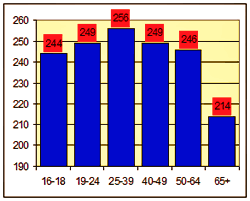
I have some other seniors statistics that I will add later, but this morning I was researching seniors and healthcare communications.  I was surprised to see some of the data around how literacy presents a big challenge for them.  Here are a few facts and some links for more information:

  • “People aged 70 years and older with limited literacy skills are one and one half [1.5x] to two [2x] times as likely to have poor health and poor health care access as people with adequate or higher reading ability, according to a study led by researchers at the San Francisco VA Medical Center and the University of California, San Francisco.” (source)
  • “One in four [seniors] had limited literacy. In practical terms, these elders ‘may have trouble reading basic health information or pill bottle instructions'” (source)
  • “Although only 12 percent of the U.S. population was age 65 and older in 2003, they accounted for one-third of all patients admitted to the nation’s community hospitals in that year – over 13 million hospital stays, according to the Agency for Healthcare Research…The elderly also accounted for 44 percent of all hospital charges  nearly $329 billion.” (source)

  • “Senior citizens (65+) scored far lower than younger people in a 2003 literacy test. The test had a maximum score of 500.” (source)

literacyhlth-6-09-12.gif

  • “Less than one out of six U.S. adults have “proficient” health literacy, according to the report released this week, but for seniors it is only about three out of a hundred.  A staggering 29% of senior citizens do not even have “basic” health literacy.” (source)

I think this is an interesting angle that you don’t hear much about.  We spend all this time trying to think about what to say and other creative aspects, but sometimes we have to simplify the story to get to the point of being usable.  Here are a few other links if interested in the topic:

Where are the generic only pharmacies?

A few years ago when there was all the debate around Canadian reimportation of drugs, I had the opportunity to write the position paper for Express Scripts on this topic and work with our internal and external counsel to summarize our position with our clients.  At the time, payors and patients were very interested in getting branded drugs filled outside the US and shipped back to them.  [Or, in some cases, driving across the border to get the prescriptions filled.]

In working on that project, I learned that the government control that worked to keep brand prices low – at a simple level think one buyer – had the opposite effect on generics.  Generic drugs actually cost more outside the US where there is massive competition for the drugs.

As I have talked about before, consumers who pay cash pay a ridiculous mark-up on generic drugs even in the US.  Given those two facts, I remember talking with a friend of mine about opening generic only pharmacies just inside the US border to attract Canadian citizens.  Problematic legally I am sure, but the concept seemed like a genius move pre-Medicare Part D.  You could save the uninsured and seniors massive amounts of money.

I haven’t had the time to do the research, but I still have to believe there is an opportunity for a highly efficient pharmacy which offers generics closer to cost.  I would see it more like a membership.  You pay $100 per year to belong and you get your prescriptions for the pennies that they cost rather than your copay or the cash price.  Everyone wins.

But, here we are four or five years later and to the best of my knowledge no one has done it.

Are We Asking the Right Question?

Obviously, one of the big mistakes that people make when they are trying to solve a problem is to ask the wrong question.  I was thinking about this on the plane and wondered if we think about healthcare wrong.

In a fully-insured world, managed care companies make the most money when patients are healthy.  In an ASO (employer self-insured) world, employers save the most money when employees are healthy.

In both cases, prevention and wellness are drivers of business value.  Obviously, retention and turnover impacts companies ability to capitalize on their investments in these areas.  But, I don’t hear people asking how can I drive wellness and preventative activities to maximize savings and profits simultaneously.  All I hear people asking about is how to fix our confusing and broken system.

Maybe we need to find a way for insurance to stay with the individual (not a new scenario but not one I hear much about right now) – aka portability.  In that case, the company would want to drive satisfaction and minimize costs to retain the members and keep them healthy.  A win-win??

It’s certainly not that easy, but a quick thought on the topic.

Certainly someone can figure out tax incentives and a framework for crediting companies that invest and the member is no longer associated with them…As long as they have done something to improve the condition…

Patient Centric Healthcare

I changed the name of the blog last week. (I am still debating changing the URL since I don’t want to lose too much of the traffic I get today.)  It fits what I want to talk about (with the exception of some of my ramblings about technology, leadership, innovation, etc).

I was trying to describe this concept of patient centric healthcare to someone the other day when I realized that I have a deck I used over the summer that was a perfect fit.  When I was debating moving from a consultant back into a corporate role, I needed to tell people what I wanted to do and how I could help them.  So, I created a slide deck that I used with executives and recruiters.  It worked well.  I trimmed out the “why George” section, but the rest of this is a good summary of how I see the market evolving.

It is also exactly why I joined Silverlink Communications.  We share the same vision and dedication to process excellence.   Their technology already does what I think is critical:

  • Create personalized communications that target patients based on data driven models.
    • Push information
    • Collect information
    • Drive behavior
  • Use dynamic call algorithms that respond to patients words to take them down different paths is key.
  • Using technology to automate processes and augment your human capital based on proven value propositions.

Time to Change

Do you ever wonder why you have to change?  Things are going well.  We are making money.  Healthcare is recession proof.  We’ve been doing this for 20 years.

Well…the world is changing.  This deck is a good reminder of what happens outside the US and how fast things will change.

Leadership in 60 Seconds

I have always been fascinated by two topics – leadership and innovation.  They have driven me to read many things and try different roles.  I also believe my pursuit of both architecture and business as a combination of right and left brain challenges was a way for me to try to learn both.

I found this presentation on leadership which is a quick summary of many points.  In the end, it is a little more of a teaser deck for a book, but it is a good reminder of many things about leading.  Since I believe healthcare companies have a chance to lead the market right now before government leads them, it is a topic to think about.

Geekipedia

Sure…a little off topic, but understanding technology is one of the critical components (in my humble opinion) to driving innovation and change in healthcare. Healthcare is not an early adopter of solutions. There is too much fear about change (and litigation).

So, when Wired but out this magazine supplement called Geekipedia, I knew it was a must read. As it says on the cover “149 people, places, ideas and trends you need to know now”.

Here are a few that jumped out at me:

  • AJAX – a suite of web-development technologies which produce squeaky clean surfaces. This allows web designers to build web sites that act like applications and accept user input and computing results without fetching entirely new pages from a server. I have worked with developers to use this before. Very cool. You see it on a lot more sites now, but anytime you enter data and the site changes without refreshing it…they built the site using AJAX.
  • APIs – application programming interfaces are sets of rules that govern how apps exchange information. These have been around for years and typically only mattered to the programmers and your engineering staff…but today APIs allow you to create custom applications using desktop widgets and mashups to have personalized sites that do all types of cool things.
  • Collaborative Filtering – this is the recommendation algorithm you see on Amazon or Netflix or many other sites. I can see healthcare one day embracing this in patient centric forums – patients with your similar benefits and genes were most likely to respond to this form of treatment.
  • Distributed Computing – most of you should know about this as the use of our computers to solve problems has been part of the news (good and bad) for years, but the point is to leverage the memory of individual computers in a network design to create a virtual supercomputer to solve complex problems that look at lots of data over years – e.g., SETI@Home that looks for extraterrestrial intelligence or FightAids@Home which looks for new AIDS treatments.
  • Mashup – these are sites / applications that are combinations of existing offerings that are cut and pasted together. For example:
  • Meganiche – with the Internet’s utilization now, it is possible to have a niche within a niche. For rare diseases, this could have some value.
  • Neurologism – all of the new areas of research driven by the breakthroughs in understanding the brain.
    • Neurofitness
    • Neuroceuticals
    • Neuroinformatics
    • Neuromarketing
    • Neuroergonomics
    • Neurosemantics
  • RNAi or Ribonucleic Acid Interference – “the silent assassin of cell biology”. It protects against viruses by tearing up the viral RNA and preventing it from making copies of itself.
  • RSS or Really Simple Syndication – you see this everywhere – on my blog, on websites, even in the new Outlook. This allows you to stream information to your reader (e.g., Google Reader) to see new information without having to go to all the individual sites. I wonder how many managed care companies and PBMs offer this on their websites today. It would be nice to get this pushed right to my personal Google page.
  • SEO or Search Engine Optimization – this is the use of tags and other links to maximize how your website shows up in a search.
  • Ultrahigh-throughput gene sequencing – this is all about the speed at which genes are sequenced which is obviously a big driver of personalized medicine and genomics. I am not sure I buy the prediction of “it won’t be long before a stall at the local shopping center will work up your genome ‘while u wait'”.
  • Widgets – these are small applications which can typically be embedded in a website using reusable code (e.g., a BMI calculator or mortgage calculator)
  • Wikipedia – this is a site that provides the modern encyclopedia full of links and information that is created by the net community – are you out there? Is your company or product?

It makes you wonder. As healthcare moves to more consumer centric and sales to commercial patients mimics Medicare Part D, will you see a United Healthcare avatar in Second Life or a Medco Facebook page. And, when will be see YouTube and Flickr being used to paint positive pictures of our healthcare system for the many people that it does work for. If politicians can begin to use these sites and big corporations encourage personal advertising of their brands, healthcare should give it some consideration.

Calculator Culture

As technology becomes ubiquitous (everywhere and anytime), do we run the risk of losing our sense of logic and memory around health (and other issues).

For example, I bet most seniors could tell you their medicines (name, dose, cost). I was asked recently what medications I took and didn’t have a clue. (If you remember, after my visit to a clinic, I got several allergy medicines.) My immediate reaction was to type medicine into my Blackberry and see what it told me. Did I have a note or some file tracking my prescriptions? I was clueless.

(Again, maybe another business idea – a simple Personal Health Record application for the cell phone.)

There was an article in Wired Magazine’s October 2007 edition called “Your Outboard Brain Knows All” by Clive Thompson which made this exact point.

“In fact, the line between where my memory leaves off and Google picks up is getting blurrier by the second. Often when I am talking on the phone, I hit Wikipedia and search engines to explore the subject at hand, harnessing the results to buttress my arguments.”

The question of course is what happens when that’s not appropriate. Multi-tasking and relying on technology works great when you are virtual, but it is hard when you are in a face-to-face conversation to inject technology.

Maybe some day when we are all “bionic people” with some robotics this could work.

(In case you don’t get the calculator culture title…the point is that people are less likely to know their basic math if they grow up doing even basic calculations with a calculator.)

Free (or low cost) generic drugs

My local pharmacist told me that they are now moving to free antibiotics.  I still haven’t figured out how I feel about this from a business perspective. 

From a patient perspective – great.  Less out of pocket (or so I hope).

From a business perspective, here are my questions:

  1. The reason to do this is to capture new market share.  Is it working?  Target gave away a $10 gift card if you brought a new prescription to them for a while.  I don’t think it is was a profitable deal for them, but I am not sure.
  2. In most cases (even WalMart), the discounted or free drugs are a minority of the total Rxs dispensed.  Assuming people are mindly happy with their current pharmacy, are they willing to move for one drug that saves them $4 or $8?
  3. For cash patients that move, are the other drugs they fill at the new pharmacy more expensive then their previous pharmacy?
  4. Has this strategy become a requirement at retail or is it still a differentiator?
  5. Why start doing this?  The right answer would be that you care about the patient.  I think the reality is the that pills cost almost nothing and your labor is a fixed cost so why not. 

Perhaps it makes sense.  It certainly gets a lot of marketing coverage.  It would be interesting to see the data at some point and see what market share moved, at what cost, and whether it was profitable marketshare. 

Your biggest risk as a pharmacy is opportunity cost.  As your staff becomes busier, do they have less time to counsel patients?  Does their error rate go up?

Cliff Walk – Off Topic

Totally off purpose here, but I was in Newport, Rhode Island this morning and had the chance to go for a great run on the Cliff Walk which is right along the ocean and runs along many of the famous mansions in the area.  Here is a quick shot.

cliffwalk-newport.jpg

Quote on Blogging

A friend sent this to me after I described to him why I blog.  Very appropriate.

“Blogging is intellectual prototyping.” Roger Martin, dean of the Rotman School of Management, University of Toronto.

You put the ideas out there and start a conversation that leads to something… or not.  (Source)

A Birthday Foundation

This is not really healthcare specific although I believe the health of our children (mental and physical) is essential. And, I can’t tell you much about this organization, but I like the idea.

Our neighbor is having a birthday party for their twins. Rather than give them gifts, which all our kids have too many of, they are collecting candy and other things for the Birthday Foundation. I was intrigued. What does a “birthday foundation” do?


The Birthday Foundation is a 501(c)3 not-for-profit organization based near St. Louis, Missouri. We provide birthday parties to children in our community who are homeless, disadvantaged, or facing medical crisis.

Seems like a great idea.  Of course, it’s sad to think that kids don’t get to celebrate birthdays, but it’s nice to have a mechanism to help.

Rant – Smoking

Excuse me while I rant for a moment.  I spent the night at a below average hotel last night.  The air quality was horrible.  At first they put me in a smoking room.  I didn’t even know they still existed in hotels.  I thought I would choke when I entered the hallway.  (If I hadn’t prepaid on Travelocity, I would have left.)

Even though they moved me, I think it is an issue throughout the hotel since I woke up with a sore throat and headache.  To top it off, the hotel doesn’t even have a workout facility.

In today’s wellness environment, I figured things like this didn’t exist (at least not at normal chain hotels).