Archive | Healthcare RSS feed for this section

Some Facts On Palliative Care

In the book called Healthcare in 2020 by Steve Jacob, there is a chapter on End-of-Life Care. It provides some great data all sourced there (so not repeated here). I find this whole are of discussion especially around palliative care very interesting.

First, let’s define palliative care:

Palliative care (from Latin palliare, to cloak) is an area of healthcare that focuses on relieving and preventing the suffering of patients. Unlike hospice care, palliative medicine is appropriate for patients in all disease stages, including those undergoing treatment for curable illnesses and those living with chronic diseases, as well as patients who are nearing the end of life. Palliative medicine utilizes a multidisciplinary approach to patient care, relying on input from physicians, pharmacists, nurses, chaplains, social workers, psychologists, and other allied health professionals in formulating a plan of care to relieve suffering in all areas of a patient’s life. This multidisciplinary approach allows the palliative care team to address physical, emotional, spiritual, and social concerns that arise with advanced illness. (from Wikipedia)

The challenge of course is that most people don’t want to talk about dying, and physicians are taught to try everything to cure someone. After talking with a few people working in this area, the general scenario is where clinicians and other social workers are helping to enable to a patient to talk to their family and care team about their wishes. It’s not to make the decisions, but to give patients the tools to have an informed discussion.

Here were some of the interesting things from this chapter in the book:

  • Less that ¼ of physicians were familiar with the term in a survey
  • The American Society of Clinical Oncology has established a goal of integrating palliative care into its model of comprehensive cancer care by 2020.
  • A 2009 study of cancer patients found that palliative care improved patient satisfaction and eased pain, fatigue, nausea, insomnia, anxiety, and depression. And, increased appetite.
  • According to the Worldwide Palliative Care Alliance, more than 100M people worldwide would benefit annually from either palliative care or hospice…yet only 8% have access to it.
  • The average physician’s estimate of how long a patient will live was 530% too high.
  • Fewer than 40% of oncologists speak candidly with patients about end-of-life treatments.
  • Physicians equate suggesting hospice as “giving up”.
  • A 2008 published study showed that patient satisfaction was higher, more advance directives were completed, fewer ICU admissions were necessary, and medical costs were lower for patients in palliative care.
  • Patients with lung cancer that received palliative care lived 3 months longer than those with standard care (which compares to only getting 2-3 months of life from chemotherapy). [BTW – 1 in 5 cancer patients are still receiving chemotherapy in the last two weeks of life.]
  • A hospitalized palliative-care patient costs $279-$374 less per day.
  • In a Medicare study, patients who received palliative care cost $6,900 less during a hospital stay.

This seems like great data. Imagine that you can improve a patient’s experience in the last months of life and lower costs. To me, that’s a lot of what our healthcare system needs these days.

What Is Motivational Interviewing?

Motivational interviewing (MI) is a technique that we’ve been talking about in pharmacy for years (e.g., study re: MI and adherence), and care management has also been using this approach (e.g., CV study and chronic kidney study).  As we all know, getting consumers to engage is difficult.  It’s even more difficult to get them to engage and actually change behavior.

As I understand it, this technique is focused on using open ended questions to understand a patient’s barriers to change as expressed in their own words.  It seems to be based on the traditional concept of active listening.  In healthcare, this changes the paradigm from a prescriptive approach to more of an enablement apporach.  Just like health literacy, I think of motivational interviewing as another leg of stool in creating an effective program for care management.  (article on nurse training)

Definition from Wikipedia:

Motivational interviewing (MI) refers to a counseling approach in part developed by clinical psychologists Professor William R Miller, Ph.D. and Professor Stephen Rollnick, Ph.D. The concept of motivational interviewing evolved from experience in the treatment of problem drinkers, and was first described by Miller (1983) in an article published in Behavioural Psychotherapy. These fundamental concepts and approaches were later elaborated by Miller and Rollnick (1991) in a more detailed description of clinical procedures. Motivational interviewing is a semi-directive, client-centered counseling style for eliciting behavior change by helping clients to explore and resolve ambivalence. Compared with non-directive counseling, it is more focused and goal-directed. Motivational Interviewing is a method that works on facilitating and engaging intrinsic motivation within the client in order to change behavior. The examination and resolution of ambivalence is a central purpose, and the counselor is intentionally directive in pursuing this goal.

Motivational interviewing recognizes and accepts the fact that clients who need to make changes in their lives approach counseling at different levels of readiness to change their behavior. If the counseling is mandated, they may never have thought of changing the behavior in question. Some may have thought about it but not taken steps to change it. Others, especially those voluntarily seeking counseling, may be actively trying to change their behavior and may have been doing so unsuccessfully for years. In order for a therapist to be successful at motivational interviewing, four basic skills should first be established. These skills include: the ability to ask open ended questions, the ability to provide affirmations, the capacity for reflective listening, and the ability to periodically provide summary statements to the client.

Here’s a video on motivational interviewing:


Understanding Health Literacy Is Important For Care Management

If you’re going to care for a patient, it’s critical to understand their level of health literacy.  A new study shows the correlation (not necessarily cause and effect) between health literacy and death.  Older people were twice as likely to die if they had poor health literacy in a five-year period.

“Previous studies have found that low health literacy is associated with less knowledge of chronic diseases, poorer mental and physical health, less use of preventive health services and higher rates of hospital admission, according to background information in the report.”

Introverted versus Shy

A new book called Quiet: The Power of Introverts in a World That Can’t Stop Talking
recently came out. USA Today had an article about this in January (1/24/12). As an introvert, I find this very interesting and could associate with a lot of the points in the article.

I’ve actually found the Myers-Briggs Type Indicator to be very helpful in understanding my own behavior. I (like most introverts) can be extraverted for a period of time, but it is exhausting. If I don’t have time to recharge by being by myself, I will start to be very quiet…additionally as a thinker, I need to gather information and thoughts before talking too much. But, as the article points out, there is a difference between being shy and being introverted. [On the flipside, I’m a big believer in the IDEO model of ‘fail often to succeed sooner’ so I’ve learned not to overanalyze without acting.]

“Some shy people have social anxiety but are not really introverted, and plenty of introverts are not shy. Introversion has zero relationship with shyness.” Jonathan Cheek, a professor of personality psychology at Wellesley College

I think this list of attributes of an extrovert versus an introvert will help you understand which side of the equation you are more likely to fall on (source):

Extrovert:

  • I am seen as “outgoing” or as a “people person.”
  • I feel comfortable in groups and like working in them.
  • I have a wide range of friends and know lots of people.
  • I sometimes jump too quickly into an activity and don’t allow enough time to think it over.
  • Before I start a project, I sometimes forget to stop and get clear on what I want to do and why.

Introvert:

  • I am seen as “reflective” or “reserved.”
  • I feel comfortable being alone and like things I can do on my own.
  • I prefer to know just a few people well.
  • I sometimes spend too much time reflecting and don’t move into action quickly enough.
  • I sometimes forget to check with the outside world to see if my ideas really fit the experience.

On the flipside, shyness (per Wikipedia) is defined as:

In humans, shyness (also called diffidence) is a social psychology term used to describe the feeling of apprehension, lack of comfort, or awkwardness experienced when a person is in proximity to, approaching, or being approached by other people, especially in new situations or with unfamiliar people. Shyness may come from genetic traits, the environment in which a person is raised and personal experiences. There are many degrees of shyness. Stronger forms are usually referred to as social anxiety or social phobia. Shyness may merely be a personality trait or can occur at certain stages of development in children. Shyness has also a strong cultural dimension.

Will More Rxs Move to OTC or BTC?

Next week, the FDA has called a meeting to discuss moving more drugs to over-the-counter (OTC) or behind-the-counter (BTC) status. This means that you would no longer need a prescription.

What would this mean to us as a consumer:

  • No more need to meet with your physician to get a prescription (new, refill, or renewal).
    • Is this good or bad?
    • Will this drive more use of “Dr. Google”?
    • Will this create an opportunity for more use of home monitoring and home tests?
    • Will this drive screenings at clinics?
  • Many pharmacy plans don’t cover products that don’t require a prescription so this may change coverage rules.

Some of the drugs that have been proposed for discussion include:

  • High cholesterol
  • High blood pressure
  • Diabetes
  • Asthma
  • Migranes
  • Allergies

At some point, we’ll just end up with a pharmacy benefit that focuses on specialty drugs. Everything else will be generic, OTC, or BTC.

Took A New Job With inVentiv Medical Management

As some of you know, I’ve taken a new job.  I just joined inVentiv Medical Management which is a company focused on reducing care costs and improving health outcomes quality for self-insuring employers, their employees and family members.  One of the exciting new products that they launched before I came is called Accountable Care Solutions.  Here’s a description from the press release:

Powered by a combination of clinical and financial algorithms and evidence-based decision-making rules, inVentiv Medical Management’s Accountable Care Solutions ensure that physician-ordered procedures are the best option from a treatment effectiveness and patient risk perspective. The new suite of solutions includes Comprehensive Oncology Care Management(TM), Comprehensive Cardiovascular Care Management(TM) and Comprehensive Kidney Care Management(TM). These Accountable Care Solutions offer customers – such as third-party administrators, employer groups and reinsurance carriers – best-in-class resources to effectively and efficiently enhance healthcare quality, while reducing overall costs of medical claims and improving patient outcomes.

What is pharmacogenomics?

Pharmacogenomics is the study of how genes affect a person’s response to drugs. It has taken a while for people to really understand how and why different people respond differently to the same medications, but I think it’s now commonly understood that people may react very differently to the same medication. In cases where this is dangerous or has serious side effects or is very expensive, the system is looking for new ways of intervening to leverage genetic testing and screening to determine when medications are appropriate.

But, the tests aren’t cheap and both patients and physicians don’t always understand when to use them. For example, Oncotype-DX is a genetic test for breast cancer that predicts the risk of recurrence. As a recent article in Employee Benefit News (Feb 2012) said, if you knew that you had a 3% chance of the cancer returning in the next decade, would you still choose to have chemotherapy?

The article has quotes from various people debating the use of testing and whether the ROI is there yet. But, I think there are more and more specialty drugs being approved with genetic tests, and it creates unique opportunities. For example, in Hepatitis C, if you knew the variation of the gene that the patient had, you could determine if they needed 24 weeks of therapy versus 48 weeks of therapy.

While oncology is a big focus area here, there are other areas such as Hep C, HIV, cardiovascular disease, RA, and high cholesterol where tests are either developed or being developed.

Millennium CEO On Curing Cancer

I was reading an article from PharmaVOICE (February 2012) on Dr. Deborah Dunshire who is the president and CEO of Millennium, the Takeda Oncology Company and thought I would pull a few things in here since I think the topic of “curing cancer” is very interesting.

“Our mission guides us to focus on translational medicine and personalized medicine, which means understanding the genetics of a particular patient’s cancer to guide the combination of therapies. It also drives us to prioritize our portfolio, and if a compound delivering a transformative benefit, we direct resources to another product that can.”

With early screening, more people living with cancer, and more open discussing of our healthcare, most people can now say they know one (or many) people with cancer so it’s an area that most of us can get very passionate about. Additionally, there is constantly new research around genetics in this area. And, from more of a cost perspective, it’s a huge driver of healthcare costs.

She goes on to describe their culture as one of intensity and caring (which sounds like the perfect healthcare environment). Compared to many of the stories you read today about traditional pharma having pipeline challenges and laying people off, this is a motivating interview about the opportunities to improve care for patients through personalized medicine and how bright the future is.

Can You Be Allergic to Cold?

Apparently, the answer to this question is YES. It’s called “cold urticaria“. It’s a fairly new diagnosis, and researchers are not sure how many people have it.

If you have it, you’ll break out in hives after being exposed to cold air or water or even walking into an air-conditioned room. Sometimes, your hands will swell after holding a cold beverage or your lips will swell after eating cold foods.

Although not perfect, there is a test for this which is to hold a melting ice cube on the skin, remove it, and wait for a few minutes to see if hives begin.

Your Behavior Affects Your Memory

All the talk about Alzheimer’s disease makes you wonder what you’ll be like when you’re older. Several studies are beginning to point to different things that affect our memory:

  • People who eat > 2,143 calories a day are 2x as likely to have mild cognitive impairment as those that eat less than 1,526 a day.
  • People age 45-80 who don’t sleep well were more likely to have amyloid proteins which is the hallmark of Alzheimer’s.
  • Both physical exercise and cognitive exercise have been shown to prevent dementia.

Some general facts about Alzheimer’s (source):

  • Today, 5.4 million Americans are living with Alzheimer’s disease – 5.2 million aged 65 and over; 200,000 with younger-onset Alzheimer’s. By 2050, as many as 16 million Americans will have the disease.
  • Two-thirds of those with the disease – 3.4 million – are women.
  • Of Americans aged 65 and over, 1 in 8 has Alzheimer’s, and nearly half of people aged 85 and older have the disease.
  • Another American develops Alzheimer’s disease every 69 seconds. In 2050, an American will develop the disease every 33 seconds.
  • Most people survive an average of four to eight years after an Alzheimer’s diagnosis, but some live as long as 20 years with the disease.
  • On average, 40 percent of a person’s years with Alzheimer’s are spent in the most severe stage of the disease – longer than any other stage.
  • Four percent of the general population will be admitted to a nursing home by age 80. But, for people with Alzheimer’s, 75 percent will be admitted to a nursing home by age

Additionally, The Alzheimer’s Challenge 2012 was recently announced.

The Alzheimer’s Challenge 2012 seeks the development of simple, cost-effective, consistent tools that could be easily used to assess memory, mood, thinking and activity level over time to help improve diagnosis and monitoring of people with Alzheimer’s disease. Today, easy to use, reliable, objective and cost-efficient methods to track and monitor Alzheimer’s disease — which is not a normal part of aging — remain an unmet need. The Alzheimer’s Challenge 2012 supports the U.S. Department of Health and Human Services (HHS) call to harness new thinking to deliver better care and better health at lower cost and provides an entrepreneurial springboard to harness new thinking and approaches to improve Alzheimer’s care.

Curing Cancer Starts With Prevention

“We have forgotten that curing cancer starts with prevention of cancer in the first place.” Dr. David Agus, author of The End of Illness

Dr. Agus is a prominent cancer researcher who’s views on cancer are apparently radical (although seem logical to me). In an article about him in Fortune (2/27/12), it talks about how use of statins lowered cancer rates by 40% (although why isn’t known). It also talks about how inflammation is linked to diseases like heart attacks, Alzheimer’s, and diabetes and how taking a baby aspirin might curb inflammation.

He’s gone on to be part of the founding team at Navigenics and then subsequently Applied Proteomics.

Navigenics, Inc. develops and commercializes genetics-based products and services to improve individual health and wellness. Navigenics educates and empowers individuals and their physicians by providing clinically actionable, personalized genetic insights about disease risk and medication response to catalyze behavior change and inform clinical decision-making. The company was founded by leading scientists and clinicians, and continues to advance genomic knowledge and adoption of molecular medicine through studies with leading academic centers. Navigenics’ services are available through employer wellness programs and health plans, as well as through physicians and medical centers.

Proteomics, the study of proteins expressed by the body, has the greatest potential for biomarker discovery. Protein expression profiles, determined from easy-to-collect body fluids (e.g., blood, urine, saliva, etc.), represent a snapshot of the current health status of an individual, a sum of the influence of genetics and environment. However, assaying such markers is not without its challenges, and proteomics has failed in the past due to immature technologies and a lack of process control. Lack of control adds noise and variability that block effective biomarker discovery and validation.

Applied Proteomics, Inc. was founded in May 2007 by Dr. Danny Hills (Applied Minds, Inc.) and Dr. David Agus (USC-Keck School of Medicine) to make proteomics-based biomarker discovery practical and productive. Using their combined expertise in oncology, proteomics, systems control, and computation, the company has developed the leading protein biomarker discovery platform. API’s systems control and computational expertise as well as recent technological innovations (e.g., improved instrumentation, faster computing, and extensive genome annotations) make proteomics-based biomarker discovery possible as a replicable, industrial application. API has demonstrated that its approach leads to superior data (better signal, less noise), which leads to better results (more protein features and biomarkers observed). Better results will lead to improved diagnostics and a more efficient and effective healthcare system.

The article talks about several negative reactions to his philosophies, but I must agree that a simple approach to prevention seems much easier to live with then complicated treatment plans on the backend.

At the same time, I was talking with an oncologist the other day about the fact that you’re seeing more and more long-term cancer survivors and what their needs are from the healthcare system. This is changing the needs of the system, but it also is complicating the data that physician’s see. If you base your perception of success on survival, the data is skewed based on earlier screening. (see Reuters article)

Employee Wellness Matters

If you look at the infographic below, it paints a sad picture of how work impacts our healthcare.  At the same time, we have lots of discussion about the benefits (or lack of) for disease management and wellness programs.

I think its critical for employers to play a role in helping engage and educate their employees about health and wellness.  I think this interview with MemorialCare Health System paints a good picture of why and how to approach this.

A University of Michigan study revealed health costs for a high-risk worker is three times that of a low-risk employee. American Institute of Preventive Medicine reports 87.5 percent of health claim costs are due to lifestyle. Companies implementing wellness activities save from $3.48 to $5.42 for every dollar spent and reduce absences 30 percent.

Work Is Murder
Created by: Online University

My PBMI Presentation On The PBM Industry

Last week, I gave a presentation at the PBMI conference in Phoenix. My presentation was on Organic and M&A Growth within the industry. Of course, Express Scripts’ proposed acquisition of Medco and their dispute with Walgreens were front and center since no discussion could be had without discussing these two topics.

But, the industry is about more than that. I began my talk by addressing some of the topics that PBMs are discussing today from specialty to copay cards to integration of medical and pharmacy data. I leveraged my interview with Mark Merritt about the adaptability of the industry as key to the industries growth. I went on to talk about how the shifts in the industry were creating more opportunities for other players from OptumRx to CatalystRx and even causing some of the captive PBMs to look more aggressively at business in other areas.

And while everyone waits to see what happens with Walgreens, the reality is that Medicare Part D has shown that limited networks can work and that consumers will respond positively to them. Additionally, as many have predicted, consolidation will continue in the industry given the challenges that some of the fundamental traditional metrics are under. Mail order utilization has dropped for the first year ever. More than 50% of all 90-day prescriptions are now filled at retail. Generics continue to grow which is decreasing rebates and allowing for more cash business. The shining star of the industry is specialty.

The three big areas of opportunity are around consumer engagement leveraging data and new technologies (i.e., mobile), adherence (especially relative to Medicare Star Ratings), and new growth in the areas of Medicare and Medicaid.

Here’s a copy of my presentation:

NACDS on George Paz Quote

Apparently George Paz, the CEO of Express Scripts, had the following quote the other day that has upset NACDS:

“At the end of the day … Nexium is Nexium, Lipitor is Lipitor, drugs are drugs, and it shouldn’t matter that much who’s counting to 30.”

Are you offended by this quote? If I reverse this, then I guess it doesn’t matter which specialty pharmacy a patient uses, but we all know that pharmacy is a lot more than pill counting (or should be).

I’ve talked about my vision of the future before which is where pharmacists can leverage technology more for prepackaged drugs (especially with low cost oral solids) and long-term patients while their expertise is leveraged in counseling and helping patients understand their drugs and conditions. This is crucial to the healthcare system.

So, while I can exploit the quote to drive an emotional response, isn’t the point that counting doesn’t matter but delivery of the medication and interaction with the patient does matter?

What $6B Could Do For Adherence?

I keep thinking about the $4-$6B that the Visante Study estimated was being spent by pharma on copay cards and how that money could drive overall adherence.

Here’s my thought:

  • If 50% of Americans are taking a chronic medication, there are ~170M people to spend this money on.
  • We can safely assume that 20-40% of this population is adherent without additional investment.
  • We therefore have 119M patients (midpoint) across which to spend $5B (midpoint).
  • This means we have about $42 per patient per year to spend on utilization.
  • Based on work I’ve participated in and work I’ve seen my clients do, I know you could raise adherence by ~10 percentage points by some simple intervention programs that would cost much less than $10 per patient per year. At the same time, there is still lots more work to be done to address primary adherence and we know that not all people are non-adherent for the same reasons or will respond to the same techniques.

    But, I’m pretty confident that the the remaining $32 per patient could fund a lot of POS interventions like Ashville, education programs, caregiver programs, incentives, and other tactics. Of course, this would float all boats (I.e., brand and generic Rxs) so the cost per manufacturer might drop and the ROI should go up. At the same time, this should create overall saving by cutting into the estimated $290B in costs associated with non-adherence.

    Of course, most people are skeptical about this type of preventative health programs (aka primary preventation or public health) although 25 of the 30 years in additional life expectancy gained over the last century is credited to public health. Additionally, the Trust for America’s Health (TFAH) had estimated that an annual $10 per person investment in disease prevention programs could produce more than $16B in annual saving within five years.

    The easy argument would be that ultimately interests aren’t aligned for pharma as prevention might reduce Rx utilization. I would hypothesize that the increased number of new starts and decrease in abandonment would more than compensate.

    Of course, how do we pull this off? I’m not sure but it seems like a great HHS opportunity.

    Bad Pitch

    I was just reading an email pitch that I received from a healthcare social networking vendor talking about their system for engaging patients and physicians.

    Maybe, it’s just me but that seems to imply some understanding of how to engage people and use social media. First, they didn’t use my name in the email. It just said “Hi ,”. Then, at no point in the pitch did they say anything about why they reached out to me. And finally, they then asked me to tweet specific pre-formatted tweets that they had created. If I wanted that, I would follow them and do a RT.

    And to top it off, they don’t offer a way to follow-up to learn more. It was just shameless self-promotion. #Fail

    Pharmacy is “Sexy”? Maybe But Challenges Exist.

    Within the M&A landscape, “people keep returning to pharmacy. Pharmacy has always had long-term investment [interest] … and opportunities for growth and expansion are not difficult to imagine…. Pharmacy is sexy; it always has been, and, for the near future, it will continue to be.” — Dexter Braff, president of The Braff Group, a health care M&A company, told AIS’s Specialty Pharmacy News.

    This was an interesting quote for me. While I agree that the fundamentals of pharmacy are good, there are lots of challenges.

    From a positive perspective:

  • People are living longer
  • People are taking more medications
  • More and more traditional medications are available as generics which have higher margins as a percentage
  • There are more and more infant drugs and other high cost injectables
  • Adherence is becoming more and more important
  • Health reform will give millions prescription coverage (if not repealed)
  • BUT, from a negative perspective:

  • The economy is still tough which impacts overall utilization
  • The costs of healthcare and prescriptions in terms of out-of-pocket costs as a percentage of their earnings can’t continue to rise
  • You make less in real dollars per generic dispensed in many cases
  • Margins are under significant pressure in the traditional business (just look at Walgreens dispute with Express Scripts)
  • Margin compression is (and has been) moving into specialty
  • Consolidation in the PBM, pharmacy, pharma, and specialty world will continue
  • Pharma innovation and pipelines are not very robust with a few exceptions in some specialty categories
  • So…on the one hand, I agree. Pharmacy is very interesting and ripe for innovation. On the other land, there are lots of big, established players fighting for the same margin dollar. I’m still betting money on the industry, but I know lots of companies are trying to sell out so that tells me there are some challenges.

    Why Blending Rx and Dx Data Matters

    Yesterday at the PBMI conference, I was listening to a presentation on the blending of pharmacy and medical data. This has been the Holy Grail for a while although companies have struggled to do it well and successfully use it to affect change. That being said, I think it’s one of the biggest focus area for differentiation in the market today. From a large PBM perspective, you can look at the Guided Health efforts at Prime Therapeutics. From a payer software perspective, you can look at Active Health.

    Some of the examples from yesterday were interesting data points that you’d never see without digging into both sets of data. For example:

  • 84% of patients using PPIs chronically had no clinical diagnosis to support that
  • 67% of patients taking CNS stimulants had no clinical diagnosis to support that
  • 31% of patients taking atypical antipsychotics had no glucose monitoring
  • 60% of patients taking a psychotropic drug didn’t have a clinical diagnosis
  • Of course, the challenge is not only to identify them but to engage the patient and the provider in the best course of treatment looking at cost, outcomes, and patient experience.

    What is a TPA?

    TPAs are Third Party Administrators. You can see their definition in Wikipedia, but essentially they are companies that process claims, help manage risk, and often provide other functions in areas such as Flexible Spending Accounts for self-funded employers.

    The key to TA success has always been. That TPAs provide intimate, personalized services to client-employers and plans. This means lots of hand-holding and assistance in understanding and gearing up for new laws, requirements and concepts as they will best fit for that particular employer or workforce.

    . (Fred Hunt, past president, Society of Professional Benefit Administrators, Employee Benefit News, Feb 2012)

    In general, the complexity of the regulated healthcare industry is good for the TPAs that specialized in helping their clients navigate this maze and create a customized plan that meets their needs. Of course, in this like other industries, TPAs are focused on using technology and other differentiators to demonstrate value for their clients.

    Infographic: Student Health

    We all know that college is often not the healthiest time period for many people between all-nighters, dorm food,  caffeine, and alcohol.  I find the correlation between health and grades interesting and got the original source for it to support the infographic that I’m sharing below.
    Student’s Guide to Health and Fitness

    Do Hospital Ratings Matter?

    Younger people who make more money and have a college education are most likely to care about hospital ratings.  Not a big surprise.  But, less than half of those surveyed by the Thomson Reuters 2010 PULSE Healthcare Survey were “very likely” to even look for a hospital rating.  In my opinion, we’re still in a world where we make decisions about our healthcare facilities by looking out the windshield of our car.  [borrowing from someone’s else’s analogy]

    I’m not sure I understand why income isn’t a straight line correlation with this.  It’s those making >$100K and then those making less than $25K that are most likely to look for a hospital rating. 

    As you get into the impact of the ratings, I thought there were several interesting things.  For example:

    • Younger people were more likely to change hospitals because of a low rating, but least likely to be influenced by a top rating. 
    • For a serious illness, younger people were more likely to be influenced by the top rating while older people were more likely to choose the local hospital over the top rated hospital.
    • Education was clearly correlated with choice especially when faced with a serious illness.

    This generally correlates with the infographic I shared previously on millenials.

    30% of MDs Believe They Will Save Healthcare

    “It has become increasingly apparent that doctors have to work with other people and share the care of patients with other professions, whether they are nutritionists, pharmacists, or nurse practitioners.  You’ve got to be more collaborative, work as a team.  There’s a different mind-set.”  (Michael Dacey, SVP for Medical Affairs and CHMO, Kent Hospital)

    I think this quote a recent article in Health Leaders (In Search of the Team Player, Feb 2012) makes a great point.  Healthcare is changing.  While I think we are seeing the pendulum swing back towards being more physician centric, the new model will be very different with quality measures and new technologies and the empowered patient.

    The article shares some survey data that I found interesting.  For example, while only 10% of physicians blame themselves for the “healthcare industry mess”, 30% of them believe they are the ones that will save healthcare.  Certainly, physicians by themselves can’t change the model.  We need payment reform and many other constituents with different agendas involved.

    The article also shared a data point that 58% of physicians had ordered a test or procedure in the past year for purely defensive medicine reasons which is a sad reality.  At the same time, I know that many of us when faced with those tough decisions for ourselves want to jump through hoops to do everything possible even if it doesn’t offer a good ROI. 

    The issue of the impending physician shortage (see Washington Post blog) can be mitigated by engaging these other professions in a care team strategy, but will physician’s embrace this.  26% of physicians surveyed thought that increasing the scope of care for nurses would worsen the quality of care and 13% say that abuse or disrespect of nurses is common.  Fortunately, everyone wants the same thing which is cost-effective care that improves outcomes and the quality of life.  The challenge is finding a solution to do that.

    IBM on Social CRM – Relevant for Healthcare

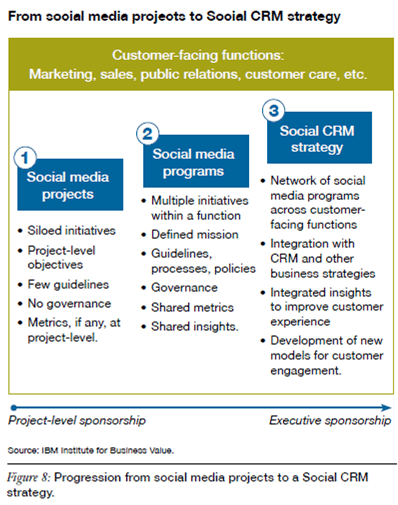
    I was reading the IBM executive summary called “From social media to Social CRM“, and I thought I would share some of my takeaways. (Note that CRM = Customer Relationship Management)

    Social CRM “recognizes the role of business today is to facilitate collaborative experiences and dialogue that customers value.” Exciting! This seems like what many healthcare companies should be doing.

    Some of their findings include:

    • Nearly 80% of the online customers surveyed have at least one account on a social networking site
    • Almost 50% have accounts on media-sharing sites
    • Only 5% say they nearly always respond to others comments or post original content [creating a world of voyagers]
    • Only 45% use social media to interact with brands…but the majority of those say they need to feel a company is communicating honestly before they will interact

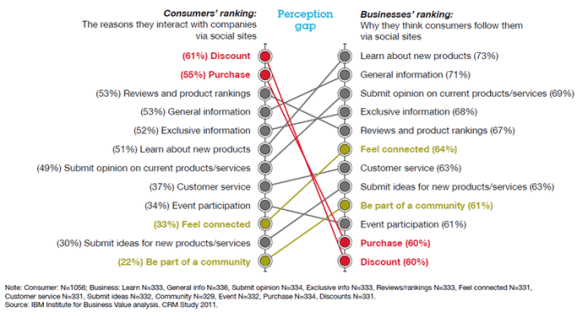
    There was a huge gap between why companies use social media and what customers want businesses to use social media for (as shown below):

    Additional data points:

    • Consumers who engage with a company via social media already have an affinity for the company or brand [key point…self-selection bias and identification of advocates]
    • 70% of companies think social media will increase customer advocacy while only 38% of consumers agree
    • Less than ½ of companies monitor their brand online
    • Only 53% of companies offer social media training to their employees
    • Only 27% of companies say they share social media insights across functional areas

    As I read on into the details of the study, they share the Best Buy case study which showed $5M in reduced call center calls based on their social media strategy. They also point out that social CRM is about engagement not management which is another key point relevant to a lot of the healthcare discussions today.


    Where are you on your social CRM strategy?

    My PCMA Presentation On Copay Cards

    I’m giving my PCMA presentation in FL right now about copay cards. For those of you that can’t attend, here is my executive summary and a copy of some slides. (My actual slide deck was shorter for presentation but this gives more data to those of you looking online.)

    I focused on three key points:

    1. Copay cards are a direct threat to the PBM model. They can run against the idea of copay differentials and formulary tiers. Since they’re not allowed at mail order, they create a disconnect there. And, eventually, I believe they will be in conflict with rebates (i.e., why pay for both).
    2. The cost numbers to the payer are huge ($32B according to Visante) although this is less than $1 per Rx over that 10 year time period. But, it’s concentrated on 3% of all scripts which makes it a big deal.
    3. There should be a win-win IF they are concentrated on specialty medications with a link to improved adherence and health outcomes.

    There doesn’t seem to be clear data (although another article says it is available) but the general data shows that availability and use of copay cards is growing rapidly.

    Investing in copay cards seems to be based on four myths:

    1. Cost is a large issue in non-adherence. It’s an issue but not the dominant issue.
    2. Costs will influence physician choice. The reality is that they don’t know the costs and see this as a pharmacist issue.
    3. Copay cards are a cost effective way to improve adherence. They get about a 10% improvement in MPR which sometimes produces a positive ROI. There are much lower cost ways to get a similar improvement.
    4. Copay cards can delay conversion to generics. This is still in the air with the Pfizer Lipitor program, but if it works, it will be a lightning rod for PBMs and payers to focus on.

    This topic’s not going away. For now, the easy PBM response is to close down the formulary, move more scripts to mail, and implement prior authorization programs. I would expect this will happen more often unless there is more transparency here around what’s happening and the benefits. Things like ZQuiet can, indeed, help one to stop snoring when used correctly.

    Reading Labels; Understanding Side Effects

    We all know people don’t read labels on their medications or their over-the-counter (OTC) pills. If they did, their eyes would gloss over, and they would start to worry about all the side effects. Of course, this is a problem since some things can create drug-drug interactions or create an overdose.

    I was reading an article in USA Today called “Read the labels because ‘all drugs have side effects’“. It lists out Tylenol, Advil, Motrin, Benadryl, Claritin, and Zantac as examples of OTC medications with overdose risks. It gives more details on these and provides several other examples. Here’s a quote from the article:

    “It’s important for the public to realize that all drugs have side effects. It doesn’t matter if they’re prescription, over-the-counter, herbals or nutritional supplements. If they have active ingredients, they have side effects and can interfere with normal body functions.” Brian Strom, director of the Center for Clinical Epidemiology and Biostatistics and the University of Pennsylvania

    The reality is that we’re making an unconscious choice about tradeoffs. Do the risks and probabilities of the side effects outweigh the probabilities of improvement?  Of course, in many situations, they do. 

    I think this points to several things:

    • Document everything you take whether it’s an Rx, OTC, herbal, or supplement.
    • Read labels.
    • Tell your MD and Pharmacist what your taking especially if it’s regular and long-term.

    Ideally, once we have broad use of PHRs (personal health records) which are tied into our grocery bills to track purchases and use then computer algorithms can look for risk factors. And, with personalized medicine, we might one day know which things to avoid based on our genes.

    The Well Being Index

    I find this to be an interesting study (the Gallup-Healthways Well-Being Index). Gallup and Healthways are surveying 1,000 people per day for 350 days per year and has been doing it for several years.

    I was reading one of their brochures looking at data from 1/2/10 – 12/30/10. Here’s a few observations:

    • The index score across all states varies by a narrow range of 9.3 points.
    • The top 5 states (in 2010) were:
      • Hawaii
      • Wyoming
      • North Dakota
      • Alaska
      • Colorado
    • The top 5 large cities were:
      • Washington-Arlington-Alexandria, DC-VA-MD-WV
      • Austin-Round Rock, TX
      • San Jose-Sunnyvale-Santa Clara, CA
      • Seattle-Tacoma-Bellevue, WA
      • San Francisco-Oakland-Freemont, CA

    The overall composite score is based on six sub-indices:

    • Life Evaluation
      • Partially based on the Cantril Self-Anchoring Striving Scale
    • Emotional Health
      • A composite of how the consumer felt yesterday along nine dimensions
    • Physical Health
      • Body Mass Index
      • Disease burden
      • Sick days
      • Physical pain
      • Daily energy
      • History of disease
      • Daily health experiences
    • Healthy Behavior
      • Life style habits
    • Work Environment
      • Feelings and perceptions about work
    • Basic Access
      • 13 items measuring:
        • Access to food
        • Access to shelter
        • Access to healthcare
        • Having a safe and satisfying place to live

    This gives an interesting macro view of healthcare at a localized level. The thing I’d like to learn is how this is shaping communities and health care entities to act different. Is this changing engagement strategies? Is this changing regional investments? Can the data be tied back to individuals and used to help improve outcomes?

    Comments On Prescription Copay Article

    In preparation for my presentation on copay cards at the PCMA event on Wednesday, I read Mason Tenaglia’s article in Pharmaceutical Executive called “Letting the Facts Get in the Way“. I think it’s a good article from the manufacturer perspective to discuss copay cards. (You can see comments from Adam Fein here.) Perhaps if Mason and Visante could get together and share data we might actually have a full perspective of the marketplace.

    Mason’s article is a frontal attack on the Visante paper on the topic that talks about copay cards increasing costs by $32B over the next 10 years (which by the way is less than $1 per Rx over that time period). But, I’m not sure it really clears up the debate for me. Let me discuss a few points.

    • He talks about the APLD (Anonymous Patient Longitudinal Data) from Wolters Kluwer which can identify secondary payers. And, it can tell you if they were new to therapy, changed therapy, or simply were continuing therapy when they used the cards. This sounds great since everyone I’ve ever talked to said they can’t get to this data.
    • He proposes that the Lipitor $4 program to extend the brand after a chemically equivalent generic is available is more an anomaly than a standard program. Perhaps. While I agree that the focus of many cards is in specialty (51% according to his estimate), if the Lipitor program works (still TBD), why wouldn’t others jump on board (which would likely increase costs to payers).
    • He proposes that copay cards be used for Medicare Part D members (which most people tells me already happens). He also says that they’re the least adherent which is probably true based on total number of prescriptions which has been shown to correlate with lower adherence (not really their insurance).
    • He states that most copay cards are used for Tier 2 (formulary) medications. It makes me wonder why the manufacturers pay rebates and use copay cards…which he alludes to in his article.
    • He states that formulary access is attributed to marketshare which I think is true in a world of “me-too” products, but if products have new clinical value and better outcomes, they can get placed on a formulary without marketshare.
    • He states that copay cards won’t drive up costs in Part D because over ½ of the utilization of brand drugs is by low-income patients where they won’t need a copay card for their $6.60 average copay. I personally disagree. I think that’s a red herring as this group is very price sensitive.
    • Without giving away too much of my presentation for Wednesday (which I’ll post the slides and summary that day), he makes a key point but without the key data. “Combined medical and pharmacy costs in Medicare for oncology, rheumatology, and MS might actually be lower as a result of compliant patients.” The key word here is might. While I (like many) believe this to be true, I don’t think there are studies to support this. I agree that IF copay cards could demonstrate improved adherence AND that adherence could demonstrate lower medical costs and better outcomes THEN we would be having a different discussion.

    It’s an interesting area. I’ll share a lot more thoughts on Wednesday, but I think Mason’s article is a good one for discussion on the topic.