Archive | Healthcare RSS feed for this section

Medco 2009 Drug Trend Report

Here are my highlights from Medco Health’s 2009 Drug Trend Report:

  • Overall trend was 3.3%.  (1.3% excluding specialty drugs.)
  • Specialty trend was 15.8%.
  • Their generic fill rate was 64.1%.
  • Interestingly, they broke out trend to show that clients with over 40% mail use had a trend of -0.7% while those with less than 40% had a trend of 5.8%.
  • I do like the generic distribution chart below although it is for 2008 Q4 while their 64.1% number is for the average of 2008.

Medco GFR Distribution

  • They point out that utilization growth was negative 1.1% last year which was the first time in a decade.  What I was surprised at is that they didn’t “blame” the economy for this.  Most surveys I have seen say or imply that people are taking less medications because of the increasing cost burden while their overall wealth is decreasing.
  • Medicare costs increased 6.8% for their PDP (prescription drug plans).

Medco Medicare Spending 2009 Rpt

  • I think it’s interesting in helping companies focus their management efforts when they project that “in the next 3 years more than 85% of drug trend will be driven by drugs in six categories: cardiovascular, endocrine/
    diabetes, central nervous system, musculoskeletal/rheumatology, respiratory, and oncology”.
  • In a brief section about the unwired state of healthcare, they share some scary statistics:
    • A review involving the medical records of 41 million Medicare patients identified $8.8 billion in error-associated costs and 238,837 preventable deaths. Moreover, a large subset of these errors are medication errors.
    • An estimated 1.5 million preventable serious medication errors occur each year, with $217 billion (2006 dollars) in associated costs.
  • Since people are always asking for quantifiable value around adherence, I liked the chart below which showed the survival rates over years based on adherence vs. non-adherence.

Medco Statin Survival Rates by Adherence

  • They introduce a new metric – Generic Opportunity Score (GOS).  It takes into account both chemical and therapeutic opportunities for generics to be used.
  • They also provide some details on a brand-to-generic $0 copay waiver program which had a 14% success rate.  That’s pretty good from what I have seen.
  • Here is a breakout of the specialty pharmacy categories:

Medco Specialty 2009

  • Now, where they do credit the economy is with improving generic fill rate, mail order utilization, and client’s use of trend management programs.
  • They show trend by age group with the lower age groups growing faster.  They also showed a nice graph of utilization by state.

Medco Geo Distribution 2009

  • Below is their chart on where trend growth in the future is projected to occur (which should tell you where to focus preventative action).

Medco Top Therapy Classes Trend 2009

A Few Medco Updates

First, Medco published their Drug Trend Report for 2009 a few days ago.  I am just starting to read it and will post my comments in the next few days.  [BTW – I am the #1 Google hit if you query “drug trend report”.]

Second, they recently posted a video of Mark Spitz talking about Medco’s website and savings money on prescriptions.

Then, they also presented a few new studies at ISPOR this past week which showed:

  • Asthma patients taking a statin were less likely to have a asthma related hospital or ER visit.
  • Patients with MS (multiple sclerosis) were more adherent when using specialty.

I think I’m going to try to learn more about the MS study.  Did it vary by age, gender, plan design, pharmacy type, stage of disease, etc.

Do Consumers Understand Cost of Individual Insurance?

In a study done by Kelton Research on behalf of eHealthinsurance.com, I found a few interesting data points:

  • 65% of people don’t think they could afford health insurance for more than 6 months if they lost their job.  (Since most Americans live paycheck-to-paycheck, that shouldn’t be surprising.)
  • Only 26% knew that individual health insurance is cheaper than COBRA although COBRA can be a lot less expensive with the Obama subsidiary.
  • 31% think that they would be denied coverage by another plan versus the actual denial rate which is closer to 11%.
  • To stay covered, only about 50% would be willing to spend less on cell phones or cable TV.
  • Only 40% would be willing to pay more than $200/ month.

CareScientific: MythBusters

A few former co-workers and friends of mine (Brenda Motheral and Steve Melnick) have formed a new company called CareScientific.  This is a follow-up to Brenda’s paper a few months ago on Disease Management.  You can now go to their site and see more about what they are doing:

  • Custom program evaluation
  • Provide a proprietary algorithm for selecting cost-effective patients for intervention

They also offer a Disease Management (DM) plausability and VBID plausability calculator to help you assess whether the saving you need are rational expectations.

I had a chance to see them officially launch this a few months ago at a conference.  Here were a few of my notes and some of their slides from the event:

  • To reduce healthcare costs, you can look at pricing, disease management, and utilization management.  If you’re looking at DM, you need to focus on outcomes from both a quality and an ROI perspective.
  • The early models for DM were much more multi-disciplinary.
  • In a recent care coordination project, only 1 in 15 people showed a reduction in hospitalization…none showed an ROI.
  • Hewitt says that less than 40% of plan sponsors are satisfied with DM.
  • In 20 CMS studies, not one has shown an improvement in Rx adherence.
  • Most DM savings are simply regression to the mean.
  • Key things to focus on:
    • Behaviors that save money
    • Improving collaboration – where it matters
    • Rigorous evaluation
    • Determine savings plausability
  • There are 3 concentric circles of focus.  At the middle is cost savings then cost-effective and then clinically appropriate.  Most programs are clinically appropriate, but only 20% show cost savings.

Dependent Eligibility Audits – a final frontier?

A colleague recently forwarded a local article on employers and plan sponsors seeking alternative avenues for cost savings – tackling dependent eligibility audits to generate plan savings.

And the trend is catching on as benefits consultant groups like Mercer, Watson Wyatt, Hewitt can attest and as Mercer recently shared that it anticipates a doubling in its private sector dependent audit business since 2008. Similarly, if one were to look at the number of state and municipal government groups looking to audit their employees this year over last, it has at least doubled.

So why are dependent audits largely considered the final frontier and why are more employers just doing audits now? Well, as all of us who read the various health care blogs and are in the business know, cost-shifting is approaching its limits– employers have only so much latitude remaining with their employees relative to increased member responsibilities with deductibles and co-insurance without cutting benefits (even though many are forced to cut regardless in this economy).

Furthermore, creative cost-saving plan design options are pretty much exhausted (though we’re seeing some innovations in pockets). So what’s left if the employer is still to offer employees the more traditional health care coverage? Some estimate that anywhere from 3 – 20% of dependents are ineligible for health coverage (most say 3-8%). Employers are taking on these audits as a means to identify dependents who clearly should not be enrolled – divorced spouses, deceased spouses (yes, they are still enrolled), older children, boyfriends – you get the idea. At anywhere from $4,700 to $12,000 total average premium PMPY (excluding any medical costs on top of premiums) there are meaningful dollars to be saved that can be the difference between continuing, trimming or altogether dropping employer-sponsored health benefits. Whether you be large or small employer group, the cost savings can be significant – well north of $1mm for many groups. So the ROI is clear and delineating who is eligible, or not, should be a relatively straightforward proposition, right?

Well, not so fast. Getting employees to comply with audits as well as send in all the necessary documentation (e.g. marriage certificates, adoption paperwork, etc.) can be tedious and cumbersome for the employer. But despite the pain of an audit for both employee and employer, there is sufficient ‘green’ in those ineligibles that employers, small and large, are launching eligibility audits.

Once an employer is determined that an audit is necessary what are the keys to a successful audit? Fundamental program design and seamless execution are critical because as a few as one irate employee can brew a firestorm in employee relations. Here are the fundamentals…

  1. Education and communication
  2. Data analytics to find higher-risk employees
  3. Access to Information and resources during the audit
  4. Ease of document submission
  5. Verification and results

So where to begin? Granted each employee population is different so flexible communication and engagement tactics should reflect this, but the evidence behind dependent eligibility audits is clear so you need to think now on how to execute and execute quickly before open enrollment season is upon us. Here at Silverlink, we are offer comprehensive communication solutions that include multi-channel outreach, inbound solutions, web tools, data management, analytics and comprehensive program management so clients can optimize their outreach goals and realize substantial cost savings so that there are no surprises during open enrollment.

Lastly, in some ways the spike in dependent eligibility audits seems too little too late for plan sponsors and it is bewildering why this is only coming onto the radar now with some gusto when eligibility verification should be a fundamental part of enrollment, shouldn’t it?

This posting was written by Cassandra Price, Payor Operations Subject Matter Expert for Silverlink Communications. Cassie has held leadership positions in managed care organizations and healthcare IT solution providers in strategic product management and client services including UnitedHealth Group, McKesson Health Solutions and Concentra, Inc.. Her healthcare background also includes private equity/M&A, care management software solution design, CRM design and implementation and managed care analytics and outcomes research.

Cassie’s work at Silverlink Communications focuses on designing multi-channel communication solutions for managed care organizations and self-insured employers where driving operational efficiencies and cost-savings are critical. Solutions areas include coordination of benefits programs, enrollment & eligibility campaigns, broker communication programs, member and provider call center call obviation solutions, and various other member, provider and employer communication programs. Cassie has her MBA in finance from Babson and an A.B. in History from Hamilton College.


Why Does WSJ Villanize CVS Caremark?

I was so annoyed when I read the WSJ this morning about CVS Caremark charging more for members that go outside the CVS store or mail order.  Come on guys.  This is a basic tiered network design.  It’s not unlike tiered formularies or preferred drug lists.

First, it’s a plan design that was created and offered to clients.  Some clients choose it.  That’s not CVS Caremark’s issue.  Anyone could do this and offer it.

Second, what’s different between this an mandatory mail or retail buy-up.  If you choose a higher cost location, you have to pay more.  You’re getting the same drug at a higher cost facility.

What frustrates me the most here is that we will never reform healthcare and drive out costs if people want to have their cake and eat it too.  You think you can have total flexibility and manage costs.  We have to make some hard decisions and push people to drugs, locations, treatments, etc. that offer similar quality at a lower cost.  That’s not going to be easy.

cake

Walgreens 2009 Trend Report

I must admit that I have been reading these reports by Walgreens for less time than those by Express Scripts, Medco, and CVS Caremark so there were a few more questions that jumped out in my mind here. From the beginning, one thing that I noticed was that Michael Nameth signed the introductory letter. I only pull that out to wonder how that compared to Express Scripts and CVS Caremark (which are the other two 2009 reports currently available).

  • The Express Scripts report was signed by George Paz (CEO).
  • The CVS Caremark report doesn’t have an opening letter.

Their trend numbers were:

  • 5.6% including specialty
  • 4.1% without specialty

They rolled out a new 90-day program called Walgreens90 which matches the Maintenance Choice program from CVS Caremark.

  • Member pay the same at mail or Walgreens store for 90-day Rx.
  • Same cost to the payor at either channel.

A semantical issue for me was that they call their program “step care therapy” versus the rest of the industry that calls it “step therapy”. Are they implying a level of care in the intervention that is different from others?

In the opening section, they talk about some general data which I found interesting:

  • 1 in 7 Americans went without a prescription in 2007 because of cost related concerns
  • 1 in 10 working age adults with private insurance also went without a prescription

    (Both stats from study by the Center for Studying Health System Change)

Their PMPY costs were $912 including specialty. $812 excluding specialty.

78.1% of their members take a prescription medication.

Their population had 13.6 Rxs PMPY.

Members aged 60 years and older used 2.6x as many Rxs as the younger members.

I was surprised that they claim that a 1% increase in generic fill rate produces a 2% savings for their clients. This is double what CVS Caremark claims. I always thought it was between 0.75% and 1.5%. Is their pricing different or is there something else that generates this increased savings per percentage?

The average annual member cost was $178.40 (PMPY).

They say the average ingredient cost was $146 for a brand and $26 for a generic. The brand price seems really high to me.

Their generic fill rate was 65.6%.

Members paid 16.6% of brand drug costs and 29.8% of generic drug costs (or 19.6% overall).

They say that 37.4% of all their prescriptions were filled as 90-day Rxs (retail or mail), but they lost me when they broke it down.

What surprised me (and maybe it shouldn’t) is that 7.4% of their clients drug spend is on 3 drugs that have easy savings programs associated with them:

  • Lipitor – split the drug or target it for therapeutic substitution with generic Zocor (simvastatin)
  • Prevacid and Nexium – step therapy for generic Prilosec (omeprazole) or move people to Prilosec OTC

Specialty drugs accounted for 0.5% of total Rxs but 10.9% of total spend.

The average specialty drug was $2,032. [for a 30-day supply I assume]

They provide a few case studies, but they point you to www.walgreenshealth.com/casestudies for more information.

One thing that jumped out for me in one of the case studies was their mention of different copays based on whether a member went to an in-network pharmacy. I wonder if (as a retailer) they have a smaller network or actually used a tiered network design. Most plans (that I’m familiar with) seem to have all (or the majority) of retail pharmacies in the network.

In their end section on the landscape, they mention new combination drugs. I would be very interested in their opinion on these…should they be covered? Are they a waste of money?

Finally, at the end, I looked at the methodology. A few things caught my eye:

  • They excluded managed care clients. Why? Wouldn’t they be the most aggressive?
  • They excluded Medicare Part D clients. (which is consistent with Express Scripts and CVS Caremark)
  • They excluded clients with a custom formulary. Again, why?

They use a discounted AWP to calculate total cost, but they don’t tell what the discounted rate is.

Express Scripts 2009 Drug Trend Report

I always enjoyed being part of the team that put the Drug Trend Report out when I was at Express Scripts from 2001-2006. With that in mind, I do await anxiously to see what new information they will share each year. I will say that the core fundamentals (as always) were very strong in the 2009 report, but I missed not having any client case studies in the document.

They reported drug trend of 1.5% (without specialty) and 3% with specialty.

Specialty drug trend was 15.4%.

Patients paid an average of $12.82 per Rx.

They say that more patients converted to Home Delivery (aka mail order). [I have to check this. My recollection is that mail volume was relatively flat and this would be hard to achieve unless they had more people filling less drugs on average at mail.]

They reported PMPY utilization of 14.32 Rxs.

Their members paid 29% of the generic drug costs; 19.6% of the brand costs; and 22.3% overall for traditional drugs. For specialty drugs, they paid 2.3% (or 20.2% for all drugs including specialty).

They have a section on compliance (which is rapidly becoming a key discussion point in the PBM world). I was a little surprised they didn’t call it adherence which is more common these days. But, they revealed some surprisingly high MPR (medication possession ratio) numbers for antidiabetics, antihypertensives, and lipid-lowering drugs. Considering adherence is where a member has an MPR of greater than 80%, they showed 77%, 83%, and 83% respectively. Since we know that 50% of people (on average) drop therapy within 12-months, this seems improbable on a book-of-business basis. (Maybe I’m just becoming a cynic in my old age.) The only reason I could find to explain this example was that this was not based on new starts (i.e., NRxs) unless they came in the first quarter. Therefore, there might be some selection bias in that they are taking MPR on people that started the year on the medication and may therefore have been people who were more likely to be adherent. I would rather see this done on a rolling 12-month basis.

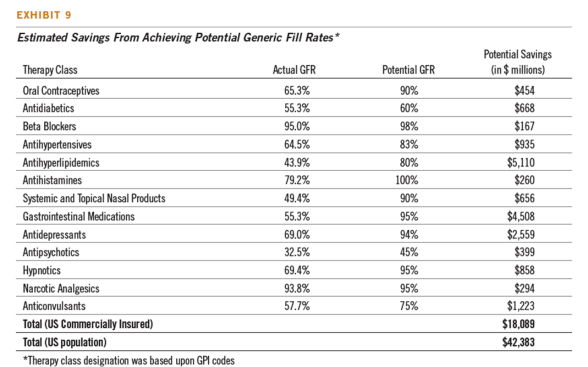
As I often use, they define waste in the system and give you a potential GFR (generic fill rate) goal for the top therapy classes.

ESI Estimated Savings GFR 2009

Their analysis shows that 55% of the costs for specialty drugs were billed through the medical benefit rather than the pharmacy benefit.

55% of their members are in plans with at least one step therapy module.

They talk about a few studies they have published showing that targeted and framed messages are more effective than general messages. And, that those messages are more effective with mail order users than people at retail.

Again, there might be some selection bias here as people at Home Delivery may simply be more active in managing their healthcare. The other question I have had for a few of my friends there has been whether we are comparing apples-to-apples. Since I ran a few of the programs before I left, I know we did a lot more interventions (web, inbound IVR, outbound calls, messaging on the invoice, letters, POS rejects) than we did for retail (letters and outbound IVR). If they’ve adjusted for that, than this is clear. If not, I would want to see that adjustment made.

As anyone who reads the blog knows, I am a big supporter of the theory behind their Consumerology story. I think Larry Zarin and Bob Nease have done a great job putting together their advisory board, creating case studies, and using behavioral economics. I always talk with our clients about these theories, and our analytics team is constantly helping clients define test plans that use these.

  • Social comparison
  • Hyperbolic discounting
  • Loss aversion

In comparing adherence at retail and mail, one thing that came into my mind was whether a driver of better adherence was a longer time window to refill. Typically, you have a refill-too-soon (RTS) edit in place until 2/3rds of the medication has been used (based on days supply dispensed from dispense date). At retail, that means you have about 10 days. At mail, that means you have about 30 days (less the 7 days for shipping). Does that make a difference?

I was also surprised under the methodology section that they now include rebates in calculating costs. It’s a quick one-line comment but how did that effect trend or other metrics here…and if so, how significantly?

As always, I love the therapy class reviews in the back that give you great numbers like:

  • Cost PMPY
  • # Rxs PMPY
  • Prevalence of Use
  • Average Cost / Rx
  • # Rxs / User / Year

Have a Swine Flu Party?

dancing-pig

I must admit that it never even crossed my mind, and I don’t plan on running out to get infected.  But, I find the debate and discussion very interesting.

In case you have missed it, the NYTimes had an article today about this.  The key concept in question is whether getting the disease today with a potentially milder strain will prevent you from a more dangerous strain which could come later.

“I think it’s totally nuts,” Dr. Moscona said. “I can’t believe people are really thinking of doing it. I understand the thinking, but I just fear we don’t know enough about how this virus would react in every individual. This is like the Middle Ages, when people deliberately infected themselves with smallpox. It’s vigilante vaccination — you know, taking immunity into your own hands.”

The Personalization of Health Care

With genomics and other tools, it seems possible that we could one day see completely personalized health care.  Of course, the immediate reaction will be won’t this mess up risk pools.  [I am sure there is someone smarter than me that will figure out how to make that piece work.]

What I see is the following:

  • Understanding personality types would allow patients to be matched to providers.
  • Genetic testing would allow for better predictive models on what individuals with need in terms of coverage.
  • Genetic testing will allow for the creation of personalized medicine.
  • Better predictive models will allow for better care plans and preventative medicine.
  • More transparency will allow people to make better decisions (e.g., calories displayed at restaurants).
  • Ubiquitous technology will integrate health decision making into everyday processes and tools.
  • Technology will allow companies to develop personalized, targeted communications that are based on patient preferences, historical responses, personality type, and experience to drive healthy behaviors.

Could we eventually get to the point where each of us had an adaptive plan that covered different things as we grew older and constantly optimized our care team or medical neighborhood based on our needs?

Of course, the risk comes when the models are wrong, but if you applied some of the chaos theory logic to a traditional modeling strategy and the current underwriting programs, who knows?

Not something for the next few years, but something I was noodling on the other day.

CVS Caremark TrendsRx Report 2009

This is one of my favorite times of year. After working on the Drug Trend Report at Express Scripts for several years, I love to get all the trend reports from the PBMs and read them. The first one that I have had a chance to review is the one from CVS Caremark. I found it an easy to read document with good case studies and a mix of strategy and tactics.

Here are some of my highlights and observations:

  • 3 out of 4 clients cited “reducing health care costs” as their primary measure of PBM success…AND 2 out of 3 prioritized “plan participant behavior change” as the way to reach that goal. [Maybe the plan design bigot is finally dead.]
  • With pharmacy spend approaching $1,000 PMPY, I found their chart on potential cost reduction a simple way of pointing people to things they should think about.
    cvs_caremark_savings-opportunities-09
  • A 10% improvement in diabetes adherence can save $2,000 in annual health care costs. [I assume this is based on improving MPR and would definitely like to learn more on how the health care costs are quantified.]
  • They layout three objectives – improve use of lower cost drugs, improve adherence, and get people to take better care of their health. [Similar to the concept I laid out in my white paper of needing to be broader than just Rx benefit management.]
  • They talk about two of their solutions:
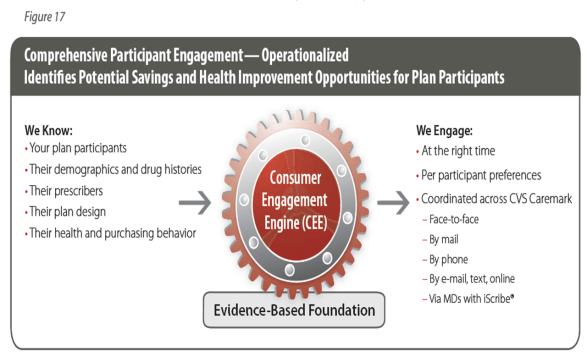
    • Consumer Engagement Engine (CEE) which is very similar to what Silverlink does and provides business logic for targeting the right member at the right time with the right message.

      consumer-engagement-engine

    • Proactive Pharmacy Care is their “medical neighborhood” concept to stitch together their entities – Mail Order, CVS retail, Specialty, MinuteClinic, and their disease management company.
  • Their trend was 3.9% PMPM in 2008 (or 2.8% excluding specialty drugs).
  • Medicare Part D utilization was up 4.1% compared to 0.8% for the rest of their BOB (book of business).
  • Their GDR (generic dispensing rate) averaged 65.1% for 2008 and was 66.3% in December 2008.
    • Best in class employers = 68.2%
    • Best in class health plans = 73.4%
  • As they remind you, a 1% increase in GDR is roughly equal to a 1% reduction in pharmacy spend.
    • [What I would like to see is improvements in GDR from new drugs coming to market in 2008 versus improvements that came from clients implementing plan design.]
  • They say [which I preach all the time} – “proactive consumer engagement improves results and lowers the risk of disruption. For best results, provide personalized actionable information at a range of touchpoints.”
  • I saw a few interesting things in one of the case studies they share about their “Generous Generics” program. [Does that name get used with consumers? What’s their reaction to it?]
    • $0 generic copay at mail [that should drive volume]
    • 10% coinsurance penalty for not shifting to mail after the second fill [similar in concept (I believe) to the Medco “retail buy-up” concept]
  • Top Ten Therapeutic categories (53% of spend):
    • Antihyperlipidemics
    • Ulcer drugs
    • Antidiabetics
    • Antidepressants
    • Antiasthmatics
    • Antihypertensives
    • Analgesics, Anti-inflamatory
    • Anticonvulsants
    • Analgesics, Opioid
    • Endocrine and Metabolic Agents
  • They state that the population of diagnosed diabetics is growing by roughly 1M a year.
  • They state that a generic for Lipitor is now expected in Q4 2011 [which I think is about a year later than originally expected]
  • They show some data from their Maintenance Choice program which I think has a lot of opportunity.
    • This is where you can get a 90-day Rx from either mail or a CVS store for the same copay. [The key here is for them to understand member profitability and for CVS Caremark to understand how to drive consumers to the preferred channel.]
    • [I would really need to understand their profitability by channel because if I read the chart in here right, it would appear that given the choice 45% of those at mail would choose 90-day at retail…a scary concept for mail order pharmacy.]
      maintenance-choice
  • They give a case on Maintenance Choice which leaves me looking for a key fact. They state that a recent implementation has a goal of 70% of the client’s day’s supply will go through the preferred network (CVS) or mail and that 20% of it goes through mail today. [What percentage goes through CVS today? If it’s a client in Boston, that one scenario. If it’s a client in Chicago, that would be another feat.]
  • Specialty pharmacy trend was 13.5%.
  • They say that pharmacogenomic testing is being used more frequently for specialty drugs. [I would love to know more…how often? For what drugs? Has it improved outcomes? Are their clients covering it? How are they playing in this space?]
  • They talk about adherence which continues to be one of the hottest areas in the Rx arena today. They give stats showing 15-48% improvement across different metrics and up to $142 in cost avoidance in one case. [Are these again control groups? What was the cost / benefit analysis or ROI? Is this improvement in average MPR (Medication Possession Ratio) or improvement in the % of people with an MPR of >80%?]
  • They talk about 88% of heart failure patients maintaining optimal prescription adherence compared to a norm of less than 50%. [My questions here (which isn’t apparent) is whether this was an opt-in program so the 88% is for engaged and active participants or whether it was across all targeted members.]
  • They provide a quick list of factors that will impact drug trend:
    • Driving costs:
      • Aging
      • Obesity
      • Diabetes
      • Specialty pipeline
      • More aggressive treatment guidelines and earlier diagnosis [which hopefully would lower total healthcare costs]
      • DTC advertising
    • Reducing costs:
      • Economy – reduced utilization and improved GDR
      • Increased availability of generics
      • FDA safety reform
      • Lackluster non-specialty drug pipeline
      • Utilization and formulary management
      • Consumer price transparency

Replacing the “Plan Design Bigot”

In my whitepaper, I talked about the fact that plan design as a tool for managing trend is “dying”. There isn’t room to shift more cost to the consumer. PBMs and plans have to actually activate consumers and get them to take preventative action and cost saving actions.

There are still plenty of people out there that I will call “plan design bigots”. They believe that the only way to drive behavior is to implement plan design – limit the formulary, change copays, put in utilization management programs, implement POS edits. Those things work…don’t get me wrong. But, if that was all there was to it, this would be easy. It isn’t.

You have to find ways to engage the consumer, get them to care, and get them to take action.

I would layout 3 challenges:

  1. Cutting through the “noise” or “communication clutter” that people have in their lives.
  2. Delivering personalized information (right message, right time, right channel).
  3. Getting them to act (AND sustaining that action over time).

Just look at adherence. Reducing copays to $0 improves adherence, but only about 5-10%.

Teachable Moments

In the world of communications, there is a lot of information out there.  And, it continues to grow.  Consumers are overwhelmed today…and that’s not going to stop.

I have been talking a lot lately with people on how to find the “teachable moments”.  If you are communicating with someone and want them to take action around their healthcare – continue to fill a medication, use the 24/7 nurse line, move to a generic drug, you have to catch them when they are willing to take action.

This is completely different from the parallel conversation around behavioral economics and how to figure out what information will motivate them to act.

Here, the question is when are they willing to be “taught” or “influenced”.  For example, if I tell you that Lipitor is not on formulary but you don’t take Lipitor, you probably don’t care.  Six months later when you get diagnosed with high cholesterol and your MD writes a prescription for Lipitor, you won’t remember.  

We have to identify when people are open to new information and time things to communicate with them at that point.  

Do you understand how your patients / members receive information?  Do you understand their lifecycle of interactions with you?  Do you understand how and when they take action?  I always like to use the “outside-in” framework for analyzing and problem solving things from the patient point-of-view.  

HINT: Stop thinking like a person who works in healthcare.  You will not solve this problem using yourself as an example of “normal”.

Communication Strategy Regarding H1N1 (Swine) Flu

“There is a lot of media, a lot of news, a lot of rumor – the sooner you can get correct and accurate information to consumers, the better – otherwise people will look to other sources that may not always be accurate.”  (Jan Berger, President of Health Intelligence Partners on podcast)

We have been hearing a few things from our clients and have put some information up on the Silverlink website.  Some of the comments have been:

  1. I have seen a spike in call center volume about this topic.
  2. Clients want to change plan design to make sure Relenza and Tamiflu are covered and don’t require a prior authorization or have a quantity level limit on them.
  3. We want to proactively reach out to at risk populations – children, seniors, or people with a compromised immune system.
  4. We want to be able to flexibly target certain geographies.
  5. We want to remind people not to panic, drive them to quality information sources, and make sure they know the basics – wash your hands.

At a minimum, everyone is adding information to their websites.  Many consumers are Googling the topic or following updates from @CDCEmergency (on Twitter).

Healthplans, PBMs, and population health companies are at the heart of this.  They need a coordinated strategy to inform people appropriately as this issue continues to be top of mind.

We recorded a podcast last night with the Medical Director from Healthwise and Jan Berger who is the former Chief Medical Officer from CVS Caremark and is now president of Health Intelligence Partners.  In here, they answer some general questions about the situation and what companies should be doing to educate members.

The two standard solutions Silverlink is offering clients are:

  1. Offer an inbound FAQ (Frequently Asked Questions) line with CDC content and specifics about their plans.  This can help with overflow from their call center and/or be used as a direct line from their website or outbound communications.
  2. Selectively target populations (age, zip code, disease state) with a brief message reminding them to wash their hands and telling them where to get qualified information.

As with all our communications offerings, these can be customized (messaging, channel, targeting, etc.) to meet client requirements.  Additionally, since one of our technology advantages over others in the space is our flexibility, we can work with clients to keep these messages up-to-date as the situation changes and as new information has to be added.

Swine Flu (H1N1) Continues To Top News

(picture from http://www.myfox8.com/lifestyle/health/la-sciw-swine-masks28-2009apr28,0,4461177.story)

It’s amazing how this has dominated traditional media and blown away the online media.

I few things that stick out for me:

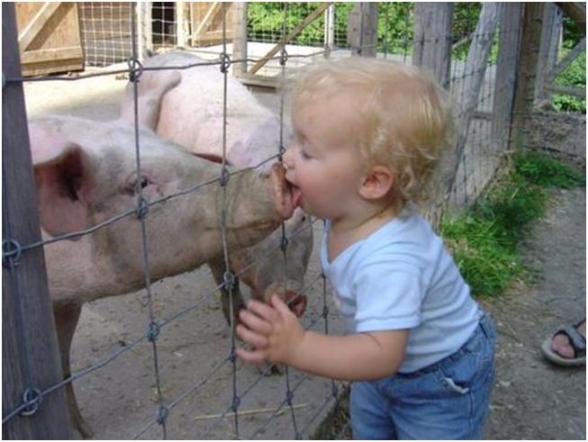
One of my favorite pictures that goes right to the health literacy issue is the following.

NOTE: This is not what H1N1 flu is about…hence the dropping of the “swine flu” term.

(picture from http://cuteoverload.com/)

Shoddy Reporting – “10 Things Your Pharmacist Won’t Tell You”

While I am usually a big Smart Money fan, I think this article is over the top. It’s sensationalist. It pulls random criminal examples and makes them sound normal. I’m not a pharmacist but I was offended for my friends that are.

Here are their points with my comments in brackets.

  1. I’m overworked and stressed out [Who isn’t these days? Maybe part of health reform should look at the right staffing levels for health professionals and put an hour maximum on them like airline pilots or truck drivers.]…note that there were 3.8B Rxs filled in 2007.
  2. …which means I’m more error-prone [more than what…I would bet technology has improved the error rate compared to the past. But, a 1% error rate would mean 38M errors per year. The question of course is errors that leave the pharmacy. The bigger issue is finding time for them to counsel patients where there would be a final safety check and discussion around the medication to minimize patient errors.]
  3. I don’t understand all my merchandise [Isn’t this what technology is for? With 10,000+ drugs today plus all the over-the-counter drugs, this is an impossible task. And, the article complains about their ability to catch OTC interactions…well that’s pretty hard when they aren’t tracked. A great opportunity for PHRs.]
  4. My drug-swapping could make you sick [While the article says it’s fine “most of the time”, it sounds like they are talking about NTI (narrow therapeutic index) drugs which aren’t switched by many pharmacists that I know. It’s a short list of drugs and probably less than 1% of the prescribed medications in the US. Talking about causing unnecessary worry…someone must have gotten their information from a brand pharma rep.]
  5. Frankly, your private records aren’t all that private [Come on. First they talk about drug companies sponsoring programs. So what…they don’t get patient data. The only way they know who uses their drug is when consumers sign up on their websites for coupons or to receive information. Then, the article goes on to talk about electronic records and electronic prescribing. That’s a very safe process with lots of protection. Don’t make people afraid of the future.
  6. I can be pretty sneaky sometimes [I am sure this is true in every profession, but they talk about some old issues like charging more than the copay or having a higher cash price than a NEGOTIATED price from your insurer. And, buying and selling samples…that would be illegal so I’m pretty sure that’s not a “common” practice.]
  7. Paying out-of-pocket? The price of your prescription just went up. [Yes. Nothing new here. It’s the same issue in medical costs. So, go somewhere else. I’m not saying it’s right to gouge someone, but costs vary and stores have a right to charge a different price.]
  8. The medication is stale [Here they quote a case from 1991. Nothing more recent than a criminal from the early 90s.]
  9. I don’t just sell drugs. I make them. [Here they talk about compounding which I think is a really small percentage of the time. I have never heard of a pharmacist compounding a drug that they could take off the shelf and give to a patient.]
  10. You can get any prescription you like online. [I don’t get their point here. If you have a prescription, you can use the Internet to order refills from your pharmacy (in many cases). There are lots of legitimate online stores for OTC products.]

New Terms – ShyPod, Tweetup

There is always new “slang” popping up, but it seems to happen more lately (or I’m just getting old). Here are a few things from an article in Delta Sky Magazine (April 09) and today’s USA Today.

  1. Blackberry Jam – delay caused by a person walking slowly, nose glued to PDA.
  2. Defaced – deleted from someone’s list of Facebook “friends”.
  3. Designated Texter – someone who receives and responds to the driver’s text messages to ensure passenger safety.
  4. Kthxbi (OK – Thanks – Bye) – Fast end to an online conversation that going nowhere.
  5. ShyPod – Someone who won’t share his or her iPod for fear of being exposed as a disco/country/Neil Diamon lover.
  6. Hashtag – users can disclose the topic of their tweet by prefixing a word with a hash symbol (#health).
  7. Tweet – a short update of 140 characters or more.
  8. Tweetup – when Twitter users meet face-to-face.
  9. Following – when you receive someone tweets, you are considered their follower.

Who’s Killing Independent Pharmacy?

This is a great question.

  1. Has it been the big mail order pharmacies?
  2. Has it been the PBM’s and their negotiating leverage?
  3. Was the final straw Medicare Part D and the loss of the cash patient?
  4. Is it other retail chains and their operating efficiencies?
  5. Was it just a natural evolution?
  6. Is it the fact that money isn’t made on the Rx anymore but on the candy bars and soda?
  7. Is it technology and the capital investments required?

Here is a quote from Jennifer Luddy, spokeswoman for Medco Health Solutions, (from AIS Drug Benefit News):

“The facts show that it is not mail-order [pharmacy], but rather chain pharmacies that are presenting a threat to independent pharmacies. According to national data from the pharmacy industry itself, for every independent pharmacy that closes, 25 chain and big-box retail pharmacies open.”

Healthcare Entities in the Fortune 500

I always find it interesting to see who the largest healthcare companies are in the annual Fortune 500 list. Here they are:

  • McKesson #15
  • Cardinal #18
  • CVS Caremark #19
  • UnitedHealth Group #21
  • AmerisourceBergen #26
  • Johnson & Johnson #29
  • Wellpoint #32
  • Walgreens #36
  • Medco Health Solutions #45
  • Pfizer #46
  • Aetna #77
  • Abbott Laboratories #80
  • Humana #85
  • HCA #88
  • Merck #103
  • Wyeth #110
  • Express Scripts #115
  • Bristol-Myers Squibb #120
  • Eli Lilly #122
  • Cigna #132
  • Schering-Plough #138
  • HealthNet #165
  • Amgen #168
  • Medtronic #196
  • Baxter International #219
  • Coventry Healthcare #226
  • Community Health Systems #243
  • Tenet Healthcare #283
  • Boston Scientific #320
  • Owens & Minor #339
  • Quest Diagnostics #341
  • Becton Dickinson #347
  • Stryker #375
  • Wellcare Health Plans #381
  • Henry Schein #389
  • Omnicare #392
  • Davita #433
  • Gilead Sciences #444
  • Mylan #462
  • Universal Health Services #467
  • Universal American #494

If you look at the lists of best investments or most bank for the buck, the company that appears the most is Express Scripts (ESRX).

7 Points in 7 Minutes

In looking at the Ix Therapy blog about the conference they just had with Health 2.0, I found this note which I found very interesting…

  • James Hereford made 7 fabulous points in 7 minutes about building Ix into the delivery system:
    • You have to deliver what patients want (doesn’t matter how cool the technology is).
    • It has to make sense for clinicians from a clinical perspective.
    • It has to make sense for from a clinical workflow perspective.
    • Focus processes on the value proposition for the patient (I may have mangled this one a bit).
    • Information needs to be common, ubiquitous, and well-designed.
    • Health care is all about trust; whatever we do needs to enhance trust in the patient-provider relationship.
    • Incentives are critical.

    Gov Leavitt On Gov’t Trojan Horse For Healthcare

    In a piece that was posted on the AmericaSpeakOn.org website this morning and which I heard Governor Leavitt talk through last night, he lays out some of the illusions that we have around government run healthcare and reminds us that Medicare isn’t a model to emulate (in case you didn’t know that).  A few of the quotes from the piece:

    • Advocates of government-run health care suffer under the illusion that Medicare operates more efficiently than the private sector.
    • The efficiency of a health-care system isn’t measured by the volume of checks it issues, but the value it generates.  Medicare’s uncoordinated, quality-indifferent, more-more-more structure is moving it rapidly toward bankruptcy, and taking our nation with it.
    • Since 1970, the cost of these flagship government-run health-care programs has risen more than two-and-a-half times as much as the cost of all other health care in the United States, the vast majority of which is run by the private sector.
    • Medicare’s budget is projected to double within ten years, topping $1 trillion annually.  The number of workers per beneficiary will soon drop from almost four to just over two and a half.
    • This is like treating chronic obesity with a perpetual regimen of double calories.
    • Inevitably, government-run systems cut costs by cutting access to services.

    There is another answer.  The government needs to promote value — to empower consumers to pursue the highest-quality care at the lowest-possible prices.  Strong government action is needed to organize an efficient market where consumers can choose insurance plans and medical practitioners who offer the best value.  What is not needed is to replace the private market with a government-run system in which only the truly rich have a choice.

    One Universal Mail Facility

    Given the market trends and the over-capacity of mail, could we ever see one facility that served everyone?  It would be an interesting play.  I think the evolution would be to allow all the existing mail facilities into the network (i.e., Express Scripts mail could serve Medco members and vice-versa).  That would force consolidation and really put everyone in a competition around cost-to-fill and customer service.

    Economically, it seems very logical to come down to a few high-volume facilities that filled all the automated scripts.

    I guess the other play would be that mail just became a central fill for retail and every Rx was picked up locally but the majority were filled centrally and shipped for pick-up.

    Neither are likely in the near future, but interesting models to debate.

    postman

    Pharma Rx Costs Tied To Outcomes

    Given our opinion that the PBM industry would be moving to more outcome based pricing, the articles today about Merck and Cigna‘s deal on pricing based on outcomes is very timely.  I “tweeted” about it early in the AM, but I have got the article sent to me by a lot of people.  So, here are a few of the things being said:

    WSJ Blog

    Now Merck and Cigna have announced what they’re calling a “performance-based contract” for Merck’s diabetes drug Januvia. But the deal is actually the reverse the pay-for-performance ideal: Merck will get paid less per pill, not more, if the drug works well.

    Under the deal, Cigna will get a discount on the drug if patients’ blood sugar falls. Cigna will get additional discounts if patients faithfully take the drug when they’re supposed to. (These two variables often go together — taking the drug faithfully helps keep blood sugar down.)

    Cigna PR

    “Merck should be recognized as the first major pharmaceutical company to offer increased discounts on its oral anti-diabetic products, supporting CIGNA’s efforts to reduce A1C levels for individuals with diabetes, regardless of what medication they may be taking,” said Eric Elliott, president of CIGNA Pharmacy Management. “Improving people’s health comes first for both CIGNA and Merck. We hope this agreement will become a model in the industry.”

    So…it seems like an aligned deal.  Merck and Cigna want adherence.  Employers want lower costs and better outcomes.

    Consumers Don’t Care About Wellness

    Here’s a good provacative quote from Forrester…are all the wellness efforts doomed or are incentives the minimum requirement to play?

    “Health plans keep saying that they have to improve consumer engagement and that one of the best ways to do this is by engaging them in wellness initiatives. The data tell me that consumers don’t care about wellness. Employers do. But while most employees may hear the [wellness] message, they also ignore it….”

    — Carl Doty, VP and research director at Forrester Research, told AIS’s INSIDE CONSUMER-DIRECTED CARE.

    Whitepaper: The Future of the PBM (Pharmacy)

    As we have been working with a lot of PBMs over the past year, the question has come up many times – “where do you see the industry going?” After bouncing some ideas off a few of you, we have pulled together a whitepaper with the Silverlink Communications perspective. Certainly, each area of the whitepaper could have been its own chapter, but rather than turn this into a thesis, we are publishing it.

    As I have said in a few recent articles including the one in HCPro, I think the Express Scripts acquisition of NextRx will likely accelerate a few of our predictions here.

    The executive summary of the whitepaper is below. The final whitepaper is available here.

    I would welcome any comments you have…

    Executive Summary

    In the next several years, we believe that three changes will drive the pharmacy marketplace and ultimately change the business model for PBMs. These changes will be accelerated by the current financial crisis which may drive further consolidation in the short-term. Consolidation which we believe will accelerate the “race to the bottom” where the traditional model of scale has been maxed out with parity achieved among the large PBMs.

    1. The need to better engage the consumer in understanding their benefits and ultimately responsibility for their care;
    2. The effort to automate and integrate data across a fragmented system and across siloed organizations; and
    3. The shift from trend management to being responsible for outcomes.

    Consumer Engagement
    The industry-wide movement to consumerism will continue to affect plan design, but it will also thrust PBMs and pharmacies into the critical path of member engagement. With pharmacy being the most used benefit as well as the volume and accessibility of retail pharmacies, they will play a critical role in driving adherence and helping consumers understand healthcare. This will renew the focus on cognitive skills, medication therapy management and ultimately drive the desire for a more traditional “corner store” approach that can be scaled using technology.

    Combining this with the macro-economic forces that are driving ubiquity of technology through mobile media and the evolution of the Internet from a pull media to a push media will also challenge the PBMs and pharmacies to innovate. They will be required to look outside of healthcare models to identify the right communications to drive behavior. PBM’s and pharmacies will have to leverage behavioral economics and personalization technology to get the right message to the right consumer at the right time through the right medium.
    Automation and Integration
    The consumer engagement challenges will only exasperate some ongoing challenges within the PBM and pharmacy community. This will include the lack of staff to provide more cognitive services and the general fragmentation of data across organizations and functional silos. Figuring out an overall “single view of the patient” which shows all the touch points and offers a coordinated multi-channel strategy for inbound and outbound communications will become a major focus.

    In addition, in order to make these solutions efficient, the development of predictive models, much like the clinical and underwriting solutions being used today, will become the norm across the industry. As these models are fine tuned and the promise of e-prescribing becomes more of a reality, the channel for engaging physicians in the member’s care will finally exist. PBMs and pharmacies will be able to use data to allow physicians to understand when patients aren’t being compliant and when there is an opportunity to drive change.

    From Trend Management to Outcomes
    The traditional business model for the PBMs has been based on large scale negotiations to drive rebates and efficiencies within mail service – cost to fill and acquisition costs. At the same time as those efficiencies reach a maximum discount, the traditional tools for managing trend will have run their course. Although plan design won’t “die”, comparative effectiveness may reduce (or eliminate) the need for formularies, and in general, the ability to shift cost to the consumer above the 25-30% level will be difficult.

    Both of these challenges will push the PBMs and pharmacies into a role where they are focused on driving health outcomes and being part of the bigger solution across the industry. They have a strong footprint to drive this change and as theranostics (or personalized medicine) evolves there will be an opportunity to find cost effective solutions to change the prescription landscape.

    Promotion vs. Nudging vs. Mandatory Mail

    Although there is always a dialogue about the lifecycle of mail order, I think some of the work out of the Consumerology group at Express Scripts is interesting.  The frameworks that they apply internally are very similar to the technology and approach that Silverlink uses with the rest of the market.  [Kudos to Sean Donnelly and Bob Nease for their work on this new approach.]

    The traditional ways of driving mail order have been:

    • Over a copay incentive (and hope)
    • Letter and calls encouraging member to convert
    • Providing a call center to facilitate the conversion to mail (from an inbound call or from a transfer on an automated outbound call)
    • Mandatory mail – requiring the member to use mail or pay the full cash price for the drug
    • Retail buy-up – allowing the member to keep getting the maintenance drug at retail (after 2 fills typically) but requiring them to pay a penalty for choosing a higher cost channel

    Now, “Select Home Delivery” uses the 401K approach of opt-out vs. opt-in to drive participation.  As behavioral economics would suggest, inertia will carry the momentum and by getting the member signed up in mail and moving them to mail will drive success versus requiring them to take an action. The idea here is to “nudge” the member versus force them or leave it up to them to take action.

    Select Home Delivery optimizes the use of cost-saving Home Delivery, requiring members to opt out of the program rather than the traditional approach of requiring members to opt in.  The program is based on the psychological principle of hyperbolic discounting, which says immediate events (for example, the hassles of signing up for Home Delivery) loom large compared to downstream benefits (such as a lower overall copayment and receiving a 90-day supply).  Dr. David Laibson, an economics professor at Harvard and member of the Center’s advisory board, conducted research showing that applying this principle to 401(k) programs dramatically improved participation rates.

    “Opt-out and active decision programs for 401(k) enrollment dramatically improved low employee participation rates. We wanted to explore whether these tools could also solve healthcare challenges,” Laibson said. “This is one of the first marketplace adaptations that successfully applies behavioral economics to improve healthcare.”  [quotes from Consumerology blog]

    I think the new results from their blog (below) are impressive.  [BTW – If you’re a member at Lowe’s or another client which has used this, I would love to hear your reactions.]

    select-home-delivery

    Express Scripts Outcomes Conference Begins

    As with each annual Outcomes conference, Express Scripts (ESRX) has released their annual trend numbers. Here are a few of the highlights from the press release:

    • Overall pharmacy trend = 3.0% (down from 5.5% in 2007)
    • Estimate consumers and employers are paying $42B too much in 13 therapy classes by not optimizing generics.
    • On average, a generic drug is over $90 cheaper than a brand name drug.
    • Generic drug usage increased by 7.5 percent, while utilization of brand name medications decreased 11 percent.
    • 67.3 percent of all prescriptions that Express Scripts filled were for generic drugs by the end of 2008. [I didn’t like the comparison which was an average across the 12 months ending in Sept 2008 from IMS of 63.7%…not apples to apples.]
    • In 2009, at least 20 branded drugs are expected to become available generically.
    • Over the next five years, more than $66 billion worth of branded drugs are expected to lose patent exclusivity.

    “Using generic drugs that are safe and effective can help lower costs while still driving value for patients and employers,” said Steven Miller, MD, senior vice president and chief medical officer at Express Scripts. “Our results indicate that cost control is achievable through careful management of appropriate use of drugs and delivery channels, without shifting costs to consumers. Although the trend is the lowest it has been in over a decade, significant opportunity to lower spending still exists.”

    “Finding ways to reduce spending without compromising health outcomes is the top priority for healthcare reform, as the Obama administration recognizes,” said Alan Garber, MD, PhD, Henry J. Kaiser Professor and director of the Center for Health Policy at Stanford University. “We have long used financial incentives to try to eliminate waste. Now we’re finding that tools that build upon the insights of behavioral economics and psychology can have powerful, positive effects.”

    “In today’s economy, we are not only tracking wasteful spending across the country but developing strategies to reduce it,” said George Paz, chief executive officer at Express Scripts. “By applying the principles of behavioral economics we are helping consumers make better and more cost-effective healthcare decisions. We understand we cannot eliminate waste alone and we are committed to working alongside likeminded organizations, such as the Federal Coordinating Council for Comparative Effectiveness Research, to continue to identify strategies to improve our healthcare system.”

    “Studies have repeatedly shown that people work much harder to avoid losses than to pursue gains,” said Bob Nease, PhD, the company’s chief scientist. “This suggests that a ‘stop wasting money’ message is more effective than a message focused on potential savings. In addition, by applying evidence-based segmentation, we have practical insight into which members are likely to be most sensitive to loss aversion. One size does not fit all.”