“Successful event-triggered marketing is a process of identification, categorization, monitoring, optimizing and executing. Marketers that do this right will see their marketing messages receive up to five times the response rate of nontargeted push messages.”
EDM, Gartner, and Event Driven Communications
Using Thermometers To Avoid Foot Ulcers
600,000 diabetics get foot ulcers each year and over 10% of those lead to amputation of toes, feet, and lower legs. A study discussed in USA Today showed that almost 2/3rds of those ulcers could be avoided by using a thermometer to identify whether an ulcer is developing. So simple…so much savings (pain and financially)
So, assuming there isn’t some analysis or clinical bias that I don’t know about, this seems like a low-hanging opportunity for managed care companies. What are you doing to reach out to your patients, get them a thermometer, collect their data, and remind them to use it on some regularity?
Coordinated Communications
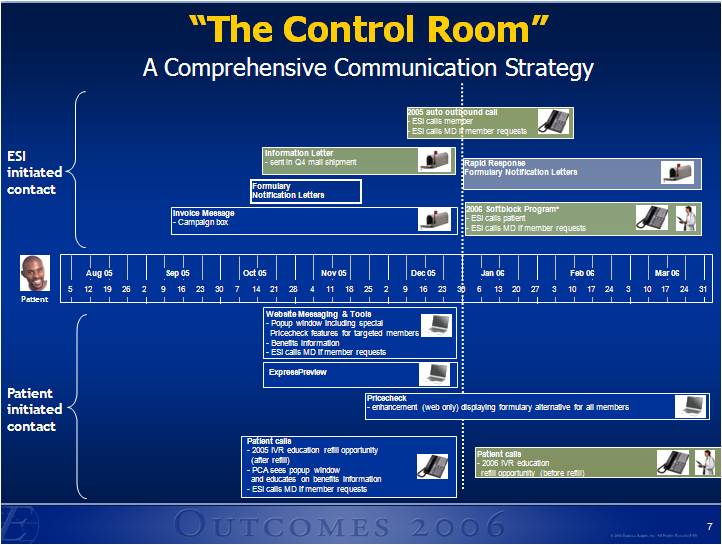
A few days ago, I talked about a press release from Express Scripts around formulary change programs to encourage patients to move to a different drug (same therapeutic category different chemical entity). I mentioned in there a single frame that I created to organize the program. Happily, I found it publicly so I can share it. Here it is. The key points here were – identifying the different constituents, determining the best mode of communication, coordinating across channels, and determining how to sequence communications based on events (aka triggers) which might be a date or a percentage of their prior prescription being used.
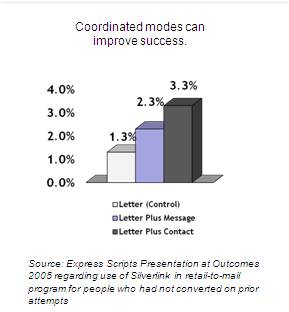
While I was searching, I also found the presentation we gave on how multi-modal coordinations using a letter and an automated call impacted success for my retail-to-mail program. The key to remember here is that we targeted people who had already received one or more letters and had not responded. The results were great.
The Wii – Learning Tool / Real Exercise
After posting on Sunday about “embodied cognition” which talks about learning better while being active, I found it interesting to play a Wii that my kids had borrowed that night. Initially, it simply made me think about what a great medium this could be to teach people especially people that learn through experience.
Then, I played the Wii boxing and actually broke a sweat. I hadn’t believed friends of mine that told me this was true [and I certainly wasn’t going crazy playing the game]. I do think it is a very interesting technology, but this isn’t an advertisement for the product. From a healthcare perspective, it seems like the technology could be exploited to get less active people to exercise and teach people.
Our beliefs about health are embodied in the way we live. We need to leverage different media to drive that message home to all generations.
How Some People Feel About HealthComm
Healthcare Communications (HealthComm) are never what we run home to receive, but they are often important. Unfortunately, it has lacked a focus historically. Most of the focus was on claims systems and underwriting and network size. Not that those areas work perfectly, but there is clearly a movement toward customer service, patient satisfaction, and communications (inbound/outbound, letter/call/e-mail/live agent).
Look at this blog entry on a very popular blog and some of the comments. It is a big uphill battle.
Learning Deficit In Healthcare Setting
Typically, when you are receiving care and instructions from a physician or other medical staffer, you are sitting down or laying down in a hospital bed. Given some of the research discussed in an article today in the Boston Sunday Globe, it makes me wonder if patients are immediately at a disadvantage. This article discusses research which correlates learning and the brain with physical movement. An area called “embodied cognition”.
“Work led by Susan Goldin-Meadow, a psychology professor at the University of Chicago, has found that children given arithmetic problems that normally would be too difficult for them are more likely to get the right answer if they’re told to gesture while thinking. And studies by Helga Noice, a psychologist at Elmhurst College, and her husband Tony Noice, an actor and director, found that actors have an easier time remembering lines their characters utter while gesturing, or simply moving.”
Obviously, there is lots of research about how people learn. At the simplest level, some people learn by reading, some by hearing, and others by experiencing. Plenty have studies have been done to say people who get information in multiple ways are the most likely to learn it. I don’t have it with me right now, but when I have done communication seminars for people before, we have talked a lot about why you want to teach and/or present using all three modes.
Tell them…Show them…Make them experience it.
This is why multi-modal coordination (e.g., letter followed by call or call giving you a website) has value and is more effective.
Is The Perception Of Health Skewed By Your Health?
I was reading a story in the WSJ (1/12-13/08) about “How the Rich Define Rich” and wondered if those that are healthy have a different perception of healthy. Is it an endless path or is there an end goal? I certainly think that those that are healthy have a different perception of what it means to be healthy. I would believe they are more likely to buy natural foods, exercise, and take other actions to continue to be healthy.
“Of the respondents, 45% said $5 million or more [is how much it takes to be rich], 25% said $25 million or more, and 8% said $100 million.” Survey of affluent households with investible assets of $500,000 or more.
For example, a marathon runner would view a 30-minute workout as pretty limited. But, someone who doesn’t workout would think of a 30-minute workout as pretty strenuous. Obviously, this is important when you interact with them. The message you deliver to motivate those 3 different groups may need to be very different. Given some of the research out last year about your health being motivated by the health of your friends, there is clearly a Health 2.0 opportunity to create communities and health activists to motivate people to improve their health together.
A Great Communication Example
Don’t get. Don’t worry. You’re probably not the target. This is a Google recruiting advertisement that they put up a few years ago. It led you to a website which had another puzzle for you to solve.
Why is this so great? It’s targeted exactly to the niche of engineers that they wanted to have apply for the jobs. It’s memorable (i.e., sticky). It compels you to action (if you’re the person they are looking for). It creates buzz.
It is a great single frame if you want to address segmented communications that are successful.
The Fifth Vial
Occassionally, when I travel, I will read some fiction books usually by one of the popular authors. I just finished “The Fifth Vial” which I would recommend to anyone who enjoys medical fiction and spy type books. But, it has a serious underlying story about illegal organ transplants which plays into many urban myth type stories you might hear.
“The organs and tissue donated by just one person can improve or save the lives of up to fifty others.” Author’s Notes at the end of the book
The author (Michael Palmer) gives out a bunch of links at the end of the book on Organ Donation which is obviously a very serious topic. Here are some of those:
- United Network for Organ Sharing
- US Department of Health and Human Services, Organ Donation Institute
- National Marrow Donor Program
- National Minority Organ Tissue Transplant Education Program
- New England Organ Bank
- Donate Life America
- American Kidney Fund
- American Lung Association
- American Liver Foundation
- American Organ Transplant Association
- Organs Watch
Physician Driving Revenue?
My friend had an interesting experience the other day. She had a call from her primary care physician’s office asking her to come in for an appointment. But, when she asked the staff why, they didn’t have an answer. The woman that called simply said that the doctor had asked her to call and set up the appointment. I told her that was pretty unusual. My friend knew that it might simply be as a follow-up to a prescription that needed to be renewed, but it’s a thyroid medication that she has taken for a decade and had gotten blood work draw on it 2 months earlier. So, it begs two questions – why couldn’t the staff answer the question and why would the physician need her to come in.
But, it made me think of a Chief Medical Officer that I know. One day, he told me this story that although clearly logically has left an impression. He said that doctors certainly have the ability to control some percentage of healthcare spend and some of their revenue stream. He took the example of a patient falling off a bike and getting hurt. They then go into their physician to get checked out. He said that a busy physician would likely check the patient out and not seeing any major issues suggest that they go home, take some Motrin, and call them if they still feel any pain in 48 hours. On the other hand, a physician that wasn’t very busy would check the patient out, ask them to go get some tests done, and schedule a follow-up visit. I have always wondered if it really is true. That would be a good “eyewitness news investigates” story.
Is Your Protected Health Information (PHI) In The Garbage?
We always hear about the need to protect your personal information (i.e., social security number, credit card numbers) from people. You can be paranoid about it (which may be appropriate) or simply smart about it. In general, you probably don’t have people rummaging through your garbage each week (unless you’re Bill Gates or someone like that).
I guess it is an older story (from 2006), but I was surprised to hear about pharmacies throwing out trash that includes prescription and patient information into unsecured dumpsters. Hopefully, it has been addressed by now, but here is a link to the story.
13 Investigates found legally-protected patient information on prescription labels, patient information sheets, pill bottles, prescription forms and customer refill lists in dumpsters in and around Boston, Chicago, Cleveland, Dallas, Denver, Detroit, Louisville, Miami, New Haven (Conn.), Philadelphia, and Phoenix.
As a corporate person, one of the things I found interesting was the responses. Regardless of the idiosyncrasies of the law, the CVS answer clearly seems more appropriate than the Walgreen‘s answer. I can imagine any patient wanting to think that their information is just being dumped.
“We are not safeguarding customer privacy as we are required to do,” said CVS corporate privacy officer Kristine Egan. “It’s sad and intolerable … and we need to do better. We will do better.”
A Walgreens spokesman said his company has not broken the law by placing patients’ personal information in unsecured dumpsters. Walgreens corporate communications manager Michael Polzin told 13 Investigates that federal law “doesn’t prohibit disposing of information in dumpsters.”
Does Brand Matter?
As anyone who works in or with marketing or sales would tell you…Of course, brand is very important.
So, that makes this study from Gorman Group on Medicare very surprising.
“Seniors with the highest [Medicare Advantage plan] satisfaction levels don’t even know what health plan they’re in.”
Jeff Fox, president of Gorman Health Group, LLC, discussing his firm’s research that indicates brand is less important than it was several years ago.
If you’re interested in some good discussion on the topic of marketing, I would encourage you to look at Foghound. I had a chance to work with Lois Kelly from there years ago and was impressed. I think you will find their articles and frameworks very helpful.
A few quick links
Just a few quick things before I dash off to get some work done this morning…
Thanks to Guy Kawasaki’s blog I found a communication’s blog which features a few things such as this entry on the best and worse communicators and another one on presenting. I will have to add it to my Google blog page.
A medical student in Australia has a collection of Medicine 2.0 thoughts and predictions collected on his website.
And, one final one as a follow-up to my entry on health goals is an entry on Brazen Careerist about achieving goals.
The Next Health 2.0 Conference
If you’re interested, the next Health 2.0 conference agenda has been released. It looks like it will be even more interesting than the first conference. From the agenda, you will see that Matthew and Indu have organized a good mix of large healthcare companies (McKesson, Kaiser, Regence) with new and rapidly growing healthcare companies (BeWell Mobile, Silverlink, ReliefInsite, Xoova) and one of my favorite companies IDEO.
If you work in healthcare, you should think about attending. If you’re a patient, you will find some of the ideas and the new companies interesting.
The $1,400 Physical
If you’ve never heard of it, concierge medicine is an interesting extreme of consumerism. I met a physician in St. Louis about 7 years ago who had such a model. He didn’t take insurance. Each patient had their own voicemail box for exchanging messages with the physician. Everyone paid him an annual fee for unlimited access. Most of his revenue was for a private company’s executive team and their families. He spent lots of time with the patients, focused on preventative care, and kept trying to find ways to keep them healthy.
Newsweek had an article about this in their 11/26/07 publication called “The Blue Chip Checkup“. It talks about the Concierge Medicine clinic in LA where you can go get a $1,400 Vehicle Loans physical just like the President gets. It is so comprehensive that it even includes a skin consultation. Apparently, over the past year, they have had 600 people come in to get this physical.
I know lots of people are pretty skeptical about this. I am not sure I have an opinion yet. It’s interesting. Obviously, you don’t want to create unneeded costs and certainly we don’t want to make care a luxury good. But, having people take responsibility for their health and wanting to learn as much as possible about how to manage their care seems like a positive.
Ideally, there should be lots that we can learn about patient-MD interactions, value of testing, preventative care, and what would happen in an ideal setting where insurance and money was not an issue.
Awake Under Anesthesia
This is a scary thought. In November, the movie Awake came out which talked about 1 in 700 patients being aware of the entire procedure while under anesthesia. I don’t either way, but that seems like a very scary statistic that would have people revolting.
In response, the American Association of Nurse Anesthetists put out a website AwakeMovieFacts.com which provides counterpoints to the movie. There is also an organization called Anesthesia Awareness Campaign focusing on this issue.
Medicare – Less Drugs Covered…Issue?
On 12/4/07, USA Today had an article titled “Medicare cuts back on drugs covered by Part D” which talked about the fact that the average number of drugs covered by the 10 largest Medicare Part D providers shrunk by 26% from 2007 to 2008. Wow! At first glance that seems pretty dramatic compared to a commercial plan [whose shrinking coverage was not quoted].
It seems like most of the changes were driven by Medicare which the article says reduced the list of drugs it would reimburse including drugs pulled by the FDA, no longer being made, or were deemed “less than effective” by the FDA.
Tom Noland (Humana spokesman) said “As the Part D program develops, the size of the formulary is becoming more aligned with utilization patterns, consumer preferences, health outcomes, and value for consumers.”
The article also quoted a study saying that low-income enrollees in Texas were being switch to coverage that had 14% fewer drugs and 15% of all drugs offered requiring a prior authorization. [15% sounds very high to me.]
In the big picture, controlling costs by focusing on value is essential for our healthcare system to survive. Having an easy exception process [which doesn’t exist today] would allow that be tolerable by the general public. It will be an interesting debate on value at some point…how do you value different side effects (for example)?
On of my first healthcare projects back in graduate school looked at two different cancer treatments. One involved much more labor and had only moderate improvements in outcomes. The question of course was what to do with that – charge more for the one option, don’t do both, focus on outcomes, etc.
Back to Medicare…Hopefully, these companies have a good strategy for communicating and providing tools to these patients to ease the transition to the other drugs rather than wait for them to get rejected or see an unusually high copay at the counter when they don’t have time to get in touch with their physician without risking missing a day of therapy.
Pharmacy Satisfaction: Communication is Key
It’s always great when you find research that clearly reinforces one of the things you always talk about – communications. At PharmacySatisfaction.com which is a website sponsored by WilsonRx and Boehringer Ingelheim, it lists the 10 steps to customer satisfaction for a pharmacy. A few key items that I think are relevant to a lot of what I talk about and do with customers in pharmacy and healthcare in general:
- Know your customer (database marketing / management)
- Speak up (you’re the expert…help them)
- Educate the customer (reach out to them proactively and help them with information)
- People skills (understand that different people respond to different messages, mediums, voices, times of day, etc)
- Address compliance (refill reminders)
It also made me think about two topics which I think are relevant to communications success – Linguistics and Nuerosciences. As you might expect, there are lots of blogs on both. Here is a list of blogs and some definitions:
Linguistics is the study of the nature, structure, and variation of language, including phonetics, phonology, morphology, syntax, semantics, sociolinguistics, and pragmatics (per The American Heritage Dictionary of the English Language).
Neuroscience is a branch (as neurophysiology) of the life sciences that deals with the anatomy, physiology, biochemistry, or molecular biology of nerves and nervous tissue and especially their relation to behavior and learning (per Merriam-Webster’s Medical Dictionary).
Enhanced Communications Have An Impact
On January 4th, Express Scripts put out a press release about consumers using a home delivery pharmacy being more likely to choose lower-cost therapies. It is an interesting study as published in the December 2007 issue of the Annals of Pharmacotherapy. I had the fun job of designing the program as one of my projects before I left Express Scripts. I will never forget my boss coming to me and asking me to think about how we could drive market share movement of several large drugs if we took them off formulary (i.e., Lipitor). He handed me a white paper written the year before on what to do. Since he was new, I didn’t give him too much grief since I was the author of the white paper from the year earlier about what we should have been doing for the past 12-months to prepare for this.
Anyways, I pulled a lot of input and created a great single-frame image which showed the major constituents and the tools/tactics we would use to drive market share both pre-formulary change and post-formulary change. I went back to my day job, but the image became the roadmap for a multi-modal communications strategy. As was my intention (since I was responsible for mail order), it looks like it worked both to move share and to show how mail could be better than retail.
Here are a few of the highlights from the press release:
- Express Scripts evaluated consumer behavior after they made a change to the formulary positioning of cholesterol lowering drugs to prepare for Zocor going generic in mid-2006.
- They looked at more than 200,000 retail and mail patients.
- All patients got a formulary notification letter informing them of their therapeutic options, materials for their physician, a website for more information, and toll-free number to call. [2 years earlier I had created the business case for mass mailings of formulary notification letters.]
- The IVR refill line included messaging about switching to a formulary agent, and we placed automated outbound calls to mail order patients [using Silverlink Communications].
- Patients that were interested were queued up for a change at mail after 1/1/06 (so as not to lose rebates for our clients in 2005).
- Obviously, other plan factors (i.e., copay differentials, step therapy) impacted choice. [I.e., if I only have to pay $5 more per month for a drug that I am used to, I probably won’t switch]
- The results were great. 52% of the mail order patients and 33% of the retail patients chose to switch therapies.
- Some of the retail patients were part of a rapid response program in which they received a letter telling them about their options in the therapy class right after they received their first fill of the non-formulary drug in the new year. [another program which I developed and launched for step therapy] Receiving this letter increased their likelihood of switching by 28%. [BTW – we tested this with letters vs. automated calls from Silverlink back in 2005 and the results were very similar.]
“Creating a dialogue with consumers is a crucial factor in successfully changing behavior and delivering value at the consumer level,” explains Emily Cox, Ph.D., senior director of research at Express Scripts. “Home delivery consumers received additional information and were more likely to seek further assistance through the Web and by calling Express Scripts. Enhanced communication clearly has an impact. The effectiveness of the rapid response program for retail consumers also supports the value of enhanced communications.”
As I have mentioned before on the blog, this was a great program. It proved that PBMs can influence market share. I was more than a little disappointed to see that after we moved all these patients to Zocor to take advantage of the generic then company than moves Lipitor back on formulary only to have to ask the patients to switch drugs again. [Fortunately, I was not there for these discussions.]
Did You Know Factoids
I found this great list of factoids or Did You Know statements at PharmacySatisfaction.com. Here were some of my favorites or more interesting ones.
- The biggest reason for not taking all medications as directed was simply, “I forgot.”
- The number one concern across all pharmacy users is that their prescriptions are filled accurately.
- The most useful feature those Web sites offer to them, the survey found, is the ability to order refills online.
- Nearly three in 10 order their refills online.
- Customers average three visits each month to their pharmacy.
- Only about 1-in-5 pharmacy customers, overall, say that they use a loyalty card that provides points, discounts or other savings.
- While the majority of loyalty card users are satisfied with the expected cost savings by using their card and with the ease of enrolling and understanding the benefits of their card, fewer than 1-in-4 card users are highly satisfied.
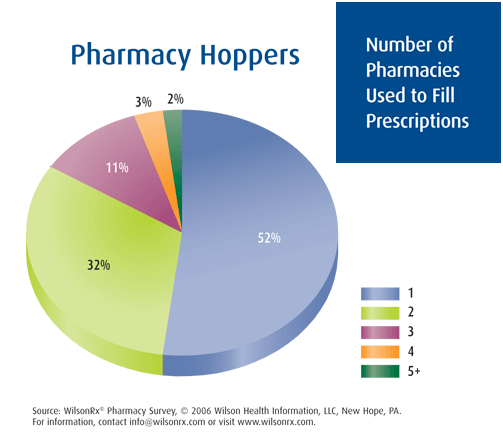
- The drug store industry remains largely up for grabs, with nearly half of pharmacy customers saying they use more than one pharmacy to fill prescriptions.
- Pharmacy use varies considerably by population. Chain pharmacies are most commonly used among residents of areas with more than 100,000 people. Independent pharmacies are most commonly used among rural respondents (areas with less than 100,000 people). Use of independent and mass merchant pharmacies decreases as population increases. Chain, food store, mail/online, and clinic pharmacy use tend to increase with population.
- However, as pharmacy customers age, they are much less likely to use chains and considerably more likely to use mail/online and clinic pharmacies.
- Seven-out-of-ten pharmacy customers indicate that they “definitely would” or “probably would” use their local pharmacy if they could receive the same amount of medication at the same price as their mail-order pharmacy.
- The heaviest users of prescriptions are survey respondents in their 60s, averaging 5.4 new scripts and 29.2 refills per year.
- How long patients have to wait for their scripts to be filled is a key component of customer satisfaction.
- The average survey respondent is spending a considerable sum each month on drugs at their pharmacy—$82 on average (versus $57 a month on food and groceries at their pharmacy).
- An average of 85.9% of computer owners/users use the computer to improve their health by looking for information about diseases.
- Much has been written about the value of closer pharmacist-patient relationships, but Americans seem to feel far more connected to their physicians, dentists and nurses than to their pharmacists. That’s clearly not all pharmacy’s fault; the same survey respondents agreed that they were usually given the opportunity to speak with their pharmacist when filling their last prescription. What’s more, pharmacists ranked a close second to doctors as sources of information about medications.
- Walgreens’ “Dial-a-Pharmacist” initiative, launched in February 2006, allows non-English speaking patients to connect with pharmacists speaking 14 different languages.
- Independent pharmacy customers have the most trust in pharmacists, while mail/online customers have the least. Compared to last year, customers of all types of pharmacies place more trust in their pharmacist as a source of information.
- More than one-third of pharmacy customers failed to fill all their prescriptions last year, and only 35 percent of all respondents said they were fully compliant on the medications they did take. Nevertheless, refill reminders from the pharmacy remain relatively rare, most patients profess.
- In general, older patients tend to be more compliant than their younger counterparts.
I mentioned poly-pharmacy a few days ago, but here is some data about how many pharmacies patients use.

Loyalty…Retention
I had a good lunch meeting today discussing loyalty in healthcare. The loyalty expert asked me what I meant when I use the word “loyalty”. Good question. I immediately jumped to points programs which is what I usually think about when I say loyalty. He asked about points versus information versus experience. I usually think of those as some of the key components of retention. Retention to me is a lifecycle program that address the patient experience from getting them to select you, welcoming them to the program, educating them, and exiting them at the right time. It involves information, tools, incentives and rewards, and has to be relevant to them.
Healthcare is unique in that you can’t simply incent on volume. I don’t want you to get an prescription if an OTC will work. I don’t want to you to go the physician unnecessarily. I want to incent you to do the right thing – go to your physician versus the ER; exercise; get appropriate tests done; participate in disease management programs; or use a generic drug. Some of these are easy to capture, but some of them become self-reported data which is hard to automate and collect.
So, we talked about the different constituents and what they might do:
- Providers (MDs, clinics, hospitals): pretty difficult to see the right model here…obviously they want your business if/when your sick so a share of wallet concept could work, but there isn’t a clear alignment of incentives without a pay-for-performance (P4P) or capitated relationship.
- Pharmacies or Durable Medical Equipment (DME) Providers: this is the easiest model to understand, but you still have to make sure you don’t incent inappropriate behavior
- Managed Care or Other Insurers: this is where the biggest opportunity exists, but the question is how to you get companies to invest in rewarding preventative actions rather than running the odds of having a major cost factor for the patient prior to the patient churning (i.e., going to another payor)
- Disease Mgmt Companies: this is a clear model since they are being paid to manage a disease and lower the costs. offering incentives or rewards that make a patient compliant (i.e., loyal) or drive behavior to a care plan would be in their interest.
- Pharmacy Benefit Managers (PBMs): there is something here especially around mail order pharmacy, but I think the big opportunity here is reward for behaviors such as using self-service (web, IVR) or choosing the lowest cost option – OTC, generic, mail order, etc.
- Pharmaceutical Manufacturers: here there is clear alignment. We used to do programs such as the 5-7-9 card which was for some drug (that I can’t remember). The patient got the 5th, 7th, and 9th fill free if they stayed compliant and enrolled in the program.
In researching this, I found this good loyalty presentation by Carlson Marketing. With healthcare being so behind other industries and struggling to figure this model out, the only place we are going to find a lot of research and information is going to be in other industries.
Healthcare Gift Cards, Memberships, and Futures
Gift cards have become the popular holiday gift. [Here is the money I was going to spend on you but since I don’t know exactly what you want, please go spend it on yourself.] As copayments go up and consumers own more of their healthcare spending, I wonder how long it will be before we get healthcare gift cards. Or maybe discount clubs that you join and get preferred pricing (i.e., Sam’s Club). Or maybe big ticket items could be like stocks where you can hedge your bets. Gift cards are definitely a reasonable probability. The others may be too far fetched.
-
A $50 gift card good at your local pharmacy.
-
A gift card good for 2 visits to the clinic.
-
A $100 gift card good for one visit to the ER.
-
A annual “membership” good for up to 5 preventative visits at any physician or hospital within a certain network.
-
An option to buy “futures”…purchase a transplant which costs $100,000 for $30,000 today based on your current health.
Where are the healthcare celebrities?
Over the past year, CNN has taken one of their morning anchors (Robin Meade) and turned her into a “celebrity” in some sense. The morning show on Headline News is now called Morning Express with Robin Meade. The news crew is called Robin and Company. Robin has a daily newsletter, and now Robin has a podcast.
So…why don’t health plans, large hospitals, and PBMs have branded personalities. It could be the Chief Medical Officer. It could be a nurse or (like pharma) they could use a celebrity. But, if CNN can take a good anchor and “brand” her, why wouldn’t healthcare companies do the same?
All your communications could come from the person. People would start to associate with that personality. That person humanizes the institution versus simply allowing it to be viewed as an annoymous corporate entity.
Forrester on PHRs
In mid-November, Forrester put out a report titled “PHRs: From Evolution to Revolution” by Liz Boehm, their healthcare lead. It’s not my lead area so I didn’t spend the money to buy the report, but here is the executive summary.
Health plans, driven by employer demand and expectations of improved member satisfaction and reduced medical costs, are investing in payer-based personal health records. But consumers have not raced to adopt them. Health plan customer experience professionals are on the hook to not only drive adoption but also engineer low-cost, interactive health support programs that will help members make better choices and save costs. To maximize their chance of success, health plan customer experience professionals need to focus on four critical areas: data management, behavior change, interface best practices, and patient and provider recruitment. This focus will help drive near-term success and position plans to weather the coming changes in the personal health record (PHR) market.
What I found interesting was the list of companies that they interviewed (and who they didn’t talk to).
- ActiveHealth (I have talked about them several times and think they have a strong offering.)
- Better Health Technologies
- CapMed (new to me, but they appear to have been in the space for a long time and are working with Microsoft on their product)
- HealthMedia
- Healthways (clearly a leader in the disease management space)
- iMetrikus
- Infosys (why them versus Accenture, IBM, McKinsey, etc.)
- Jeremy Nobel
- Matthew Holt Consulting (you can see his blog at The Health Care Blog)
- McKesson Health Solutions (they are everywhere)
- Medem (formed by the AMA and other groups…hadn’t heard much about them since they formed)
- Microsoft (why them versus Google)
- Protocol Driven Healthcare (I have never heard of these guys, but it appears that they work with some big clients in the population health arena.)
- WebMD (why them versus Revolution)
Book by Kaiser CEO
George Halvorson, the Chairman and CEO of Kaiser Foundation Health Plan and Kaiser Foundation Hospitals, has just published a book called “Health Care Reform Now! A Prescription for Change”. A news clipping service I have sent me a summary from Business Insurance. It is published by John Wiley & Sons and is $27.95. It sounds quite interesting. Here are a few things which the article highlighted.
He says that the US does not have a health care system in place but has a “plethora of uncoordinated, unlinked, economically segregated, operationally limited microsystems…a nonsystem of care.”
He talks about the concentration of spending (based on Kaiser Permanente data):
- 1% of the US population uses more than 35% of health care dollars
- 5% uses 60%
- 10% spends 70%
He talks about the fact that five chronic diseases are responsible for upwards of 70% of the health care costs in the US:
- Asthma
- Diabetes
- Congestive heart failure
- Coronary artery disease
- Depression
He talks about the problems that arise when there is no communication between health care silos of care which leads to drug interactions and costly hospitalizations.
I haven’t read it yet, but the article says that he offers solutions for each problem and talks in a conversational and occasionally funny way. He proposes using insurance records to create a type of Electronic Medical Record rather than waiting for the long-term solution of integrated systems. He also proposes using computerized medical records to track quality issues.
Academic Detailing
Their is a concept is the pharmacy world called academic detailing which essentially means educating physicians about the cost / benefits of prescription drugs. It can be done via letter, phone, and face-to-face. Many managed care companies and PBMs have tried it over the years. Does it work?…sometimes.
“It’s estimated the pharmaceutical industry spends about 90% of its $21 billion marketing budget on physicians each year.” (Journal of the American Medical Association article from January 2006)
Logically, it seems like a great idea. Get out and provide physicians with unbiased information about the drugs they prescribe. Provide them with published research. Show them how they behave versus their peers through benchmark data based on their prescribing habits.
Since I briefly owned academic detailing as a product line, I remember the challenge that our lead pharmacist had on proving the business case of why we should invest there. There were too many challenges:
- Why does the physician care about cost? They care about what works. If you can clearly prove the compliance is tied to out-of-pocket costs, they might get interested, but the cost to the patient (at least if they have insurance) has historically not been significantly different between different options. [I do believe consumerism and consumer-driven healthcare might change this.] I always compare this to the expression “no one ever got fired for hiring IBM”.
- To compete with the brand manufacturers who have 10’s of thousands of representatives out meeting with physicians, it would take billions of dollars. Who is going to fund this? You see change happen in small pockets where there is large marketshare by one dominant payor that can influence the physicians. With the government as the largest payor in healthcare, they could do this, but where is the money going to come from?
- Do the physicians have the time? There are 10,000+ drugs out there. Physicians are busy and under lots of pressure. Some physicians have stopped seeing detail representatives. Others charge for their time. This is not a 2 minute discussion. (I believe that is the average for a manufacturer’s representative with a physician.) This is a 30+ minute discussion of clinical and cost information.
Perhaps P4P (pay-for-performance) may change this. I know that when physician’s were capitated for both medical and pharmacy costs that it could impact their prescribing habits. I always here about different groups trying academic detailing for all the right reasons…BUT, I never see any great proof.
Another CEO Interview – ABC
I think a lot of times when I quick say ABC company people think I just mean any “generic” type company (i.e., typical MBA case study speak), but in healthcare, we have AmerisourceBergen Corporation which some people (probably no one in their corporate marketing) refer to as ABC. It competes with Cardinal Health and McKesson and is in many areas of healthcare especially in prescription drug distribution. (They are a $57B company in a market where the 3 of these companies control 90% marketshare.)
SmartMoney had an interview with their CEO (David Yost) in February 2007 (which I am just reading over the holidays). Since their margins are in the single-digits, the logical question was how do they grow. He pointed out that generics and specialty drugs represent the big opportunities. Interestingly on specialty drugs he talked how they can “tell the manufacturers where the patients are and how much insurance companies will probably reimburse on certain drugs.” This doesn’t strike me as the role I would typically look to them for.
It was also an interesting discussion around Wal-Mart’s $4 generics. I have been skeptical of the promotion, but he would have some visibility to data to understand the results. Regardless, the effort of the pharmacies to lower the cash costs for prescriptions (for those without insurance) is an important effort.
“The pricing difference Wal-Mart is offering isn’t enough to cause them [patients] to change pharmacies. Plus, a lot of people are going to Wal-Mart looking for $4 prescriptions and can’t find them.”
BCBSA President Interview on Forbes.com
If you are interested in what the president of the Blue Cross Blue Shield Association is talking about, you can see a quick 5 minute video interview on Forbes.com. He talks about his original vision when he joined of wrapping a strong national support organization around a group of companies that are embedded in the local areas and serve 100M people nationally. He talks about working with the government to figure out the “superhighway” needed to drive interoperability across plans to allow Electronic Health Records, Personal Health Records, and e-prescribing to be successful. He also touches on the issue of how to better use and share the data across plans to improve healthcare quality.

Polypharmacy Programs
I am sure that some people are focused on this, but I rarely hear about it. Although most people go to more than one pharmacy, today’s claims adjudication systems are programed to identify serious issues across pharmacies. But, since you can’t reject every claim, the edits in the system are focused on the serious issues which might leave some opportunity for improvement. If you add in OTCs and supplements that people take, there may be opportunities that aren’t captured by the system.
I found some results from a 2003 Premera BC program which I thought were quite impressive. They built a program that offered a medication review with your physician if you took 5 or more prescriptions. Their results included:
- 50 percent of the targeted members brought in their medications for the physicians to review.
- One out of every three members received prescription changes.
- Sixty four percent had a medication added.
- Forty seven percent had one or more medication stopped.
- Sixty five percent had the dosage of a medication changed.
Given results like this, it would seem like a program everyone should be doing.
Parents on DNA Testing and Mandatory Vaccines
In the Early Fall 2007 Michigan Alumnus magazine (Go Blue!), they had a few health stories. The CS Mott Children’s Hospital asked 2,000 adults if they would endorse genetic testing to determine if their children were at risk for developing a disease when no treatment exists.
- 54% (of those with an opinion) said yes.
- 39% agreed but only if an effective treatment existed.
- Only just over a third said they were willing to have the DNA stored in a biobank (a collection of DNA to help researchers identify treatments and preventative strategies).
The authors believe the reluctance is related to fears of how that information could be used to affect employment or insurance coverage. Apparently, Congress is evaluating a Genetic Information Nondiscrimination Act to address that concern.
With many states considering making it mandatory that girls 11-12 get the HPV vaccine that provides protection against human papillomavirus (the virus linked to cervical cancer and genital warts), the hospital polled US parents to get their opinion. 44% were in favor of making it mandatory for school entry. 23 states and Washington DC have introduced bills regarding this and Virginia has passed a law requiring it.
On the vaccine issue, I really don’t know enough to have an educated opinion right now. On DNA testing, I think of it like participating in the national bone marrow donor program. I would want mine on file so that if I had a disease and they found a cure that they would reach out to me and help me. People might try to abuse the information, but I believe that in the long-term the benefits outweigh the risks and society will be protected.

January 15, 2008