Archive | Managed Care RSS feed for this section

Defensive Medicine

On April 23rd, USA Today had an article on Defensive Medicine by Kevin Pho (a PCP who blogs at KevinMD).

It was a well written piece with a few facts that I thought I would capture here:

  • $2.2T are wasted in our healthcare system (per PWC) due to medical errors, inefficient use of technology, and poorly managed chronic diseases.
  • Defensive medicine was the situation where physicians order tests to avoid the threat of malpractice.
  • Defensive medicine was estimated to contribute $210B annually to this $2.2T in waste.
  • According to the JAMA (2005), 93% of doctors reported practicing defensive medicine.
  • An American Academy of Family Physicians cited a study that physicians who had fought medical liability cases which showed that 90% “suffered significant mental effects from the lawsuits” and 10% contemplated suicide.
  • The New England Journal of Medicine analyzed 1,400 malpractice claims and found that 40% of cases had no medical error.

Kevin goes on to explain that most patients don’t mind the extra tests.  I would argue that patients probably feel that their doctor cares by going the extra mile.

As he talks about, more isn’t always better:

  • Risk of a false positive
  • Radiation from a CT scan might be unnecessary
  • Biopsy can lead to complications

Researchers at the Dartmouth Atlas Project concluded that higher intensity medical services have led to worse outcomes, higher costs, and an increased number of medical errors.

It’s a pretty sad state of affairs.  Physicians afraid of being sued.  Consumers with no direct understanding of the cost.  Again, it gets back to incentives and communication.  We have to align interests and protect people who are doing the right thing.  But, all parties have to be willing and able to provide information and disclose the implications and rationale.

Healthcare Retention

Retention in healthcare has become an emerging focus.  With the initial land grab for Medicare lives over, it is more and more important to retain them.  Focusing on new lives is becoming harder.  And, with one of the few green fields out there being individual lives, retention will continue to be a business driver for the next decade (or until we move to a single payor system).

Fortunately or unfortunately, there is no silver bullet.  But, this is clearly the time to act.  Figure out what works.  Set your baseline.  Learn from the consumer, customer, patient, or member.

I recently gave a webcast on this topic, and without giving away anything proprietary, I thought I would share some cliff notes.  If interested, feel free to contact me for the content or even to learn more about our retention solution.

  • Retention is a journey from employee satisfaction to customer satisfaction to loyalty and ultimately retention.
  • There are many different types of loyalty – price, programmatic, experience, and relationship.  (Forrester Research)
  • There are many lessons to be learned from outside the industry on the value of retention, how to measure retention, and what drives it.
  • A data centric approach to learning and understanding your consumers is critical path.
  • There are some basic programs emerging as foundational.
  • Health plans unfortunately start by having to build trust.
  • One way to build trust is to demonstrate that you are looking out for the best interest of the patient.
  • Your brand is affected by all the constituents in the delivery chain.
  • Price and product are the obvious drivers of satisfaction, but there are others.
  • The most satisfied are not always those with the lowest price.  (There is a great example of this in another industry.)
  • Your healthy members are the most likely to disenroll.
  • Satisfaction varies by condition.
  • There is a big difference in likelihood to renew between someone that scores you in the top box (i.e., 10 out of 10).

Lots more to come on this topic.

Doctors Won’t Trust PHRs

One step forward and two steps backwards is my reaction to this comment…if it’s true.

Steve Leiber — who runs Healthcare Information and Management Systems Society, the trade group for health IT — told the WSJ Health Blog that physicians won’t trust PHRs.  As John Sharp mentions on the eHealth Blog, this points to the need for PHR certification especially around data sources (i.e., payor claims data, patient self-reported).

Wow.  I just assumed that was part of any legitimate PHR.  I have asked the question of several vendors and always thought I got the answer that you could tell where the data came from.  I would certainly think some data in an emergency situation is better than none especially if you have some understanding of the source and date of the information.

If PHRs just become a tool for patients with no use in the medical community, they are doomed for extinction or will simply be marginalized.  We need solutions that bring us together.

What A Difference A Few Years Makes

Before a whole week passes, I need to capture my interview with Gene Drabinski from Trizetto. Gene is the President of Cost and Quality of Care. This was a fun interview where we just kicked back at the end of day two at the World Healthcare Congress and talked.

I haven’t spent much time around the Trizetto people recently and still thought of them as Facets which was the software that I remember from my payor days at Ernst & Young LLP.

Of course, I had done some homework prior to the meeting and began by asking some questions about being acquired by Apax who is taking them private. We talked about the advantages of being private versus public. The big one being the ability to plan long-term and make investments rather than try to make each quarter’s number.

He was then kind enough to walk me through some of the history of Trizetto. If you go to their news page off their website, I had realized before I talked to them that I was outdated in my frame of reference. They are talking about social networking and consumerism and decisioning not about claims processing and efficiencies.

We talked a lot about the CareKey application which they acquired. CareKey (now CareAdvance) is a PHR (personal health record) which sits on top of a member database. He described several key features of the application:

  • Good metadata (i.e., data about data)
  • Ability to reach out and capture new data systemically
  • Custom rules environment
  • Able to be integrated with workflow and used in disease management, case management, and utilization management

CareAdvance Enterprise – Enterprise software that allows health plans to automate utilization, case, disease and population management, and to extend a personal health record and personal health management tools to their members. The system includes two modules: Personal CareAdvance and Clinical CareAdvance, which integrate with the health plan’s core information systems, aggregating the member’s personal claims and diagnosis history, current prescriptions, and laboratory data into a single data repository.

We talked about transfering the information from one PHR to another. He clarified that the transaction data was transferable but not the context. We then spoke about their vision for Integrated Healthcare Management as an out-of-the-box solution to make the patient “be the best I can be”. From what he said, the physician is the final constituent that they need to get integrated.

“Integrated Healthcare Management is the systematic application of processes and shared information to optimize the coordination of benefits and care for the healthcare consumer,” said TriZetto Chairman and CEO, Jeff Margolis.

From Gene’s session at the conference, he facilitated a panel that included Vicky Gregg who is the President and CEO of BlueCross BlueShield of TN. One of her slides which captures the Trizetto IHM vision is here:

My takeaways were (a) Gene’s would be an enjoyable person to work with and (b) Trizetto is doing a bunch of interesting stuff and focused on how to use technology to transform the industry.

It’s also worth reading through Jeff Margolis’ document called The Health Plan of Tomorrow.

Silverlink Coming To A City Near You

I am really excited about a new initiative at work.  We have pulled together a great set of speakers and are doing a road show around the country.

The speakers include:

The topic of the event is Healthcare Communications: Think Differently and is about how to engage the new healthcare consumer and drive behaviors in scale.  Very much like what a lot of the talks were about at the World Healthcare Congress.  It’s not simply getting data and information, but it is about making that information actionable.  That is exactly what this 1/2 day session will be about.

The meetings will be in Boston, NY, Hartford, Minneapolis, Oakland, and Westlake (CA).  Click here to find out more information and to get registered.  We hope to see you there.

WHCC 2008 Potpourri

I am flying home and trying to catch up on all my notes so that I can get back to work. It has been a good 2.5 days, and I got some business done, learned several things, and met a bunch of interesting people. Not bad. I have a few more interviews to write up, but I want to throw some of my notes out there so that you can pick up some of the other comments / thoughts that I captured.

  • Michael Leavitt (Secretary, Department of Health and Human Services) spoke at the end and talked about several things:
    • He told the story of someone saying “the great thing about healthcare standards is that there are just so many to choose from” and went on to talk about how problematic that was.
    • He talked about 4 things:
      • Standard quality measures
      • Standard cost-of-care groupings
      • Interoperable EMRs
      • Incentives to seek value
    • He said “the billing system in healthcare is insane”. And had an analogy that I am sure many traditionalists thought naïve about what buying a car would be like if it had the same billing process as healthcare…starting with making a purchase with no price available.
    • He said that things are so bad that “people with average intelligence and limited patience can’t understand healthcare pricing”.
    • He talked about moving to a value-based system and compared it to video games. He said we are at Pong today and need to evolve through Donkey Kong and Pac-Man to get to Wii. (Nice vivid analogy)
    • It was refreshing to see a government official very passionate about the dilemma. He talked about ongoing cost increases as the most serious economic threat to our country. He talked about how there is an inflection point in every generation where we have to prove ourselves and healthcare reform is ours. He said we have three options:
      • Fight change and fail
      • Accept change and survive
      • Lead change and prosper (which is what he called upon us as Americans to do)
  • In a session yesterday, there was talk about:
    • DASH – Dietary Approach to Stop Hypertension – where EMC talked about saving $1,000 per participant.
    • The Prochaska change model looking at different stages of change and moving from awareness to education to supportive environment to changing behavior to sustaining change.
    • Engaging consumers through education, motivation, access to reliable information, reinforcement, and support. But the speaker lost me when she claimed that consumers don’t engage since they assume their physician is taking care of their health. What consumers are these?
    • I liked the analogy of “supersizing” referring to the fact that healthcare often delivers more than needed.
    • I was a little shocked in watching a video which made three suggestions that I didn’t agree with:
      • Patients should go to hospitals with the most experience (what about the best outcomes)
      • Patients should always go to the health plan website (since they don’t trust this source is that really the default answer)
      • You should call your MD first at 3AM. (are they really going to call you back to triage you)
    • I liked the positioning that “there is no free lunch” to make the point that there is a tradeoff between spending. Sure you can have more health benefits, but we will have to limit benefits elsewhere. The speaker also compared healthcare to giving someone a “platinum charge card” and that there needed to be education about how and when to use it responsibly.
    • And, I believed it but was surprised to hear one speaker say that when they educated their members about what questions to ask their physician that physicians complained saying they didn’t have time to answer all these questions and see all their patients. (Now there’s a systemic problem.)
  • One of the best speakers (who deserved a longer dedicated session) was Reed Tuckson from UnitedHealth Group. He spoke with Peter Neupert from Microsoft about “Achieving a Consumer Focus”:
    • He talked about changing the question from what is the best hospital in Chicago to what is the best hospital for me based on my preferences and my conditions.
    • He talked about segmentation and targeting communications.

“Data is only exciting if you can do something with it.” [Reed Tuckson]

  • He talked about two challenges literacy and longitudinal view of the patient. He said today’s students don’t know “diddly squat about science.”
  • There was a good discussion with the moderator about whether people perceive the Internet to be secure or whether that is still an issue.
  • Peter provided two differences that he thinks makes healthcare security still an issue:
    • Work about discrimination if the information were to be misused
    • Work about insurability if the information were to be misused
    • Both of these being a much bigger deal than having your bank account compromised
  • There seemed to be consensus that consumers wouldn’t mind de-identified healthcare information being shared for the purpose of public health research which is clearly a benefit of aggregating data, but Peter clearly pointed out that HealthVault’s data belongs to the consumer so they would have to opt-in.

“Today’s system is broken and fragmented…you can’t track a patient through the system.”

  • In a session on Massachusetts with people from BCG, Tufts, Harvard Pilgrim, and the Commonwealth Health Insurance Connector:
    • What should come first was the question – access, quality, or payment? Great discussion.
    • The typical uninsured was a 37-year old male who was “just starting to think they weren’t invincible”.
    • This will be an interesting example of a stick. People who don’t have coverage will be penalized $75 a month on their taxes for 2008.
    • They were able to offer 50% more benefits at 50% of the costs.
    • The deficit issue is mostly due to too many people signing up (and I suspect too many employers taking the smaller penalty to get out).
    • They talked about most reform being historically killed by either the broker community or the managed care community and that they needed to get a broker representative more involved versus simply having a broker advisory role today.
    • They mentioned the website several times – www.maconnector.org. They compared it to Travelocity.
    • They also talked about www.notinvincible.org.
    • Today, more people are choosing the higher premium plan options but that will likely change as they push the last people in their under a penalty model.

Sorry for the long mix of stuff, but I think it will cause you to think and share some of the experience. I have to write-up my last interviews later today.

Hidden Gem at WHCC 2008

For those of you missing the World Health Care Congress 2008 in DC, you are missing a good meeting.  It has lots of networking opportunities, good speakers, lots of company booths, and good content.  I have been here and trying to run between presentations, meetings, and interviews.

I went to a presentation yesterday on PHRs (personal health records) which is a hot topic here.  I think the presentation by Jan Oldenburg (Practice Leader, Health Content, Internet Services Group, Kaiser Permanente) could be the the hidden gem of the conference.  I know a lot of people will immediately discount it for being part of an IDS (integrated delivery system) but don’t.  There is a lot to learn here.

Some of the key things include:

  • Integration of the PHR and EMR.  [Their EMR is from Epic.]
  • A focus on four key attributes – transparency, accessibility, consistency, and security.
  • Four major components: record of information (lab values, visits, notes), an interaction tool (e-mail your physician, HRA), transaction engine (refills), and links to health content.

They have an amazing 2M members on the PHR with over 60% who signed in and used the tool more than 5 times in 2007.  [They probably deserve an award just for this ability to create a sticky application.]  And, 16% signed in more than 12 times.  […which is probably all of their chronic patients with co-morbities.]

Jan talked about their promotion of the site which includes all of their materials, registration drives, and even physicians giving out cards promoting the site.  She talked about making meaningful improvements like moving from mailing out the password to the patient to instant password set-up using a similar algorythm to what banks use.  (This improved their activation to 88% over the past 2 months.  They used to lose 30% between password request and actual registration.)

And, it sounds like they have taken a very thoughtful approach to the application:

  • She spoke about the fact that they had over 3.6M e-mail exchanges between MDs and patients in 2007.  Originally, they didn’t pay MDs for e-mails since it was like returning phone calls.  But, they are looking for how to distinguish between an e-visit and an e-mail.

“E-mail helps me take better care of myself” [a quote from a patient]

  • In a published study, they showed that patients using e-mail had 7-10% less visits and 14% less use of the phone for support.  [very impressive]  But…to George Halvorson’s point on day one, this is a perfect example of misaligned incentives.  The MD uses e-mail to improve health and patient satisfaction but makes less revenue.
  • They addressed one not so obvious issue which is timing of data being released.  For sensitive lab values, they are either delayed so the physician sees it first or its only released after the physician approves it.  The key is that the physicians don’t want the patients to see the data before they get a chance to call them.
  • The patient can take an HRA (health risk assessment) and decide whether or not to share it.
  • They have some impressive statistics around changing behavior:
    • 55% lost weight
    • 58% decreased stress
    • 78% had better pain management
  • They are just beginning to analyze who the users are (e.g., chronic patients, acute patients, family).  This was a question in every PHR meeting yesterday.
  • Some of their key learnings included:
    • Information has to be timely and current
    • You have to create “in the moment” opportunities to act (i.e., e-mail your provider)
    • You have to create teachable moments
    • You have to meet members where they live
    • You have to heal the fractures of our healthcare system

“Patients who use the PHR are 65% more likely to stay with Kaiser when they have a choice of plan options.”  [WOW!  Talk about a case for adoption.]

  • They were one of the first ones that I heard talk about working with portability standards to move data from PHR to PHR and to a DTC model (i.e., Google, Microsoft).
  • The final point which was similar to what I discussed with ActiveHealth was around genomics.  Jan talked about some of the analysis they were doing thinking out years in the future about how that data could influence generations.

This is certainly worth following and looking at as a model.  Some of the things are easier because of their model (e.g., getting MDs to use e-mail and promote the web), BUT somethings are lessons that can be leveraged.

Data + Rules + Transportable = ActiveHealth PHR

I had the chance yesterday to sit down with Nita Stella (SVP of Product Management at ActiveHealth) and talk about their PHR.  It was a helpful meeting given that I spent much of today in PHR discussions.  Some of my takeaways were:

  1. You have to have a PHR which pulls in your claims data.
  2. You need to have rules which use the data to drive specific actions.
  3. The PHR has to be transportable.

ActiveHealth has two ways that the PHR is offered: (1) through your payor and (2) direct-to-consumer (launching next week).  This works great if you originally get it through your payor and have your claims data pulled in.  Then, even if you leave, you can take the data with you.  Additionally, they are linked to HealthVault (Microsoft offering) which should help address some of the transportable issues.

Their key offering has been about using an evidence-based approach to drive decisioning using business rules so from what I know this is a key component of their offering (see more on Care Engine).

We talked a little about size and utilization.  Some of the statistics that I wrote down were:

  • They have 6M eligible users (i.e., provided through their payor).
  • Average use is 40% (i.e., meaning that they register and sign-in).
  • Use ranges from 10% – 75% with the top client using incentives to drive adoption.
  • Based on some initial data, they are getting 1.7 visits on average.
  • Most of the repeat visits are due to an e-mail being triggered to let the patient know of some care alert.  [Since e-mail is not secure and you can’t send PHI (protected health information), I wonder how much more effective this would be using a different medium that included personalized information.]

She gave me a tour of the application which has a nice GUI (graphical user interface).  I liked the fact that that alerts and reminders were at the top of the page when you logged in and prompted you for an action.  Additionally, so you couldn’t just defer the action, it asks you for a reason if you choose to ignore it.  [That would be interesting data to see and track.  Why do consumers ignore opportunities and how does that vary by segment.]

I asked her what they were doing about using genetic markers and pulling in data from companies like 23andMe.   [A topic that came up in several PHR presentations today.]  She mentioned that they were talking with Rand about this and thinking through it.

The final point that I took away was that in using their business rules they are focused on pulling out the alerts and/or reminders where they have more than one marker to indicate a possibility (to eliminate false positives).

Obviously, the key to all of this is getting consumers engaged; keeping them engaged; and making the application valuable in ways that they want to use it.  A challenge for everyone in the space.

Consumer Engagement Tools

This next session is with James (Jim) Roosevelt (President and CEO of Tufts Health Plan) and Phyllis Anderson (VP of Marketing from Humana). It should include real-life discussions on what works.

Interestingly, Jim is making a point that he made earlier which is about how to differentiate when all the providers are in each plan. I talk about this a lot. My opinion based on what JD Power showed in their study is that communications is the differentiator. How? What? When? Personalization? Rules? Preference based? Integrated?

Jim said that 3-years ago they were in touch with 1.5% of their members on a regular basis…that number is now 22%. I am not sure there is a benchmark to know if that’s too much or too little…but it seems good. Some of the words he uses which I think are important are – cost management, quality improvement, evidence-based, self-care, comprehensive and integrated, effective, and positive ROI.

He laid out a good continuum of programs moving from low cost, healthy programs (wellness) to more expensive programs for at-risk people (disease mgmt) to high cost programs for the chronic patients. Tufts is moving to a consumer empowerment plan called My Wellness Plan which will focus on engaging 100% of their members and still get an ROI of greater than or equal to 1.5:1. He showed a chart that 50% of health costs are driven by health behaviors (good news in that it is an addressable challenge).

He talked about an example around bariatric surgery which I thought was a good case study. Rather than simply not covering it, they cover it after certain steps including a six-month lifestyle modification program. The key point he made is that surgery without behavior modification is dangerous.

They have 3 categories for engaging members:

  1. Lead a Healthly Lifestyle
  2. Manage Care and Treatment
  3. Effectively Navigate Health Care System

He made the point that it could be copied, but the question is do you act first. I think the question really is how well do you implement the vision. It’s easy to envision and know what to do. It’s very difficult to execute it well and make a difference.

Phyllis started with some patient messages which were interesting.

  • Take a deep breath. We dare you.
  • The food groups are your friends.
  • Make you next smoke break a clean break from smoking.
  • Where do you see yourself in 5 pounds?
  • Lower back under attack?

“Healthiness is a nuance.”

As the quote indicates, health information and engagement varies dramatically, and it will take a while and some trial and error.

“Incremental change will ulimately result in significant impact.”

She talked about a pilot they did and what they learned:

  1. Create real-life goals (relevant to where they are and where they live)
    • Want to fit a dress by reunion versus lose 100 pounds in the next 6 months
  2. Community is key
    • Coach
    • Peers (the participants blogged and got feedback via the blog)
  3. Rewards and incentives are necessary
    • Personalized to individual
    • Not just monetary
    • Include recognition

“It costs less to support well people.”  Phyllis went on to make the point that it’s worth spending the money now rather than waiting until people get sick.

There was a good question from the audience on whether ROI mattered.  Apparently, some of the employers here at the conference had said that they were willing to invest in programs that promoted health without any ROI.  I think the key is that there are limited resources…I would spend money first where I got a return.  I am willing to bet that I don’t have much money (or time) to address the other programs.

Upcoming Webinars

If you missed it last week, I am giving a repeat performance of my webinar on retention.  I am going to talk about driving customer satisfaction and building loyalty to improve retention which is and should be a hot topic for everyone in healthcare. (Sign up here for the 23rd at 1:00 EDT)

Additionally, my peers are giving a webinar on closing the adherence gap which should be another hot topic for many of you.  (Sign up here for their sessions on April 30th and May 22nd)

Wrong Question: What Does The Consumer Want?

After hearing Grant Harrison (VP, Integrated Consumer Experience) speak a few times on stage yesterday about his role at Humana, I was glad that I had time booked with him to learn more about what he does. I found it to be a very interesting discussion. Grant works in the Innovation group at Humana, and he brings a background which includes Virgin HealthMiles where I believe he was one of the founders and time at Tesco and SkyTV (among other consumer facing experiences).

The first thing we talked about was their VirtualMe initiative which is the creation of an avatar (i.e., virtual persona) for use on the web. They haven’t launched it yet, but it sounded like it was an effort to give some personality and interactivity to the consumer. Interestingly, they are already working on a mobile solution and how to use this in kiosks within the physicians office to pull up your data and minimize your rework. As we continued to discuss this, Grant talked about pushing it to the physician as an interface for them to input data essentially into the patient’s page or portal. I asked him if this would essentially create an integrated PHR / EMR which was shared by both parties which he agreed it could. [Maybe someday they will use the avatars in Second Life to open up a virtual Humana location.]

I asked him about creating a points program since he had done that at Tesco in the UK. He mentioned that they were looking at it. One of the things he mentioned was that they believed the amount of points or incentives you had to offer someone was directly linked to how good of an application you had and how clearly the patient saw value from their interaction. [It’s a great point.] Interestingly, he used RealAge as a good example of an HRA that people willingly do all the time. I never thought of RealAge that way.

When I started asking him about measuring success, he pointed out to me that people who ask “what does the consumer want?” don’t know what they are doing. Essentially, they are trying to generalize the healthcare masses when it is all about micro-segmentation. [It was clearly an opportunity for me to plug what I work on at my day job at Silverlink, but I was good and stuck to the press role.] He talked about a current effort they have to learn about the “care-giving woman” who is between 35-65 and has both a child to care for and a parent.

In talking about groups, we talked about a few things like measuring happiness. He had mentioned that this was their objective and talked about the whole body of international research on this topic and how you could look at proxy metrics like their engagement as a measure of happiness. We also talked about segmentation models and tracking things like their awareness and/or interest in communications from Humana.

We talked briefly about retention at the end of the discussion which seems like something they are getting ready to address with a focus on group retention, brokers, and Medicare lives. [He is one of a few healthcare people I know that ever talk about retention in groups…which I believe is a clear opportunity.]

“Not an insight unless you act on it.”

I think this quote was a good ending to the discussion since I was asking about what they were doing to actualize this information. Another question I had had was whether they would really build out all this within Humana or take it out to an Entrepreneur in Residence at a VC firm. I know we struggled at Express Scripts when we looked at how to develop and manage businesses that had little (operationally) in common with the core business. [As an interesting side note, I asked him what he thought about Express Scripts recent announcement about their Center for Cost Effective Consumerism, but it wasn’t on his radar screen at all.]

Reverse Engineering and the Golden Goose

I listened to part of the initial presentation by Hans Rosling from Sweden which was very interesting, but I was mostly getting coordinated for the day.

Here is the video of a similar talk he gave at TED.

I am very excited to sit down and listen to George Halvorson’s presentation called “A Practical Model to Achieve Health Reform”. [George is the Chairman and CEO of Kaiser and recently wrote the book Healthcare Reform Now! A Prescription for Change. Some of my notes on this are here although I am still finishing up the book.]

Here are some of his quotes and some of my notes. [You know you are a key person when you are able to quote yourself.]

  • Talking about Kaiser, “When we look for someone to blame, we have to look in the mirror.” He talked about how they play all the positions all of the time (payor, provider, lab, pharmacy).
  • Said that they had about 2M e-visits last year and have 92,0000 member contacts per day on the Internet. They are trying to figure out how to leverage the new toolkit in a way that makes sense.
  • He dedicated his presentation to Dr. Jerome H. Grossman who recently passed away.

“American health care could be transformed fairly quickly if a number of high leverage buyers chose to strategically use their market leverage.”

  • Reform can’t be voluntary…it needs to be a product…defined, purchased, and paid for by buyers.
  • He talked about the old market:
    • Hundreds of “slices”
    • Commodity products
    • Financial conduits rather than care delivery focused
  • He talked about the new market:
    • Sumo wrestling
    • Total replacements
    • Shrinking total market
    • Growth focus to drive stock value
  • This new market reality gives power to the employers in terms of pushing change. This is an interesting perspective really pushing the employers to drive for change.
  • It is a great, simple point that he makes around HC in America is becoming unaffordable…BUT financing reform is not enough. Most of what we hear about is financing change. He points out that the multiple payor system only explains 20% of the cost difference between the US and Canada.
  • What we need:
    • Universal coverage
    • Individual mandates
    • Guaranteed issue
    • Subsidized coverage for low income

“Care delivery in the US is uncoordinated, unfocused, inconsistent, unmeasured, extremely inefficient, perversely incented, and excessively expensive.”

  • He talked about how healthcare is the fastest growing and most profitable segment of US economy ($1.2Trillion). [Key point on profitability.]

“HC takes everyone’s money with an amazingly low level of accountability for the product it sells.” [Key point on why HC will never reform itself.]

  • Smart people don’t kill the geese that lay the golden eggs. We have lots of smart people and golden geese in the US HC system.
  • More efficient and effective caregivers simply deprive themselves of income.
  • Truths:
    • Current increases in cost are unsustainable.
    • Current rates of increase for Medicare and Medicare with eat entire budget by 2050.
    • 1% of people drive 35% of costs
      • If everyone in CA had coverage – $300 per month
      • If only 1% – $12,000 per month in cost
    • 75% of cost is from chronic care
      • Eliminating breast cancer would be create but only impact 2% of costs
    • Benefit design is clumsy and even inept
  • Some realities that drive out costs assuming we start with roughly the same base as other countries: [Although he points out that we do start at a higher base than Canada around office visits…$23 in Canada…$73 in US…$150 in NY.]
    • Inflation
    • Worker shortages – lab techs, nurses, pharmacists
    • New technology, treatments, drugs, etc. which all drive costs
    • Number of MRIs, transplants, etc. all higher…more high tech care (tertiary care)
    • No value screen for technologies or drugs…test is will someone buy it [Seems like an obvious problem]
    • Inefficient, uncoordinated, unlinked care
    • Multiple mds with no coordination
    • 10,000 codes for units of care
    • No reward for outcomes
    • Aging population

“We can’t stop aging, inflation, new technology and provider financial motivations.”

  • What we can do:
    • Focus on chronic conditions (CHR, Asthma, Diabetes, +2 others)
    • Work backwards (continuous improvement)…where do we want to get and then how do we get there

“Random reengineering doesn’t work…need a goal in mind.”

  • Tools:
    • Benefit design
    • Public messaging
    • Care tracking – PHR/EMR
    • Mandatory care registries and care linkages (tools will evolve once we have a goals)
  • Nurses spend 25% of their time on direct patient care [a pretty low amount]

Interview with Phyllis Anderson (Humana)

As part of my opportunity to be part of the press at the World Healthcare Congress, I opted to interview some of the participants and speakers. This is my first of several that I have scheduled.

I had a chance to sit down with Phyllis Anderson who is the VP of Corporate Marketing for Humana. She has an interesting background from Pillsbury, Nabisco, and Bank of America as I discovered when I asked her what they were doing to bring in non-healthcare people to help them address consumerism within healthcare. Her story about working on healthier snack foods where they wanted to protect the quality of taste while addressing the healthy trends in the US seems very applicable.

How do we manage our history of healthcare while addressing the sea of change?

We talked a little about the paradigm shift that they are addressing in moving towards an individualized healthcare sell. Phyllis talked about focusing on the benefit to the consumer. Sticking on that same concept, when I asked her about how they were addressing preference-based marketing, she talked about creating “viable consumer experiences”. She talked about looking at 3 factors: message x channel x frequency. She mostly spoke about the differences in needs / interests around messaging by health status. I asked about using different models like Prizm versus Pro-Change, and she said they were still exploring the right model.

Given what she said plus what one of her colleagues had said on the main stage, I asked her about how they captured feedback (i.e., indirect on direct) about satisfaction. She said that they ask for feedback on a lot of their outreach programs today.

Listening and Leading

She talked about their CEO’s term of listening and leading and trying to balance those two things. Sometimes you have to listen. Other times you have to lead the consumer. We also talked about the fact that if the patient isn’t engaged then it’s pretty hard for them to give feedback.

I then asked about how they’re using JD Power and Forrester’s healthy studies. I was glad to hear that they had embraced the JD Power study and were working on an expanded relationship with Forrester.

Health and Wealth

There have been several articles about the potential convergence of healthcare and financial services.  Can a Fidelity become a one-stop shop where you invest your money and also get your insurance (health, auto, home)?  If consumerism really transfers the healthcare spend to the individual, are they in the best position to manage that money and help you plan for the future?

It is both a scary and interesting question.  Do they understand healthcare?  Would they focus on outcomes or just return?  [Is that different from most payors today?]  Would we make different decisions if we were evaluating our out-of-pocket costs for healthcare versus buying a few more shares of a stock?  I think it would certainly drive a different view of the patient as the consumer and push all their lessons learned around behavior and customer service into healthcare which would be good.

You have the Blue Healthcare Bank and OptumHealth Financial Services (previously Exante) as two examples of historical healthcare companies (BCBS and United) who have expanded into this converged area.

Going back to a McKinsey article on this topic from June 2005 called “The coming convergence of US health care and financial services”, they laid out several opportunities:

  1. Savings oriented health care products (e.g., HSAs).  They estimated there could be 25M HSAs by 2013 generating $55-$75B in revenues.  (Big market)  They quoted a statistic that as many as 80% of consumers don’t reach their plan deductibles which creates an opportunity for financial services companies to make money managing their deductible dollars.
  2. Consumer health care payments and financing.  They estimate that there is $375B in out-of-pocket expenses that could be managed and $60B in consumer bad debt related to healthcare.  These create opportunities around debit cards or credit cards.
  3. Supplemental risk products.  I think this is a clear opportunity to provide the safety net for consumers around long-term care and major accidents.  They estimated this to be a $3-$5B in net profit opportunity.
  4. Benefits administration.  They estimated this to be a $50B space growing at 15% but with lots of established players (Accenture, Hewitt).
  5. Payment assurance and transaction processing.  They estimated that streamlined operations here could save as much as $4B in operating costs.

Obviously, this forecast and many of these opportunities have led to dozens of acquisitions and investments since the report came out.  But, we still haven’t seen any major sea change.  I predict that once the election is over and the future direction from the government is set that we will see some additional energy here.

Medco’s Customer Event 2008

Medco doesn’t host their event and release their drug trend report until mid-May. [You can see some of the highlights from the past few years online.] But, I think it is interesting to look at the agenda and topics to understand what they are talking about with their clients. As you would expect, consumerism, the election, and healthcare communications are present in both agendas.

  • The Predictions Conference: Five insights that will shape healthcare by David Snow, Medco’s Chairman and CEO
  • Emerging trends in the science of healthcare by Dr. Robert Epstein, SVP, Medical and Analytical Affairs and Chief Medical Officer, Medco
  • Wiring healthcare: Bringing personalized healthcare technology to consumers by Steve Case, founder of Revolution Health and co-founder of AOL
  • Politics of change: Preparing for a new administration’s impact on healthcare by TBD
  • Future shock: The economics of the uninsured by Former US Senate Majority Leader Bill Frist, MD and Uwe Reinhardt, PhD, James Madison Professor of Political Economy and Professor of Economics and Public Affairs at the Woodrow Wilson School at Princeton University
  • Prescription for savings: Using health literacy principles in your communications (breakout session)


2008 Outcomes Conference

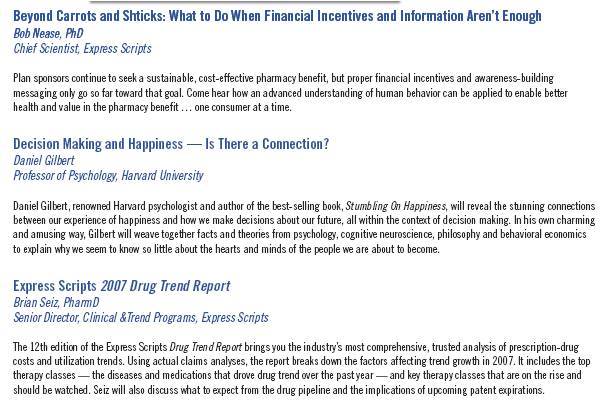
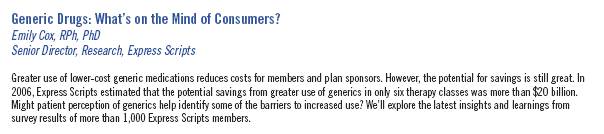
As a follow-up to my last post, I thought I would share some of the agenda items and the new Drug Trend Report from Express Scripts‘ Outcomes conference 2008 which is happening right now.  Unfortunately, they don’t let many external people in (even on my own dime) to hear the presentations.  I have to get it off the website and talk about it 3rd hand.

I will have to read the report and will have more to share.  Here are a few things that caught my eye:

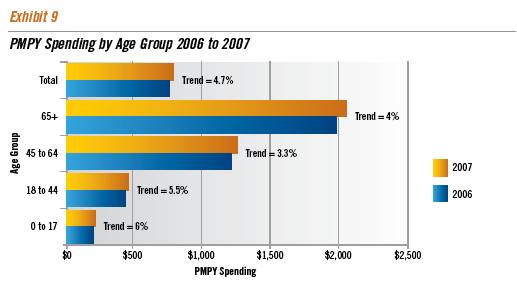
As you can see from the agenda, several topics around consumerism which is a hot topic there.

Transient Insurance

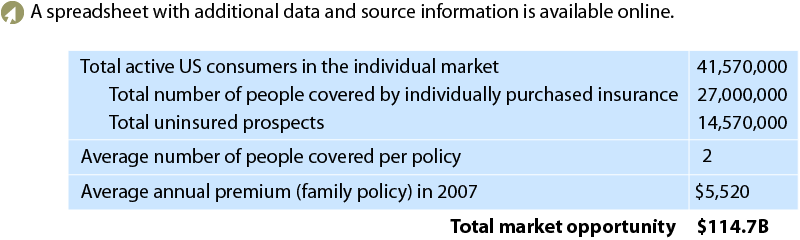
According to an article in the Detroit News, 1 in 6 Americans lack insurance for some part of the year. They could be chronically uninsured or simply in transition between jobs. Today, the individual health care market is certainly one of the fastest growing (if not the fastest growing) market for managed care companies.

Forrester estimates that this is a $115B market today.

With an average annual premium of $5,520 per family (or $2,400 per person assuming 2.3 people per family), that means the average premium per day is $6.58. Will we ever get to a point where you can buy short-term (i.e., less than 30-day) health insurance? And, if we did, can you set it up so that people don’t go on and off just as they feel ill?

The Forrester article talks about a Prudential model in Europe that is pay-as-you-go around health insurance.

Several Good Entries On Other Blogs

I was doing some blog surfing this morning and found a few entries worth going out and reviewing:

On EverythingHealth:

On HealthCareReformNow!:

On e-patients:

On The Sentinel Effect:

On Running a Hospital:

And to wrap up, on the Forrester Marketing Blog, you can get links to all the information being captured at their event on Engagement.

Medco on Future of Pharmacy

Medco has introduced a new publication called Perspectives. The one I just read was by Dr. Robert Epstein who is their Chief Medical Officer and is about how pharmacy will become personalized, specialized, and consumer driven. It is a well written piece with some good and interesting facts. Here are a facts and takeaways:

  • “Over the past five years we’ve seen a 60 percent increase in adult ailments diagnosed in children and treated with adult medicines.”
  • “The use of proton pump inhibitors (PPIs), drugs for heartburn and acid-reflux disease, increased by 60 percent in children between the ages of 1 and 4. This is despite studies revealing that as many as 95 percent of young children who present with symptoms of reflux self-correct for the condition in 12 to 16 months. Furthermore, some recent research suggests the long-term use of these products – particularly in the early years of life – can lead to infections, pneumonia or gastroenteritis.”
  • “Blockbuster medicines in three new major therapeutic categories – Fosamax® for osteoporosis, Risperdal®, an antipsychotic, and Imitrex® for migraines – soon lose patent protection.” [He then suggests that payors begin to look at strategies for driving Fosamax and Imitrex marketshare now, especially for new patients, so that when they go generic they are positioned to take advantage of the savings.]
  • He talks about the changing guidelines for hypertension, asthma, and cholesterol and points out that “It’s estimated that 25 percent of Americans have hypertension, and another 25 percent have “pre-hypertension” – which means half of the U.S. population will become candidates for treatment.”
  • He talks about nano-technology and gives the following example:

“One company, based in Houston, has taken nano-sized particles of gold, which are injected into the bloodstream and leach from the leaky blood vessels associated with rapidly growing tumors. When exposed to infrared light – these gold particles literally absorb the heat and destroy the tumor. Called AuroLaseTM Therapy, within 10 days of a single treatment this therapy caused, laboratory rats with prostate cancer to attain a 90-percent survival rate.”

  • “More than one in five people placed on Coumadin® are hospitalized by side effects, many of which could be averted by genetic tests to more accurately guide proper dosing”

Communications As Trend Mgmt Tool for Pharmacy: Cliff Notes

Here are a few points from my recent webinar on this topic. If you are interested and a potential client, I would be happy to share the detailed content with you offline.

[Since all our competitors tried to sign up to listen in, I won’t give away everything here.]

  1. Talked about all the value sitting on the table that could be captured (>$30B per year).
  2. Talked about how communications can both be the trend management tool and enable utilization of other trend management tools (e.g., utilization management).
  3. Talked about things like loss aversion versus cost savings, the placebo / price correlation, and the transition from the Ford framework to the Starbucks framework in the healthcare industry.
  4. Talked about how people are different and the need for a systemic approach to dynamically optimizing program success using a scalable model.
  5. Talked about some frameworks for retail-to-mail and brand-to-generic along with the importance of asking the right questions in program design and measuring ROI.
  6. Finally, we talked about some results and the different levers to play with to impact results.

Example of Misalignment

One of the points in George Halvorson’s book Health Care Reform Now! is about misalignment of incentives.  Providers are not paid for better outcomes.  They are paid per activity (i.e., to keep people coming back).  It’s a key point which deserves a much longer discussion.  That being said, I couldn’t help but think of this when reading yesterday’s WSJ article “Flu Economy Takes Unexpected Turn“.  A few quotes that it mentions include:

  • CEO of Walgreens at shareholder meeting – “If attendees of the meeting needed to cough, he joked, they should leave the room and ‘go to a movie theater or on a bus’ to spread their germs. ‘We’re really hoping for a very strong flu season’.”
  • “Unfortunately, people have not been getting sick at a rate that we would all like yet.” P&G CEO
  • “On the pediatric side, young kids coming into the hospital, that’s a nice margin for us, as well.” CFO of LifePoint Hospitals

Now, the easy discussion here would be to criticize these executives for being insensitive, but that’s not the problem.  The problem is that we have incented our healthcare system so that people make money when people are sick.  To my earlier post, this doesn’t mean people shouldn’t make money, but it means we should find a way to incent them to make people better.  We have decades of benchmark data (somewhere).

Questions On Health Care Policy For McCain

Elizabeth Edwards (wife of former presidential candidate John Edwards) provides some thoughts on John McCain’s healthcare plan on the The Wonk Room blog.  It will be interesting to see if his team engages in the conversation and provides a response.  Regardless, I think the key points are good ones for any candidate to answer:

  1. How are we going to address pre-existing conditions?  We can’t exclude or gouge people that have chronic diseases.  On the other hand, it is often the fact that they don’t manage these diseases that drive up costs.  Would it be reasonable to charge them more if they didn’t take responsibility for their disease?
  2. What is the long-term market mechanism to make sure that the solution doesn’t increase costs?
  3. Will this really be cheaper for everyone in America?  Does the estimate include all the patient’s out-of-pocket costs for healthcare – copays and deductibles?  If the plans being proposed talk about shifting away from employer sponsored, do you really think that those dollars are going to be shifted to higher wages?   

These are my generalizations of her questions.  The Kaiser Family Foundation has put out a PDF which compares the plans of the three candidates – Clinton, Obama, and McCain.

Healthcare As A Non-Profit Industry

I am a big believer in the fact that our healthcare system needs to be more focused on outcomes, but I am not ready to jump on the bandwagon of making healthcare a non-profit industry. I had to throw in my comments on one of the entries on The Health Care Blog to talk about this.

A couple of the key points that I think are worth repeating are:

We need to address healthcare as a profession. We are facing a shortage of PCPs, RNs, and RPhs over the next decade.

I don’t think it’s a bad thing to see more business school people getting into healthcare. This new perspective can only help. It doesn’t mean that the industry will become less health focused.

I think ROI is an important metric even in healthcare. The reality is we don’t have good data to look at ROI in any holistic way in healthcare. We don’t know outcomes. We don’t know the impact of outcomes on absenteeism and other metrics. We don’t have an activity-based costing system to understand the costs of treatment.

The author says that “by law, a corporation’s first obligation is to make a profit for its shareholders. Its customers come second.” I am not sure that A makes B true. There is lots of proof out there in the business world that shows that a focus on customers sometimes at the short-term expense of profits will drive a sustainable business model.

I think we just need a different system with passionate leadership (from whatever background) who understand the long-term management model and are committed to impacting outcomes through financially aligned incentives. This likely may need to be a combination of public and private especially when you realize that 1% of the population drives 35% of the cost meaning that a small focus can make a big difference.

Next Webinar – Retention

The webinar I did last month on using patient communications to drive pharmacy trend went very well. We are continuing our educational series. I also have the honor of giving the next one on a topic I have discussed here a little, but one which I feel very strongly about. Here it is below. [I will try to post some notes that give some of the highlights without disclosing any “secret sauce”.]

If you are a pharmacy, PBM, managed care company, PDP, disease management company, or other provider of care to a group of patients, I would encourage you to sign up.

How Communications Can Influence Member Satisfaction, Loyalty, and Ultimately Retention

When: April 15th & 24th, 1:00 PM EST

We’ve all been told for years that it costs five times as much to win a new member as it does to retain an existing one. With the big focus on consumerism in healthcare, the continuing evolution in Medicare Part D and new growth and innovation happening in support of individual markets, it is time for the science of member communications to take center stage within healthcare companies.

Join Silverlink as we discuss ways of addressing this opportunity through comprehensive communications solutions that connect with your members and increase their advocacy for your insurance product.

We’ll look at some non-healthcare examples and some leading edge ideas in healthcare, while grounding it all with short-term actions that you can implement to achieve measurably better results.

Register now >

Patient Ping-Pong: Cholesterol

As if it’s not already difficult for patients to navigate their benefits, DTC advertising, and all the healthcare information on the web, it seems we are structurally trying to make it more difficult. With the recent news around Vytorin and Zetia, the drugs used to treat high cholesterol have gone through some dramatic changes over the past few years. (Here is the formal study.)

In an editorial by the New England Journal of Medicine:

“Until such data are available, it seems prudent to encourage
patients whose LDL cholesterol levels remain elevated despite
treatment with an optimal dose of a statin to redouble their
efforts at dietary control and regular exercise. Niacin, fibrates,
and resins should be considered when diet, exercise, and a statin
have failed to achieve the target, with ezetimibe [Vytorin] reserved for
patients who cannot tolerate these agents.”

For several years, Lipitor was clearly the market leader with Zocor as a close second. Even with one drug (Mevacor) available generically, most plans (other than Kaiser) had single digit utilization. Kaiser was able to drive significant use of generic Mevacor as a first-line agent. When Zocor was going to lose it’s patent protection in 2006, most plans began moving Lipitor to the 3rd tier and introducing programs to move Lipitor patients to Zocor (generic name simvastatin). These included step therapy programs along with simple copay incentives by having a large copay differential between the 1st or 2nd tier and the 3rd tier.

Then, last year, Pfizer, which makes Lipitor, began to offer aggressive discounting to encourage some plans to actually encourage Lipitor utilization over generic Zocor. All the while, Vytorin and Zetia were gaining marketshare to capture a $5B piece of the market. Now, with the recent study, the authors are suggesting that these patients should be on generic Zocor or another drug in the statin class. I am sure there are some clinical nuances here, but the quote above seems to limit them.

And, of course, patients should discuss this with their physicians. They shouldn’t stop taking their drugs. And, generally, when you switch drugs, you want to get lab work done in this class. So, are we asking patients to change drugs again? Do they incur an office visit copay? Do they need to pay for the lab test?

Talk about confusing. And, at the same time, the Improve-It study around Vytorin and Zetia is enrolling more patients. Seems counterintuitive to the data just released.

I’m not a pharmacist, but after working in the industry, if I can’t figure out what to do, how can your average patient. At this rate, healthcare will be as confusing as our taxes.

Note: There are a handful of entries on this out at the WSJ Health Blog.

Convergence: The White Space Between Ford and Starbucks

I recently read a great book called Microtrends. If you haven’t seen it, I highly recommend it for its interesting analysis of trends and the way it makes you think. For example, it talks about how people are drinking more water and more caffeine drinks. It talks about how people have much shorter attention spans yet there is a rise in knitting and books are getting longer. It talks about obesity and young vegans. It plays on the power to see small trends (i.e., 1% of the population) and how they can impact the overall framework. (You can read my detailed notes here.)

One of the frameworks that the authors use is to compare the world as moving from a Ford economy (one choice) to a Starbucks economy (personalization). As healthcare typically lags other industries, I think we this analogy works to show where healthcare was and where we are going over time. Historically (at least in the modern era), we had one choice for healthcare coverage which was offered through our employer. Over time, that has changed to where most people have more than one option for healthcare coverage from their employer. And now, more and more people are losing coverage and the fastest growing segment is individual health insurance.

We have evolved to personal healthcare, but we aren’t yet to personalized healthcare which I think will be largely driven by genomics and some radical change to our healthcare system. Unfortunately, I think we are stuck somewhere in between right now where to personalize your healthcare you need to go to a series of providers or tools which aren’t integrated. There are a few scenarios out there where there is some integration of medical, pharmacy, lab, and other data (Kaiser jumps to mind). But, even in an integrated environment, they haven’t yet fully digitized the offering and created a seamless patient experience (to the best of my knowledge).

As George Halvorson says in his latest book, Health Care Reform Now!, “We have an expensive plethora of uncoordinated, unlinked, economically segregated, operationally limited Microsystems, each performing in ways that too often create suboptimal performance both for the overall health care infrastructure and for individual patients.”

In a likely scenario, you have the following for a sick patient who is actively managing their health:

  • A primary care physician and their staff to interact with
  • A specialist and their staff to interact with
  • A pharmacist (or likely multiple pharmacists)
  • A specialty pharmacy and their nurse
  • A managed care company (and possibly Medicare) which offers a member portal and tools
  • A PBM which offers a member portal and tools
  • A disease management company and their health coach
  • Health portals or information sites (e.g., WebMD, RevolutionHealth)
  • A gym and potentially a trainer
  • A series of vitamins and OTCs that no one has visibility to (other than maybe their grocery frequent buyer card program)
  • One or more disease specific communities that they participate in (i.e., some of the Health 2.0 companies)
  • Blogs and news feeds they subscribe to for information on their disease

The reality is that they have to go out and build a series of interactions to create this semi-personalized offering with no hope of the data being integrated, getting consistent messages, or any true learnings being generated. Each party has a 1:1 relationship with them (best case) and knows a piece of the puzzle. Without an integrated infrastructure, aligned incentives, and a mechanism to engage each patient according to their preferences, we have a very difficult challenge (as an industry) and each patient bears the brunt of this.

Until we can create physical or virtual convergence (i.e., integration of data and tools into one framework), we won’t be able to move from buying coffee at one store and skim milk at another store and our muffin at another store to a Starbucks world where we have one interface to select and personalize our healthcare experience. I wish I had the answer. Unfortunately, as more and more people are talking about, it seems like we have to make a radical change to be successful. Evolution from the status quo will likely not work. Much like GE had a program in the dotcom days called DestroyYourBusiness.com where they encouraged their leadership to figure out how to develop a new model, that is what healthcare needs with the support to initiate the skunkworks organization which might eventually become the norm.

Compliance / Persistency / MPR

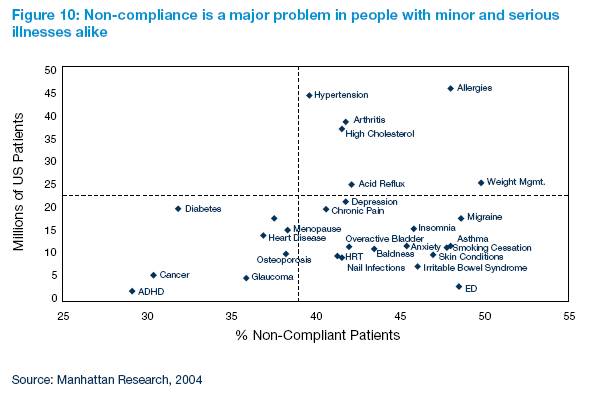
Non-compliance is a significant issue in healthcare.  You have the issue of whether people fill the prescriptions that their physician writes; whether they use them once they pick them up; and whether they continue to refill them and stay compliance over time.

You will hear several terms used:

  • Compliance is “the extent to which a patient acts in accordance with the prescribed interval and dose of a dosing regimen”. (source)
  • Medication Possession Ratio is the days supply of medication divided by the days between refills.
  • Persistence or length of therapy (LOT) is the number of days elapsed between the date of the first claim and the date when the days supply of the last claim is depleted.
  • Medication Possession Ratio (MPR) is the days supply of all fills minus days supply of last fill / days elapsed between first and last fill.
  • Adherence to therapy can be defined as being both compliant and persistant.
  • The medication ownership ratio (MOR) is calculated as the proportion
    of patients on each initial prescription on a given day. It was
    used to describe the percentage of patients within a treatment cohort
    who had the medication in their possession on any given day.

Here are a few good sources for information:

I found the following chart in PWC’s publication Pharma 2020: The Vision a good graphic.

noncompliance-pwc2020.jpg

Where Is “The Best Care”?

In a great post on the HealthBeat Blog, Maggie Mahar talks about research from The Commonwealth Fund called “Aiming Higher: Results from a State Scorecard on Health System Performance.” It provides a comparative state-by-state study of care in the U.S. (States in white are in the top quartile…ND, SD, NE, MN, IA, WI, ME, VT, RI, MA, HI.)

statehealthcarerankings.jpg

As she points out, the researchers used 32 indicators which look at “Access”, “Quality”, “Potentially Avoidable Use of Hospitals and Cost of Care”, and “Healthy Lives”.

She also goes on to talk about the lack of connection between quality and cost of care. She talks about research from Dartmouth Medical School that supports the data from this study.

“If insurance rates nationwide reached that of the top states, the nation’s uninsured population would be halved,” the Commonwealth report observes. “If all states could approach the low levels of mortality from conditions amenable to care achieved by the top state, nearly 90,000 fewer deaths before the age of 75 would occur annually. Matching the performance of the best states on chronic care would enable close to four million more diabetics across the nation to receive basic recommended care and avoid preventable complications, such as renal failure or limb amputation. By matching levels achieved in the best-performing states, the nation could save billions of dollars a year by reducing potentially preventable hospitalizations or readmissions, and by improving care for frail nursing home residents. If annual per-person costs for Medicare in higher-cost states came down to median rates or those achieved in the lowest quartile of states, the nation would save $22 billion to $38 billion per year. While some savings would be offset by the costs of interventions and insurance coverage expansions, there would be a net gain in value from a higher-performing health care system.”

As the economy continues to be challenged and with the election coming, this will certainly be an issue that those planning the future of our healthcare system need to analyze. There are lots of opportunities for improvement to the system, but we have to realize the challenge of aligned incentives within the system and external to the system. I predict it would take three election cycles (12 years) for us to make fundamental change. How we get politicians aligned and committed to something that outlasts them may be as difficult as changing the system itself.

Cigna’s Digital Coupon

Cigna recently announced some changes to their website. The one that caught my eye was the ability for a patient to print a coupon for a reduced copayment on their first fill of a generic drug.

I think it is a great step. My hope and questions would be as follows:

  • Is it to promote therapeutic switching or simply for movement from a multi-source brand to its chemical equivalent?
  • Is the coupon for anyone who is using a generic? Or is it only for new starts on a generic? Or is it only for those switching from a higher cost brand to a generic?
  • How do you drive awareness of the coupon and adoption of the web?
  • If all they really need is a coupon code, can you send it to their phone (much more likely to have it with them at the pharmacy)? Or could you trigger a fax to the pharmacy?

Anyways, I think couponing and incentives have a role in driving behavior, and it is good to see a MCO jumping into the digital age with this.