Archive | PBM / Pharmacy RSS feed for this section

Retail Rxs By State

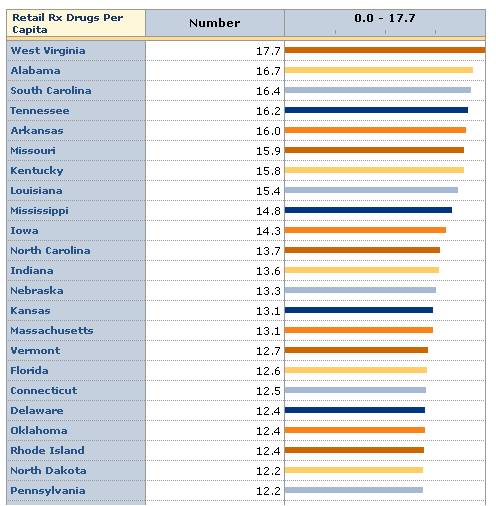
The Kaiser Family Foundation recently published an interactive chart that lets you look at the number of retail prescriptions filled in each state based on Verispan data.

This is interesting, but it doesn’t tell you much until tied to population or compared by disease state or some other metric.  So, here is their view by retail Rxs per capita.

There are lots of other data point out there by state for you to look at.

[BTW – Since I heard from one “ex-fan”, I will apologize for some distraction with the political process.  It is hard not to comment on timely events that will affect healthcare such as the US presidential race.  I appreciate readers interest in focus, but that’s not always possible.  Thank you for reading!]

They Charged The Wrong Insurance

Only a year late, I just got a notice from an insurance company telling me that we had several prescription claims processed under the wrong insurance card.  Apparently, they allowed our pharmacy to process claims for over 2 months after we had switched insurance.

Why is this my problem to deal with?  Shouldn’t the insurance company have responsibility for maintaining the eligibility file?  Shouldn’t the pharmacy have made sure my insurance was current?  Now, I have to either pay $300 or go back to the pharmacy and ask them to reverse out claims that are over a year old.

What a pain!  Of course, I am going to the pharmacy.  I had coverage so why would I pay out-of-pocket.

No Pharmacy Coverage – I Doubt It

In the AIS e-mail on Friday, it had the following quote:

“If the economy remains weak over the long term, we could certainly see employers and government agencies looking to investigate cutbacks on the type of pharmacy benefit they are offering, or eliminate pharmacy as a benefit altogether [in commercial plans]….The problem with [this] is that if an individual is unable to obtain their necessary drug therapy, you will typically see an increase in the overall health care costs associated with an individual.”

— Mesfin Tegenu, president of PerformRx, the pharmacy benefit manager division of the AmeriHealth Mercy Family of Companies, told AIS’s Drug Benefit News.

I must admit that I am more than a little skeptical of this.  The pharmacy benefit is the most used part of a benefit plan (average of 14 times per year).  Don’t you think there would be lots of other things cut back first?  Heck…I even see them cutting out 401K matching before they cut out prescription drug coverage.

Sure, it might get scaled back in terms of cost sharing or # of drugs covered, but that’s been happening for years.  But, elimination seems unlikely in a society that is very prescription drug focused.

Skip The Patch…Send Them To Church

“Overall, 21% of Americans interviewed in our Gallup Daily tracking program this year say that they smoke.  (By the way, that’s down from an all-time high of 45% back in 1954).

But the percentage of smokers is only 12% among those who attend church once a week.  Smoking rises to 15% among those who attend almost every week.  Then 22% for those who attend once a month, 26% for those who seldom attend church, and finally 31% among those who never attend church.” (see 7/31 entry on USA Today Gallup blog)

I am always fascinated by correlations such as this.  Who thinks of the null hypothesis to look at this?  (Null hypothesis being that people who go to church smoke less which is what they collected the data to prove or disprove.)

With smoking being a huge health driver, what can you do with this information?  It’s hard to believe your employer or health plan could drive church attendance.  Perhaps this gets us back to social networking and your peer group.  Groups of friends or others coordinating and talking about quiting smoking may be more successful if someone active in a church was part of the team helping them.  (I am grasping at straws here.)

Compliance is complicated

I am going to try a posting from my blackberry.

I just read this in the AIS newsletter and was surprised that this was news.

“Personally, I believe the reasons people take prescription medications are quite complex. There are a lot of motivations and issues in that, and copays may not, in and of themselves, be enough to change adherence and compliance.”
— Keith Bruhnsen, manager of the University of Michigan, Ann Arbor, prescription drug program, told AIS’s Drug Benefit News when discussing the need for research and data to support the idea that lower copays for essential services actually remove barriers to their use.

Gas Prices Helping PBMs

Unfortunately, the WSJ Health Blog beat me to it, but I think it’s an interesting perspective that apparently David Snow (CEO of Medco) talked about.  High gas prices cause people to reconsider things…like driving to the pharmacy or paying for brand drugs.  That would mean that mail order penetration should go up and people should use more generics.

It seems logical, but I am trying to reconcile it with two other economic realities…people not filling their prescriptions or skipping doses to save money and the fact that mail order requires upfront payment for the longer supply.  I have always struggled with why someone doesn’t offer a credit card for their mail order pharmacy so that you can save money and spread the payment over three months.  In tough economic times, that cash flow can be an issue.

And, for the first time in over a decade, it appears that the growth in prescriptions actually fell as reported on the 16th in the WSJ.

The burden on consumers has increased sharply. The average copay for a preferred drug on an insurance company’s tiered system rose 67% to $25 in 2007 from $15 in 2000, according to the Kaiser Family Foundation. Out-of-pocket costs to cover family insurance premiums were $3,281 per employee last year, up nearly 84% from 2001.

Consumers appear to be skimping on medicines as a result. An April poll from the Kaiser foundation showed 23% of patients who responded didn’t fill a prescription in the last year because of cost, up from 20% in 2005; 19% split pills or skipped doses, up from 16% in 2005. A report last month from the nonpartisan Center for Studying Health System Change in Washington, D.C., said 20% of respondents in a 2007 survey of 18,000 people had put off or gone without medical treatment in the previous year, compared to 14% in 2003.

Data from IMS Health show growth in prescription volume for the first five months of this year slowed to 1.5%, the lowest rate at least since 1996. From 2003 to 2007, annual volume growth averaged 3%. In December 2007, total prescriptions dipped by 2.1%. The decline was 0.2% in April and 0.1% in May.

New Drug Trend Blog

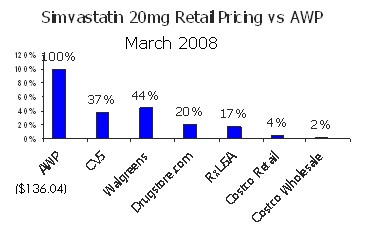
In a new blog called DrugTrendsToday by DestinationRx, you can find some good initial posts and some good data such as the following on generic Zocor (aka simvastatin).  What this shows you (that I have blogged about before) is the massive difference between AWP and actual cost for a generic.  In this case, the AWP is $136, but Costco pays 2% (or $2.72) for the drug.  This huge difference is only true on generics, but unfortunately, the industry has come to depend on generic pricing as the profit engine to subsidize the brand pricing which is some cases is a loss leader.

PBM Competitive Intelligence

TMA, a group that was doing a PBM study, called me with questions a few months ago.  They sent me some of the results of the work last week.  A few interesting observations from them looking at CVS Caremark, Medco, Express Scripts, Wellpoint NextRx, Prescription Solutions, Aetna Pharmacy, and CIgna:

  • Aetna was cited as having the best online capabilities.
  • Express Scripts was cited as having the best generic drug conversion.
  • Medco was cited as having the best disease management.
  • Medco was cited as having the best sales channels.
  • CVS Caremark was cited as having the best practices for implementation.

“As competition among PBMs is forecasted to remain high, customer service will continue to become more and more important as members/patients have greater expectations.”

Beating The Patient Over The Head

Something that I don’t normally do, but I am going to edit this after the fact to stress what the story really is supposed to be about since someone told me the original text might be offensive to a competitor that I respect.  The point is whether being pushy is worth it in some cases.

The other day a patient asked one of our people about a mail order order pharmacy where they had gotten a call every other day for the past 12 days about refilling their medication. Each message was slightly different – your supply of medication is about to run out, you need to refill your medication, your prescription has run out, etc.  The patient didn’t like the call program.

I found this an interesting debate…how pushy is good if you drive a desired outcome?  Also, we all obviously know that vendors and consultants don’t always make the decision so if a client tells you to do this even if it makes no sense, what do you do?

I think it makes for a good debate and had it with several clinical people:

  • At what cost is a better refill rate okay…especially since this doesn’t mean that they are compliant? Are you willing to drop your patient satisfaction by several points?  (We often used to give clients a report that showed savings per disrupted member or per drop in satisfaction at my prior employer.)
  • If the company is just driving up refills and can they do that without creating more waste?  This was a constant debate at mail.  One trick here is whether you base it on refill dates or days supply.
  • With this frequency of calls is there a chance that you actually get people that would have refilled to just wait for the calls to come and say yes?
  • If people take the call because they know you will keep calling them, is this actually better acceptance of calls or just being an “obnoxious salesperson”?
  • Are you calling people that have refilled at retail due to data latency issues?
  • Do you drive people back to retail?
  • Have you dulled them to future calls by upsetting them on this program?

Now, on a more clinical program, my opinion here might be different. If you could successfully get an overweight individual to diet by constantly reminding them. This might be okay. It’s an interesting debate.

Putting Your Kid On Cholesterol Drugs

I was a little surprised to see the news this morning claiming that it was okay to start putting kids as young as 8 years old on cholesterol lowering drugs and starting testing as early as 2 years old.  Talk about an obesity epidemic out of control.  I would think that there were lots of things we could be doing about diet and exercise to address this before setting kids up to be on these maintenance medications for the rest of their life.

Not a clinical opinion, but my personal opinion.  It makes me think of the social commentary delivered in the new movie – Wall-e – where the people don’t know how to walk anymore and just float around getting fatter and fatter.

What is a Mail Order Pharmacy (Home Delivery Pharmacy)?

My most popular post ever is “What is a PBM?” which made me think that this is probably a relevant post for the average healthcare consumer.  And, given the historical push to mail combined with the current economy, you can expect mail order pharmacy (or home delivery pharmacy) along with 90-day retail pharmacy to be a hotter topic.

At Silverlink Communications, we work with a lot of companies on their retail-to-mail (RTM) communications strategy and execution.  One of the first things I point out to all of them is that over 50% of people don’t usually know what mail order pharmacy is.  So, you have to address awareness at the same time as recruiting new patients.

So, for all of you that receive a letter or call talking to you about moving your prescription to mail order, let me answer a few of your basic questions:

  • Mail order pharmacies are also called home delivery pharmacies since they deliver your medications through the mail and directly to your home (or other address provided).
  • The mail order pharmacy is typically owned by either your managed care company (aka health insurer) or by a pharmacy benefit management company that your insurer contracts with directly to provide this service.
  • There is typically only one mail order pharmacy that you can use (i.e., is considered “in-network”).
  • The service is typically the fulfillment of 90-day prescriptions of medications which you will take on a long term basis (aka maintenance medications).  This is not true for controlled substances which typically only allow a 30-day prescription and for some specialty and injectable drugs.
  • You often have a financial incentive to choose mail order where you will get a 90-day supply for less than it would cost you to buy three 30-day prescriptions at your local pharmacy.  This discount is due to the buying power of the mail pharmacy, the automation which reduces the costs of dispensing the drugs, and the lower distribution costs (i.e., no need to move the drug to all 5,000 retail locations).
  • The drugs are the same drugs you buy at your local pharmacy.
  • You have the same access to a pharmacist but it is over the phone not face to face (which I personally prefer and think is more confidential).
  • You can do your refills over the IVR (interactive voice response) line and over the Internet along with traditional means of live agents and using snail mail.
  • These mail order pharmacies use robotics and other highly sophisticated solutions to dispense the drugs accurately and quickly.
  • Many of the mail order pharmacies that we work with offer services around calling your physician to get new prescriptions and also use our automated outbound calls to provide you with order status (WISMO calls – what is the status of my order) and refill reminders.
  • You shouldn’t typically start a new drug at mail order.  You want to wait until you have had two fills locally to make sure you are titrated to the right strength (i.e., your MD might switch your dosage initially so you don’t want to buy too much supply of a drug you might not use).

Are Involved Patients More Compliant?

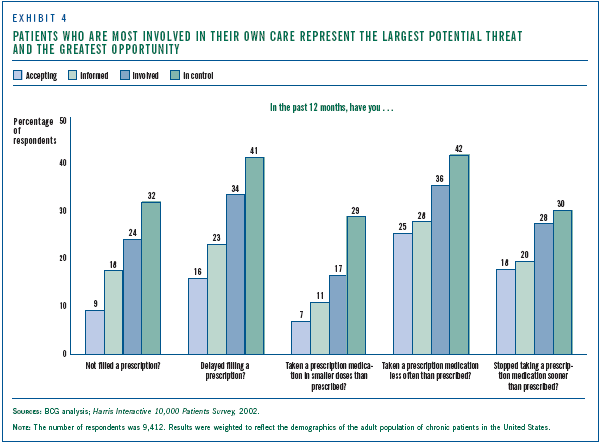
This is a study from a few years ago from Harris Interactive and BCG that I found on the BioPlus website.  If I am interpreting it right, it would imply that those that are most involved in their healthcare are most likely to be non-compliant.  It doesn’t seem logical, but perhaps those are the people that want to play doctor and are most likely to think they know better.

Why Can’t I Go To Any Physician?

In pharmacy, there is a rarely used benefit structure called Therapeutic MAC (Maximum Allowable Cost).  What this does is say that in any class of drugs (e.g., cholesterol lowering drugs) there is a maximum amount of money that will be paid by the plan.  But the individual can get any drug.

That can be controversial since a patient could end up being required to take a more expensive drug by their physician costing them a lot of money.  (Although most pharmacy plans allow for a clinical prior authorization in cases like this where they might pay less.)

My thought is why not do the same thing at least for physician visits.  If my health plan simply published statistics that said they will pay $100 for any visit to a physician’s office.  I could then go to any physician and that physician would know they were going to get $100 for my visit plus whatever they charge me.  It would eliminate a whole process of constantly managing the network and focus patients on the price that their physician charged.

I am sure there is something that I am oversimplifying, but it seems logical.

Would You Pay $100 To Be Told To Take Your Rx?

We know adherence is a serious issue that drives healthcare costs.  And, as I have talked about a little here and a lot with many of our pharmacy clients, it’s not a simple issue.  People aren’t adherent for a variety of reasons – cost, side effects, health literacy, or simply just forgetting (among others).

There are lots of tools out there to help you organize your medications and manage them.  Whose job is it to help you – yours, your physicians, your managed care company, your pharmacy, your pharmacy benefit manager?  Obviously, you (the patient) have the primary responsibility.  After that, your pharmacy is best positioned to help you with this.  But, the managed care company stands to benefit the most by preventing serious medical conditions associated with non-compliance.

So, I was a little surprised to see a new company come up that offers to send you calls, e-mails, or text messages to remind you to take your medications.  And, you can even talk to a pharmacist.

Let’s break this down:

  • Whatever pharmacy you use (mail, retail, specialty) will offer you consultation with a pharmacist for free.
  • I believe most pharmacy benefit management (PBM) companies offer automated e-mail reminders that you set up yourself off their website for free.

I don’t know why I as a consumer would pay for this.  And, it seems pretty high for a managed care charge.  If I went to a client of ours and told them I would send messages to patients for $100 PMPY (per member per year), I think they would choke on that price tag.

So, will it work??  Who knows?  I have been surprised by business models before.

Tier Zero

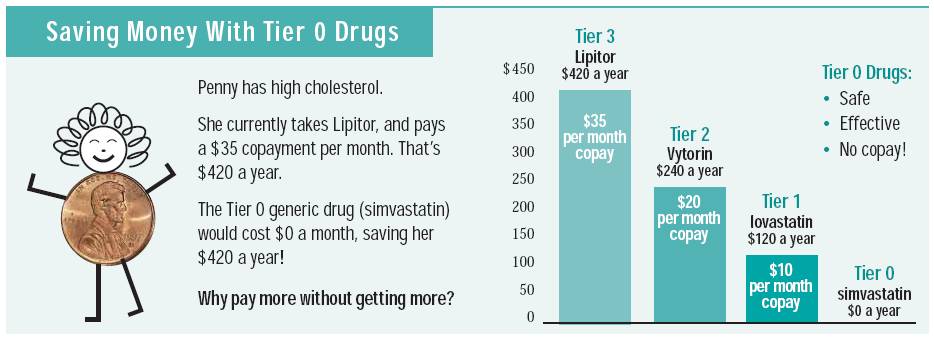
Frank Koronkiewicz, the Director of Pharmacy, at Blue Cross of Northeastern Pennsylvania (BCNEPA) just launched a new plan where people can get 65 different generics focused on chronic diseases at no copay AND without any premium.  It’s called Tier Zero.

Frank has always been a progressive Director of Pharmacy.  We worked on several programs together at Express Scripts.   You can also find some of their collateral and videos on generics on their website – click here.

It would be interesting to look at the overlap between these drugs and the Wal-Mart list of drugs, but I think you would find that an individual could have a pretty comprehensive benefit of generic drugs between these two solutions with low out-of-pocket (OOP) costs and no increase to their medical premium.  A compelling story to many.

Brand Prices Up; Generics Down

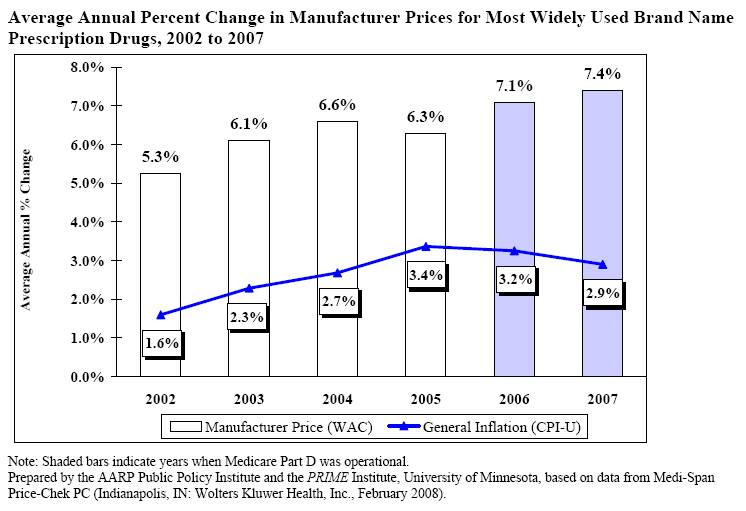
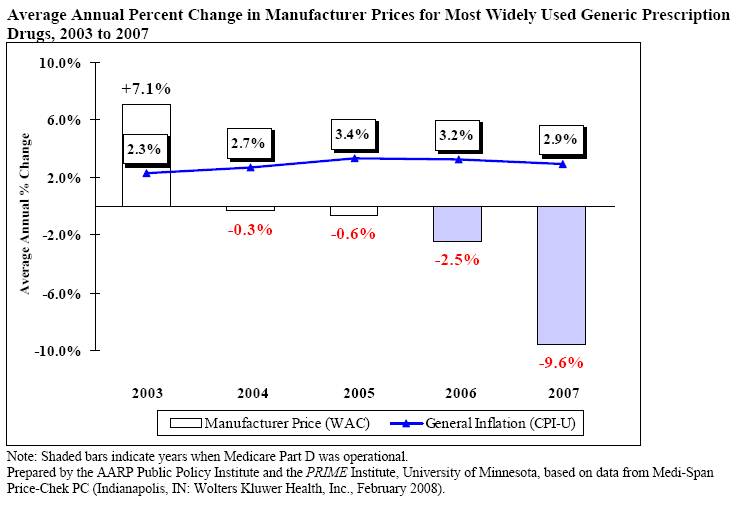
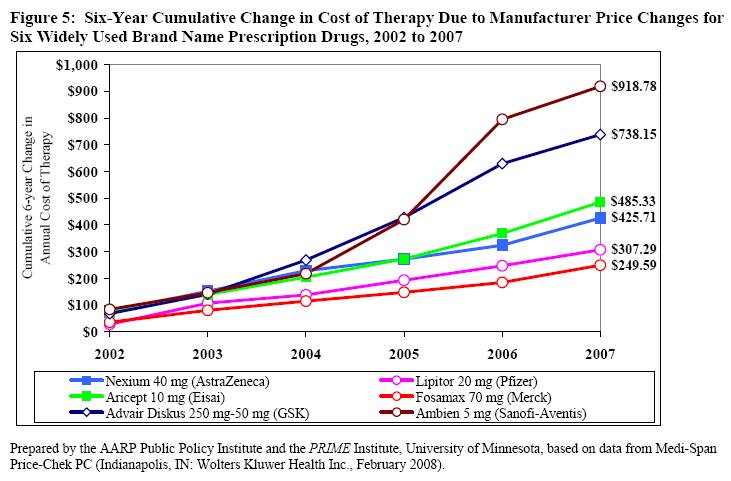
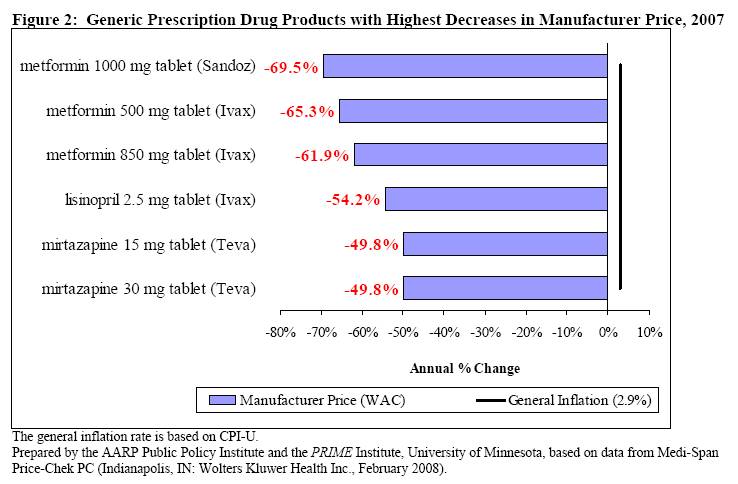
For those of you who are interested in this type of stuff, I think the AARP Watchdog reports (Brand Report, Generic Report) which track prescription drug prices over time are pretty interesting.  (Note: This is for drugs most commonly used by Medicare recipients, but I think you’ll get the point.)

Why People Choose Mail Order Pharmacy?

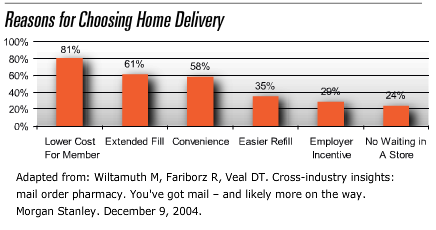
I was looking for something else in the Express Scripts Drug Trend Report 2005 when I came across this study referenced on page 209. I should have remembered since I wrote this section (yes I was a contributor see page 332). This is a Morgan Stanley study which talks about why people choose mail order pharmacy. Of course, the primary reason here is savings. The more savings the higher the likelihood of a person moving to mail order. This is a factor of savings per Rx multiplied by the number of maintenance drugs that an individual has that can be filled at mail order (or home delivery). This study shows the frequency of the response. If you focus on the weighted scores, you would see a dramatic cliff after savings. (I.e., 61% of people may choose mail for convenience, but they are much less likely to do it than someone with significant savings) So, why don’t all PBMs communicate exact patient savings to each individual? It’s hard. Given minimums and maximums; deductibles; percentage copays; and other benefit plan designs, the systems are stressed to produce this.

Sell Your Captive PBM – Why?

I was a little surprised by the quote from Lisa Gill from JPMorgan Chase about why health plans should sell their in-house PBMs (Pharmacy Benefit Management):

“I think it makes a lot of sense for PBMs [pharmacy benefit managers] to be sold or spun off as a stand-alone business. The only time it will make sense for a managed care company to actually own a PBM is after they move to real-time [medical] claims processing. And that’s not going to happen near term.”

Maybe I am missing some context here, but I don’t understand.  Why would you have a “captive” PBM (i.e., owned by a managed care company)?

  • Able to align total healthcare interests (e.g., drive Rx usage up to manage ER visits)
  • No conflicts of interest (real or perceived)
  • Able to keep margins of the PBMs (look at the stocks of Medco, Express Scripts, and CVS Caremark)
  • Manage the customer service experience

What does any of this have to do with real-time claims access?

Why would you use a standalone PBM?  (Again an easy decision)

  • Economies of scale on rebates
  • Mail order pharmacy efficiencies
  • Manage capital outlays
  • Get a dedicated focus on pharmacy which as only 10% of the total healthcare spend will be a stepchild under a managed care plan no matter what
  • Best practices being leveraged across companies

And, we all know from bidding on RFPs that managed care companies use this service to win business talking about the integrated solution and underwriting pharmacy with medical.

If you understand the rationale here, help me out.

Express Scripts Jumps Into Worker’s Compensation

Express Scripts has been in the Worker’s Compensation space for years now.  As I suggested several months ago (see #2), buying a worker’s compensation PBM makes some sense.  The margins are good, but it does require a different service model.

That being said, they jumped in last week with the announcement to buy the worker’s compensation PBM business from MSC down in Florida.  It would have been intriguing to see them buy the other ancillary business that MSC has to get their footprint a little bigger.  Now, this can go from being someone of a stepchild for Express Scripts to a major business unit.  As Joe Paduda points out in his blog post, they have good teams at both organizations so they should be able to make some things happen in the market with a focused team, financial resources, and some efficiencies.

Given that fact that PMSI has been on the block, this may create a reason for a Coventry or a CypressCare to step in and buy them to gain more marketshare to take on Express Scripts.

George Paz (Express Scripts) on Adherence

Paul Levy who is the CEO of a hospital has a blog called Running A Hospital.  He posted a summary the other day of a presentation by George Paz who is the CEO of Express Scripts.  It has some good facts and there are several good comments on there about defining the terms in this area (see my old post) and whether these are reasonable rates of compliance.  There is also a patient commenting about getting nurse calls and reminder e-mails which sounds great but puts them in the 1% of the population for which this happens.

The numbers do seem understated to me – 85% compliance with cholesterol lowering drugs.  That might be the amount of people that get a paper prescription and then fill the drug or it might be the amount of people that get one refill, but I believe by month 6 or certainly by month 12 most compliance rates are closer to 50%.

There is clear value in adherence.  Everyone should (in key therapeutic categories and using evidence-based standards) want to increase adherence to reduce total medical costs.

What surprised me most recently around this was what Kaiser had observed when looking at how doctors shared information with patients (Archives of Internal Medicine, Sept 2006):

  • Only 74% of the time did the physician tell the patient the name of the prescription drug
  • Only 35% of the time did the physician discuss adverse events with the patient
  • Only 58% of the time did the physician explain the frequency and timing of dosing

More On Silverlink’s Think Different Event

I am now up in Minneapolis at our 4th Think Different event on how to engage the healthcare consumer.  I talked about the first few speakers the other day, and I finally had a chance to hear the other speakers present.  This week, I had the chance to listen to  James Taylor (of Smart (enough) Systems fame not music) and Fred Jubitz (American Express).  Here are a couple of my takeaways.

[Again, if you are coming to the upcoming events, this might be a little bit of a spoiler.]

A few notes from James’ presentation:

  • He gave a great example of a program they did at Fair Isaac where they compared the standard, baseline program with one that was highly personalized.  What was the improvement – 2,000%!!
  • He gave a good real-life example of the need for channel coordination talking about buying tickets for the Chunnel and how he got different prices on the web and phone which were also different from the prices his father in England got using the same channels.
  • The Chunnel example reminded me of something that someone told me the other day.  They were using the Dell self-service example and pointed out that Dell now uses real-time chat right before you buy.  They have found that this increases the average sale by 15%.
  • The Chunnel example also made me think about how web technology allows us to do a lot of customization by visit, but most companies don’t do this.  At the simplest level, I remember a competitor of Firepond (previous employer) where if I visited their website from work it looked one way and from home looked different.
  • James talked about ATM customization as an easy example.  How much money do you normally take out.  Only showing you services that you have access to.  Some of this is starting to happen, but not much.
  • He also talked about rules creation and how that varies.  I think it is always interesting to trace the evolution of rules and policies within a company.  Are they there because of regulatory issues?  Is it because someone coded the legacy systems that way?  Is it based on a personal interpretation?  Or are they dynamic and regularly reviewed?  One of the worse examples that I have ever seen was a large healthcare company that believed that HIPAA required them to re-code everything as it moved from development to production.  (A very costly error in interpretation.)
  • He also talked about the evolution of interactions:
    • Automate decisions
    • Apply rules
    • Segment customers
    • Predict risk and value
    • Optimize
  • James hammered home the point of never stopping to try to optimize since as the environment and your customer base change the optimal solution might change.

Fred who ran the gold and green cards at AMEX talked about:

  • American Express really wanted to be a lifestyle enabler not a payments company.
  • He talked about the Centurian Card (black AMEX card) which apparently is able to charge $5,000 initiation fee plus a $2,500 annual fee.  (Surprising that people still pay it, but I have heard examples of people buying a plane with their black card so I guess that level of service requires something.)
  • He gave examples of how companies think about cards and showed a lot of affinity cards which made me think about groups and how people like to affiliate with others (e.g., by diseases).
  • He talked about the importance of several things:
    • Know your audience
    • Key metrics
    • Segmentation
    • Personalize
    • Continuous improvement
  • He showed the standard framework for segmentation looking at size of wallet (i.e., how much you charge / spend per year) versus their share of wallet (i.e., how much of that is with AMEX).  Each box on the grid then had a strategy – invest, retain, focus, divest, etc.
  • He showed a lot about how the financial services companies can personalize the web experience, but he pointed out that this took months to develop as they built up your profile.
  • I think a key point he made relative to healthcare is that a lot of a new member’s behavior was determined in the initial months which led to how they used their card.  He gave an example of his blackberry.  The first couple features he learned are all he uses.
    • What are you doing in the initial months to “train” your members or be trained by your healthplan to use the website and leverage other ancillary services (e.g., gym membership) that they might offer?
  • He stressed evolving your segments but not starting over each year or you will lose some of the lessons you have developed.
  • Finally, as you always want to stress, he said to keep it simple.

Additionally, you can see some of Matthew Holt’s comments about the event at The Health Care Blog (here and here) and Les Masterson’s comments in The Health Plan Insider.

NCPA Survey on Adherence

I have been talking a lot about adherence lately (or lack of). A friend sent me the results of a survey of 1,000 adults by NCPA (National Community Pharmacy Association) from October 2006. This is now the 3rd study I have read this week with different results. Of course, they all used different channels – web, mail, and phone. And, I am sure that the questions asked were slightly different.

  • While most consumers believe they are highly compliant when it comes to taking their prescription medications (64% said they follow their physician’s instructions “extremely closely”), the survey found they are not as compliant as they believe.
  • Nearly three-fourths (74%) of respondents admitted to non-adherent behaviors in the past.
  • Nearly half (49%) said they had forgotten to take a prescribed medication.
  • Nearly one-third (31%) had not filled a prescription they were given.
  • More than one in 10 (13%) had taken someone else’s prescription medicine.
  • Nearly one-quarter (24%) had taken less than the recommended dosage.
  • Nearly three out of 10 (29%) had stopped taking a medication before the supply ran out.
  • More than one in 10 (11%) substituted an over-the-counter medication instead of filling the prescription they were given.
  • Nearly four out of 10 (38%) had forgotten whether they had taken a medication.
  • Less than half of respondents (48%) said they had consulted their doctor or pharmacist before making these changes.
  • An overwhelming 90% of respondents saw non-adherence as a serious problem.
  • More than eight out of 10 (83%) respondents agree that pharmacists can play a role in improving adherence by helping to make sure patients are taking their prescription medications correctly.
  • More than two-thirds (68%) believe pharmacists are more knowledgeable than other health care professionals when it comes to information about prescription medications.
  • Two-thirds (66%) go to one pharmacy for their prescription medications, which presents an opportunity for pharmacists to advise patients how to take their medications properly.
  • Nearly nine out of 10 (86%) say they would be likely to talk to their pharmacist about their medications.

PBM Satisfaction Survey

It should be out soon, and it will be interesting to see the data. The WilsonRx PBM Satisfaction Survey is the only (I think) independent survey done of the industry. [Although I never remember paying attention to it at Express Scripts.] From what I know, they seem to get a good sample of more than 25,000 responses rating 18 PBMs (Pharmacy Benefit Managers).

Some of the new factors they are including:

  • Overall Medicare costs and availability
  • Annual increases in premiums or costs
  • Overall delivery of pharmacy benefit services
  • Courteousness and helpfulness of PBM plan representatives
  • Ease and timeliness regarding conversations with a PBM representative
  • Ease and ability to access prescription records and order refills
  • Resolution of denied drug claims or appeals
  • Overall quality of care
  • Adequate coverage of treatment medication needs
  • Personalized care for Rx needs

They seem like logical factors, but some of them aren’t controlled by the PBM but by either the self-insured employer or the managed care company (1, 2, 9). Depending on the service model, several others may be done by the managed care company (4, 5, 6, 7). And, I have no idea of how they are going to gauge things like overall delivery (3); quality of care (8); or personalized care (10). I hope they at least look at how responses vary by high utilizers versus low utilizers (of drugs) along with the type of coverage (which I doubt the individual knows whether their pharmacy coverage is through Aetna’s PBM or Medco (for example)).

Walgreens Health Initiatives (WHI) won the award last year and is certainly building a very competitive offering:

  • A goal of 10,000 retail locations
  • Mail pharmacy
  • Specialty pharmacy
  • 90-day at retail
  • On-site (or worksite) pharmacy
  • PBM

“While we already knew from our own surveys that members are highly satisfied with the wide selection of innovative products and services we offer, it was gratifying to have it confirmed by an independent third-party,” according to Richard Ashworth, Pharm.D., MBA, executive vice president for WHI, a wholly owned subsidiary of drugstore giant Walgreen Co.

He believes member satisfaction ultimately boils down to choice and convenience, noting how a 90-day medication option at the retail level serves as an important mail-order alternative for those who prefer face-to-face consultations with a pharmacy team they know and trust. Of WHI’s national retail network of more than 62,000 pharmacies, more than 39,000 offer this option and the number continues to grow.

Walgreens also offers worksite pharmacies on many corporate campuses across the U.S., which encourages employees to be more proactive about their health and, in turn, helps reduce absenteeism and the overall health care spend. Serving just one employer allows pharmacists to focus solely on that particular patient population, maximizing plan design and wellness strategies as part of a tailor-made approach to comprehensive care.

Pharmacists can help engage, educate and empower employees, as well as provide informed feedback on clinical prior authorizations, therapy-specific programs or the impact of formulary changes on medication options. There’s also room for leveraging a company’s core cost-containment strategies by promoting generic utilization, formulary efficiency and other key clinical programs whether or not WHI is the plan’s PBM. (Text from article by Employee Benefit News)

You Only Have To Be Compliant For 10-Days…What Happened?

On the topic of non-compliance, I found this a pretty pathetic statistic:

56% of children on a 10-day course of penicillin for streptococcal infections were no longer receiving the drug by day three. (The Merck Manual of Diagnosis and Therapy)

I guess I expect it with maintenance drugs, but this is for your sick kids where you have already purchased the medication.

Our First Think Different Event

Today was our first Think Different event in Boston. This is a road show we are doing around our new positioning and how health care companies need to get outside the box to improve the effectiveness of their communications. It has four external speakers plus our CEO.

[Spoiler Alert: If you are attending an upcoming session, I may reveal some of the content here.]

I missed ½ the session today due to a client call, but I will be at 3 of the other 5 events. In listening to the first two speakers, I jotted down a few thoughts.

From Kinney Zalesne:

  • She spoke about moving to the Starbucks economy and how we have much more choice today in what we do, who we love, religion, and our gender. Everyone immediately thinks of gender meaning sex change operations, but the point here is that there is a group of people who don’t want to be forced to select a gender identity. Before you discount it, you should know that 100 corporations, 75 colleges, and 8 states now ban discrimination based on gender identity. This was a bit of a surprise to me, but when I was talking with a large health plan about this, they informed me that their new EMR (electronic medical record) allowed for 5 possible gender options.
  • She talked about people basically starving themselves to focus on the theory that has been demonstrated in animals, but not yet in humans which says that by eating 30% less calories you can extend your life by 40%. (Not something I will be doing.)
  • She talked about the Do-It-Yourself (DIY) Doctors which are the people who use the Internet to self-diagnose and treat the MD as an ATM for drugs (i.e., I need a prescription for simvastatin can you please write it for me). I have heard a lot of talk recently about the changing perception of physicians. I haven’t seen the statistics, but one person said that they have lost the most respect over the past 20 years than any other profession. I think Kinney’s point is more about them moving from being a supervisor role (i.e., you should do this) to an advisor role (i.e., thanks for your opinion…I will take it into consideration).
  • Her statistics about 5M working retired (i.e., >65 years old) and 2M working teens (i.e., using the Internet to make money before they leave high school) says a lot about how benefit design will need to change. The implications on needs and flexibility (e.g., imagine two primary addresses for snowbirds) could be significant.
  • In her talk about micro-targeting, my mind drifted to a few thoughts:
    • How has gas prices changed our opinion of other costs? A $15 copay used to be equal to 7 gallons of gas. When it only equals 3 gallons of gas, do we view the $15 differently? [Have you caught yourself saying gas is only $3.75 at this one station near my house?]
    • Just like your segmentation can change in healthcare, it is important to consider the macro-economic and political environment when communicating. Have you listened to all the car advertisements lately…they all talk about gas mileage?
    • If you need a simple example of why personalization matters, think about buying a car. I am not a mechanical person so if I came in and someone talked to me about horsepower and cylinders then I would be turned off. I care about comfort and low maintenance.
    • Finally, getting back to health, I thought about how difficult it is to be successful. Let’s assume there were 10 primary reasons for non-adherence and 3 primary channels for delivering information (live, letter, automated call). In this case, you have 10% chance of hitting the right message and a 33% chance of using the right channel (i.e., a 3% chance to be successful).

From Liz Boehm:

  • She shared a lot of great facts about patient awareness of technology and how adherent they are.
  • She points out a scary fact that while our health care needs are going up with the boomers we simultaneously have an issue with health care workers retiring which will only make things worse in the short term.
  • She showed that 47% of people had visited their health plan’s website. [I will have to push her on this data since I believe they visited, but I think the percentage that log-in and use the site has to be very small. I would estimate 10-15%.]
  • She talked about use of social media and gave an example of a MySpace group on diabetes.
  • I found the discussion on wellness very interesting where she pointed out that things like chocolate, riding an elevator, or for some smoking gives you an immediate positive feeling while dropping your cholesterol by 10 points or even trying to lose 1 pound per week is pretty abstract.
  • I have talked about loss aversion several times, and she talks a lot about it. Using it to make a link to why incentives matter in health care.
  • Talking about motivation, I like her point that it isn’t a reasonable suggestion if you can’t achieve it. It may make good clinical sense to have a BMI of <25, but for someone with a BMI of 31, perhaps setting a goal of 28 is more reasonable and not as discouraging.
  • In her talk about trust, it made me wonder how many people that work for managed care companies and pharmacy benefit management companies reveal that fact at cocktail parties. I am not talking about professional networking events, but your neighborhood events. Do you say who you work for and address their comments about service and/or coverage issues?

I finished my client meeting in time to hear Stan Nowak, our CEO and co-founder, speak and tie together the different points of view with some potential actions that people could take. As he often does, he talked a lot about the power of data and the fact that what’s new to health care is often old in other industries. We are an industry with the most data about people, but the least ability to use it effectively.

It’s also interesting to hear him talk about some of the “data exhaust” that is created by the analysis that the team does. These are facts that get revealed which may be surprising and may be things you never even thought to look for. For example:

  • Patients with emphysema are 40% more likely to engage in a communications program related to additional coverage than patients with migraines.
  • Patients with uncommon names are 18% more likely to complete a healthcare survey than those with common names.
  • Males with depression are 83% less likely to do pill splitting than females with depression.

Groups And Microsegments

When I was listening to Kinney Zalesne (Microtrends author) present this morning at our Think Different event, there were several things that crossed my mind:

  1. Which micro-trends am I part of?
  2. How much micro-targeting is too much?
  3. Will consumers self-identify into groups?

Without going back to the whole book, I can think of several micro-trends with which I associate:

  • Marathoning
  • Stay-at-home worker and extreme commuter
  • 30-winker (don’t sleep a lot)
  • DIY Doctor (research my own care)
  • Pet Parent (pamper my dog)
  • Video Game Grown-ups (enjoy playing Wii w/ and w/o my kids)
  • Blogger

It has come up in the past two sessions where I have seen Kinney present. The question is how much is too much. Just because I know that you like cats, subscribe to Popular Mechanics and GQ, and have 3 siblings, should I use that information?

  • I certainly think that more targeting is better although I might not always want you to tell me how much you know about me.

  • You have to be flexible enough to allow for mistakes in interpretation and/or not too presumptuous. (For example, one of our co-founders is from Brazil but has been here for years. He recently started getting all of his communications from a few companies in Spanish. He didn’t opt-in, but they assumed his last name meant he spoke Spanish (which is not what they speak in Brazil BTW).)
  • You have some issues of parity which must be either addressed or are legally required (i.e., you may have to treat everyone in a similar way). I am sure we might all like to drive high satisfaction for healthy members to increase their retention, but this deliberate adverse selection would be an issue and abuse of information.

Finally, there is a lot of discussion about capturing preferences (i.e., I prefer calls over letters) and how to segment populations. I think there is an interesting trend in social media for people to self-identify into groups. For example, I pulled up my LinkedIn profile to look for a second at all the groups to which I belong. The same thing is happening in Facebook. Until recently, this was not a huge driver of activity, but over the past 6 months, I have noticed people forming and joining groups. We want to be associated with certain things. I think if I knew how the information was being used that I would spend a few minutes during enrollment filling out information about how and when to communicate and interact with me. I think I would even reveal my Myers-Briggs category (INTJ) if it helped someone better deliver information to me that would make me healthier.

The younger generation is rapidly becoming used to revealing lots of information about themselves. I don’t think that things are considered as private as they once were.

Express Scripts Settlement on Statin Switches

I don’t know the insider details, but I am certainly familiar with the original program in 2005/2006 which targeted users of 3rd tier branded cholesterol (statin) drugs to get them to move to a lower cost agent which could either be a brand or generic drug on formulary (obviously wanting it to be the generic).

Apparently Express Scripts settled with 28 states for $9.5M associated with their program.  I would guess there were several issues:

  • Switches within this class might require follow-up physician visits and/or lab work to be done.  That could increase copays for the patient and/or drive up plan costs.  How clearly that was explained could be an issue?
  • Depending on timing some of these switches might have occurred right when Lipitor was moved off formulary.  It would have then been more expensive for the plan sponsor, but I believe all the clients would have signed off on this knowing that they would save money over the initial 12-month period.
  • Depending on when this is from, they moved Lipitor back on formulary for 2008 which might mean some people were bounced around different formulary agents.  (But, I can’t imagine this was already identified and settled.)

It basically appears to be a communication issue.  Was the right information disclosed to the right person at the right time with the right amount of detail?  And, even if it was, is it worth fighting it?

From a patient perspective, I would hope that this doesn’t prevent my health plan / PBM from reaching out to me to tell me how to save money.  I spend a lot on health care each year and hate to believe that there aren’t ways to save money.

From a PBM / plan perspective, I wouldn’t be discouraged.  This just continues to clearly layout the rules about what needs to be done.  There are still plenty of opportunities, but they need to be designed the right way with the right information included in the communications.  There is nothing there that is not achievable or unreasonable.

Missing The First Step

When I saw Forrester’s data around Personal Health Records (PHRs), it reminded me of one of the facts we struggled with around increasing mail order utilization…most people didn’t know what it was or whether they had it as a benefit.  (From their Q2 – 2007 Social Technographics Online Healthcare Survey)

So, given all the buzz about PHRs and which one will work and what needs to be included, I wonder if we often miss the first step as people in the industry.

The first step in any “marketing” or communication approach has to be to build awareness.  Although it might sound great to say that I have 80% of chronic drug users that are aware of their mail order benefit using mail order, I am not maximizing the size of the pie.  (I.e., 50% have chronic medication x 50% aware of mail x 80% use mail = 20% penetration)

Book Review: Health Care Reform Now!

Health Care Reform Now! A Prescription For Change is the latest book by George Halvorson (CEO of Kaiser Permanente). I have been talking about it and using quotes from it for a few months. I finished the book a few weeks ago and figured that I better carve out the time to capture my thoughts now.

First, if you are looking for a great book on why healthcare is a big issue in this election, you don’t have to look any further. As someone running one of the biggest healthcare entities in the US, George clearly knows what he is talking about and speaks from a position of authority. I know that he has talked with all of the candidates about their policies.

If you are in healthcare and trying to be a catalyst for change, you have to read the book. It is pointed, opinionated, and supported with lots of facts and examples. If it doesn’t make you want to change what we have, I would be shocked. Some of the examples of mis-alignment are scary.

Some of the facts he shares:

  • Family health insurance rates in CA already exceed the per capita income of 147 countries.
  • General Motors now spends more money on healthcare then on steel.
  • Nearly 50% of the time, patients in the US are receiving less than adequate, inconsistent, and too often, unsafe care.
  • Healthcare costs are unevenly distributed in America.
    • 1% of the population uses 35% of the healthcare dollars
    • 5% uses 60%
  • Care linkage deficiencies abound – and can impair or cripple care delivery.
  • Economic incentives significantly influence healthcare.
  • Systems thinking isn’t usually on the healthcare radar screen.
  • Most of our costs are for chronic diseases – primarily diabetes, congestive heart failure, coronary artery disease, asthma, and depression.
  • Prevention is a lot less expensive than addressing these chronic diseases at their late stages.
  • The US ranks 35th in the world in infant mortality.
  • We could cut the complications of diabetes by 90% with best care and involved patients.
    • We could cut second heart attacks by 40%.
    • We could cut school and work days lost because of asthma by 90%.
  • Incentives work…yet while we have 9,000 billing codes for procedures and services not one of them is for curing someone or improving someone’s health.
  • There is up to a 60% difference in the 5-year mortality rate for breast cancer patients, depending on which hospital’s surgery team did the surgery.
  • 1 in 10 doctors use electronic medical records (EMR) and only 5% of hospitals use computerized physician order entry (CPOE). This means our history exists mostly in paper files with no standards.
  • Almost 50 developing nations have higher immunization rates for preventable childhood diseases than the US.
  • The Institute of Medicine showed that it takes “seventeen years before a proven new technique becomes the standard of care in a given medical specialty.”
  • There were 2,000 published clinical trials in 1985 and 30,000 published in 2005. (Can your provider really keep up without an electronic system?)
  • Diabetes is the number one cause of new blindness (90% preventable) and foot and leg amputations (85% preventable). It is the number one co-morbidity associated with death from heart failure.
  • Asthma causes – 2M emergency room visits, 500,000 hospital stays, 5,000 deaths, and 14M lost school and work days per year.
  • The vast majority of asthma attacks can be prevented.
  • If Americans were 5-10% thinner and walked just 30 minutes per day, the incidence of Type 2 diabetes could be cut by more than half. (Culture and incentives matter)
  • We spend $250,000 every minute on heart disease.
  • More than 15M Americans have depression…and on average, people with depression have 3 other chronic diseases.
  • A 10% reduction in spending for the top 0.5% of patients would create enough savings to fund universal coverage for the uninsured.
  • The most expensive acute conditions are cancer, maternity, and trauma care. (Acute conditions account for 30% of the health care spend.)
  • The median life expectancy across the 117 cystic fibrosis centers is 33, but it is 47 at the highest performing center. (This seems embarrassing that there could be such a difference here.)
  • US employers pay an average of $6,600 Per Employee Per Year compared to $600 in Canada.
  • 4% of people believe they have insurance…but they don’t. (Who are these people?)
  • Government pays 44% of the healthcare bill today; employers 26%; and individuals 30%.

Key Point – I think everyone wishes that we could address the uninsured and underinsured issue here in the US. It is ridiculous. But, I think most people feel it would further complicate the economy and be a downward drag. George presents a good case that today’s model simply cost shifts so that we are paying for care but paying at the high cost of emergency care not preventative care for those people. In the book, they say that this cost represents $922 per employee today in what is paid. Someone has to pay the providers for these real costs that they incur and can’t recoup. We could cover the costs of the uninsured without any real increases in costs.

Some of my favorite quotes:

  • “We don’t really have a health care delivery system in this country. We have an expensive plethora of uncoordinated, unlinked, economically segregated, operationally limited Microsystems, each performing in ways that too often create suboptimal performance both for the overall health care infrastructure and for individual patients.” (introduction)
  • “Performance reporting that actually exists about either processes or outcomes is almost always regarded in the current culture of American health care as an onerous, externally imposed burden, extraneous and irrelevant to the actual business and profession of care delivery.” (pg. 23)
  • “I do not want ‘rules-based’ medicine. I do want accountable care.” (pg. 29)
  • “Process reengineering will not happen on any scale in health care until there is a financial reward for doing just that.” (pg. 33)
  • From the book Escape Fire: Designs for the Future of Health Care by Don Berwick – “A patient with anything but the simplest needs is traversing a very complicated system across many handoffs and locations and players. And as the machine gets more complicated, there are more ways it can break.” (pg 86)
  • “We need highly credible doctors, nurses, and health educators talking to patients in targeted and effective ways to help people make the lifestyle changes necessary to avoid diabetes.” (pg 117)
  • “Health care can be improved. The challenge is to do it consistently and systematically, not incidentally and haphazardly.” (pg 122)
  • “Improving care by 50 percent for diabetics is wonderful, but not as wonderful as reducing the number of diabetics by 50 percent by preventing the disease.” (pg 206)

Comments:

  • He talks about studying the international models and that none of them are the same. They have all been individually developed to fit the culture and needs of the country.
  • He talks about creating a “patient-centered American health care marketplace”.
  • He is careful about not just pushing the Kaiser model of vertical integration. He focuses on virtual integration which is more achievable.
  • More care is not better care.
  • He gives several examples of how following best practices for evidence based medicine improved outcomes but reduced revenues for the providers which is a hard model to sell.
  • He compares HEDIS scores (which measure how often health plans offer care that complies with best practices) with Six Sigma:
    • Average performance for screening for colorectal cancer is 49% (or 1.5 sigma).
    • Recommended treatment of acute depression is 61.6% (average) and 70.8% (90th percentile) which are 1.8 and 2.1 sigma performance.
    • Note: 2-sigma performance means 308,000 cases of non-compliance per million patients…6-sigma means only 3.4 cases per million.
  • He talks about the fact that 5% of patients experience an adverse drug event. I think the PBM industry has consolidated a lot of data to minimize this, but I am surprised more people don’t talk about samples here. Although they are supposed to track samples, I bet most physicians don’t record them in the chart and they certainly aren’t electronically managed to look for potential drug-drug interactions. (In my opinion, there is still opportunity for improvement, but it is at the pharmacy level not the provider level.)
  • He proactively addresses one major excuse about controlling patient behavior. Yes…we can’t control the patients, but we can make sure that the right events happen to align them for success.
  • I like his suggestion that a personal health record could be a more logical first-step than a full blown EMR solution due to costs and ability to execute.
    • “That personal health record data set for each patient should show all care received by that patient, all prescriptions paid for, all tests given, all diagnosis made, and all providers who delivered care to each person as a patient. The information should be in an easy-to-use format and available to each patient on demand, either electronically or on paper.”
  • He provides a good, quick comparison of PHR and EMR:
    • EMR has the exact Rx dosage and level. PHR may just have the name of the drug.
    • EMR will have the x-rays and scans. PHR will just say the date the test was done.
    • EMR will have notes from physician visit. PHR will just know the patient visited.
  • Preventing a CHF (congestive heart failure) crisis might only generate $200 in billable revenue while treating a crisis creates $10,000 – $20,000 in revenue. (And, we really wonder why people aren’t acting preventatively.)
  • Preventative care makes me think of two examples:
    • People have to want to be healthy and manage their risk. I know numerous people who are told to be on bed rest when they’re pregnant that don’t listen to their physicians.
    • People have to know there is not a risk of discrimination. I know a friend with MS who didn’t go see a doctor for several years until she had found a job with good health insurance.
  • He talks a little about it, but I think the issue of helping patients evaluate trade-offs is a big one. Enabling them with information is important, but how do we help them compare two treatments based on both outcomes and the experience (i.e., pain, functionality). Is it always better to simply live longer even if you have limited functionality and are always in pain?
  • He talks about plan design with some very good insight:
    • Deductibles only work if the unit of care being purchased is less than the deductible.
    • Deductibles tend to discourage chronic patients from getting preventative and maintenance care.
    • Percentage copays only work on big dollar differences. Otherwise, paying 10% more of a drug or office visit that costs $20 more is only $2.
  • In talking about plan design, he talks about something that in pharmacy is referred to as Therapeutic MAC. (MAC = maximum allowable cost) This allows patients access to any drug, but the plan only pays for the lowest cost drug which produces equal outcomes. Therefore, a patient might get the first $70 of any office visit covered, and they pay the difference. Then they care about where and when they go to the doctor.
  • For all the talk about price transparency and driving decisions, he makes a great point that this is thrown out the window at times. For example, when you are having a heart attack, you don’t have time to research your options and make tradeoffs.
  • Kaiser saw first-hand what happens after seniors pass a cap on prescription coverage (pg 137):
    • 18% started skipping doses of medication
    • 9% increase in ER visits
    • 13% increase in hospital admissions
    • 22% increase in mortality
  • He talks about 8 developments that have made health care reform possible:
    • Common provider number
    • Computerized databases
    • Electronic claims data portability
    • Government transparency about payment data
    • Universal awareness of the quality issues
    • Buyers are ready for change
    • Internet functionality used for care
    • Lawmakers are ready for reform
  • He talks about blending virtual care and live care with a technology infrastructure which I think makes a lot of sense. I wonder how we change physicians to be more comfortable with the “DIY” (Do It Yourself) patient that comes in with lots of information and suggestions from other caregivers or even getting “second-guessed” by the rules engine of the EMR.
  • He talks about health care needing a Target, Best Buy, or Wal-mart to manages the buy and sell side of health care.
  • (I am going to massively over-simplify this) He talks a lot about having the buyers issue an RFP requiring certain things and creating a new type of entity – the Infrastructure Vendor (IV). “The IV should facilitate and operate electronic connectivity support tools for the patients and caregivers and should demonstrate their effectiveness to the buyers.”
    • He doesn’t see the government playing this role which limits who could do this nationwide.
    • Conceptually, I agree that a technology backbone that connects everyone would be key.
    • It sounds a little too build it, and they will come to me. This is a radically and risky change that would need everyone on board.
    • Some mandated change at a government level has to be required.
    • Could you do this at a state level first?? For example, I know a coalition that got all the employers to agree to a RFP and moved all their business to Humana for one area after they won the RFP.
  • At many points in the book, I kept thinking about the need for SLAs (service level agreements) on outcomes. (I haven’t studied the capitation modes tried in the US years ago, but there seems to be something there about paying a provider a fixed amount per year. Their job is then to act preventatively.)
  • I am a fan of using incentives and penalties in the system with one caveat. I think you need to tie this to genomics. So, someone who has high cholesterol based on their family history and tries to treat it shouldn’t be treated the same way as someone who eats junk food all the time with no family history.
  • I think making people buy-up to different providers or drugs works great for events that can be planned, but not for emergency. It would be possible to tell which one was which with a fully integrated system. Of course, you have to manage people not gaming the system, but that is where there should be incentives for being preventative. Trading off metrics in your design to balance behavior will be key.
  • Another sad fact that he relays toward the end of the book is some of the data pointing to the racial and ethnic disparities in coverage and care in the US.
    • The death rate from asthma for African American children is 4x the death rate for white children.
    • Minority Americans make up ~ 1/3rd of our population but over ½ of the uninsured.
  • One thing I didn’t see or get was whether any of the international models that he studied had a focus on outcomes.
    • I thought one interesting point he made that in a government system where votes are at stake there is a strong focus on primary care which is used by the masses (i.e., more votes) versus specialists which are used by the minority of patients. Another example of how incentives skew solution design.
  • I am always shocked when I see the Federal Poverty Guidelines. How does someone survive on $9,800 or $20,000 for a family of 4? If you ever wonder how all the tasks get done around you and still feel like addressing the uninsured and underinsured is an issue, you should try to live on that income.

My summary after reading the book was:

  • Wow! We have a lot of work to do.
  • We can make a difference pretty easily.
  • There are three things that matter – infrastructure, incentives, and culture.
  • Employers have to be willing to push incentives or penalties to their employees. The strategy of lowering costs without “disrupting” people doesn’t work.

Go read the book. Help make a change.