Archive | Politics RSS feed for this section

Generational Differences On Health Reform

I heard it today from CNN and then separately from an analyst who covers Medicare.  They both were talking about the differences in support for health reform based on age.

The CNN reporter and interviewee were talking about how seniors see health reform as taking away from Medicare and are therefore not supportive.  Seniors are generally happy with what they have.  On the flipside, they were saying that younger people are skeptical that there will be a system there to support them so they want health reform.

It’s interesting since that was different than the research that the analyst shared with me.  She said that they found that seniors were from the generation that was saved by the government during the depression, and they trust the government.  On the flipside, she said that they found that those about to be seniors were from the generation that felt the government let them down in Vietnam and have little trust in a government solution. 

I think it just points to the need to understand the consumer and drive messaging that appeals to their different backgrounds.  Politics has done this for years.  Consumer products have done this for years.  Healthcare is now focused on it.  This is just another example of why it’s important.

Americans Don’t Expect Healthcare Changes To Be Positive

In the latest poll by USA Today and Gallup, the majority of people expect health care legislation to either have no change or make things worse.  (A $1T for neutral would be a problem.)

Here are the results from four questions:

  1. Quality of health care you and your family receive.  [19% get better; 40% no change; 39% get worse]
  2. Health care coverage you and your family receive.  [20% get better; 40% no change; 37% get worse]
  3. Insurance company requirements you have to meet to get certain treatments covered.  [25% get better; 25% no change; 46% get worse]
  4. Cost you and your family pay for health care.  [22% get better; 27% no change; 49% get worse]

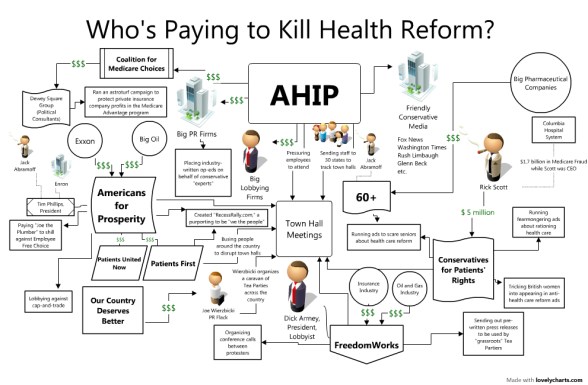
Blog Link – Who’s Paying To Kill Health Reform

As those of you that read this blog know, I certainly support reform, but I disagree with the approach the administration is taking.  That being said, I liked this graphic that I found on the Campaign For America’s Future blog.  Whether it’s true or not, I have no idea.  [But, it gives me a good list of companies to whom I might want to send donations!]

Who Paying To Kill Health Reform

My Healthcare Strategy For Obama

So, this is getting messy quickly.  Support is waning.  The public is confused.  It’s time to do something.

If I put myself in your shoes [President Obama] here’s how I would have proceeded:

  1. Make 2009 about the uninsured.  Focus on one problem which is achievable – coverage for all.  You would have people rallying around you.  And, if the numbers that I have seen are right, the net costs to the insured population would be the same.  Right now, they pay for the uninsured through higher bills from the providers who ultimately have to cover their bad debt. 
    • Challenge – getting the providers to agree to lower their rates once their bad debt dropped.
    • Financing – short-term coverage of the 12-18 month lag between coverage and rates dropping.  long-term mandate with costs covered by taxes for those who can’t pay.
  2. In 2010-2011, I would take on the issue of evidence-based medicine, comparative effectiveness, and health IT.  I would save health reform for my second term (if I got one). 

    Everyone knows the system is broken.  BUT, I would stop talking about a trillion dollars in cost to fix the system.  Think like when we stretched to put a man on the moon. 

    Set a goal of “designing a healthcare system in which the total cost per individual is no more in 2020 than it is in 2010.” 

    Now, you can get people to rally around your efforts to save a trillion dollars and get us out of debt as a country. 

    The goal of keeping everyone happy and taxing the rich plays well on TV, but it’s not reality.  People can’t have their cake and eat it to.  People are going to have to give up some of the luxuries in the healthcare system.  We can’t have defensive medicine.  We have to have some limits on litigation.  We have to have health IT to push evidence-based medicine.  We have to reward people for actively managing their health. 

One of the winning strategies for you in the campaign was a simple focus on change.  You can’t change everything at once.  People have limited capacity.  Think like a program manager – phased implementations; goals people call rally around; simple wins.  People don’t understand what a trillion dollars is.  People can’t focus on 10 year plans. 

Healthcare is complex.  Focus on making it simplier:

  • Get universal coverage.
  • Establish standards of care which are driven by technology.
  • Hold costs flat.

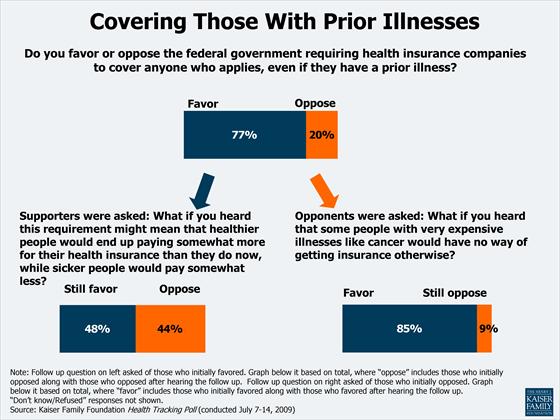
How You Ask The Question Matters – Pre-Existing Conditions

All of those in the communications space realize that linguistics do matter especially in certain healthcare situations.  I think this is a great example of how politics and healthcare are playing out.  No one really understands everything.  They understand and get excited (pro or con) based on the soundbite.

Covering_Those_With_Prior_Illness

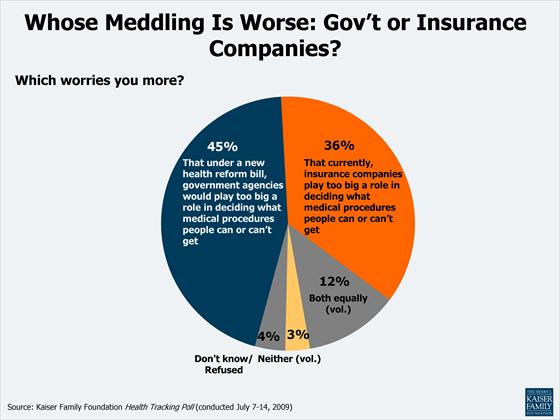
Consumers Fear Gov’t Involvement More Than Insurers

This was a pleasant surprise since I completely agree.  Based on this Kaiser survey, consumers worry more about the gov’t being involved in health care decisions than healthcare insurers.  Considering we always worry about consumer awareness and trust in healthcare entities, I think this is a positive.

Whose_Meddling_is_Worse_Govt_or_Insurance_Companies

Regarding House Bill 458 (MO) On PBMs

To Whom It May Concern:

You should be embarrassed to produce this bill. It’s obviously based on a one-sided view of the world regarding Pharmacy Benefit Managers which is generated by sensationalist journalists, jilted employees, independent pharmacists who have lost marketshare to chain drugstores, and pharma manufacturers who have seen their marketshare decline. This type of legislation will only serve to drive up healthcare costs and is exactly the reason why a government run plan won’t work in this country. They’ll focus on lobbyist interests and not the true interests of the consumer.

Let’s go point by point through your legislation and point out some flaws – (see bill here)

1 – Why would a PBM have to tell a consumer what they pay the pharmacy? That’s like Best Buy being required to tell the consumer what they pay for a TV. Most PBMs and/or pharmacies often print on the receipt what the consumer’s payor (employer, managed care company) paid for the drug (i.e., your insurance saved you $100).

2 – Why is the government telling businesses how to do their job? As an HR manager, if I can get a better discount for my employees on their prescription drugs by limiting the pharmacy network, why shouldn’t I have that option. We have preferred vendors in most companies. Why shouldn’t that be true in pharmacy? There are ~60,000 pharmacies in the US which is more than enough.

3 – Again, why is the government interfering in pharmacy law and telling me (the consumer) what I can or can’t do? Why can’t I move my prescription from one pharmacy to another based on discount, convenience, service, or other issues? All you are doing is creating a consumer burden and physician burden with no benefit to anyone.

4 – Now you want to take away my ability to manage drug coverage. There are plenty of circumstances where limiting or denying coverage makes sense due to inappropriate utilization, availability of lower cost options, abuse, and other issues.

5 – I’m completely confused here. You want to tell the insurance companies that they can’t increase the percentage of costs that the member pays (which is really a benefit design issue for the employer) unless the drug prices go up.

6 – This topic has been discussed a lot around switching medications. Of course, the communications should be clear. The patient should understand their choices. They physician should be in the loop (which they are since they have to write the new prescription). You hopefully realize that these are done to lower healthcare costs AND that physicians neither discuss costs with patients (generally) nor do they believe it’s their job to do this.

7 – Do you really believe that the dispensing physician who is focused on caring for their patients has the time to keep up with all the medical literature that a Pharmacy & Therapeutics (P&T) Committee reviews in determining protocols around step therapy? Look at the research…it shows that it takes 17 years for evidence-based standards to become standard practice. I personally don’t want to rely on my individual physician (who does a damn good job) to understand all the latest literature (w/o an EMR). And, I would hope no MD would willingly write an Rx that causes harm. All step therapy programs offer a prior authorization override to the MD and the PBM systems look for drug-drug and other types of interactions.

So, I guess the question is why are you (the legislation) trying to force me (the consumer) to have more administrative headaches, higher costs, and be treated with outdated protocols? And, at the same time, you’re going to force my employer to have higher costs and likely have to stop offering healthcare. And, you’re going to put more administrative burden on my physician who is already overworked and potentially underpaid.

Oh, wait, I get it…If you make the existing companies unable to run their business and unable to use evidence-based standards to lower costs then a government run experiment in socialized medicine will look much better. I hope that the Obama camp recognizes you for your hard work in advocating for them.

Gov’t Reduce HC Costs: Rx Decisions Say No

I have nothing against the pharmaceutical companies.  We need medications.  Development of medications costs money.  There are lots of failures to find one that works.  They deserve to make money.

That being said…they are smart and apparently the administration is inappropriately (IMHO) paying attention to what they suggest is right.

  • For Medicare PDP, the plans can no longer require the member to pay more when they choose a brand drug which is available as a generic.  WHY NOT?  It’s the same drug.  There may be a few exceptions called Narrow Therapeutic Index (NTI) drugs, but just make them exceptions.  This was a bad decision which will cost us taxpayers money.  (See prior posts – Potentially Ridiculous Decision and Uproar Over “Reference-Based”…)
  • Now, they jump on the savings that are offered for members who hit the “donut hole” and stay on the brand medication.  Why not just require MDs to give out samples?  Of course this will effect behavior and drive brand utilization.  Pharma is not stupid.  This is another decision which will cost us taxpayers money.

On the one decision where they go against pharma – drug reimportation, they make a bad decision.  Why import drugs?  Why not implement a therapeutic MAC (maximum allowable cost)?  This will definitely impact drug costs AND generic drugs (which make up almost 70% of the claims filled) are cheaper in the US.

This is the government that we want to manage the costs of our healthcare system when they can’t even make the logical decisions that anyone close the business could make.  Come on!

[IMHO = In My Humble Opinion]

Sold to Pharma

Could / Should Healthcare Follow The Car Dealer

Healthcare is one of the few industries where more supply equals more demand.  (Maybe the only one.)

So, as we look at the healthcare shortage of PCPs, RN, and RPhs, should there be more discussion of closing locations?  Should we pursue the tact of the car manufacturers in closing dealerships to have less locations?  This would fly in the face of the MinuteClinic type of strategy.

Or, I guess the better question is whether there are certain points in the process where more access points are needed, but there are other points in the process where less access points are needed.  For example, do we really need 6x,000 retail pharmacies in the US.  Certainly, in some urban and suburban locations where the average person passes more than 3 pharmacies to get to the one they use, the answer is no.  In some rural locations, there is no option other than the one pharmacy that is 20 miles away.

Would this change our behavior?  I believe analysis would show that less testing facilities and more difficult access to certain tests would certainly change their use.  Would this address the problem or simply create more services that were being done outside the system (i.e., cash businesses)?

I don’t know the answer, but I haven’t heard anyone talking about what seems like a logical discussion.

What Would A Public Healthcare Company Give Us?

I’ll admit upfront that I’m well behind in all my policy reading, but as a citizen and someone who works in healthcare, I have to wonder why this makes sense.

  1. Is it to lower administrative costs as Kathleen Sebelius said on TV this morning?  Since they only represent ~10% of the total healthcare costs, that’s not going to make a big difference.
  2. Is it to provide coverage for the uninsured?  This seems like a fundamentally good cause but how is that population defined.  Why can’t that happen in the existing system with the right incentives / mandates?
  3. Is it to provide competition for the current insurers?  This seems like a bad path.  Government competing with industry…will the playing field be even?
  4. Is it to provide a government subsidy to those that can’t be profitably insured?  Again…this is probably in the social interest of the country.  Can it be done w/o simply overspending?
  5. Is it to drive a long term investment in preventative care?  Now, this seems like an interesting perspective.  We know one of the issues with long-term investments in patient care is that members churn.  If I invest today in a member that I won’t have, I don’t get my money back.

I think my point here is that a public system (IMHO – In My Humble Opinion) isn’t the right question.  We have systemic challenges around incentives, payment structure, long-term care, supply and demand, health literacy, etc. that have to be addressed.

From what I’ve seen in Medicare Part D (PDP), I have no faith that a public system would manage trend.  They won’t even push people to chemically equivalent generics.  They blindly pursue re-importation.  They don’t have a very limited formulary.  They don’t have aggressive utilization management programs (e.g., step therapy).

Someone needs to set an aggressive goal of keeping trend to 0% for the next decade and then work toward that.

Retail Clinics Scarce in Poorer Areas

Just like there are less grocery stores in poorer areas, less retail clinics are being built in those areas.  This systemic challenge makes health changes hard to overcome.  From USA Today (5/27/09):

Walk-in retail clinics in grocery and drugstore chains were designed primarily for convenience but also can help the uninsured find health care, proponents say. But a new study suggests most retail clinics aren’t in the poorest neighborhoods — they are in more affluent areas already well-served by other medical resources. A study by University of Pennsylvania researchers in Monday’s Archives of Internal Medicine mapped 930 retail clinics operating last year, then used U.S. Census data to describe the income and racial makeup of the neighborhoods. Only 123 clinics were located in areas defined by the federal government as medically underserved. Census tracts with clinics had lower percentages of black and Hispanic residents, lower rates of poverty, higher rates of home ownership and higher median incomes.

Gov Leavitt On Gov’t Trojan Horse For Healthcare

In a piece that was posted on the AmericaSpeakOn.org website this morning and which I heard Governor Leavitt talk through last night, he lays out some of the illusions that we have around government run healthcare and reminds us that Medicare isn’t a model to emulate (in case you didn’t know that).  A few of the quotes from the piece:

  • Advocates of government-run health care suffer under the illusion that Medicare operates more efficiently than the private sector.
  • The efficiency of a health-care system isn’t measured by the volume of checks it issues, but the value it generates.  Medicare’s uncoordinated, quality-indifferent, more-more-more structure is moving it rapidly toward bankruptcy, and taking our nation with it.
  • Since 1970, the cost of these flagship government-run health-care programs has risen more than two-and-a-half times as much as the cost of all other health care in the United States, the vast majority of which is run by the private sector.
  • Medicare’s budget is projected to double within ten years, topping $1 trillion annually.  The number of workers per beneficiary will soon drop from almost four to just over two and a half.
  • This is like treating chronic obesity with a perpetual regimen of double calories.
  • Inevitably, government-run systems cut costs by cutting access to services.

There is another answer.  The government needs to promote value — to empower consumers to pursue the highest-quality care at the lowest-possible prices.  Strong government action is needed to organize an efficient market where consumers can choose insurance plans and medical practitioners who offer the best value.  What is not needed is to replace the private market with a government-run system in which only the truly rich have a choice.

Waxman at the AMA

I am finally catching up on some notes from Rep. Henry Waxman (D-CA) when he spoke to the AMA in March 2009.  (From “The Pink Sheet”, March 16, 2009, pg. 27)

“We all know we have to get costs under control, but the way to do that is not to tell physicians what they can and cannot do or put them in a position where they cannot put the needs of their patient first.”

“I am not interested in trying to put a public plan in place that would drive out competition.  I believe we must have a significant role for private insurers.  We must allow them a fair opportunity to compete.”

“We have to reward quality and outcomes, not just reward volume.”

Drug Importation

From what I saw this morning, it looks like the administration is going to go down this path.  I don’t think it’s a good idea.  I will point to my post from a few months ago on why.

My prediction is that it’s an arbitratage opportunity which will appeal to the public, but will cost us more in the long run.

On the flipside, I guess it’s better than having people take buses to Canada to buy drugs and sneak them into the country risking arrest.

bus1

Responsibility Based Healthcare

Are we finally to a point economically where healthy people will get tired of bearing the cost burden of supporting their sicker coworkers?  As costs continue to skyrocket, most people probably don’t realize that those are from a minority of their coworkers who have chronic conditions.  (Or in the case of Medicare, are from the costs incurred in the final year of life.)

If you’re like me, I generally don’t mind the risk pool concept (since I don’t know where I might end up any year).  And, I certainly don”t mind paying for people who are genetically pre-disposed to some condition (we all may be in that bucket someday), but I could take issue with paying for people who don’t comply with their physician’s recommendations (most of us), don’t act preventatively (most of us), abuse their body with things like smoking, and I could go on.

It got me thinking this morning about a model where we were able to push costs to people based on them taking responsibility for their care (i.e., “responsibility-based care”).  While we certainly won’t be at a place in the near future where genomics dominates and we can pull out people who can’t control their health, we can track things like compliance and adherence once we get an integrated HIT (healthcare information technology) system in place.

Additionally, we might get someday to a place where we can offer incentives based on active management and results which are self-reported by remote devices that track blood pressure, weight, cholesterol, etc.  But, many of these have issues around confidentiality and would challenge the risk pool process that we use today to underwrite medical costs.

I am not sure what the right answer is, but I think it’s about time for this debate to rear its head again with more energy.

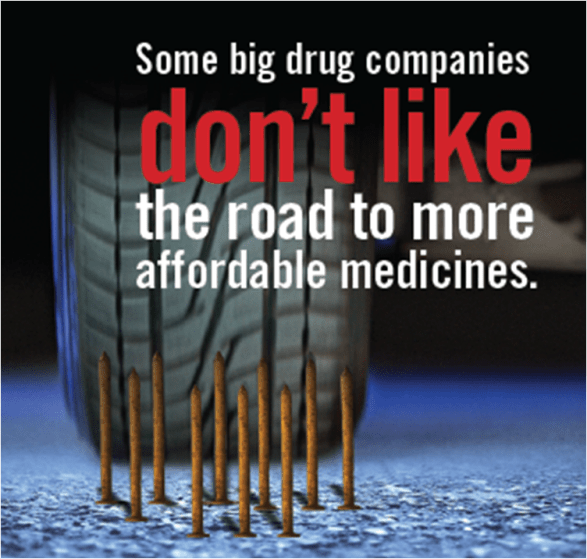
PCMA Carve-Out Advertisement

I was a little surprised to see the latest PCMA advertisement that goes for the jugular on pharma companies that support generic carve-out legislation.

pcma-ad

What is the “generic carve-out” concept – legislation which proposes making certain classes of drugs exempt from the ability of the pharmacy to substitute an A-B rated generic for its brand equivalent when the physician has not marked the prescription – Dispense As Written (DAW).

$2.3T on Healthcare and 47M Uninsured – National Disgrace

Kaiser Permanente recently launched a series of advertisements that drive this message around health disparities home. It is (or should be) a concern for most of us.  Health outcomes and especially preventative care is driven by health literacy, our attitudes towards health, and our access to the healthcare system.  We should all be working with our families, our communities, and our country to try to make this better.

I am a firm believer that one of the best ways to start to manage cost is to find a viable strategy to get universal coverage.  The costs of emergency care and absenteeism all get passed on to us in one way or another.  And, as the government is the dominant payor of healthcare (Medicare, Medicaid), long term costs are a significant issue for our economy.  If there is a systemic way of improving it, we should seek that out.

So, a cause that is both moral and economical…what more do you need?

Today, more than 50 percent of Americans and 75 percent of Californians without health care coverage are people of color.  Uninsured men, women, and children are far more likely to get sick and forego care simply because they lack coverage.  This is a national disgrace. We spend 2.3 trillion dollars on care in this country. Securing health care coverage for every American is the next great civil rights issue of our time. We can and should achieve universal coverage.

kaiser-ad

Some of the facts highlighted on their new website about disparities include:

  1. Disparities in health and health care impact everyone. African Americans, American Indians, Alaska Natives, Asians, Pacific Islanders, and Hispanics are most affected.

  2. 27% of adults report having no usual source of care. African-American (28%), Hispanic (51%), and Asian (23%) adults are all more likely to report not having a usual doctor.

  3. Uninsured adults are disproportionately, young, and minorities; 82% are between 19-49 years of age, and 41% identified themselves as black, Hispanic, or other.

  4. American Indian and Alaskan Native death rates from sudden infant death syndrome are the highest of any population groups.

  5. Asian Americans have the highest tuberculosis case rates of any racial and ethnic population.

  6. During 1996-2000, Native Hawaiians were 2.5 times more likely to be diagnosed with diabetes than non-Hispanic white residents of Hawaii of similar age.

  7. In 2005, African Americans accounted for 18,121 (49%) of the estimated 37,331 new HIV/AIDS diagnoses in a national poll which encompassed 33 states.

  8. 21.9% of U.S. children live in poverty, far and away the worst in the industrialized world. Comparable figures for the Nordic countries are 4.2% and less.

  9. Adults who have not finished high school are almost two times more likely than college graduates to be obese.

To learn more about the topic, you can go to their community of information.

BioGenerics, Text Analysis, and Transparency

Here are a couple of blog posts from other blogs worth reading:

  • David Williams on the “Folly of BioGenerics” which talks about why they won’t be just like generic drugs.
  • James Taylor on Text Analysis which if ever figured out would be very helpful in taking inbound e-mails, letters, and call center notes and using them for customer relationship management.
  • Gilles Frydman on “Opaque Inc.” and how difficult it is to understand the US healthcare system.

Pharmacy Principles for Healthcare Reform

Several pharmacy groups have put out their principles for healthcare reform:

“Proper use of prescription medications helps improve quality of life and health outcomes. How ever, the health care system incurs more than $ 177 billion annually in mostly avoidable health care costs to treat adverse events from inappropriate medication use. T he proper use of medication becomes even more important as treatment of chronic disease costs the health care system $ 1.3 trillion annually, or about 7 5 cents of every health care dollar.”

The document goes on to talk about the importance of pharmacists in managing chronic diseases and helping patients.  A role that I completely support although I question the bandwidth of the pharmacists to do this given the massive shortage in the US.

The Principles are:

  1. Improve Quality and Safety of Medication Use
  2. Assure Patient Access to Needed Medications and Pharmacy Services
  3. Promote Pharmacy and Health Information Technology Interoperability

They are kind of like “No Child Left Behind” in that you can’t argue with the concepts.  At first read, the only thing that raised an eyebrow for me was some of the language around Principle 2.  I could interpret it to be a subtle play against some of the trend management tools that the PBMs use to help control prescription costs – e.g., mail order pharmacies.

Potentially Ridiculous Decision

I’m trapped in Boston waiting to get home due to the snow storm last night.  While I am waiting, the guy sitting a few chairs away from me was talking on the phone to a reporter.  If what he said is true, it’s a massive step backwards.

He said that CMS is no longer going to allow Medicare Part D plans to charge more for multi-source brands (MSBs).  These are brand drugs that have a generic equivalent (i.e., they are the same drugs based on active ingredients).  This would be a massive win for pharma since the manufacturers typically drive the price up after patent expiration so that they can make as much money as possible on the people that continue to use these drugs.

In most cases, these drugs are immediately moved to the 3rd tier of the formulary while the generic version is placed on the first tier.  This allows people to get them, but they have to pay more.  If CMS doesn’t allow this anymore, it will create lots of potential waste and be a big step backwards for all the progress we have made around generics.

sold-to-pharma

A Few Examples Of Technology Going Mainstream

Two things caught my attention this week on how technology (especially social networking) is making its way into the mainstream.

In today’s USA Today, they compare this year’s Heisman winner (Sam Bradford) with last year’s winner (Tim Tebow).  As it runs through their statistics – age, year, records, first place votes, one jumped out at me – Facebook friends.  They actually compared how many friends the two quarterbacks had in Facebook.  Really…how does that matter?

A few days ago, Michigan’s GOP Chairman Saul Anuzis announced his interest in leading the Republican Party via Twitter.  Who was subscribed to his Twitter feed would be my question?

“It would be suicide for the Republican Party and conservatives to not aggressively embrace technology,” said Matt Lewis, a writer for the conservative Web site Townhall.com. “The world is dramatically changing in the way people get their information and the way they communicate — the party needs to change with it.”

Both examples make the point that these technologies are here to stay and are revoluntionizing the way we think about communications, marketing, personal branding, etc.  Where is healthcare?  When is the last time you saw the CEO of a major insurance plan providing his Twitter feed to the members?  In most cases, you can’t even find contact information for a lot of companies anymore.

Want Senator Daschle To Come To Your HC Party

Obama’s team is leveraging the power of the people to solicit input.  You can go to their site www.change.gov to provide input. 

He is specifically asking for groups to meet on healthcare and document their thoughts.  Senator Daschle will attend at least one of these events personally.

It worked to get him elected so it will be interesting to see what they get and how they leverage this.

Facts About The Uninsured

The Robert Woods Johnson Foundation has a project called Cover The Uninsured.  As we all know, this is a major issue which is only getting more pressing with the economy the way it is today.  With food going up and gas going up, it is putting more and more economic pressure on people.

Granted…not all the uninsured are uninsured due to their economic condition, but even those that think they are invincible would be better off with some safety net.

I point this out since this is Cover the Uninsured Week (April 27, 2008 – May 3, 2008).

Here is a slideshow of data from their website: