Archive | Value Propositions RSS feed for this section

New Year Blog Survey

Happy New Year!

For those of you that are regular readers, I’d love to get your thoughts on the following:

  1. Do you like me including infographics in the blog?
  2. Do you like the mix of content from mHealth to PBM to population health management?
  3. Do you like the mix of short posts sharing articles and other information or would you prefer less posts that were more detailed analysis of a subject?
  4. What would generate more discussion / comments on the blog?

Thanks for your time.  You can comment here, e-mail me at gvanantwerp at mac dot com, or respond anonymously to the survey embedded here.

Are You Going To The 2013 PBMI Conference?

Are you going to this year’s conference (February 18-20th) in Las Vegas? I’ll be presenting again this year, and I hope to see some of you there. If you’ll be there, let me know and we can connect.

This year, I’m going to talk about one of my favorite topics which is how the pharmacy industry needs to transform itself. This touches on several topics which I’ve blogged about multiple times:

  • Health reform and ACOs
  • Turning data into wisdom
  • Predictive models
  • Coordinating medical and pharmacy data
  • The role of the pharmacist in the broader care team strategy
  • Consumer engagement as fundamental to healthcare
  • Outcomes-based contracting
  • Population health management
  • Consumer experience

Do you have a specific example of how you see companies (pharma manufacturers, PBMs, or pharmacies) transforming from a traditional Fee-For-Service (FFS) model to an outcomes based model in terms of payment and how that is changing the way they do business? I’m always interested in learning more.

Here’s the official description from the brochure for the conference.

Pharmacy — Data, COEs, Predictive Models, and Consumer Engagement

George Van Antwerp, Vice President, Product Development, inVentiv Medical Management

ACPE UAN 0221-9999-13-009-L04-P 1.0 Knowledge-based contact hour

Pharmacy is the most used benefit, and for most chronically ill patients, they take multiple medications per day and interact with their pharmacist/pharmacy frequently. With the transformation in healthcare to an outcomes-based focus, PBMs, pharmacies, and pharma are looking at new models and new ways to work with payers, providers, and patients to be part of the care team. We will explore how companies are using this data and technology to intervene, change behavior, and improve outcomes from a broader population health management perspective.

Finally…A Use For Klout Scores?

Klout Score

Do you know your Klout score?  I know mine – 51.  Is that good or bad?  I guess it’s all relative.  Mine is only based on Twitter and LinkedIn.

The bigger question is should I care.  I’ve struggled with why to care, but it finally hit me the other day.  There are a few circumstances where I might care:

  • If my purpose was to get a job as a social media consultant.
  • If I was trying to be a community manager.
  • If I was trying to get a job in PR or as a reporter…or maybe if I tried to monetize my blog.
  • If I was trying to get some role driving awareness of a product or topic.
  • Maybe as an individual consultant.

As an average person working for a company, I’m not sure it matters.  Of course, you can argue with the “scoring” process, but the reality is that people do want some benchmark to compare themselves to for what they do online.  The interesting question is whether companies will care.  And, is there a minimum that you should have just to be able to say you understand and use social media?

Here’s a few recent articles discussing the topic of Klout.

It’s competitors are Kred and PeerIndex which I only went to because of this post.  But, I signed up for them to see what my scores where there.

Screen Shot 2012-12-26 at 2.29.09 PM PeerIndex Score

My question would be how do you adjust this for people (like me) who don’t use Facebook or should that fact alone exclude me from certain things like being a community manager for a product that needs a Facebook presence?  Perhaps.

So, if you’re hiring a mHealth or social media team, you might want to know their Klout (or Kred or PeerIndex) scores (on average for the team).  I’d say it’s like gamification.  I wouldn’t want someone just using that buzzword with me.  I’d want to know the last game they got sucked in to.  Why it kept their attention?  And, then I’d ask them things like why they think Steam is gathering gaming apps in their and whether it’s critical path for them in gamifying their app.

Updated: What Is A PBM? Pharmacy Benefit Manager

The short answer is that a PBM is the company hired by your employer (either directly or through your health insurance company) to manage your pharmacy benefits.  When you use your pharmacy card at the retail pharmacy to get a prescription, the pharmacy interacts with your PBM electronically to find out if the drug is covered and the copay to you the consumer.

*****************

Back when I first started blogging, I used a lot of my experiences at Express Scripts to shape some of my perspectives about the PBM or Pharmacy Benefit Manager industry.  It took me a few months before I realized that some people reading the blog didn’t know what a PBM was.  That led me to my all time most popular blog post – “What Is A PBM?

Since that was over 5 years ago, I figured it was time for an update.

The market has shifted in the past 5 years especially with Express Scripts purchase of Medco to become the largest player in this space.  Walgreens has also divested their PBM to CatalystRx which was then bought by SXC and the new entity renamed CatamaranRx.  At the same time, you’ve seen United Healthcare insource their PBM business from Medco to combine it with their old Pacificare PBM to create OptumRx.  You’ve also seen Humana’s PBM business and mail order business – RightSourceRx – grow significantly.

There are other big PBMs which I didn’t mention such as CVS Caremark which after years of rumors about them splitting back up seems to have proven their case as an integrated, retail-owned PBM.  There is MedImpact which has 32M lives according to the latest PBMI market share report, and Prime Therapeutics which is a PBM owned by several of the BCBS plans.  Additionally, Aetna, Cigna, and several other managed care companies also have their own PBMs.

While I would have argued that the PBM wasn’t typically known to consumers 5 years ago, I think that the very public dispute between Walgreens and Express Scripts has changed some of this.

But, what a PBM does is relatively simple:

  • Process pharmacy claims (i.e., when you go to your retail pharmacy, the pharmacist enters your prescription and electronically submits it for adjudication. The claim is routed to the PBM where it is checked for eligibility and then to see if it pays and what copayment you owe.)
  • Set up pharmacy benefits (i.e., based on the plan selected by your employer or payor, the PBM codes what drugs are covered and the copayment structure).
  • Administer rebates…since large pharma companies (e.g., Pfizer) pay rebates for having their drugs on formulary (aka preferred drug list), someone has to manage the negotiations and billing of this.
  • Set up clinical programs (i.e., most PBMs have a clinical committee which evaluates new drugs and looks at market data to help employers choose coverage options).  This also includes programs to look for drug-drug interactions and pharmacy adherence.
  • Establish a retail pharmacy network (i.e., work with retailers to get them to agree to discounts on drugs) and are a big part of SureScripts which is the hub to enable electronic prescribing between physicians, pharmacies, and PBMs.
  • Communicate with patients and physicians (i.e., look at pharmacy claims data and help find ways to save money or identify clinical issues to inform the patient or physician about).
  • Provide cross pharmacy data for drug-drug interactions…this is a critical function since many people use more than one pharmacy for claims.
  • And, last but not least, most PBMs provide a mail order and often specialty pharmacy where they ship prescriptions to patients.

The PBM’s clients are employers who are self-insured, government entities (i.e., state employees, Department of Defense), unions, TPAs (third party administrators), and managed care companies (i.e., BCBS of).

PBMs are sometimes referred to as middlemen, but I will point to a few other posts on this:

In general, if you’re looking for more information on PBMs, I would point you to several sources:

The only other blogger who really offers any coverage of this space is Adam Fein which his blog – Drug Channels.

What Do MDs Tell Patients About Their Rx … with only 99 seconds?

As part of a new study mentioned on The Doctor Weighs In, it shows that physicians spend an average of 10 minutes and 10 seconds with patients in an average visit.  Of that, 99 seconds (or 16% of the time) they are discussion prescriptions.  The big question is what are they discussing.

MD Rx discussions

A 2006 study showed the following:

74 percent of the doctors mentioned the trade or generic name of the medicine, and 87 percent stated its purpose. Sixty-six percent said nothing about how long to take the medicine, 45 percent did not say what dosage to take and 42 percent failed to mention the timing or frequency of doses. Physicians mentioned adverse side effects only 35 percent of the time.

Of course, research on the physician and patient dialogue around prescriptions should also include looking at these studies:

That is asking a lot of the money spent by the manufacturers on the physicians.

Detailing to physicians, nurse practitioners, and physicians’ assistants cost $12 billion, accounting for more than half of that promotional spending (see Figure 1). Drug companies spent another $3.4 billion sponsoring professional meetings and events and about $0.4 billion placing advertisements in professional journals. Pharmaceutical manufacturers spent the rest of their promotional budgets, $4.7 billion in 2008, on direct-to-consumer advertising.

Diabetes Innovation – mHealth; Quantified Self; Business Model

I’m not a diabetic, but I’ve been researching the topic to understand the space and what innovation is occurring around diabetes. This is a space where there are lots of applications, tools, devices, communities, and research. The ADA estimates the total US cost at $218B with very high prevalence. If you expand that on a global scale, the costs and impact is staggering.

  • Total: 25.8 million children and adults in the United States—8.3% of the population—have diabetes.
  • Diagnosed: 18.8 million people
  • Undiagnosed: 7.0 million people
  • Prediabetes: 79 million people*
  • New Cases: 1.9 million new cases of diabetes are diagnosed in people aged 20 years and older in 2010.

So, what’s being done about it? And, what opportunities exist? I think you’ve certainly seen a lot of innovation events being sponsored by pharma and others.

You’ve seen a shift from drug to engagement for a few years as evidenced in this old post about Roche – http://www.diabetesmine.com/2009/10/a-visit-to-the-roche-new-concept-incubator.html

You’ve seen a proliferation of diabetes apps. (A prime opportunity for Happtique.)

From my traditional PBM/Pharmacy focus, you’ve seen several efforts there:

Obviously, Medco (pre-Express Scripts acquisition) thought enough of this space to buy Liberty Medical.

I pulled some screen shots and examples into a deck that I posted on SlideShare. I’d welcome people’s thoughts on what’s missing or what are the key pain points from a diabetes perspective (e.g., not integrated devices).

While I was doing my research, I found a few interesting things worth sharing.

Several interesting studies:

Some good slide decks:

Additionally a few videos:

I also posted some diabetes infographics on my blog – https://georgevanantwerp.com/2012/12/13/more-diabetes-infographics/

And, while I started to pull together a list of diabetes twitter accounts below, you can follow @AskManny’s list with 360 people already tagged in it. https://twitter.com/askmanny/diabetes

My starting twitter List:

Interview With BodyMedia CEO at mHealth Summit #mhs12

BodyMedia 1

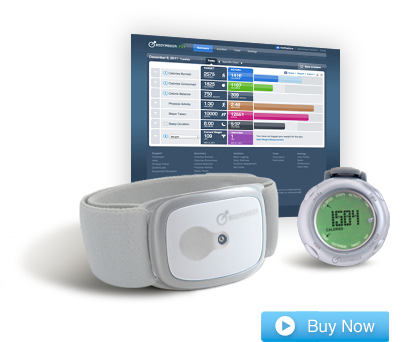
Last week at the mHealth Summit in DC, I had a chance to sit down and visit with Christine Robins who is the CEO of BodyMedia. (see bio below)  One of the most exciting things (mentioned at the end) is their new disposable solution coming out.

Christine Robins is currently the Chief Executive Officer of BodyMedia, Inc., a pioneering market leader in wearable body monitors. BodyMedia’s devices are unparalleled in the marketplace, and equip professionals and consumers with rich information to manage a range of health conditions impacted by lifestyle choices.

Prior to joining BodyMedia, Christine was the CEO of Philips Oral Healthcare where she led the global Sonicare® brand to significant sales and share growth. Christine also has extensive experience in a wide range of marketing and finance capacities gained during her 17 years at S.C. Johnson, where she ran notable brands such as Raid® insecticides, Glade® air fresheners, and Aveeno® skin care. With this background rooted in global multi-national companies and an entrepreneurial zeal essential to lead a high technology upstart, Chris is passionate about developing turnaround strategies, building teams, and driving innovation.

A noted speaker, Christine has delivered presentations at universities such as Harvard, Stanford and Duke, as well as keynotes at industry shows such as the Consumer Electronics Show, Health 2.0 and CTIA. She holds a degree in Marketing and Finance from the University of Wisconsin-Madison and an MBA from Marquette University.

If you’re not familiar with BodyMedia, it’s definitely a company to know from a Quantified Self perspective. They have been around since 1999 providing solutions and have 150 global studies about the effectiveness of their devices in weight loss (see one chart below). The devices that they use continue to get smaller and smaller with time and are registered with the FDA as Class II medical devices.

clinical charts_2012_updated

Their devices track 5,000 data points per minute using 4 different sensors. Here are a few screen shots from the mobile apps that they have.

bodymedia iOS 3

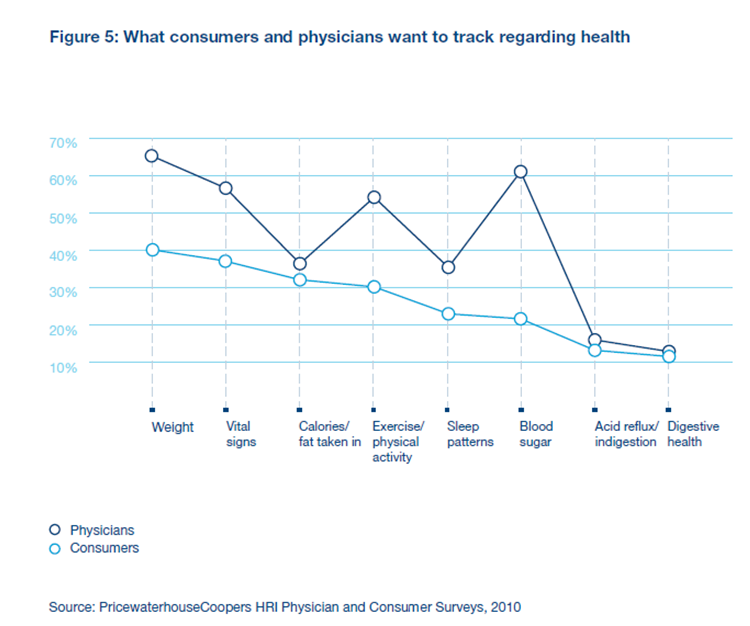
And, as you can see, they map well to the chart below which shows what data consumers and physicians want to track with weight, calories, physical activity, and sleep patterns.

Quantified Self 2

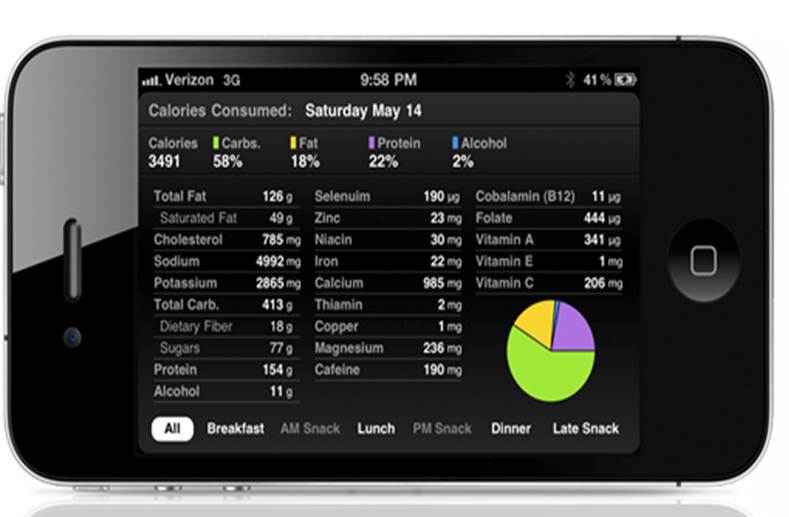
For food tracking, they work with MyFitnessPal which provides them with data on products you eat. I think a good example can be seen in this screen shot from the Android app.

bodymedia 4

But, honestly, a lot of what I was really intrigued by was a new offering they’re rolling out called the “PATCH” which will be a 7-day, disposable body monitoring system that does everything the full blown system does. I don’t know the price point yet, but this is really exciting as a way to pull new people into the market and to use as a strategy for setting a baseline with a patient to understand their data. It could then lead to recommendations around disease management.

Another thing that Christine talked about was they’re approach to partnering with places like the Biggest Loser and other to allow for a customized content approach to your messaging from the system. She also showed me how the device will project where you will end up at the end of the day based on your past history.

They also have a module for a coach or weight loss professional to help manage and view data across all the people they’re working with.

(And, I just grabbed this image from their website since it points out the 3 key things to weight loss.)

iBlueButton Interview At The mHealth Summit #mhs12

I had a chance to sit down and do several interviews at the mHealth Summit earlier this week in DC. I’m slow to get my interviews posted, but they were all very interesting.

One of the best was with Dr. Bettina Experton (see bio below) of Humetrix. I will admit that reading about iBlueButton doesn’t do it justice. I was confused as to what they were trying to do and why it won an award. And, while explanatory after the fact, I found the graphic below intimidating as a consumer before talking with her.

[For those of you that don’t know what BlueButton is, you should go research it here.]

Dr. Experton explained to me how broad the BlueButton initiative now is. I only knew that CMS was using it, but apparently, there are now 200 plans also using it including Aetna, United Healthcare, and Humana. What Humetrix focused on for this offering was the mobile empowerment of BlueButton allowing the patient to have control of their information in the iOS platform (i.e., your Apple products – iPhone, iPad). They provide a tool for downloading and encrypting the data – prescription, medical claims, lab, and procedures.

iBlueButton

Of course, if you’ve ever seen what this data looks like in the raw form, this wouldn’t seem very helpful. Most of us wouldn’t know what to do with this. But, as Dr. Experton showed me, they’ve rendered the data in a great GUI (graphic user interface) that really brings it to life in a readable and understandable format. For example, they translate the NDC code (used for prescriptions) into the drug name with the chemical name and the dosage. The GUI is very iPod like in terms of simplicity and ease of use.

iBlueButton 2

The iBlueButton app even will pull in patient self-reported data from a PHR (personal health record) and show it in a different color and different section so the provider can understand the sources. Of course, this was another point of confusion for me before we talked which was how would a physician get this and what would they do with it. She showed me a demonstration of the patient opting to share their data and records with the provider in real-time. Of course, this assumes the provider’s office and/or the physician is actually using a device in the presence of the patient, but we know that is changing quickly these days. (See article on survey about MD use of iPad / iPhone.) So, with their tool, I can now store and share my data. The challenge still is integrating this data into the physician’s EMR (electronic medical record), but the iBlueButton app on the provider’s device can do this. It can also print it for those physicians who still want to see the printout in their paper file.

Another thing that you see in the second set of screen shots above is that you can start to report on whether you’re using the prescriptions still that it shows you on. Assuming patients engage, this would be a great tool for medication reconciliation and adherence discussions.

I’m not the Meaningful Use expert, but Dr. Experton pointed out to me that all of this is important since meaningful use requires viewing, downloading, and transmitting capabilities. They provide all of these.

I definitely plan to download iBlueButton and my data, and I hope to use this as a tool to reinforce why any claims provider should be offering you BlueButton access to your data. This is definitely a company to watch.

Bettina Experton, M.D., M.P.H.
President & CEO

Dr. Experton is the founder, President and CEO of Humetrix which she has led over the last 15 years on the HIT innovation path starting with the development of health risk appraisals, chronic care management software, and since the early 2000s with the development of novel mobile device-based solutions which have been deployed worldwide. A physician with over 20 years of healthcare informatics experience, Dr. Experton is the author of multiple information technology patents. At Humetrix, Dr. Experton also conducted groundbreaking health services research on the frail elderly which led to major federal legislation in the area of Medicare and managed care, and has been a national healthcare policy advisor in the US, China, and France. As a healthcare IT advisor to the French Ministry of Health, she made important contributions to the design of the newly launched French government sponsored single web-based individual health record with smart card access made available to French citizens and their physicians. Dr. Experton is an Adjunct Professor of Medicine at the University of California at San Diego, School of Medicine and a permanent member of the Faculty of the School of Medicine in Paris, after graduating Summa Cum Laude where she completed her training in Internal Medicine. In California, Dr. Experton received a Master’s degree in Public Health with a major in epidemiology from Loma Linda University School of Public Health, completed a Pediatrics internship at University of California Davis Medical Center and a Public Health residency with the State of California Department of Health Services.

Stay Moving Avoid Sitting Disease

A clinician was talking to me he other day about “sitting disease“. They said that our increasingly sedentary lifestyles are causing all kinds of problems – not least of them being obesity.

With that in mind, I thought I’d share this article and Infographic…

Office workers can exercise at their desk to get into better shape

Stuck working in an office with no time to hit the gym on a regular basis? There are ways to burn off a few calories during office hours, says Selen Razon, a physical education professor at Ball State.

“Studies have shown that long periods of inactivity — including sitting at your desk — increase the risk of cardiovascular disease and cancer,” she says. “I suggest that people do a few simple exercises to get their bodies moving and then stretching and toning at your desk. Moving a little goes a long way.”

Razon suggests:
• Start exercising before arriving at your desk by first parking your car as far away from the building as possible and then walking.
• Take the stairs whenever possible.
• Do exercises at your desk, including flexing arms, legs and abs on 30-second intervals.
• Get rid of a chair and sit on a medicine/fitness ball while working. Sitting on a ball will tone and strengthen your abs.
• Stand up and/or take short walks every 20 minutes at desk. Studies show even simple frequent standing breaks significantly decrease your chances of getting diabetes.
• Exchange the typical desk for one that allows you to stand, which burns more calories.
• Bring gadgets to the office. Hand grippers and stretch cords are relatively cheap and can provide great outlets for keeping active while you look at your screen.

FitBit vs. Pedometer – Test One

I’ve been enjoying the FitBit One for a few days now.  I decided there were a few tests that I’d like to do.  The first one was to compare it to the step count from a pedometer that I’ve had. 

It hasn’t been a highly active day (as I’ve been working from my home office), but there doesn’t seem to be much of a difference. 

Kroger Expansion – Digital, Physical, Strategic, and Specialty Pharma … Oh My!

Since one of my first jobs was at Kroger, I’ve always been intrigued to see what happens with them. (I can even still go back almost 30 years later and still have some of the General Managers at my old store come out and remember me.) So, I was initially intrigued a few weeks ago when the story came out in Drug Store News about their expansion plans.

“Over the course of a day-long investor conference Tuesday, Kroger outlined its future growth strategy. Across its physical store base, Kroger plans to enter one or two as-yet-to-be-named new markets along with boosting presence in existing markets. But Kroger also has significant designs on the multichannel consumer, and outlined for analysts the grocer’s plan to grow its marketshare across the digital landscape as well.”

Kroger has several interesting assets to leverage:

Now, with today’s announcement, they’ve made a jump into the Specialty Pharmacy Space with their acquisition of Axium. It begs the question of what they want to be – a grocer with a pharmacy, a pharmacy with groceries, a health destination, or something new.

Looking at some JD Powers data from 2010, they are positioned in the middle of the pack from a pharmacy satisfaction perspective.

On the other hand, if I look at their positioning from Bruce Tempkin’s analysis, they score well.

I have to believe there’s some great opportunity here. I’m a big believer that the retail assets create large opportunities for them to play in the broader healthcare market.

  • They have broad hours (in some cases 24/7).
  • They are natural destinations for people.
  • They can host clinics.
  • They already have pharmacies.
  • They have food which is a critical part of addressing obesity and for certain conditions like hypertension and diabetes.
  • They have patient specific data around things like home monitoring tests, food products, OTCs, and other products.
  • They are generally located in easy access locations.
  • They have good brand equity.

For example, just look at this press release from Target from a few years ago. This is a broad vision (that I’ve never heard or seen in the market). On the flipside, we know that CVS, Walgreens, and WalMart are spending considerable efforts trying to really “own” this space with their teams. We also know that specialty pharmacy (and even pharma in general) is trying to see how it gets out of its box and become broader players in the health continuum looking beyond just drugs to actual outcomes. (This is why healthcare is so exciting right now!)

My Fitbit One Has Arrived – Challengers?

I’m a big believer in the idea of connected devices – Quantified Self movement.  While I’d love to track my data via manual input, that comes and goes.  So, over the summer, I began thinking about a device to use.  There are lots of them out there, but I’lll admit that it was hard to determine which one would be best (see one review):

For me, I decided there were several criteria:

  1. Able to track multiple activities – walking, running, biking, and steps.  (in terms of calories and raw numbers)
  2. Easy mobile and web interfaces with wireless integration.  (Mac and PC)
  3. APIs for connecting into other applications.
  4. Battery life.

I didn’t spend much time looking at the communities associated with each and how they work to motivate you to exercise.  I do think that’s important.

I also like the Striiv game idea where you earn points based on your activities (badges) to unlock more things in a virtual world.  For gamers and others, this plays into the “gamification” trends.


Did I pick right?  We’ll know soon, and I’ll give you an update.  But, I certainly welcome challengers.  (If you want me to try your device and compare it, let me know.)

Is War A Good Framework For Addressing Cancer?

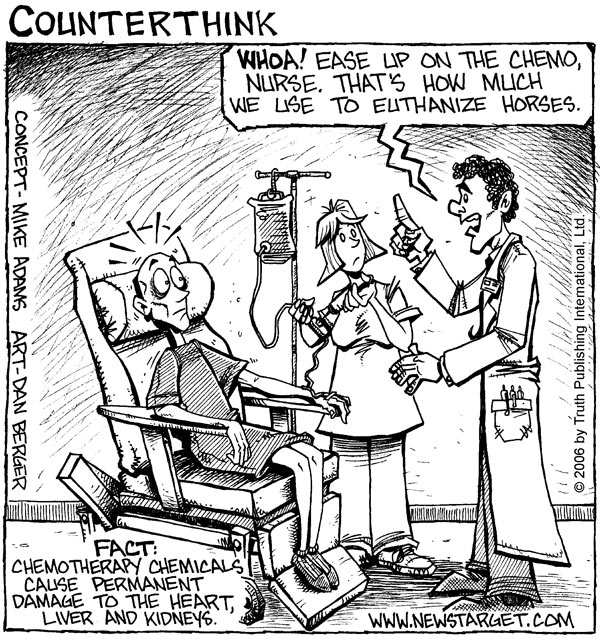
A physician asked me this a few months ago, and I thought it was a great point.  We were discussing the fact that there are often times when we (the medical institution) may try too hard to “cure cancer” (see some of the points in my post about palliative care).  When it’s viewed as a war that has to be won, it may be that too much effort is spent to beat cancer into remission rather than thinking about the patient’s experience.  (see cartoon from naturalnews.com below)

A friend game me this example…While his brother’s cancer was in remission, the toll of the chemo and the other treatments was so much that he was never able to work again.  The patient would have preferred to be able to work a few more years and die of cancer, but that discussion never happened. 

In general, I believe most physicians would consider this a failure.  They’re taught to “beat” the disease not to back off and let the disease “win”.  But, I often hear about the “war on cancer“. 

Even after 40 years, we still have a large amount of annual deaths from cancer. 

Infographic: Obesity

Unfortunately, I don’t think a lot of this will surprise many of you, but it’s scary to think about the impact of obesity across different industries.  For some of them this is big business.  And, while I don’t think employers have fully realized how to focus on this from a “wellness” or “disease management” perspective, I think that will change. 

10 Healthcare Trends To Monitor in 2013

I came across the chart below and thought I would post it with my perspective on trends for next year.

  1. “Accountable Care” in the form of CMS ACOs or Patient Centered Medical Homes will continue to expand.  I predict some companies will begin to provide the infrastructure such that providers don’t have to come up with the $2-4M in capital needed.
  2. Integrated “Big Data” looking at pharmacy, medical, lab, AND patient reported data AND physician EMR data will be the rage to mine and use in predictive models. 
  3. Consumer engagement around health will continue to be a huge focus.
  4. Obesity will continue to be an issue that people struggle with and employers begin to focus more actively on managing.
  5. mHealth in the form of mobile apps, connected devices, telemedicine, and remote monitoring will begin to move from the innovators to be a more standard component of the solutions with ROIs being more standard.
  6. The core components of health reform will remain (regardless of who wins) and the shift of people from underinsured and uninsured into the insured pool will finally be the tipping point for provider access and push growth in the clinics and telemedicine (video and phone) world. 
  7. Transparency will become something that consultants begin to mandate and try to get into contracts around pricing, claims auditing, and other services across the entire healthcare spectrum.
  8. Hospitals will continue to buy physicians and look at how they can play a more dominant regional role especially outside of the urban areas. 
  9. Consolidation will continue across all areas – providers, payers, pharmacy, pharma, technology.
  10. Investment in healthcare will continue to outpace other industries. 

Will You Be Charged More For Not Participating In Wellness Programs?

Thus, the major factors that insurance companies traditionally use to charge higher premiums – such as health status, the use of health services, and gender – will no longer be allowed under the ACA. However, the ACA does permit employment-based health plans to charge employees up to 30 percent more on their premiums (and potentially up to 50 percent more) if they fail to participate in a wellness program or meet specified health goals.  [From Kaiser document]

Traditionally, health plans and employers have rewarded consumers for taking some basic action (e.g., $100 for completing an HRA)…although some companies prefer penalties versus incentives.

At that same time, there is some evolution happening here with companies moving from simply paying for an action to requiring participation in a program (e.g., disease management).  The next step that a few companies are engaging in is actually incenting or penalizing consumers based on health outcomes.  This will certainly open some doors for legal challenges where people will argue that they are genetically pre-disposed to some factor that limits their ability to lose weight or lower their cholesterol or some other measure of health.

But, in one of the first legal challenges in FL, the court recently upheld the idea of rewarding (or penalizing) consumers based on taking a specific action (like completing a biometric screening).  With that, I expect companies will be more empowered to take advantage of the fact that under health reform they can charge consumers up to 30% more for their healthcare for either not participating or not achieving a specific health outcome.

With an average monthly premium of $468 per month of single person coverage and consumers paying an average of 21% of their healthcare costs (or $97 per month), this means that a consumer could pay an additional $29 per month (or $349 per year).  [If I interpret all of this correctly…if it’s 30% of the total health premium (not just the consumer’s share), then this jumps up dramatically.]

Not surprisingly, employees aren’t real excited about this.  In a survey by the National Business Group on Health, 62% oppose charging employees more for health coverage if they do not participate in wellness programs.  And, 68% oppose requiring employees to participate in a wellness program in order to qualify for health insurance.

And, according to the survey, the most effective cost control tactic was believed to be Consumer Driven Health Plans by 43% and wellness programs by 19% while 60% of employers plan to increase the premium paid by employees (i.e., cost shifting).

But, if companies throw out a life preserver (i.e., wellness program) to a drowing individual (i.e., unhealthy individual), why isn’t it a reasonable expectation that the individual has to grab it (i.e., participate in the program)?

Guest Post: Treat Your Health Like Your Finances

I am a big believer that we need to change our approach to how individuals manage their health. After a dinner with a financial planner friend of mine, it got me thinking what if we helped individuals plan for a long healthy life the same way we help them plan their careers or their finances. We have whole industries dedicated to helping people make smarter investment decisions for their retirement and job choices for their careers, but when it comes to our health we are rarely proactive.

According to Morgan Stanley, 90% of Americans think financial planning is important. Why? Three of the top reasons people undertake financial planning include:

  • Making sure your money will last during retirement or rolling over a retirement plan
  • Being prepared for a financial crisis such as a serious illness
  • Caring for aging parents or a disabled child

The common thread through all of these reasons is personal health. Whether concerned directly about illness, both our own and that of our loved ones, or about our ability to enjoy our retirement to its fullest, personal health is a key component of a well-planned retirement.

The reality is life expectancy has increased dramatically. We may live 30 years in retirement. I would argue the quality of that retirement is even more dependent upon our health than our finances. Yet no one hires a “personal health coach” or creates a “personal health plan.”

It is about time we stop neglecting our future health. You can take control of your future health by developing a personal health plan. These simple steps can help you get started:

Step 1: Conduct a Personal Health Audit. Before you can build a plan you need to understand your base-line. You can’t map directions to your destination until you know where you are. When you meet with a financial planner the first thing they want to know is how much money you have saved for retirement. Your personal health plan is the same way. Do you suffer from any chronic illness? What is your height & weight? How much exercise to you get? What are your eating habits? Do you have any family history of disease? What type of pain do you suffer from? How is your mental health your relationship with your spouse and children? Capture everything and identify areas that need attention or improvement.

Step 2: Define Success. What does a healthy future look like? The second question a financial planner will ask you is how much monthly income will you need in retirement to live the lifestyle you want? The same is true for health. When do you plan on retiring? What hobbies do you have that you would like to pursue? Do you plan on having grandchildren? How will bad or good health impact all of these plans? Does your family history require you to focus on preventing cancer or heart disease or Alzheimer’s? The ability to visualize your health in the future both good health and your health if you let yourself go is a strong motivator for change. A point of note: Thinking about health 30 or 40 years into the future can be very abstract; I suggest breaking down your definition of success into annual targets is more manageable and motivating.

Step 3: Know your Personal Health Indicators of PHIs. By this point in the process you should have a sense of what measurements are most critical to your health. Develop a method for capturing your PHIs on a regularly basis. For some like weight you might update your PHI daily, weekly or monthly. For others like a PSA level for men at risk for prostate cancer, you might update it annually. I detail some of the more common PHIs here: http://www.billpaquin.com/do-you-know-your-phis/.

Step 4: Engage your Health Partners. Now that you have completed your audit, defined success and developed your most important PHIs it’s time for you to engage all of the people in your life who help you manage your health. This will include your family, your physician or other healthcare professionals; maybe you have a nutritionist, acupuncturist or other complimentary practitioner that you frequent. Inform them of your personal health plan and get their feedback and buy in. The more people who are on your side the greater the likelihood of success and the more people that know your health, the greater the likelihood you will have a plan that fits you and your goals.

Step 5: Build and implement your Plan. Building the right plan takes an understanding of what you learned in steps 1-4. By way of example, if you have a family history of colon cancer, you need to understand what behaviors help reduce your chances of getting this cancer, what preventative screening you should be getting and when you should be getting them. All of our plans should include a path to maintaining an ideal Body Mass Index that includes some form of daily exercise and nutrition plan, but we are all unique and will have plans specific to our health situations and desired goals. I do think it’s important to understand that no one is perfect 100% of the time, if you deviate from your plan for a day, week or even month, you are only one day from starting again.

Step 6: Review & Measure your progress. You can’t manage what you can’t measure. At some pre-planned interval you should step back and take stock of your progress. Use your annual physical or dental cleaning as a reminder to sit down and review your health plan. Personally I like to review different elements weekly or monthly, but find what works for you and stick with it. Like the stock market, it won’t be a straight line, but as long as the trend continues up over time you will be alright.

No one is responsible for your health but you. We all need to take a proactive approach to our health. Developing a personal health plan is a great way to insure you live a long, healthy and happy life.

About the Author

Bill Paquin is the Chief Executive Officer at Vertical Health, a publisher focused on improving patient care associated with back pain and endocrine disorders such as diabetes. He is a husband, father and writer who is passionate about and supports the creative destruction of our current healthcare system.

The Transtheoretical Model And Setting Goals

There’s a good article in Time (9/17/12) called “Goal Power” by Dr. Oz.  I found it interesting on a few fronts.

“Getting people to make meaningful changes in their lives is much more complicated than explaining to them what to eat for dinner, how often to exercise and which kinds of tests they should get from their doctors.  The psychology of health is every bit as complex as the biology, and to create seismic shifts in behavior, we have to probe the subconscious.”

1. The topic of goals and objectives and their importance relative to healthcare behavior change is a repeating theme.

  • A month ago, I was at a presentation by Dr. Victor Strecher who founded HealthMedia.  He was talking about the importance of getting people to articulate their goals or objectives for changing.  (E.g., I want to become healthy to see my daughter get married.)
  • I had a pharmacy client who was looking into this as part of an adherence program a few years ago.

2. The topic of behavior change and behavioral economics has been a very popular theme with Nudge and many other publications and programs over the past few years.

3. Obesity, which is part of the focus of his article, is widely becoming recognized as the greatest public healthcare challenge of the 21st century.  And, it is a very complex issue tied to sleep, stress, social network, and many other factors.

4. He introduces the transtheoretical model (also known as the Prochastka model or the Stages of Change), which is widely known in the academic and health areas, into the public domain which surprised me.

(Here’s the abstract from what one widely quoted paper on this.)

The transtheoretical model posits that health behavior change involves progress through six stages of change: precontemplation, contemplation, preparation, action, maintenance, and termination. Ten processes of change have been identified for producing progress along with decisional balance, self-efficacy, and temptations. Basic research has generated a rule of thumb for at-risk populations: 40% in precontemplation, 40% in contemplation, and 20% in preparation. Across 12 health behaviors, consistent patterns have been found between the pros and cons of changing and the stages of change. Applied research has demonstrated dramatic improvements in recruitment, retention, and progress using stage-matched interventions and proactive recruitment procedures. The most promising outcomes to data have been found with computer-based individualized and interactive interventions. The most promising enhancement to the computer-based programs are personalized counselors. One of the most striking results to date for stage-matched programs is the similarity between participants reactively recruited who reached us for help and those proactively recruited who we reached out to help. If results with stage-matched interventions continue to be replicated, health promotion programs will be able to produce unprecedented impacts on entire at-risk populations.

5. He references two of the big studies that looked at social pressure an its influence on health.  Something that peer-to-peer healthcare and social network tools can create for us by developing support communities and “buddies” to support our change.

  • 2012 study in the journal Obesity about weight loss.
  • 2008 study in the NEJM about smoking

6. He references Dr. Nicholas Chrisakis who co-authored the book Connected which is being manifest in the company called Activate Networks.

Overall, for those of us that work in the healthcare field, these are all critical topics that we constantly talk about.  It’s nice to see it brought to the “popular press”.

How And Why I Use Twitter

I often get stopped by people I know who say things like:

  • I see a lot of your tweets in LinkedIn.
  • You use Twitter. Why? I don’t really want to tell people that I’m going to eat dinner or some other miscellaneous fact.
  • Can you really get anything out of 140 characters?

So…let me share my perspective on how my use of Twitter has evolved and what I get out of it.

It took me a few tries before I found out how to use Twitter effectively.

  1. First, I tried just using it to share thoughts or opinions across a variety of topics. I didn’t find that valuable and wondered why anyone would follow me to know that.
  2. Second, I tried using it to pose questions about healthcare topics that I was interested in. That worked ok because it synched with LinkedIn, but I didn’t have enough Twitter followers for that to make a difference.
  3. Finally, I decided to just use it as a “notebook” to capture facts while I read or to bookmark articles that I found interesting. (Of course, some of this became possible as every web article now offers a “share” feature.) This works especially great when you’re at a conference and is even a good way to follow a conference that you miss.

The next thing that I had to figure out was just understanding the technology.

  1. Reading things in Twitter is ok, but a lot of people post links. Often times, it’s not that effective to be constantly going out to the links to see what they say. In comes Flipboard to save the day. (see older post here)
  2. To make things more searchable, you have to use hashtags where you put a “#” in front of a key expression or search term.
  3. Most people don’t get a lot of followers although you hear about all the celebrities with millions of followers. (see HubSpot presentation below for general Twitter statistics)

I figure it must be working for me now. I have over 1,000 followers which according to this site is true for less than 1% of people on Twitter. But, I don’t think followers is the best indication (especially since almost ½ of followers might be bots and you can buy followers). I know that it’s working for now since I can post a question and sometimes get an answer. I can connect with companies and meet people. I’ve even heard from people at conferences that they follow my feed. Probably my best experience was when I read an article early in the morning, posted a quick summary, and then had a national reporter call me to ask me for the source so he could write an AP article…all before 8 am.

Just to check, I went out to the StatusPeople application which tells you how many of your followers are bots versus simply inactive. I was pleased with the results.

Comparing Obese States With Less Obese States

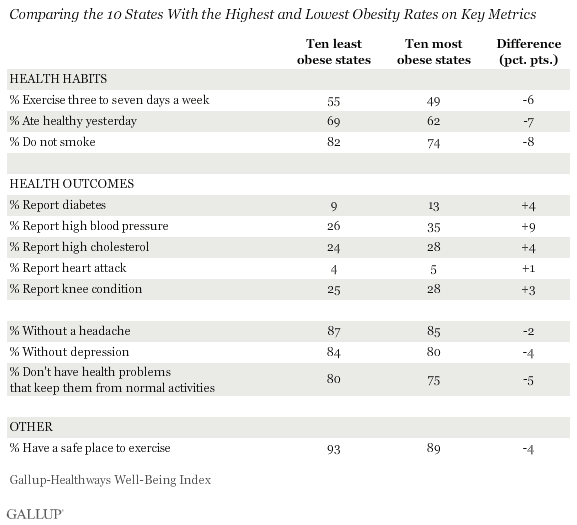
You can’t really call any state “non-obese” these days with every state having at least 20% of their population considered obese and 12 states having over 30% of their population obese.


But, in a separate study, I found it interesting to compare some metrics from the most obese to least obese states.  Not surprising.


One of the things that I do always find interesting is whether people consider themselves to be obese.  People generally don’t.  I’ve spoken about it before, but I sometimes think healthcare providers need to be more direct with people to let them know that they are obese and this in going to increase their chances of dying sooner (2x more likely to die prematurely) and having other health problems.

Would You Pay $100 A Month For A Diabetes Application?

An article in MobiHealthNews caught my attention this morning when it talked about 2 payers agreeing to pay $100 a month for Welldoc’s diabetes application. This is fascinating to me since (a) I’m always interested in how people price and value services and (b) I’d love to bundle something like this into our diabetes offering. 

This of course begs the key question which is what is the value of the application.  We’re all familiar with the fact that diabetes drives significant costs within our healthcare system.  Here’s a quick summary from the ADA.

The national cost of diabetes in the U.S. in 2007 exceeds $174 billion. This estimate includes $116 billion in excess medical expenditures attributed to diabetes, as well as $58 billion in reduced national productivity. People with diagnosed diabetes, on average, have medical expenditures that are approximately 2.3 times higher than the expenditures would be in the absence of diabetes. Approximately $1 in $10 health care dollars is attributed to diabetes. Indirect costs include increased factors such as absenteeism, reduced productivity, and lost productive capacity due to early mortality.

Of course, diabetics also spend a lot of money on out-of-pocket costs themselves.  $6,000 from one study mentioned here.

But, I think the key question here is what assumptions make this a good investment.  Let’s me walk through my thought process.

  • At $100 per month, you pay $1,200 per year per member.
  • BUT, members won’t actively stay engaged with the application all year long so you have to assume some percentage of engaged members.  (A key question is whether you pay only for actively engaged members or all members enrolled in the program.)  And, how long does a patient have to use the application to achieve the results?
    • If 20% are engaged, the cost per engaged member would actually be $6,000 ($1,200 divided by 20%). 
    • If 60% are engaged, the cost per engaged member would be $2,000.
  • The next question is how you estimate the value of the application.  Based on their study, they saw a 1.9 point drop in A1c which is a good one-year drop and a good outcome metric to focus on (see article).  So the question becomes…what is the value of a 1.9 point drop in A1c?  This is a question I was looking for earlier.
    • This pharmacist based study talks about a 0.8% reduction in A1c leading to $1,200 in total savings.
    • This CVS study showed a $3,756 annual savings for an adherent diabetic versus non-adherent.  (But, adherence wasn’t shown in the Welldoc study.)
    • The President from Welldoc quotes a savings of $3,500-$4,000 per point drop in A1c, but I couldn’t find the study to support that.  (I e-mailed their PR people about this.)
    • And, a few weeks ago at a mHealth conference, I heard someone say the value was $7,000 per point reduction in A1c.

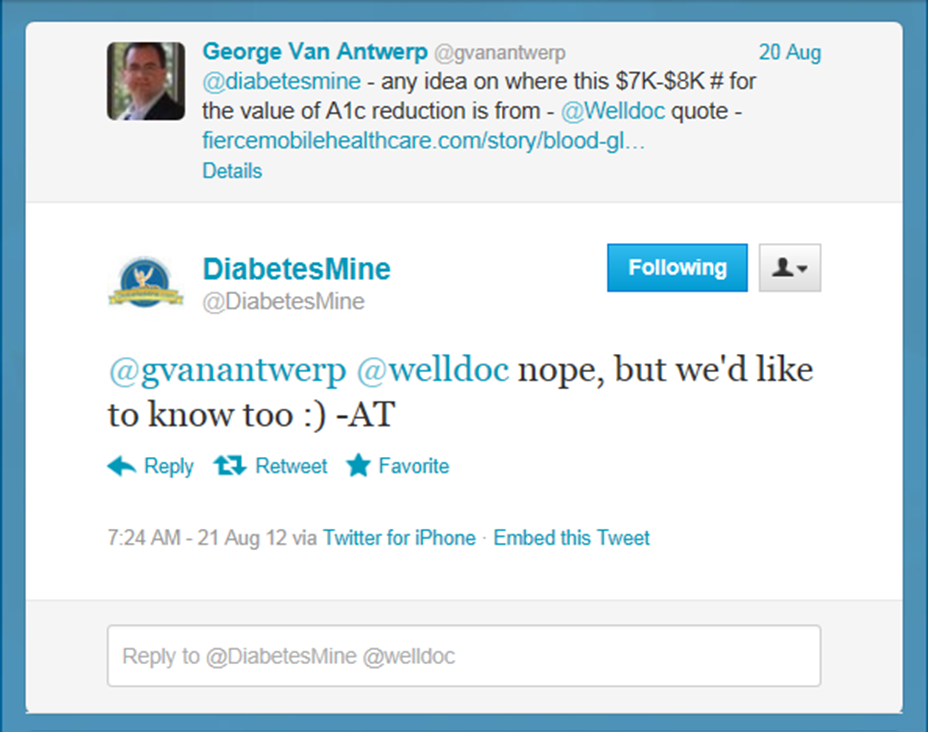
As you can see from this tweet, I was looking for this study yesterday and mentioned DiabetesMine to see if Amy might know, but she didn’t.


So, my conclusion is that this is worth it if:

  1. The value is closer to the $3,500 point.
  2. You pay based on actual engagement or utilization…or you only give it to people who actually use it versus the overall population. 
  3. The application improves adherence.

I hope to figure this out since this was the first FDA approved device and looks very promising.

Vaccine Excemptions By State

This is an interesting map from Every Child By Two which is a pro-immunization advocacy group.  And, per the article in USA Today, this discussion around vaccines is heating up with kids coming back to school and the biggest epidemic of whooping cough in 50 years.

I’ll also pull up this video that I posted last year which I thought to be a fun presentation of this topic.

Chronic Kidney Disease (CKD) Action Plan Poster

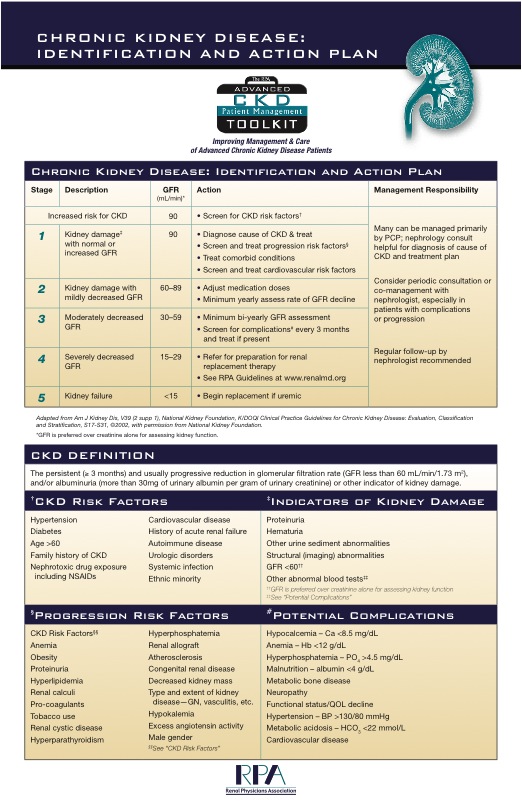
I was at my physician’s office yesterday and noticed this great poster on the wall from the Renal Physicians Association (RPA).  I reached out to them and got a PDF of the poster – RPA Toolkit Action Poster FINAL.  (Note: It’s meant to be a poster on the wall not a graphic in a blog post so it’s here for you to go look at, but it’s not easy to read and digest here.  Use the link to get to the PDF.)

The key points are that it shows you stages of CKD based on GFR along with the action you should take.  It also highlights the risk factors for CKD and the possible complications.


When Is It Good To Pay 300% Profit For A Medication?

Another interesting discussion at this Oncology event was about physician reimbursement for drugs.  In Oncology, one historical source of revenue (~50%) for physicians has been the medications they dispense and administer in their offices.  And, depending on who you believe, this has some degree of influence on what drugs they dispense.

The problem that was discussed is that today’s reimbursement model is ASP (Average Selling Price) plus 6% mark-up.  This assumes that everyone buys at some price near that average which by definition means that not everyone does.  One of the presenters suggested that physicians lose money on about 20-25% of the drugs they dispense and that it would need to be ASP + 12% for them to be positive on every drug.  (I don’t know the math here and am simply sharing the dialogue as I found it very intriguing.)

The examples that they kept talking about in several presentations were that for a generic drug that costs $40 then their margin is theoretically $2.40 (6%) versus for a brand drug that’s $4,000 where their margin is $240 (or 6%).  The suggestion was that if generics were reimbursed at 200-400% of ASP then it would take this economic factor out of the oncologists influence (when conscious or subconscious). 

It’s an interesting debate.  (Here’s some comments from another conference on this topic.)

On the flipside, some of this may go away with oral oncolytics being more common in the future (and therefore being more likely to be controlled by the PBM) although companies will look to enable in-office dispensing of these drugs also to help the physician from losing this income. 

The other strategy being pushed has been called “brown bagging” where the patient is directed to obtain their medications from a specific specialty pharmacy and then bring those to the oncology practice for them to use.  This eliminates the “buy-and-bill” approach but is not something that the physicians like (from what I know). 

At the end of the day, I don’t really care.  I think there are several key principles that if met would make me neutral to any solution:

  1. Are decisions made in the patient’s best interest or do financial implications impact clinical decisions?
  2. Is the safety of the patient impacted in any way?
  3. Is the patient experience impacted negatively in any way?

What Would You Pay For A Week Of Life?

I was at an Oncology meeting earlier today, and there was a brief discussion about pharmaceutical costs which is certainly one factor in overall healthcare costs.  (See article on the 11 most expensive drugs ranging from $200-$410K / year)  Ultimately, this always brings you back (at some point) to the topic of Quality Adjusted Life Year (QALY) or (a new term to me) “futile care” meaning care done essentially with a very low probability of working. 

Of course, like the lottery, we all like to believe that we’ll be the 1% for which this effort pays off.  (see Prospect Theory or a broader article on use of incentives in healthcare).  This can often be a very cost effective way to get people excited.  This is especially true for poorer people who spend as much as 3% of their income on lotteries which have a very low return

But, the question at the center of this is what you would pay for a week of life?

  • $100
  • $1,000
  • $10,000
  • $50,000

And, would that answer change based on timing?  I believe so.  If asked today, when you were healthy, would you agree to spend $50,000 to gain one week of life?  Perhaps not.  When you’re on your death bed and realize that you still want to see a few more people, your answer may change.  And, your family’s answer might change.  If you had to make that decision for your parent, it might be tough to make at the hospital, but if you sat down with them when they were healthy and asked them whether they would like you to spend your kid’s college savings account on gaining them a week of life, the answer might change.

But, what about when the money’s not yours.  We all know the infamous diner’s dilemna where we’re likely to spend more money when your splitting the bill with everyone.  When you’re covered by insurance or by the government, it’s not always your money being spent.  So, what if it was positioned differently?  If you knew that spending $50,000 for that one week of life meant that there wouldn’t be money to fund a shelter for 3-months that provided 20 homeless families with a place to sleep.  Would that change your answer?

It’s a tough question.  No one like to put a financial value on life.  I don’t have an easy answer other than having the discussions earlier with the patient and framing them the right way. 

Never mind the question about quality of life…Would you rather die in 2 days at home or would you rather live 8 days in the hospital where your throwing up all the time?

I don’t know the economic tradeoff of these treatments or drugs so this isn’t specific to any scenario, but is a situation which come up and everyone runs away from.  I understand why.

Condition Specific ACOs – Perhaps Kidney and Oncology

One of the more interesting discussions out there about ACOs is that around carving out specific conditions. While the general ACO concept is built around the idea of a Medical Home where the PCP is your “guide” (not gatekeeper) and helps you to make decisions, complex patients with certain chronic conditions may be better served to have a specialist managing and coordinating their overall care.

While DaVita with their push for Kidney specific ACOs built around their focus on dialysis has been one key player here, BCBS of FL has actually come out with what they referred to as an Oncology ACO. What CMS will do here is still TBD, but the idea of taking some of these high-cost and complex conditions and putting them into a fixed fee or bundled payment structure tied to outcomes sounds right.

I personally could even see more drug companies and medical device companies playing in this area since they could directly control certain costs and often have incredible amounts of research in certain conditions.

[To see more about our physician directed Accountable Care Solutions at inVentiv Medical Management, click here. Or contact me if you’re interested in how we’re applying these to support ACO and “ACO-like” organizations in their efforts to engage consumers and drive health outcomes.]