Highlights From The Prime Therapeutics Drug Trend Report

It’s been a busy year, and I’m getting a late start on reviewing the drug trend reports as I’ve done in the past. I’ll try to get to the CVS Caremark and Express Scripts reports next week.

As I mentioned last year, the Prime Therapeutics Drug Trend Report takes a more aggressive stand and how they compare to the competition. I’ll give a lot of that credit to Eric Elliot’s presence there as the CEO.

“Smart car buyers know that the actual cost of a car does not always align with the price on the window; the same is true for pharmacy benefits. Yet plan sponsors continually focus on “sticker price” measures such as brand-name discounts or manufacturer rebates — metrics that can be manipulated to make a deal look more attractive.”

The one thing which is noticeably different this year is that the document has more of a care management sound to some of the programs they talk about with an emphasis on total healthcare cost savings. Again, I attribute that to both being owned by the Blues and having several people in the management team that came from payers. Buried towards the back, they call themselves “total health focused” versus their competitors.

As always, here’s a few things that caught my attention:

  • A $4.73:$1 ROI for using the local pharmacist to address gaps-in-care.
  • 1.3% trend increase.
  • 74.7% generic fill rate.
  • 20.1% specialty trend increase.
  • 15.4% of client’s pharmacy spend is for specialty drugs which cost on average $2,654.
  • 0.4% of Rx claims processed are for specialty drugs.
  • Their Rxs PMPY have gone up to 12.4 which I think is closer to industry.
    • This is an interesting one. I pointed out a few years ago that they were below average which I wasn’t sure if this was due to plan design, member mix, or client mix.
    • They seem to be going up even though some industry data suggests a downturn in Rxs filled which again is something I can’t explain.
    • It could simply be more people >50 years old are staying in the insured mix…and they use more drugs.
  • Their average net costs per Rx were:
    • $165.33 brand
    • $17.95 generic
    • $57.53 combined
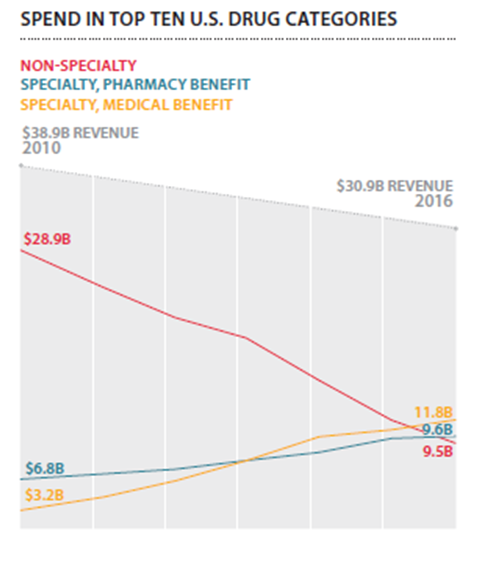
  • They breakdown specialty spend by category and also show how it’s growing and is projected to grow as a percentage of total drug spend.
  • Of course, another big piece of the specialty picture is how the spend breaks out between medical and pharmacy benefits. This is why blending data to understand the complete picture is important.
  • I thought the list of specialty drug management tools was a good starting point although I expected to see more here about how to integrate with the payers especially around categories like oncology and what BCBS of Florida is doing around an oncology ACO solution.


Some ACO Facts From Modern Healthcare and CMS

In a Modern Healthcare article about ACOs, there was the following graphic which is a quick snapshot.  The key here is that companies are rapidly moving forward with ACOs (commercial and Medicare).  The initial data is positive, and it seems like everyone is jumping on board.

McKinsey Quarterly On B2B Social Media

The recent McKinsey Quarterly had an article called Demystifying Social Media which I thought was a good read with a good framework to use (see below). 

In short, today’s chief executive can no longer treat social media as a side activity run solely by managers in marketing or public relations. It’s much more than simply another form of paid marketing, and it demands more too: a clear framework to help CEOs and other top executives evaluate investments in it, a plan for building support infrastructure, and performance-management systems to help leaders smartly scale their social presence. Companies that have these three elements in place can create critical new brand assets (such as content from customers or insights from their feedback), open up new channels for interactions (Twitter-based customer service, Facebook news feeds), and completely reposition a brand through the way its employees interact with customers or other parties.


Scary Infographic On the Effects Of Soda

The scariest stat in here is that kids ages 1 and 2 are drinking soda on a daily basis.

Now, the fact that we’re fat and drink too much soda isn’t the soda’s company’s fault.  We drink soda of our own free will, but this is a contributor to our obesity and this is why the NY soda law makes sense.  (And, IMHO, this is why the soda companies supported removing their drinks from schools and went into the business of selling non-soda beverages…they know there are issues regardless of what they say.)

Soda Infographic

Drug Trend Reports: Quick Summary Of Big Three PBMs

“Comparative” is a very loose word to use here since each PBM has a slightly different approach to their analysis.

But, while it’s truly impossible to compare apples to apples and I will continue to argue that trend may be an irrelevant metric, I know may consultants and others are focused on these metrics.

With that in mind, I pulled the trend numbers (overall and specialty) along with the generic fill rate from the Express Scripts, CVS Caremark, and Prime Therapeutics trend reports.


Overall Rx Trend

Specialty Trend

GFR

CVS Caremark

2.2%

19.1%

74.1%

Express Scripts

2.7%

17.1%

75.0%

Prime Therapeutics

1.3%

20.1%

74.7%

Notes:

  • I used the CVS Caremark health plan overall and specialty trend data which I thought would be most comparable to Prime’s data.
  • Express Scripts reports their overall trend (without specialty) being 0.1%.
  • CVS Caremark provides a break out of trend along with best practices by sector (see below).


How Often Do Patients Receive Needed Preventative Care?

I thought this image from Optum was very telling.  This is why coordinated care is so important and why it’s important to leverage technology to engage consumers and support their care team. 

Interview With Michael Graves On Healthcare Design

When I was in architecture school, Michael Graves was one of those architects that we studied.  Everyone wanted to be like him designing cool building like this one below.  Since then, he’s gone on to be even more famous both from an architecture perspective and a design perspective (even having his own Target line).

But, since he was left paralyzed from the chest down in 2003, he’s had an incredible focus on redesigning healthcare from the perspective of the patient.  [I would put him in a similar e-patient category as e-Patient Dave, but while Dave is focused on technology and data, Michael is focused on furniture and spatial experience.)

I was thrilled to get the chance to talk with him yesterday to see how this effort was taking off, and on a personal note, to see if this idea of architecture influencing outcomes would be generally accepted.  My general takeaway after talking with him was that he’s getting a very positive response as he talks to people about it, but you’re not seeing a sea-change in terms of clients focusing on this or his fellow architects embracing this.  But, as someone in healthcare, this isn’t surprising.  We know it takes physicians 17 years to adopt new standards…why should it take the administrators of those physicians any less.

At the same time, there is a huge focus on the patient experience and on outcomes these days.  Both of those can be improved through a focus on the physical experience.  I asked him whether he was seeing interest from both inpatient and outpatient facilities.  He indicated that the dialogue is all happening around hospitals which isn’t surprising given their investments in new facilities and the industry shift around ACOs and PCMHs.  But, any of us that have sat in a physician’s office looking at posters from the drug companies, outdated magazines, or just an overly sterile room, know that these things don’t relax you or make you comfortable.

Michael tells a story that I’d seen in other articles about how he first came to understand all the problems with the physical space in the hospital.  He wanted to shave one day and realized that he couldn’t see himself in the mirror and he couldn’t reach the water to turn it on.  It was all designed by someone that hadn’t put themselves in the patient’s shoes (or wheelchair) to understand their perspective on the space.

Since “evidence-based medicine” is all the buzz in the healthcare area, I asked him about the term “evidence-based design” which is used in several articles and on his website.  As he pointed out, it’s basically about just using common sense, but I do think there’s more there (to eventually sell this).  To me, this implies a level of rigor linking more practical furniture and spatial redesign to clinical outcomes and patient satisfaction.  These are the things that are going to motivate the CFO to open the purse strings to make a change.  Unfortunately in our healthcare system, there aren’t a lot of changes made just because the patient wants them or they make sense.  Otherwise, we’d have a healthcare system not a sick care system.

The final topic we discussed was moving beyond furniture to look at art and color and other things that could effect the patient’s experience.  He told me that he’s also a painter (which I didn’t know) and mentioned that one of his clients had bought some of his art and furniture for their facility.  He also reinforced a study that I’d seen before about not using abstract art but focusing more on natural scenes within the patient setting (also mentioned below).

Here’s a few articles from other interviews and a link to the work he’s doing with Stryker on medical equipment / furniture.  You can also see a press release on his upcoming presentation at the end of this post.

And, while Michael is focused on the furniture and spatial experience, there are others focused on the art, colors, and other aspects of the hospital experience.  I found this text from The Atlantic from a few years back that even talks about some of the studies that have been done.  [Maybe case managers should be asking for specific rooms in facilities!]

Such “evidence-based design,” which draws its principles from controlled studies, is the great hope of professionals who want to upgrade the look and feel of medical centers. Much of this research follows a seminal 1984 Science article by Roger S. Ulrich, now at the Center for Health Systems and Design at Texas A&M. He looked at patients recovering from gallbladder surgery in a hospital that had some rooms overlooking a grove of trees and identical rooms facing a brick wall. The patients were matched to control for characteristics, such as age or obesity, that might influence their recovery. The results were striking. Patients with a view of the trees had shorter hospital stays (7.96 days versus 8.70 days) and required significantly less high-powered, expensive pain medication.

Along similar lines, a 2005 study compared patients recovering from elective spinal surgery whose rooms were on the sunny side of a ward with those on the dimmer side. Those in the sunnier rooms rated their stress and pain lower and took 22 percent less pain medication each hour, incurring only 80 percent of the pain-medication costs of the patients in gloomier rooms. Other studies, with subjects ranging from the severely burned to cancer patients to those receiving painful bronchoscopies, have found that looking at nature images significantly reduces anxiety and increases pain tolerance. Not all distractions are good, however. Ulrich and others have found that inescapable TV broadcasts and “chaotic abstract art” can increase patients’ stress.

Press release about his upcoming presentation:

World-Renown Architect Becomes Healthcare Advocate After Rare Illness Leaves Him Paralyzed

Michael Graves to speak at medical conference about his passion for healthcare design


Michael Graves, the award-winning architect and product designer famous for his collection of home products sold at Target, will address the country’s top healthcare professionals during a special reception at the 2012 Health Forum and the American Hospital Association Leadership Summit next month.  He will give a personal account about how paralysis fueled his desire to improve healthcare design.

Graves, who was recently named the 2012 recipient of the Richard H. Driehaus Prize and applies his design philosophy to designing better hospitals and home care environments, will be the featured speaker immediately following the welcome reception of the 2012 AHA Summit, at the San Francisco Marriott Marquis, at 7 p.m., Thursday, July 19.

In his lecture, “People First: Redesigning the Hospital Room,” Graves will discuss his own experience with a sinus infection that left him paralyzed from the chest down and how undergoing hospitalization and rehabilitation in inadequately designed hospital rooms has inspired his healthcare designs.

Graves talk will focus on design solutions for Stryker Medical, including a collection of hospital patient room furniture that addresses common hospital problems such as infection control, patient falls and clinician back.

“We are thrilled to have such a highly-acclaimed and gifted architect speaking before the healthcare community about ways of improving the hospital setting,” said Harold Michels, senior vice president of the Copper Development Association (CDA), the organization hosting the dinner event with Graves.  “This is a can’t-miss event that will certainly have hospital CEO’s and healthcare advocates talking about way after it’s over.”

Graves has said that spending months in hospitals during his recovery in 2003 opened his eyes to poorly designed patient rooms, and made him realize the patient experience could be improved by design.  He immediately began to sketch ideas for improving hospital buildings, room and furniture.

The event is being presented by CDA’s Antimicrobial Copper team, which is working to advance the message that copper surfaces intrinsically kill disease-causing bacteria.  On display will be a variety of antimicrobial copper products, which can play a pivotal role in healthcare facilities by killing bacteria that cause hospital-acquired infections and by reducing costs.

Laboratory testing has demonstrated that antimicrobial copper surfaces kill more than 99.9% of the following HAI causing bacteria within 2 hours of exposure:  MRSA, VRE, Staphylococcus aureus, Enterobacter aerogenes, Pseudomonas aeruginosa, and E. coli O157:H7.

Graves is internationally recognized as a healthcare design advocate, and in 2010, the Center for Health Design named Michael Graves one of the Top 25 Most Influential People in Healthcare Design.  Graves regularly gives lectures to major healthcare advocacy groups, including AARP, the Healthcare Design Conference, Medicine X and TED MED.

About Michael Graves & Associates

Michael Graves & Associates has been in the forefront of architecture and design since AIA Gold Medalist Michael Graves founded his practice in 1964. Today, the practice comprises two firms run by eight principals. Michael Graves & Associates (MGA) provides planning, architecture and interior design services, and Michael Graves Design Group (MGDG) specializes in product design, graphics and branding. MGA has designed many master plans and the architecture and interiors of over 350 buildings worldwide, including hotels and resorts, restaurants, retail stores, civic and cultural projects, office buildings, healthcare, residences and a wide variety of academic facilities. MGDG has designed and brought to market over 2,000 products for clients such as JC Penney, Target, Alessi, Stryker and Disney. Graves and the firms have received over 200 awards for design excellence. With a unique, highly integrated multidisciplinary practice, the Michael Graves Companies offer strategic advantages to clients worldwide. For more information, visit www.michaelgraves.com.

About the Copper Development Association

The Copper Development Association Inc. is the market development, engineering and information services arm of the copper industry, chartered to enhance and expand markets for copper and its alloys in North America. Learn more on ourblog. Follow us on Twitter.

Are You Turning Data Into Knowlege?

I’ve used this framework for years, but I wanted to post it here as I think about outcomes reporting. (image source)

This is key as you move to add value around data and use the knowledge and wisdom to create informed actions.


Different Types Of Leaders

As yesterday was Father’s Day, I was thinking about my father and the many things he taught me:

  • You can do anything.
  • Be humble and kind to those around you.
  • Family is important.
  • Have values and stick to them.
  • Enjoy life.

He didn’t push me to be a star athlete.  He didn’t push me to get a 4.0.  He did have high expectations of me, but he was more focused on building my moral code than anything else.  He wanted me to learn things like the games of Chess and Bridge.  He wanted me to meet lots of people.  He wanted me to do chores and contribute to the household.  He wanted me to have a job.  He’d take me to play golf or tennis or any other sport, but only for fun, not to try to build the next pro athlete. 

This made me think about other types of leaders that I’ve experienced in my life:

  1. Leader as mentor who takes you under their wings and tries to open your eyes to new possibilities
  2. Leader as teacher who is constantly trying to get you to try new things to become better
  3. Leader as friend who is trying to know you and hang out with you to build loyalty
  4. Leader as genius who is just amazingly smart and someone you want to try to be around
  5. Leader as innovator or entrepreneur who is pushing the envelope and trying to change the world and motivates through big ideas
  6. Leader as workaholic who simply motivates by working so hard that you try to keep up
  7. Leader as prison guard who motivates through punishment and yelling who motivates through fear of losing your job
  8. Leader as preacher who captivates you with stories and vision that motivates you in a cult like fashion

Is anyone perfect?  Probably not, but thinking about Father’s Day got me thinking about the leader as father model who blends some of all of these.  Friend, Preacher, Teacher, Punisher, Genius, Workaholic, etc.  They provide you a model to follow and have a vested interest in your success whether it’s working for them or working somewhere else.  They care about you being the best that you can.

Sports As Training For Real Life

A former sales executive once pointed out to me the fact that he liked to hire people that had competed at the highest level in sports.  I didn’t understand why, but his explanation made a lot of sense to me. 

  1. They learned how to set goals and train and prepare for those goals.
  2. They knew how to win.
  3. They knew how to lose, reflect on the loss, move on, and prepare to win again. 

I think number three is what gets lost in the “trophy generation” that we see out there today.  Kids that only know how to win and throw their rackets or get upset if they lose.  They don’t understand the value of competition, of being pushed, and of learning how to lose with grace.

Do You Push Your 10 Year Old To Be An Olympian?

When I was watching the movie The Tooth Fairy last week, it really got me thinking about how some people push their kids so hard into sports at such an early age.  I heard one 10 year old parents talk about their kid being in the next Olympics (when their not even the best at their sport that I know). 

Here’s some examples of what I’ve seen which seem wrong:

  • A 6-year old that is home schooled so he has more time for private lessons in his sport
  • A kid who is only rewarded if she sets 3 records this summer
  • A kid who is paid to beat certain people at her sport
  • A kid who is punished by extra practice if she doesn’t perform perfectly
  • Multiple kids playing on 2 or 3 different teams simulateously in the same sport
  • Kids training 4-5 hours per day / 6 days a week at age 9

I see more and more parents (of kids under 11) video tapping their performances and then breaking down their play after they perform with them.  The focus is always on the negative.  As I heard one kid say, “be my parent not my coach”.  I think that’s important.  Parents can’t project their expectations of paying for college and fame on their kids at such an early age. 

This leads to self-esteem issues.  It leads to burnout.  It leads to over training.  And, it can lead to false expectations that manifest themselves in poor sportsmanship. 

For example, I know one kid that my kid has to compete with came up to her and said “why are competing on this team…I can’t win if you compete”.  Never mind the team spirit.  This kid wants the personal recognition even in a category that she doesn’t compete in year-round, but she thinks she should be a star in whatever she does.  This is what leads kids to cheat and be bullies. 

Here’s a few other articles on this topic:

Here’s a quote from an interview with David Ellis a sports nutritionist about specializing too early:

Early bloomers typically have an advantage on these AAA teams, and while they dominate the domestic stage with their early maturity and specialization, they are not as competitive on the international stage once other competitors have matured. In fact there is evidence that the athlete who didn’t specialize early and was a little later in maturation might end up being the better athlete! Why you ask?

That multi-sport athlete kept on developing motor skills and competitive vision that might have been more challenging in totality than the narrowed focus of the specialized athlete. These multi-sport athletes are hungry to compete as they approach their prime, and because many were late bloomers, they had to be smarter players to make up for their lack of size and strength. So when their bodies do catch up maturation-wise, they often times have a sharper set of skills, and the net result is an athlete who has the tools and the motivation to compete at an elite level versus the burn out early specialized athlete who often seems to have peaked too early and below their net potential.

Healthcare Transparency, Out-Of-Network Claims, and Technology Solutions

Another big focus area these days is around the creation of transparency solutions to enable consumers to make better cost decisions about their healthcare.  While several companies have sprung up to work directly with consumers, the large payers have begun to rollout their own solutions.   And, as you can see from the Towers Watson and National Business Group on Health 2012 Survey, this issue of transparency was the 3rd biggest focus area for 2013. 

If you havent’ heard much about the topic, here’s several articles about the challenge of price discrepancies and surprise bills to consumers:

Here’s what UHG and Aetna are doing:

A few of the companies to look at are:

Companies like GoodRx are creating solutions in this area. 

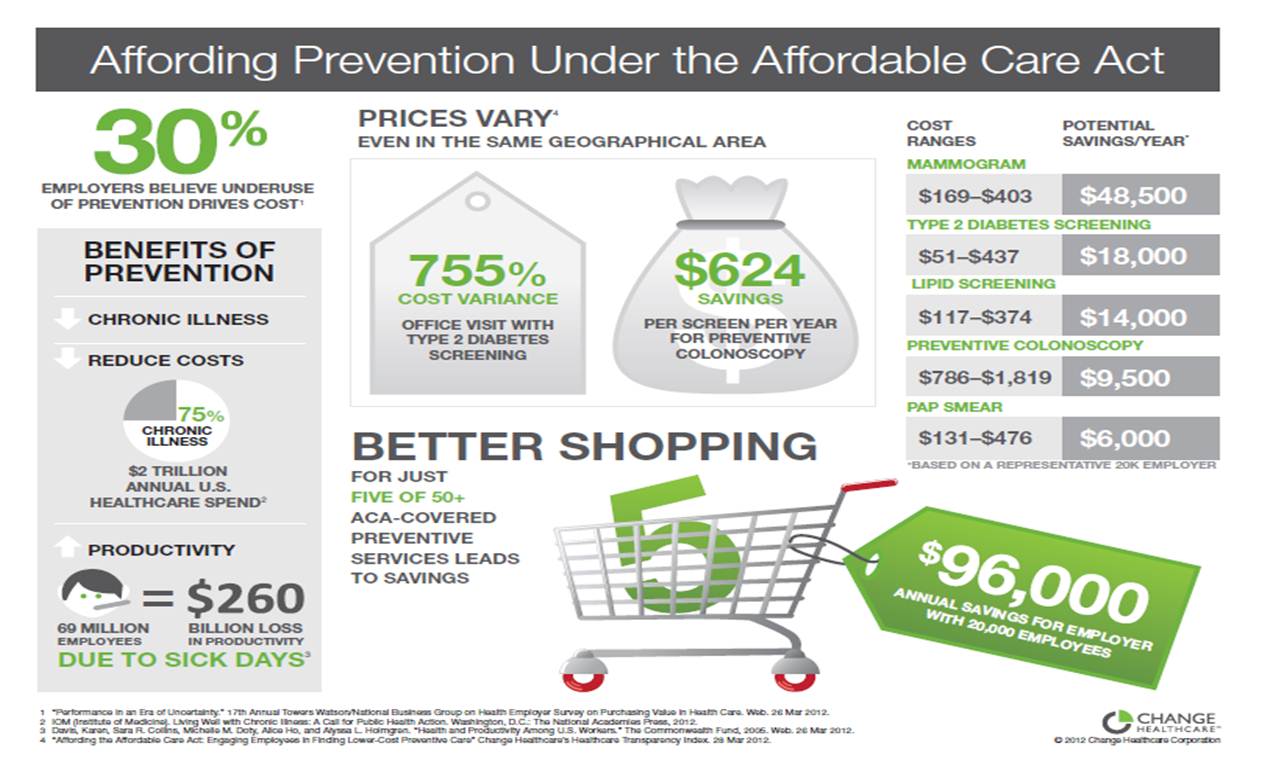
You also might enjoy this infographic from Change Healthcare.


If you don’t believe this is a big issue in terms of price differentials, take a look at this data from the Healthcare Blue Book.  This shows a huge swing in prices which depending on your plan design can directly impact your out-of-pocket spend. 

Test or treatment Low Fair High
Brain MRI $ 504 $ 560 $ 2,520
Chest X-ray 40 44 255
Colonoscopy 800 1,110 3,160
Complete blood count 15 23 105
Hip replacement 19,500 21,148 43,875
Hysterectomy 8,000 8,546 16,480
Knee replacement 17,800 19,791 42,750
Knee arthroscopy 3,000 3,675 7,350
Laminectomy (spine surgery) 8,150 11,744 25,760
Laparoscopic gallbladder removal 5,000 6,459 12,480
Tubal ligation 2,865 3,183 5,729
Transurethral prostate removal 4,000 4,409 8,875
Ultrasound, fetal 120 169 480
Vasectomy 700 1,003 2,100

CellScope – Another Smartphone Bolt-On

Turning your smartphone into a diagnostic device seems to be a large focus right now.  I just saw another one called CellScope.  They allow you to take a picture of your inner ear or your  skin and submit those for review. 


From a recent article:

Khosla Ventures also recently invested $1 million in CellScope, an alum from Rock Health’s first class of startups in 2011. The company is developing smartphone peripheral devices designed for consumers to use for at-home diagnosis.

Think of it as a “modern-day digital first aid kit.”

CellScope’s first offering will be a smartphone-enabled otoscope that will enable physicians to remotely diagnose ear infections in children. Parents will be able to use the peripheral, which attaches to a smartphone camera lens, to send an image of their child’s inner ear that physicians can use to make a diagnosis and then write a prescription if need be. CellScope says ear infections in children make up 30 million doctor visits annually in the US alone. The consumer device would help parents miss less work and potentially cut down on late night emergency room visits, according to the startup.

The startup traces its origins to bioengineering Professor Dan Fletcher’s lab at UC Berkeley, where CellScope founders Erik Douglas and Amy Sheng were developing cellphone-microscopy for remote diagnosis in developing countries. CellScope expects to launch future products focused on throat and skin exams, including non-clinical apps for consumer skincare.

Infographic: United States of Organ Donors

Transplants is huge issue especially with the increasing rates of obesity and diabetes leading to increased kidney disease.


Brought to you by: TermLifeInsurance.org

A Few Diabetes Facts From Express Scripts

Here’s a summary of some of the data from the latest Express Scripts Drug Trend Report relative to Diabetes.

  • 26M Americans have diabetes
  • 15% of Americans (or 39M) will have diabetes by 2020
  • Diabetes costs $194B per year (health spending) and that is expected to rise to $500B by the end of the decade
  • 41% of diabetes are non-adherent to their medications
  • 60% of diabetics using insulin don’t regularly self-monitor their blood glucose levels
  • The drug costs are $81.12 PMPY (based on high utilization of metformin (a generic)) with 14.91 Rxs per user per year (which seems low since the average diabetic takes 5 medications from what I know)

This gives you some data, but I pulled this data from an older blog post of mine from the ADA…

I found this list of diabetes fact from the American Diabetes Association in an article I was reading:

  • 25.8M children and adults in the US have diabetes (8.3% of the population).  This includes 7.0M who haven’t yet been diagnosed.
  • 1.9M new cases of diabetes were diagnosed in people 20+ in 2010.
  • 215,000 or 0.26% of all people under 20 have diabetes.
  • In 2007, diabetes was listed as the underlying cause of death on 71,382 death certificates and as a contributing factor on another 160.022 death certificates.
  • Adults with diabetes have heart disease death rates 2-4x higher than adults without diabetes.
  • The risk for stroke is 2-4x higher for people with diabetes.
  • Diabetes is the leading cause of blindness among adults ages 20-74.
  • Diabetes is the leading cause of failure accounting for 44% of new cases in 2008.
  • Total cost of diagnosed diabetes in the US was $174B in 2007.

And, depending on if you focus on pre-diabetics, the population becomes even larger.  I expect with more and more companies doing onsite biometric screening that the population in diabetes management programs will increase significantly over the next few years.  The keys will be treating them differently based on risk, disease understanding, and patient preferences to make the programs cost effective.

Setting Expectations As First Line Therapy

I read a great article the other day about adherence.  It took a great big picture view of the topic.

You can’t expect a patient to be adherence to a medication or compliant with your orders if they don’t understand their condition and/or the medication.  This is a very necessary topic even if they’re not a newly diagnosed patient.

This brings into account their literacy level, their plan design, their experience with you as a provider, their experience with the drug, their home life, and many other factors.

I’m going to use an experience from this past week outside medicine to reinforce this point…

I was down in the Destin Beach area this past week and wanted to go out on a charter fishing boat with my family.  We finally found a boat and rented it.  At 6:30 am when we were about to get there, the captain called to cancel because the boat wouldn’t start.  We were disappointed, but I’d rather be stuck on land then trapped at sea.

But, with 4 others in tow, I wanted to make good on my coordinated plan so I walked the docks for 20 minutes and found a captain who’s charter had no showed.  I’ve been on a few charters so I had some expectations.  But, in the end, I was very disappointed.

  • The captain drove the boat like a madman bouncing all of us around and never really gave any directions.
  • His first mate had only been doing this for 2 weeks and while more personable wasn’t much help.
  • Apparently, they have to catch their live bait every morning which ate up over an hour of our trip before someone shared some of theirs with him.
  • And, after a 4 hour trip, we only caught two catfish.

To make it worse, when we pulled in there were boats unloading all kinds of huge fish.

So, did we hire the wrong boat?  Did we get ripped off?

I don’t know, but I know that the paper said that the waves were so ruff that 4 boats capsized the day before leaving fishers in the water being tossed around and requiring the coast guard to save them.  (This was certainly not what I wanted.)  I also know I had a choice between bay fishing (more calm) and gulf fishing (more rough).

My point with this comparison was:

  • Although I’ve been fishing before, like a patient going to a new provider, they could have set some expectations for me by knowing what they do compared to others.
  • Communications are key.  If the captain had provided some perspective on what he was doing instead of just doing it, I might have had a better expectation and perspective.  Do fish bite in rough water?  Why would they catch a lot in the gulf and nothing in the bay?  Were others catching more?

Now if only fishing would move to a pay-for-performance experience then I would have left there disappointed but not having paid for being disappointed.

NY Law On Soda Is Simply A Nudge To Be Healthy

I know we can all complain about the government telling us what to do, but at the end of the day, they’re not saying we can’t drink soda.  As far as I know, you can still have unlimited refills in NY.  They are simply reframing one aspect of drinking soda to try to nudge us into being healthier.  Ultimately, this should be a good thing for us for several reasons.

  1. We eat or drink whatever is put in front of us.  Just look at this research.
  2. Soda and other sugary drinks are generally not good for us.  Just look at the infographic below.
  3. We have an obesity problem in this country (in case you didn’t know it).
  4. Obesity drives diabetes, kidney problems, hypertension, and many other problems that are driving up our healthcare costs and turning us into the first generation to potentially live shorter lives than our parents.
  5. Nudging people into behavior change works.

Pediatric Cancer Article in EBN

“In the 1950s and 1960s, 4% of children survived with that diagnosis [leukemia].  In 2010, 80% to 85% of children in all risk categories survived and are cured.”  Dr. Beverly Bell, Medical Director of the oncology program at inVentiv Medical Management

This is a quote from the June 1, 2012 article titled Trial and Error in Employee Benefit News.  It’s an important fact as we watch cancer go from a terminal diagnosis and medical event to a chronic disease.  Working with the survivors is something that Dr. Bell and I have discussed several times.

Here are some other facts from the article:

  • 1/3 of childhood cancers are leukemias.
  • 10,400 kids under 15 in the US were diagnosed with leukemia in 2007.
  • About 1,545 of them will die fro the disease.
  • Approximately 75-80% of pediatric cancer patients are put on a clinical trial.

The article goes on to talk about several things to consider:

  • Plan language modifications.
  • Access to pediatric oncology nurses.
  • Access to a oncology network of centers of excellence.
  • General support for the entire family perhaps through an EAP program.
  • Hospice care.
  • Medical travel / tourism.

Creating a holistic strategy to address oncology is a big effort and one that is critical to helping these patients.

A Few Basics On Health Risk Assessments

Like many of you, I’ve heard a lot about HRAs (Health Risk Assessments) for years.  A few times I’ve even taken them.  And, depending on your employer, you may even get paid to complete one.  But, what are the basics about HRAs that you should know?

  1. What is a HRA?  An HRA is a series of questions that can be administered over the Internet or by the phone or by a nurse to help collect patient reported data to help screen patients for chronic conditions or risk of developing a chronic condition based on their behaviors or other data.  Additionally, they often lead to either immediate feedback on behaviors to address or lead to the patient being engaged into a program with a wellness, disease management, or case management. 
  2. Should employees be incented to take an HRA?  Incentives are basically used to increase response rates to the HRA.  Not surprisingly, several studies show that incentives work, but education about the need to take the HRA is also important.  In some cases, employers are even linking participation to premiums.  Additionally, here’s a list of the top incentives used based on a 2010 study. 
  3. How should an HRA be used?  An HRA is a key component of an overall care management strategy.  Like claims analysis, the objective of the HRA is a screening mechanism to identify patients who should be included in wellness, disease management, or care management program. 
  4. Are HRAs valuable?  There have been studies over the years that have shown a 2:1 or 3:1 ROI for wellness programs and a ROI for case management.  HRAs are valuable in identifying more patients who should be enrolled in these programs. 
  5. Should you combine biometrics with HRAs?  Here’s a good study that shows that blending lab work with HRA data significantly increases the likelihood of identifying patients with diseases especially kidney disease. 

Of course, no HRA is valuable if:

  • You can’t get enough members to actually take the HRA.
  • You don’t have an engagement strategy to get the members to participate in the program.
  • You don’t continue to follow-up and help the member manage their condition.
  • The member doesn’t get engaged in their healthcare. 

Amazing iPhone Application For The Blind

When I saw this presentation at World Health Care Congress in DC earlier this year, it was definitely the most amazing presentation there.  We all talk about all the new applications being developed.  There is one that looks at your tongue to tell if you’re sick.  There’s one that will take an audio file of your cough and compare it to other coughs.  Lots of amazing applications.

This one by LookTel can really make the difference for blind people. 

Regenerative Medicine – TEDMed Video On Printing A Kidney

It takes a lot to wow me, but this is an amazing video from TED.  It shows several different innovations within the field of regenerative medicine

Given the growth in chronic kidney disease due to diabetes and obesity, the need for kidney transplants is only going to go up.

Healthcare, a New Car, or Paying for College

Based on the latest Milliman Medical Index data, that average costs for an American family to receive healthcare in an employee sponsored PPO plan is $20,728. In general, that’s more than 20% of the households in the US make per year. And, I believe you can buy a decent car and still attend many colleges for less than that.

Can someone say “problem”?

While companies pick up the majority of it, the average employee is paying $8,584 of that for their family. That’s a strong reinforcement for the NPR article earlier this week about how it’s hard even for the insured to afford their healthcare…much less the uninsured.

The one thing that I think many of us miss is that there are ways to fix this beyond simply waiting for the Holy Grail of health reform to transform us overnight. (I’ll let you in on a secret…even if it’s not overturned, it’s not going to fix everything.) Let’s just look at some articles about our healthcare system:

  1. This story talks about the importance of communications in healthcare.
  2. This story talks about non-adherence even with cancer patients and high cost medications.
  3. This story talks about pharmacy waste.
  4. This story is about the scary amount of wrong diagnoses.
  5. And, here’s one about how infrequently evidence-based medicine is followed.

So, if you combine the systemic issues with the human behavior issues, it seems like a low likelihood of getting the best care. That’s why we all need some “big brother” who’s watching out for us. Someone monitoring our claims. Someone providing counsel to us to help us make informed decisions. Even the physicians in the ACO or PCMH concepts need that.

Jeff Welch on HCSC, Bloom, and Defined Contribution

Unfortunately I’ve been swamped lately, but I wanted to get out the notes from the last interview I did at the World Health Care Congress (#WHCC12) in DC. I had the chance to sit down with Jeff Welch from Health Care Service Corporation (HCSC). Jeff’s the Divisional Vice President of Consumer Markets which is obviously a very hot area these days as everyone is talking about the “retailing of healthcare“.

Jeff’s focused on some of HCSC’s consumer efforts including their work with Bloom which they bought with Wellpoint and BCBSMI. As we know from lots of surveys (e.g., Medco survey, Towers Watson survey), consumerism is a hot topic with lots of recent articles about the work that companies like Change Healthcare and Castlight are doing (see Money article or Bloomberg article). From Jeff’s presentation at the conference, he pointed out that 6M Americans are in consumer driven health plans today and that $550-$600B in premium dollars are already controlled by individuals. A key driver in this area is the adoption of defined contribution plans in healthcare which like retirement plans is a model where employers set aside a fixed amount of money for employees to spend on healthcare and then give them options from which to choose.

Bloom Health, established in 2009, provides employers and employees greater flexibility, access and choice of health care services by simplifying how they select and pay for health insurance. Through its platform, Bloom Health helps employers define and better manage their health benefits spending through a defined contribution model. The employer contributes a defined amount per employee toward the cost of employee health care benefits. Employees and individuals are presented with a wide selection of benefit plans through an online “marketplace” to best fit their individual needs. (from Bloom PR link above)

Bloom is a platform for defined contribution to help consumers manage multiple choices and to facilitate them making choices. Essentially, as Jeff explained it, Bloom allows the employer to act as an automated broker. Bloom provides both technology and call center support to enable front end enrollment (not claims processing). Right now, it sounds like they are focused on small groups and national accounts, but they are adding Medicare in the future. To me, it sounds like this is the kind of front end GUI that consumers need to help them begin to understand healthcare options and make educated tradeoffs about what choices fit them best.

One of the interesting things that we talked about is the Bloom “configuration engine” (my term) which uses survey data about individual health, financial, and personality data to match you with the best health offerings for your needs. Ultimately, this makes me think about how individuals can create a personalized health insurance plan in the future rather than picking from a subset of options today. I don’t think consumers are ready to do that since we’re not good at predicting the future, but there are algorithms that could help with this especially if Bloom were to load our claims history and health risk assessment data in and use it as part of the guidance process.

Today, the basic process is:

  1. Employer implements a defined contribution plan.
  2. Employer defines what the consumer can see in terms of options.
  3. The Bloom Health tool helps the consumer select their best option.
  4. The consumer selects their plan.
  5. Bloom then transfers the process to the plan for implementation and ongoing management.

So, what does this mean in the future? This will play into the Health Insurance Exchange part of the health reform. Bloom offers a private exchange platform today. I think the Kaiser Family Foundation does a good job of identifying several key components of Health Insurance Exchanges:

  1. Offering consumers a choice of health plans and focusing competition on price
  2. Providing information to consumers
  3. Creating an administrative mechanism for enrollment
  4. Moving towards portability of coverage
  5. Reforming the insurance market

Perhaps not surprisingly, even with health reform’s fate still in the air, the government and health plans appear to be moving down this path based on an article yesterday.

2/3rds of Pharmacy Spend to be in Specialty by 2016

I found this chart to be very interesting.  According to the latest CVS Caremark projections, over 60% of healthcare spending on drugs will be on specialty drugs by 2016.  That’s a huge shift!  A lot of it still sits in the medical side which no PBM has really figured out how to manage, but it creates great opportunity for those that can integrate medical and pharmacy claims to analyze the data and leverage it for cost and care management programs.

9 Leading Trends In Rx Plan Management

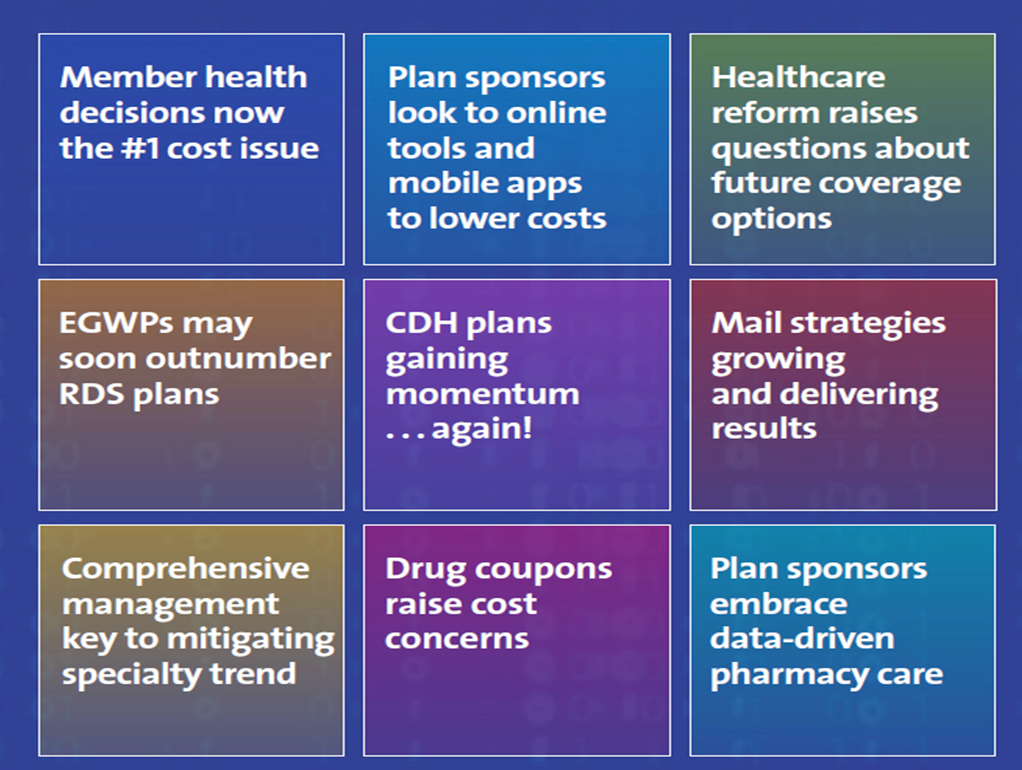
This a Medco report (now Express Scripts) that they recently released.  It lays out what’s on the minds of clients (payers) in terms of prescription management.  Not a lot of surprises here.  (But, if you’re looking at this, you might also note that the URL www.drugtrendreport.com is now up with the new branding and Express Scripts drug trend report.)

Screening Gaps

I took a quick look at some data from the Thomson Reuters 2010 PULSE Healthcare Survey about screenings by age compared to recommendations. Here’s what it showed (in summary):

Screening

Recommendation

Actual From Survey Respondents

Prostate

Vary but the National Cancer Institute indicates that age is the most common risk factor

31.5% of all men have had a prostate screening in the past 2 years (48.5% of those 65+)

PAP / Cervical

American Cancer Society recommends all women between 21-30 get a screending each year or two

65% of those <35 have had a test

Osteoporosis

US Preventative Services Task Force recommends that all women >65 and those with certain risk factors get tested

16.2% of all women have been tested in the past two years and only 28.1% of those >65

Colorectal

American Cancer Society recommends screenings beginning at 50

33.6% of those 65+ have had a screening in the past 2 years and 22.9% of those 35-64

Diabetes

American Diabetes Association recommends screening for everyone 45+ every 3 years and more for those who are overweight or have multiple risk factors

27.7% all respondents reported having a screening in the past 2 years

Cholesterol

National Cholesterol Education Program recommends screening for all Americans over 20

48.4% have had a screening in the past 2 years

Mammogram

Recommended yearly for women over 40

53% of those 35-64 and 61% of those 65+ report having one in the past year

Only 20% of Americans Perceive Themselves To Be In Poor Health

Should we be surprised?  It always looks worse around us than what we think about ourselves.

BUT, this has huge implications.  If we’re trying to get people engaged in their care at a pre-disease point (i.e., pre-diabetic) or trying to engage them earlier in their chronic kidney care continuum, this matters.  They’re likely to ignore the outreach about wellness and disease management if they don’t think it applies to them.  I guess it’s like thinking that you’ll win the lottery.  Or thinking that the last dose of chemotherapy (even though you’re about to die) might just save you.

But, if you dig into the data, you do see some differences by age and by income (per Thomson Reuters 2010 PULSE Healthcare Survey):

  • 35.5% of those making >$100K think of themselves in excellent health versus 11.1% of those making less than $25K.
  • Only 1.1% of those making >$100K think of themselves in poor health versus 14.3% of those making <$25K.

(While we know that there are healthcare discrepencies tied to income, this wouldn’t explain this great of a gap in self-perception.)

  • 61.7% of those <35 perceive themselves to be in very good or excellent health versus 40.7% of those >65 (but a lot of that could be explained away since they are much more likely to have symptomatic diseases at that age)

(comments in parenthesis are my perspective not from the study)

Testing To Identify Future Type 1 Diabetics

There is a lot of information in the news about obesity, metabolic syndrome, and diabetes these days. In many cases, these are related. But, Type 1 diabetes is an autoimmune disorder which attacks the body’s ability to make insulin. Currently, there is no way to prevent or cure Type 1 diabetes.

While it has long been called juvenile diabetes, the reality is that of the 30,000 new cases diagnosed each year, about ½ of them are in adults. The key question is whether you could screen for this. There is now a blood test which is being used at Type 1 Diabetes TrialNet (18 research centers conducting clinical trials) which can help physicians identify the onset of the disease as early as 10 years before symptoms.

Right now, people that qualify can get the test for free, but I think this brings into play the larger question. When is it appropriate and cost effective to screen people about future diseases? In today’s US healthcare model, the “churn” of membership often downplays the long-term public value of prevention. Unless you know a member will be with you in the future when these costs come to be, should you bear the costs of the test today?

A few stats from yesterday’s WSJ on this:

  • 3 million Americans have Type 1 diabetes (compared to 22M who have Type 2)
  • 80 people a day in the US that are diagnosed with Type 1 diabetes
  • 3% annual increase in the Type 1 diabetes cases world-wide under the age of 14
  • 11-14 is the peak age for Type 1 diagnoses

So, the key question is how do you know if you’re at risk…

The primary factor that was identified in the article was whether you have a family member with the disease. If yes, you’re 15x more likely to have Type 1 diabetes than the general population. Perhaps as part of an HRA (health risk assessment), we should be asking about Type 1 diabetes in the family and screening those that say yes. Or, we could look at medical or pharmacy claims and reach out to family members about being screened.