
(Note: Videos and slides may not appear in your e-mail summary. You may have to visit the website to see them.)
Archive | March, 2011
Who Should Decide Rx Location – Payer Of Course
 March 4, 2011
  7 Comments
Today’s NYTimes article “Pharmacists Fight The Rise Of Mail Order” begs an interesting question. Who should have the right to determine choice?
As the retail pharmacies imply, should they be able to legislate that payers (employers, government, insurance companies, unions) have to allow consumers to come to their location? That seems strange to me.
If the shoe were on the other foot and payers didn’t allow their members to go to mail order, would retail allow the PBM to ask the legislature to change that? (Maybe someone can show me examples of a PBM arguing for mail having to be an option with a client that doesn’t offer mail order.)
Maybe I’m missing something here. Doesn’t the person who is paying the majority of the bill (~80%) have the right to direct care to the lowest cost channel? If someone has an issue with that, shouldn’t it be the consumers talking with their employers?
Shouldn’t competition play out in pricing and value proposition not in the government?
I’ve never heard Chrysler go to the government and say that they had to stop a large employer from limiting their choice of cars for their executive to team to Ford products.
If my employer offers me a discount to Sam’s Club, can CostCo go and argue that with the legislators?
Wouldn’t that turn our whole free-market economy upside-down?
In my opinion, payers should be able to choose their network which could include a limited number of retail locations if that met their expectations on price, outcomes, access standards, and satisfaction. It could include mail or not. BUT, it’s their choice based on the options they have and their management of their spend. Why does government have a role here?
Daniel Pink Video On Drive
March 4, 2011 0 Comments
I was just visiting Daniel Pink website and saw this video on his book. Good summary plus I love the RSA Animate videos.
RSA Animate — Drive: The surprising truth about what motivates us from Daniel Pink on Vimeo.
You Have Cancer…Blah Blah Blah
March 3, 2011 0 Comments
After you get diagnosed with a serious disease like cancer or even a chronic condition like diabetes, do you remember anything the physician says? Someone once told me that patients remember something like 12% of what the physician says after that (I couldn’t find the source). Another person shared with me that their physician told them to go home and call them later to talk about all their questions.
This is the extreme example, but a situation that repeats itself day after day. Patients learn that they have a disease. In some cases, they’ve been searching for an answer to their symptoms for a while, and there is a sense of relief followed by anxiety. In other cases, they had a minor problem which leads to identification of a much more serious issue.
I talk about this because in some cases we start this patient on a course of therapy that they don’t understand or a drug which has side-effects they didn’t expect. Health literacy is a big enough issue, but not understanding the receptiveness of the patient based on environmental issues such as shock is a big deal.
We (as a healthcare system) have to continue to help close this gap to educate consumers and leverage the broader care team including physician, pharmacist, and caregivers to help patients understand their condition and the next steps they need to take. Trisha Torrey does a good job of laying out a series of steps for you to take beginning with acknowledging your fear.
Congressional Statements Regarding MTM
March 3, 2011 0 Comments
In the new Medication Therapy Management Empowerment Act of 2011, there is a nice summary at the beginning of why this is important:
Congress finds the following:
- Medications are important to the management of chronic diseases that require long-term or lifelong therapy. Pharmacists are uniquely qualified as medication experts to work with patients to manage their medications and chronic conditions and play a key role in helping patients take their medications as prescribed.
- Nonadherence with medications is a significant problem. According to a report by the World Health Organization, in developed countries, only 50 percent of patients with chronic diseases adhere to medication therapies. For example, in the United States only 51 percent of patients taking blood pressure medications and only 40 to 70 percent of patients taking antidepressant medications adhere to prescribed therapies.
- Failure to take medications as prescribed costs over $290,000,000,000 annually. The problem of nonadherence is particularly important for patients with chronic diseases that require use of medications. Poor adherence leads to unnecessary disease progression, reduced functional status, lower quality of life, and premature death.
- When patients adhere to or comply with prescribed medication therapy it is possible to reduce higher-cost medical attention, such as emergency department visits and catastrophic care, and avoid the preventable human costs that impact patients and the individuals who care for them.
- Studies have clearly demonstrated that community-based medication therapy management services provided by pharmacists improve health care outcomes and reduce spending.
- The Asheville Project, a diabetes program designed for city employees in Asheville, North Carolina, that is delivered by community pharmacists, resulted over a 5-year period in a decrease in total direct medical costs ranging from $1,622 to $3,356 per patient per year, a 50 percent decrease in the use of sick days, and an increase in productivity accounting for an estimated savings of $18,000 annually.
- Another project involving care provided by pharmacists to patients with high cholesterol increased compliance with medication to 90 percent from a national average of 40 percent.
- In North Carolina, the ChecKmeds NC program, which offers eligible seniors one-on-one medication therapy management consultations with pharmacists, has saved an estimated $34,000,000 in healthcare costs and avoided numerous health problems since implementation in 2007 for the more than 31,000 seniors receiving such consultations.
- Results similar to those found under such projects and programs have been achieved in several other demonstrations using community pharmacists.
Book Review: Drive by Daniel Pink
March 2, 2011 0 Comments
I just finished the book Drive by Daniel Pink. It’s a great book. I’d recommend it from both a personal and professional perspective because it challenges so much of what we normally think. But, it’s both logical and based on tons of research.
He lays out three reasons why people act:
- Food, water, or sexual gratification (Motivation 1.0)
- Rewards and punishment (Motivation 2.0)
- Intrinsic reward (Motivation 3.0)
The concept of intrinsic reward was new to people. The concept of having this drive challenges all which we believe around incentives. And, his examples reinforce this point. People performed worse on certain tasks when a clear reward was identified.
“When money is used as an external reward for some activity, the subjects lose intrinsic interest for the activity.” Edward Deci
He uses open source collaboration as a great example of this. His example is whether you would have expected Encarta , an encyclopedia by Microsoft, or Wikipedia to succeed. Why wouldn’t a big company with unlimited resources beat out a collection of volunteers?
Business today is based on the whole concept of Motivation 2.0 (i.e., carrots and sticks). He talks about the historical presumption that absent some reward or punishment that people are inert.
“Enjoyment-based intrinsic motivation, namely how creative a person feels when working on the project, is the strongest and most pervasive driver” Lakhani and Wolf
He goes on to explain the difference between algorithmic and heuristic problems. Algorithmic problems can be solved based on a single path while heuristic problems have different options. [It’s like when I went to business school and architecture school.] He quotes a McKinsey study which says that 70% of job growth in the US is around heuristic work. Therefore, applying a traditional model of motivation to creative work creates a major issue. It turns creative work which we feel passionate about into a disutility (something we won’t do without payment).
Now of course, creative “work” isn’t “play” if the basics aren’t addressed – i.e., fair pay. This has application in lots of areas including how we get kids to learn. Paying kids for specific activities pushes them to focus on completing those but not necessarily learning how to apply the knowledge. I think it’s a key issue which should be getting debated in when, if, or how to use incentives in health care. This is why you may see a short-term improvement that falls off over time.
This will be very relevant as P4P becomes more important. If rewards narrow the focus of solutions and limit creativity, will that be good in that it focuses people on specific processes? Or will it be a problem because in complex cases or cases where there are alternatives, the creativity of solutions and consideration of options will be limited?
But, he’s careful to make sure you don’t think that rewards are always bad. They have to be used appropriately and for the right tasks.
“If we watch how people’s brains respond, promising them monetary rewards and giving them cocaine, nicotine, or amphetamines look disturbingly similar.” Brian Knutson
He lays out “The Seven Deadly Flaws” of using carrots and sticks:
- They can extinguish intrinsic motivation.
- They can diminish performance.
- They can crush creativity.
- They can crowd out good behavior.
- They can encourage cheating, shortcuts, and unethical behavior.
- They can become addictive.
- They can foster short-term thinking.
He suggests that for tasks that don’t inspire passion nor requires deep thinking that there are three things that are important:
- Offer a rationale for why the task is necessary.
- Acknowledge that the task is boring.
- Allow people to complete the task their own way.
He talks about how using bonuses can work even for creative tasks when it’s not an “if-then” reward, but it’s a “surprise”. (Which is hard to repeat multiple times.)
He goes on to talk about Type A personalities. Theory X and Theory Y. Type I and Type X. It makes some key points about how we perceive people. Do we believe in the “mediocrity of the masses” or do we believe in people’s interest in succeeding? This is where Motivation 3.0 begins to come in and there is a focus on people’s desire to success or to master something.
He makes a lot of points that remind me of Malcolm Gladwell’s book Outliers. Mastery is hard work.
“The most successful people, the evidence shows, often aren’t directly pursuing conventional notions of success. They’re working hard and persisting through difficulties because of their internal desire to control their lives, learn about their world, and accomplish something that endures.” (pg. 79)
He talks about how these frameworks can be applied at an organizational level and cites a Cornell University study of 320 small businesses. Those that offered autonomy grew at four times the rate of control-oriented firms and had one-third the turnover. He talks about ROWE (Results Oriented Work Environment) and gives examples of companies that really give their employees freedom. It’s a radical change for many people…imagine a work environment where you set your own hours.
He introduces the concept of “flow” from work by Csikszentmihalyi which was new to me. It describes this state where people are challenged but have an opportunity to stretch to get there.
He talks about mastery as a mindset and how what people believe shapes what people achieve. This belief is critical especially in addressing things like obesity (my opinion) and plays into a lot of what you see on The Biggest Loser. Losing weight (mastering being in shape) is a lot of work, and you have to believe you can do it. You also have have to have some motivation other than financial goals.
There is an interesting discussion of “entity theory” versus “incremental theory” which talks about whether you believe you have a finite intelligence or an opportunity to expand your intelligence. There is lots of talk about education in the book which I think is really important. Are we creating kids that want to “prove their smart” by getting A’s or who are really trying to learn?
“West Point grit researchers found that grittiness – rather than IQ or standardized test scores – is the most accurate predictor of college grades.”
He has a whole chapter on purpose. I think this is key to healthcare. He talks about autonomy and mastery, but without purpose, we don’t have balance. Think about someone who is obese. They want to be autonomous and master being in shape, but when you listen to them talk, it is typically a focus on being there for their family that motivates them to actually take action.
He made me wonder about linking health outcomes to lower costs (i.e., value based). If I know that my healthcare premiums go down if I manage my BMI or cholesterol or get certain tests done, am I just checking a box or am I really changing my lifestyle in a sustainable way?
Social Media Analysis – The Involved Patient
March 2, 2011 1 Comment
I just finished reading a whitepaper by ListenLogic Health. They do social media analysis for pharmaceutical companies on what patients think. There is some interesting data in there looking at what people talk about based on age. They also show several charts about information searched for or discussed by stage. I pulled out one chart from their whitepaper to share:
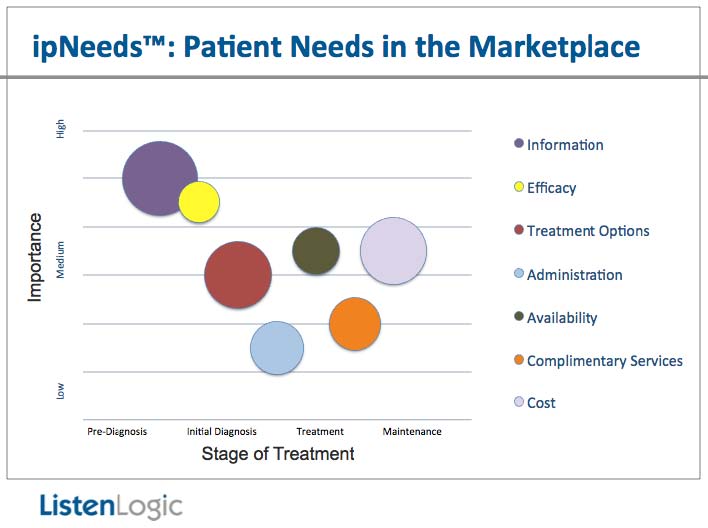
They also share some data on what patients say they want from physicians. This is things like explaining their data better, helping them understand their options, and all basically focus on engaging them.
Can We Use Technology To Address Gaps In Resources – YES!
March 1, 2011 0 Comments
Dr. Joseph Kvedar writes a great piece about the psychology of persuasion and the possibility of using technology to engage consumers and drive behavior change. This is an important topic as we look at addressing healthcare as a country. Since behavior and consumer choice drive a significant portion of our healthcare costs, we have to think more about how to engage patients – what is the right message? what is the right channel? what is the right time to deliver the message?
We can deploy technology in smarter to ways to engage consumers in new ways that leverage our limited resources in better ways – i.e., get good and scalable outcomes without increasing costs. That is what we do everyday at Silverlink Communications with our clients whether it’s around HEDIS, adherence, condition management, or many other programs. Recently, there was an article in Time Magazine that talked about some work we did with a Medicare population for Aetna.
I also think you can look at the research Stanford has published on the topic over the past decade. You can also look at some of the data from the CVS Caremark Pharmacy Advisor program. While it certainly showed the value of having pharmacists involved, it also showed some positive results from automation.
The reality is that combining automation and live resources can be very powerful. Technology can screen and triage people to connect the at risk population with critical resources. This can allow resources to support as many as 4x as many consumers.
Words Matter: Have You Drugged Your Kid Today
March 1, 2011 0 Comments
I think I’m going to start a series tagged to “words matter” where I call out some of the examples that I notice. The first one is the story about a teacher getting fired for her bumper sticker on her car. (Something I never thought would happen.) Her bumper sticker said “Have You Drugged Your Kid Today”.
First off, I think people are entitled to their opinions.
Second, I think we all would agree that there are certainly times when patients are given medications rather than ask to change.
Whether kids are over-medicated today versus the past is hard to know. We are certainly more aware of conditions these days, but I think this is a hot topic. Just look at some of the articles on the topic.
- New Yorker Magazine on kids and medication
- Article on the growing number of kids on medications
- Huffington Post on whether kids should be on these medications
- Article on whether we take too many mind altering drugs
It’s not like the teacher was taking some massively controversial position. She wasn’t teaching the kids. She was simply expressing an opinion on a hotly debated topic in a quick sound bite which she put on her car in the form of a bumper sticker.
Share This


My LinkedIn Profile


 WSJ Health Blog
- Is a Paleo Diet Healthier Than Standard Nutritional Guidelines?
- Small Business and the Affordable Care Act: How Has Your Business Been Affected?
- HealthCare.gov Explorer: Decode the Health Law’s Subsidies
- One Reporter, Four Families, Six Scientists and the Search to Cure a Rare Disease
- Your Responses: How Has the Health Law Affected You?
- What Does the Health Law Mean for You? Your Questions Answered
- How Has the Health Law Affected You?
- Rare Diseases and the Search for a Cure: A Reddit AMA
- Robots to Cure Rare Diseases: A Reddit Ask Me Anything (AMA)
- Six Tips For Better Napping
Drug Channels
- The Rare Journey Needs a Special Pharmacy Partner
- Reflections and Photos from the Drug Channels Leadership Forum 2026
- NOW AVAILABLE: The 2026 Economic Report on U.S. Pharmacies and Pharmacy Benefit Managers
- Medical Benefit Maximizers Are Emerging as a Critical Market Force: What Manufacturers Need to Understand
- The Top 15 U.S. Pharmacies of 2025: Market Shares and Revenues at the Biggest Chains, PBMs, and Specialty Pharmacies
- Reshaping Patient Affordability: The Power of Expertise and Agility
- PBM Industry Update 2026: Trends, Challenges, and What’s Ahead (NEW Live Video Webinar)
- Time to Evolve: Hubs Flex to New Demands
- Preorder Now: DCI’s 2026 Economic Report on U.S. Pharmacies and Pharmacy Benefit Managers
- Beyond DTP 2.0: How Flexible Direct-to-Patient Programs Power Best-In-Class Patient Experiences
KevinMD Blog
- An error has occurred; the feed is probably down. Try again later.
Health Populi
- Consumers Using AI for Health — Especially Motivated When People Lack Access to Care
- Consumer Adoption of AI for Health and Self-Care – Doubling to 36% in a Year, Via Rock Health’s Latest Snapshot
- The “Five-Month” Cognitive Penalty of Financial Decline: A Significant Loss of Financial Well-Being Correlates with About Five Months of Cognitive Decline A Year
- Healthcare AI Direct-to-Consumer: Everything, Everywhere, All At Once
- Self-Rationing Health Care in America – 1 in 2 Americans Earning As Much as $180,000 Have Postponed a Life Event Due to Healthcare Costs
- Consumers Are Ahead of Consumer Health Innovation: Insights from IQVIA
- “Will Work For Health Care:” Americans Trading Off Wages For Healthcare (Again)
- Why Clorox Talks about Hygiene at Home: Health, Wellbeing, and the Home as Health Hub
- Dr. Wachter Bets on A Giant Leap for AI in Health Care
- Financial Stress and Trust in Health Care Takes Many Forms – Listening to Jarrard’s 2026 State of Play Survey
e-Patients
- Introducing the CHAMP Principal Investigator: Cait DesRoches (Part 1)
- Everylife Foundation Community Congress Annual Meeting Highlights
- Collaboration is the Best Medicine: Patient-Centered Collaboration Grounded in Caritas®
- Collaboration is the Best Medicine: It’s the Heart of Caregiving
- Collaboration is the Best Medicine: How to Partner with Your Doctor for Better Care
- Collaboration is the Best Medicine: Bridging the Gap in Patient Participation
- Dealing with Medical Uncertainty, Ambiguity, and Frustration
- Collaboration is the Best Medicine: The Time for Participatory Medicine is Now
- In Memory of Nancy Finn: e-Patient, Advocate, Author, SPM Supporter
- A cure for what killed Doc Tom! Can people afford it?

Enabling Healthy Decisions Blog by www.georgevanantwerp.com is licensed under a Creative Commons Attribution-Noncommercial-No Derivative Works 3.0 United States License.
Contact Information
Contact me at gvanantwerp @ mac.com. Enabling Healthy Decisions