Archive | Books / Articles RSS feed for this section

Overload: Why We Don’t Pay Attention

Why don’t people read your messages and respond to marketing activities or even educational materials.  Overload.

With the average white-collar worker receiving 140 e-mails a day, being booked in meetings for hours, getting numerous voicemails, spending an average of 87 minutes a day in the car,  getting traditional mail, and (of course) trying to work and spend time with their family and friends, there isn’t much bandwidth left over.  You could argue this is a reason to be creative and spend a lot on branding.  You could argue this is a reason to make your messaging concise and to the point.  As most bosses I have had would argue, this is a reason to make your communications deliver value.

  1. Tell them who you are (branding).
  2. Tell them why you are contacting them (value).
  3. Then, if their still reading or listening, tell them very clearly what you need them to do.

Heart Attack Not Urgent Enough At ER

With an increase of Emergency Room (ER) patients from 93.4M to 110.2M from 1997 to 2004 and a reduction in 24-hour ERs by 12%, it now takes an average of 30 minutes to get seen. If you are a heart attack victim, it takes an average of 20 minutes with 25% of the cases taking almost an hour to get seen. Since every minute counts, that seems pretty worrisome. Where else are you supposed to go with a heart attack? [This is all according to a new study in Health Affairs that is described in USA Today.]

“We can no longer guarantee that a bed is going to be available when you have your heart attack.” Linda Lawrence, president of the American College of Emergency Physicians

Interestingly, when I was looking at this article, I clicked through a few links and found a CMS tool to compare hospitals called Hospital Compare. Just selecting a few local hospitals and looking at some metrics raised some questions. Here is one quick metric. Obviously, like anything, a single metric in isolation isn’t the best way to judge, but it certainly might make you do more research.  [HINT – Click on the image below to be able to read it.]

hospital-compare-graph.jpg

Using Thermometers To Avoid Foot Ulcers

600,000 diabetics get foot ulcers each year and over 10% of those lead to amputation of toes, feet, and lower legs.  A study discussed in USA Today showed that almost 2/3rds of those ulcers could be avoided by using a thermometer to identify whether an ulcer is developing.  So simple…so much savings (pain and financially)

So, assuming there isn’t some analysis or clinical bias that I don’t know about, this seems like a low-hanging opportunity for managed care companies.  What are you doing to reach out to your patients, get them a thermometer, collect their data, and remind them to use it on some regularity?

Coordinated Communications

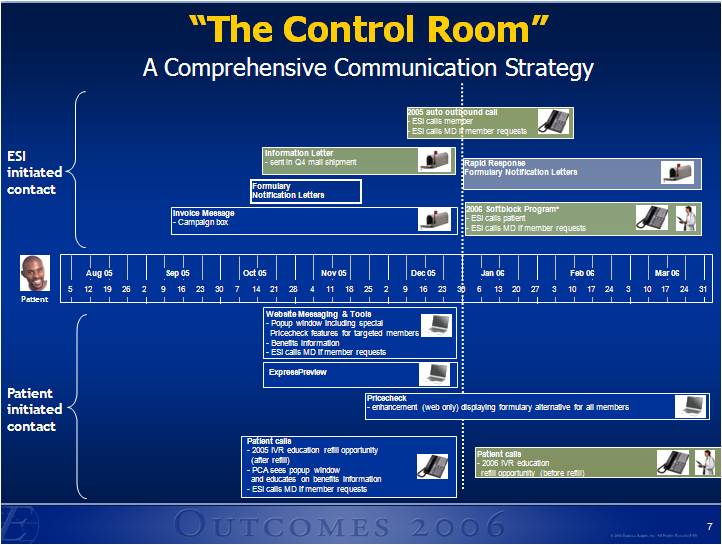
A few days ago, I talked about a press release from Express Scripts around formulary change programs to encourage patients to move to a different drug (same therapeutic category different chemical entity). I mentioned in there a single frame that I created to organize the program. Happily, I found it publicly so I can share it. Here it is. The key points here were – identifying the different constituents, determining the best mode of communication, coordinating across channels, and determining how to sequence communications based on events (aka triggers) which might be a date or a percentage of their prior prescription being used.

zocor-control-room.jpg

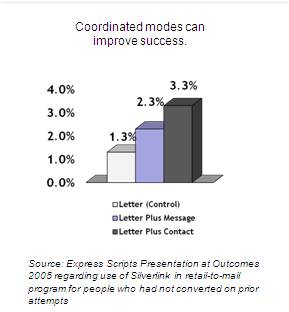
While I was searching, I also found the presentation we gave on how multi-modal coordinations using a letter and an automated call impacted success for my retail-to-mail program. The key to remember here is that we targeted people who had already received one or more letters and had not responded. The results were great.

esi-rtm-results.jpg

Learning Deficit In Healthcare Setting

Typically, when you are receiving care and instructions from a physician or other medical staffer, you are sitting down or laying down in a hospital bed.  Given some of the research discussed in an article today in the Boston Sunday Globe, it makes me wonder if patients are immediately at a disadvantage.  This article discusses research which correlates learning and the brain with physical movement.  An area called “embodied cognition”.

“Work led by Susan Goldin-Meadow, a psychology professor at the University of Chicago, has found that children given arithmetic problems that normally would be too difficult for them are more likely to get the right answer if they’re told to gesture while thinking. And studies by Helga Noice, a psychologist at Elmhurst College, and her husband Tony Noice, an actor and director, found that actors have an easier time remembering lines their characters utter while gesturing, or simply moving.”

see-hear-speak.jpgObviously, there is lots of research about how people learn.  At the simplest level, some people learn by reading, some by hearing, and others by experiencing.  Plenty have studies have been done to say people who get information in multiple ways are the most likely to learn it.  I don’t have it with me right now, but when I have done communication seminars for people before, we have talked a lot about why you want to teach and/or present using all three modes.

Tell them…Show them…Make them experience it.

This is why multi-modal coordination (e.g., letter followed by call or call giving you a website) has value and is more effective.

Is The Perception Of Health Skewed By Your Health?

I was reading a story in the WSJ (1/12-13/08) about “How the Rich Define Rich” and wondered if those that are healthy have a different perception of healthy.  Is it an endless path or is there an end goal?  I certainly think that those that are healthy have a different perception of what it means to be healthy.  I would believe they are more likely to buy natural foods, exercise, and take other actions to continue to be healthy.

“Of the respondents, 45% said $5 million or more [is how much it takes to be rich], 25% said $25 million or more, and 8% said $100 million.”  Survey of affluent households with investible assets of $500,000 or more.

For example, a marathon runner would view a 30-minute workout as pretty limited.  But, someone who doesn’t workout would think of a 30-minute workout as pretty strenuous.   Obviously, this is important when you interact with them.  The message you deliver to motivate those 3 different groups may need to be very different.  Given some of the research out last year about your health being motivated by the health of your friends, there is clearly a Health 2.0 opportunity to create communities and health activists to motivate people to improve their health together.

Types of Business Blogs

I was looking at something that someone sent me from Paul Gillin’s Social Media Report about different types of blogs. I found it pretty interesting especially some of the examples.

First, he talks about company blogs including the CEO blog and the group blog. They definitely can be interesting, but it really is a question of momentum and interest. I also think blogging has to be from top of mind not from some carefully scripted public relations process. (I.e., there will be times that the blogger gets someone upset and stirs some discussion…which ultimately is a positive)

For example, I was really disappointed to see that Unica was unable to continue their blog. Now, on the other hand, I do think there is a definite role for topical blogs that have numerous participants from several companies. I used to syndicate my old process management blog through one of these sites and found it worked great. (Not to mention that I got 7,000 readers overnight.)

Paul talks about three other types of blogs – Executive Blog; Advice Blog; and Advocacy Blog. Here are a couple of examples that he gives:

For more on corporate blogs, you can go to his website or BlogWrite.

I have talked about why I blog before, but I often think about it as a modern journal and an alternative to e-mailing people with articles that I read. If it helps business…great. The reality is that I am passionate about what I do and talk about it all the time. I choose the job to emulate my passion. I would think that is the only way a corporate blog will work and be genuine.

The Fifth Vial

Occassionally, when I travel, I will read some fiction books usually by one of the popular authors.  I just finished “The Fifth Vial” which I would recommend to anyone who enjoys medical fiction and spy type books.  But, it has a serious underlying story about illegal organ transplants which plays into many urban myth type stories you might hear.

“The organs and tissue donated by just one person can improve or save the lives of up to fifty others.”  Author’s Notes at the end of the book

The author (Michael Palmer) gives out a bunch of links at the end of the book on Organ Donation which is obviously a very serious topic.  Here are some of those:

Is Your Protected Health Information (PHI) In The Garbage?

We always hear about the need to protect your personal information (i.e., social security number, credit card numbers) from people. You can be paranoid about it (which may be appropriate) or simply smart about it. In general, you probably don’t have people rummaging through your garbage each week (unless you’re Bill Gates or someone like that).

I guess it is an older story (from 2006), but I was surprised to hear about pharmacies throwing out trash that includes prescription and patient information into unsecured dumpsters. Hopefully, it has been addressed by now, but here is a link to the story.

13 Investigates found legally-protected patient information on prescription labels, patient information sheets, pill bottles, prescription forms and customer refill lists in dumpsters in and around Boston, Chicago, Cleveland, Dallas, Denver, Detroit, Louisville, Miami, New Haven (Conn.), Philadelphia, and Phoenix.stop-sign.jpg

As a corporate person, one of the things I found interesting was the responses. Regardless of the idiosyncrasies of the law, the CVS answer clearly seems more appropriate than the Walgreen‘s answer. I can imagine any patient wanting to think that their information is just being dumped.

“We are not safeguarding customer privacy as we are required to do,” said CVS corporate privacy officer Kristine Egan. “It’s sad and intolerable … and we need to do better. We will do better.”

A Walgreens spokesman said his company has not broken the law by placing patients’ personal information in unsecured dumpsters. Walgreens corporate communications manager Michael Polzin told 13 Investigates that federal law “doesn’t prohibit disposing of information in dumpsters.”

Does Brand Matter?

As anyone who works in or with marketing or sales would tell you…Of course, brand is very important.

So, that makes this study from Gorman Group on Medicare very surprising.

“Seniors with the highest [Medicare Advantage plan] satisfaction levels don’t even know what health plan they’re in.”
Jeff Fox, president of Gorman Health Group, LLC, discussing his firm’s research that indicates brand is less important than it was several years ago.

istock_decision-cube.jpgIf you’re interested in some good discussion on the topic of marketing, I would encourage you to look at Foghound. I had a chance to work with Lois Kelly from there years ago and was impressed. I think you will find their articles and frameworks very helpful.

A few quick links

Just a few quick things before I dash off to get some work done this morning…

Thanks to Guy Kawasaki’s blog I found a communication’s blog which features a few things such as this entry on the best and worse communicators and another one on presenting.  I will have to add it to my Google blog page.

A medical student in Australia has a collection of Medicine 2.0 thoughts and predictions collected on his website.

And, one final one as a follow-up to my entry on health goals is an entry on Brazen Careerist about achieving goals.

The $1,400 Physical

If you’ve never heard of it, concierge medicine is an interesting extreme of consumerism.  I met a physician in St. Louis about 7 years ago who had such a model.  He didn’t take insurance.  Each patient had their own voicemail box for exchanging messages with the physician.  Everyone paid him an annual fee for unlimited access.  Most of his revenue was for a private company’s executive team and their families.  He spent lots of time with the patients, focused on preventative care, and kept trying to find ways to keep them healthy.

Newsweek had an article about this in their 11/26/07 publication called “The Blue Chip Checkup“.  It talks about the Concierge Medicine clinic in LA where you can go get a $1,400 Vehicle Loans physical just like the President gets.  It is so comprehensive that it even includes a skin consultation.  Apparently, over the past year, they have had 600 people come in to get this physical.

I know lots of people are pretty skeptical about this.  I am not sure I have an opinion yet.  It’s interesting.  Obviously, you don’t want to create unneeded costs and certainly we don’t want to make care a luxury good.  But, having people take responsibility for their health and wanting to learn as much as possible about how to manage their care seems like a positive.

Ideally, there should be lots that we can learn about patient-MD interactions, value of testing, preventative care, and what would happen in an ideal setting where insurance and money was not an issue.

Medicare – Less Drugs Covered…Issue?

On 12/4/07, USA Today had an article titled “Medicare cuts back on drugs covered by Part D” which talked about the fact that the average number of drugs covered by the 10 largest Medicare Part D providers shrunk by 26% from 2007 to 2008.  Wow!  At first glance that seems pretty dramatic compared to a commercial plan [whose shrinking coverage was not quoted].

It seems like most of the changes were driven by Medicare which the article says reduced the list of drugs it would reimburse including drugs pulled by the FDA, no longer being made, or were deemed “less than effective” by the FDA.

Tom Noland (Humana spokesman) said “As the Part D program develops, the size of the formulary is becoming more aligned with utilization patterns, consumer preferences, health outcomes, and value for consumers.”

The article also quoted a study saying that low-income enrollees in Texas were being switch to coverage that had 14% fewer drugs and 15% of all drugs offered requiring a prior authorization.  [15% sounds very high to me.]

In the big picture, controlling costs by focusing on value is essential for our healthcare system to survive.  Having an easy exception process [which doesn’t exist today] would allow that be tolerable by the general public.   It will be an interesting debate on value at some point…how do you value different side effects (for example)?

On of my first healthcare projects back in graduate school looked at two different cancer treatments.  One involved much more labor and had only moderate improvements in outcomes.  The question of course was what to do with that – charge more for the one option, don’t do both, focus on outcomes, etc.

Back to Medicare…Hopefully, these companies have a good strategy for communicating and providing tools to these patients to ease the transition to the other drugs rather than wait for them to get rejected or see an unusually high copay at the counter when they don’t have time to get in touch with their physician without risking missing a day of therapy.

Pharmacy Satisfaction: Communication is Key

It’s always great when you find research that clearly reinforces one of the things you always talk about – communications. At PharmacySatisfaction.com which is a website sponsored by WilsonRx and Boehringer Ingelheim, it lists the 10 steps to customer satisfaction for a pharmacy. A few key items that I think are relevant to a lot of what I talk about and do with customers in pharmacy and healthcare in general:

  1. Know your customer (database marketing / management)
  2. Speak up (you’re the expert…help them)
  3. Educate the customer (reach out to them proactively and help them with information)
  4. People skills (understand that different people respond to different messages, mediums, voices, times of day, etc)
  5. Address compliance (refill reminders)

It also made me think about two topics which I think are relevant to communications success – Linguistics and Nuerosciences. As you might expect, there are lots of blogs on both. Here is a list of blogs and some definitions:

Linguistics is the study of the nature, structure, and variation of language, including phonetics, phonology, morphology, syntax, semantics, sociolinguistics, and pragmatics (per The American Heritage Dictionary of the English Language).


Neuroscience is a branch (as neurophysiology) of the life sciences that deals with the anatomy, physiology, biochemistry, or molecular biology of nerves and nervous tissue and especially their relation to behavior and learning (per Merriam-Webster’s Medical Dictionary).

Enhanced Communications Have An Impact

On January 4th, Express Scripts put out a press release about consumers using a home delivery pharmacy being more likely to choose lower-cost therapies. It is an interesting study as published in the December 2007 issue of the Annals of Pharmacotherapy. I had the fun job of designing the program as one of my projects before I left Express Scripts. I will never forget my boss coming to me and asking me to think about how we could drive market share movement of several large drugs if we took them off formulary (i.e., Lipitor). He handed me a white paper written the year before on what to do. Since he was new, I didn’t give him too much grief since I was the author of the white paper from the year earlier about what we should have been doing for the past 12-months to prepare for this.

Anyways, I pulled a lot of input and created a great single-frame image which showed the major constituents and the tools/tactics we would use to drive market share both pre-formulary change and post-formulary change. I went back to my day job, but the image became the roadmap for a multi-modal communications strategy. As was my intention (since I was responsible for mail order), it looks like it worked both to move share and to show how mail could be better than retail.

Here are a few of the highlights from the press release:

  • Express Scripts evaluated consumer behavior after they made a change to the formulary positioning of cholesterol lowering drugs to prepare for Zocor going generic in mid-2006.
  • They looked at more than 200,000 retail and mail patients.
  • All patients got a formulary notification letter informing them of their therapeutic options, materials for their physician, a website for more information, and toll-free number to call. [2 years earlier I had created the business case for mass mailings of formulary notification letters.]
  • The IVR refill line included messaging about switching to a formulary agent, and we placed automated outbound calls to mail order patients [using Silverlink Communications].
  • Patients that were interested were queued up for a change at mail after 1/1/06 (so as not to lose rebates for our clients in 2005).
  • Obviously, other plan factors (i.e., copay differentials, step therapy) impacted choice. [I.e., if I only have to pay $5 more per month for a drug that I am used to, I probably won’t switch]
  • The results were great. 52% of the mail order patients and 33% of the retail patients chose to switch therapies.
  • Some of the retail patients were part of a rapid response program in which they received a letter telling them about their options in the therapy class right after they received their first fill of the non-formulary drug in the new year. [another program which I developed and launched for step therapy] Receiving this letter increased their likelihood of switching by 28%. [BTW – we tested this with letters vs. automated calls from Silverlink back in 2005 and the results were very similar.]

“Creating a dialogue with consumers is a crucial factor in successfully changing behavior and delivering value at the consumer level,” explains Emily Cox, Ph.D., senior director of research at Express Scripts. “Home delivery consumers received additional information and were more likely to seek further assistance through the Web and by calling Express Scripts. Enhanced communication clearly has an impact. The effectiveness of the rapid response program for retail consumers also supports the value of enhanced communications.”

As I have mentioned before on the blog, this was a great program. It proved that PBMs can influence market share. I was more than a little disappointed to see that after we moved all these patients to Zocor to take advantage of the generic then company than moves Lipitor back on formulary only to have to ask the patients to switch drugs again. [Fortunately, I was not there for these discussions.]

Did You Know Factoids

I found this great list of factoids or Did You Know statements at PharmacySatisfaction.com. Here were some of my favorites or more interesting ones.

  • The biggest reason for not taking all medications as directed was simply, “I forgot.”
  • The number one concern across all pharmacy users is that their prescriptions are filled accurately.
  • The most useful feature those Web sites offer to them, the survey found, is the ability to order refills online.
  • Nearly three in 10 order their refills online.
  • Customers average three visits each month to their pharmacy.
  • Only about 1-in-5 pharmacy customers, overall, say that they use a loyalty card that provides points, discounts or other savings.
  • While the majority of loyalty card users are satisfied with the expected cost savings by using their card and with the ease of enrolling and understanding the benefits of their card, fewer than 1-in-4 card users are highly satisfied.
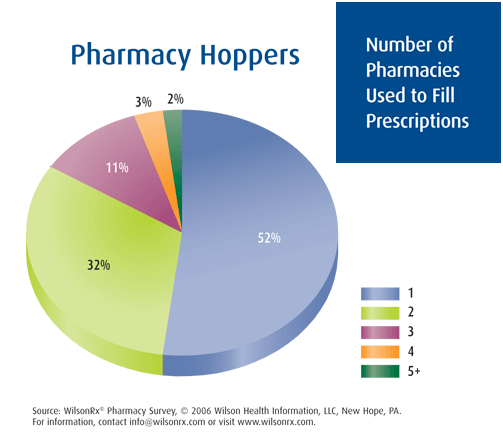
  • The drug store industry remains largely up for grabs, with nearly half of pharmacy customers saying they use more than one pharmacy to fill prescriptions.
  • Pharmacy use varies considerably by population. Chain pharmacies are most commonly used among residents of areas with more than 100,000 people. Independent pharmacies are most commonly used among rural respondents (areas with less than 100,000 people). Use of independent and mass merchant pharmacies decreases as population increases. Chain, food store, mail/online, and clinic pharmacy use tend to increase with population.
  • However, as pharmacy customers age, they are much less likely to use chains and considerably more likely to use mail/online and clinic pharmacies.
  • Seven-out-of-ten pharmacy customers indicate that they “definitely would” or “probably would” use their local pharmacy if they could receive the same amount of medication at the same price as their mail-order pharmacy.
  • The heaviest users of prescriptions are survey respondents in their 60s, averaging 5.4 new scripts and 29.2 refills per year.
  • How long patients have to wait for their scripts to be filled is a key component of customer satisfaction.
  • The average survey respondent is spending a considerable sum each month on drugs at their pharmacy—$82 on average (versus $57 a month on food and groceries at their pharmacy).
  • An average of 85.9% of computer owners/users use the computer to improve their health by looking for information about diseases.
  • Much has been written about the value of closer pharmacist-patient relationships, but Americans seem to feel far more connected to their physicians, dentists and nurses than to their pharmacists. That’s clearly not all pharmacy’s fault; the same survey respondents agreed that they were usually given the opportunity to speak with their pharmacist when filling their last prescription. What’s more, pharmacists ranked a close second to doctors as sources of information about medications.
  • Walgreens’ “Dial-a-Pharmacist” initiative, launched in February 2006, allows non-English speaking patients to connect with pharmacists speaking 14 different languages.
  • Independent pharmacy customers have the most trust in pharmacists, while mail/online customers have the least. Compared to last year, customers of all types of pharmacies place more trust in their pharmacist as a source of information.
  • More than one-third of pharmacy customers failed to fill all their prescriptions last year, and only 35 percent of all respondents said they were fully compliant on the medications they did take. Nevertheless, refill reminders from the pharmacy remain relatively rare, most patients profess.
  • In general, older patients tend to be more compliant than their younger counterparts.

I mentioned poly-pharmacy a few days ago, but here is some data about how many pharmacies patients use.

Forrester on PHRs

In mid-November, Forrester put out a report titled “PHRs: From Evolution to Revolution” by Liz Boehm, their healthcare lead. It’s not my lead area so I didn’t spend the money to buy the report, but here is the executive summary.

Health plans, driven by employer demand and expectations of improved member satisfaction and reduced medical costs, are investing in payer-based personal health records. But consumers have not raced to adopt them. Health plan customer experience professionals are on the hook to not only drive adoption but also engineer low-cost, interactive health support programs that will help members make better choices and save costs. To maximize their chance of success, health plan customer experience professionals need to focus on four critical areas: data management, behavior change, interface best practices, and patient and provider recruitment. This focus will help drive near-term success and position plans to weather the coming changes in the personal health record (PHR) market.

What I found interesting was the list of companies that they interviewed (and who they didn’t talk to).

Book by Kaiser CEO

George Halvorson, the Chairman and CEO of Kaiser Foundation Health Plan and Kaiser Foundation Hospitals, has just published a book called “Health Care Reform Now! A Prescription for Change”. A news clipping service I have sent me a summary from Business Insurance. It is published by John Wiley & Sons and is $27.95. It sounds quite interesting. Here are a few things which the article highlighted.

He says that the US does not have a health care system in place but has a “plethora of uncoordinated, unlinked, economically segregated, operationally limited microsystems…a nonsystem of care.”

He talks about the concentration of spending (based on Kaiser Permanente data):

  • 1% of the US population uses more than 35% of health care dollars
  • 5% uses 60%
  • 10% spends 70%

He talks about the fact that five chronic diseases are responsible for upwards of 70% of the health care costs in the US:

  • Asthma
  • Diabetes
  • Congestive heart failure
  • Coronary artery disease
  • Depression

He talks about the problems that arise when there is no communication between health care silos of care which leads to drug interactions and costly hospitalizations.

I haven’t read it yet, but the article says that he offers solutions for each problem and talks in a conversational and occasionally funny way. He proposes using insurance records to create a type of Electronic Medical Record rather than waiting for the long-term solution of integrated systems. He also proposes using computerized medical records to track quality issues.

Another CEO Interview – ABC

I think a lot of times when I quick say ABC company people think I just mean any “generic” type company (i.e., typical MBA case study speak), but in healthcare, we have AmerisourceBergen Corporation which some people (probably no one in their corporate marketing) refer to as ABC.  It competes with Cardinal Health and McKesson and is in many areas of healthcare especially in prescription drug distribution.  (They are a $57B company in a market where the 3 of these companies control 90% marketshare.)

SmartMoney had an interview with their CEO (David Yost) in February 2007 (which I am just reading over the holidays).  Since their margins are in the single-digits, the logical question was how do they grow.  He pointed out that generics and specialty drugs represent the big opportunities.  Interestingly on specialty drugs he talked how they can “tell the manufacturers where the patients are and how much insurance companies will probably reimburse on certain drugs.”  This doesn’t strike me as the role I would typically look to them for.

It was also an interesting discussion around Wal-Mart’s $4 generics.  I have been skeptical of the promotion, but he would have some visibility to data to understand the results.  Regardless, the effort of the pharmacies to lower the cash costs for prescriptions (for those without insurance) is an important effort.

“The pricing difference Wal-Mart is offering isn’t enough to cause them [patients] to change pharmacies.  Plus, a lot of people are going to Wal-Mart looking for $4 prescriptions and can’t find them.”

Parents on DNA Testing and Mandatory Vaccines

In the Early Fall 2007 Michigan Alumnus magazine (Go Blue!), they had a few health stories.  The CS Mott Children’s Hospital asked 2,000 adults if they would endorse genetic testing to determine if their children were at risk for developing a disease when no treatment exists.

  • 54% (of those with an opinion) said yes.
  • 39% agreed but only if an effective treatment existed.
  • Only just over a third said they were willing to have the DNA stored in a biobank (a collection of DNA to help researchers identify treatments and preventative strategies).

The authors believe the reluctance is related to fears of how that information could be used to affect employment or insurance coverage.  Apparently, Congress is evaluating a Genetic Information Nondiscrimination Act to address that concern.

With many states considering making it mandatory that girls 11-12 get the HPV vaccine that provides protection against human papillomavirus (the virus linked to cervical cancer and genital warts), the hospital polled US parents to get their opinion.  44% were in favor of making it mandatory for school entry.  23 states and Washington DC have introduced bills regarding this and Virginia has passed a law requiring it.

On the vaccine issue, I really don’t know enough to have an educated opinion right now.  On DNA testing, I think of it like participating in the national bone marrow donor program.  I would want mine on file so that if I had a disease and they found a cure that they would reach out to me and help me.  People might try to abuse the information, but I believe that in the long-term the benefits outweigh the risks and society will be protected.

A Few Other Facts From CSC’s Survey

While I was flipping through CSC’s 2004 Customer Intelligence Diagnostic Survey, I found a few other interesting facts:

  • Only 20.7% of the 58 Fortune 1000 companies have a 360 degree view of the customer (i.e., consolidated data across the enterprise)
  • Only 41% of them had used external data to augment their internal customer data
  • Only 10% of the companies had a high degree of confidence that their customer data was clean, accurate, and timely
  • 20% of the companies never capture responses to marketing campaigns for evaluation and another 40% only collect the data occasionally
  • Only 25% were capturing and using customer preferences
  • Only 28% were using an external source (e.g., National Change of Address) to update and verify addresses
  • 62% of them were segmenting customers based on demographic or behavioral criteria
  • 59% of them segment customers based on preferences and needs
  • Almost 80% believe they are missing revenue opportunities due to poor data quality or lack of integrated information
  • Only 22% make customer insights readily available to all their personnel in sales, marketing, and service
  • Only 19% have business rules and triggers to launch targets treatments across customer touch points

There were no healthcare companies included in the survey, but I am sure they would have lagged even more.  Now, some of this has likely changed over the past few years, but there is a lot to be done to address the opportunities.

Proactively Addressing Customer “Defection”

Where your customer (or patient) has the ability to defect (i.e., chose another health plan, go to another PCP or hospital, chose another drug or pharmacy), what are you doing to predict this and act in advance.  As the old saying goes, it is cheaper to keep a customer than to attract a new one.

In wondering what other industries do, I was a little discouraged to find the following in CSC’s 2004 Customer Intelligence Diagnostic Survey:

“half of the respondent firms never, or almost never, perform defection analysis to identify customers who are on the verge of defection.  Nevertheless, over half of the respondents claim that they have developed targeted programs to prevent defection.”

Even companies that ask about your experience or satisfaction often don’t act on it.  For example, I have stayed at the Detroit Ritz several times for personal travel.  Each time, check-in has been bad.  Every time I check out, they ask how my experience was.  I say it was okay.  They say great and move on.  [Which shouldn’t be acceptable at a place like the Ritz that prides themselves on customer service.]  Never have they asked me for feedback.  So, instead, I complain to the national office and get a gift certificate which costs them money…simply for not acting on my lack of satisfaction.

In healthcare, it may be a little harder to predict, but not filling a maintenance drug or not scheduling a follow-up appointment are definitely bad signs.  A quick follow-up survey to any experience will tell you a lot.   And, as I think I have mentioned before, for healthy people that never experience their healthplan, it makes a lot of sense to reach out to them prior to open enrollment when all they will see is another rate hike.

A few recent entries on other blogs

It is always important to see what others are writing about on their blogs. There are now almost 700 healthcare blogs tracked by eDrugSearch. (Just 6 months ago, I think it was only 400.) Here are a few recent posts worth reading.

The main value of transparency is not necessarily to enable easier consumer choice or to give a hospital a competitive edge. It is to provide creative tension within hospitals so that they hold themselves accountable. This accountability is what will drive doctors, nurses, and administrators to seek constant improvements in the quality and safety of patient care. So, even if we can’t compare hospital to hospital on several types of surgical procedures, we can still commend hospitals that publish their results as a sign that they are serious about self-improvement.

    • On DiabetesMine, there is a great summary of all the things that have happened around this disease in 2007.
    • It’s not healthcare specific, but Seth Godin’s entries are always interesting.  Read this one about what you did in the past and grabbing opportunity.  It should help you set a positive outlook for 2008.
    • A new blog that I recently started following is called Enterprise Decision Management.  Here is one entry on Business Intelligence 2.0.  He has lots of great entries that I will elaborate on later.  This approach is core to creating an intelligent healthcare communications strategy.
    • The Hospital Impact blog has a nice entry on 2007: A Year in Review.
    • On the Health Business Blog, David talks about “shopdropping” which is a retail activity where people leave things at stores (i.e., reverse shoplifting).  Interesting.
    • John quotes a study on the eHealth blog that says that 39% of physicians are e-mailing patients.  I find that amazing.  I have never heard of a physician doing this.
    • On Hospital Marketing, there is an entry on Hospitals in Facebook which makes the point about healthcare being behind and not thinking creatively about how to use new media.  I would like to see some discussion there on the topic, but there hasn’t been any yet.

    Just a few other blogs to check out.

      Merry Christmas and Happy New Year

      I hope you all are enjoying the holidays whether it is Hanukkah, Kwanzaa, Christmas or another holiday. As we move into a New Year, I find it is always a time to sit back and reflect. What did I accomplish this year? Am I on track for my personal or professional goals going forward? Have I made a difference this year?

      In that spirit, I share a few things both serious and lighthearted:

      1. Regardless of how you feel about the war in Iraq and Afghanistan, the reality is that we have real people working on behalf of us to defend our country. These soldiers are away from their families and loved ones sacrificing to do what they believe will keep us safe. In that spirit, I recently adopted a soldier so that I could hopefully let them know that we are thinking about them. Here is a good local site for that –http://cornbread.wil92.com/adoptsoldier.
      2. And, here is a great story about a bank that gave their employees $1,000 to “pay-it-forward” and do something good for someone else. They received video cameras to record the event and to share with their colleagues. What a great, creative idea for the holidays. One company and 500+ people making a difference.
      3. My uncle recently e-mailed this to me (so I can’t validate its legitimacy, but it makes a good story) and in the spirit of the holidays, I share it. It is the translation of the famous song about the 12 days of Christmas. (If it’s not true, it’s very creative.)

      From 1558 until 1829, Roman Catholics in England were not permitted to practice their faith openly. Someone during that era wrote this carol as a catechism song for young Catholics. It has two levels of meaning: The surface meaning plus a hidden meaning known only to members of their church. Each element in the carol has a code word for a religious reality which the children could remember.

      • The partridge in a pear tree was Jesus Christ.
      • Two turtle doves were the Old and New Testaments.
      • Three French hens stood for faith, hope and love.
      • The four calling birds were the four gospels of Matthew, Mark, Luke & John.
      • The five golden rings recalled the Torah or Law, the first five books of the Old Testament.
      • The six geese a-laying stood for the six days of creation.
      • Seven swans a-swimming represented the sevenfold gifts of the Holy Spirit-Prophesy, Serving, Teaching, Exhortation, Contribution, Leadership, and Mercy.
      • The eight maids a-milking were the eight beatitudes.
      • Nine ladies dancing were the nine fruits of the Holy Spirit – Love, Joy, Peace, Patience, Kindness, Goodness, Faithfulness, Gentleness, and Self Control.
      • The ten lords a-leaping were the Ten Commandments.
      • The eleven pipers piping stood for the eleven faithful disciples.
      • The twelve drummers drumming symbolized the twelve points of belief in the Apostles’ Creed.
      • To stay lighthearted for a minute (and as a parent), I also got a smile out of this letter to Santa that someone sent me.

      Dear Santa,

      I’ve been a good mom all year. I’ve fed, cleaned and cuddled my children on demand, visited the doctor’s office more than my doctor and sold sixty-two cases of candy bars to raise money to plant a shade tree on the school playground. I was hoping you could spread my list out over several Christmases, since I had to write this letter with my son’s red crayon, on the back of a receipt in the laundry room between cycles, and who knows when I’ll find anymore free time in the next 18 years.

      Here are my Christmas wishes:

      I’d like a pair of legs that don’t ache (in any color, except purple, which I already have) and arms that don’t hurt, but are strong enough to pull my screaming child out of the candy aisle in the grocery store.

      If you’re hauling big ticket items this year I’d like fingerprint resistant windows and a radio that only plays adult music, a television that doesn’t broadcast any programs containing talking animals, and a refrigerator with a secret compartment behind the crisper where I can hide to talk on the phone.

      On the practical side, I could use a talking doll that says, “Yes, Mommy” to boost my parental confidence, along with two kids who don’t fight and three pairs of jeans that will zip all the way up without the use of power tools.

      I could also use a recording of Tibetan monks chanting “Don’t eat in the living room” and “Take your hands off your brother,” because my voice seems to be just out of my children’s hearing range and can only be heard by the dog.

      If it’s too late to find any of these products, I’d settle for enough time to brush my teeth and comb my hair in the same morning, or the luxury of eating food warmer than room temperature without it being served in a Styrofoam container.

      If you don’t mind, I could also use a few Christmas miracles to brighten the holiday season. Would it be too much trouble to declare ketchup a vegetable? It will clear my conscience immensely. It would be helpful if you could coerce my children to help around the house without demanding payment as if they were the bosses of an organized crime family.

      Well, Santa, the buzzer on the dryer is calling and my son saw my feet under the laundry room door. I think he wants his crayon back.

      Have a safe trip and remember to leave your wet boots by the door and come in and dry off so you don’t catch cold.

      Help yourself to cookies on the table but don’t eat too many or leave crumbs on the carpet.

      Yours Always,
      MOM

      US News and World Report Health Links

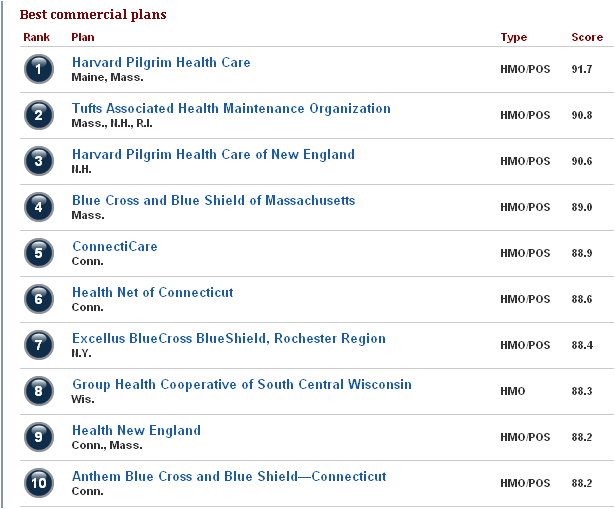
      If you haven’t been there, US News and World Report has a good site for healthcare rankings and other information. Here are a few of the things you will find there:

      1. A link to Healthline where you can get help with Medicare Part D
      2. A list of the top plans according to rankings by NCQA (National Committee for Quality Assurance)
      3. Risk assessment tools on things like heart disease
      4. Links to health centers on topics like Asthma

      Of course, the ranking are the most unique feature since the other health information is probably available on lots of other sites.  You can see some of the things that NCQA looked at in the rankings on the site also.

      us-news-rankings-of-plans.png

      Passing on the costs of unhealthy behavior

      I mentioned it in a blog post a few days ago, but apparently, companies can now screen employees for something like smoking if they have a published policy.  [I don’t know all the details.]

      The Cleveland Clinic won’t hire anyone who smokes anymore and Scott’s gives you six months to quit smoking or you get fired.  (Based on the fact that it costs about $3,400 more per year to employ someone who smokes.)

      I asked a friend of mine at a large insurer this week who verified that they are getting lots of requests from employers around smoking.  Most companies are trying to figure out whether they discourage smoking or simply pass on the costs to the smoker.  This begs the obvious carrot or stick discussion in terms of motivation.

      It made me wonder what would be next.  Obesity would seem like the condition that companies would want to address since it is tied to so many diseases and drives so much cost.  Maybe a BMI sliding scale for healthcare costs.  Of course, you would need to have some type of test to exclude people who were genetically pre-disposed or medically not able to control their weight. 

      Whatever approach was taken, there is a lot to driving positive behavior.  A blog entry on Consumer Focused Care does a great job of talking about this.  He talks about how a group of maids became healthier simply by being told that their work (e.g., scrubbing floors) was equal to the recommended daily exercise.  There is a power in being positive and helping people realize what they can do to make a difference. 

      The Cost of Stress

      I think it is always interesting to quantify something that many of us may deal with abstractly.  Money Magazine (Dec 2007, pg. 44) has an article called “Hidden Costs of Stress” which does just that.

      “Chronic stress, the kind you experience when the demands of life exceed your ability to cope, boosts the risk of developing ailments ranging from the common cold and gum disease to obesity and heart disease.”

      The author working with several other groups puts the costs per year of stress at:

      1. $300 for over-the-counter drugs (e.g., pain relievers and decongestants)
      2. $5,600 for physician visits and other out-of-pocket healthcare costs
      3. $375 for high life insurance premiums
      4. $500 or more for dental costs

      The other big issue is lost productivity which the article mentions saying that workers with severe stress miss 23 days of work a year.  That’s an economic hit to the employer along with a source of additional stress since your performance will be lower and you will use all your vacation days to cover your stress days.

      The article throws out a few simple methods to reduce stress – exercise, stretching and breathing deeply, and reducing caffeine.  Personally, I believe we have to learn to say “no” to control stress.  No – I am too busy to do that.  No – I don’t need to buy that until I have the money.  A lot of stress is often self-induced trying to do or have too much.

      So, given some obvious costs, I wonder if we will ever see a “disease management” type program to reduce and manage stress.

      If Trust is Important…What Do I Do With This?

      I don’t think anyone would argue that trust is one of the most important components of corporate branding especially if you are communicating with consumers.  How do you compel them to act (even if its in their self-interest) if they don’t trust you?

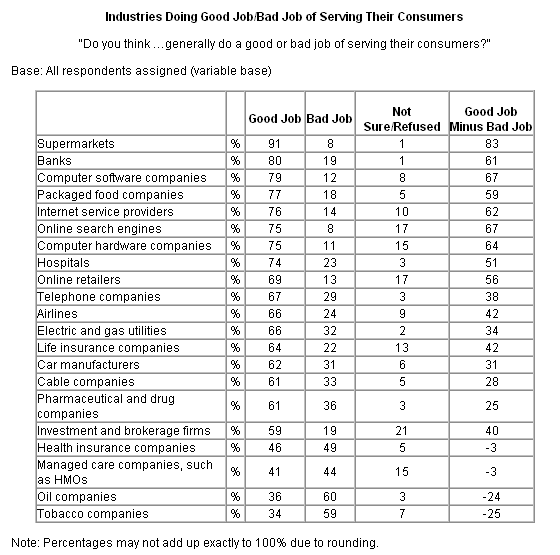
      That being said, what does it tell us that the healthcare industry ranks so low in the annual Harris Interactive survey which asks “Do you think <industry> generally do a good or bad job of serving their customers?”  Hospitals do okay with 74% of those surveyed saying yes.  Even drug companies rank okay at 61%.  [Cable is also at 61% and the phone company at 67%.]  Health insurance comes in at 46% with managed care at 41%.  The only lower companies are oil and tobacco companies.  We have to figure out how to fix this if we are going to successfully drive wellness and change healthcare in this country.

      harris-industry-survey.png

      Sticky Messaging

      We used to talk a lot about stickiness of websites and eyeballs back in the late 1990s. The word still has some attraction and is a key point in the recent McKinsey interview with Chip Heath. Chip is a professor of Organizational Behavior at Stanford University’s Graduate School of Business.

      “The key to effective communication: make it simple, make it concrete, and make it surprising.”

      Although the article is primarily around what executives need to do to make their messaging and ideas stick with diverse audiences, it has a lot of relevance for healthcare.

      “A sticky idea is one that people understand when they hear it, that they remember later on, and that changes something about the way they think or act.”

      Think about all the things you want to tell your patients or members or employees (or vice-versa all the things you patients want your healthcare companies to tell you):

      • There has been a change to your X (copay, formulary, network).
      • You have an opportunity to save money by doing X.
      • We are missing X data that will delay your coverage.
      • We see that X happened and wanted to gather data on your experience or proactively address your question.
      • Welcome to our plan. Have you registered on the website? Have you received your ID card?
      • Please take this Health Risk Assessment.
      • Your credit card has expired. Would you like to update it?
      • Your order is delayed. If this is an emergency, please do X?
      • We see you were on the website. Did you find what you needed?
      • Do you need a copy of your X (formulary, provider directory)?
      • You have not yet picked a Primary Care Physician. Would you like to do that now?
      • Did you receive the information that we sent you?
      • Are you following your physicians orders? Did you do X? Why or why not?
      • Our records show us that you are due for a X. (Flu shot, screening)
      • Are you using any over-the-counter products that we should have in our database to identify drug-drug interactions?
      • Please remember to refill your medication?
      • Are you having any side effects or complications associated with your recent medication or procedure?
      • Have you enrolled yet in our disease management (or incentive) program? Would you like more information?
      • Welcome to the plan.
      • We know it is time for open enrollment. We hope you will renew with us. We are offering a local meeting to help you learn more about your benefits. Would you like to attend?
      • X has changed with your drug, condition, etc. There is new information available at Y.
         

        Getting back to the article…He offers several good examples of sticky messages which are primarily what I would call rallying calls for organizations. In healthcare, the key is to find these simple messages that compel people to act. So, bottom lining it, he gives six basic traits:

      1. Simplicity – short and deep
      2. Unexpectedness – uncommon sense messages generate interest and curiosity
      3. Concreteness – his example is don’t say “seize leadership in the space race” but say “get an American on the moon in this decade”
      4. Credibility – this should be so easy in healthcare if you leverage all the people and stories out there
      5. Emotions
      6. Stories

      He has a few great stories such as:

      • A Nordstrom’s person wrapping something bought at Macy’s just to make the customer happy. [And probably without point it out.]
      • A FedEx driver who forgot the key to a box simply unbolting the box from the ground and throwing it in the truck so they weren’t late.

      These things reinforce the message while becoming a type of urban legend that stay with people. They evoke emotion in a simple way.

      One good example I have from Express Scripts was around trying to motivate people to change from one drug to another. When Zocor was going generic, we decided to launch a huge multi-modal campaign to drive down Lipitor marketshare and move people to Zocor so that when it went generic everyone would win. [Clients would save; patients would save; and we would make more money.] It worked. But, prior to the program, we worked with linguists and others to design and test a set of messages. The one that resided best was “we have a secret that can save you money”. People were intrigued and listened. They felt like they were being let in on something that was important. We ended up positioning it similar to a Consumer Reports Best Buy. It worked.

      Looking for an Acquisition – Speculation

      With the stock market handsomely rewarding the PBMs especially Medco and Express Scripts, they have cash and stock value to go on the acquisition path. Express Scripts has grown through acquisition over the years leading up to its acquisition of several specialty pharmacy companies a few years ago. In the St. Louis Business Journal, David Myers (VP, Investor Relations) is quoted as saying “Acquisitions are Express Scripts ‘No. 1 priority for our strong cash flow'”.

      [By the way, as I have previously disclosed, I own no ESRX stock or other stocks individually. I only invest in mutual funds…and do very well with it.]

      Although it’s been out for a week, I just read it this morning so before I run into anyone there I want to have fun guessing what Express Scripts might acquire. Usually, all I hear about is speculation of who might buy them. It typically is either a retailer like Walgreens or Wal-Mart or occasionally a managed care company. I don’t see them getting bought with the valuation so high. And, there are very few payor other than United Healthcare (which is tied to Medco) or WellPoint that could swallow such an acquisition. And, I am sure Walgreen’s won’t do anything until they see what the CVS/Caremark deal looks like, but if it works, they would have to make a bid for Medco or Express Scripts to compete.

      1. Buy one of the many regional PBMs that exist. This would be the easy play. It could be integrated. There is lots of synergy. But, people still go to the regional players for a reason, and you may lose a lot of the lives. Now, buying Walgreen’s PBM might be an interesting play and create a sticky relationship with them to align against CVS/Caremark.
      2. Buy a niche PBM in an area such as Worker’s Compensation. Not a bad strategy. They used to have about 20% marketshare in this space. They could also go after the Third Party Billers here although I think that market space may collapse.
      3. Buy another specialty PBM. I hope not. They have the assets already to be successful here. All you would be doing here is buying lives for people committed to one particular pharmacy. I think the premium would be too high.
      4. Go into a related space like dental or vision, but they tried vision before and it never really took off.
      5. Go into the data (e.g., IMS) or IT space (e.g., Ingenix), but they have also tried this and it never took off.
      6. Continue to acquire in the consumerism space. They recently bought ConnectYourCare. There are lots of companies out there doing interesting things in this space and with the projected growth here there are lots of opportunities. The problem is valuation of these companies, maturity of the business model, their risk in going into this business, and their focus on the traditional PBM model.
      7. Buy a technology company like an e-prescribing company (e.g., Prematics where Barrett Toan (founder of ESI) is an advisor) or a Physician Practice Management company (e.g., Pat McNamee the Chief Administrative Officer came from Misys which I believe was for sale) or healthcare IT company like Cerner or a pharmacy automation vendor like ScriptPro or a Personal Health Record company (like Aetna bought ActiveHealth).
      8. Buy a disease management company. Medco has a 10-year (I think) deal with Healthways which I would assume is a “try and buy” type relationship (i.e., let’s try this out and if it works we will buy you at a pre-determined price). ESI has worked with LifeMasters in the past, but I assume there are lots of players out there with interesting models.
      9. Follow Medco and buy in the disease space and DME (durable medical equipment) space. Medco bought PolyMedica earlier this year as part of their strategy to develop disease specific pharmacies called Therapeutic Resource Centers. This would probably be the most logical extension. It seems to be working for Medco.
      10. Buy into the international health
        space
        . This would probably be the most adventuresome with the biggest upside (if it could work). There is a lot of opportunity outside the US, but with limited investment, no managed care companies or PBMs have ventured too far. Express Scripts has a company in Canada. I know a few others have explored and/or tried small ventures.
      11. Buy into the generic manufacturer or distribution space. This would probably be the most lucrative. They have a huge distribution channel. Why not buy a portion of an existing generic manufacturer, open a distribution company (like McKesson, Cardinal, or AmerisourceBergen), and create a single source relationship with the Express Scripts pharmacy and give the retail pharmacies a different reimbursement rate if they used them.
      12. They could always try to become a retailer or go into the clinic business. There is something here, but it is a very different model and given the “training” they have done with the street over the past decade to focus on ROIC (return on invested capital), I don’t think they could do this.

      Now, the two things I would suggest if I were still there would be:

      1. Invest in IT. Look at how to automate more workflow activities. Look at technologies that drive patient self-service. Look at things that drive patient behavior (online tools, educational programs, incentive systems). Build out mass customization and personalization based on integrated data – medical and lab – so that no one can catch them. (But, if you are waiting to sell, don’t spend the money to overhaul the system.)
      2. Create some mad money in a Venture Capital type relationship with someone like Google or Microsoft that are trying so hard to get into the healthcare space and would welcome the relationship to jumpstart.

      Who knows? I certainly don’t know what they will do, but it is a fun position to be in. You have money. The market is at an inflection point. You want to be a catalyst. You have driven incredible results for a decade. What next?