Archive | Healthcare RSS feed for this section

Who’s Your Date To The Genetic Testing Prom?

Genetic testing (aka pharmacogenomics, personalized medicine) is certainly a hot topic these days.  There is lots of research around how to use the testing to manage drug spend by appropriately matching drugs with genetics at the individual member level. 

I find it interesting to see who’s going to the “prom” with whom here.  Another interesting perspective is how physicians feel about these (see survey).

  1. Medco acquired DNA Direct.
  2. CVS Caremark hired Per Lofberg from Generation Health and invested in the company.
  3. P&G invested in Navigenics.
  4. Walgreens was going down the path with Pathway Genomics before the FDA intervened.

So…what is Express Scripts doing?  I’ve heard some talk at a conference about their strategy which involves a broader focus on integrating data from multiple sources including genetic testing to help drive clinical decisions.  It seems like they’re either late to the party or smart in staying away.  The question is whether this is a nice to have, a differentiator, or something that consultants will start requiring the PBM to provide.  From their 2009 Outcomes conference:

[Genomics and personalized medicine]  The potential for improved outcomes and cost savings are attractive but still unproven.

Is Bad Debt In Healthcare Inevitable?

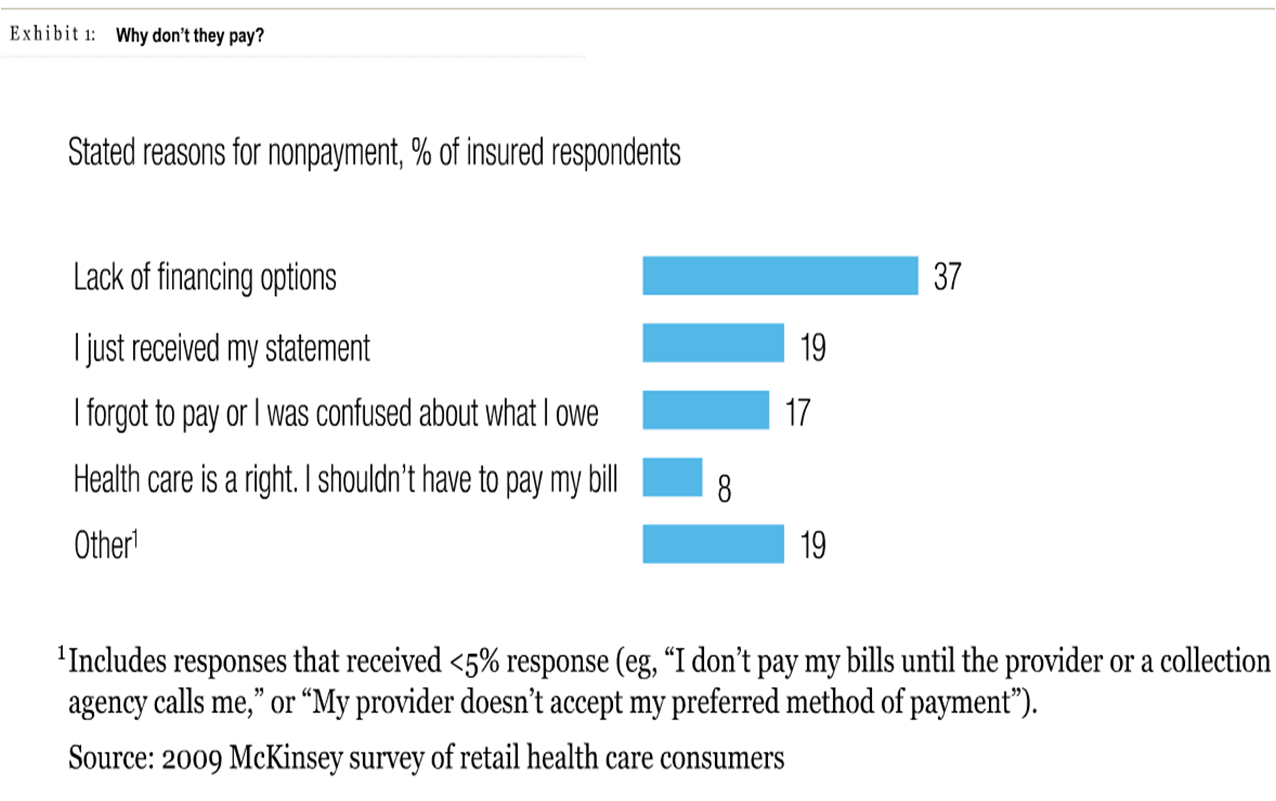
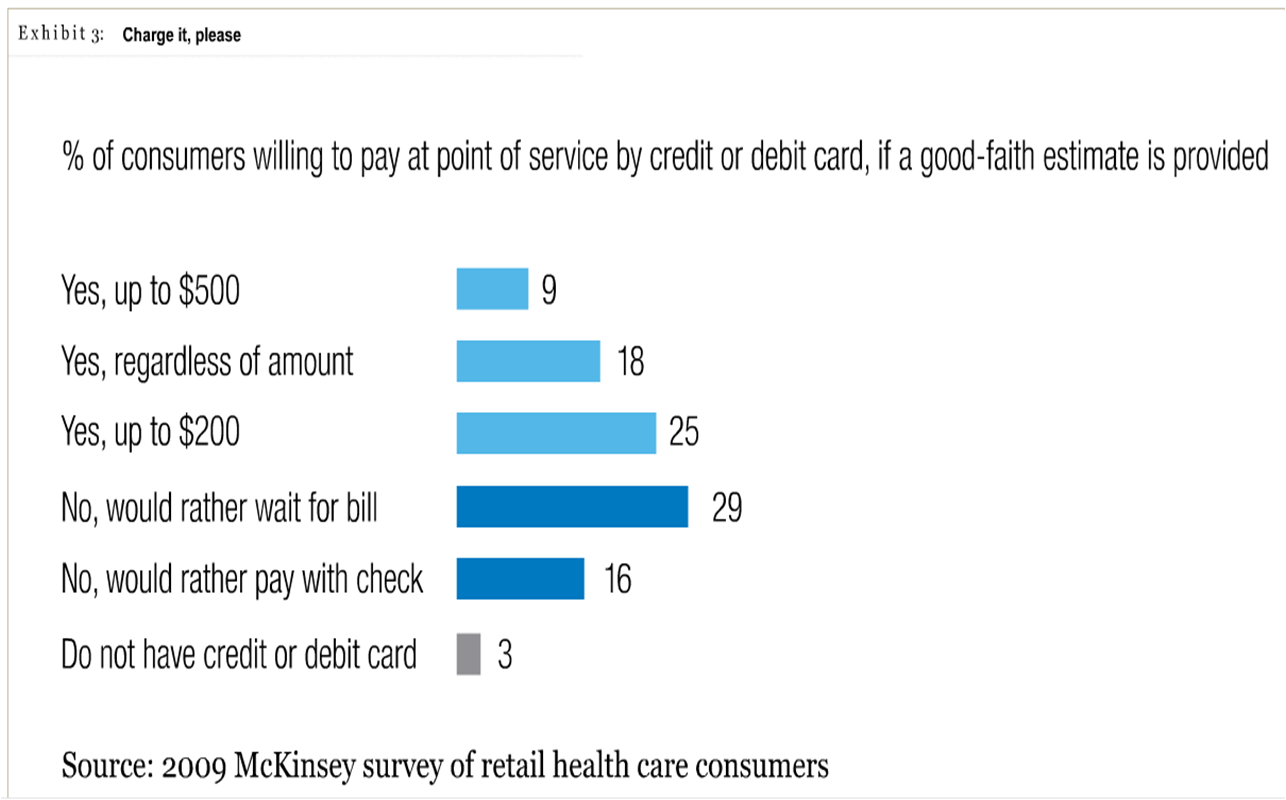
It’s an interesting question since there is quite a lot of bad debt.  I’ve certainly believed the default hypothesis which is that people can’t afford their healthcare out-of-pocket costs, but I know I’ve had several instances where I had delayed payment due to misinformation or provider billing errors that I tried numerous times to get fixed.

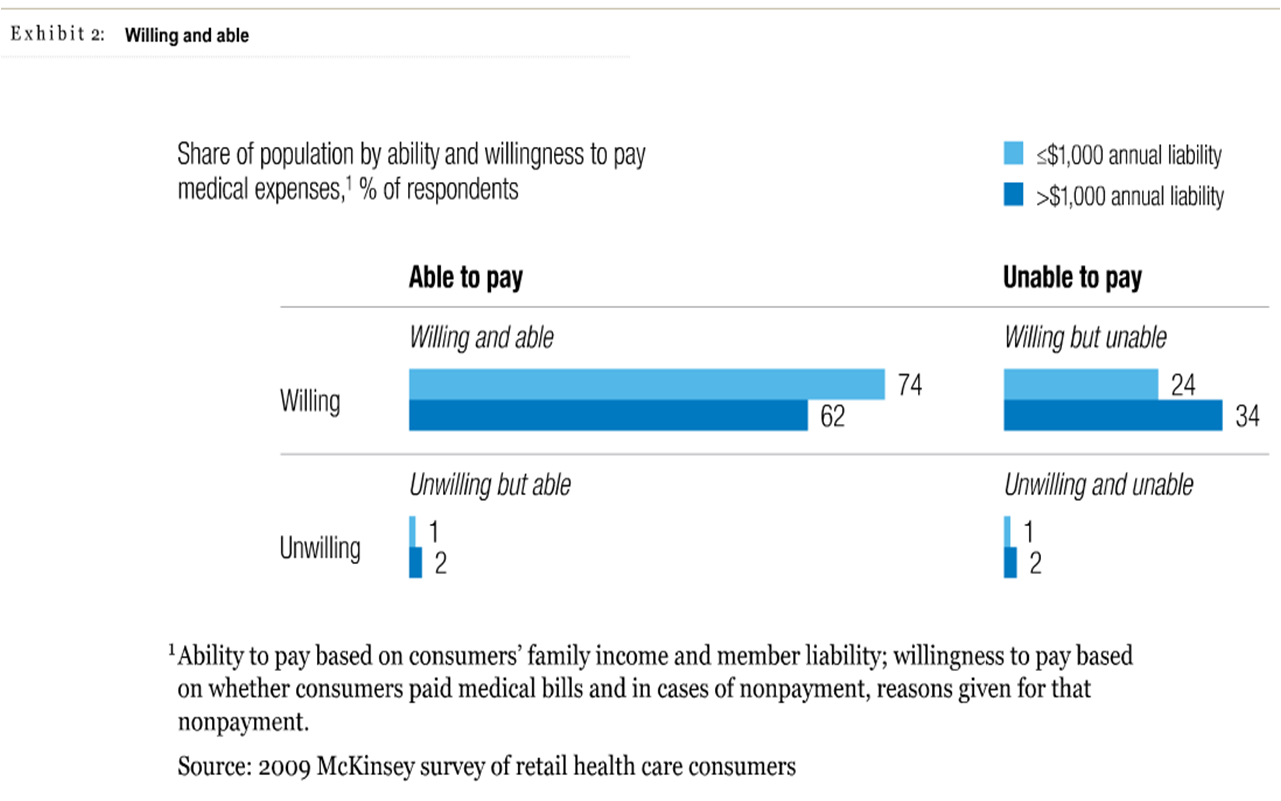
McKinsey’s new research suggests that I’m the norm (i.e., most people would AND could pay their bills).

  • 90% if <$500
  • 74% if <$1000
  • 62% if >$1000

Interesting Articles

On one of those rare days when I have a chance to clean my office, I figured I would post some quick things that are in my “Blog Pile”. In no particular order, here are some of the things I ripped out of magazines, printed, and/or otherwise captured and meant to write about.

Anyways, a few things you should read and look at.

CVS Caremark Split Up?

I guess I have to comment on this hot topic.  Since I’ve been an advocate since the beginning, I think my opinions are different than the masses.  Looking at Adam Fein’s blog this morning, he asks three questions:

How does patient care improve when a PBM owns a brick-and-mortar pharmacy chain? Where can a combined PBM-pharmacy chain improve performance on traditional PBM metrics? How exactly does a payer benefit when CVS increases its pharmacy market share?

1. How does patient care improve?  CVS Caremark just announced this week the rollout of their Pharmacy Advisor program (think response to Medco TRCs).  This leverages their 7,000 retail stores and their face-to-face interactions with patients to manage chronic conditions (beginning with diabetes).  Assuming this scales, it has the great opportunity to improve patient care.  AND, when they eventually roll-in Minute Clinics to this solution (which I don’t think has happened yet) there may be more opportunity.  The retail side of the company also added to their ExtraCare strategy a diabetes focus earlier this week which makes a lot of sense. It remains to be seen the effect this could have on super beta prostate.

2. Where can a combined entity improve on traditional PBM metrics?  This is a softball.  Traditional PBM metrics are GFR (generic fill rate), rebates, mail order penetration, and trend (see comments on trend).  Generic fill rate involves talking with patients about therapeutic alternatives and intervening with MDs to change the script.  A retail chain can do that and can make changes before the first fill and before the patient starts a routine.  They also have a relationship often with the MD.  Driving rebates (as a proxy for lower net cost) can happen the same way.  Mail order is a more difficult metric, but Maintenance Choice createst that option and a store with the right POS (point-of-sale) system could make a difference.  I would argue that the goal for a combined entity is to optimize the right channel for the patient.  And, since all of these lead to lower trend…a combined entity has power.

3. How does the payor benefit?  Again…a softball.  Just like a limited network (less stores), pharmacies have always offered lower rates to payors (or PBMs) in return for marketshare.  CVSCaremark could offer tiers based on marketshare to their clients (i.e., you get a 17% discount for all Rxs processed if your marketshare is 30% and you get 19% discount if your marketshare is 40%).  There are obviously fixed costs (real estate, transportation, technology, staffing) so there are incentives for store operations to optimize volume (without getting too much such that they have to hire additional staff).

Little Improvements To Healthcare Process

I saw an advertisement for a site where you could share your thoughts on improving the healthcare system.  I went to the website, but I was disappointed.  It didn’t seem to have many patient inputs.  There are huge issues for us to deal with around this many of which are wrapped up in reform (whether that’s the right answer or not).

But, if I put my re-engineering hat on from the 90’s, I think there are lots of little improvements that I would make.  Here are some thoughts:

  • Online appointment scheduling for physician’s offices.  It would be great to do this outside of normal business hours or understand the open time slots.
  • Real-time updates if the physician is behind schedule – text message alerts.
  • Kiosks at the pharmacy for picking up refills so that pharmacists could spend their time on first-fills and counseling.
  • A forum to allow consumers to create a profile about communications preferences and relevant behavioral profiling that would help healthcare companies provide them with relevant information…and allow this profile to follow them as they moved from company to company.
  • Some type of online certification for health information websites so that we knew which sites to trust for information.
  • Simpler plan information so I really knew what was covered and what my costs would be.
  • A virtual coach to help me interpret information, guide me to content, decide when to get a second opinion, provide me with pre-screening, and manage worries (i.e., do I have the flu or just a cold).
  • Online portals and PHRs that were engaging, portable, and learning systems.
  • Better communications design and literacy considerations.
  • Full genomic profiles that not only told me what I was genetically pre-disposed to but what I can do about it.
  • Aggregation of all the cool tools into a front-end where I could manage a condition thru without having to have multiple logins and different pieces of content to put together.
  • Easy to understand billing.
  • A way to stop having to repeat myself on the phone, in the office, at the pharmacy, at the clinic, etc.
  • No waiting in line – ER, Urgent Care, pharmacy.
  • Automatic, real-time suggestions (did you know there’s a generic alternative to that?  did you know the urgent care down the road 2.3 miles is open and will save you $50 compared to your ER copay?).

I’m sure I could go on, and each of these has implications.  For example, to have no waiting in line means creating more locations which creates more costs which ultimately requires them to create more demand to stay business.  A vicious cycle.

Don’t Believe The Hype – Copay Waivers

Don’t believe the hype – its a sequel
As an equal, can I get this through to you
 

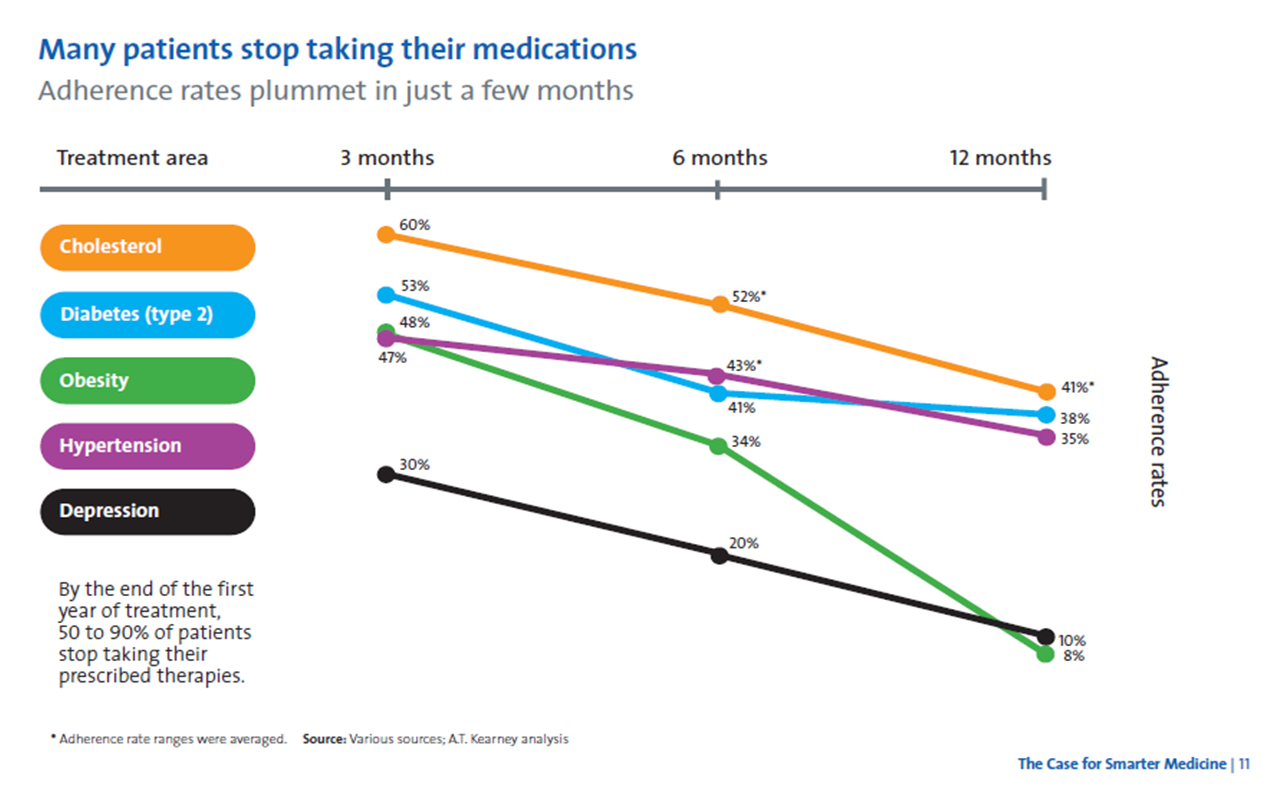
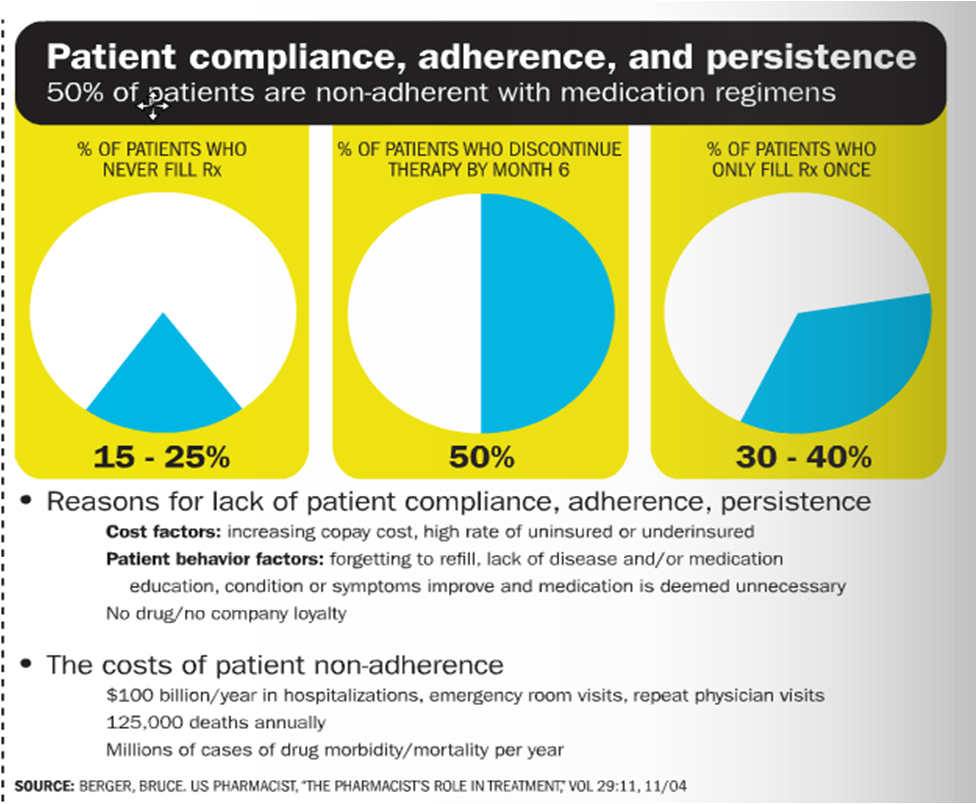
I talk about it all the time as most people do…non-adherence to prescription drugs is a real issue.  People don’t fill their initial script.  People who do fill their first script drop off after the first several fills.  By 12-18 months after a patient starts therapy, less than 50% of them are still taking their medications.  Here’s a few key articles on this: 

Common barriers to adherence are under the patient’s control, so that attention to them is a necessary and important step in improving adherence. In responses to a questionnaire, typical reasons cited by patients for not taking their medications included forgetfulness (30 percent), other priorities (16 percent), decision to omit doses (11 percent), lack of information (9 percent), and emotional factors (7 percent); 27 percent of the respondents did not provide a reason for poor adherence to a regimen.  Physicians contribute to patients’ poor adherence by prescribing complex regimens, failing to explain the benefits and side effects of a medication adequately, not giving consideration to the patient’s lifestyle or the cost of the medications, and having poor therapeutic relationships with their patients.  (NEJM article) 

Depending on what study you look at cost is certainly an issue, but it typically isn’t the primary issue.  I typically see cost as being a factor in 5-15% of the cases.  I think if you look at how Merck weighs cost in their Adherence Estimator that it is only a small factor.  A lot of this plays out in VBID (Value Based Insurance Design) which while not purely about copay waivers that certainly is an element of most solutions.  

A few friends of mine formed their own company (CareScientific) and had a paper published in AMCP recently.  From that article: 


VBID is receiving attention as a tool to increase medication adherence and lower medical costs. However, applying a “plausibility calculation” method to data generated from a recent VBID study involving reduction of drug copayments, this evaluation found that health plan sponsors are highly unlikely to experience net savings by implementing VBID programs, even under generous assumptions, for 2 reasons. First, the price elasticities of medications are too low to generate meaningful increases in medication adherence when copayments are lowered. Second, the potential reductions in the avoidable hospitalization and ER utilization rates across a commercially insured population with varying risk levels are generally not large enough to offset the additional plan costs of lowering copayments to increase medication adherence. 

I would also suggest looking at some of their tools that they’ve developed

So, getting back to how I’m tying in my reference to Public Enemy (rap musicians)… 

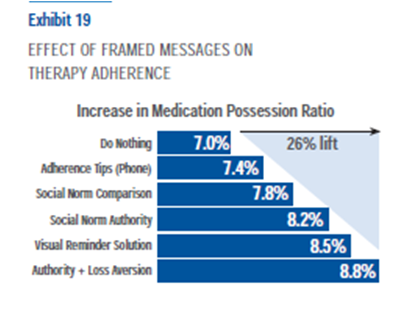
When I look at the upside for pharmaceutical manufacturers to grow the pie (get more Rxs through adherence), I often wonder why one of the default solutions is to fund copay waivers.  That happens by employers, health plans, and even the manufacturers.  There are many less expensive ways to get that lift by addressing things like reminders and tailoring information to individuals based on their personalized barriers. 

There are lots of high cost solutions that will make an impact.  The question is how to triage those resources to focus them on the right people.  It’s important to identify adherence risks (pro-active intervention) and adherence gaps (retrospective) and intervene with the patient.  

Here are a few of my other posts on this: 


Do People Self Diagnose?

I think we all venture a guess on why we feel bad – cold, flu, rash.  And, at least from my perspective, that might lead to an OTC (over-the-counter) medication.  BUT, apparently 30% of people use that self-diagnosis to self-prescribe and borrow medication from friends and family.  That has some more significant risks associated with it and can lead to an incomplete medical record if something happens to you (i.e., a severe side effect). 

According to the recent survey:

  • 3/4th of those that borrowed a medication did it to avoid seeking formal medical care
  • 1/3rd of those who tried to avoid a medical visit (or 1/4th of those that borrowed a medication) ended up at the physician anyways
  • 25% of those that borrowed a medication experienced a side effect (or believed they did)

I think we all know that borrowing medications is wrong.  The only time I would think you might be okay is you were prescribed the identical chemical entity and strength and had a friend that had changed medications and had some extra.  Since the reality is that there is a lot of excess medication out there given all the non-adherence.

Could You Change Behavior With Virtual Reality?

I am a big believer in experiential learning.  To that effect, every time I’ve decided to change behavior I only have to envision myself at some future state affected by my current state decisions.  When I believed that my drinking caffeine would impact my future health, I quit cold turkey for 15 months.  (I observed no meaningful difference in health and allowed myself to drink caffeine again.)

So… I guess my question is why can’t this be harnessed in all of us.  Would we make different decisions if there was a way to reflect on our decisions in a “magic mirror” of sorts that showed us how these would impact our lives?  Is this a role for a “Future Life” play on Second Life?

Imagine:

  • Inputing your food decisions for a month and having it show you your weight, physical attributes, diseases, impact on your kids, etc in 10-years and do that in a 3D virtual reality environment.
  • People who smoke observing themselves thru the eyes of others and smelling the smell that others smell when the smoke is saturated into their clothes.
  • People who chew tobacco seeing what their mouth would look like in 20 years without teeth and having dentures and the things they could no longer do.
  • People who drink and drive imagining themselves in a car crash where they die and the impact that has on their friends and family.

Or, if you focus on the carrot versus the stick maybe there’s more motivation to change by letting them dream what is possible if they change behavior:

  • Running a marathon at age 70.
  • Seeing their grandchildren and being able to chase them around.
  • Being without any medications.

Service Recovery And Frontline Empowerment

Healthcare is by its nature a service business.  Your experience matters.  If you don’t get your script on time from mail order, you’re upset.  If you come back to pick up your script at retail and it requires a prior authorization, you’re annoyed.  If you have to wait to see your physician when you had an appointment, you’re upset.  If your bill is wrong, you’re upset.  If your care isn’t covered due to some loophole, you’re upset. 

But, some companies recover better than others.  And, some companies do a better job of empowering their frontline employees.  Let me just give a few non-healthcare examples to make my point.

  • Recently, I stayed at a Marriott property (which by the way is my favorite chain).  This was for personal travel, and I had reserved two adjoining rooms.  They not only didn’t have the adjoining rooms, but they didn’t even have two rooms.  It wasn’t the end of the world, but we crammed into one room.  The staff at the hotel weren’t apologetic and didn’t do anything to note their mistake.  Instead, I had to escalate it to the senior team at Marriott to get resolution.  Now, once I sent the e-mail, it was less than 12 hours before I had gotten e-mails and several calls admitting their mistake and making amends.  But, this could have been solved by the front desk staff.
  • In another case, I was at a different Marriott property a few months ago on vacation.  We also had two rooms, but only one of them was ready at the 3:00 check-in time.  The other one was only 30 minutes late, but we’d been waiting around since 11:00 to get into the room.  They immediately sent up a food snack to apologize, AND when the waiter heard my kids say “I wish they’d just brought us some gummy worms”, he was back in 10 minutes with a platter of gummy worms and other candy.  It probably cost them $5 to make us happy, and we quickly recovered from the inconvenience.

Little things do matter.  The best example in healthcare that I’ve ever heard was from a plan in the Boston area.  A spouse called up to ask some questions about a hospital bill they had recieved.  The associate on the phone realized it was for a heart surgery and asked how the patient was doing.  The woman responded that her husband had passed away and she was trying to address his finances.  The associate expressed her regrets and asked the woman to hold for a few minutes.  When she came back, they chose to waive the payment due.  I think that’s overly generous, but it makes the point.

I know at Express Scripts that we empowered many of our call center agents to be able to offer a minor (I think up to $10) coupon or waiver for inconveniences at mail order.  But, all the research shows that companies that recover from service issues are more likely to create loyalty over time.

And, I find it strange that companies don’t follow-up when loyal customers churn.  I had used Avis (for example) for well over a decade and was generally very happy with them.  About 12-months ago, they changed their inventory management model to be more real time which led to more waiting after I got to certain rental lots.  I put up with this for a few times until I was late for a meeting since they didn’t have any cars for me.  I’ve switched the majority of my business now to Hertz which while a little bit more expensive doesn’t have this issue.  But, Avis never reached out to me.

The Facebook and iPod Generation

When I think of the current generation that is coming into the workforce, I think of people who:

  • Grew up with social media all around and are less concerned about privacy
  • Grew up with the ubiquity of technology having an iPod always on and being in constant communication with their mobile phone
  • Grew up with the US in a constant state of war – 9/11, Iraq, Afghanistan
  • Grew up with the idea of constant stimulus – portable video games, TVs in the car
  • Grew up with periods of market instability – technology bubble, 9/11, housing bubble
  • Grew up with a likelihood of living at home after college [and think that’s ok]
  • Grew up with more global awareness via CNN and the Internet
  • Grew up with allergies and general paranoia – no more leaving home as a kid and coming back when the sun set or eating peanut butter at school


I think the more typical perception of many of them is an overly privileged generation who can’t focus on one thing, expect everything (money, position, title, responsibility) regardless of whether they deserve it, don’t follow basic protocols (like a thank you after an interview), have been coddled their whole life, and have no respect for what others have done.  But I think every generation thinks that of the next generation.

I guess the official definitions are: (see good presentation)

  • Traditionalists – born before 1946
  • Baby Boomers – born btwn 1946 and 1964
  • Generation X – born between 1965 and 1981
  • Millennials – born 1982 to 2000

The Millennials are also called Generation Y, GenNext, the Google Generation, the Echo Boom, or the Tech Generation and are 76M strong. With immigration they are likely to surpass the Baby Boom generation in the 2010 census. [Note – Comments derived from reading an exerpt of The M Factor by Lynne Lancaster and David Stillman in the May 2010 Delta Sky Magazine.]


Their book – The M Factor – is focused on this generation. They talk about the fact that this generation is talking about and searching for “meaning” in their work. They’ve been raised by working parents that struggled with life balance and want more out of work for their kids. They see how work has become so engrained in our lives with Blackberries and other tools.

More than 90% of US Millenials said having opportunities to give back thru their company was somewhat to very important when considering joining an organization.

51% of young workers surveyed as part of the Kelly Global Workforce Index were prepared to accept a lower wage or lesser role if their work contributes to something “more important or meaningful”.

The question that a lot of this drives at is how do you leverage the passion and tech savvy Millenials as part of your workforce. They are going to drive changes. They are going to be innovators. And, they’re not going anywhere. Here’s a good blog on Generation Y.

It reminds me of some mock interviews I did a few years ago at my business school. I was stunned by some of the accomplishments of these people. They had founded companies and businesses. They had volunteered in the community. They were well read and had passion for things that I didn’t care about at their age. I was glad to have made it thru school with my peers. But, on the flipside, I talked with my friends who are the Dean of the School and run the Career Center to point out that not one of those people wrote me a thank you or sent me an e-mail. None of them ever asked me to help them find a job leveraging my network.

The article talks about this Millenial generation growing up at a time when the divorce rate had dropped and parents spent more time with their kids and transformed from authority figures to mentors and friends of their kids. This whole concept of “helicopter parents” has been explored in other areas and still amazes me. [Are you a helicopter parent test.] For example, 11% of US Millenials said they would feel comfortable involving their parents in salary negotiations. [If I had the option legally and a parent showed up with their kid for a salary negotiation, I would rescind the offer. If they can’t do that by themselves, how can I trust them to drive my business in pressure situations?]

In healthcare, the best example I always use for a company focusing on this generation or the “Young Invincibles” is Tonik Health which is a Wellpoint brand. I’m always surprised how few people know them. Take a look at their website (below) – the colors, the words, and the positioning is all so different than how most of us think about our health insurer. Here’s a good blog entry on the “millennial patient“.

Why is this relevant to my healthcare communications blog – because segmentation is so key to effective messaging. You have to understand this generation and how to engage them and drive them to take care of their health. Traditional language, modes, techniques, and messages may not work. The article (from the book) talks about their focus on feedback and scoring. They are used to constant [positive] stroking and having a score to evaluate success. They grew up being rewarded for everything. How does that manifest itself in a wellness system that tracks their good deeds (exercise, diet, preventative actions), provides them with rewards, frames their effort as contributing to the greater good, and integrates technology (e.g., connect devices)?

Only 3% of the people they surveyed said that Millenials handled negative feedback well. They haven’t been allowed to fail. This makes me think about one of my favorite quotes from IDEOFail Often To Succeed Sooner. You have to understand how to try, fail, learn, and try again to make improvements.

Here’s some recent research we’d done at Silverlink on the “young invincibles” and “Why I Have Health Insurance”:

Implications of Frugality as the New Black

I have heard some dialogue about consumers freeing up their spending even without their salaries going up or their house value going up (although their portfolio may have recovered by now).  But, the question is how the frugality that was learned in the past year will impact consumers long-term.  Will it change the way they buy?  Will that be true across generations or will this just have a major impact on certain generations that are just coming of age?

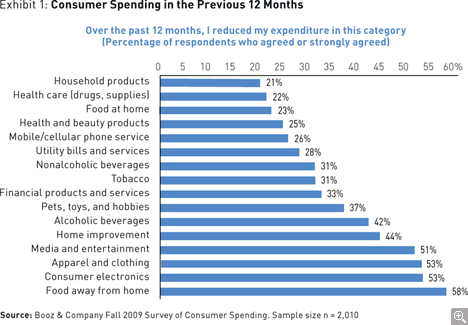
An article released by Booz & Company a few weeks ago has some interesting data in it.  For example, in the chart below, it shows 22% of people spending less on healthcare (drugs, supplies).  What does that imply – pill splitting, more generics, more mail order, lower adherence, less preventative care?  So are they more receptive to cost messages from healthcare entities?

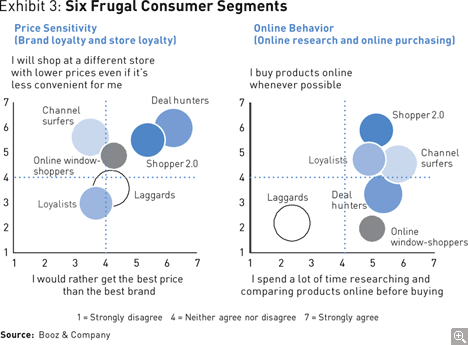
Most of the consumers surveyed said they continue to consider saving more important than spending (65 percent). They sacrifice convenience for price (65 percent), frequently use coupons (65 percent), and, to a lesser extent, prefer the best price to the best brand (55 percent).

Maybe it’s time for the PBMs to emphasize convenience more – simplify your life, use mail order…one less errand to run.  I’m still skeptical that this would beat a traditional cost savings message.  BUT, perhaps it’ time to reconsider coupons / incentives.  They’ve been tried with limited upside over the years in pharmacy.  They do drive up results, but they don’t always pay for themselves.  Maybe a lower value incentive would have the same yield thereby increasing ROI. ???

They identify six segments of the population with this frugality filter:

AIS Quote Of The Day – 25 Years Of Health Efforts Wasted


“Other than on cancer, we’ve spent 25 years wasting our time on trying to reduce health risk. I think it’s been a disaster….We weigh more than we did 30 years ago, we exercise less than we did 30 years ago and we have more diabetic people than we did 30 years ago….” 

— Dee Edington, Ph.D., director of the University of Michigan Health Management Research Center, at the recent World Health Care Congress in Washington., D.C. [From today’s quote of the day from AIS]

Should Pharmacy Trend Go Up or Down?

As we enter the “drug trend report” season and we get to see everyone pull out their rules (not always equal) to show that their smaller, a friend asked me a good question the other night.  Is lower trend better?

It’s an interesting discussion.  We always assume that lower trend means the PBM is doing a better job shifting utilization to generics, moving people to mail order, driving specialty claims to the specialty pharmacy, implementing utilization management programs, etc.

BUT, if the PBM improves adherence, the trend’s going to go up.

If the PBM does a better job of moving specialty claims from medical to pharmacy, the trend’s going to go up.

If the PBM does a better job of making sure people get a claim after a step therapy reject, the trend’s going to go up.

If the PBM does a better job of getting people to fill their initial claims, the trend’s going to go up.

If the PBM does a better job of closing gaps in care, the trend’s going to go up.

I think this is one of the big reasons why a captive PBM (i.e., owned by the managed care company) should be viewed differently and has a unique opportunity.  They can make a convincing case that the trend should go up and be offset by lower medical costs.  That’s much harder for a standalone PBM to make.

Why Not Just Give Patients a 365 Day Supply of Generics?

There are certainly some exceptions where the drug is a narcotic or where the drug could be clinically abused.  BUT, in most cases, it probably is the most efficient solution for the market.  The cost of the waste is probably outweighed by the savings.  And, if you’re not a retailer looking for foot traffic, isn’t efficient what matters?  [Not always of course as this flies in the face of my last post on pharmacy as the cornerstone for communications.]

For example:

A – 30-day supply of generic

  • Assume the drug cost is $0.20 per day
  • Assume the cost of filling the drug is $5.00
  • Total cost every 30 days = $11
  • Total annual cost (12 fills) = $132
  • A 365 day supply would save $55 in dispensing costs with only a minor uptick in bottle costs.

B – 90 day supply of generic

  • Assume the drug cost is $0.18 per day
  • Assume the cost of filling the drug is $10.00
  • Total cost every 90 days = $26.20
  • Total annual cost (four 90-day fills) = $104.80
  • A 365 day supply would save $30 in dispensing costs with only a minor uptick in bottle costs and shipping costs.

Especially if you waited until the initial drop in adherence after the first 3-months, you would have less waste.

Why Is Pharmacy So Important For Healthcare Communications?

I’ve talked about pieces of this before, but I really believe that pharmacy is the cornerstone of a successful healthcare communication strategy.

Pharmacy is the most used benefit.  On average people have over 12 pharmacy claims per year.  And, if you take out the people that don’t have any, the number rises to around 20 pharmacy claims per year.

That’s 20 opportunities to intervene at a logical event and educate the patient about their condition, talk to them about saving money, stress the importance of adherence, capture feedback from them, drive them to take an action, etc.

Additionally, pharmacy is a very tangible event that consumers can control.  They get to choose (in most cases) their pharmacy – retail, mail, specialty.  They can talk with physicians about the options – generics versus branded.  It’s a space with lots of DTC (direct-to-consumer) information.

I don’t think most of us (even those in the healthcare field) would feel as open to debating one surgery versus another type or talking about the quality differences between one location and another.  The data’s not as accessible and therefore we’re more dependent upon the system to drive us to good decisions.

Thoughts On Express Scripts 2010 Drug Trend Report

As one of my favorite annual projects during my time at Express Scripts, I love the drug trend report. It has been a historical benchmarking tool for the industry and become a normal deliverable for many of the PBMs. Here are my initial thoughts after reading this year’s document which looks at 2009 data.

Individuals often are not rational.

  • As driven by their Consumerology initiative over the past few years, Express Scripts has shifted the dialogue around the B2C components of the PBM industry to one of behavior change versus simply plan design. This report continues to reinforce that messaging.
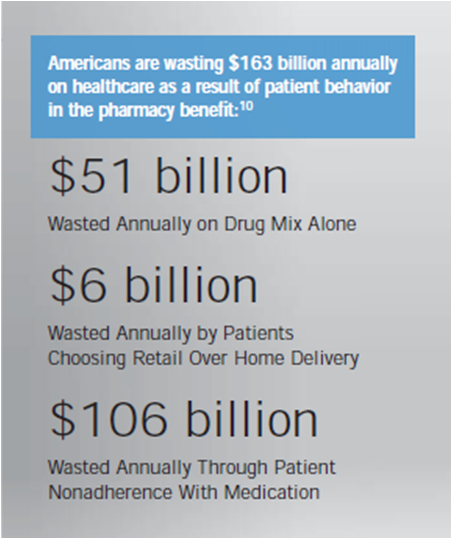
  • Waste has been an ongoing drum beat since my days there. This continues to be the message with a shift to include non-adherence to channel mix and drug mix.
  • They talk about the Healthy People 2010 initiative and that key to closing “the last mile” in achieving our objectives is the ability to influence behavior.
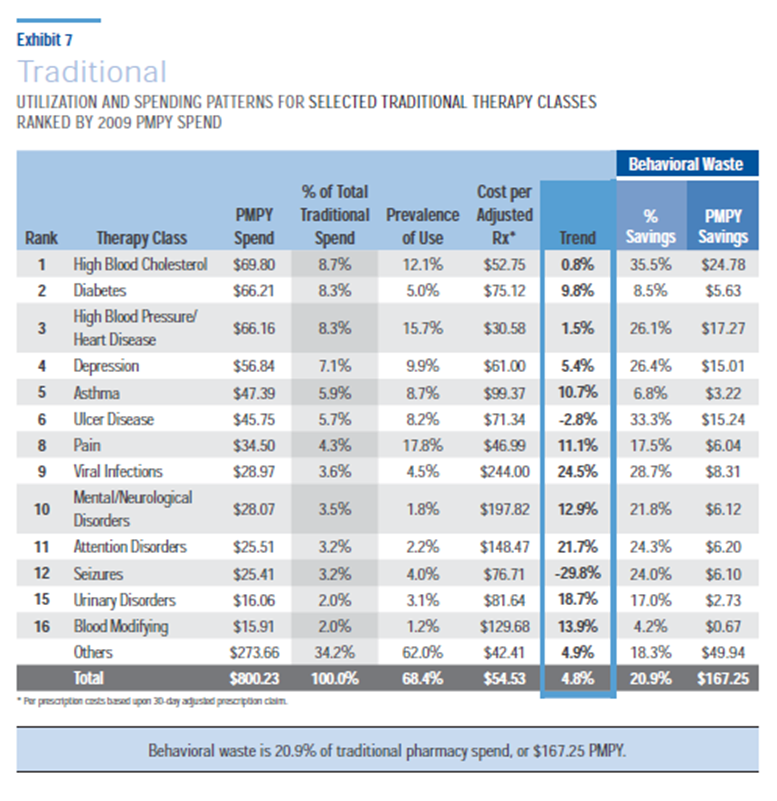
  • One of my favorite charts is below showing the waste by class. Not surprising, plan sponsors should focus on heart disease, depression, high cholesterol, and ulcer disease. [Diabetes is not in the top four but is one of the typical areas of focus.]
  • Key Performance Indicators (KPIs):
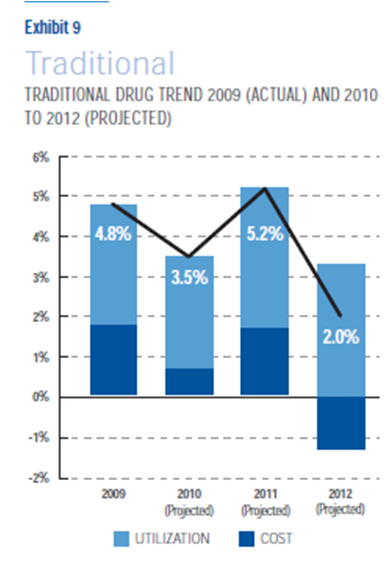
    • Overall drug trend – 6.4%
    • Specialty drug trend – 19.5%
    • Traditional (non-specialty) drug trend – 4.8%
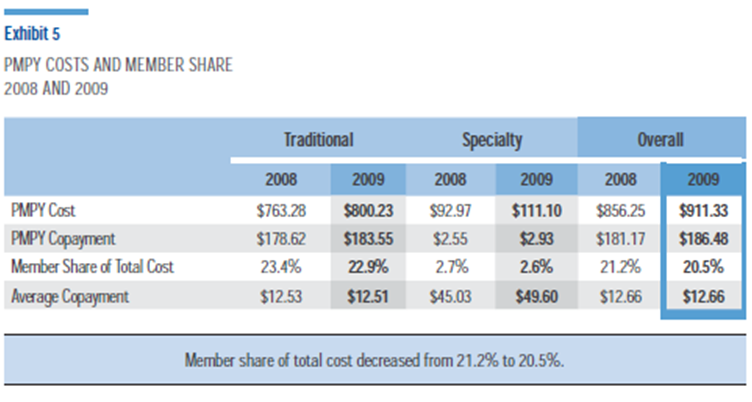
    • $800.23 PMPY average drug spend
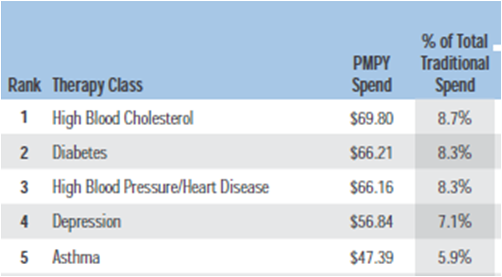
  • The top five classes are:
  • Specialty drug spend is up to $111.10 (processed under the prescription benefit) with a belief that this is only 50% of the total spend which includes specialty drugs processed under the medical benefit.
  • The top specialty classes include inflammatory conditions, MS, and cancer which represent 67% of total specialty spend.
  • I was surprised to see the member contribution to the drug costs had gone down while the actual dollars had stayed flat.
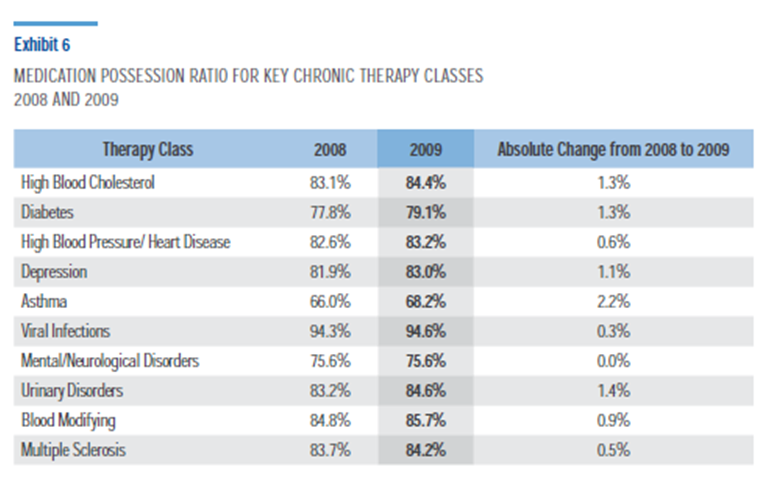
  • I was also surprised that they found adherence (as measured using Medication Possession Ratio) stayed flat from 2008-2009. I think most of the information available had implied thru survey data that it was going down with the recession.
  • I’m having some difficulty reconciling the MPR analysis below with the waste argument. If 80% MPR is ideal and most classes are above 80% MPR, I’m not sure I see the crisis in the data.
  • One of the key charts that I always copied and hung on my wall is the one below. It shows the classes by rank, the utilization, the average cost, and now the estimated behavioral waste (generics and mail).
  • You should certainly go into the document and look at the class level detail. They’ve included a utilization chart by gender by age which I really like. The sections also give some insight into future pipeline. I think I’ll pull diabetes out into a separate post.
  • It’s interesting that they identify only three segments for non-adherent patients with specialty medications versus more on the traditional side:
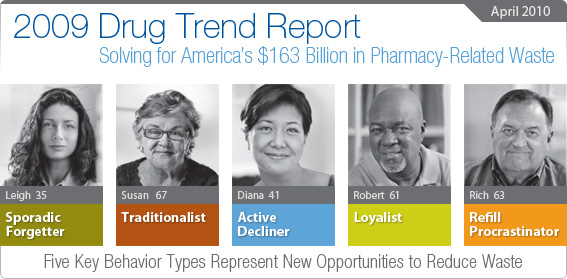
    • Active Decliner
    • Refill Procrastinator
    • Sporadic Forgetter
  • They project that utilization will continue to go up at about 3% per year and that trend will be mitigated with new generics coming to market.
  • Another interesting analysis is where the waste is by state:
  • They have some information on their Consumerology approach, but I’ve talked about that before.
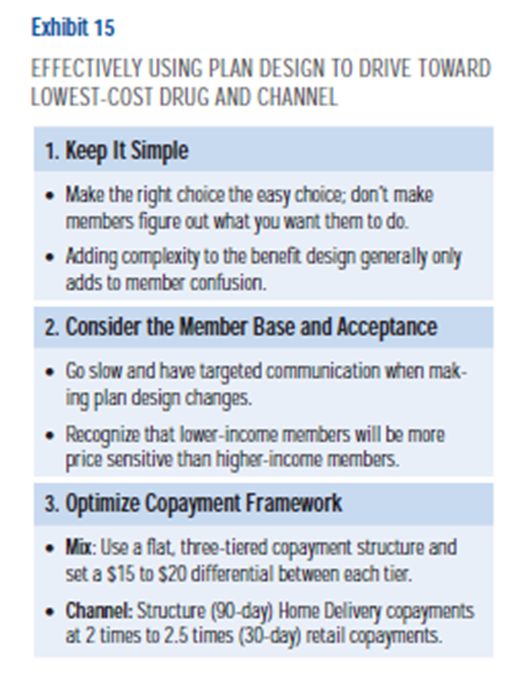
  • I liked their simple plan design primer:
  • Towards the end, they talk about some of the changes they’ve made over the past few years to their programs to reflect their consumerism approach:
    • Step Therapy Choice
    • Formulary Rapid Response
    • Call4Generics
    • Select Home Delivery (which is gem of their new programs in my assessment)
    • First Generic Fill Free
    • Select Curascript
  • A simple graphic that points to the importance of understanding the consumer and developing programs to effectively drive behavior is below. [This is very similar to all the work we do at Silverlink with clients to help them drive health outcomes and behavior.]

I like it. Very humanized versus purely statistical document. Good job Emily, Steve, Yakov, Andy, Bob, Brian, and Chris. (That’s the core group that I know well.)

$300K for an additional year of life?

I’m sure this is the politically incorrect way to look at this, but it’s how my mind immediately works. A new drug – Provenge – was approved by the FDA. It’s a vaccine for men with prostate cancer that gives them (on average) four additional months of live.

The drug costs $93,000 for the 3 shots. So, $93,000 for four months or $279,000 for a year [although you don’t really have that option].

I wonder what a life insurance company puts as value on a year of life? Or the courts?

Who should bear the costs of this drug? The insurance company? The individual? Medicare (taxpayers)?

Or, another complexity…I assume the drug doesn’t work if you don’t take all 3 shots. Of course, it’s going to have side effects – fevers, chills, and headaches. Will patients want to spend the last two years of their life with those side effects for the few additional months of life?

What if they get the first shot at $31,000 (1/3rd of $93K) and decide not to get the additional shots? Assuming that makes the first shot a total waste of money, should they bear some responsibility for that? Could you make them pay $3,100 (10%) for the first shot and nothing for the future shots or some other way to make their costs front loaded?

How Does Adherence Fall Off?

This is a nice simple graphic from a new Medco document that’s out – Case For Smarter Medicine.  We all know adherence is an issue especially in the first 3 months (for those that ever fill even their drugs one time), but this gives us a good picture of how it drops off over the first 12 months. 

The Best Healthcare Conference

In today’s budget conscious economy, people are constantly evaluating where to spend their time and money from a conference perspective.  Some conferences are good networking events.  Some of requirements to work in an industry.  Some are educational.  Some give you new ideas on how to run your business.  Some are in great fun locations with fun events.  Very few fit all of those.

I think our Silverlink Communications client event called RESULTS2010 does all of those.  [Hint – the conference is called RESULTS since that’s what we focus on with our customers.]  It takes on all the key issues we see in the market.  It brings in industry experts and clients to talk about what they are doing to address these issues.  Those problems are framed out by our industry experts that have line experience with these roles.  [Our leadership team comes from places such as Express Scripts, CVS Caremark, Gorman, and HCSC and our team includes people from McKesson, Humana, United Healthcare, IMS, DigitasHealth, Medco, and WebMD.  I challenge anyone to find a more knowledgeable vendor team.]  It gives people a chance to network and talk to their peers.  And, there’s some fun mixed in there.

This year’s event is focused on THE HEALTH CONSUMER.  I’m pretty sure it’s the only conference focused on communicating with consumers in healthcare.  The objective is to provide clients with ideas about how to educate, support, and motivate consumers to take actions which support health outcomes. 

Honestly, it was the original event that convinced me to come to Silverlink.  I was a consultant at my first event working with the company.  I met 75 users who were passionate about the company and had great first hand experience using the technology to make a difference in their companies.  I was able to ask them about the competition and understand why they choose Silverlink for their member communication partner.

So, what does this year’s event have in store:

  1. An amazing list of external speakers including Mark McClellan, David Wennberg, Don Kemper, Jack Mahoney, and Janice Young.
  2. A long list of client case studies – 14 so far.
  3. Specific tracks to cover our different client groups and allow for smaller discussion versus formal presentations – Pharmacy, Population Health, Medicare, and Managed Care.
  4. Industy experts on key topics such as consumer engagement, use of data in healthcare, consumer data, behavior change models and incentives, pharmacy economics, pharmacogenomics, medicare market dynamics, and the evolving retail healthcare model.
  5. Adherence experts such as Dr. Will Shrank from Harvard and Valerie Fleishman who led the NEHI adherence study that is widely quoted.
  6. Several fun events including golf, morning runs, and a few special sports related surprises.

There are several more speakers who you would know and I’m very excited to have come and speak…BUT, I want to leave something inside the package for you to want to rip it open and learn more.

How much does it cost?  Nothing (as long as you’re a Silverlink client).

Where is it?  Boston (a great city).

How do I learn more?  Well…if you work for a large managed care company, a population health company, or a pharmacy / PBM, you may already be a client.  We have over 80 clients today.  So, if you’re not on our invite list, think you might be a client, and want to learn more, let me know.  I’m at gvanantwerp at silverlink dot com.  [spelling it out avoids spam]

This year’s event is in late May so I hope to see many of you there!

Would You Like Some Food With Your Salt?

This is a good example of too much of a “good thing”.  The recommended daily salt maximum is 2,300 milligrams.  But, men consume 4,300 mg per day and women consume 3,003 per day (National Health and Nutrition Examination Survey).

What’s the problem?  Excessive sodium can lead to high blood pressure which is associated with strokes, kidney damage, and congestive heart failure.  The Institute of Medicine estimated that reducing sodium intake could prevent 100,000 deaths a year and save $18B in medical costs.

And, salt also contributes to the obesity crisis by creating a brain response that craves more and causes people to drink more soft drinks and alcoholic beverages.  Some big claims.

Express Scripts’ Slides From Barclay’s Conference

I was reviewing the latest presentation from Express Scripts (ESI) and thought I would share a few of the slides here.

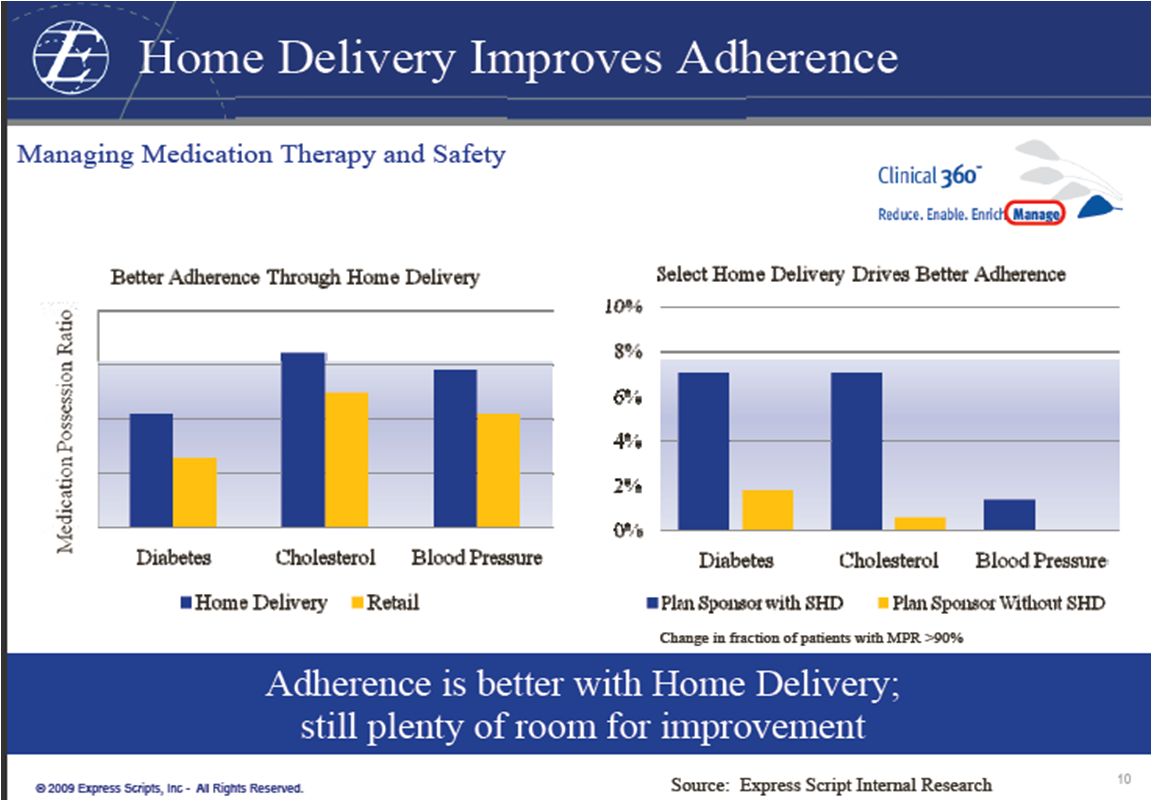
The first one is ESI’s new focus on Waste as a way of driving focus.

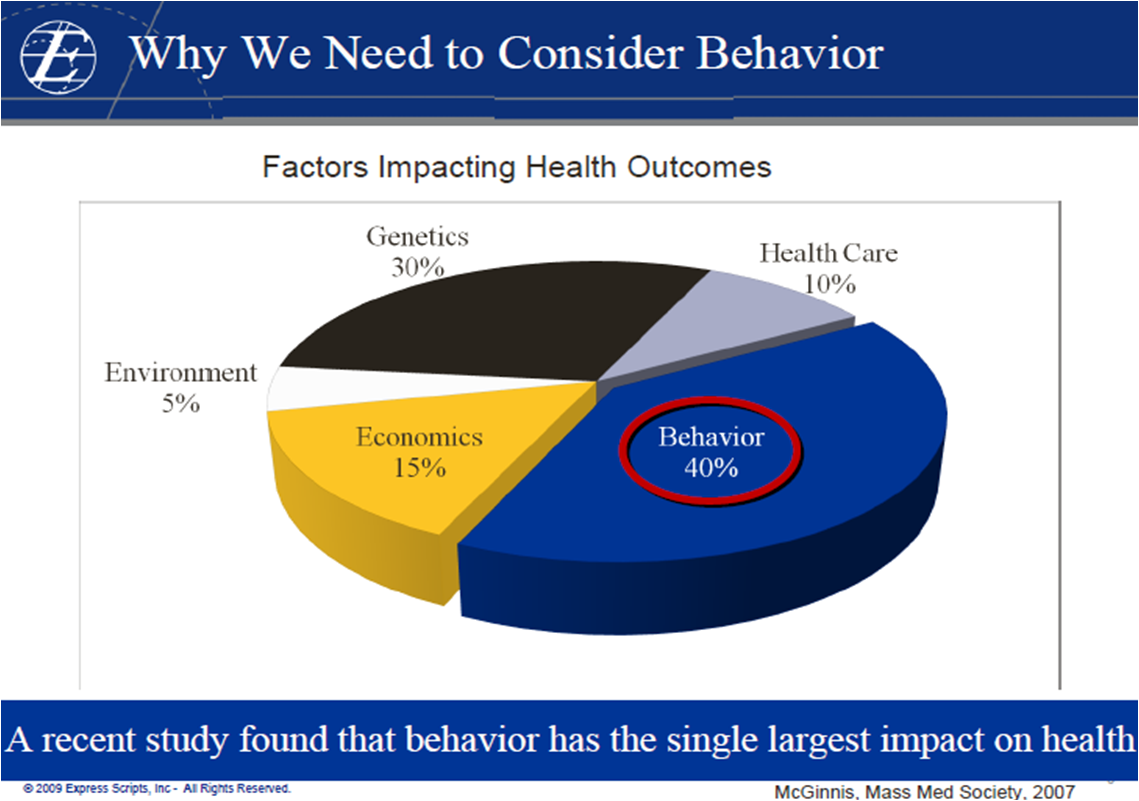
The second is a chart that everyone’s been using lately on behavior as the biggest impact on health outcomes.

The third is two charts on adherence.  The first is the one everyone is showing on mail adherence being better than retail.  The second one shows how few people actually have optimal adherence which they define as 90% medication possession ratio (most people I know would use 80%).

Prescription Growth Trends March 2010

These charts from IMS and Barclays Capital show 0.9% script growth for 2010 YTD. Retail continues to grow while mail continues to decrease volume.


So, I guess the question is what to make of this.  Is it right? 

  • IMS doesn’t get all the data (e.g., Wal-Mart and I think some mail order data).
  • The independent pharmacies all complain about the PBM’s taking business away.  This would say that’s not true. 

Let’s just take Express Scripts as an example.  In 2004, Express Scripts filled 39.1M mail Rxs out of 437.8M total claims.  In 2009 (after the Curascript, Priority, and MSC acquisitions), Express Scripts filled 41.8M mail and specialty claims out of a total of 530.6M total claims.  So, over 5 years and with lots of effort, the number of mail claims has grown slower than the total claims growth.  Some of this is due to client mix and plan design.  Some of this is due to things like the $4 generic programs at Wal-Mart.  But, how does this gel with the IMS data and the independent pharmacy complaints?

Or, is this due to the increased growth and focus on 90-day retail?

Sugar and Cholesterol

If you have high cholesterol, drink water NOT soda, juices, lemonade, sweetened teas, etc!  That’s my quick summary of the article I read

Of course we all know that sugar intake is linked to obesity which is linked with high blood pressure and heart disease.  I think logically many of us would know that sugar is tied to cholesterol but generally the focus is on reducing fat intake.  I simplistically think of it as the primary driver of my tricyceride levels. 

Based on the study just published looking at over 6,100 adults:

  • Participants consumed an average of 21.4 teaspoons of added sugars a day.
  • 16% of participants total calorie intake was from added sugars (compared with 11% in 1977-78).
  • People with higher levels of sugar intake were more likely to have low HDL and high triglycerides (blood fat).

The American Heart Association says that women should consume no more than 6.5 teaspoons of sugar a day and men no more than 9.5 teaspoons a day.  [A Coke has 16.5 teaspoons in a 20 oz bottle or 10 teaspoons in a 12 oz can.]

HealthEngagement Barometer 2010

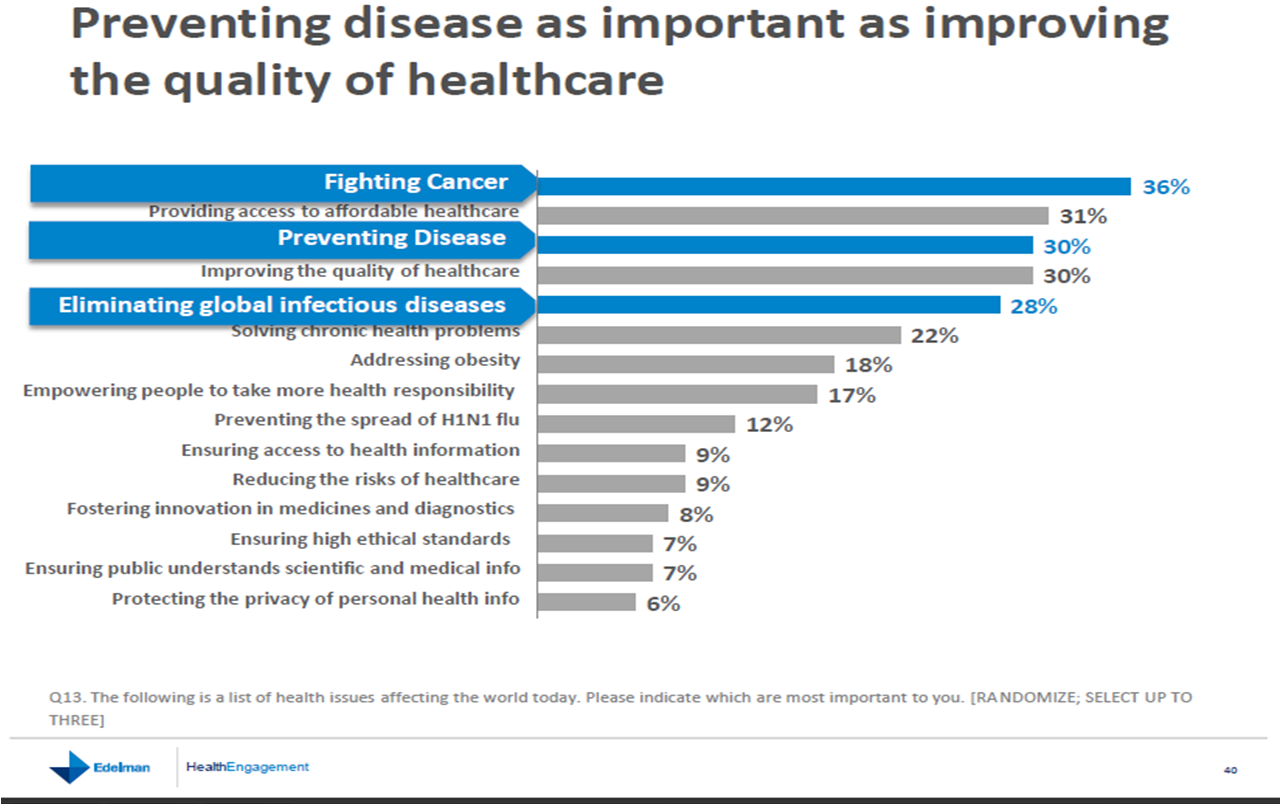
Edelman recently published the results of a survey of over 15,000 people across 11 countries.

The study is interesting in terms of people’s opinions. Here’s a few highlights.

  • More than 50% of people believe businesses are doing a poor job of engaging in health.
  • 73% say it’s as important to protect the public’s health as it is to protect the environment.
  • 61% believe they need to do a better job of taking charge of their own and their family’s health.
  • Only the UK reads and shares less information than the US. 41% of people read health information weekly and 33% share health information weekly.

So, what do people mean by how businesses should engage?

One of the things that interested me was the slide about what motivates people to get active in their health.

While 58% of people use some form of digital media to research health, the majority use Google or some search engine. 34% of them (globally) use health company websites. [If this were limited to health plan or PBM websites in the US, that would seem high.]

I wasn’t surprised that fighting cancer was the most important issue, but I was surprised that privacy of information was the least important.

Express Scripts Drug Trend Report 2010

I knew the new report must be out when I had about 40 hits this morning on my blog based on Google searches for it.  Here’s the banner showing some segmentation.  I haven’t had the chance to read it and comment, but I will in the next 2 weeks.  You can search my blog to see my comments on all the PBM drug trend reports from the past few years.

[added later…my comments are now posted here.]

The Adherence Estimator by Merck

Merck did research that was published last year showing that their 3-question Adherence Estimator (TM) was 86% accurate in identifying patients at risk for nonadherence.  Pretty impressive. 

A copy of the questions are below and were on the Tuft’s website which also shows the scoring mechanism.  This is something patients can take to determine their risk or plans, PBMs, pharmacies, MDs, disease management companies, or others could use. 

Dialogues From WHCC About Population Health

I’m sure population health is one of those terms that means nothing to a consumer but is actively used within the healthcare system. Disease management is one of the old terms which is subsumed under this phrase. I think wellness is synonymous with it. But lots of older terms like case management fall under it. [In my humble opinion]

I had the chance to sit down with several leaders in the space and talk about their companies while I was in DC earlier this week.

I talked with Rob Webb (CEO of OptumHealth Care Solutions), Mike Tarino (President of DSM Personalized Nutrition), Stuart Slutzky (Chief Mktg Officer at The Vitality Group), and Calvin Schmidt (President of J&J’s Wellness and Prevention Group). There were some definite similarities in what they all were focused on and their thoughts about reform, but each of them certainly had a different perspective. Here’s a few of my takeaways from the conversations.

The Vitality Group:

  • They are more of a start-up here in the US, but they have a lot of interesting experience from work in South Africa and the UK. [I’ll admit that while I liked some of their ideas a lot I’m a little more of a skeptic about the easy of leveraging learnings outside the US to our unique environment.]
  • He talked about the fact that places like Europe have a greater awareness of the benefits of Wellness so the ROI / sales process is different.
  • I liked the fact that in South Africa they developed a discount program with the largest grocery chain. For Vitality members, they get a 15% discount (or 20% if you have completed an HRA). I believe this is just limited to healthy foods which seems like a good motivator.
    • This reminds me of another company Linkwell which is doing some interesting programs here in the US. I talked with their CEO about using grocery data to identify what people buy and rather than trying to radically shift their buying patterns simply move them to a healthier alternative within the same category (e.g., frozen foods).
  • They have a partnership to expand within China.
  • In one of the countries, they have developed a link to life insurance so you get discounts for participation and staying active.
  • They link incentives to outcomes based on 14 different risk factors and 30 different factors that they track.
  • They’ve integrated with gyms like LifeTime Fitness to track your use of the gym. They’ve also integrated with several devices. The goal is to remove access barriers.
  • We talked about the difference in the “value” of points between the US and South Africa. In SA, you earn discounts as your status increases (like an airline). In the US, you earn Vitality Bucks which you can cash in for free stuff.
  • They don’t want to focus on certain fixed outcomes because people are different and they want to offer a non-discriminatory path to success.
  • We talked a lot about corporate culture, using incentives appropriately, and developing a communication plan for how this is rolled out and engagement is sustained.
  • This seems like a lot of work to finalize integrations especially as healthcare can be local in many cases. He said it only takes about 60-days.

DSM Personalized Nutrition:

  • This is a newer group within a large global entity.
  • They are looking at how to use nutrition to create health from disasters (i.e., Haiti) to Olympic athletes (e.g., faster recovery formula).
  • They deliver employer solutions around wellness and how to most effectively drive lifestyle change.
  • I asked him naively if nutrition equaled diet. He pointed out that it was broader than that. It was what you eat, how much you eat, when you eat, and the supplements you take.
  • As I’ve talked about before, this is a personal area for me. We digressed several times to talk about the challenge of changing diet versus exercising more. (Only about 2% of people can lose weight without changing what they eat…something I learned a few months ago.)
  • I asked him who they competed with which is a broad area since there are a lot of companies out there now competing for wellness dollars.
  • I asked him about Jenny Craig and Weight Watchers who seem to be moving into the employer space. He said that they were focused on performance not just on weight loss, but he did talk about the Biggest Loser type competitions and challenges that are part of a cultural change.
  • One of the most interesting stats was when he asked me what the average calorie intake difference was between someone who was of a healthy weight and overweight…I would have thought about 500 calories. What do you think? (See bottom for the answer)
  • I asked him what they do to gain insight into the health today and in the future:
    • Assessments (web)
    • Screenings (in-person)
    • Coaching (phone, in-person)
  • He talked about using teachable moments to get commitment to a goal.
  • He felt that incentives often create false motivation and therefore create a short-term return, but don’t create sustainable change. He used the term Intrinsic Motivation several times.
  • We talked about the BlueZones research about people living long lives.

OptumHealth Care Solutions:

  • I first met Rob at this conference a few years ago where I interviewed him.
  • I now know a lot more about what they do and we had a good dialogue about several things.
  • We talked about their recent partnership with American Well to leverage their technology.
  • I asked him how that played into their traditional model of the health coaches and nurses. He described the need to match up the patient with the right physician and make sure to keep them in the care delivery system. This tele-health strategy allows them to do that.
  • I hadn’t seen the American Well presentation yet so I immediately jumped to the value of getting a second opinion using this (or bringing a specialist into the dialogue…which is even better). He agreed and talked about how they’ve been able to lower the transplant rate in their population from 16 per 1,000 (which is the norm) to 11 per 1,000.
  • We talked about the measurement and payment challenges in the industry where there’s no clear definition of engagement (or more importantly sustained engagement). It’s too easy to manage to an opt-out list or simply send people a letter saying that you didn’t get them on the phone and check the box that they’ve been “engaged”.
  • We talked about incentives for a while and the challenge with them. He (like many I talked to at the conference) was quick to point out that they can often be used to cover up the problem of people not being engaged for the right reasons.
  • We talked about back surgery and the fact that if you talk to a surgeon about it then you are 17x more likely to get back surgery than if you talk to a chiropractor about it. (Or 5x more likely if you talk to a PCP about it.) We also talked about the fact that most back pain lasts about 5-6 weeks so if you get someone in a stretching program (for example) that last six weeks then the pain will be gone before their done.
  • We talked about a Center of Excellence (COE) concept which many people have been discussing both at hospitals along with call centers (e.g., Medco’s Therapeutic Resource Centers).
  • Then we had a really interesting discussion on geography and how consumers are so focused on geography which is something they have access to versus quality and affordability which are harder to access and understand. For example:
    • There are >200,000 physician offices in the US
    • There are about 100,000 gas stations in the US
    • There are about 60,000 pharmacies in the US
    • I often think there are too many gas stations so…
  • We ran out of time to talk about their eSync platform, but I find this to be an interesting concept.

Johnson & Johnson Health & Wellness Division:

  • They have bought a few companies (e.g., HealthMedia) to get into this space and at one point were looking to build a stand-alone $20B company.
  • They seem very focused on the employer and creating custom solutions for them that blend technology, science, and engagement.
  • He described it as a “holistic, multi-dimensional consumer approach” and talked about creating a seamless experience.
  • I liked his five “pillars” that he categorized as important – leadership and communications, programs, policies and practices, marketing communications, and outcomes.
  • We talked about ROI and the two areas to be analyzed – productivity and cost reduction.
  • We also talked about incentives and looking at carrots versus sticks and how to use carrots to drive participation.
  • They’ve developed 1.3M individual plans for consumers to improve their health.
  • I asked him whether HealthMedia was one leg in their stool or the platform upon which to build. Interestingly, he said it wasn’t binary that HealthMedia provided them with both a set of solutions along with a platform to build upon.
  • I asked him for some insights into consumers. One that I noted was that they found binge eaters were more willing to talk with or interact with a system than with an agent. [This is similar to what we’ve found at Silverlink where consumers with some specialty conditions are more willing to provide information to an automated call than to the nurse…they don’t want to feel like their being judged.]
  • We talked about health as a strategic imperative and the need to create a top-down leadership culture to effectively change behavior and environmental factors.

[Answer from above…It’s only a 100-calorie a day difference between being healthy and being overweight.]

World Health Care Congress 2010 Notes (#WHCC10)

For the third year, I’ve been able to come to the WHCC big spring event in DC. I would say this is one of the best conferences in terms of total attendance, level of speakers, and level of attendees.

Between recovering from vacation, work (no…the blog doesn’t pay the bills), and interviewing people, I only made it to a few sessions. My notes from them are here.

Kathleen Sebelius (Secretary of Health and Human Services) talked about:

  • Reform is not a gov’t takeover but providing an operating framework (paraphrased).
  • Some of the immediate changes – no more pre-existing conditions. Moving coverage of dependants to age 26.
  • Medicare spends over $1B per day.
  • Preventative care incentives…great example on comparing the costs of amputation for a diabetic versus the costs of preventing it. (want to run this model in more detail later)
  • There are $56B in uncompensated healthcare costs (to hospitals) which leads to $1,000 in insurance premiums for all of us that are covered.
  • She quoted someone saying that healthcare costs are the tapeworm that is eating into American competitiveness in the global marketplace.

Dr. Mehmood Khan (SVP, Pepsi) talked about:

  • How a food company can contribute to the health discussion and change in health (e.g., taking full calorie sodas out of the schools).
  • The research and work they do internally.
  • The fact that we are now seeing both overfeeding and under-nurishment co-existing in the same geography.

Andy Webber (CEO, National Business Coalition on Health) talked about:

  • Challenges that employers see:
    • Improving health
    • Transforming the delivery system to focus on outcomes
    • Controlling expenditures
  • The healthcare delivery system is a small input into the overall outcomes. He says that jobs and income are the #1 driver in determining outcomes. [Good for pitching a focus on economic growth, but I don’t buy it.]
  • Improving population health is a team sport focused on the local level.

Dr. Reed Tuckson (EVP, UHG) talked about:

  • Chronic disease is a tsunami to our delivery system.
  • We need to understand what is killing people locally and how to solve it.

Nathan Estruth (VP/GM of FutureWorks at P&G) talked about:

  • The innovation strategy at P&G (see detailed paper here)
  • The Connect & Develop strategy they use where P&G brings the consumer to the table.
  • Some of their investments including MDVIP and Navigenics.
  • The power of “and” (try to find solutions that do A and B not just optimizing around one component)
  • I think the most telling message was that they clearly did not subscribe to the “Not Invented Here” innovation challenge that many companies do. He said they focus on >50% of their innovation coming from outside the company.

Roy Schoenberg (CEO of American Well) talked about:

  • The issues around healthcare in the US – access, MD income, PCP shortage, specialty care access, ER abuse, and systems agility.
  • Work they are doing with pharmacies, payers, OptumHealth, Ascension (hospital), and the military.
  • A very interesting point about retired MDs coming back into the system since they can work on their schedule and without having to have an office.
  • Another cool point about the ability to coordinate visit between a PCP and a specialist. They also enable easier referrals. (I think this could be game changing.)
  • They can also project care where needed – e.g., Haiti.

General Observations:

  • Lots of talk about creating a culture of health and innovation.
  • Lots of talk about wellness.
  • Most of the people I talked to from the wellness companies were very skeptical of incentives.
  • Lots of people trying new things and trying to innovate.