Archive | Healthcare RSS feed for this section

Morning “Excitement” and Vultures

I got up early this morning to catch the first flight out of Logan. (Even for a morning person, it is hard to set my alarm for 2:30am.)

As I was waiting in line at Starbucks, the person behind me fainted while he was on the phone. I must admit it was a little scary. He was awake but twitching and hardly responsive. After a minute or two, he sat up and seemed okay so we helped him stand. (Probably a mistake in retrospect.) He immediately collapsed again hitting his head for the second time. We were able to brace his fall somewhat, but he seemed to be having some type of seizure. His tongue swelled up and was stuck between his teeth (making me realize that I have no idea what the right protocol is here). He then started to vomit.

At this point, I am holding this guy’s head and hoping that some emergency help comes before I see somebody die in my hands. It seemed like it took forever, but someone came. No one really seemed interested in what I saw instead relying on the individual to answer questions (which was only possible since one of the Starbucks employees spoke Spanish and English). The man only spoke Spanish and was traveling alone to go back home. To the best that I could figure out, he was a 61 year old male on several medications which he kept all together in a pill bottle so they weren’t sure of his condition. They were keeping him overnight in a hospital here.

It made me think of a lot of questions which I am sure are going through his head:

  • How do I contact my family? (I think the Starbuck’s employee called them.)
  • How do I pay for this care? I don’t have health insurance in the US.
  • What happened to me? I can’t imagine that he knew.
  • How am I going to get home? Will I get a new ticket or have to pay for it?

A few lessons for all of us on having emergency contact information and lists of allergies, conditions, medications, etc. with us. (or a case for some type of personal health record accessible by medical professionals)

The most amazing part to me was people’s focus on getting their Starbucks. The area is roped off with a man on the floor, vomit on the floor, a policeman, airport personnel, and two EMR people. Regardless, people were trying to go around them to get to the register to order. When they started to wheel the man out on a stretcher, I saw one man go in and actually step over the EMR people who were sitting on the ground where the man had been 30 seconds earlier.

They definitely needed a big neon sign that said to go someplace else for your caffeine. (There is a Dunkin Donuts less than 100 yards away.)
Silverlink HealthComm Behavioral Index

Although this new index was released in a story a few weeks ago, the official press release should be out this morning. It has been interesting to watch this transform from a concept to an initial survey with some data.

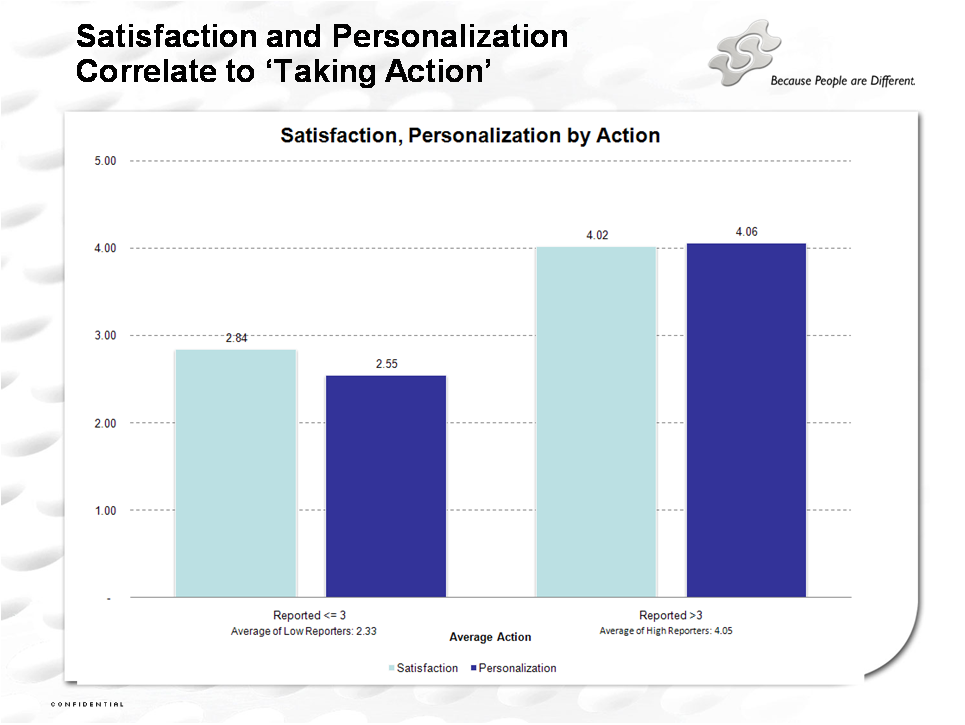
What is it? The Healthcomm Behavior Index is a quarterly survey of 1,000+ commercially insured adults in the US that measures the effectiveness of healthcare communications. It focuses on three areas – personalization, satisfaction, and action.

What are some of the key findings?

  • Effective healthcare communications (i.e., targeted and personalized) have the potential to build member affinity, loyalty and trust, and significantly drive behavior change.
  • There is a direct relationship between healthcare behavior change (the willingness to take action) and how personalized and satisfied members are with their healthcare communications.
  • Respondents are generally lukewarm on healthcare communications and there is significant opportunity for health plans to improve the effectiveness of their communications programs.
  • Unlike other consumer industries, demographics are not as predictive
    of healthcare behaviors.
  • The single most consistent
    determinant of healthcare behaviors is health status.
  • Unhealthy members (those who arguably use health benefits more actively) are the least satisfied and the least likely to take action. These are the members who are the most costly to the health plans so if the plans improve the effectiveness of their communications, they will be able to drive behaviors within this segment and thus have the opportunity to significantly reduce healthcare costs.
  • Seniors are more satisfied and take more action relative to other age groups. This was a counter-intuitive finding as it was assumed that seniors as a whole would have a higher percentage of ‘unhealthy’ members. However, we found that people tend to rate their health status relative to their age.

What are the conclusions? Personalized healthcare communications leads to better satisfaction which leads to a higher likelihood that a healthcare consumer will take action relative to their healthcare behaviors. To most effectively drive member behavior, health plans should micro-segment their populations and deliver extremely targeted and personalized communications programs.

I found the most interesting fact to be that those who took action were the most satisfied with their healthcare communications and felt that they were personalized to them. Digging in a little on the research process, those terms were based on questions that addressed the following:

  • Took action = acted on information + adopted a healthier lifestyle + improved my health
  • Satisfaction = got the right amount of communications + easy to understand + timely + useful
  • Personalization = trust the communications + specific to my needs + treat me like an individual

It will be interesting to see how we can use these results with clients to create a benchmark, compare them to a national average, and then look at how self-reported data correlates to claims data. Ultimately, this could prove to be a defining moment in creating the business case for why healthcare communications are so important beyond the obvious – patient satisfaction, lowering inbound call volume, driving behavior, improved profits, etc.

Literacy and Consumer Empowerment

A few of the highlights from external speakers at the Spring client event for Medco included:

Helen Osborne talking about the “Prescription for Savings: Using Health Literacy Principles in Your Communications.”

  • Finding the right words for the best reasons
  • Not about dumbing down but about smartening up
  • Health literacy is a shared responsibility between patients and providers and each must communicate in ways the other can understand.
  • Age, disability, language, cultural barriers, emotion, and literacy all come into play
  • Eight ways to improve health communications:
    • Know your audience
    • Tailor communications
    • Create a welcoming and supportive environment
    • Communicate in whatever ways work
    • Confirm understanding
    • Offer ways to learn more
    • Weigh the ethics of simplicity
    • Collaborate for good communication
  • Keep things clear, simple, and written for the end-user

“You need to develop an allergy to miscommunication and then turn that allergy into advocacy.”

Steve Case talking about streamlining healthcare by empowering consumers:

“I believe there is a degree of skepticism about managing one’s health, but we need to spend less time on the public policy debate and more time on how to change consumers’ thinking about health.”

  • It may take time for consumers to get fully invested in the notion of taking charge of their health
  • It took nine years for AOL to get its first million users and then rapidly jumped to 25M

“We want to engage people on the Internet and move them from a static situation, where they only go online when they have a problem, to a situation where they go back more habitually.”

  • Many employers are frustrated with their attempts to get employees involved
  • Revolution Health is working more with employers, hospitals and providers
  • Revolution Health is now the top visited site (passing WebMD in January)

Most Medicated Generation

Well, we have finally broke the 50% mark of people using maintenance (or chronic) medications. It shouldn’t be a big surprise. Sit around the table with your friends and ask who takes a medication (without asking what for). Why do so many people take medications:

  • We are in worse health…think obesity.
  • There are better medications.
  • Doctors are more willing to prescribe.
  • Patients know more about using medications through DTC (direct-to-consumer) advertising.

This is all according to a Medco report that was just published looking at a sample of 2.5M customers of all ages from 2001 – 2007. A few of the facts:

  • 2/3 of women 20 and older take maintenance medications.
  • ¼ of children and teenagers take maintenance medications
  • 52% of adult men take maintenance medications
  • ¾ people 65 or older take maintenance medications
  • Among seniors, 28% of women and 22% of men take 5 or more maintenance medications

“Honestly, a lot of it is related to obesity. We’ve become a couch potato culture (and) it’s a lot easier to pop a pill” than to exercise regularly or diet. (Dr. Robert Epstein, Chief Medical Officer at Medco)

Dr. Epstein makes the point that in some cases we have turned diseases that were once a death sentence into chronic conditions – AIDS, some cancers, hemophilia and sickle-cell disease. I was just talking about this yesterday with a nurse about an adherence program where I said we needed to look at some specialty drugs because they are being used chronically.

The biggest jump was in the 20-44 year old age group where utilization grew 20% mainly for depression, diabetes, asthma, ADD, and seizures.

Medco estimates about 1.2 million American children now are taking pills for Type 2 diabetes, sleeping troubles and gastrointestinal problems such as heartburn. (This should be troubling to everyone in terms of the long-term implications to our health care system.)

The Brand Only PBM

A few years ago, I would have argued that PBMs could one day simply cover generic drugs and not cover brand drugs.  With most therapy classes (excluding specialty) having multiple generic options, this seemed possible.  Already, some companies have generic fill rates which are above 70% (meaning that 70% of all prescriptions filled are filled with a generic).

But, now I am wondering the opposite.  If retailers drop generic drugs to $4 and make them available in 90-day supplies for $10 (see Wal-Mart), do you need to PBM in the middle managing those claims?

There are of course several questions to be answered:

  • What percentage of the total generics filled in the market are available at these prices?
  • What happens with new generics that typically have a higher price for the first 6-months?
  • Do these claims still get processed so that they show up in the PBM claims database to be used for drug-drug interactions?

And, Wal-Mart upped the ante here including over-the-counter drugs which typically aren’t covered by insurance.  We aren’t there yet, but it poses an interesting question about the future breadth of coverage and what the implications could be.  Today, most PBMs don’t make money on the brand drugs other than perhaps an administrative fee paid by the pharmaceutical manufacturer for those drugs that are on formulary.  (Something in the range of $1-$5 per claim depending on the cost of the drug and the contract.)

It would turn the market upside down also since a lot of the intervention programs today are in place to drive use of generics as first-line therapy so if they weren’t part of the benefit then the programs wouldn’t have as much value.

Just a thought.  BTW – I have asked the Wal-Mart people to answer the last question above for me since I am interested in whether this is a real issue today or whether most of these claims get paid out using the U&C (usual and customary) field and logic in the POS (point-of-sale) system (i.e., they process as paid claims not cash claims).

Pharmacy Satisfaction Did You Knows

PharmacySatisfaction.com puts out a weekly factoid. They are very interesting and make some great points. I have talked about it before, but here is an updated list with the new factoids from 2008.

  • Independent drug stores continue to score highest in customer satisfaction, followed by food stores, clinics, and chain and mass merchandise pharmacies, in that order.
  • The number one concern across all pharmacy users is that their prescriptions are filled accurately.
  • Independent pharmacy customers are the most satisfied with the services their stores provide.
  • The most useful feature those Web sites offer to them, the survey found, is the ability to order refills online.
  • Nearly three in 10 order their refills online.
  • An average of 69.4% of customers own or use a computer.
  • Customers average three visits each month to their pharmacy.
  • Only about 1-in-5 pharmacy customers, overall, say that they use a loyalty card that provides points, discounts or other savings.
  • While the majority of loyalty card users are satisfied with the expected cost savings by using their card and with the ease of enrolling and understanding the benefits of their card, fewer than 1-in-4 card users are highly satisfied.
  • The drug store industry remains largely up for grabs, with nearly half of pharmacy customers saying they use more than one pharmacy to fill prescriptions.
  • Pharmacy use varies considerably by population. Chain pharmacies are most commonly used among residents of areas with more than 100,000 people. Independent pharmacies are most commonly used among rural respondents (areas with less than 100,000 people). Use of independent and mass merchant pharmacies decreases as population increases. Chain, food store, mail/online, and clinic pharmacy use tend to increase with population.
  • However, as pharmacy customers age, they are much less likely to use chains and considerably more likely to use mail/online and clinic pharmacies.
  • Seven-out-of-ten pharmacy customers indicate that they “definitely would” or “probably would” use their local pharmacy if they could receive the same amount of medication at the same price as their mail-order pharmacy.
  • The heaviest users of prescriptions are survey respondents in their 60s, averaging 5.4 new scripts and 29.2 refills per year.
  • The most preferred method for filling those prescriptions among respondents is to take them to the pharmacy and wait for them to be filled.
  • Indeed, physically handing a paper script to the pharmacist or tech in the store—or picking up a script phoned in by the doctor—remains the overwhelming choice among consumers. Most shun the use of drive-through windows.
  • How long patients have to wait for their scripts to be filled is a key component of customer satisfaction.
  • Fully 93 percent of those surveyed expressed satisfaction with the ability of pharmacies to dispense their new prescriptions in the time promised.
  • Pharmacy customers’ most commonly preferred method of refilling prescriptions (assuming prices and amounts of medication are the same) is calling an automated telephone system and picking up prescriptions at the store.
  • Independent customers are the most likely to receive prescription refills in less than 15 minutes, followed by food store, chain and mass merchant customers.
  • The average survey respondent is spending a considerable sum each month on drugs at their pharmacy—$82 on average (versus $57 a month on food and groceries at their pharmacy).
  • Customers who paid full retail price for their medications, paid an average of $81 for their most recent prescription.
  • Customers who paid the store discounted amount for their medications, paid an average of $75 for their most recent prescription.
  • Customers who paid a fixed-percent co-pay for their medications, paid an average of $56 for their most recent prescription.
  • Customers who paid a fixed-dollar co-pay for their medications, paid an average of $36 for their most recent prescription.
  • On average, respondents spend $82 a month at their pharmacy on prescription drugs, $57 on food/groceries, $18 on non-prescription (OTC) drugs and $14 on personal care/cosmetics.
  • An average of 85.9% of computer owners/users use the computer to improve their health by looking for information about diseases.
  • Much has been written about the value of closer pharmacist-patient relationships, but Americans seem to feel far more connected to their physicians, dentists and nurses than to their pharmacists. That’s clearly not all pharmacy’s fault; the same survey respondents agreed that they were usually given the opportunity to speak with their pharmacist when filling their last prescription. What’s more, pharmacists ranked a close second to doctors as sources of information about medications.
  • Only 16 percent of respondents describe their relationship with their pharmacist as “We are on a first-name basis and have known each other for a very long time.”
  • Walgreens’ “Dial-a-Pharmacist” initiative, launched in February 2006, allows non-English speaking patients to connect with pharmacists speaking 14 different languages.
  • Doctors (94%) are the most commonly referenced source of information on medications, followed by pharmacists (83%), nurses (57%), pharmacy brochures (50%) and the Internet (42%).
  • Doctors (77%) are the most trusted source of information on medications, followed by pharmacists (64%), nurses (43%) and pharmacy brochures (20%).
  • Independent pharmacy customers have the most trust in pharmacists, while mail/online customers have the least. Compared to last year, customers of all types of pharmacies place more trust in their pharmacist as a source of information.
  • More than one-third of pharmacy customers failed to fill all their prescriptions last year, and only 35 percent of all respondents said they were fully compliant on the medications they did take. Nevertheless, refill reminders from the pharmacy remain relatively rare, most patients profess.

2008 Factoids

  • In general, older patients tend to be more compliant than their younger counterparts.
  • The biggest reason for not taking all medications as directed was simply, “I forgot.”
  • Nearly 2-out-of-3 (65%) indicate that they missed a dose or took less medication than prescribed in the past year.
  • The most commonly cited reason for not filling all prescriptions is not needing (42%), followed by too costly (27%), changed by doctor (20%), side effects (17%) and insurance did not cover (16%).
  • Among the medical conditions displayed, those treated for HIV/AIDS and high blood pressure are the most likely to have filled all of their prescriptions in the past year. Those treated for RLS are the least likely to have filled all their prescriptions in the past year.
  • For competing pharmacy providers, satisfaction is a key measurement. Customers who say they are “highly satisfied” with their pharmacy are much more likely to return than those who are simply “satisfied.”
  • Pharmacy customers who are “highly satisfied” with their pharmacy overall are considerably more likely to have positive return intentions, compared to customers who are simply “satisfied” (97% definitely intending to return versus 65%). Survey results have also shown significant revenue differences between highly and poorly rated pharmacies, health plans, and PBMs.
  • Compared to last year, pharmacy customers place more importance on four of the six overall areas of pharmacy services—most notably professional services — followed by pricing and insurance, and overall convenience.
  • 31% of customers consider it “very important” that Pharmacists give advice on OTC/herbal products.
  • 38% of customers consider it “very important” that Pharmacists give advice on health conditions.
  • 57% of customers consider it “very important” that Pharmacists are friendly and courteous.
  • 65% of customers consider it “very important” that they are able to speak to a Pharmacists give clear instructions about Rxs.
  • 65% of customers consider it “very important” that they are able to speak to a Pharmacists about their concerns/questions.
  • 66% of customers consider it “very important” that their pharmacy protects the privacy of their health info.
  • The most common ailment that drives customers into your stores is high blood pressure, which afflicts nearly 50 percent of the respondents surveyed by WilsonRx. High cholesterol, allergies, ailments of the esophagus, arthritis and diabetes also are extremely common among patients.
  • When asked about their satisfaction levels, respondents who received birth control prescriptions were happiest with the medical treatment they’re getting, followed by those thyroid disorders, epilepsy/seizures and type I diabetes.
  • Among the pharmacy services customers say are most important to them is: Help untangling complicated insurance issues, and money-saving alternatives like generic drugs.
  • Consumers are generally satisfied with many of the services, medicines and health-oriented advice they find at their local pharmacy, but they’re also keenly aware of the high costs of pharmaceuticals and quick to shift outlets if they feel their needs aren’t being met.
  • Those who are covered by prescription plans—including nearly 39 million Medicare patients enrolled in some kind of coverage—often feel overwhelmed by the complexities and co-pay issues they encounter at the pharmacy counter.
  • Know your customer — whomever, wherever they are. Being able to identify different customer types is an important first step in anticipating customer needs and managing the expectations of each person.

Are You Doing Enough To Drive Generics?

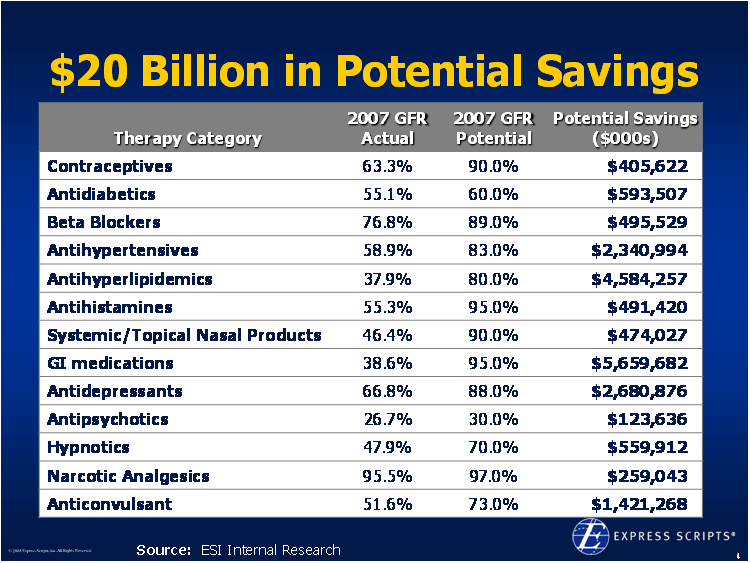
From the Express Scripts Outcomes event a few weeks ago, here is an estimate of all the money left on the table by not increasing your generic fill rate in certain key categories.  Are you doing enough?

  • Utilization management programs – step therapy, prior authorization, quantity level limits?
  • Formulary coverage?
  • Plan design incentives?
  • Pharmacy incentives?
  • eRx messaging?
  • Web tools?
  • Patient communications?
  • Patient incentives?
  • Driving people to mail?

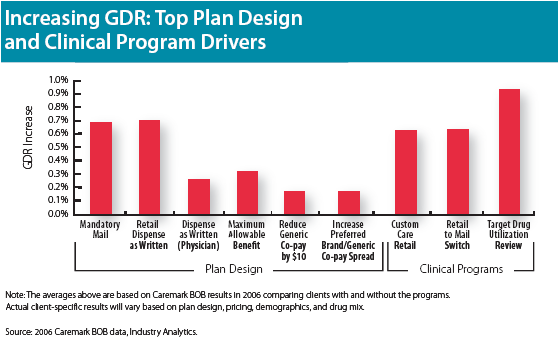
Here is a graph from CVS/Caremark‘s trend report from last year that shows correlation between certain programs and generic fill rate.

Incentives and Communications

Everybody looking at the healthcare system understands that incentives and alignment of goals is a critical component for successful change.

  • Providers need to be motivated to focus on wellness and prevention.
  • Individuals need to be motivated to care about the cost of care and to act in a healthy manner.
  • Pharmacists need to be motivated to take the extra action of moving patients to lower cost agents, resolving administrative edits, and counseling patients.
  • Hospitals need to be motivated to focus on Six Sigma type process initiatives.
  • Health Plans need to be motivated to invest in long-term care initiatives that prevent people from getting sick.
  • PBMs need to be motivated to drive optimal prescription use even if that includes more over-the-counter (OTC) drugs.
  • Employers need to be motivated to offer benefit plans to cover their employees which are simple to understand and align employees with healthy outcomes.
  • Pharmaceutical manufacturers need to be motivated to drive adherence across clinical conditions and to bring new drugs to market that represent significant improvements in therapy (better outcomes, less side effects, easier deliver methods).

With that in mind, I am glad that Silverlink Communications announced this morning that we are partnering with IncentOne to incorporate incentives into our communication programs.  Going forward, incentives will offer us another lever to improve outcomes in our programs that we conduct for clients.

“If applied appropriately in healthcare, incentives are an influential lever to motivate healthcare behaviors, arguably the most powerful force for changing the economics of healthcare,” said Stan Nowak, CEO and co-founder of Silverlink. “We’re excited to be partnering with IncentOne to design highly flexible, personalized and incentive-driven outreach that enables health plans to better connect with and engage their members to drive healthcare behaviors and reward them at the same time.”

“This is a truly integrated technology partnership that seamlessly connects healthcare consumer participation to incentives,” said Michael Dermer, CEO at IncentOne. “Silverlink and IncentOne together can deliver complementary solutions that drive participation and ultimately cost savings in healthcare. The combination of our expertise in finding the right incentives and Silverlink’s personalized communications to drive consumer behavior delivers the ability to implement more effective programs.”

Matthew Holt (author of The Healthcare Blog) did a podcast with both the CEOs yesterday that you can listen to to learn more.

You can also look at a study by Hewitt Associates of large employers which covers several related topics:

  • 2/3rds plan to offer incentives to motivate sustained health care behavior change.
  • 67% will utilize health care data and measurements to drive their organization’s health care strategy.
  • 74% of employees think their employer should help them understand how to use their health plan better.
  • 12% of employees think employers should help them become healthier.
  • Employee decisions on healthcare were influenced by cost:
    • Nearly one-third (30 percent) said they did not go to the doctor when they were sick because of cost.
    • 27 percent didn’t fill a prescription given by a doctor.
    • Almost one in five (19 percent) stopped taking medications before their prescription ran out, and of those, 18 percent did so due to finances.

Certainly, there are numerous examples of incentives being used to drive behavior.  Moving patients to evaluate mail order pharmacy has been a solution where coupons have been used over th years.  Driving therapeutic conversions have used incentives in the form of copay waivers.  Getting patients to complete health risk assessments (HRAs) and other tools have given incentives.

The interesting component will be the personalization of incentives.  While I may enjoy a $10 gift card to the dog store, my wife may enjoy a $10 gift card to the spa.  Flexibility of incentives and alignment of incentives with what drives behavior will be important.

Addressing Medicine Adherence

There are numerous studies on this, but they all point to the same issue…compliance.

The National Council on Patient Information and Education (NCPIE) released a report last year that I just came across titled “Enhancing Prescription Medicine Adherence: A National Action Plan“. With only 50% of patients using medication as prescribed, the systemic costs are enormous – $177B annually according to their estimates.

“Besides an estimated $47 billion each year for drug-related hospitalizations, not taking medicines as prescribed has been associated with as many as 40 percent of admissions to nursing homes and with an additional $2,000 a year per patient in medical costs for visits to physician’s offices.”

  • Between 40% and 75% of older people don’t take their medications at the right time or in the right amount.
  • As few as 30% of adolescents take their asthma treatments as prescribed.

Look at this in light of the recent study that showed about a quarter of people share drugs.  Another huge problem.

Their 10-step national action plan includes:

  • Elevate patient adherence as a critical health care issue
  • Agree on a common adherence terminology that will unify all stakeholders
  • Create a public / private partnership to mount a unified national education campaign to make patient adherence a national health priority
  • Establish a multidisciplinary approach to compliance education and management
  • Immediately implement professional training and increase the funding for professional education on patient medication adherence
  • Address the barriers to patient adherence for patients with low health literacy
  • Create the means to share information about best practices in adherence education and management
  • Develop a curriculum on medication adherence for use in medical schools and allied health care institutions
  • Seek regulatory changes to remove roadblocks for adherence assistance programs
  • Increase the federal budget and stimulate rigorous research on medication adherence

I am a little surprised that they didn’t talk about technology.  Integrated electronic medical records, personal health records, etc.  Since at least 1/4 of people don’t even fill their initial script, I don’t see how we can address adherence without beginning there and providing full lifecycle data to physicians about the status of scripts and refills.  I think there is also a huge role for collecting data about why people fill or don’t fill.

Poor Health Plan Satisfaction Due To Poor Communications

JD Power just finished their second annual National Health Insurance Plan Study which looks at member satisfaction.

“The study finds that the majority of health plan members rate their insurer lowest for the communications and information that are provided to help them understand their plan. Only 45 percent of members reported they fully understand how to use their health insurance coverage and member services. Enhancing member understanding with critical plan details—such as prescription coverage, co-pays, how to locate physicians and how to appeal coverage denials—can lead to higher satisfaction ratings for insurers.”

They evaluated 17 regions and publish reports like the following:

Information and communications is the third largest driver of health plan satisfaction at 17%. The only two things above it are coverage and benefits (#1) and choice of physicians, hospitals, and pharmacies (#2). So, it makes a great case for why communications is something to invest in and focus on. It drives satisfaction which drives retention. Additionally, it is something through which you can create sustainable differentiation. Benefit design and network size are pretty easy to copy.

Health: A Luxury

With rising food costs and constantly increasing costs for health insurance, could health become a luxury? It’s an interesting (and sad question).

Let’s take a pessimistic view of the situation for someone living in poverty:

  • Fast food is probably cheaper than many health foods.
  • The working poor likely have less time to exercise and no money to belong to a gym.
  • The working poor may have more than one job to make ends meet and/or may work in an environment which is hazardous to their health.
  • Financial stress could impact sleep which impacts obesity.
  • Access to quality health providers may be limited based on location and/or access to transportation.

I saw an article in the Philadelphia Inquirer about this, and it made me think. Talk about a long-term crisis. This is a great rallying call for why reform is necessary.

Five Ways To Recognize the Best Doctors

An average visit to the MD lasts less than 20 minutes and when you ask questions, you are interrupted in 18 seconds (see article).

Is this a fulfilling experience? I think they forgot to add the time you wait to get in the office and the lost opportunity cost for many of us (i.e., what else I could do with that time)?

“On the one hand, there are claims that doctors or drug companies are evil and dishonest. On the other hand, news reports describe triumphs of modern medicine in curing disease and improving quality and quantity of life,” says Dr. Brown in his new book, Navigating the Medical Maze: A Practical Guide. “How can so many seemingly intelligent, caring people reach such different conclusions? The solution is teaching people how to sort through conflicting advice so they can arrive at the best choices for themselves and for their families.”

I haven’t read the book yet, but I have a copy of it. I have a few things in front of it, but I did get this article from Dr. Brown that I thought I would post here.

Five Ways to Recognize the Best Doctors
By Steven Brown, M.D., PhD.

Doctors are just like any other group of people. Some are good, some are bad, and some are mediocre. How can you be sure you are getting one of the good ones? Rate your doctor in these five areas and see how he stacks up.

1. Thoroughness
The best doctors want to get your whole story. The first time she sees you, she (or her staff) should get your whole medical history, not just the details of the problem that brought you in that day. Since the parts of our bodies are all connected, problems in one part often relate to another part, even if the connection is not obvious to the layperson.

2. Communication
Does the doctor take time to listen to your story? Does he take time to explain the problem and answer your questions? Do you have to sit in front of the door to keep him from leaving? Doctors today are under considerable pressure. Costs of practice are rising, and payments from insurance companies are falling. Since doctors are paid based on how many patients they see, the only way to maintain their income is to see more patients in less time. If the doctor takes the time you need, that shows that he has decided to make less money in order to take better care of you. That is the kind of doctor you want.

3. Knowledge
Does your doctor know what she is talking about? When you ask why she is recommending one treatment over another, does her answer reflect knowledge of the medical literature? Is she threatened by questions, or does she welcome them? By the way, it is a good sign, not a bad one, if the doctor tells you she needs to look something up. That shows that she is humble enough and careful enough to check for the latest facts.

4. Self-sacrifice
If you need a doctor who does a lot at the hospital, such as a heart doctor, a lung doctor, or a surgeon, make friends with a nurse or secretary at the hospital. Ask them what doctors answer their pages quickly. Some doctors call back in less than a minute. Others take two hours to call back despite multiple pages. A doctor who cares about his patients will call back right away. He wants to know what is wrong, and he wants to do something about it. His patients are more important to him than his other activities. This exemplifies self-sacrifice. We all want a doctor who makes us a priority. If the doctor is in a specialty that does not go to the hospital, look for other evidence of self-sacrifice. Your friends may be able to tell you stories about a particular doctor who went the extra mile to help them.

5. Character
The single factor that ties these areas together is the doctor’s character. Anything you see that suggests poor character is a reason to go elsewhere. Has the doctor had any serious issues with your State’s Medical Board? You can find out by going to their web site. Does she treat her staff badly? Does he treat you and others with respect? If a doctor does not have good character, at some point it will affect his decisions. As vulnerable as we are to our doctors, we cannot afford that risk.

Anything that shows good character, for example doing well in the areas above, is a reason to overlook minor annoyances, such as an unpleasant receptionist. Having a doctor with good character is also more important than bedside manner. Some doctors may not seem particularly warm or friendly, but they exhibit the attributes we have discussed.

Fortunately, there are not a lot of truly bad doctors out there, but there are a lot who are mediocre. If your doctor does not show these traits, try to find one who does. If your doctor does show these traits, rest assured – he’s a keeper.

Dr. Brown is the author of Navigating the Medical Maze: A Practical Guide. He is a cardiologist in private practice, and is also a Clinical Associate Professor of Internal Medicine at Texas Tech University. He is a contributor to Chest, Circulation, and other health journals. For more information, please visit www.drstevenbrown.org.

Shared Savings With The Patient

Shared savings is always an interesting idea. It is often something that companies look at in a business to business relationship. What about health plan or employer with the patient? Is this an avenue to drive smarter decisions?

The whole theory behind consumer directed health care is making the consumer more responsible and aware of cost. [Although I will continue to argue that the original premise years ago was about driving quality of care not simply cost effectiveness.] But, clarity around the total long-term cost of a healthcare decision is not always readily apparent. In a best case scenario, I may understand the cost of a provider compared to another provider, but do I understand their comparable outcomes and those implications on longer terms costs…NO.

Pay-for-performance is something being tried (not for the first time) in healthcare. But, I don’t hear anyone talking about incentivizing the patients. If they go to the clinic instead of the Emergency Room, why not give them 25% of the savings generated. If they use self-service (i.e., the Internet) versus calling a live agent, why not give them points towards a healthy reward? There are a few innovative models being tried, but it is certainly not the focus. The focus is on making them pay the first X thousand dollars out of pocket with limited information. Transparency and access to data in a real-time setting is critical. I should be able to text message Google and say compare price of Dr. Smith versus Dr. Adams or Hospital A versus Hospital B and provide me with their comparable outcomes for my disease.

Perhaps the bigger question is whether or not incentives can be a key element in any structural re-design of healthcare. We know that providers clearly aren’t aligned to provide preventative care in most cases. If they treat you and educate you to not get sick, you don’t come into the office and you don’t need surgery. It’s great for the health plan, but it reduces provider (i.e., MDs and hospitals) revenue and drug company revenue. I am sure I am not the only one who sees that that is a problem.

Reminder: It’s Time For Your Patient To Come In For A Visit

Aetna announced that it is launching electronic alerts to 320,000 physicians. They will be called Care Considerations.

My understanding is that they will use the ActiveHealth engine to compare claims data to treatment guidelines to identify gaps in care. They will then send the physician a message through the NaviMedix platform and through fax, e-mail, or the phone.

This will be an interesting program to follow:

  • Will physicians take action off the alerts? How?
  • Since the NaviMedix system will allow two-way interaction, what will they say about the alerts?
  • Will this impact health outcomes?
  • Are these preventative alerts or are they catching things late in the lifecycle of a disease?
  • What will patient’s reactions be to their physician reaching out to them? I would be a little hesitant.

I am a little surprised that the program doesn’t include outreach to the patient also. I would be skeptical of a request to schedule an appointment without some understanding of why I should do it. Otherwise, it would look like an obvious attempt to drive revenue. It reminds me of something a physician said to me once. He said that they can control revenue in many cases. For a patient with mild pain, they can send them home and suggest they take Advil and call them if the pain continues. Or, they can write them a prescription, send them for a test, and schedule a follow-up visit in a few days.

This gets to the issue of Defensive Medicine which I talked about a few days ago.

Health Reform and Tax Reform

Maybe it’s a stretch, but I think that conceptually there is a parallel here. If we had to all of a sudden pay all of our taxes in one big check at the end of the year, I think people would be a lot more focused on taxes. How much they are? How they are calculated? But, we pay each paycheck (or at least most of us), and the impact is muted.

Even if employers simply transferred the dollars to us and we bought individual insurance through our employer to get the group discount, we would still be writing the monthly checks and be much more sensitive to the costs and what we get for our money. Today, those of us still lucky enough to have group health insurance often don’t realize the true cost of an office visit, a surgery, a medication, or any of the other things we use.

Home Delivery Versus Mail

Do you care what it’s called? Some people really dislike Mail Order Pharmacy and go with Home Delivery. I made that change when I was responsible for the product at Express Scripts.

It becomes a little bit more meaningful when you talk about Mandatory Mail which is a benefit design where you are required to fill your maintenance medications at a specific mail order pharmacy after you have titrated to (i.e., found) the right strength for your chronic medications.

Should it be Exclusive Home Delivery? How about Retail Refill Allowance? Or Mail Preferred? Do they make a difference? Do you feel better about being forced to use one particular pharmacy?

On the other hand, if they are giving you money (i.e., a lower copay), to do something that saves your employer money and is equally as safe and more convenient, should you care?

Virtual Consultations

When I talk with people about using American Well or some other type of service, I continually get two very good questions which point to a next generation offering (I think).

  • How can they get my vitals – temperature, blood pressure, etc.?
  • Can they write a prescription?

For the first question, there is a logical future state where we have home devices for these things that are wirelessly connected to our PC and data can be captured and pulled back to the consulting professional (i.e., doctor, nurse, pharmacist).

For the second question, I think it is more complicated. A prescriber can write a prescription today without seeing you. But, they traditionally have data available from looking up your nose or feeling your throat or listening to your cough. There is a fine line to walk between self-diagnosis and prescribing off limited information. This is especially true when the physician is only seeing the patient for the first time and has no history.

Surgery To Make You Taller

I read about this years ago, but I am still amazed by it.  Did you realize that there is limb lengthening surgery that you can undergo to grow taller?  And, that you can do it cosmetically?  It basically involves cutting your legs, breaking the bones, and then over months slowly stretching them by turning screws in braces in your legs.

A friend of mine told me that his cousin who is a surgeon in the US has even done it to make someone shorter so that they could do some undercover work.  That is dedication to your job.

Imagine, if you will, a surgeon breaking your leg bones in four places, then attaching a steel scaffold frame to the outside of your limbs with metal pins jutting into your bones.

Every day for months you rotate screws attached to the pins in your legs. There are many moments of excruciating pain and the constant worry of infection. After that there is a grueling regimen of physical therapy. (ABC News)

Here are a few articles:

Drugs Down. Gas Up. Food Up.

With most of our good going up.  According to CNN, I heard them say this morning that gas is up $0.60 per gallon in the past year and earlier this week, they said that food is up 35% in the past year.  (Neither of these are scientific, but they make the point.)

That makes me wonder how our impression of price changes.  Will we become less price sensitive as we get used to higher prices on everything.  A friend of mine told me that when they had a global meeting the people from Europe were commenting about how great it is to come to the US where taxes are low and gas is cheap.  It’s all a matter of perspective.

So, with most things going up, I found this press release from Express Scripts interesting:

Last year marked the first time in at least five years that consumers paid less, on average, in their prescription drug copay, according to the 2007 Drug Trend Report released by pharmacy benefit manager Express Scripts. The average copay dropped 25 cents to $13.20 even as the average total cost of a prescription rose from $55.01 to $55.93.

Express Scripts attributed the average copay decrease to greater use of generic drugs, saying in the report that consumers saved an average of $15 per prescription each time they moved from a brand to a generic.

Where $15 was once a big deal, will that need to be increased over time to have the same effect as the price of goods increases?  My dad still talks about seeing movies for $0.10, but we know those days are gone and a dime doesn’t buy much any more (if anything).

Drug Testing At 12…At Home

My local area paper – West NewsMagazine – has an article in the April 30th edition about Teens and Drugs.  I will save my comments for the end here, but I found it an interesting read.

  • The company they talk about is TestMyTeen.com.  They distribute one free kit to the parents through school and they charge $18.99 for additional kits that test for the 10 most commonly used drugs.
  • It says that drug testing gives teens a socially acceptable excuse to say no.
  • The article has several people talking about testing before you have a problem as a source of prevention.
  • According to the Drug Test Resource of St. Louis which also offers a home drug test kit for $49:
    • 54% of all high school students will use an illegal drug by the time they are a senior
    • 82% of those that use a drug try cocaine
    • 2 of those that use a drug try heroine
  • They say that the average age for first drug use is 12.
  • The article talks about making it routine and providing rewards for a positive test.

“We should be telling our children that we love them and trust them, but we don’t trust the environment they’re going to be in.  In the end, I’d rather they think we don’t trust them than to bury them.”  Shelley Kinker, co-founder of Drug Test Resource of St. Louis

“The problem is, you’re not dealing with the issues that caused them to use in the first place and drug testing them might just drive them to use something else, like more alcohol or a substance you’re not testing for.”  Tish Fontana, a professional counselor

WOW!!  I am not sure where to start.  I certainly worry about my kids and peer pressure.  Some days, I feel like I want to have software to record their every keystroke on the computer; give them a GPS tracking watch so I know where they are; and eventually have a way of recording the speed and location of the car at all times.

BUT, I ultimately think it’s our duty as parents to teach our kids how to make decisions and enable them to become productive adults.  Let me go point by point here:

  • Testing for the most common drugs.  Great, but doesn’t that just encourage creativity to get around the system…look at steroid use?  Isn’t drinking a bigger issue with teenagers?  Isn’t abuse of prescription drugs a real issue?
  • I can’t see kids (that wouldn’t already say no) using the excuse of being tested to stop peer pressure.  And if they do, what are they going to do when they go to college?
  • I really can’t see testing my kids at 12 without any reason to suspect they were using.  I agree that trust is earned, but don’t we start with the assumption of innocence in this country.
  • The age and prevalence of use statistics are scary.  I wonder what the frequency of use is.
  • Rewarding your kid for not using drugs.  How about punishing them for using drugs?  Or rewarding them for stopping using drugs.

I care, but I think this is pretty extreme.

Deloitte On Healthcare Consumers

Deloitte recently published their results from a survey of more than 3,000 Americans on healthcare.  Here were some of their high level findings:

  • 93 percent of consumers say they’re not adequately prepared for future health care costs
  • 79 percent say candidates’ positions on health care are likely to influence their presidential vote
  • 46 percent place health care among their top three voting concerns
  • 26 percent would pay more for online access to medical records and results
  • 84 percent prefer generic drugs to name brands
  • 39 percent say they’d go abroad for treatment if quality was comparable and the cost was cut in half
  • 66 percent either strongly support (36 percent) or might support (30 percent) state-mandated health insurance
  • 63 percent either strongly support a tax increase to provide coverage for the uninsured (29 percent), or are inclined to support one (34 percent)
  • 52 percent understand their health insurance plans
  • Only 8 percent understand their health insurance completely
  • 18 might turn down a job to retain current health care coverage
  • 34 percent would use a retail/walk-in clinic; 16 percent have already have
  • 78 percent want to customize their insurance to include the features they value, with the cost changed accordingly

“The U.S. health care system is in the midst of a transformational change that many believe is centered on consumerism — the process of enabling and engaging consumers more directly in selection and purchase decisions regarding health care services. A traditionally one-way conversation is becoming a dialogue as the health care system transitions from patient-oriented to consumer-oriented. Industry stakeholders need to prepare to address the challenges and opportunities that consumerism presents.”

They have a lot more on their website about this:

Facts About The Uninsured

The Robert Woods Johnson Foundation has a project called Cover The Uninsured.  As we all know, this is a major issue which is only getting more pressing with the economy the way it is today.  With food going up and gas going up, it is putting more and more economic pressure on people.

Granted…not all the uninsured are uninsured due to their economic condition, but even those that think they are invincible would be better off with some safety net.

I point this out since this is Cover the Uninsured Week (April 27, 2008 – May 3, 2008).

Here is a slideshow of data from their website:

Defensive Medicine

On April 23rd, USA Today had an article on Defensive Medicine by Kevin Pho (a PCP who blogs at KevinMD).

It was a well written piece with a few facts that I thought I would capture here:

  • $2.2T are wasted in our healthcare system (per PWC) due to medical errors, inefficient use of technology, and poorly managed chronic diseases.
  • Defensive medicine was the situation where physicians order tests to avoid the threat of malpractice.
  • Defensive medicine was estimated to contribute $210B annually to this $2.2T in waste.
  • According to the JAMA (2005), 93% of doctors reported practicing defensive medicine.
  • An American Academy of Family Physicians cited a study that physicians who had fought medical liability cases which showed that 90% “suffered significant mental effects from the lawsuits” and 10% contemplated suicide.
  • The New England Journal of Medicine analyzed 1,400 malpractice claims and found that 40% of cases had no medical error.

Kevin goes on to explain that most patients don’t mind the extra tests.  I would argue that patients probably feel that their doctor cares by going the extra mile.

As he talks about, more isn’t always better:

  • Risk of a false positive
  • Radiation from a CT scan might be unnecessary
  • Biopsy can lead to complications

Researchers at the Dartmouth Atlas Project concluded that higher intensity medical services have led to worse outcomes, higher costs, and an increased number of medical errors.

It’s a pretty sad state of affairs.  Physicians afraid of being sued.  Consumers with no direct understanding of the cost.  Again, it gets back to incentives and communication.  We have to align interests and protect people who are doing the right thing.  But, all parties have to be willing and able to provide information and disclose the implications and rationale.

Healthcare Retention

Retention in healthcare has become an emerging focus.  With the initial land grab for Medicare lives over, it is more and more important to retain them.  Focusing on new lives is becoming harder.  And, with one of the few green fields out there being individual lives, retention will continue to be a business driver for the next decade (or until we move to a single payor system).

Fortunately or unfortunately, there is no silver bullet.  But, this is clearly the time to act.  Figure out what works.  Set your baseline.  Learn from the consumer, customer, patient, or member.

I recently gave a webcast on this topic, and without giving away anything proprietary, I thought I would share some cliff notes.  If interested, feel free to contact me for the content or even to learn more about our retention solution.

  • Retention is a journey from employee satisfaction to customer satisfaction to loyalty and ultimately retention.
  • There are many different types of loyalty – price, programmatic, experience, and relationship.  (Forrester Research)
  • There are many lessons to be learned from outside the industry on the value of retention, how to measure retention, and what drives it.
  • A data centric approach to learning and understanding your consumers is critical path.
  • There are some basic programs emerging as foundational.
  • Health plans unfortunately start by having to build trust.
  • One way to build trust is to demonstrate that you are looking out for the best interest of the patient.
  • Your brand is affected by all the constituents in the delivery chain.
  • Price and product are the obvious drivers of satisfaction, but there are others.
  • The most satisfied are not always those with the lowest price.  (There is a great example of this in another industry.)
  • Your healthy members are the most likely to disenroll.
  • Satisfaction varies by condition.
  • There is a big difference in likelihood to renew between someone that scores you in the top box (i.e., 10 out of 10).

Lots more to come on this topic.

Doctors Won’t Trust PHRs

One step forward and two steps backwards is my reaction to this comment…if it’s true.

Steve Leiber — who runs Healthcare Information and Management Systems Society, the trade group for health IT — told the WSJ Health Blog that physicians won’t trust PHRs.  As John Sharp mentions on the eHealth Blog, this points to the need for PHR certification especially around data sources (i.e., payor claims data, patient self-reported).

Wow.  I just assumed that was part of any legitimate PHR.  I have asked the question of several vendors and always thought I got the answer that you could tell where the data came from.  I would certainly think some data in an emergency situation is better than none especially if you have some understanding of the source and date of the information.

If PHRs just become a tool for patients with no use in the medical community, they are doomed for extinction or will simply be marginalized.  We need solutions that bring us together.

What A Difference A Few Years Makes

Before a whole week passes, I need to capture my interview with Gene Drabinski from Trizetto. Gene is the President of Cost and Quality of Care. This was a fun interview where we just kicked back at the end of day two at the World Healthcare Congress and talked.

I haven’t spent much time around the Trizetto people recently and still thought of them as Facets which was the software that I remember from my payor days at Ernst & Young LLP.

Of course, I had done some homework prior to the meeting and began by asking some questions about being acquired by Apax who is taking them private. We talked about the advantages of being private versus public. The big one being the ability to plan long-term and make investments rather than try to make each quarter’s number.

He was then kind enough to walk me through some of the history of Trizetto. If you go to their news page off their website, I had realized before I talked to them that I was outdated in my frame of reference. They are talking about social networking and consumerism and decisioning not about claims processing and efficiencies.

We talked a lot about the CareKey application which they acquired. CareKey (now CareAdvance) is a PHR (personal health record) which sits on top of a member database. He described several key features of the application:

  • Good metadata (i.e., data about data)
  • Ability to reach out and capture new data systemically
  • Custom rules environment
  • Able to be integrated with workflow and used in disease management, case management, and utilization management

CareAdvance Enterprise – Enterprise software that allows health plans to automate utilization, case, disease and population management, and to extend a personal health record and personal health management tools to their members. The system includes two modules: Personal CareAdvance and Clinical CareAdvance, which integrate with the health plan’s core information systems, aggregating the member’s personal claims and diagnosis history, current prescriptions, and laboratory data into a single data repository.

We talked about transfering the information from one PHR to another. He clarified that the transaction data was transferable but not the context. We then spoke about their vision for Integrated Healthcare Management as an out-of-the-box solution to make the patient “be the best I can be”. From what he said, the physician is the final constituent that they need to get integrated.

“Integrated Healthcare Management is the systematic application of processes and shared information to optimize the coordination of benefits and care for the healthcare consumer,” said TriZetto Chairman and CEO, Jeff Margolis.

From Gene’s session at the conference, he facilitated a panel that included Vicky Gregg who is the President and CEO of BlueCross BlueShield of TN. One of her slides which captures the Trizetto IHM vision is here:

My takeaways were (a) Gene’s would be an enjoyable person to work with and (b) Trizetto is doing a bunch of interesting stuff and focused on how to use technology to transform the industry.

It’s also worth reading through Jeff Margolis’ document called The Health Plan of Tomorrow.

Silverlink Coming To A City Near You

I am really excited about a new initiative at work.  We have pulled together a great set of speakers and are doing a road show around the country.

The speakers include:

The topic of the event is Healthcare Communications: Think Differently and is about how to engage the new healthcare consumer and drive behaviors in scale.  Very much like what a lot of the talks were about at the World Healthcare Congress.  It’s not simply getting data and information, but it is about making that information actionable.  That is exactly what this 1/2 day session will be about.

The meetings will be in Boston, NY, Hartford, Minneapolis, Oakland, and Westlake (CA).  Click here to find out more information and to get registered.  We hope to see you there.

OptumHealth Interviews

Both Rob Webb (CEO of OptumHealth Care Solutions) and Chad Wilkins (CEO of OptumHealth Financial Services) were presenting at the WHCC in DC and were able to sit down with me for an hour to talk about their business.

Let’s start with some of the basics:

  • OptumHealth is part of United Health Group.
  • OptumHealth Care Solutions provides consumer advocacy, wellness, health care decision support, disease management, case management, health information portals, and specialized networks.
  • OptumHealth Financial Solutions is a health care financial services provider which provides consumer health accounts (HSAs, FSAs, HRAs), benefits administration, and debit cards (among other things).

In preparing to write up my notes from the interview, I retrospectively read the press packet. My one takeaway is that most of the programs here (e.g., dental or incentives) are not what you typically think of when you think of UHG. They second caveat I will add is that we jumped around a bit as I was interested in learning about lots of little things versus creating one big story.

I began by asking them what they thought about using flat dollar copays on drugs versus percentage dollar copays. [Dr. Gupta from CNN had done a report that morning around how patients should look for health plans with flat dollar copays. And, the WSJ had earlier in the week had a story about how percentage copays on specialty drugs disadvantage the sick.] I think their response (rather than no comment) was appropriate in saying that:

  • In general, simpler plan design eases adoption which I take to mean drives the intended behaviors. (and I know it reduces calls)
  • Using a percentage copayment brings the condition into play. (I completely agree)

We moved on to my favorite topic – communicating with patients. We talked about how socio-economic conditions play into prevalence of conditions and phases of change in terms of messaging. Rather than being big believers in the Pro-Change model, they talked about focusing on “how compelling is the case for change”. They focus on delivering a message that says something like “we have something for you to consider” and including some data to reinforce that suggestion. I will have to follow-up with them to get the data, but we then spent some time talking about using inductive call logic versus deductive call logic.

I can’t talk about communications without talking about messaging channels so we addressed that next. I specifically asked them what if anything they had done on the SMS / text messaging front. Although I am generally a skeptic about text messaging in healthcare for things that require lots of PHI (protected healthcare information), I do think there is a role for some wellness type activities like smoking cessation and weight loss. There has also been a study done over in Scandinavia that had positive results (although the cell phone culture there is more like Japan than the US). They mentioned two things:

  • They added a second phone option for cell phones several years ago.
  • They recently added an “opt-in” type of field for patients to say they were willing to accept text messages. (Since some people still get charged per message, this is important.)

After that, we spent a few minutes talking specifically about each of their businesses. First, Chad talked about the Financial Services business giving me some of the history. We then talked about their scope of services. A couple of interesting takeaways were:

  • They are able to take the card data and integrate it into their PHR. (Which I think every PHR should do.)
  • 27% of the people with HSA plans used to be uninsured. This is a very interesting fact.
  • Since it was Earth Day, their PR person pointed out the amount of paper they save per year by moving all these things to electronic.
  • He talked about linking accounts, cards, and incentives.
  • We also spoke about the impact that the economy would have on the business. He pointed out that at $1 to print a check, $30 to talk with a provider, and $5 to re-process a check that the current downward trend in the economy would likely drive cost-focused programs.

Next, I talked with Rob specifically around Care Solutions. A few of my takeaways here were:

  • They focus on trying to identify why a patient has (or could have) a gap in care and solve the problem systemically (what I would call quality at the source) versus how he positions their competitors as focusing on the gap in care.
  • Since United Health Group is the biggest buyer of their services, he believes they bring a healthy skepticism to the table in terms of evaluating program outcomes and ROI.
  • I asked him about their predictive engine which I know companies like ActiveHealth have. He talked about the fact that they have a similar model, but that ActiveHealth has done a great job of bringing back the appeal of the predictive engine. And, he talked about their interest in pursuing a low-cost model for intervention using letters at $1.50 per intervention. [It was hard for me not to point out here that for similar or less cost we could probably get them a much higher response rate and ROI using our personalization engine and automated outbound call technology at Silverlink.]

Overall, I found it a very interesting conversation about two areas of United Health Group that aren’t always the first thing consumers think of. I am sure our interactions with them are more that each of us think given their market prevalence.