Archive | Healthcare RSS feed for this section

10 Ways To Fix Healthcare (From LiveSmarter)

I am not sure whether this is a new blog or some content off a business site, but I think it is a good entry.  This lays out comments from a bunch of people in and outside the industry about how to fix the situation that we are in.

It includes comments like:

  • “encourage healthcare professionals to cooperate and develop a shared mission.” [Health 2.0]
  • “market forces bear no consequence on rising healthcare costs” [individualized health insurance]
  • “individuals rely on random health events like hospital stays and office visits for care.” [preventative care]
  • “Though preventive programs incorporating diet, exercise and stress management might cost more money upfront, overall costs will drop by 30 percent and may save the patient from going for tests and getting treatment with expensive machinery.” [low-hanging fruit exists]

Data Access Issue

For those of you that ever wonder how easy it is for big technology companies to get to internal data, the WSJ blog highlights an issue that Vioxx litigants are having with Express Scripts.  They want to charge for the data access since it will take 420 hours (or one person for over 10 weeks fulltime) to pull the data at a cost of $150/hr for a total cost of $63,000.  [Not a bad job for someone…$300K per year to run a bunch of queries.]

Myers-Briggs in Healthcare: Part 2 of X

I was looking for a book the other day to read on some of my flights and came across Health Care Communication Using Personality Type by Judy Allen and Susan A. Brock. I have just started reading it, but I related very well to their key assumptions:

  1. People prefer to communicate in different ways.
  2. Most people have a preferred style of communication.
  3. It is easier to communicate with some people than it is with others.
  4. A system exists which provides a simple framework for understanding these differences.

As I have mentioned before, I think that Myers-Briggs is a good framework for understanding people. I often pull up my notes about my personality type and can see that I respond as predicted to certain situations.

Applying some of their initial thoughts with my perspective, it would seem like there are some basic hypotheses that you could make in talking with patients.

  • Extraversion: People that like to talk things out. Probably more likely to respond to verbal outreach.
  • Intraversion: People that like to think things through. Probably more likely to respond to print (e.g., letter or web).
  • Sensing: People that like the specifics and the details. Probably more responsive to a detailed message (e.g., you can save exactly $X by doing this). Probably want to see the path of exactly who needs to do what.
  • Intuition: People that see the big picture. Probably more responsive to a communication that helps them understand the impact of their decision on overall healthcare trend. Probably want to understand their options versus being guided down a path.
  • Thinking: People who are very logical. They should respond well to automation and would want an if/then type of message.
  • Feeling: People that are more emotional. They would likely respond best to live agents where they could empathize with them and potentially even respond to a “peer pressure” type of message (e.g., most people are now using generic prescription drugs).
  • Judging: People that are organized, punctual, and focused on getting things done. They would likely respond to messages about how to save time and money delivered in the quickest format possible.
  • Perceiving: People that are flexible, don’t plan ahead, and are often more disorganized. They would likely respond to a just-in-time message, a compliance reminder, and a communication process that did everything for them (e.g., you should go in for a colonoscopy…would you like us to schedule that for you).

Obviously, one framework doesn’t solve everything, but I expect that there is a lot more to gain from this book as I read through it. I was just so excited after the first section given my interests that I wanted to post this quick entry.

COB Predictive Values

COB (or Coordination of Benefits) is a core managed care function that is often ignored (and varies by state to make things more complicated). It is a required process by which managed care companies need to identify if people have other coverage (i.e., should I send someone else the bill). Given the high dollars here, you would think companies would be focused on driving this as a cost management or profit initiative.

Good companies find 2.5% or more of their population have secondary insurance. I have seen analysis saying that if you include claims that should be billed to worker’s compensation, auto insurance companies, etc. that the number could be as high as 15%, but that seems really high.

An interesting fact that one of our experts shared with me was that claims data could explain over 65% of the variance in COB responses for a working age population while it could only explain just over 40% for seniors. They have found some incredible correlations to create ROIs for clients in the 2,000% range. [Not bad. If I could get my boss a 20:1 return, I think he would pay attention.]

Of course, as a patient, all I care about is that my claim gets paid, and I don’t get a bill from my provider.

Again…I may be preaching to the choir, but this is why data matters. This is why you need metrics. This is why you need to know your baseline and track how you improve this.

And, always make sure you understand the definition, the data sources, and the data quality. I remember doing data standardization processes for Sprint back in the mid 1990s. It took a while just to get agreement on what a customer was from a business and systemic perspective. Another example I previously had when looking at two vendors was defining success. They attempted to create a standard metric of abandonment for people that came to a website to take a survey (i.e., how many abandoned the process before completion). One seemed dramatically better than the other.

Upon research, we found that one broke the survey into sections and offered them an out on each page. As long as the consumer exited at a planned opt-out point, they were a “success” and had not abandon the survey (even though they hadn’t completed it). The other only counted those that finished the survey. Not surprising who had a better score.

Why Consumerism Matters For Pharmacy

I found this Hewitt data in a presentation by UHPS (United Healthcare Pharmaceutical Services) which is the subsidiary of United Healthcare that manages the Medco relationship (they still outsource their pieces including mail and claims adjudication) and the RxSolutions (former Pacificare PBM). It was from a slide deck given by their National Sales Director at an AeA Seminar on 9/20/07.

[On an interesting side note, UHPS recently won a 1M life competitive contract for PBM services which I believe is one of their biggest wins as a PBM selling outside their existing base.]

I think the key point from this image is that patients have the most influence over the drugs they utilize. With multiple drugs for any therapy and lots of information out there, patients can have an intelligent dialogue with their physician about their choices. This becomes much harder for certain medical situations.

If you get fascinated by the space, they talk about a few of their differences:

  1. A different formulary strategy – evidence based, real-time changes, place drugs on any tier (e.g., generic on 3rd tier if appropriate)
  2. They recommend a $35 differential between Tier 2 and Tier 3 (which probably means that their clients are price neutral if the patient chooses Tier 3…they may even be better off as the rebates to be at Tier 2 are probably much less than $35)
  3. They recommend a 2.5x to 3x multiplier for mail order (i.e., take your 30-day copay and multiply it by2.5 or 3 to determine your 90-day copay). This probably means very little mail adoption, but that patients that use mail will save the payor money on brands. They probably save on generics no matter what.

It is interesting to see the different models emerging in the PBM space. For a while the companies were highly clustered and faced with a price path. Now, you have a few key differences:

  • CVS / Caremark has the play of integrating retail and mail
  • Medco is going down the path of disease state differentiation
  • Express Scripts latest presentations have focused on consumers and engaging them
  • United is talking about their different approach along with the benefit of an integrated data set and captive PBM working with the managed care entity. If they figure out the evidence-based strategy and convince their clients of the value of this, they may be able to get a jump start on the market from a clinical perspective.

The one constant for all of them is communications and engaging the consumer. Interesting. A friend of mine who works with benefit consultants told me that that is the hot topic he hears everywhere today. They want to know how to engage them, what the value is, and how to prove it.

hewitt.png

Glass Ceiling for Adoption of New Programs

A common discussion point that I have had with many people is why don’t companies adopt more cost control mechanisms.  Some typical programs from a pharmacy perspective would include:

  1. Limited formulary (cover less drugs)
  2. Percentage copay versus flat dollar copay
  3. Mandatory generics (you have to get the chemically equivalent generic if available or pay the difference)
  4. Mandatory mail order (you have to fill any maintenance drug at mail after the 2nd fill)
  5. Limited retail network (you can only use certain preferred retail pharmacies)
  6. Step therapy
  7. Prior authorization
  8. Quantity level limits
  9. Intervention programs (you are taking a brand name drug with a therapeutically equivalent generic.  if you switch to the lower cost drug, with your physician’s approval, we will waive your copayment for the next 6 months.)

Since the reality is that the most effective programs have traditionally been programs that contain a hard edit or reject at the pharmacy or ones that clearly transfer cost to patients if they don’t take the preferred route, these programs cause disruption.  Some people hate that word, but it is the reality.  People call into the call center.  They call HR.  They log onto the website.  They talk with their friends.  They have to call their physician to get a new script.  It is not business as usual.

So, in a theory proposed by Larry Zarin (Chief Marketing Officer at Express Scripts), you could visualize a glass ceiling which blocks adoption of new programs.  So the question is how to raise the glass ceiling such that those paying the bill would be willing to be more aggressive in managing their drug trend.  (The same theory applies to managed care also.)

I agree with the null hypothesis that says that education is the key.  The question is how to drive information at a broad scale when you don’t know who will be affected necessarily.  And, the reality is that those that aren’t immediately impacted will likely ignore the general educational message.  We want targeted, personalized messages that are timely and come exactly when I am about to be impacted.

You are likely to be going to refill your prescription for ABC in the next 3 days.  If you continue using this drug, your copayment will have increased from $25 to $50 as the drug has moved to the third tier of our formulary.  Please say help to talk to a live agent or log on to our website at www to see your alternatives. 

So, it is really a question of creating generalized information and then having a communication campaign that is triggered by events – a claim, a diagnosis, logging into the website, calling a call center agent, etc.  Something has to happen that tells you the person is a likely target and receptive to the message.  Then, you can target them with a personalized communication.

Information Latency: Why Don’t We Change?

I have had this note to self for a while so I am finally going to put a quick entry out here on the topic.

The issue is data latency or more appropriately information latency.  The data often exists right away, but the challenge is how to you get the data into a usable form, with context, and with enough data to make decisions.

In communications, this manifests itself in healthcare in two ways that immediately jump to mind:

  1. In a traditional letter program:
    • You send a letter to a patient (7-10 days from data targeting to mailbox)
    • Patient opens the letter and has to contact their physician (if they choose to do anything)
    • Patient trades messages with physician and/or has to schedule an appointment
    • Patient meets with physician who (for example) writes them a new prescription
    • Patient waits for medication to run out then refills with new drug (e.g., generic, on-formulary drug)
    • Claims get aggregated and reports run
    • Best case – 30+ days to see if program had any effect (most likely 6 months)
  2. In a traditional survey:
    • Company prints a survey and mails it to 10,000 people hoping for a 10% response rate to get a statistically valid sample size of 1,000
    • Patients fill out the survey over the next month and mail them to a data entry company
    • Data entry company manually enters them, aggregates the data, and creates a report
    • 45-60 days later the company has information from the survey

Of course, the issue with both of these is that you have lost a huge window of time especially if you need to make changes to your program or the survey tells you that you need to gather more information.

Why don’t more companies talk about on-the-fly program changes and how to use modern technology to get real-time feedback for programs where they can pause the program, make change (e.g., change the message, add a new question), and then continue the program?

Another AIS Gem

AIS has a daily newsletter that comes out which starts with a quote.  I have found a lot of these good teasers.  Here is one from last week.

“Providing education and information [about Health Savings Accounts] is very important. Too many companies talk too much about the money. That’s not the key. The tax benefits are nice, but people want to know what happens if they get sick. They want to know how the HSA works and whether they’re going to be stuck with a medical bill.”

— Roger Abramson, director of legal, compliance, education and human resources at Fontis Healthcare Services, Inc., told AIS’s Inside Consumer-Directed Care.

It is a good point about how often we communicate one thing which seems relevant to us without thinking about the receiver of information’s framework and hierarchy of information needs.

Generic Changes: Patient’s Confused

Typically these things play out behind closed doors or in court and don’t always impact the patient, but I think the latest Protonix saga will have a brief impact on patients.  Primarily causing some confusion.

The basic scenario:

  • Teva decided to challenge Wyeth’s patent and launches generic Protonix early (this means that they are going at risk and if they lose the patent fight that they owe Wyeth 3x the revenue collected from the product)
  • Teva ships about $300-$400M worth of generic Protonix in December and January
  • Wyeth fights them in court and decides to bring its own generic version of Protonix to market
  • Now, Teva has decided to stop shipping generic Protonix (see WSJ blog on this)

If you’re a United patient, you likely just got a letter telling you that they have moved the generic to the third tier (i.e., highest copay) and moved the brand to the first tier which is typically for generics.  They obviously worked a deal directly with Wyeth.  But, the consumer has to deal with issues such as state mandatory generic laws that require the pharmacy to fill a brand drug that has a chemically equivalent generic available with the generic unless the physician has checked DAW (dispense as written) for the brand drug.

Good business logic saving everyone money, but this may burden the consumer and the pharmacy and the physician.  Hopefully, they have an effective communication strategy to drive patient behavior.

So, your prescription history might look something like this (while staying on the same drug):

  • November – brand Protonix (2nd tier)
  • December – generic Protonix from Teva (1st tier)
  • January – generic Protonix from Teva (1st tier)
  • February – brand Protonix (1st tier)
  • March – generic Protonix from Wyeth (1st tier)

Healthcare Decisions

I will get this roughly right, but I was talking with a non-healthcare person a few days ago.  He has built several successful companies and was studying the healthcare industry.  He described healthcare decision making as “passively aggressive, supposedly consensus driven”. 

istock_decision-cube.jpgAs anyone in the industry knows, it is not always a logical process given all the different constituents, the embedded processes, the historical momentum, the confusing data, and many different frameworks (e.g., clinical versus financial).

It made me think of a quote by  who wrote several books on great companies.

“No major decision that we’ve studied was ever taken at a point of unanimous agreement.”

I agree.  Companies can’t focus on consensus.  They need to focus on open debate and then come to a decision which the company rallies around.

Making Good Decisions

This is a classic article that I have reused several times.  The article “Great Escapes” by Michael Useem and Jerry Useem appeared in Fortune (6/27/05) on pg. 97.  It is about thing to use to avoid typical decision making problems.

These are all relevant for anyone in business or healthcare, but with the massive amount of change required in healthcare, it seems like these will be relevant at the macro level.

  1. Problem: Analysis paralysis
    Solution: 70% solution
    “A less than ideal action, swiftly executed, stands a chance of success, whereas no action stands no chance.”
  2. Problem: Sunk-cost syndrome
    Solution: Burn the boat
    “There is no such thing as timeless perfection, only obsolescence.”
  3. Problem: Yes-man echoes
    Solution: Voice question not opinions
    This one is pretty obvious, but if you have a strong personality or executive in the room, once they state their opinion you will get a much different level of interaction.
  4. Problem: Anxiety overload
    Solution: Look at the clock
    “A panicked mind stops processing new information, reverts to tried-and-true responses, and is prone to snap decisions that make things worse.”
    It talks about fighter pilots looking at the calm clock while things are spinning on their gauges.  The idea of finding a calming point to focus on.
  5. Problem: Warring camps
    Solution: Let the battle rage
    “Political infighting can be destructive, but battles over substance, managed well, can be constructive.”
    This reminds me of a boss who taught me that it was critical to have a close team where people could share opinions openly to drive value.
  6. Problem: A wily adversary
    Solution: Clone your opponent
    “Assigning a person (or a group) to think like your competitor can expose flaws that, identified early, are less likely to be fatal.”
  7. Problem: To be?  Or not to be?
    Solution: Go with the omen
    I am not so sure about this, but the point is that sometimes your mind is made up and allowing an event to trigger a decision may make sense.
  8. Problem: Inexperience
    Solution: Educate your instincts
    “Blind instincts cannot be trusted, but they can be educated.”  (Think flight simulator as preparing you for different situations.)
  9. Problem: Self-interested thinking
    Solution: What would Sara Lee do?
    Harder to use advice, but they suggest imagining that the company is a person with rational desires – security, growth, good relationships, respect, and a sense of purpose.  Then thinking about how they would react.  (Or our test at Express Scripts was what would Barbara Martinez say.  She is a journalist on the topic for the WSJ.)

Henry Ford said, “My advice to young men is to be ready to revise any system, scrap any methods, abandon any theory if the success of the job demands it.”

Single Answer or Multiple Answers

I was having an interesting discussion yesterday about how to solve a problem.  The two opinions were whether there is a best answer or whether there are multiple best answers.  It’s a great question.

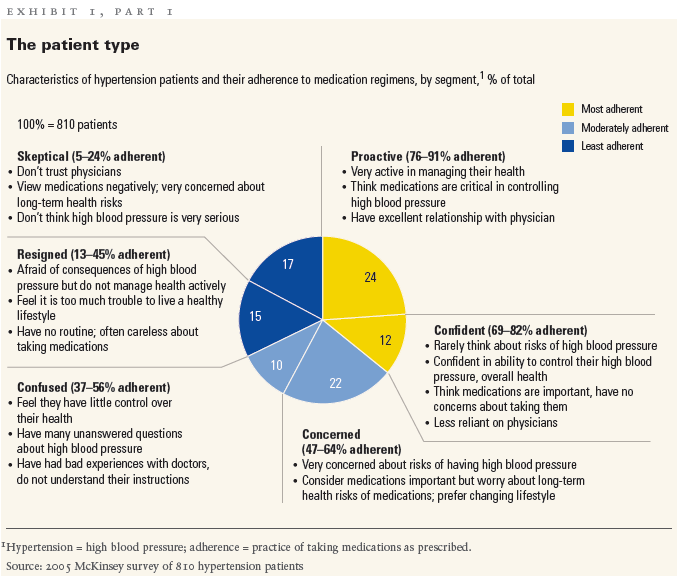
Let’s frame it this way.  Is there a message that is most likely to drive compliance for a group?  I gave them the benefit of the doubt that they aren’t crazy enough to suggest that one message works generally with no segmentation.  (McKinsey‘s article “Getting Patients To Take Their Medication” has some good research around creating segments and showing how some of the segments vary in what they want.)

The other person was presenting a case that they could do lots of research on linguistics and other topics and suggest one optimal message that would work across broad segments of the population.  I was of the opposite opinion that a personalized message that had certain core research but varied by geography, condition, age, income, benefit type, prior interactions, etc. was better.  And, that what is good today may change both generally and individually over time.

I would rather get all the micro-niches of people to their highest compliance and adherence level versus getting a better average across all group. 

Basically, my position is that there are multiple optimal solutions to the problem not just one.  It triggered a memory for me of when I first went to business school.  In architecture school, design is somewhat subjective.  (There are some logical rules such as the Fibonacci Sequence which serve as guiding principles of scale…for example.)   We were taught to always bring three solutions to our initial presentations to let the judges decide which one we should push to finalize.  We had to pick one for a deliverable, but it was always a tradeoff.  In business school and the hard sciences, there is often only one answer that is valid.  (1+1 always equals 2.)

But, for communications, marketing, and other things, it seems obvious to me that companies are best served by dynamic flexibility that allows them to bring multiple solutions to the market in parallel that adapt to different patients and change over time to respond to the market and the patient.

Here is a quick snapshot of the segmentation from the McKinsey report…

mckinsey-hypertension-segmentation.png

Call Center Metrics – JD Powers

As you know, I love metrics.  I began my business career in that space working on Balanced Scorecards and Datareferee.jpg Warehousing.  I got a press release announcement the other day about CVS/Caremark winning a JD Powers Call Center Award.  It caught my attention.  Obviously, I haven’t dug into all the data, but from how it is described, it appears that they are focused on the right metrics and winning an award for this would be meaningful.

In order to qualify for certification, a call center must perform within the top 20th percentile of all centers evaluated nationwide, based on benchmarks established by J.D. Power and Associates for courtesy; knowledge, concern for the customer; usefulness of the information provided; convenience of operating hours; ease of reaching a representative and timely resolution of issues. Call centers must also successfully pass a detailed audit of their recruiting, training, employee incentives, management roles and responsibilities, and quality assurance capabilities. As part of its evaluation, J.D. Power and Associates conducted a random survey of Caremark’s customers who recently contacted its call centers.

Excellent Versus Very Good Service

On my vacation, we took the kids on a Disney Cruise.  We also went last January.

For the first time, I think I can actually differentiate between very good and excellent on the survey.  I always struggle with that and tend to grade down.  In general, we love the Disney experience and the cruise is very well run.  We are already booked for next year and will be going with several other families.

Anyways, on the boat, you go to a different restaurant each night and your wait staff follow you.  This year, they were attentive.  No food was messed up.  They were polite.  They did magic for the kids each night at the table.  They engaged us in conversation.  It was very good service.  Better than almost any restaurant.

BUT, since we were there last year, we had a very high expectation.  Last year, the wait staff learned each day.  After day one, they knew what drinks my kids liked and had them waiting for them when we arrived for dinner.  By day three, they knew my son was a picky eater and had one of his favorite foods on the table.  And, they knew that my daughter wanted some snack other than the typical appetizers and they had that waiting.  Basically, they learned, adapted, personalized, and acted proactively.  The difference was amazingly clear within very tight parameters.

Of course, it took someone else to point out to me that this was an example to share since this is the key point for my healthcare companies.  You need to learn from your communications.  You need to adapt to today’s technology and your patient’s expectations.  The patient experience has to be personalized (in scale) to be in a message they respond to, in a channel they like, at a time that is convenient to them, and based on previous interactions.  And, you have to act proactively.  The patient doesn’t always know when to act.

Since traditional differentiators are basically null (i.e., network size, plan design), it becomes all about communications and service.  How do you drive the patient experience?   It is worth looking at the Forrester data on customer experience index.  Healthplans score incredibly low in terms of usefulness, ease of use, and being enjoyable.  The highest (that they looked at) was Kaiser at 63% with the lowest being Aetna at 49%.   [60-69% meant that the customer had an “okay” experience with the company.]

Diagnosis Code Plus Rx

In a WSJ Blog article about sound alike drugs, they have a potential solution about having the physician add information about why the drug is being used.  Obviously, the low hanging fruit here is to move to electronic prescribing where the clinical information (i.e., diagnosis code) is in the same file as the drug and technology can be utilized to look for potential issues.

In the short-term, adding the diagnosis code (aka ICD-9 code) to the prescription would have lots of benefits.

  • Avoid getting some point-of-sale rejects when a drug is used off label.  Or vice-versa, avoid off-label use by rejecting claims.
  • Avoid getting suggestions you change prescriptions only to find out that you should not do it given your diagnosis.
  • Development of proactive algorithms (e.g., macros) in the technology where whenever a doctor diagnosed diabetes then it would pull up their typical regiment of drugs based on formulary status and other inputs.
  • Better tailor / personalize information based on disease and drug to help the patient and their care team drive successful outcomes.

The issue of sound alike drug names is a real issue.  Obviously, any time you have multiple human handoffs in a process then you increase the likelihood of error.  As I think I have talked about before, I remember my MD prescribing an eye drop.  I picked up a prescription and the pharmacist clearly told me to put one drop in each eye twice a day.  At the end of the second day, I read the label in detail and realized that it said to put the drops in the ear only.  When I called them back, they talked to the MD and realized that they had heard the wrong name when they listened to his voicemail.

Where Are The Evidologists?

After one of their team posted a comment on my site, I went to Bazian‘s website.  Very interesting.  They are a UK based company that focuses on providing evidence-based healthcare information to publishers, governments and insurers.  Sounds promising.  This is an important issue across the world as companies and practitioners look at how to embed intelligence into process and technology to deliver the best outcomes.  Here is a presentation that they have for download on their website.  In it, they propose a new healthcare role of the evidologist and draw a nice parallel to the radiologist.

“In late 2005, Bazian gave a presentation about putting evidence into practice – a much discussed topic in the world of evidology.  It summarised 10 years of experience in evidence-based medicine, and draws conclusions about who should be putting evidence into practice, when, and what has to really happen for evidence to become a routine part of medical practice.”

Ev·i·do·l·o·gy n.

A new medical specialty that enables medical research to be incorporated systematically into clinical practice [Latin videre to discern, comprehend; evideri to appear plainly]  

Factoid: Off-Label Use

I cut this from one of the many e-mail clipping services I use. It said that “20% …of the 725 million U.S. prescriptions written in 2001 went to treat conditions not approved on the drugs’ labels” according to a study published in Archives of Internal Medicine.

I always wonder:

  • How do physicians know to use a prescription off label?
  • How is that information shared? (I think drug reps are prohibited from promoting off-label use.)
  • How do patients and pharmacists respond to off-label use?

Concise Summary of Compliance Reality

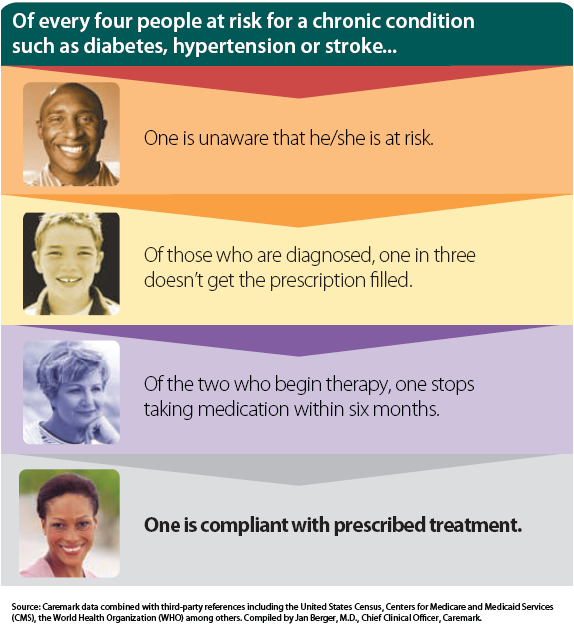
I have shared other facts with you on compliance. This is a hot topic in healthcare right now. I thought pulling this one graphic out of my entry on Caremark’s trend report made sense. This really gets to the point. Take this in light of the following quote from WHO (World Health Organization) and you can understand why.

“Increasing the effectiveness of adherence interventions may have a far greater impact on the health of the population than any improvement in specific medical treatments.”

caremark-compliance.png

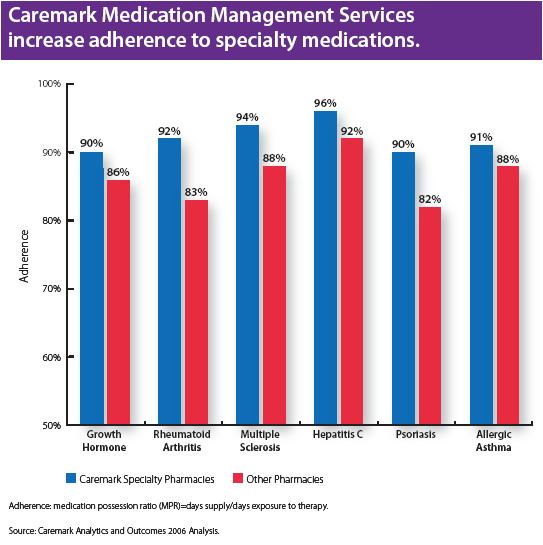
They have a good chart in the document about speciatly medications and the impact of medication management services.

caremark-specialty-adhearence.png

Increasing GDR

I love reading healthcare articles which have acronyms that not everyone knows. (Maybe it was defined earlier, but I didn’t see it.)

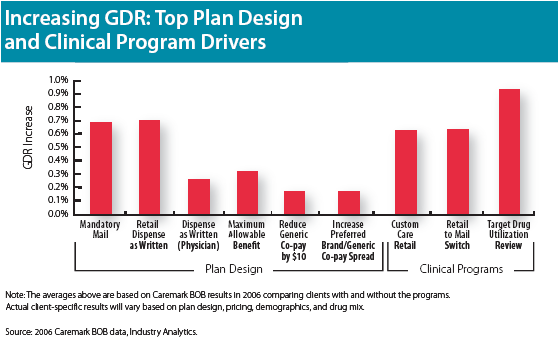
Another nugget from the Caremark trend report is on programs and plan design components to drive generic dispensing rate (GDR) which is the number of prescriptions filled as generics divided by the total number of prescriptions filled. (Versus generic substitution rate which is the number of prescriptions filled as generics divided by the total number of prescriptions filled for which a chemically equivalent generic is available. I can’t remember whether we used only A-B rated generics or all generics, but that is a technical discussion for another time.)

caremark-driving-gdr.png

This is great. It tells you the impact (on average) of implementing a plan design or some of their clinical programs on your GDR. (BTW…a good rule of thumb is that an increase of 1% in GDR is worth about 0.75-1.5% savings in your overall prescription spend.)

Caremark’s TrendsRx Report 2007

Well…I better get this posted before all the 2008 reports start coming out. I have started it a few times, but there is so much good content in here that I haven’t finished. I am determined to get this done tonight. As you may know, all of the PBMs publish very well done annual research reports on the trends in the industry and what they have learned from their data. I have talked about Express Scripts research and reports (here, here, and here) and Medco’s report (here). [Note: For simplicity sake, I am not going to put all the sources here. They are in the Caremark
document.]

“Consumers experience the [healthcare] system as complex, impersonal, disconnected, reactive, and increasingly unaffordable.”

  • In 2006, the average number of retail Rxs per capita was 12.4.
  • 59% of those <65 had an Rx in 2004 and 92% of those >65.
  • With consistent use of effective prevention, early intervention, and adherence strategies, they estimate that 30% of current healthcare spending could be eliminated. Image the impact of that on MLR (medical loss ratio) which is a key metric for managed care companies on how much of each premium dollar they actually spend on healthcare costs.
  • They layout a very logical vision that would take advantage of their unique set of assets with CVS, Caremark, and MinuteClinic.
    • Preference based consumer access.
    • Patient focused view within their systems and communications.
    • POC (point-of-care) connectivity. (i.e., pushing relevant information real-time to physicians and pharmacists to optimize care)
    • Personalized health advocacy (“make the healthcare experience less disconnected and impersonal”)
  • The price of brand drugs (on average) increased by a rate of 3x the CPI (consumer price index) in 2006…the highest since 2002. [In my opinion, this will continue as they face more price pressures with the government being the largest buyer now with Medicare Part D and with the majority of claims now being filled with generics.]
  • At the same time, the price of generic drugs decreased by 1.2%.
  • With Medicare, Medicaid, and other public payer, the government now pays 40% of the total drug spend in the US.
  • They are working with the Coalition for a Competitive Pharmaceutical Marketplace (CCPM) to reduce patent expiration “loopholes” (aka ways that brand manufacturers extend their patent lifecycles which are often perceived to not add any additional value).

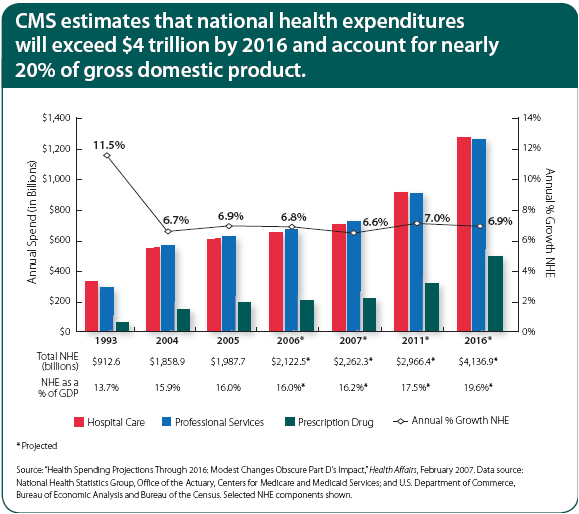
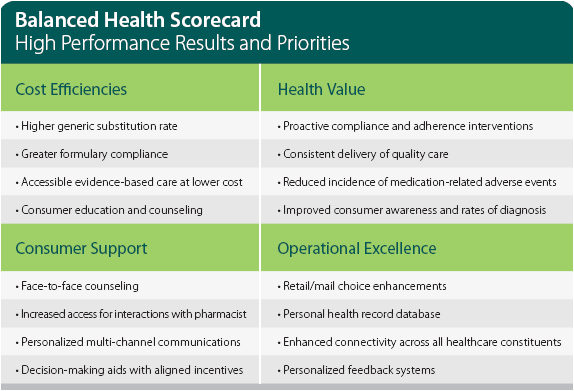
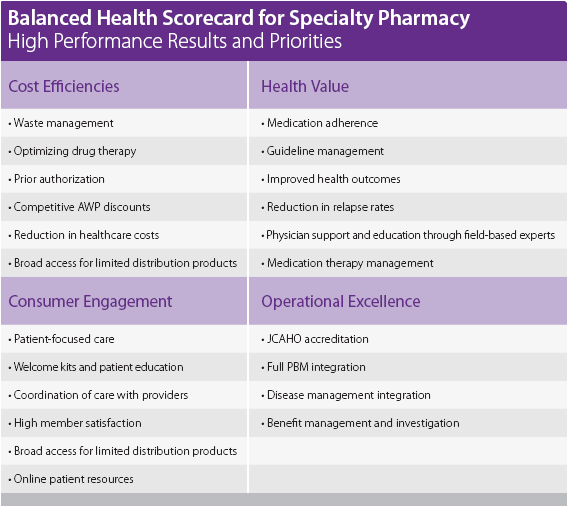
Some of the graphs and charts that I found interesting and helpful are below. (I pulled one of my favorites out in its own posting.)

caremark-national-health-expenditures.png

caremark-30-reduction.png

caremark-balanced-scorecard.png

caremark-awp-inflation.png

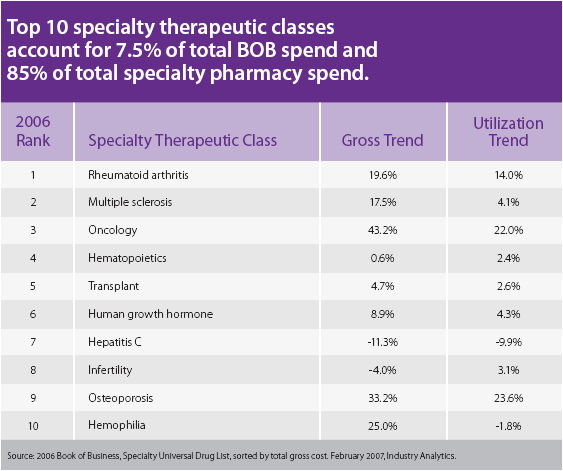
(BTW – If you don’t know who BOB is, it stands for Book of Business which means the payors whose data was included in the analysis.)

(They make the point that 5 of the 10 drugs face patent expiration by 2010 so as expected prices are increased in the years prior to maximize return.)

I haven’t talked a lot about specialty drugs here on the blog. Here is a good list of the top classes. Typically these drugs are either high cost and/or require special care (mostly meaning injection). The average specialty drug would typically cost $1,500 per 30-day supply versus more like $80 for a non-specialty drug.

caremark-specialty.png

caremark-specialty-balanced-scorecard.png

Medical Mistakes

  •  Wash hands with soap.  Check.
  • Clean patient’s skin with antiseptic.  Check.
  • Wear sterile mask, gown, and gloves.  Check.
  • Put sterile drapes over  entire patient.  Check.

And that’s all it takes to reduce common infections from medical tubing by 2/3rds.  (12/28/06 study in the New England Journal of Medicine looking at 108 ICUs in Michigan hospitals)  Seems pretty simple.checkup.jpg

Do you remember when the Institute of Medicine put out their study in 1999 that said that 100,000 people died annually from preventable hospital errors?  People were shocked.  The medical profession thought the numbers were too high.  So, I find it more that a little interesting that the Institute for Healthcare Improvement (which includes 3,000 of the 5,000 hospitals in the US) put out a report in 2006 on saying that they had saved over 120,000 lives.  [If that was for 3/5th of the hospitals, I guess that means that about 200,000 people were dying per year in the US due to preventable hospital errors.]

So, it is with mixed emotion that I look at their latest campaign which is the 5M lives campaign to reduce deaths, injuries, and near misses in US hospitals.  Now, I am being a little sensationalistic.  The fact that hospitals are collaborating, sharing information, being transparent, looking for best practices, and trying to improve is great.  Sometimes, it is just shocking what has been going on.  [Imagine the error rates in some 3rd world countries.]

Here is an article from today in the LA Times about this.

Quick Update – Zyrtec OTC

Getting back into the swing of things today, I decided to run out and buy some Zyrtec OTC.  It should be out this week from everything I know.  But, my grocery store didn’t have any.  The first Walgreens I tried had received some, but it had sold out.   The second Walgreens had some but had sold out of several sizes.  And, it had a stack of $3 off coupons.

I paid $7.99 (less $3) for a pack of 5-tablets of 5mg chewables.  Seems like a lot ($1 per tablet) until I realize that I was paying $50 in copayments for a 30-day supply for my kids.

For me, I bought a 45-day supply of the 10mg for $28 (less $3) which seems like a bargain compared to the $75 copayment I would have had for an equal supply of the Rx or even the $45 copayment, I would have had for a formulary agent (aka brand drug that was covered at a $30 copay for 30-day supply).

Nuclear Medicine – What???

I compare what I know about nuclear medicine today to what I knew about genomics back in 1998.  [I remember my boss calling me and telling me to pull together a presentation for our team at E&Y to give to Jay Geller (CEO of Pacificare at the time) on e-business with a focus on how the Internet would effect genomics.]

Nuclear medicine is a branch of medicine and medical imaging that uses the nuclear properties of matter in diagnosis and therapy. More specifically, nuclear medicine is a part of molecular imaging because it produces images that reflect biological processes that take place at the cellular and subcellular level. Nuclear medicine procedures use pharmaceuticals that have been labeled with radionuclides (radiopharmaceuticals).  [Wikipedia definition]

I don’t know a whole lot about nuclear medicine today, but after seeing that Dom Meffe who was the CEO of Curascript, a specialty company we bought at Express Scripts, is now CEO of Triad Isotopes, it caught my eye.  He was an incredibly charismatic leader and seemed very passionate about driving patient care.

But, even reading the definitions of nuclear medicine and skimming the site, I feel like I need to go back to school.

A nuclear pharmacy is a pharmacy that compounds and distributes radiopharmaceuticals used primarily in imaging procedures for cardiac and cancer diagnosis. Cyclotrons are utilized to produce FDG (Fluorodeoxyglucose) a short-lived positron-emitting isotope suitable for PET (Positron Emission Tomography), an imaging technology that can be used to assess tissue biochemistry.  [Triad Isotopes press release]

Predictions…Not Mine

Rather than rehash or even post my thoughts right now (still digging out from vacation)…I will simply point you to a good summary on the WorldHealthCareBlog about what people are predicting for 2008 and beyond around healthcare.

It is a summary from IBM, Deloitte, and many others talking about spend, technology, adoption, new drugs, etc.

Freakonomics on Pharma

The Freakonomics blog has an interesting piece on pharmaceuticals.  It basically asks five experts what is the best secret in the industry.  Here were a few of the quotes from the posting…

  1. “Events are revealing that many pharmaceutical companies, along with their consulting academic physicians, have engaged in practices that obscure or misrepresent information about their products.”
  2. “The United States is subsidizing prescription drug prices for the rest of the world.”
  3. “The obscene profits made on generic drugs by the large chain stores.”
  4. “While most people understand in a vague way that modern biomedical science is advancing at a remarkable pace, many people are less aware that we have been far less successful at translating science from the laboratory bench to the clinic. This is not to say that the pharmaceutical industry has been quiescent; total spending on health related research by the drug industry has increased from about $6 billion in 1980 to about $39 billion in 2004. During that period, basic science research has increased the number of potential drug targets (the biological site on which a drug is intended to act) from 500 to more than 3,000.”
  5. “Underpinning many of the marketing strategies of big drug companies is a very sophisticated and comprehensive plan to widen the boundaries of illness, and create an environment in which more and more formerly healthy people are defined as ‘sick.'”

Paying MDs to Switch

Another WSJ article that I caught on the plane ride home last night was about Doctors Paid To Prescribe Generic Pills. When I read the WSJ Health Blog about this, I was shocked by the comments. It would appear that the blog is followed by people that don’t believe generics make sense. That perspective is a little outdated now that most therapy classes have one of the most popular drugs available as a generic.

Yes, in some cases there have been minor improvements, but I don’t think anyone can (with a straight face) get up and talk about how Nexium is clinically superior to generic or OTC Prilosec (see general comments about category of PPIs). There has been numerous research showing that the probability of having success with any anti-depressant is the same regardless of what drug you begin therapy with (so why not start with a generic). And, generic drugs have been around for a long time so all their side effects and drug-drug issues are well known and documented. There has never been a generic drug pulled from the market.

Here was what I posted there.

Wow! There seem to be a lot of the glass is half-full people out here. What if the generic (which often was the most prescribed drug in the class before the patent expired) is clinically appropriate.

There are 10,000+ drugs out there. Physicians can’t be expected to know and monitor the comparisons on each one. That is what technology and pharmacists are focused on. So, if companies can identify a way to help the patient save money, what’s wrong with switching drugs.

The exact process of paying the physician seems suspect, but some incentive to reward them for their time (perhaps regardless of outcome) makes sense. You are asking them to pull the patient’s file, look at a different drugs and perhaps some clinical information provided by the payor, and determine if a switch makes sense.

Physicians today rarely have an incentive linked to drugs so why not prescribe the most expensive, most heavily sampled, most advertised drug. That’s the easy path.

I don’t disagree that more sharing of the benefits might make sense, but the market has changed. Generics and therapeutic conversions can make a lot of sense.

The issue of incentives is a broader one.  Paying physicians directly per switch seems a little suspect.  But, incenting them to save money for plans and patients makes a lot of sense.  But, like any incentive system, it has to be balanced.  Health outcomes balanced with cost management.  Patient satisfaction balanced with simplicity of the process.  I won’t get on my soapbox here.  Metrics are difficult, but the system today doesn’t always align the parties correctly.

Wal-Mart: New PBM?

Well.  I am back from vacation.  I grabbed a WSJ on my way home from Orlando and was surprised to see an article about Wal-Mart potentially going into the PBM businessNot a surprise that they would go into the business, but a surprise that they would build it organically.  (Although I don’t believe they have confirmed their exact intent.)

Of course, pre-stock market correction, the PBM stocks (Medco, Express Scripts, and Caremark) were all very expensive, but there are numerous smaller PBMs which could be bought and give Wal-Mart the adjudication systems, logic, and other processes to jumpstart the business.

Logically, Wal-Mart is strong at many of the core PBM functions – supply chain management, cost management, and distribution.  But, this is not a retail play.  There is no efficiency per square foot to compare to other functions.  And, you are selling primarily to the payor not the individual.  And, face facts, Wal-Mart hasn’t traditionally been recognized as the healthcare friendly company for many of its million workers.  Would employers face backlash trying to convince their employers that they were simply containing costs or actually engaging Wal-Mart to educate and help employees make good health decisions?

So, it bears the question of whether they see a broader trend.  Could consumerism spell the end of the traditional business-to-business PBM and drive a business-to-consumer PBM?  Since the Wal-Mart Bank idea never took off, could they get into the space through healthcare.  [The convergence of Health and Wealth has been written about numerous times.]

Obviously, CVS saw a strong play in the PBM space with its purchase of Caremark.  Walgreens already has their own PBM.  And, with Wal-Mart being the third largest retailer, it would seem like a logical trend to build out their PBM functions.  [I think they have some PBM services that they provide today, but mostly for their own employees.]

Heart Attack Not Urgent Enough At ER

With an increase of Emergency Room (ER) patients from 93.4M to 110.2M from 1997 to 2004 and a reduction in 24-hour ERs by 12%, it now takes an average of 30 minutes to get seen. If you are a heart attack victim, it takes an average of 20 minutes with 25% of the cases taking almost an hour to get seen. Since every minute counts, that seems pretty worrisome. Where else are you supposed to go with a heart attack? [This is all according to a new study in Health Affairs that is described in USA Today.]

“We can no longer guarantee that a bed is going to be available when you have your heart attack.” Linda Lawrence, president of the American College of Emergency Physicians

Interestingly, when I was looking at this article, I clicked through a few links and found a CMS tool to compare hospitals called Hospital Compare. Just selecting a few local hospitals and looking at some metrics raised some questions. Here is one quick metric. Obviously, like anything, a single metric in isolation isn’t the best way to judge, but it certainly might make you do more research.  [HINT – Click on the image below to be able to read it.]

hospital-compare-graph.jpg