Archive | Managed Care RSS feed for this section

Myers-Briggs in Healthcare: Part 2 of X

I was looking for a book the other day to read on some of my flights and came across Health Care Communication Using Personality Type by Judy Allen and Susan A. Brock. I have just started reading it, but I related very well to their key assumptions:

  1. People prefer to communicate in different ways.
  2. Most people have a preferred style of communication.
  3. It is easier to communicate with some people than it is with others.
  4. A system exists which provides a simple framework for understanding these differences.

As I have mentioned before, I think that Myers-Briggs is a good framework for understanding people. I often pull up my notes about my personality type and can see that I respond as predicted to certain situations.

Applying some of their initial thoughts with my perspective, it would seem like there are some basic hypotheses that you could make in talking with patients.

  • Extraversion: People that like to talk things out. Probably more likely to respond to verbal outreach.
  • Intraversion: People that like to think things through. Probably more likely to respond to print (e.g., letter or web).
  • Sensing: People that like the specifics and the details. Probably more responsive to a detailed message (e.g., you can save exactly $X by doing this). Probably want to see the path of exactly who needs to do what.
  • Intuition: People that see the big picture. Probably more responsive to a communication that helps them understand the impact of their decision on overall healthcare trend. Probably want to understand their options versus being guided down a path.
  • Thinking: People who are very logical. They should respond well to automation and would want an if/then type of message.
  • Feeling: People that are more emotional. They would likely respond best to live agents where they could empathize with them and potentially even respond to a “peer pressure” type of message (e.g., most people are now using generic prescription drugs).
  • Judging: People that are organized, punctual, and focused on getting things done. They would likely respond to messages about how to save time and money delivered in the quickest format possible.
  • Perceiving: People that are flexible, don’t plan ahead, and are often more disorganized. They would likely respond to a just-in-time message, a compliance reminder, and a communication process that did everything for them (e.g., you should go in for a colonoscopy…would you like us to schedule that for you).

Obviously, one framework doesn’t solve everything, but I expect that there is a lot more to gain from this book as I read through it. I was just so excited after the first section given my interests that I wanted to post this quick entry.
COB Predictive Values

COB (or Coordination of Benefits) is a core managed care function that is often ignored (and varies by state to make things more complicated). It is a required process by which managed care companies need to identify if people have other coverage (i.e., should I send someone else the bill). Given the high dollars here, you would think companies would be focused on driving this as a cost management or profit initiative.

Good companies find 2.5% or more of their population have secondary insurance. I have seen analysis saying that if you include claims that should be billed to worker’s compensation, auto insurance companies, etc. that the number could be as high as 15%, but that seems really high.

An interesting fact that one of our experts shared with me was that claims data could explain over 65% of the variance in COB responses for a working age population while it could only explain just over 40% for seniors. They have found some incredible correlations to create ROIs for clients in the 2,000% range. [Not bad. If I could get my boss a 20:1 return, I think he would pay attention.]

Of course, as a patient, all I care about is that my claim gets paid, and I don’t get a bill from my provider.

Again…I may be preaching to the choir, but this is why data matters. This is why you need metrics. This is why you need to know your baseline and track how you improve this.

And, always make sure you understand the definition, the data sources, and the data quality. I remember doing data standardization processes for Sprint back in the mid 1990s. It took a while just to get agreement on what a customer was from a business and systemic perspective. Another example I previously had when looking at two vendors was defining success. They attempted to create a standard metric of abandonment for people that came to a website to take a survey (i.e., how many abandoned the process before completion). One seemed dramatically better than the other.

Upon research, we found that one broke the survey into sections and offered them an out on each page. As long as the consumer exited at a planned opt-out point, they were a “success” and had not abandon the survey (even though they hadn’t completed it). The other only counted those that finished the survey. Not surprising who had a better score.

Information Latency: Why Don’t We Change?

I have had this note to self for a while so I am finally going to put a quick entry out here on the topic.

The issue is data latency or more appropriately information latency.  The data often exists right away, but the challenge is how to you get the data into a usable form, with context, and with enough data to make decisions.

In communications, this manifests itself in healthcare in two ways that immediately jump to mind:

  1. In a traditional letter program:
    • You send a letter to a patient (7-10 days from data targeting to mailbox)
    • Patient opens the letter and has to contact their physician (if they choose to do anything)
    • Patient trades messages with physician and/or has to schedule an appointment
    • Patient meets with physician who (for example) writes them a new prescription
    • Patient waits for medication to run out then refills with new drug (e.g., generic, on-formulary drug)
    • Claims get aggregated and reports run
    • Best case – 30+ days to see if program had any effect (most likely 6 months)
  2. In a traditional survey:
    • Company prints a survey and mails it to 10,000 people hoping for a 10% response rate to get a statistically valid sample size of 1,000
    • Patients fill out the survey over the next month and mail them to a data entry company
    • Data entry company manually enters them, aggregates the data, and creates a report
    • 45-60 days later the company has information from the survey

Of course, the issue with both of these is that you have lost a huge window of time especially if you need to make changes to your program or the survey tells you that you need to gather more information.

Why don’t more companies talk about on-the-fly program changes and how to use modern technology to get real-time feedback for programs where they can pause the program, make change (e.g., change the message, add a new question), and then continue the program?

Another AIS Gem

AIS has a daily newsletter that comes out which starts with a quote.  I have found a lot of these good teasers.  Here is one from last week.

“Providing education and information [about Health Savings Accounts] is very important. Too many companies talk too much about the money. That’s not the key. The tax benefits are nice, but people want to know what happens if they get sick. They want to know how the HSA works and whether they’re going to be stuck with a medical bill.”

— Roger Abramson, director of legal, compliance, education and human resources at Fontis Healthcare Services, Inc., told AIS’s Inside Consumer-Directed Care.

It is a good point about how often we communicate one thing which seems relevant to us without thinking about the receiver of information’s framework and hierarchy of information needs.

Generic Changes: Patient’s Confused

Typically these things play out behind closed doors or in court and don’t always impact the patient, but I think the latest Protonix saga will have a brief impact on patients.  Primarily causing some confusion.

The basic scenario:

  • Teva decided to challenge Wyeth’s patent and launches generic Protonix early (this means that they are going at risk and if they lose the patent fight that they owe Wyeth 3x the revenue collected from the product)
  • Teva ships about $300-$400M worth of generic Protonix in December and January
  • Wyeth fights them in court and decides to bring its own generic version of Protonix to market
  • Now, Teva has decided to stop shipping generic Protonix (see WSJ blog on this)

If you’re a United patient, you likely just got a letter telling you that they have moved the generic to the third tier (i.e., highest copay) and moved the brand to the first tier which is typically for generics.  They obviously worked a deal directly with Wyeth.  But, the consumer has to deal with issues such as state mandatory generic laws that require the pharmacy to fill a brand drug that has a chemically equivalent generic available with the generic unless the physician has checked DAW (dispense as written) for the brand drug.

Good business logic saving everyone money, but this may burden the consumer and the pharmacy and the physician.  Hopefully, they have an effective communication strategy to drive patient behavior.

So, your prescription history might look something like this (while staying on the same drug):

  • November – brand Protonix (2nd tier)
  • December – generic Protonix from Teva (1st tier)
  • January – generic Protonix from Teva (1st tier)
  • February – brand Protonix (1st tier)
  • March – generic Protonix from Wyeth (1st tier)

Single Answer or Multiple Answers

I was having an interesting discussion yesterday about how to solve a problem.  The two opinions were whether there is a best answer or whether there are multiple best answers.  It’s a great question.

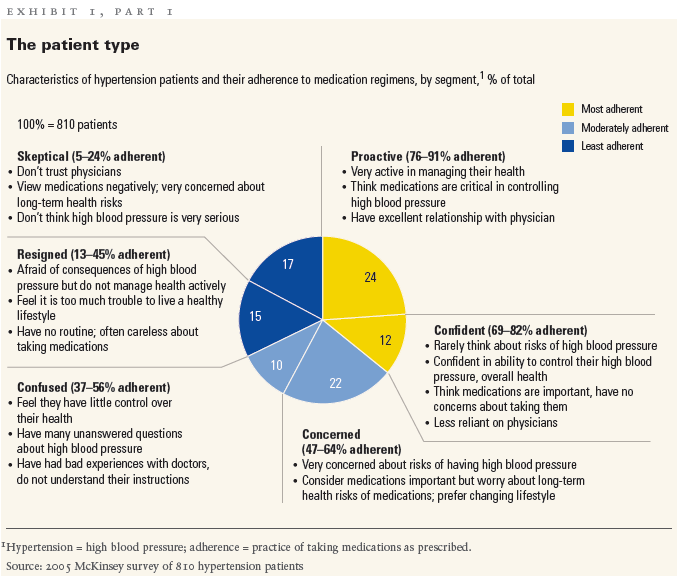
Let’s frame it this way.  Is there a message that is most likely to drive compliance for a group?  I gave them the benefit of the doubt that they aren’t crazy enough to suggest that one message works generally with no segmentation.  (McKinsey‘s article “Getting Patients To Take Their Medication” has some good research around creating segments and showing how some of the segments vary in what they want.)

The other person was presenting a case that they could do lots of research on linguistics and other topics and suggest one optimal message that would work across broad segments of the population.  I was of the opposite opinion that a personalized message that had certain core research but varied by geography, condition, age, income, benefit type, prior interactions, etc. was better.  And, that what is good today may change both generally and individually over time.

I would rather get all the micro-niches of people to their highest compliance and adherence level versus getting a better average across all group. 

Basically, my position is that there are multiple optimal solutions to the problem not just one.  It triggered a memory for me of when I first went to business school.  In architecture school, design is somewhat subjective.  (There are some logical rules such as the Fibonacci Sequence which serve as guiding principles of scale…for example.)   We were taught to always bring three solutions to our initial presentations to let the judges decide which one we should push to finalize.  We had to pick one for a deliverable, but it was always a tradeoff.  In business school and the hard sciences, there is often only one answer that is valid.  (1+1 always equals 2.)

But, for communications, marketing, and other things, it seems obvious to me that companies are best served by dynamic flexibility that allows them to bring multiple solutions to the market in parallel that adapt to different patients and change over time to respond to the market and the patient.

Here is a quick snapshot of the segmentation from the McKinsey report…

mckinsey-hypertension-segmentation.png

Excellent Versus Very Good Service

On my vacation, we took the kids on a Disney Cruise.  We also went last January.

For the first time, I think I can actually differentiate between very good and excellent on the survey.  I always struggle with that and tend to grade down.  In general, we love the Disney experience and the cruise is very well run.  We are already booked for next year and will be going with several other families.

Anyways, on the boat, you go to a different restaurant each night and your wait staff follow you.  This year, they were attentive.  No food was messed up.  They were polite.  They did magic for the kids each night at the table.  They engaged us in conversation.  It was very good service.  Better than almost any restaurant.

BUT, since we were there last year, we had a very high expectation.  Last year, the wait staff learned each day.  After day one, they knew what drinks my kids liked and had them waiting for them when we arrived for dinner.  By day three, they knew my son was a picky eater and had one of his favorite foods on the table.  And, they knew that my daughter wanted some snack other than the typical appetizers and they had that waiting.  Basically, they learned, adapted, personalized, and acted proactively.  The difference was amazingly clear within very tight parameters.

Of course, it took someone else to point out to me that this was an example to share since this is the key point for my healthcare companies.  You need to learn from your communications.  You need to adapt to today’s technology and your patient’s expectations.  The patient experience has to be personalized (in scale) to be in a message they respond to, in a channel they like, at a time that is convenient to them, and based on previous interactions.  And, you have to act proactively.  The patient doesn’t always know when to act.

Since traditional differentiators are basically null (i.e., network size, plan design), it becomes all about communications and service.  How do you drive the patient experience?   It is worth looking at the Forrester data on customer experience index.  Healthplans score incredibly low in terms of usefulness, ease of use, and being enjoyable.  The highest (that they looked at) was Kaiser at 63% with the lowest being Aetna at 49%.   [60-69% meant that the customer had an “okay” experience with the company.]

Where Are The Evidologists?

After one of their team posted a comment on my site, I went to Bazian‘s website.  Very interesting.  They are a UK based company that focuses on providing evidence-based healthcare information to publishers, governments and insurers.  Sounds promising.  This is an important issue across the world as companies and practitioners look at how to embed intelligence into process and technology to deliver the best outcomes.  Here is a presentation that they have for download on their website.  In it, they propose a new healthcare role of the evidologist and draw a nice parallel to the radiologist.

“In late 2005, Bazian gave a presentation about putting evidence into practice – a much discussed topic in the world of evidology.  It summarised 10 years of experience in evidence-based medicine, and draws conclusions about who should be putting evidence into practice, when, and what has to really happen for evidence to become a routine part of medical practice.”

Ev·i·do·l·o·gy n.

A new medical specialty that enables medical research to be incorporated systematically into clinical practice [Latin videre to discern, comprehend; evideri to appear plainly]  

Factoid: Off-Label Use

I cut this from one of the many e-mail clipping services I use. It said that “20% …of the 725 million U.S. prescriptions written in 2001 went to treat conditions not approved on the drugs’ labels” according to a study published in Archives of Internal Medicine.

I always wonder:

  • How do physicians know to use a prescription off label?
  • How is that information shared? (I think drug reps are prohibited from promoting off-label use.)
  • How do patients and pharmacists respond to off-label use?

Concise Summary of Compliance Reality

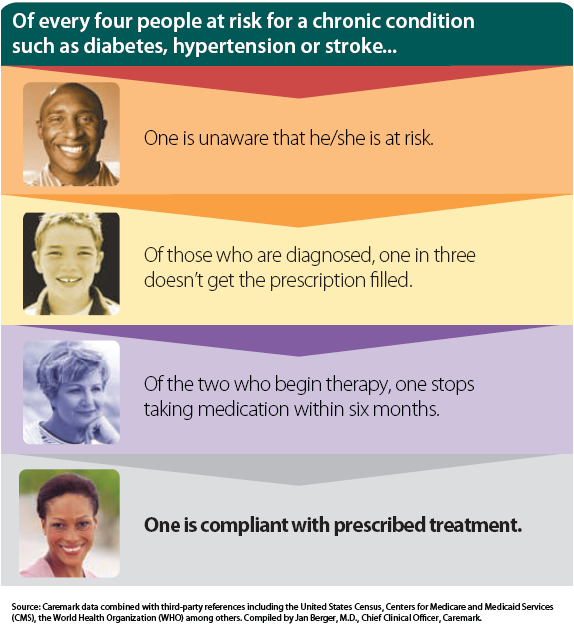
I have shared other facts with you on compliance. This is a hot topic in healthcare right now. I thought pulling this one graphic out of my entry on Caremark’s trend report made sense. This really gets to the point. Take this in light of the following quote from WHO (World Health Organization) and you can understand why.

“Increasing the effectiveness of adherence interventions may have a far greater impact on the health of the population than any improvement in specific medical treatments.”

caremark-compliance.png

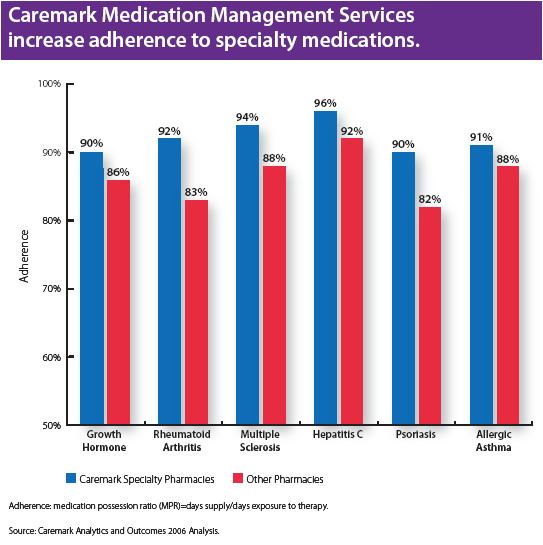
They have a good chart in the document about speciatly medications and the impact of medication management services.

caremark-specialty-adhearence.png

Caremark’s TrendsRx Report 2007

Well…I better get this posted before all the 2008 reports start coming out. I have started it a few times, but there is so much good content in here that I haven’t finished. I am determined to get this done tonight. As you may know, all of the PBMs publish very well done annual research reports on the trends in the industry and what they have learned from their data. I have talked about Express Scripts research and reports (here, here, and here) and Medco’s report (here). [Note: For simplicity sake, I am not going to put all the sources here. They are in the Caremark
document.]

“Consumers experience the [healthcare] system as complex, impersonal, disconnected, reactive, and increasingly unaffordable.”

  • In 2006, the average number of retail Rxs per capita was 12.4.
  • 59% of those <65 had an Rx in 2004 and 92% of those >65.
  • With consistent use of effective prevention, early intervention, and adherence strategies, they estimate that 30% of current healthcare spending could be eliminated. Image the impact of that on MLR (medical loss ratio) which is a key metric for managed care companies on how much of each premium dollar they actually spend on healthcare costs.
  • They layout a very logical vision that would take advantage of their unique set of assets with CVS, Caremark, and MinuteClinic.
    • Preference based consumer access.
    • Patient focused view within their systems and communications.
    • POC (point-of-care) connectivity. (i.e., pushing relevant information real-time to physicians and pharmacists to optimize care)
    • Personalized health advocacy (“make the healthcare experience less disconnected and impersonal”)
  • The price of brand drugs (on average) increased by a rate of 3x the CPI (consumer price index) in 2006…the highest since 2002. [In my opinion, this will continue as they face more price pressures with the government being the largest buyer now with Medicare Part D and with the majority of claims now being filled with generics.]
  • At the same time, the price of generic drugs decreased by 1.2%.
  • With Medicare, Medicaid, and other public payer, the government now pays 40% of the total drug spend in the US.
  • They are working with the Coalition for a Competitive Pharmaceutical Marketplace (CCPM) to reduce patent expiration “loopholes” (aka ways that brand manufacturers extend their patent lifecycles which are often perceived to not add any additional value).

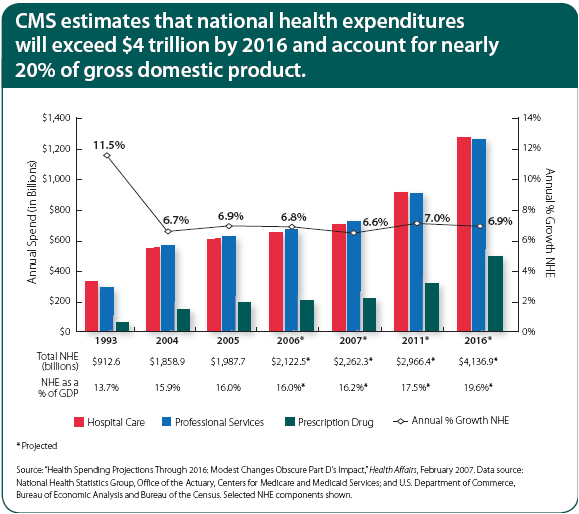
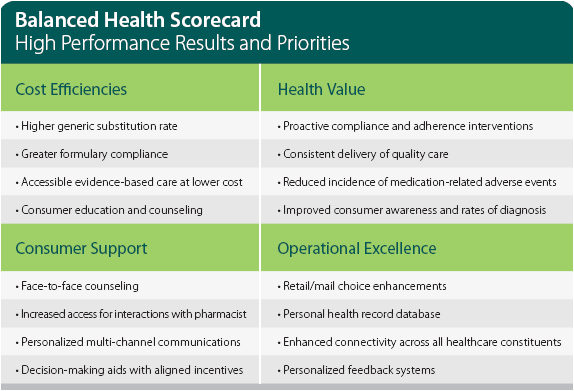
Some of the graphs and charts that I found interesting and helpful are below. (I pulled one of my favorites out in its own posting.)

caremark-national-health-expenditures.png

caremark-30-reduction.png

caremark-balanced-scorecard.png

caremark-awp-inflation.png

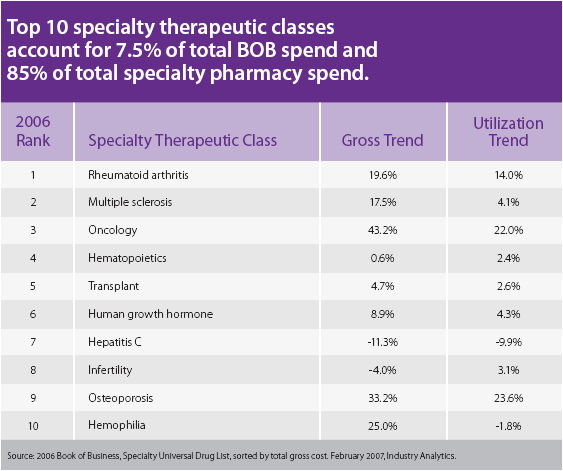
(BTW – If you don’t know who BOB is, it stands for Book of Business which means the payors whose data was included in the analysis.)

(They make the point that 5 of the 10 drugs face patent expiration by 2010 so as expected prices are increased in the years prior to maximize return.)

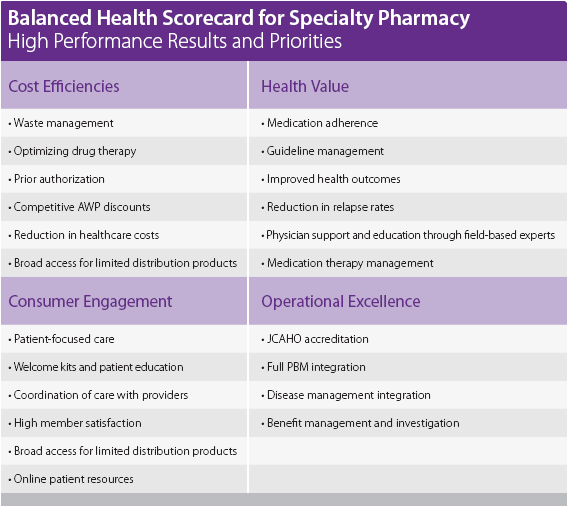
I haven’t talked a lot about specialty drugs here on the blog. Here is a good list of the top classes. Typically these drugs are either high cost and/or require special care (mostly meaning injection). The average specialty drug would typically cost $1,500 per 30-day supply versus more like $80 for a non-specialty drug.

caremark-specialty.png

caremark-specialty-balanced-scorecard.png

Paying MDs to Switch

Another WSJ article that I caught on the plane ride home last night was about Doctors Paid To Prescribe Generic Pills. When I read the WSJ Health Blog about this, I was shocked by the comments. It would appear that the blog is followed by people that don’t believe generics make sense. That perspective is a little outdated now that most therapy classes have one of the most popular drugs available as a generic.

Yes, in some cases there have been minor improvements, but I don’t think anyone can (with a straight face) get up and talk about how Nexium is clinically superior to generic or OTC Prilosec (see general comments about category of PPIs). There has been numerous research showing that the probability of having success with any anti-depressant is the same regardless of what drug you begin therapy with (so why not start with a generic). And, generic drugs have been around for a long time so all their side effects and drug-drug issues are well known and documented. There has never been a generic drug pulled from the market.

Here was what I posted there.

Wow! There seem to be a lot of the glass is half-full people out here. What if the generic (which often was the most prescribed drug in the class before the patent expired) is clinically appropriate.

There are 10,000+ drugs out there. Physicians can’t be expected to know and monitor the comparisons on each one. That is what technology and pharmacists are focused on. So, if companies can identify a way to help the patient save money, what’s wrong with switching drugs.

The exact process of paying the physician seems suspect, but some incentive to reward them for their time (perhaps regardless of outcome) makes sense. You are asking them to pull the patient’s file, look at a different drugs and perhaps some clinical information provided by the payor, and determine if a switch makes sense.

Physicians today rarely have an incentive linked to drugs so why not prescribe the most expensive, most heavily sampled, most advertised drug. That’s the easy path.

I don’t disagree that more sharing of the benefits might make sense, but the market has changed. Generics and therapeutic conversions can make a lot of sense.

The issue of incentives is a broader one.  Paying physicians directly per switch seems a little suspect.  But, incenting them to save money for plans and patients makes a lot of sense.  But, like any incentive system, it has to be balanced.  Health outcomes balanced with cost management.  Patient satisfaction balanced with simplicity of the process.  I won’t get on my soapbox here.  Metrics are difficult, but the system today doesn’t always align the parties correctly.

EDM, Gartner, and Event Driven Communications

edm-blog.jpg
I mentioned the EDM (Enterprise Decision Management) Blog a few weeks ago. James Taylor has a post out there today about Using EDM to deliver event-based marketing. Those of you that know me or have been reading the blog for a while know that this fits into what I talk about perfectly. It involves decomposing a process into its key tasks, understanding the rules behind the process, determining data events that can be used to identify opportunities, and then executing a coordinated communication process.
He references a Gartner publication with the following abstract:
“Successful event-triggered marketing is a process of identification, categorization, monitoring, optimizing and executing. Marketers that do this right will see their marketing messages receive up to five times the response rate of nontargeted push messages.”
He also talks about key considerations such as rules, analytics, predictive modeling, champion/challenger, and multi-modal.

Using Thermometers To Avoid Foot Ulcers

600,000 diabetics get foot ulcers each year and over 10% of those lead to amputation of toes, feet, and lower legs.  A study discussed in USA Today showed that almost 2/3rds of those ulcers could be avoided by using a thermometer to identify whether an ulcer is developing.  So simple…so much savings (pain and financially)

So, assuming there isn’t some analysis or clinical bias that I don’t know about, this seems like a low-hanging opportunity for managed care companies.  What are you doing to reach out to your patients, get them a thermometer, collect their data, and remind them to use it on some regularity?

How Some People Feel About HealthComm

Healthcare Communications (HealthComm) are never what we run home to receive, but they are often important.  Unfortunately, it has lacked a focus historically.  Most of the focus was on claims systems and underwriting and network size.  Not that those areas work perfectly, but there is clearly a movement toward customer service, patient satisfaction, and communications (inbound/outbound, letter/call/e-mail/live agent).

Look at this blog entry on a very popular blog and some of the comments.  It is a big uphill battle.

Does Brand Matter?

As anyone who works in or with marketing or sales would tell you…Of course, brand is very important.

So, that makes this study from Gorman Group on Medicare very surprising.

“Seniors with the highest [Medicare Advantage plan] satisfaction levels don’t even know what health plan they’re in.”
Jeff Fox, president of Gorman Health Group, LLC, discussing his firm’s research that indicates brand is less important than it was several years ago.

istock_decision-cube.jpgIf you’re interested in some good discussion on the topic of marketing, I would encourage you to look at Foghound. I had a chance to work with Lois Kelly from there years ago and was impressed. I think you will find their articles and frameworks very helpful.

The $1,400 Physical

If you’ve never heard of it, concierge medicine is an interesting extreme of consumerism.  I met a physician in St. Louis about 7 years ago who had such a model.  He didn’t take insurance.  Each patient had their own voicemail box for exchanging messages with the physician.  Everyone paid him an annual fee for unlimited access.  Most of his revenue was for a private company’s executive team and their families.  He spent lots of time with the patients, focused on preventative care, and kept trying to find ways to keep them healthy.

Newsweek had an article about this in their 11/26/07 publication called “The Blue Chip Checkup“.  It talks about the Concierge Medicine clinic in LA where you can go get a $1,400 Vehicle Loans physical just like the President gets.  It is so comprehensive that it even includes a skin consultation.  Apparently, over the past year, they have had 600 people come in to get this physical.

I know lots of people are pretty skeptical about this.  I am not sure I have an opinion yet.  It’s interesting.  Obviously, you don’t want to create unneeded costs and certainly we don’t want to make care a luxury good.  But, having people take responsibility for their health and wanting to learn as much as possible about how to manage their care seems like a positive.

Ideally, there should be lots that we can learn about patient-MD interactions, value of testing, preventative care, and what would happen in an ideal setting where insurance and money was not an issue.

Medicare – Less Drugs Covered…Issue?

On 12/4/07, USA Today had an article titled “Medicare cuts back on drugs covered by Part D” which talked about the fact that the average number of drugs covered by the 10 largest Medicare Part D providers shrunk by 26% from 2007 to 2008.  Wow!  At first glance that seems pretty dramatic compared to a commercial plan [whose shrinking coverage was not quoted].

It seems like most of the changes were driven by Medicare which the article says reduced the list of drugs it would reimburse including drugs pulled by the FDA, no longer being made, or were deemed “less than effective” by the FDA.

Tom Noland (Humana spokesman) said “As the Part D program develops, the size of the formulary is becoming more aligned with utilization patterns, consumer preferences, health outcomes, and value for consumers.”

The article also quoted a study saying that low-income enrollees in Texas were being switch to coverage that had 14% fewer drugs and 15% of all drugs offered requiring a prior authorization.  [15% sounds very high to me.]

In the big picture, controlling costs by focusing on value is essential for our healthcare system to survive.  Having an easy exception process [which doesn’t exist today] would allow that be tolerable by the general public.   It will be an interesting debate on value at some point…how do you value different side effects (for example)?

On of my first healthcare projects back in graduate school looked at two different cancer treatments.  One involved much more labor and had only moderate improvements in outcomes.  The question of course was what to do with that – charge more for the one option, don’t do both, focus on outcomes, etc.

Back to Medicare…Hopefully, these companies have a good strategy for communicating and providing tools to these patients to ease the transition to the other drugs rather than wait for them to get rejected or see an unusually high copay at the counter when they don’t have time to get in touch with their physician without risking missing a day of therapy.

Enhanced Communications Have An Impact

On January 4th, Express Scripts put out a press release about consumers using a home delivery pharmacy being more likely to choose lower-cost therapies. It is an interesting study as published in the December 2007 issue of the Annals of Pharmacotherapy. I had the fun job of designing the program as one of my projects before I left Express Scripts. I will never forget my boss coming to me and asking me to think about how we could drive market share movement of several large drugs if we took them off formulary (i.e., Lipitor). He handed me a white paper written the year before on what to do. Since he was new, I didn’t give him too much grief since I was the author of the white paper from the year earlier about what we should have been doing for the past 12-months to prepare for this.

Anyways, I pulled a lot of input and created a great single-frame image which showed the major constituents and the tools/tactics we would use to drive market share both pre-formulary change and post-formulary change. I went back to my day job, but the image became the roadmap for a multi-modal communications strategy. As was my intention (since I was responsible for mail order), it looks like it worked both to move share and to show how mail could be better than retail.

Here are a few of the highlights from the press release:

  • Express Scripts evaluated consumer behavior after they made a change to the formulary positioning of cholesterol lowering drugs to prepare for Zocor going generic in mid-2006.
  • They looked at more than 200,000 retail and mail patients.
  • All patients got a formulary notification letter informing them of their therapeutic options, materials for their physician, a website for more information, and toll-free number to call. [2 years earlier I had created the business case for mass mailings of formulary notification letters.]
  • The IVR refill line included messaging about switching to a formulary agent, and we placed automated outbound calls to mail order patients [using Silverlink Communications].
  • Patients that were interested were queued up for a change at mail after 1/1/06 (so as not to lose rebates for our clients in 2005).
  • Obviously, other plan factors (i.e., copay differentials, step therapy) impacted choice. [I.e., if I only have to pay $5 more per month for a drug that I am used to, I probably won’t switch]
  • The results were great. 52% of the mail order patients and 33% of the retail patients chose to switch therapies.
  • Some of the retail patients were part of a rapid response program in which they received a letter telling them about their options in the therapy class right after they received their first fill of the non-formulary drug in the new year. [another program which I developed and launched for step therapy] Receiving this letter increased their likelihood of switching by 28%. [BTW – we tested this with letters vs. automated calls from Silverlink back in 2005 and the results were very similar.]

“Creating a dialogue with consumers is a crucial factor in successfully changing behavior and delivering value at the consumer level,” explains Emily Cox, Ph.D., senior director of research at Express Scripts. “Home delivery consumers received additional information and were more likely to seek further assistance through the Web and by calling Express Scripts. Enhanced communication clearly has an impact. The effectiveness of the rapid response program for retail consumers also supports the value of enhanced communications.”

As I have mentioned before on the blog, this was a great program. It proved that PBMs can influence market share. I was more than a little disappointed to see that after we moved all these patients to Zocor to take advantage of the generic then company than moves Lipitor back on formulary only to have to ask the patients to switch drugs again. [Fortunately, I was not there for these discussions.]

Loyalty…Retention

I had a good lunch meeting today discussing loyalty in healthcare.  The loyalty expert asked me what I meant when I use the word “loyalty”.  Good question.  I immediately jumped to points programs which is what I usually think about when I say loyalty.  He asked about points versus information versus experience.  I usually think of those as some of the key components of retention.  Retention to me is a lifecycle program that address the patient experience from getting them to select you, welcoming them to the program, educating them, and exiting them at the right time.  It involves information, tools, incentives and rewards, and has to be relevant to them.

Healthcare is unique in that you can’t simply incent on volume.  I don’t want you to get an prescription if an OTC will work.  I don’t want to you to go the physician unnecessarily.  I want to incent you to do the right thing – go to your physician versus the ER; exercise; get appropriate tests done; participate in disease management programs; or use a generic drug.  Some of these are easy to capture, but some of them become self-reported data which is hard to automate and collect.

So, we talked about the different constituents and what they might do:

  • Providers (MDs, clinics, hospitals): pretty difficult to see the right model here…obviously they want your business if/when your sick so a share of wallet concept could work, but there isn’t a clear alignment of incentives without a pay-for-performance (P4P) or capitated relationship.
  • Pharmacies or Durable Medical Equipment (DME) Providers: this is the easiest model to understand, but you still have to make sure you don’t incent inappropriate behavior
  • Managed Care or Other Insurers: this is where the biggest opportunity exists, but the question is how to you get companies to invest in rewarding preventative actions rather than running the odds of having a major cost factor for the patient prior to the patient churning (i.e., going to another payor)
  • Disease Mgmt Companies: this is a clear model since they are being paid to manage a disease and lower the costs.  offering incentives or rewards that make a patient compliant (i.e., loyal) or drive behavior to a care plan would be in their interest.
  • Pharmacy Benefit Managers (PBMs): there is something here especially around mail order pharmacy, but I think the big opportunity here is reward for behaviors such as using self-service (web, IVR) or choosing the lowest cost option – OTC, generic, mail order, etc.
  • Pharmaceutical Manufacturers:  here there is clear alignment.  We used to do programs such as the 5-7-9 card which was for some drug (that I can’t remember).  The patient got the 5th, 7th, and 9th fill free if they stayed compliant and enrolled in the program.

In researching this, I found this good loyalty presentation by Carlson Marketing.  With healthcare being so behind other industries and struggling to figure this model out, the only place we are going to find a lot of research and information is going to be in other industries.

Healthcare Gift Cards, Memberships, and Futures

Gift cards have become the popular holiday gift.  [Here is the money I was going to spend on you but since I don’t know exactly what you want, please go spend it on yourself.]  As copayments go up and consumers own more of their healthcare spending, I wonder how long it will be before we get healthcare gift cards.  Or maybe discount clubs that you join and get preferred pricing (i.e., Sam’s Club).  Or maybe big ticket items could be like stocks where you can hedge your bets.  Gift cards are definitely a reasonable probability.  The others may be too far fetched.

  • A $50 gift card good at your local pharmacy.
  • A gift card good for 2 visits to the clinic.
  • A $100 gift card good for one visit to the ER.
  • A annual “membership” good for up to 5 preventative visits at any physician or hospital within a certain network.
  • An option to buy “futures”…purchase a transplant which costs $100,000 for $30,000 today based on your current health.

Where are the healthcare celebrities?

Over the past year, CNN has taken one of their morning anchors (Robin Meade) and turned her into a “celebrity” in some sense.  The morning show on Headline News is now called Morning Express with Robin Meade.  The news crew is called Robin and Company.  Robin has a daily newsletter, and now Robin has a podcast. 

So…why don’t health plans, large hospitals, and PBMs have branded personalities.  It could be the Chief Medical Officer.  It could be a nurse or (like pharma) they could use a celebrity.  But, if CNN can take a good anchor and “brand” her, why wouldn’t healthcare companies do the same? 

All your communications could come from the person.  People would start to associate with that personality.  That person humanizes the institution versus simply allowing it to be viewed as an annoymous corporate entity.

Forrester on PHRs

In mid-November, Forrester put out a report titled “PHRs: From Evolution to Revolution” by Liz Boehm, their healthcare lead. It’s not my lead area so I didn’t spend the money to buy the report, but here is the executive summary.

Health plans, driven by employer demand and expectations of improved member satisfaction and reduced medical costs, are investing in payer-based personal health records. But consumers have not raced to adopt them. Health plan customer experience professionals are on the hook to not only drive adoption but also engineer low-cost, interactive health support programs that will help members make better choices and save costs. To maximize their chance of success, health plan customer experience professionals need to focus on four critical areas: data management, behavior change, interface best practices, and patient and provider recruitment. This focus will help drive near-term success and position plans to weather the coming changes in the personal health record (PHR) market.

What I found interesting was the list of companies that they interviewed (and who they didn’t talk to).

Book by Kaiser CEO

George Halvorson, the Chairman and CEO of Kaiser Foundation Health Plan and Kaiser Foundation Hospitals, has just published a book called “Health Care Reform Now! A Prescription for Change”. A news clipping service I have sent me a summary from Business Insurance. It is published by John Wiley & Sons and is $27.95. It sounds quite interesting. Here are a few things which the article highlighted.

He says that the US does not have a health care system in place but has a “plethora of uncoordinated, unlinked, economically segregated, operationally limited microsystems…a nonsystem of care.”

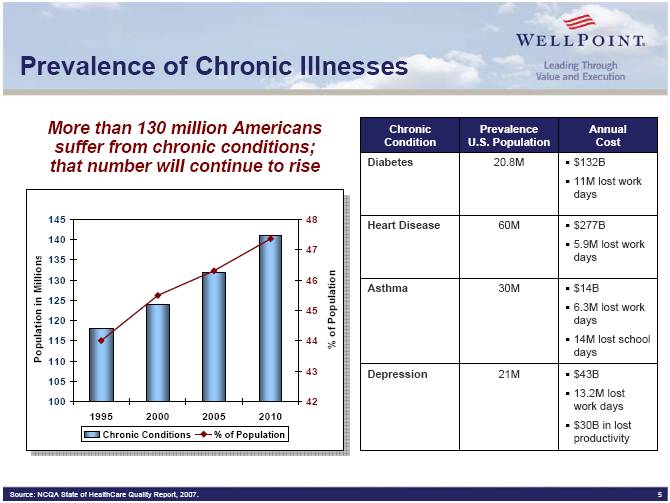
He talks about the concentration of spending (based on Kaiser Permanente data):

  • 1% of the US population uses more than 35% of health care dollars
  • 5% uses 60%
  • 10% spends 70%

He talks about the fact that five chronic diseases are responsible for upwards of 70% of the health care costs in the US:

  • Asthma
  • Diabetes
  • Congestive heart failure
  • Coronary artery disease
  • Depression

He talks about the problems that arise when there is no communication between health care silos of care which leads to drug interactions and costly hospitalizations.

I haven’t read it yet, but the article says that he offers solutions for each problem and talks in a conversational and occasionally funny way. He proposes using insurance records to create a type of Electronic Medical Record rather than waiting for the long-term solution of integrated systems. He also proposes using computerized medical records to track quality issues.

Academic Detailing

Their is a concept is the pharmacy world called academic detailing which essentially means educating physicians about the cost / benefits of prescription drugs.  It can be done via letter, phone, and face-to-face.  Many managed care companies and PBMs have tried it over the years.  Does it work?…sometimes.

“It’s estimated the pharmaceutical industry spends about 90% of its $21 billion marketing budget on physicians each year.”  (Journal of the American Medical Association article from January 2006)

Logically, it seems like a great idea.  Get out and provide physicians with unbiased information about the drugs they prescribe.  Provide them with published research.  Show them how they behave versus their peers through benchmark data based on their prescribing habits.

Since I briefly owned academic detailing as a product line, I remember the challenge that our lead pharmacist had on proving the business case of why we should invest there.  There were too many challenges:

  •  Why does the physician care about cost?  They care about what works.  If you can clearly prove the compliance is tied to out-of-pocket costs, they might get interested, but the cost to the patient (at least if they have insurance) has historically not been significantly different between different options.  [I do believe consumerism and consumer-driven healthcare might change this.]  I always compare this to the expression “no one ever got fired for hiring IBM”.
  • To compete with the brand manufacturers who have 10’s of thousands of representatives out meeting with physicians, it would take billions of dollars.  Who is going to fund this?  You see change happen in small pockets where there is large marketshare by one dominant payor that can influence the physicians.  With the government as the largest payor in healthcare, they could do this, but where is the money going to come from?
  • Do the physicians have the time?  There are 10,000+ drugs out there.  Physicians are busy and under lots of pressure.  Some physicians have stopped seeing detail representatives.  Others charge for their time.  This is not a 2 minute discussion.  (I believe that is the average for a manufacturer’s representative with a physician.)  This is a 30+ minute discussion of clinical and cost information.

Perhaps P4P (pay-for-performance) may change this.  I know that when physician’s were capitated for both medical and pharmacy costs that it could impact their prescribing habits.  I always here about different groups trying academic detailing for all the right reasons…BUT, I never see any great proof.

BCBSA President Interview on Forbes.com

If you are interested in what the president of the Blue Cross Blue Shield Association is talking about, you can see a quick 5 minute video interview on Forbes.com.  He talks about his original vision when he joined of wrapping a strong national support organization around a group of companies that are embedded in the local areas and serve 100M people nationally.  He talks about working with the government to figure out the “superhighway” needed to drive interoperability across plans to allow Electronic Health Records, Personal Health Records, and e-prescribing to be successful.  He also touches on the issue of how to better use and share the data across plans to improve healthcare quality.

Polypharmacy Programs

I am sure that some people are focused on this, but I rarely hear about it.  Although most people go to more than one pharmacy, today’s claims adjudication systems are programed to identify serious issues across pharmacies.  But, since you can’t reject every claim, the edits in the system are focused on the serious issues which might leave some opportunity for improvement.  If you add in OTCs and supplements that people take, there may be opportunities that aren’t captured by the system.

I found some results from a 2003 Premera BC program which I thought were quite impressive.  They built a program that offered a medication review with your physician if you took 5 or more prescriptions.  Their results included:

  • 50 percent of the targeted members brought in their medications for the physicians to review.
  • One out of every three members received prescription changes.
  • Sixty four percent had a medication added.
  • Forty seven percent had one or more medication stopped.
  • Sixty five percent had the dosage of a medication changed.

Given results like this, it would seem like a program everyone should be doing.

Proactively Addressing Customer “Defection”

Where your customer (or patient) has the ability to defect (i.e., chose another health plan, go to another PCP or hospital, chose another drug or pharmacy), what are you doing to predict this and act in advance.  As the old saying goes, it is cheaper to keep a customer than to attract a new one.

In wondering what other industries do, I was a little discouraged to find the following in CSC’s 2004 Customer Intelligence Diagnostic Survey:

“half of the respondent firms never, or almost never, perform defection analysis to identify customers who are on the verge of defection.  Nevertheless, over half of the respondents claim that they have developed targeted programs to prevent defection.”

Even companies that ask about your experience or satisfaction often don’t act on it.  For example, I have stayed at the Detroit Ritz several times for personal travel.  Each time, check-in has been bad.  Every time I check out, they ask how my experience was.  I say it was okay.  They say great and move on.  [Which shouldn’t be acceptable at a place like the Ritz that prides themselves on customer service.]  Never have they asked me for feedback.  So, instead, I complain to the national office and get a gift certificate which costs them money…simply for not acting on my lack of satisfaction.

In healthcare, it may be a little harder to predict, but not filling a maintenance drug or not scheduling a follow-up appointment are definitely bad signs.  A quick follow-up survey to any experience will tell you a lot.   And, as I think I have mentioned before, for healthy people that never experience their healthplan, it makes a lot of sense to reach out to them prior to open enrollment when all they will see is another rate hike.