Archive | Marketing / Communications RSS feed for this section

Are You Doing Enough To Drive Generics?

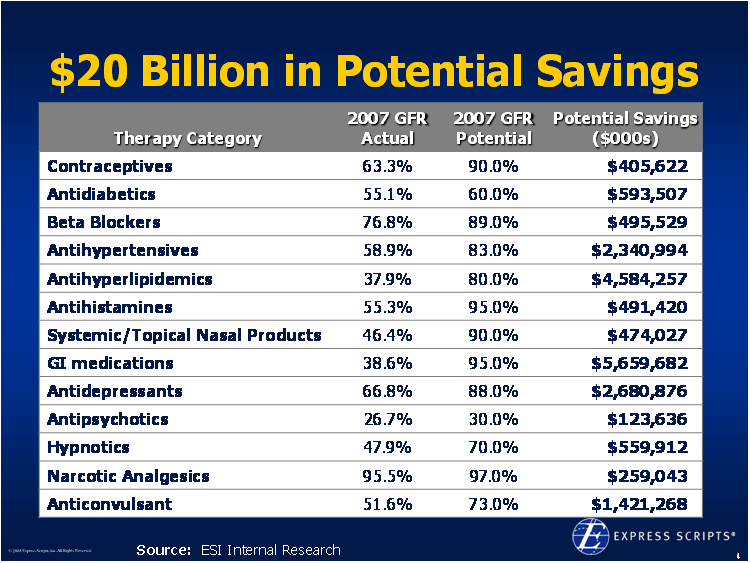
From the Express Scripts Outcomes event a few weeks ago, here is an estimate of all the money left on the table by not increasing your generic fill rate in certain key categories.  Are you doing enough?

  • Utilization management programs – step therapy, prior authorization, quantity level limits?
  • Formulary coverage?
  • Plan design incentives?
  • Pharmacy incentives?
  • eRx messaging?
  • Web tools?
  • Patient communications?
  • Patient incentives?
  • Driving people to mail?

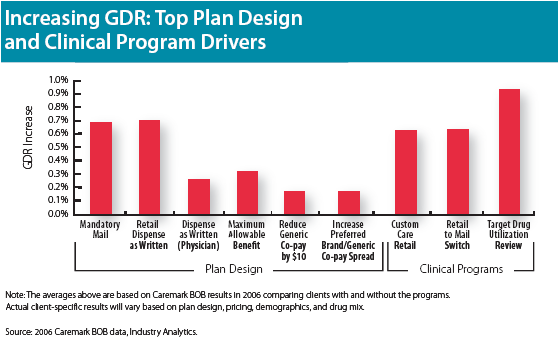
Here is a graph from CVS/Caremark‘s trend report from last year that shows correlation between certain programs and generic fill rate.

Incentives and Communications

Everybody looking at the healthcare system understands that incentives and alignment of goals is a critical component for successful change.

  • Providers need to be motivated to focus on wellness and prevention.
  • Individuals need to be motivated to care about the cost of care and to act in a healthy manner.
  • Pharmacists need to be motivated to take the extra action of moving patients to lower cost agents, resolving administrative edits, and counseling patients.
  • Hospitals need to be motivated to focus on Six Sigma type process initiatives.
  • Health Plans need to be motivated to invest in long-term care initiatives that prevent people from getting sick.
  • PBMs need to be motivated to drive optimal prescription use even if that includes more over-the-counter (OTC) drugs.
  • Employers need to be motivated to offer benefit plans to cover their employees which are simple to understand and align employees with healthy outcomes.
  • Pharmaceutical manufacturers need to be motivated to drive adherence across clinical conditions and to bring new drugs to market that represent significant improvements in therapy (better outcomes, less side effects, easier deliver methods).

With that in mind, I am glad that Silverlink Communications announced this morning that we are partnering with IncentOne to incorporate incentives into our communication programs.  Going forward, incentives will offer us another lever to improve outcomes in our programs that we conduct for clients.

“If applied appropriately in healthcare, incentives are an influential lever to motivate healthcare behaviors, arguably the most powerful force for changing the economics of healthcare,” said Stan Nowak, CEO and co-founder of Silverlink. “We’re excited to be partnering with IncentOne to design highly flexible, personalized and incentive-driven outreach that enables health plans to better connect with and engage their members to drive healthcare behaviors and reward them at the same time.”

“This is a truly integrated technology partnership that seamlessly connects healthcare consumer participation to incentives,” said Michael Dermer, CEO at IncentOne. “Silverlink and IncentOne together can deliver complementary solutions that drive participation and ultimately cost savings in healthcare. The combination of our expertise in finding the right incentives and Silverlink’s personalized communications to drive consumer behavior delivers the ability to implement more effective programs.”

Matthew Holt (author of The Healthcare Blog) did a podcast with both the CEOs yesterday that you can listen to to learn more.

You can also look at a study by Hewitt Associates of large employers which covers several related topics:

  • 2/3rds plan to offer incentives to motivate sustained health care behavior change.
  • 67% will utilize health care data and measurements to drive their organization’s health care strategy.
  • 74% of employees think their employer should help them understand how to use their health plan better.
  • 12% of employees think employers should help them become healthier.
  • Employee decisions on healthcare were influenced by cost:
    • Nearly one-third (30 percent) said they did not go to the doctor when they were sick because of cost.
    • 27 percent didn’t fill a prescription given by a doctor.
    • Almost one in five (19 percent) stopped taking medications before their prescription ran out, and of those, 18 percent did so due to finances.

Certainly, there are numerous examples of incentives being used to drive behavior.  Moving patients to evaluate mail order pharmacy has been a solution where coupons have been used over th years.  Driving therapeutic conversions have used incentives in the form of copay waivers.  Getting patients to complete health risk assessments (HRAs) and other tools have given incentives.

The interesting component will be the personalization of incentives.  While I may enjoy a $10 gift card to the dog store, my wife may enjoy a $10 gift card to the spa.  Flexibility of incentives and alignment of incentives with what drives behavior will be important.

Addressing Medicine Adherence

There are numerous studies on this, but they all point to the same issue…compliance.

The National Council on Patient Information and Education (NCPIE) released a report last year that I just came across titled “Enhancing Prescription Medicine Adherence: A National Action Plan“. With only 50% of patients using medication as prescribed, the systemic costs are enormous – $177B annually according to their estimates.

“Besides an estimated $47 billion each year for drug-related hospitalizations, not taking medicines as prescribed has been associated with as many as 40 percent of admissions to nursing homes and with an additional $2,000 a year per patient in medical costs for visits to physician’s offices.”

  • Between 40% and 75% of older people don’t take their medications at the right time or in the right amount.
  • As few as 30% of adolescents take their asthma treatments as prescribed.

Look at this in light of the recent study that showed about a quarter of people share drugs.  Another huge problem.

Their 10-step national action plan includes:

  • Elevate patient adherence as a critical health care issue
  • Agree on a common adherence terminology that will unify all stakeholders
  • Create a public / private partnership to mount a unified national education campaign to make patient adherence a national health priority
  • Establish a multidisciplinary approach to compliance education and management
  • Immediately implement professional training and increase the funding for professional education on patient medication adherence
  • Address the barriers to patient adherence for patients with low health literacy
  • Create the means to share information about best practices in adherence education and management
  • Develop a curriculum on medication adherence for use in medical schools and allied health care institutions
  • Seek regulatory changes to remove roadblocks for adherence assistance programs
  • Increase the federal budget and stimulate rigorous research on medication adherence

I am a little surprised that they didn’t talk about technology.  Integrated electronic medical records, personal health records, etc.  Since at least 1/4 of people don’t even fill their initial script, I don’t see how we can address adherence without beginning there and providing full lifecycle data to physicians about the status of scripts and refills.  I think there is also a huge role for collecting data about why people fill or don’t fill.

Poor Health Plan Satisfaction Due To Poor Communications

JD Power just finished their second annual National Health Insurance Plan Study which looks at member satisfaction.

“The study finds that the majority of health plan members rate their insurer lowest for the communications and information that are provided to help them understand their plan. Only 45 percent of members reported they fully understand how to use their health insurance coverage and member services. Enhancing member understanding with critical plan details—such as prescription coverage, co-pays, how to locate physicians and how to appeal coverage denials—can lead to higher satisfaction ratings for insurers.”

They evaluated 17 regions and publish reports like the following:

Information and communications is the third largest driver of health plan satisfaction at 17%. The only two things above it are coverage and benefits (#1) and choice of physicians, hospitals, and pharmacies (#2). So, it makes a great case for why communications is something to invest in and focus on. It drives satisfaction which drives retention. Additionally, it is something through which you can create sustainable differentiation. Benefit design and network size are pretty easy to copy.

Does Social Media Help With Retention?

Lois Kelly posted an interesting entry on her Foghound blog about the Catholic Church beginning to use Social Media.  This is an obvious reaction to the statistics she quotes about retention of active membership.

As she asks, the true question is whether tools themselves can impact this or whether the message has to change also.

On the other hand, it also makes me wonder what we are waiting for in healthcare relative to social media.  If a conservative organization like the Catholic Church can embrace it, why aren’t we jumping into it more aggressively.

Reminder: It’s Time For Your Patient To Come In For A Visit

Aetna announced that it is launching electronic alerts to 320,000 physicians. They will be called Care Considerations.

My understanding is that they will use the ActiveHealth engine to compare claims data to treatment guidelines to identify gaps in care. They will then send the physician a message through the NaviMedix platform and through fax, e-mail, or the phone.

This will be an interesting program to follow:

  • Will physicians take action off the alerts? How?
  • Since the NaviMedix system will allow two-way interaction, what will they say about the alerts?
  • Will this impact health outcomes?
  • Are these preventative alerts or are they catching things late in the lifecycle of a disease?
  • What will patient’s reactions be to their physician reaching out to them? I would be a little hesitant.

I am a little surprised that the program doesn’t include outreach to the patient also. I would be skeptical of a request to schedule an appointment without some understanding of why I should do it. Otherwise, it would look like an obvious attempt to drive revenue. It reminds me of something a physician said to me once. He said that they can control revenue in many cases. For a patient with mild pain, they can send them home and suggest they take Advil and call them if the pain continues. Or, they can write them a prescription, send them for a test, and schedule a follow-up visit in a few days.

This gets to the issue of Defensive Medicine which I talked about a few days ago.

Home Delivery Versus Mail

Do you care what it’s called? Some people really dislike Mail Order Pharmacy and go with Home Delivery. I made that change when I was responsible for the product at Express Scripts.

It becomes a little bit more meaningful when you talk about Mandatory Mail which is a benefit design where you are required to fill your maintenance medications at a specific mail order pharmacy after you have titrated to (i.e., found) the right strength for your chronic medications.

Should it be Exclusive Home Delivery? How about Retail Refill Allowance? Or Mail Preferred? Do they make a difference? Do you feel better about being forced to use one particular pharmacy?

On the other hand, if they are giving you money (i.e., a lower copay), to do something that saves your employer money and is equally as safe and more convenient, should you care?

Drugs Down. Gas Up. Food Up.

With most of our good going up.  According to CNN, I heard them say this morning that gas is up $0.60 per gallon in the past year and earlier this week, they said that food is up 35% in the past year.  (Neither of these are scientific, but they make the point.)

That makes me wonder how our impression of price changes.  Will we become less price sensitive as we get used to higher prices on everything.  A friend of mine told me that when they had a global meeting the people from Europe were commenting about how great it is to come to the US where taxes are low and gas is cheap.  It’s all a matter of perspective.

So, with most things going up, I found this press release from Express Scripts interesting:

Last year marked the first time in at least five years that consumers paid less, on average, in their prescription drug copay, according to the 2007 Drug Trend Report released by pharmacy benefit manager Express Scripts. The average copay dropped 25 cents to $13.20 even as the average total cost of a prescription rose from $55.01 to $55.93.

Express Scripts attributed the average copay decrease to greater use of generic drugs, saying in the report that consumers saved an average of $15 per prescription each time they moved from a brand to a generic.

Where $15 was once a big deal, will that need to be increased over time to have the same effect as the price of goods increases?  My dad still talks about seeing movies for $0.10, but we know those days are gone and a dime doesn’t buy much any more (if anything).

Defensive Medicine

On April 23rd, USA Today had an article on Defensive Medicine by Kevin Pho (a PCP who blogs at KevinMD).

It was a well written piece with a few facts that I thought I would capture here:

  • $2.2T are wasted in our healthcare system (per PWC) due to medical errors, inefficient use of technology, and poorly managed chronic diseases.
  • Defensive medicine was the situation where physicians order tests to avoid the threat of malpractice.
  • Defensive medicine was estimated to contribute $210B annually to this $2.2T in waste.
  • According to the JAMA (2005), 93% of doctors reported practicing defensive medicine.
  • An American Academy of Family Physicians cited a study that physicians who had fought medical liability cases which showed that 90% “suffered significant mental effects from the lawsuits” and 10% contemplated suicide.
  • The New England Journal of Medicine analyzed 1,400 malpractice claims and found that 40% of cases had no medical error.

Kevin goes on to explain that most patients don’t mind the extra tests.  I would argue that patients probably feel that their doctor cares by going the extra mile.

As he talks about, more isn’t always better:

  • Risk of a false positive
  • Radiation from a CT scan might be unnecessary
  • Biopsy can lead to complications

Researchers at the Dartmouth Atlas Project concluded that higher intensity medical services have led to worse outcomes, higher costs, and an increased number of medical errors.

It’s a pretty sad state of affairs.  Physicians afraid of being sued.  Consumers with no direct understanding of the cost.  Again, it gets back to incentives and communication.  We have to align interests and protect people who are doing the right thing.  But, all parties have to be willing and able to provide information and disclose the implications and rationale.

Healthcare Retention

Retention in healthcare has become an emerging focus.  With the initial land grab for Medicare lives over, it is more and more important to retain them.  Focusing on new lives is becoming harder.  And, with one of the few green fields out there being individual lives, retention will continue to be a business driver for the next decade (or until we move to a single payor system).

Fortunately or unfortunately, there is no silver bullet.  But, this is clearly the time to act.  Figure out what works.  Set your baseline.  Learn from the consumer, customer, patient, or member.

I recently gave a webcast on this topic, and without giving away anything proprietary, I thought I would share some cliff notes.  If interested, feel free to contact me for the content or even to learn more about our retention solution.

  • Retention is a journey from employee satisfaction to customer satisfaction to loyalty and ultimately retention.
  • There are many different types of loyalty – price, programmatic, experience, and relationship.  (Forrester Research)
  • There are many lessons to be learned from outside the industry on the value of retention, how to measure retention, and what drives it.
  • A data centric approach to learning and understanding your consumers is critical path.
  • There are some basic programs emerging as foundational.
  • Health plans unfortunately start by having to build trust.
  • One way to build trust is to demonstrate that you are looking out for the best interest of the patient.
  • Your brand is affected by all the constituents in the delivery chain.
  • Price and product are the obvious drivers of satisfaction, but there are others.
  • The most satisfied are not always those with the lowest price.  (There is a great example of this in another industry.)
  • Your healthy members are the most likely to disenroll.
  • Satisfaction varies by condition.
  • There is a big difference in likelihood to renew between someone that scores you in the top box (i.e., 10 out of 10).

Lots more to come on this topic.

What A Difference A Few Years Makes

Before a whole week passes, I need to capture my interview with Gene Drabinski from Trizetto. Gene is the President of Cost and Quality of Care. This was a fun interview where we just kicked back at the end of day two at the World Healthcare Congress and talked.

I haven’t spent much time around the Trizetto people recently and still thought of them as Facets which was the software that I remember from my payor days at Ernst & Young LLP.

Of course, I had done some homework prior to the meeting and began by asking some questions about being acquired by Apax who is taking them private. We talked about the advantages of being private versus public. The big one being the ability to plan long-term and make investments rather than try to make each quarter’s number.

He was then kind enough to walk me through some of the history of Trizetto. If you go to their news page off their website, I had realized before I talked to them that I was outdated in my frame of reference. They are talking about social networking and consumerism and decisioning not about claims processing and efficiencies.

We talked a lot about the CareKey application which they acquired. CareKey (now CareAdvance) is a PHR (personal health record) which sits on top of a member database. He described several key features of the application:

  • Good metadata (i.e., data about data)
  • Ability to reach out and capture new data systemically
  • Custom rules environment
  • Able to be integrated with workflow and used in disease management, case management, and utilization management

CareAdvance Enterprise – Enterprise software that allows health plans to automate utilization, case, disease and population management, and to extend a personal health record and personal health management tools to their members. The system includes two modules: Personal CareAdvance and Clinical CareAdvance, which integrate with the health plan’s core information systems, aggregating the member’s personal claims and diagnosis history, current prescriptions, and laboratory data into a single data repository.

We talked about transfering the information from one PHR to another. He clarified that the transaction data was transferable but not the context. We then spoke about their vision for Integrated Healthcare Management as an out-of-the-box solution to make the patient “be the best I can be”. From what he said, the physician is the final constituent that they need to get integrated.

“Integrated Healthcare Management is the systematic application of processes and shared information to optimize the coordination of benefits and care for the healthcare consumer,” said TriZetto Chairman and CEO, Jeff Margolis.

From Gene’s session at the conference, he facilitated a panel that included Vicky Gregg who is the President and CEO of BlueCross BlueShield of TN. One of her slides which captures the Trizetto IHM vision is here:

My takeaways were (a) Gene’s would be an enjoyable person to work with and (b) Trizetto is doing a bunch of interesting stuff and focused on how to use technology to transform the industry.

It’s also worth reading through Jeff Margolis’ document called The Health Plan of Tomorrow.

Silverlink Coming To A City Near You

I am really excited about a new initiative at work.  We have pulled together a great set of speakers and are doing a road show around the country.

The speakers include:

The topic of the event is Healthcare Communications: Think Differently and is about how to engage the new healthcare consumer and drive behaviors in scale.  Very much like what a lot of the talks were about at the World Healthcare Congress.  It’s not simply getting data and information, but it is about making that information actionable.  That is exactly what this 1/2 day session will be about.

The meetings will be in Boston, NY, Hartford, Minneapolis, Oakland, and Westlake (CA).  Click here to find out more information and to get registered.  We hope to see you there.

Hidden Gem at WHCC 2008

For those of you missing the World Health Care Congress 2008 in DC, you are missing a good meeting.  It has lots of networking opportunities, good speakers, lots of company booths, and good content.  I have been here and trying to run between presentations, meetings, and interviews.

I went to a presentation yesterday on PHRs (personal health records) which is a hot topic here.  I think the presentation by Jan Oldenburg (Practice Leader, Health Content, Internet Services Group, Kaiser Permanente) could be the the hidden gem of the conference.  I know a lot of people will immediately discount it for being part of an IDS (integrated delivery system) but don’t.  There is a lot to learn here.

Some of the key things include:

  • Integration of the PHR and EMR.  [Their EMR is from Epic.]
  • A focus on four key attributes – transparency, accessibility, consistency, and security.
  • Four major components: record of information (lab values, visits, notes), an interaction tool (e-mail your physician, HRA), transaction engine (refills), and links to health content.

They have an amazing 2M members on the PHR with over 60% who signed in and used the tool more than 5 times in 2007.  [They probably deserve an award just for this ability to create a sticky application.]  And, 16% signed in more than 12 times.  […which is probably all of their chronic patients with co-morbities.]

Jan talked about their promotion of the site which includes all of their materials, registration drives, and even physicians giving out cards promoting the site.  She talked about making meaningful improvements like moving from mailing out the password to the patient to instant password set-up using a similar algorythm to what banks use.  (This improved their activation to 88% over the past 2 months.  They used to lose 30% between password request and actual registration.)

And, it sounds like they have taken a very thoughtful approach to the application:

  • She spoke about the fact that they had over 3.6M e-mail exchanges between MDs and patients in 2007.  Originally, they didn’t pay MDs for e-mails since it was like returning phone calls.  But, they are looking for how to distinguish between an e-visit and an e-mail.

“E-mail helps me take better care of myself” [a quote from a patient]

  • In a published study, they showed that patients using e-mail had 7-10% less visits and 14% less use of the phone for support.  [very impressive]  But…to George Halvorson’s point on day one, this is a perfect example of misaligned incentives.  The MD uses e-mail to improve health and patient satisfaction but makes less revenue.
  • They addressed one not so obvious issue which is timing of data being released.  For sensitive lab values, they are either delayed so the physician sees it first or its only released after the physician approves it.  The key is that the physicians don’t want the patients to see the data before they get a chance to call them.
  • The patient can take an HRA (health risk assessment) and decide whether or not to share it.
  • They have some impressive statistics around changing behavior:
    • 55% lost weight
    • 58% decreased stress
    • 78% had better pain management
  • They are just beginning to analyze who the users are (e.g., chronic patients, acute patients, family).  This was a question in every PHR meeting yesterday.
  • Some of their key learnings included:
    • Information has to be timely and current
    • You have to create “in the moment” opportunities to act (i.e., e-mail your provider)
    • You have to create teachable moments
    • You have to meet members where they live
    • You have to heal the fractures of our healthcare system

“Patients who use the PHR are 65% more likely to stay with Kaiser when they have a choice of plan options.”  [WOW!  Talk about a case for adoption.]

  • They were one of the first ones that I heard talk about working with portability standards to move data from PHR to PHR and to a DTC model (i.e., Google, Microsoft).
  • The final point which was similar to what I discussed with ActiveHealth was around genomics.  Jan talked about some of the analysis they were doing thinking out years in the future about how that data could influence generations.

This is certainly worth following and looking at as a model.  Some of the things are easier because of their model (e.g., getting MDs to use e-mail and promote the web), BUT somethings are lessons that can be leveraged.

Consumer Engagement Tools

This next session is with James (Jim) Roosevelt (President and CEO of Tufts Health Plan) and Phyllis Anderson (VP of Marketing from Humana). It should include real-life discussions on what works.

Interestingly, Jim is making a point that he made earlier which is about how to differentiate when all the providers are in each plan. I talk about this a lot. My opinion based on what JD Power showed in their study is that communications is the differentiator. How? What? When? Personalization? Rules? Preference based? Integrated?

Jim said that 3-years ago they were in touch with 1.5% of their members on a regular basis…that number is now 22%. I am not sure there is a benchmark to know if that’s too much or too little…but it seems good. Some of the words he uses which I think are important are – cost management, quality improvement, evidence-based, self-care, comprehensive and integrated, effective, and positive ROI.

He laid out a good continuum of programs moving from low cost, healthy programs (wellness) to more expensive programs for at-risk people (disease mgmt) to high cost programs for the chronic patients. Tufts is moving to a consumer empowerment plan called My Wellness Plan which will focus on engaging 100% of their members and still get an ROI of greater than or equal to 1.5:1. He showed a chart that 50% of health costs are driven by health behaviors (good news in that it is an addressable challenge).

He talked about an example around bariatric surgery which I thought was a good case study. Rather than simply not covering it, they cover it after certain steps including a six-month lifestyle modification program. The key point he made is that surgery without behavior modification is dangerous.

They have 3 categories for engaging members:

  1. Lead a Healthly Lifestyle
  2. Manage Care and Treatment
  3. Effectively Navigate Health Care System

He made the point that it could be copied, but the question is do you act first. I think the question really is how well do you implement the vision. It’s easy to envision and know what to do. It’s very difficult to execute it well and make a difference.

Phyllis started with some patient messages which were interesting.

  • Take a deep breath. We dare you.
  • The food groups are your friends.
  • Make you next smoke break a clean break from smoking.
  • Where do you see yourself in 5 pounds?
  • Lower back under attack?

“Healthiness is a nuance.”

As the quote indicates, health information and engagement varies dramatically, and it will take a while and some trial and error.

“Incremental change will ulimately result in significant impact.”

She talked about a pilot they did and what they learned:

  1. Create real-life goals (relevant to where they are and where they live)
    • Want to fit a dress by reunion versus lose 100 pounds in the next 6 months
  2. Community is key
    • Coach
    • Peers (the participants blogged and got feedback via the blog)
  3. Rewards and incentives are necessary
    • Personalized to individual
    • Not just monetary
    • Include recognition

“It costs less to support well people.”  Phyllis went on to make the point that it’s worth spending the money now rather than waiting until people get sick.

There was a good question from the audience on whether ROI mattered.  Apparently, some of the employers here at the conference had said that they were willing to invest in programs that promoted health without any ROI.  I think the key is that there are limited resources…I would spend money first where I got a return.  I am willing to bet that I don’t have much money (or time) to address the other programs.

Who is the health care consumer?

I guess it gets to the question of how you refer to people in healthcare.  Are they individuals?  Are they patients?  Are they members?  Are they customers?  Are they consumers?

I was talking with an MD yesterday who asked me what I thought to the question “who is the consumer in health care?”.  I clearly think it’s the patient.  He thought it was the providers as they were deciding what goods the patient should buy.  I was surprised.  I could have said it was the payor, but I never would have said the provider is the consumer.

Some of it’s perspective, but some of it is definition.  I think if you add copays plus over-the-counter spend plus spend on things like alternative medicine and gym memberships then it is a lot bigger question that simply who pays claims.  It’s a key question.  if you can’t determine who’s the consumer, it’s going to be hard to agree on the strategy.

Consumerology?

Express Scripts launched their Center for Cost-Effective Consumerism just recently.  If interested, here is the site.  Impressive group of contributors.  I know and respect the staff.

Is it enough to drive differentiation?  We will see.

It has a blog.  Does it become a “corporate blog” which is just informal PR speak or does it actually have the team’s raw thoughts?

What learnings will they share publicly versus keep internally?

Can We Build The Goodies (PHR)?

I am sitting in on a discussion around PHRs and Consumer Connectivity which features Jeffrey Gruen (Chief Medical Officer at Revolution Health) and Jeffery Rideout (Chief Medical Officer from Health Evolution Partners).

Let’s start with utilization – only 10% of people have access to a PHR (Personal Health Record) through their plan and only about 2% actually use it (at best).  This brings three challenges to the table: (1) building awareness; (2) security and trust and (3) automating the data load.  The next question is can you make these fun and engaging tools (i.e., the goodies).

The presenters and the facilitator who is from Carol all start with a fairly skeptical view of the world.  They pointed out that it’s like an ink test…everyone sees something different.

It seems to be a big challenge.  Do you build it for what everyone wants which would be a laundry list or do you build it for what you think they want which generalizes?  I do agree that systemically the value is collecting and tracking data that can be shared with your care team across providers and insurers.

I must admit that some of the things that I would want include:

  1. Claims access (lab, medical, pharmacy)
  2. Tracking of OTCs (pulled from my savings accounts)
  3. Current benefit information (which assumes it is transferable across payors)
  4. Disease information
  5. A communication hub for sending and receiving secure messages
  6. Outbound reminders to me about events or opportunities
  7. Identification of care opportunities
  8. Tracking of information
  9. Integration of health social networks
  10. Recommendations of things to do or act upon

But, like I would consult any sales person, why are we talking functionality and features versus value.  From a value perspective, I want a safe, proactive application that helps me become healthier.  Not an easy request.  If I track my running, can it tell me that I am adding miles too fast?  Can it tell me about a drug-drug interaction?  Can it tell me that I paid too much for a treatment?  Can it track my total spend?  Can it help me predict comorbities based on data and possibly even my genomics information?

One of the members of the audience chimed in (rather passionately) that no one wants a PHR from a payor or stand-alone company.  The majority want it from the physician.  [An opinion of one, but I don’t and can’t imagine getting anything from my physician.  Maybe I don’t have the right relationship or the right chronic diseases, but I move and I want to have the choice to find the best doctor and not feel stickiness to them.]

Here’s a couple of presentations on this:

I didn’t realize until yesterday that for the DTC (direct-to-consumer) PHRs that are available the consumer has to actually enter all their own data.  It isn’t automated.  What a potential nightmare.

So, a real couple of questions are:

  • Who is this for – patient, providers, payors, care team?
  • Why would I ever spend anytime on a PHR if I couldn’t transfer it to my next payor?  I think this makes a play for Google and Microsoft and Dossia to provide a backbone that all the other PHRs use to create interoperability.

Upcoming Webinars

If you missed it last week, I am giving a repeat performance of my webinar on retention.  I am going to talk about driving customer satisfaction and building loyalty to improve retention which is and should be a hot topic for everyone in healthcare. (Sign up here for the 23rd at 1:00 EDT)

Additionally, my peers are giving a webinar on closing the adherence gap which should be another hot topic for many of you.  (Sign up here for their sessions on April 30th and May 22nd)

Wrong Question: What Does The Consumer Want?

After hearing Grant Harrison (VP, Integrated Consumer Experience) speak a few times on stage yesterday about his role at Humana, I was glad that I had time booked with him to learn more about what he does. I found it to be a very interesting discussion. Grant works in the Innovation group at Humana, and he brings a background which includes Virgin HealthMiles where I believe he was one of the founders and time at Tesco and SkyTV (among other consumer facing experiences).

The first thing we talked about was their VirtualMe initiative which is the creation of an avatar (i.e., virtual persona) for use on the web. They haven’t launched it yet, but it sounded like it was an effort to give some personality and interactivity to the consumer. Interestingly, they are already working on a mobile solution and how to use this in kiosks within the physicians office to pull up your data and minimize your rework. As we continued to discuss this, Grant talked about pushing it to the physician as an interface for them to input data essentially into the patient’s page or portal. I asked him if this would essentially create an integrated PHR / EMR which was shared by both parties which he agreed it could. [Maybe someday they will use the avatars in Second Life to open up a virtual Humana location.]

I asked him about creating a points program since he had done that at Tesco in the UK. He mentioned that they were looking at it. One of the things he mentioned was that they believed the amount of points or incentives you had to offer someone was directly linked to how good of an application you had and how clearly the patient saw value from their interaction. [It’s a great point.] Interestingly, he used RealAge as a good example of an HRA that people willingly do all the time. I never thought of RealAge that way.

When I started asking him about measuring success, he pointed out to me that people who ask “what does the consumer want?” don’t know what they are doing. Essentially, they are trying to generalize the healthcare masses when it is all about micro-segmentation. [It was clearly an opportunity for me to plug what I work on at my day job at Silverlink, but I was good and stuck to the press role.] He talked about a current effort they have to learn about the “care-giving woman” who is between 35-65 and has both a child to care for and a parent.

In talking about groups, we talked about a few things like measuring happiness. He had mentioned that this was their objective and talked about the whole body of international research on this topic and how you could look at proxy metrics like their engagement as a measure of happiness. We also talked about segmentation models and tracking things like their awareness and/or interest in communications from Humana.

We talked briefly about retention at the end of the discussion which seems like something they are getting ready to address with a focus on group retention, brokers, and Medicare lives. [He is one of a few healthcare people I know that ever talk about retention in groups…which I believe is a clear opportunity.]

“Not an insight unless you act on it.”

I think this quote was a good ending to the discussion since I was asking about what they were doing to actualize this information. Another question I had had was whether they would really build out all this within Humana or take it out to an Entrepreneur in Residence at a VC firm. I know we struggled at Express Scripts when we looked at how to develop and manage businesses that had little (operationally) in common with the core business. [As an interesting side note, I asked him what he thought about Express Scripts recent announcement about their Center for Cost Effective Consumerism, but it wasn’t on his radar screen at all.]

Presidential Discussion at WHCC

Joanne Silberner from NPR is moderating a panel on the Presidential HC Agenda which includes people from McCain, Clinton, and Obama’s campaign.

  • Regardless of who wins…we must have reform was the way that Jim Cooper from the State of Tennessee started when talking about Obama. [I must admit I missed much of his talk.]
    • 50% believe it is feasible.
    • 54% believe it would impact cost.
  • Thomas Miller who advises McCain is talking now. A few things I heard from him were a focus on financial incentives and talking about outcomes. (a good point) He talked about focusing on the family and empowering them. (Although I generally agree conceptually, we are a long way from having information in a format that the family can digest and leverage.) He just blasted the dems for requiring purchase of politically motivated, cookie cutter plans. (I think this is my first experience listening to a political script which is clearly being read.)
    • 45% believed his plan was feasible.
    • 46% believe it would impact cost.
  • Chris Jennings is speaking for Clinton. Affordability. IT. Effectiveness. Chronic care management. In concert with doctors and nurses.
    • 54% believe it’s feasible.
    • 51% believe it will impact cost.
  • All of them should have listened to Halvorson speak in the prior session. He is on the panel so I will be interested to see what he asks and his opinion. Will he support a particular plan?? His comments included:
    • Most sophisticated and informed debate on healthcare ever this year.
    • Candidates talking about chronic care and expenses of system. Talking about IT systems and best practices.
    • Candidates almost ahead of the policy wonks. He says he has great optimism.
    • McCain’s plan looks like a Switzerland model.
    • The Democrats look like the Netherlands model.
    • He wonders if they looked at the European models and what they learned.
  • George Shultz (former Secretary of State) was also a commenter:
    • Grow the pie…then it’s easier to cut a piece out. [I think I missed the point here.]
    • Lots of the things in the system fail to capture incentives to make them work.
    • Compare the GDP in the US in 2050:
      • $1T difference if you compare retiring at todays age versus scenario where you retire for the same amount of years
    • People are living longer and being healthier is NOT because of insurance. It is from lots of medications that have come out of research and equipment. “That’s a huge development.” Basic research is the key. Why we are flatlining this research from the NIH makes no sense.
    • Universal coverage should be a ground rule.
    • Doesn’t work to just mandate coverage.
    • Years ago, it was suggested that everyone get a HSA type offering based on a risk adjusted basis. (From Milton Friedman – conservative economist)
    • Competitive market for individuals will drive costs.
  • Audience question “How will you limit the greatest cost driver – technology – so that universal coverage doesn’t explode costs?” and “Do we need something like in the UK to evaluate new drugs from a value perpective?”
    • Obama Rep – Affordability is the key. UK approach goes too far. No one wants rationing. People will choose wisely with full information.
    • McCain Rep – Technology is how we have paid for technology. Subsidizes have diminishing returns. Need better research. No binary decision making like UK (coverage or not). Need information on how care is actually delivered.
    • Clinton Rep – Support around price management is growing. Will not go as far as UK. Need more support for NIH. But, funding needs to be linked to outcomes.
    • Schultz pushed back on research linked to outcomes. Interesting breakthroughs come from basic research not focused research. Manufacturer only wants applied research.
    • Halvorson – basic research. EMR. Linking EMR to DNA. Dozen different prostate cancers. Targeting based on DNA (genomics) will be much better. need to follow-up on technology once it’s used to see long-term impact. Systematic care delivery and follow-up important.
    • Schultz talks about education and people’s desire for information. People need to take responsibility for their health.
  • Another question “Would any of you mandate preventative care? Or provide incentives?”
    • Obama Rep – should certainly be part of any plan. customers shifting across plans limits ROI. Lots of things that could be done to push knowledge out. Tragedy in America that there is an 7-year lag between onset of Diabetes and diagnosis.
    • McCain Rep – can’t get in front of campaign which is thinking about this. Better educated Americans will navigate system better.
    • Clinton Rep – children can’t be exposed to what they are today leading to obesity without addressing this. People without coverage don’t seek prevention. Uninsured have big cost sensitivity. Uninsured going into Medicare drive costs high quickly. Education isn’t enough. There is some information about this in the senator’s policy.
  • Another question: “Do you think the candidate would win the presidency if they presented a workable plan that controlled costs?”
    • 68% said yes.
    • Schultz says that people respond well to straight talk. He encouraged the candidates to pledge to each other that they would support the plan of whichever candidate wins.

Interview with Phyllis Anderson (Humana)

As part of my opportunity to be part of the press at the World Healthcare Congress, I opted to interview some of the participants and speakers. This is my first of several that I have scheduled.

I had a chance to sit down with Phyllis Anderson who is the VP of Corporate Marketing for Humana. She has an interesting background from Pillsbury, Nabisco, and Bank of America as I discovered when I asked her what they were doing to bring in non-healthcare people to help them address consumerism within healthcare. Her story about working on healthier snack foods where they wanted to protect the quality of taste while addressing the healthy trends in the US seems very applicable.

How do we manage our history of healthcare while addressing the sea of change?

We talked a little about the paradigm shift that they are addressing in moving towards an individualized healthcare sell. Phyllis talked about focusing on the benefit to the consumer. Sticking on that same concept, when I asked her about how they were addressing preference-based marketing, she talked about creating “viable consumer experiences”. She talked about looking at 3 factors: message x channel x frequency. She mostly spoke about the differences in needs / interests around messaging by health status. I asked about using different models like Prizm versus Pro-Change, and she said they were still exploring the right model.

Given what she said plus what one of her colleagues had said on the main stage, I asked her about how they captured feedback (i.e., indirect on direct) about satisfaction. She said that they ask for feedback on a lot of their outreach programs today.

Listening and Leading

She talked about their CEO’s term of listening and leading and trying to balance those two things. Sometimes you have to listen. Other times you have to lead the consumer. We also talked about the fact that if the patient isn’t engaged then it’s pretty hard for them to give feedback.

I then asked about how they’re using JD Power and Forrester’s healthy studies. I was glad to hear that they had embraced the JD Power study and were working on an expanded relationship with Forrester.

Finally…Digitally Integrated Coupons

Using Shortcuts.com, Kroger has become the first retail partner to link their loyalty card to their digital coupon service.  I find this to be a great idea.  The consumer can go online and search for coupons by brand, product, or category.  They then add those coupons to their account.  When they use their loyalty card at checkout, the coupons are redeemed automatically.

No more paper.  No more remembering.

What a great opportunity.  If I worked at pharma, I would be looking at how I could get my over-the-counter products (OTCs) and even my Rx products into a program like this and link them to my health savings account or flexible spending account card from companies like the Benny Card or TriHealix (for example).

Commit. Don’t Just Try.

These were the words from Liz Murray (Homeless to Harvard) at the SMG Summit.  I am not sure of the context since I saw it in a summary in Chain Store Age this morning, but I think it is relevant in healthcare in so many ways.

  • Commit…don’t just try to build a focus on the patient.
  • Commit…don’t just try to understand how your processes impact the patient.
  • Commit…don’t just try to focus on outcomes over ROI.
  • Commit…don’t just try to create a positive, personalized experience for each member.
  • Commit…don’t just try to be responsive, timely, and meet the service needs of your patients.
  • Commit…don’t just try to improve.

The Implication Of Choices

I have heard this theory many times, but I was glad to run across an article on it.  The basic point is that too many choices have negative implications on people.  In this article from Health Day News, it discusses a study published in the Journal of Personality and Social Psychology about the effect of multiple choices.

“If people have a day or period of time in which they are making many choices, they will be vulnerable to low self-control,” said study lead author Kathleen Vohs, assistant professor of marketing at the University of Minnesota. This could lead “to overeating, overdrinking, overspending, losing one’s temper, and procrastination.”

This has a significant implication within healthcare.  How do you empower a patient in a consumer driven world and make information transparent without overwhelming them with options and data?  How do you communicate to a patient about their options without giving them every possible scenario? 

We generally want a simple solution and to be guided to a good decision without being manipulated.  How do we accomplish that?  It reminds me of a JD Power study on the auto insurance industry that I often quote that showed that the most satisfied consumers were not those whose rates went down, but those who rates went up BUT were proactively informed and offered options. 

Blogging Next Week – WorldHealthcareBlog

Next week, I will be posting my blogs to this site and to the WorldHealthcareBlog as part of my press efforts at the conference in DC.  I look forward to meeting lots of industry people there and have set up a bunch of interviews to talk about topics such as:

  • Gaining mindshare with the patient / member / consumer / customer
  • Mass personalization
  • PHR adoption
  • Consumerism
  • Patient segmentation
  • Getting ready for the individual market
  • Building trust with patients

More On Sound And HealthCare

Noel Franus at Sonic ID posted a follow-up entry on his blog to my comment about sonic (or audio) branding.

I like the description on his blog about what and why:

Sound has an immediate, direct link to both the rational and emotional parts of our brain. Sound shapes our thoughts, our feelings, our behaviors, our lives.

Yet most brands lack an awareness of the power of sound; many spend millions each year on music, sound and voice…but very little of that is influenced by strategy. Those touchpoints are disconnected dots, and for customers, that’s a disconnected brand and a poor investment.

Our goals are to change that — to strengthen connections between people and brands through the use of sound, and to provide economic value in doing so.

The reality is that there is so many multi-media opportunities for us to build branding and awareness using sounds.

Medco’s Customer Event 2008

Medco doesn’t host their event and release their drug trend report until mid-May. [You can see some of the highlights from the past few years online.] But, I think it is interesting to look at the agenda and topics to understand what they are talking about with their clients. As you would expect, consumerism, the election, and healthcare communications are present in both agendas.

  • The Predictions Conference: Five insights that will shape healthcare by David Snow, Medco’s Chairman and CEO
  • Emerging trends in the science of healthcare by Dr. Robert Epstein, SVP, Medical and Analytical Affairs and Chief Medical Officer, Medco
  • Wiring healthcare: Bringing personalized healthcare technology to consumers by Steve Case, founder of Revolution Health and co-founder of AOL
  • Politics of change: Preparing for a new administration’s impact on healthcare by TBD
  • Future shock: The economics of the uninsured by Former US Senate Majority Leader Bill Frist, MD and Uwe Reinhardt, PhD, James Madison Professor of Political Economy and Professor of Economics and Public Affairs at the Woodrow Wilson School at Princeton University
  • Prescription for savings: Using health literacy principles in your communications (breakout session)


2008 Outcomes Conference

As a follow-up to my last post, I thought I would share some of the agenda items and the new Drug Trend Report from Express Scripts‘ Outcomes conference 2008 which is happening right now.  Unfortunately, they don’t let many external people in (even on my own dime) to hear the presentations.  I have to get it off the website and talk about it 3rd hand.

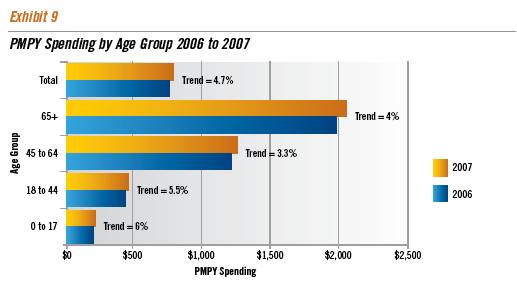
I will have to read the report and will have more to share.  Here are a few things that caught my eye:

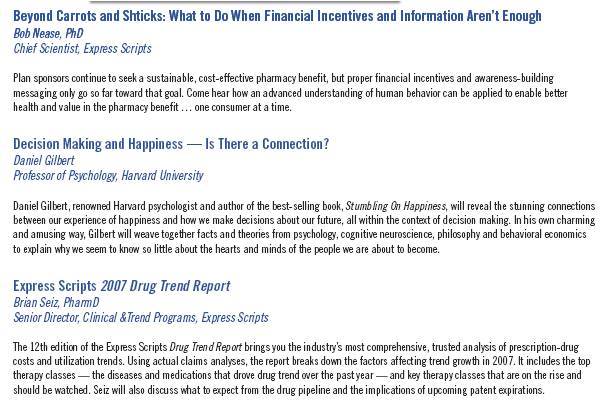
As you can see from the agenda, several topics around consumerism which is a hot topic there.