Archive | Technology RSS feed for this section

A Single View of the Member

Do you dream of being treated as one consistent individual across a company?  Wouldn’t it be nice if they knew every communication they sent to you – letters, calls, e-mails – and knew every communication touch you had with them – webpages visited, faxes, inbound calls, e-mails?  Unless someone can tell me different, this is still a dream world at most companies and maybe more than a dream at most healthcare companies.  (It’s even more complicated if you start thinking about all the touches by the health players – hospitals, clinics, MDs, disease management companies – and integrating them.)

All that data could help paint a much better picture of each individual if blended with outcomes data.  Who responded to what?  When did they respond?  What did they do?  How did it vary by condition?  How did it vary by gender?  By age?  What can you use to predict response rates? (I.e., the key here is having data transparency, easy to access data, and the ability to mine and analyze the information.)

There are so many variables that it can be overwhelming.  That’s why I found the discussion around Campaign Management 2020 by Elana Anderson and then commentary by James Taylor interesting.

“we can dream of technology that supports fully automated marketing processes and black box decisioning, tools that simplify marketing complexity and support collaborative, viral, and community marketing” (Elana’s blog entry)

This really gets at the heart of some of the fun projects we are working on these days at Silverlink Communications with our clients where we are bringing Decision Sciences to healthcare and helping clients optimize their engagement programs, retail-to-mail, brand-to-generic, HEDIS, and coordination-of-benefits (among dozens of other solutions).  Helping clients layout a strategy, define a process, develop a test plan, execute a program, and then partner with them to improve results is what makes my job so exciting.

As we go into the new year, I hope all of you are having fun at your jobs or quickly find a new job if your unemployed.

Taking My Insurance Out For a Test Drive

I heard a commercial this morning talking about a “test drive” for drivers insurance. It made me think that with data standards this would be a pretty easy thing in healthcare.

Imagine that every year for open enrollment you would simply create a file of all your claims from the prior 12 months and upload them at some website “TestMyHealthInsurance.com”. That website would show your employer sponsored options along with individual insurance options and show you what your total out of pocket costs would be under each scenario (assuming the same claims).

We had an application like this at Express Scripts called ExpressChoice which allowed members to compare their next year’s pharmacy plan options based on the prior year’s claims. It was a very cool tool. Of course, there are limitations, but it’s much better than most of us have.

So, why not extrapolate that to a bigger market play and include health and pharmacy. Given all the exclusions and other small print in our policies, it is always impossible to compare.

Now, if you really wanted to blow people away, guarantee that the costs per claim for the same drug, treatment, etc. won’t deviate from the forecasted price by more than 10% year-over-year. I think you would capture some attention here.

Viral Marketing in Health: Humana Steps Up

I talked about Humana‘s innovation group a few days ago. They have done it again with two new games. One is on HumanaGames.com and the other is a Facebook application.

The Freewheelin Cycle Challenge is an online bicycle-racing videogame that matches you and a quirky virtual opponent. To make it to the finish line first, players energize their bicyclist and pick up speed by capturing nutritious snacks, such as nuts and oranges. They lose energy, however, by rolling over holiday junk food, including candy canes, cookies and other sugary snacks.

“The Battle of the Bulge” is an application that will be available at Facebook.com beginning Dec. 24. To participate, users go to “The Battle of the Bulge” Facebook page and answer a few questions about their lifestyle, including exercise and eating habits. Based on the responses, users are assigned a virtual waistline, affectionately called a “bellytar.” The goal of the game is to maintain an ideal weight.

But it won’t be easy. Other “friends of flab” can “fling fat” your way, making your bellytar’s pants literally bulge at the seams. In a worst-case scenario, you could be headed toward an online heart attack. To shape up, simply answer questions about exercise correctly and watch your bellytar shrink before your very eyes. Then answer questions about nutrition correctly to fling some fat of your own.

I find these to both be great examples of viral marketing which Seth Godin does a good job of explaining on his blog. Obviously, there is a long-term objective here which is driving healthy behaviors and positioning Humana as a leading edge company. They also hope to learn about human behavior and understand how tools like these can affect healthcare.

A Few Examples Of Technology Going Mainstream

Two things caught my attention this week on how technology (especially social networking) is making its way into the mainstream.

In today’s USA Today, they compare this year’s Heisman winner (Sam Bradford) with last year’s winner (Tim Tebow).  As it runs through their statistics – age, year, records, first place votes, one jumped out at me – Facebook friends.  They actually compared how many friends the two quarterbacks had in Facebook.  Really…how does that matter?

A few days ago, Michigan’s GOP Chairman Saul Anuzis announced his interest in leading the Republican Party via Twitter.  Who was subscribed to his Twitter feed would be my question?

“It would be suicide for the Republican Party and conservatives to not aggressively embrace technology,” said Matt Lewis, a writer for the conservative Web site Townhall.com. “The world is dramatically changing in the way people get their information and the way they communicate — the party needs to change with it.”

Both examples make the point that these technologies are here to stay and are revoluntionizing the way we think about communications, marketing, personal branding, etc.  Where is healthcare?  When is the last time you saw the CEO of a major insurance plan providing his Twitter feed to the members?  In most cases, you can’t even find contact information for a lot of companies anymore.

Views on Electronic Prescribing (eRx)

I worked on eRxing when I first joined Express Scripts back in 2001. At that time, it was a huge focus with the recent investment in RxHub with Medco and Caremark. Everybody was drawing these hockey stick projections on adoption.

So, what happened…

  • Physicians began to use the technology in limited numbers and most of them ended up with equipment that didn’t work or didn’t seem more efficient that writing a paper prescription.
  • Vendors came and went so there wasn’t much stability.
  • The technology focus shifted to EMRs (Electronic Medical Records) which might have some eRxing technology embedded in it.
  • According to one slide I saw at a recent conference, there are estimated to be about 22% of registered physicians with the technology by the end of 2008 and 10% who actively use it.

The problem was that there wasn’t much alignment of incentives. A problem that I don’t see getting solved anytime soon. There is some legislation now to help drive adoption. Physicians who use the technology can get bonus payments from CMS in 2009.

I am still a skeptic.

Let me provide some representative perspectives (as I see them):

  • Consumers:
    • Generally, very positive.
    • You mean my physician will route my prescription electronically to the pharmacy of my choice, and it should be ready for me to pick it up when I drive there in 20 minutes. That’s convenient. (Something made a lot easier when RxHub and Surescripts decided to combine efforts earlier this year.)
    • Less errors is a good thing. (The study To Err Is Human really began this focus several years ago and more recent estimates are that 1.5 million people are affected by pharmacy errors each year.)
    • Why is my physician staring at a computer when they should be talking to me.
    • If this was done electronically, why do I still show up at the pharmacy and find out my drug isn’t covered (or not on formulary). (About 40% of claims are blocked for some administrative or clinical reason today.)
  • Physicians:
    • If this is easy (and inexpensive), I am happy to use this.
    • Is this faster than just writing a prescription on a piece of paper?
    • How much additional revenue do I generate from CMS and what do I have to do to earn that?
    • Patients like to leave with a prescription in hand. (Something that was solved by creating a printed “receipt” while also sending it electronically to the pharmacy.)
    • Who’s going to support this when it goes down? (For a small practice or individual physician, there are no onsite IT resources.)
    • This doesn’t fit into my workflow. (A lot of this is a generational issue. Medical school students are used to using technology as part of the process.)
    • This is easy. I can write a macro that when I write for a certain diagnosis code it brings up my typical set of prescriptions. (The tech savvy physician’s response.)
    • I can’t remember all the different formularies (i.e., drug lists) so this will be a lot easier.
    • I get paid per visit so what will this do to increase my visits? (Even though they get hit with a lot of callbacks after prescribing, doctors don’t feel this pain today since it is handled by their staff.)
    • I hope there’s not a bunch of advertisements on this.
    • By telling me whether my patient is compliant with the prescription I gave them, you are giving me new insight. (This is a definite value add that I know companies like CVS Caremark are working on with their eRx solutions.)
  • PBMs:
    • If physicians actually use this, we can really manage trend at lower cost by pushing edits to the POP (point-of-prescribing).
    • What additional information can we provide the physician that will improve adherence? What will the consumer reaction be?
    • What additional information can we provide physicians about poly pharmacy or patients that get multiple prescriptions from different physicians? Who should take action on this?
    • How much will the physician do with the patient sitting right there? Will they check formulary status? Will they switch drugs if there is a step therapy or prior authorization required? Will they take the patient’s credit card down to send the prescription to mail order? Will they take care of the edits (I.e., Drug Utilization Review…drug-drug interactions) that the pharmacy does today?
  • Pharmacies:
    • Will we get clean prescriptions (i.e., no additional work required other than filling it)?
    • How do we let the patient know when to expect the prescription to be ready for pick-up? (This can vary from 10 minutes to ½ a day depending on how busy the pharmacy is.)
    • How will we handle a new patient where we need billing information and allergy data?
    • How does that change our job as a pharmacist? Are we relegated to simply filling Rxs and no longer helping the patient manage their benefit?
  • Pharma Companies:
    • Will PBMs and their clients (managed care plans, unions, government entities, employers, TPAs) be willing to adopt more aggressive plan designs that defeat our detailing and marketing efforts?
    • How does this change the importance of formulary positioning and rebating?
    • How does this change our marketing strategies? (There are a lot of bright people in this industry so it’s not going away.)
    • If they physicians really use these, can we push advertisements (or let’s call them virtual detailing sessions) to the device (PDA, computer)?
  • Other:
    • Can you believe the errors in the industry? This will fix everything.
    • Why won’t someone want to adopt this technology?

Nothing is ever simple. This is a case of great intentions with lots of money and expertise being spent to solve the problem. But, aligning incentives and changing behavior is hard.

Will it happen? Yes.

Let’s put it this way…if it takes over 15 years for best practices in medicine to be adopted, how long will it take for this to be adopted?

Humana is “Crumpling It Up”

I have given it away in the title, but would you have looked at the webpage below and imagined this was from Humana.

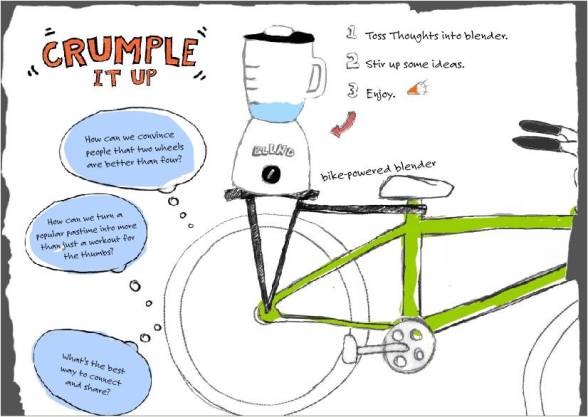
crumpleitupYou can go to their website CrumpleItUp to learn a little more about what they are doing with bikes called freewheelin and what they are doing around games and health.

They have a fascinating group there in Louisville that works on innovative ideas.  A lot of them don’t drive the core business of health insurance but they are related to improving the health of the general public or looking at interesting ways to use technology.

They have recently added a blog about this that you can see here.  Additionally, I had a chance to meet with Grant Harrison from this group at the WHCC and also hear him speak as part of a panel on innovation.  I was very impressed with him and a few of the other people in the group.

As John talked about over at Chilmark Research, it is refreshing to see someone focusing on this type of innovation.  When I talked about innovation with a reporter recently, I suggested that Humana would be one of the first groups that they should interview.

Design For Six Sigma (DFSS)

Getting it right from the start is always a critical issue when designing process-based solutions.  DFSS or Design For Six Sigma is an approach that companies are starting to use in applying the rigors of Six Sigma to their product management approach.  This allows them to leverage proven fundamentals using a DMAIC framework.  (DMAIC = Design, Measure, Analyze, Improve, Control)

DFSS is built around a couple of Six Sigma fundamentals such as the VOC (Voice of the Customer) and the CTQ (Critical to Quality) framework (example.  Understanding root cause of issues in your process allows you to start finding solutions for them.

And, however you approach this, it is critical to understand your value stream (i.e., where is value created) and have a statistically valid approach for capturing data and rigorously reviewing and improving the process (i.e., continuous improvement).

The other thing that all this Six Sigma talk makes me think of is an automation of process which can be seen in a lot of the BPMS (Business Process Management Systems) which exist.  These process based applications can be created as flexible tools that sit above (i.e., abstracted from your legacy systems) to run using an event-based architecture (i.e., data triggers) or SOA (service oriented architecture).

Why do you care as a member or patient reading this? Because you hate things that don’t flow smoothly.  This approach is supposed to begin with the customer, understand their needs, develop a process with minimal potential quality or failure points, measure and continuously improve the process, and then automate the process with the flexibility of making dynamic changes as the needs and market changes.

Why do you care as a healthcare enterprise? Quality is always an issue.  As the economic times squeeze everyone, it is going to be critical to find efficient ways of improving processes and automating processes to drive better results without sacrificing quality.

Joining The Board of Advisors at CareFlash

After learning more about CareFlash, I was excited to have the opportunity to join the Board of Advisors.  You can learn more about the company below, but what struck me was the examples of how this could be used by a family dealing with a complex medical situation where they needed help from their community of friends.  After seeing several families with kids in the ICU for prolong periods of time, I can only imagine their challenge in keeping everyone up to date on their child’s condition and seeking out help with errands without being overwhelmed.  CareFlash offers a simple, Health 2.0 type approach to solving that problem using blogging, a shared calendar, and 3D annimation of medical conditions. (See a video tour here.)

We deliver unprecedented healthcare advocacy and world class education to people in the richest circumstances imaginable, while offering unique philanthropic benefits to healthcare-related foundations, advocacy groups, religious institutions, etc. What CareFlash does is unique and unprecedented… and free.

When someone learns that they (or their loved one) have been diagnosed with a chronic healthcare challenge, a flurry of painful emotions appear ranging from fear and feelings of aloneness, to anxiety, uncertainty and even depression. As families begin the process of navigating through this experience together, it commonly becomes clear that people are unprepared and inexperienced at the realities of serving as a caretaker. CareFlash addresses these challenges, empowering our users to do the following:

Establish private and secure online communities around a loved one in order to share and facilitate updates, discussions and well-wishes

  • Update friends, family, coworkers and congregants through a ‘many-to-many’ communication tool. CareFlash streamlines the sharing of updates and well wishes
  • Educate the patient, caretaker and community on the specific disorder and treatment options at hand, using easy to understand 3-D medical animations narrated in plain everyday English, Spanish and other languages.  They range from pregnancy and neonatal issues to cancer, cardiovascular, ears/eyes, neurological, genetic, bladder/kidney, digestive/mouth, endocrine, blood/immune, respiratory, orthopedic, skin/cosmetic and hundreds of others.
  • Engage and organize involvement where help is needed… doing so in an unobtrusive, non-confrontational way through our easy-to-use iHelp Calendar
  • This is all offered to our users for free because our revenues are derived from advertising

In addition, CareFlash delivers unique philanthropic benefits to healthcare-related foundations and institutions, advocacy groups and religious institutions via alliance partnerships that provide them fundraising and marketing… never at any cost to them.

Another more lighthearted video about CareFlash is below.

This is a free service so I would encourage you to consider recommending this to families you know who could leverage this technology approach.  It is also a great tool for alumni groups (e.g., colleges, large institutions) or organizations who deal with families or patients to promote (e.g., specialty pharmacies).

MD Rating Sites

(Getting a few things out here and off my desk)

This is a question I often wonder about.  I was glad to see that e-patients put a report online.  I haven’t read it yet, but I think it is something that many of you would want to know.

I think that the main issue Given hit upon in the report (but I’m not sure she recognizes as the primary challenge of doctor rating sites) is the numbers issue. With over 700,000 physicians in the U.S., a ratings database of 10,000 or even 20,000 is pitifully and woefully small.

Ix and Health 2.0

Yesterday, I had a brief (5 minute) opportunity to present on a webinar by the Center for Information Therapy (Ix).  Similar to the Health 2.0 conferences, they talked about some trends and then asked 5 companies to talk about how they were delivering information to patients/members.  The companies that presented were:

As one of the moderators observed, it is interesting to see how information is being delivered using different modes.  Certainly web is great if you get people there, but as I think I have spoken about before, one of the challenges is that some of the patients at the highest risk aren’t engaged so you have to have an outbound strategy to engage them.  You can’t depend upon them engaging without being prompted.

Health 3.0 Conference

I guess we shouldn’t be surprised.  The Health 2.0 movement has gotten lots of press and had great attendance at the conferences.  Now there is a Health 3.0 LinkedIn group and conference

I am not sure I know the difference yet.  I speculated on Health 3.0 after my first Health 2.0 conference to get a stake in the ground.  The one big thing that I notice is that the speakers are established companies talking about what they are doing which was one thing missing in the Spring Health 2.0 conference, but which seemed to have changed slightly in the more recent Health 2.0 conference in October.

More On The Economic Impact On Healthcare

Deloitte just published the results of a survey they did which continues to hammer home the issue of how today’s economic times are affecting people’s health behaviors.  I am just getting ready to do my webinar on this.

Here are some of the results from Deloitte:

  • Only 6 percent of Americans surveyed believe their family is completely prepared to handle future health care costs.
  • More than half of respondents surveyed said that reducing costs (67 percent), increasing access (56 percent) and improving quality (57 percent) of health care are issues that are important to them in selecting a president.
  • Of the survey respondents who reported delaying or skipping care in the past 12 months, 27 percent said they did so because they could not afford the cost.
  • Nearly half (47 percent) said their household’s spending on health care products and services has increased during the past 12 months, and 63 percent said it limits their spending on other essentials.
  • Twenty-two percent said they have an outstanding medical bill that is more than 90 days past due.

So, I guess the question is “What are you doing for your members?”:

  • Are you helping them understand how to save money?
  • Are you encouraging them to stay compliant with their medications to avoid complications?
  • Are you encouraging them to be preventative (e.g., flu shot) to avoid ER visits?
  • Are you providing them with timely guidance on when to use Over-the-Counter (OTC) medications versus prescriptions?
  • Are you helping them split medications?
  • Are you moving them to mail order?
  • Are you encouraging 90-day prescriptions?
  • Are you offering them incentives for being healthy or managing their health – coupons, points?

We are seeing a lot more interest from members in this information.  They don’t know what they can do, but they want to do something.

Of course, the challenge is setting up these programs, personalizing the messaging, and getting results.  For those of you interested in these programs, contact me.  We have had some great results offering these as a turnkey service and driving the success rates up dramatically.  [2-5x improvement in 5 weeks]

No More “Robo-Calls”

This is a phrase you have probably heard several times this election period.  Somedays I think the same thing when I get 5-6 a day mostly from the Obama campaign.  It reminds me of some education I do with a lot of companies on the technology evolution around outbound calling.  Let me hit a few key points here.

First, everyone across industries is trying to figure out how to improve their access to customers (members).  How do they keep them up to date with relevant information in a timely, efficient, and effective manner.  Direct mail is a dying strategy.  E-mail is good sometimes, but you can’t push sensitive health information out via e-mail.  Text messaging has a role, but it’s not relevant for everyone.  So, automated calling has become a first-line solution rather than using call center representatives which are expensive (or more often as a complement to the call center representative making them more efficient).

Historically, call center representatives would “smile and dial” just trying to catch someone at home.  You might get lucky, but in most cases, you call 5-10 times just to get a person on the phone to talk with.  It’s not a good use of resources and time.

The next evolution was the dialer technology which calls out to people and once it hears a voice, it transfers the respondent to a call center agent.  But, the voice could be an answering machine in some cases or in many cases it might not be the right person.  These are the annoying calls you get where there is a delay after you say hello and before the person at the other end responds.  The technology is searching for an agent that’s not on the phone to connect you with.

People realized that using agents to call out wasn’t always necessary so they moved to “blast” or “robo-calls”.  These are non-intelligent calls that simply push a message out to someone.  As soon as you say hello, they start playing a recorded message and likely repeat it at the end in case it’s an answering machine they are “talking” to.  There is no interaction and no personalization.

But, that technology too has evolved.  You can now place highly personalized and interactive calls that leverage speech recognition technology.  The calls use your name and ask you to confirm that they are speaking with the right person.  The calls use the name of the company calling and potentially your employer.  The calls can also provide personalized information such as the drug you are taking or the health condition you have.  The voice is a recorded voice not a text-to-speech (TTS) solution.

The calls respond differently based on how you answer certain questions – i.e., different paths are dynamically generated.  And, the calls start to interact with other modes of communication – would you like to transfer to an agent to talk further?, would you like a copy of this offer sent to you in a letter or e-mail?, would you like a reminder sent to you as a text message?, or would you like us to fax your physician to get a new prescription for you?

The technology focuses on the interaction with the consumer and making it a pleasant experience.  In healthcare, people respond to this technology because of several factors:

  • It’s highly personalized to them.
  • It’s coming from a company they trust – their health insurer or pharmacy.
  • It’s interactive and conversational.
  • It’s important information – refill reminder, savings information, benefit change.
  • They have to authenticate themselves in order to receive sensitive information.
  • It adapts to them (e.g., please call me for future calls in the morning).
  • It offers them an opportunity to talk to an agent by transferring.

Now, I would say most companies are evolving from individual campaigns using different modes of communication (letter vs. calls) to an integrated communication strategy which has common messaging and is based on consumer preferences.  This approach allows for even better results and continues to drive personalization and customization based on historical learning and experiences with the individual.

But, mass customization does require technology and analysis.  Pulling in different data elements and looking at how to best deliver a message and get someone to listen and take action is complex work.  But, it’s a lot of fun watching success and outcomes improve as you move across the continuum.

Tough Times To Start A Company

After trying my own venture a few years ago, I have greater empathy for this challenge. I have watched a few friends and neighbors doing this. I have the ultimate respect for them.

Even so, most business experts conform to a theory of “thirds”: Of all the new business startups, 1/3 eventually turn a profit, 1/3 break even, and 1/3 never leave a negative earnings scenario. According to a study by the U.S. Small Business Association, only 2/3 of all small business startups survive the first two years and less than half make it to four years.  (source)

A few comments I have heard from friends:

  • A physician who wanted to go out on his own to open his practice (a time honored tradition) could not get a loan and even putting up his house didn’t work since the house was worth less than he owed.
  • A friend who does small business loans told me that the criteria to approve loans made it difficult for her to give small companies money.
  • I talked to a VC on my plane this morning who said they can’t raise funds in this economy and that valuations are down since there is less money chasing deals.

Then in USA Today, they had an article about venture capitalists losing their nerve.

  • US venture capital for the 3rd quarter dropped to $7.4B (down 7% from last year).
  • There were only 270 information technology deals done in the 3rd quarter which is the lowest quarterly amount since 1st quarter of 1996.
  • The Silicon Valley venture capitalist confidence index hit 2.9 (lowest in 5-year history of the index).
  • Tesla Motors, Redfin, Zillow, and AdBrite (promising start-ups) have all announced layoffs.
  • People are looking to sell their holdings in venture funds to companies like Industry Ventures that buys holdings at a discount.
  • The exceptions are biotech and clean tech which continue to grow funds.

Health 2.0 Conference

From the outside looking in, it looks like the Health 2.0 Conference is going to be a big hit this week with almost 900 people attending.  Rather than going to back-to-back conferences, I opted to go to a pharmacy conference over this one which has several of our executives attending.

It promises to be an interesting session, and it looks like the press coverage of the event continues to go up.

To learn more about the conference – click here.

To official conference blog is here, but I expect there will be lots of bloggers adding their notes.  They also pointed to Twitter for information (use #health2con or #health 2.0).

Some of the companies sponsoring the conference include:

Kaiser Permanente

Johnson and Johnson

Cisco

A.D.A.M.

American Well

Connextions Health

Community for Connected Health

Destination Rx

Edelman

ICW

ICW

Sage Software

Sermo

Eliza

Microsoft HealthVault

Myca

PhysiciansWellnessNetwork

RightHealth

Silverlink

TelaDoc

Athena Health

Physic Ventures

Safe-Med

Cisco

Locate-A-Doc

OptumHealth

SharpBrains

PrivateAccess

BeWell

BodyMaps

Invest Northern Ireland

healthcare

phreesia

olive tech

gene ed

Conecto

Within3

Navigenics

Praxeon

Relay Health

PharmaSurveyor

icyou

Medical Marketing and Media

MHS

MHS

Article On Silverlink Communications

The October 2008 issue of ADVANCE for Health Information Executives contains a nice article about Silverlink Communications by Robert Mitchell. Here are a few items from the article:

  • It focuses on our Adaptive HealthComm Science approach which brings decision sciences to the area of driving healthcare behaviors. [This is what leading consumer companies, credit card companies, and gaming companies use to understand consumers.]
    • “Adaptive HealthComm Science looks at microsegments of the member population to try different interventions with different populations — all standing against control groups and measurements of what works best. It then adapts, learns and tries again. “The communication system continually learns and automates its processes so that it is capturing new data and learning along the way from those interactions. It is consistent and can be measured.”
      • It is amazing to see how much programs can be improved over relatively short periods of time by rapidly testing isolated variables to find the right solution for each microsegment of the population.
    • One of my favorite examples from my past was simply using stamps turned at an angle on a letter to improve the rate at which direct mail was opened. It looked more like a human had hand licked each stamp rather than a machine which put the stamp on perfectly each time.
  • It talks about the ability to do on the call calculations and dynamic pathing on the core automated calling platform.
    • On-the-call calculations: If you have 3 drugs to refill, but you only choose two of them then it can tell you what your copay is. Or, if you tell the caller your weight, it can calculate the difference from a prior weight it had collected.
    • Dynamic pathing: Based on answers you give, the call is intelligent enough to serve up different content to the member and/or route you to a different group of live agents based on rules.

“We’ve invested heavily in people, technology, processes and a methodology that continuously improves to maximize the effectiveness of health care communications,” Stan Nowak, CEO and co-founder of Silverlink, said. “Over the next few years, changes in the way health care stakeholders communicate with patients and health plan members will be one of the keys to lowering health care costs while driving consumer affinity.”

“To the consumer, health plan products are largely undifferentiated on the basis of benefits or network, and consumers experience their health plan almost exclusively through the communications they receive from the plan,” Nowak continued. “Health care organizations have an opportunity to clearly differentiate themselves through proactive and personalized communications, improving their members’ experiences with each interaction, and earning consumer trust and affinity. In essence, for health plans, communications is their product.”

How Are You Classified?

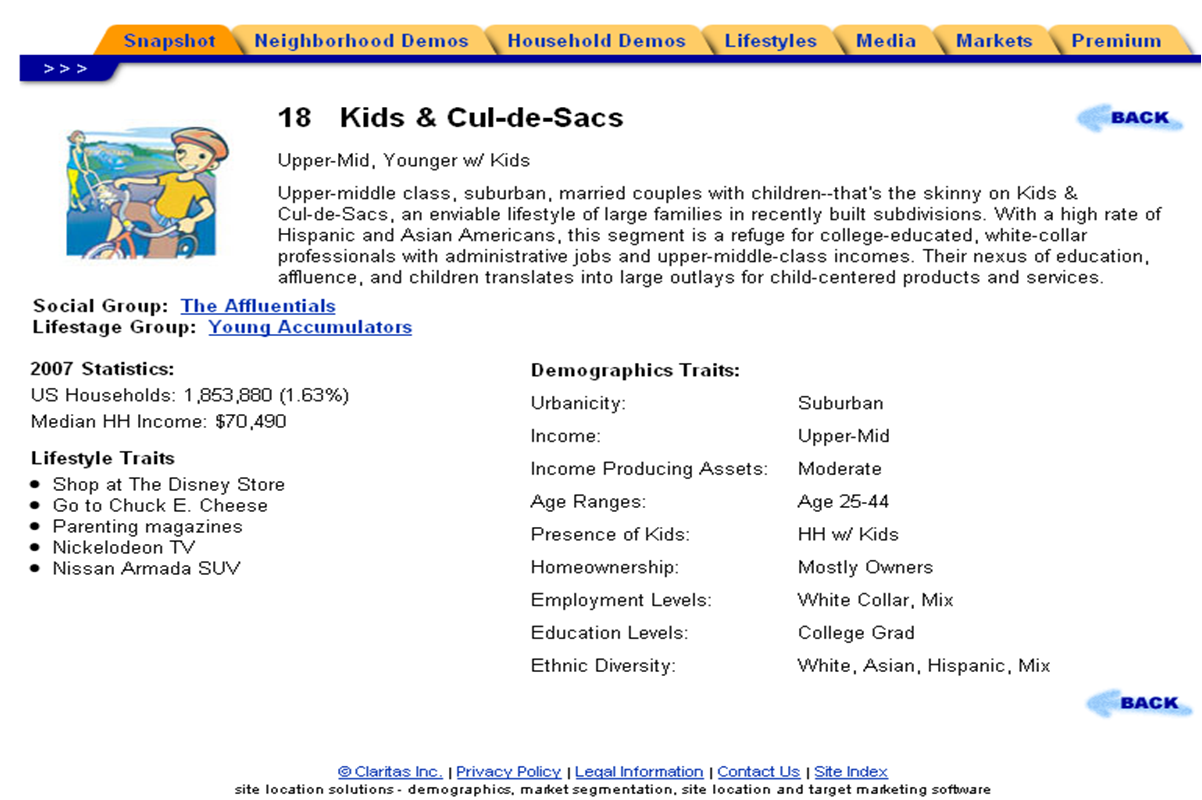
One of the typical models used by consumer marketers is the Prizm model by Claritas.  If you’re interested in whether you’re a “Pools & Patios”, “Home Sweet Home” or “Empty Nest”, go here and put in your zipcode.  In my case, it gave me five possible classifications – Blue Blood Estates, Exec Suites, Kids & Cul-de-Sacs, Movers & Shakers, and Winner’s Circle.  After looking at them, I could quickly see myself being classified as the Kids & Cul-de-Sacs one (see below).

They start with 66 different categories which can be used.  Of course, this is primarily driven by zipcode and a few other attributes and misses things around your attitude towards health that you might find in other health segmentation models, but it is an important marketing fundamental to understand.

Express Scripts Patient Segmentation

In a recent investor deck, Express Scripts laid out some of their segmentation from their Consumerology program.  This is similar to some of the work we do with clients at Silverlink Communications to help them develop segmentation models through a test and control approach.

What they have come up with are 5 segments of their members – “Movers and Shakers”, “Rock Solid”, “Getting By”, “Rising Stars”, and “Here and Now”. They describe some of the attributes of each segment on the first slide below and then show how messaging on driving mail order utilization was applied for each segment over the web.  The final slide below shows the results when the targeted messaging is used on the web.

It will be interesting to see how that messaging plays out via other channels (i.e., letter or outbound call) and when pushed to the member versus a situation where the member is on the portal and looking for information (a fairly engaged member).

Revolution Health For Sale

I was a little surprised to find out that Revolution Health is up for sale.  On the one hand, they pursued a WebMD type strategy when we all know tons of companies have died going down this path.  But, they had lots of money and lots of smart people.  Does that mean success?  Not necessarily?  We have all seen the teams full of stars that can’t outperform the true team of average players.

On the flip side, it seems so early to go up in a space that is obviously destined to grow.  It just goes to show how undefined it is and how hard it is to make money.

Texting for Deductibles and Copays

I often get a lot of ideas from financial services.  I was watching a banking advertisement yesterday where the customer could text their bank to get a real-time balance.  It made me think what a great service that would be in healthcare.

Imagine texting your plan for an immediate response on:

  • Your deductible
  • Your FSA balance
  • Your copay on a specific drug
  • Whether a provider is in network
  • The status of your prior authorization
  • A list of formulary alternatives

Since a lot of the logic exists, the question becomes one of using this medium and designing a secure mechanism for accessing the system and providing information.  Patients would have to register their mobile phone and approve it for PHI.  (There may be more to this, but it seems like it must be doable.)

Disease Management Evaluation – Care Scientific

My former boss, Brenda Motheral, from Express Scripts spent a year at Healthways running their research group and has now decided to go out and do some consulting (new company is Care Scientific).  Her evaluation of the Disease Management industry was just published in the Journal of Managed Care Pharmacy.  It is a pretty critical view of the state of the industry.  Here are a few highlights:

  • There have been several articles published questioning the value of these programs this year.
  • There are five reasons for dissatisfaction:
    • Desire for better alignment of vendor and client interests
    • Desire for greater transparency in business arrangements
    • Desire for improved plausibility in reports of financial and clinical outcomes
    • Desire for more rigorous evaluation methodology
    • Desire for more convincing evidence of outcomes improvement
  • There is misalignment today…For example, if I get paid per member, how hard should I try to contact them when all that will do is drive up my costs.
  • Lack of alignment can be addressed through contractual requirements and pay per engagement.
  • There is a lack of data available on how many members are contacted.  [Not for companies that use Silverlink for their automated outreach who have real-time data available with detailed call information.]
  • There are calculation questions in comparing vendors.  [Something I have talked about several times here.]
  • She compares the move to transparency in this industry to what happened to the PBM industry earlier this decade which created new competition and changed several business models.
  • She advocates for really looking critically at the ROIs claimed by these vendors and talks about NND (number needed to decrease) which is the model that the DMAA (Disease Management Association of America) adopted as part of their outcomes guidelines.
  • She also raises concern about DM companies moving into wellness which is another area “fraught with numerous new methodological issues that warrant close attention”.
  • She talks about an industry push (from buyers) to demand new expectations from vendors.
  • She talks about the fact that the focus on ROI may not make sense since “literature suggests that less than 20% of treatments for existing conditions are cost-saving.”

“Plan sponsors also bear responsibility for the current situation.  As long as they demand a short-term ROI in the current model and inconsistently require comparison groups, they are more likely to promote methodological creativity than they are to inspire true innovation.”

As with the dozens of publications she has had over the years, this one is well written with a well referenced set of facts.  She presents a challenge to the industry in how to approach.

The challenges are interesting to reflect on given the overall industry focus on improving healthy behavior, being more proactive, more actively managing patients, and other activities that a DM company should be well positioned to do.  But, a high touch model is certainly challenged given lower cost options.  Creative solutions that leverage technology to identify gaps in care, create data segments, personalize interactions based on preferences, and use motivational interviewing to drive behavior exist and should be able to create value.  It will be an interesting 12-18 months for the industry.

Medco’s CEO on National Healthcare Reform

David Snow, the Medco CEO, presented his blueprint for healthcare reform today. You can read it here. My notes from reviewing it are:

  • We’re paying twice as much per person (~$7,000) as other countries with little incremental value. To get back in balance, we need to reduce costs by 50% or $1 trillion per year.
  • 3 rules for reform:
    • “First, keep it simple – in business, complex solutions always fail.” [good advice…difficult to do with politics and government involved]
    • Incremental, evolutionary change is more accepted than revolutionary change. [yes…but it will take a lot longer]
    • Government and private sector’s roles have to be clear:
      • Government – promulgate and regulate.
      • Private – operate and innovate.
  • “Setting policy around life-and-death decisions is, and should remain, the province of the public sector.” [what politician or elected official wants to determine the value of a life]
  • Five suggestions (which create $1 trillion in savings per year):
    • Wiring healthcare
    • Fixing Medicare’s financial fundamentals
    • Eliminating medical liability and defensive medicine
    • Increasing compliance and reducing errors
    • Promoting healthy lifestyles
  • “In an era when preschoolers use the Internet to chat with friends half a world away, it is inexcusable that doctors write prescriptions – in Latin – that patients need to take to another professional in a process fraught with countless opportunities for error.”
  • “30% of Medicare spending today, roughly $130 billion, relates to healthcare costs incurred by patients in their last year of life – often where there is no hope for recovery or improvement in quality of life.”
  • He makes some good points about the need for government involvement in changing attitudes around wellness comparing it to the changes around forest fires and seatbelt safety.
  • “When our political discourse is limited to ‘who pays the bill’ instead of ‘the bill is too high,’ and fails to address root-cause problems, that isn’t health care reform.”

Payers Spending On BI and Information Delivery

“Healthcare payer spending on business intelligence, information delivery and transparency is the fastest growing spending category in 2008 for healthcare payers,” said Janice Young, IDC Program Director, Payer IT Strategies.

This quote was in our press release this morning around the growth at Silverlink.  You can read about the company in the release, but I wanted to focus on this quote from IDC.

On the one hand, I think consumers should be saying “Amen!” that payers are focusing on business intelligence (BI) although that can mean a lot of things.  On the other hand, they would shocked to know how new this is to the healthcare space compared with the consumer packaged goods industry.  BI can help identify gaps in care and identify how to help patients become better.  BI can help personalize the messaging that you receive from your health plan so you don’t have these huge legal caveats about all savings and other specifics being based on your exact plan design and deductible.

Information delivery can also mean a lot of things.  Is this reporting to the employer?  Is this online analysis for the consumer?  Is this communications?

And, I am not sure what transparency means, but I hope it means things like letting consumers actually understand the price of goods and services and how to make tradeoffs between different options with all the data (e.g., quality, price, outcomes, patient experience).

Overall, for those of us in the healthcare communications space, this is a rising tide that helps.  It means the payers who support all of you consumers are raising the bar and looking at how to use their information to improve the experience and outcomes (ideally).  It could also allow them to better focus their efforts on the riskiest patients and discover the best way to drive behavior.

The data is there and has been there so figuring out how to use it and what to use it for is critical.  Mapping this against the patient expectations and desired activities can be a great positive for the consumerism movement.  Integrated data.  Accessible data.  Digestible data. Sounds great.

Health Plan Week on Retention

I had an opportunity to get interviewed a few weeks ago by one of the contributors to Health Plan Week about retention within health plans.  With growth in the group market stagnant and ultra-competitive, the individual market offers lots of upside, but makes satisfaction and retention a much bigger issue.

You can read the article here where it discusses things like the “top box”, the importance of personalized communications, and champion / challenger processes to determine the best approach.

Call Center Agent vs. Automated Calls

The other day I called some service provider to ask some questions about their product.  It was painfully obvious that the person at the call center was reading from a script.  This made me realize that there are reasons (beyond simply cost) for using automated, speech-recognition technology for calling people versus humans.

It would have been more conversational for me to have talked with an automated phone call where I could answer questions with certain hotwords that dynamically moved me through the path of the call.  Depending on content, I think it is often nice to have the option to transfer out to a call center agent since that role will never disappear.  Some people prefer a human (look at all the grocery store lines) and some exceptions don’t fit into a rules-based decision tree.

But, quality is a huge issue with complex plan designs in healthcare.  How do you teach each call center agent (especially when you have high turnover) to respond and explain things exactly the same?  You can’t unless you force them to read a script which is a bad experience for the member / patient.  We used to have to do lots of secret shopper calls to work with our agents to get them to the right place and meet minimum expectations.  Again, this is something that a computerized system can address.

The thing I always hear about calls is aren’t they like those election calls I get where the voice sounds a little computer-like (aka text-to-speech) or there is a big pause between the person answering the phone and saying hello and the actual recording kicking in or the live person talking.  With the top vendors out there, those are old issues.  There is no pause.  The messages are recorded in human voice.  Ideally, the variable text (e.g., patient’s name or drug name) are part of a custom audio library which is in the same voice.

Avoiding Calls Then Texting

CNet has an interesting article about teens avoiding live calls only to text back the person immediately so they can continue their current activity.  I do it all the time when I am in meetings or on conference calls.

They provide some interesting statistics on text messaging (see below) for this young group.  Not a prime focus for healthcare, but it will be interesting to see how this use of technology applies as they grow older.

More broadly, nearly one out of every two U.S. tweens (or kids between 10 and 13 years old) and 83 percent of teens own a cell phone, according to new research from Chicago-based C&R Research. And with that many kids using mobile devices, the text messages are flying.

The average teen, according to C&R, generates between 50 and 70 text messages a day, or as many as 18,000 a year.