Archive | Weblogs RSS feed for this section

Patient as Googler

This story seems almost unbelievable to me, but I am sure it is true.  Time Magazine published this story “When the Patient is a Googler” on November 8th.

It is basically a physician’s perspective on an aggressive patient that uses the Internet to find out lots of information about him.  The patient treats the physician with total disregard (which is unacceptable in any situation).  The physician on the other hand rants about patients and doesn’t grab control of the situation but simply “punts” her to another doctor.

“A seasoned doc gets good at sizing up what kind of patient he’s got and how to adjust his communicative style accordingly. Some patients are non-compliant Bozos who won’t read anything longer than a headline. They don’t want to know what’s wrong with them, they don’t know what medicines they’re taking, they don’t even seem to care what kind of operation you’re planning to do on them. “Just get me better, doc,” is all they say.

At the other end of our spectrum are patients like Susan: They’re often suspicious and distrustful, their pressured sentences burst with misused, mispronounced words and half-baked ideas. Unfortunately, both types of patients get sick with roughly the same frequency.”

In my opinion, they are both wrong.  Patients should certainly do their research before and after meeting with a physician.  They also need to give the physician a chance to use their training and experience to help the patient.  Physicians need to be open to patients doing research and asking questions.  They should be willing to suggest sites to patients for research.  This is not a subject that will go away.

There are several other discussion streams out there about this article if interested:

Identifying Your Generation

This discussion of using texting in healthcare (and other new channels) reminded me of a posting from earlier this year on Penelope Trunk’s blog.  [A great blog if you’re interested in career type topics and work / life balance with a focus on Generation X and Generation Y.]

Penelope introduces a quick “test” to determine whether you are a Baby Boomer, Generation Jones, Generation X, or Generation Y.  It made me feel old, but it is a good reminder of how technology and communication has changed radically. 

Mashing Two of My Posts

I was thinking about Google’s SMS service earlier today (see post on this).  Separately, I was thinking about my post on remembering health information (e.g., drugs, strength, previous lab values).

So I went to one of the Google Health Blogs to suggest the idea.  Unfortunately, the e-mail they list bounces back and you can’t leave comments…strange.  Why not combine the two comments from my earlier blogs was my suggestion?  Obviously, it only appeals to a piece of the population, but I would love to be able to text message my PHR (Personal Health Record) with “Rx name, strength” or “PCP name, phone” or “HCL scores and dates”.  [Look at myPHR, iHealthRecord, ActiveHealth, Microsoft, or Google for PHR solutions.]

It is always so difficult to remember that information, but if I could get it texted to me in a few seconds, it would be great.  I have to believe there is some unique code in my Blackberry that could serve as a unique identifier for security purposes.  Just a thought…

BTW – If you try to find Google blogs on health, you find out there are dozens of Google blogs:

“There’s all this hubub about what Google and Microsoft are doing,” Aetna CEO Ron Williams (pictured) said this afternoon on a visit to Health Blog HQ. “We’re perplexed by the fact that their vaporware gets all this attention and we get very little.” (comment on the WSJ Health Blog)

Don’t forget to add this blog to your reader or sign up for e-mail updates whenever a new entry is posted. 

New (to me) Blog – Consumer Focused Care

I found a new blog this morning called Consumer-Focused Healthcare written by an ex-McKinsey consultant which seems to have a very similar focus to my blog – “refocusing healthcare on serving consumer needs“.  [As a sidenote, the benefit here of LinkedIn was that I could quickly look him up and see that we have a mutual friend which instantly gives him some validation.]

Vijay has a lot of posts that I liked.  Here are a few exerpts:

  1. “the consumer often pays MORE for a visit to a retail clinic than a physician’s office. The implications are that they really prize the convenience and time taken far over the extra training provided by the physicians.”  In this blog entry, he shared some data about out-of-pocket expenses for clinic visits.
  2. “It is pretty clear that many doctors don’t know how to tell their patients that they have no idea”  In this blog entry, he talks about the inexact aspects of patient advice.  Determining a diagnosis or the right advice is very situational.
  3. “why are people willing to spend $3.50/ pill on sleep meds when they’re discouraged by $10 co-pays to take other, potentially life-saving medication?”  In this entry, he talks about consumerism.
  4. He also points out an assumption from Google that technology will push physicians to spend less time with patients which I think isn’t logical based on the work I did around e-prescribing.  I already put a comment in this blog entry this morning.

And, these are just his most recent entries.  I am interested to flow his blog more.

Bing Blog – A Little Harse?

Stanley Bing has written for Fortune for a while and now has a blog.  One of his latest entries is about healthcare and insurance.  Obviously, we have problems with the system (as pointed out in Sicko), but I found some of the comments a little harse.

We can get better, but we should all be thankful for what we do have which allows us access to experts 24×7 using good technology.  We pay a lot per measure of clinical outcome but we have lots of options for how to get treated.  The system isn’t seamless, but it generally works.

I guess for all the criticism which is easy to lob sometimes it seems too harse when people focus only on the negative.  The more you work in healthcare the more you realize how difficult it is to find the right solution.  I don’t envy the politicians.

Analyzing Your Writing

Lois Kelly has an interesting post on her blog about the Linguistic Inquiry and Word Count program. You run text through the program and it categorizes the writing style. She compares 3 CEO bloggers. I grabbed text from my site and ran it through.

If I understand the results below correctly, it says I am fairly honest, somewhat outgoing, not very optimistic, have no anxiety, am actively thinking about the topic, and use lots of big words. I am sure my writing about all the problems in healthcare explains the low score on positive emotions, and I intentionally try not to make things too personal.

LIWC dimension

Your data

Personal texts

Formal texts

Social words – outgoing

7.08

9.5

8.0

Negative emotions – anxiety

1.13

2.6

1.6

Big words (> 6 letters) – higher grades which tend to be less emotional

22.35

13.1

19.6

Permission Marketing – This is What I [patient] Want

Permission Marketing is certainly not my concept. Seth Godin invented the term and wrote the book on this several years ago. But, I think it is a concept way behind it’s time in healthcare.

“Permission Marketing cuts through the clutter and allows a marketer to speak to prospects as friends, not strangers”

The concept (in my words) is that you ask the consumer (aka patient) what they want.

  • What information do you want from us?
    • Opportunities to save money
    • Alternative therapies
    • News about your drug
    • Benefit information
    • Compliance reminders (Rx, lab visit, tests)
  • How do you want that information delivered to you?
    • Phone
    • Voicemail
    • Cell phone
    • SMS / Text message
    • E-mail
    • Fax
    • Letter
  • Does the channel you want the message delivered through vary by the message?
    • Deliver savings information within 24 hours to me via my cell phone
    • Send benefit information via PDF using my home e-mail address
  • When do you want that information delivered to you?
    • Pro-actively
    • Reactively
    • Bundled (i.e., send me one “package” of information monthly)

Wouldn’t that be nice? Most of us don’t even know what the options are. We just get bombarded with information from our employer, managed care company, pharmacy, PBM, disease management company, wellness programs, HSA / HRA account manager, etc. Different messages. Different information.

In reality, one of the biggest problems is that our healthcare companies just can’t manage these type of personal rules today. Managing do not call lists are difficult enough. This should change over the next 5 years, but it will be a combination of patient generated preferences along with data mining to develop algorithms that predict what channel and message is most effective at driving behavior for certain patient segments.

Title Change

Although I initially thought “The Patient Advocate” fit what I wanted to talk about which was advocating a patient centric marketing view of healthcare, it seems to have a lot of other meaning across healthcare.  I am going to modify the title to be “Patient Centric Healthcare” which hopefully isn’t a prior space and continues to fit my perspective. 

Several New Sites – Blogs and Other

Thanks to John Sharp for blogging about several interesting sites that I visited this morning:

  • Life as a Healthcare CIO Blog (see example entry on PHRs) – this is a new blog by one of the more outspoken CIOs in the industry.  Based on the initial entries, it should be an interesting blog to follow.
  • eHealth Initiative Blueprint – I haven’t read the PDF yet, but it sounds like an interesting organization.  Browsing the site offers lots of information and strategy level thoughts on how to improve healthcare across constituents using IT.
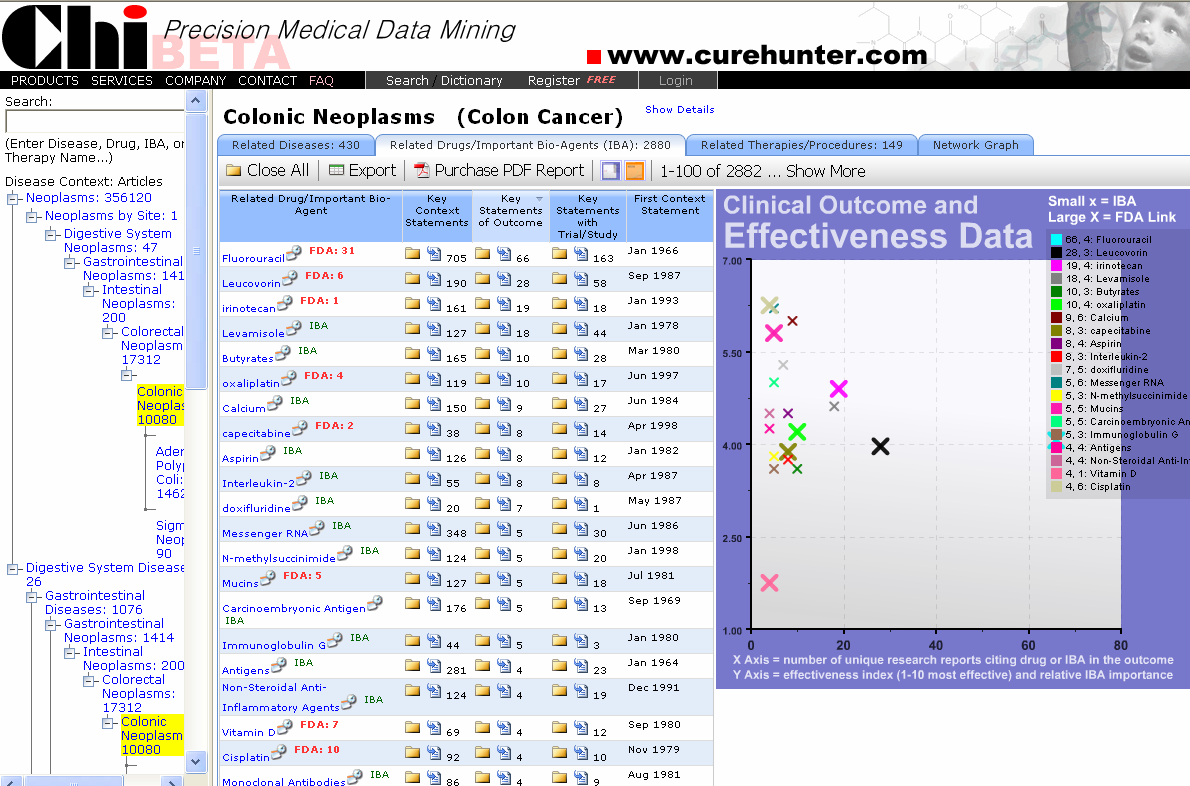
  • Curehunter – a new healthcare online data mining tool for pulling up disease specific research and information.  As described on their website, the uses for the application are:
    • For patients we provide low-cost Summary PDF Reports with all drug evidence for all known cures or symptom improvement
    • For medical professionals CureHunter on-line access delivers decision support in 10-20 seconds of real clinical time to make an evidence check as SOP as a BP or Temp
    • For pharma research scientists we offer powerful data export functions that deliver over 1.5 million specific clinical outcome data points to new drug discovery software
  • VisibleBody – this is a 3-D model of the human anatomy which will soon be available online.  The graphics that you can see look great and it seems like an interesting and fun tool.  Probably a good way to teach your kids or even explain to patients what is going on inside them.  From the site, here are a few things they say about using it:
    • View highly detailed models of all body systems. 
    • Search for and locate anatomical structures by name.
    • Click on anatomical structures to reveal names.
    • Rotate and explore anatomy in a virtual space. 
    • Peel away layers to view relative placement of the components of all body systems. 
    • See placement of specific organs relative to other anatomical structures. 
    • View anatomical structures with or without surrounding anatomy. 
    • Investigate anatomy virtually, without the costly cadaver lab.

visible-body.png

Quote on Blogging

A friend sent this to me after I described to him why I blog.  Very appropriate.

“Blogging is intellectual prototyping.” Roger Martin, dean of the Rotman School of Management, University of Toronto.

You put the ideas out there and start a conversation that leads to something… or not.  (Source)

Microsoft’s HealthVault

health-vault-microsoft.jpghealth-vault-microsoft.jpg

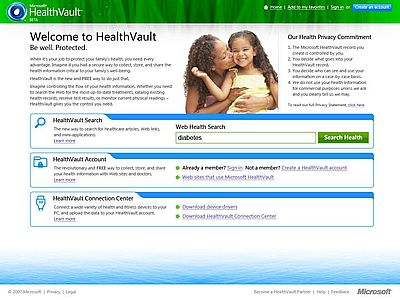
Microsoft has their new healthcare tool out – HealthVault.  It does three primary things – search, collect / store / share (i.e., PHR), and connect with devices.  The “connect with devices” concept seems pretty interesting especially as we get more intelligent home care devices that track blood pressure and other key metrics. 

Connect your HealthVault-compatible home health monitoring devices from partners, such as sport watches, blood glucose monitors, peak flow meters and blood pressure monitors to HealthVault Connection Center, and let our software copy your device data to your HealthVault record.

Given issues with Internet Explorer, will people worry about security – probably.  Given the challenge of connecting with numerous systems and devices, will Microsoft have a leg up – probably.  Will patients use these tools – definitely over the next 5 years.  Who will win – I don’t have a clue.

Here is their blog for developers.

There is lots of talk about this on blog sites:

Aetna CEO on Price Transparency

Here is a entry on the WSJ blog about Aetna’s new price transparency policy.  Conceptually, this is an important first step.  The next question of course is how do you get this to consumers in a timely and easy to digest manner.  Then, how does this correlate with outcomes (i.e., quality) and finally, how does this change people’s decisions.

It is great for planning.  It is great for benchmarking or negotiation.  But, I am waiting to see the impact.

Companies from Health 2.0

I thought it was interesting to catalog the companies that were at Matthew Holt’s Health 2.0 conference. Many of which I was not familiar with.

MedHelp.org (interesting site which offers Q&A by disease topic with MDs and nurses)

ThinkHealth (medical management software)

Health Evolution Partners (a private equity firm)

Medstory (intelligent search for health)

Healia (health search engine)

Healthline Networks (health search engine)

WeGoHealth (disease specific communities)

Patients Like Me (patients sharing information with other patients)

Daily Strength (support groups)

Organized Wisdom (MD handcrafted search results)

Inspire (health and wellnes support networks)

DiabetesMine (site all about diabetes)

Enhanced Medical Decisions (uses natural language to look at drug interactions)

HealthEquity (health savings account software)

DNADirect (source for genetic testing)

Within3 (social networking tool for physicians)

Vimo (comparison shopping for healthcare)

Careseek (sharing information about physicians)

Health Hero – home health monitoring device

Additionally, John Sharp mentions a few other companies in his blog including:

Unified Communications

Those of you that know me (or follow the blog) know that one of my key issues is how to improve healthcare communications.  I think this is where we (as an industry) missed the boat.  I used to tease our VP of Call Centers that Dominos knew more about me when I called in than we did.

I was glad to see a blog entry from earlier this year by the physician that leads Microsoft’s healthcare group on this topic.

“Healthcare is a communication intensive business.  Good communication has a profound effect on the quality and safety of patient care.  Communication also has a huge bearing on patient satisfaction.  Yet historically, the options for how we communicate with each other in the healthcare industry have been somewhat limited.” 

Obviously, we have a long way to go.  Many times companies simply give up due to regulatory issues or the challenges of changing behavior.  The reality is that communications are difficult.  It is both an art (i.e., messaging, branding, design) and a science (i.e., linguistics, data mining, targeting, personalization).

Technology will drive a step change in the relationship between patients and providers and insurance companies.  This is the time to jump on board and figure out how to improve.

Sad Example of Poor Customer Service

Assuming it is real…This is one of the worst stories I have seen about claims denial.  Not only is it insulting, but it also shows how frustrating the process can be.  (BCBSKC complaint)

“we have had Blue Cross and Blue Shield of Kansas City for less than three months, they have denied every claim we have submitted to them. EVERYONE!”

BTW – The blog here (The Consumerist) is pretty interesting.  You might enjoy some of the entries:

  1. Launching an e-mail campaign to get something resolved at a company.  (I have done exactly what they describe numerous times with great success.)
  2. Saving money on prescriptions by paying cash.  (Yes this can work, but you lose visibility for drug-drug interactions if you use multiple pharmacies and a lot of pharmacies charge you more then the drug costs not less…but it can work.)
  3. Sample letter for appealing an insurance claim.  (Seems interesting.)

Weight Loss Impact on Your Career

If you have never read Penelope Trunk’s blog, you are missing out.  She is one of my favorite bloggers and has good, controversial opinions about worklife.

I think we all wonder about the correlation between health and professional (and personal) success.  She has a good blog entry today about being overweight.

“Heavier people do worse at work than everyone else, employers discriminate against overweight people, and it’s even legal to do.”

As health drives cost and impacts performance (e.g., missed hours), people consciously or subconsciously pay attention to it.  We could debate endlessly the ethical issues here, but let’s stick with reality.  It happens.  So, how do you address it.

Some people don’t like smokers.  Some people worry about people that are chronically absence.  Others realize that caring for a sick kid impacts their entire team.

Bus Week Article on CDHPs

In a special Business Week Report, Joseph Paduda (who writes the ManagedCareMatters blog) provides a critical summary of CDHPs (see CDHPs: No Rx for Health Care).  I think he makes several good points (although some of the commentors seem to disagree).

“The concept behind CDHPs is simple: People will be more careful about choosing which health-care services they buy if a big chunk of the dollars comes out of their own wallet.”  [As I have said before, I thought the original intent was to drive transparency and improved quality, but it is clearly about cost shifting (oh sorry I mean savings) today.]

  1. Of all workers in employee health plans, the percentage enrolled in CDHPs went from 2.7% in 2006 to 3.8% in 2007.
  2. employers hearing horror stories from employees about the myriad issues with CDHPs: no money in the deductible kitty, providers refusing to discuss price or negotiate post-treatment, health plans refusing to require providers to accept negotiated contract rates.
  3. just 4% of large employers think CDHPs are “very effective” at controlling costs.
  4. To be a smart consumer, one has to have information on pricing, quality, and results. Not only is this information sorely lacking, much of what does exist is complex and difficult to understand, requiring a good bit of in-depth knowledge of health-care terms and procedures.

“A RAND Corp. study concludes that when individuals are required to pay more for prescription drugs, they don’t take them as they should. As far as drug co-pays go, increasing consumers’ costs actually drives up total medical expenses. It’s not a great leap to think individuals with high deductibles will likely wait before scheduling an appointment with their physician to see if a problem just goes away on its own. That often leads to higher costs as the patient’s medical condition worsens and grows more difficult to treat.”

Health 2.0 Conference – Blogs

This week was the Health 2.0 Conference in San Francisco.  I was not there, but I am sure it generated a lot of good discussion.  Numerous bloggers were there and put there comments up.  Here are a few sites for content.  It is certainly worth the read if only to keep up on new technology and new buzz words.  But, getting together a group of technologists focused on changing healthcare can only lead to some new ideas.

The Health Wisdom Blog

The Healthcare Blog

Francine Hardaway’s Blog

The Healthcare Law Blog

The eHealth Blog

Healthcare IT Blog

Silverlink – My New Employer

After trying a few entrepreneurial things, I am excited to have accepted a job working with a consulting client of mine – Silverlink Communications. [I am also a former client of theirs from my time at Express Scripts.] The role is a good mix of entreprenerial and stability since they are a high growth, VC backed company. And, one of the most impressive things is their track record of delivery and impressive clients including lots of the big MCOs and PBMs (examples).

As I was getting ready to do an e-mail blast out to a 1,000+ people in my Outlook database, I figured that linking them to the blog and answering their predicted questions here might be a good solution. I could go with the micro-segmentation of my audience (i.e., my healthcare friends want to know something different than my consulting friends) that I started to do, but it’s turning out to be more time consuming than I would like.

So here goes. Here is more information about what I am doing and why. If you are in the healthcare space, I would encourage you to look at Silverlink and give me a call. We can leverage our technology and services to help you cut costs, grow revenue, and inprove patient satisfaction and outcomes.

Q&A:

  • Who is Silverlink and what do they do? Silverlink is a healthcare technology company that provides HIPAA compliant, targeted communications to patients [consumers] primarily using a automated voice-centric technology. This allows them [us] to push information (e.g., reminder call), collect data (e.g., surveys, COB, HRA), and qualify leads for transfer to a live agent (e.g., retail-to-mail, brand-to-generic, 30-day to 90-day). They provide consulting support, data mining, and great reporting. [and now outsourcing]

[Official PR Text] Silverlink is the leader in automated voice solutions for healthcare enterprises. Silverlink’s services enable customers to design, deploy and manage HIPAA compliant automated call programs to educate, collect information from and drive behavior of thousands of patients and members at a time. Serving six of the top ten health plans and with a customer base that collectively represents over 150 million covered lives, Silverlink drastically reduces the cost of communicating with customers while improving financial results and customer care.

  • Why did you join Silverlink? (A) Proven Value Proposition and Technology. (B) Great Team. (C) Very Impressed by Client Feedback. (D) Good Investors. (E) Great Market Demand.

We saw great results at Express Scripts. In one controlled study we ran through research, we saw our success rates improve by 30% by blending letters and calls. Additionally, access to data and flexibility were critical. We launched one new call program in under a day (either for Katrina or for a new drug warning).

Everybody is talking about consumerism and Health 2.0. Silverlink plays right into that strategy. Delivering timely information to patients. Blend their core technology with multi-modal, data mining, and experience based branding, and you have a unique opportunity to change the paradigm.

  • What are you going to do for them? I am going to be responsible for building out a business process outsourcing (BPO) and professional services group. As with any process oriented change, technology often enables step improvements. Their core technology has allowed companies to radically reduce key metrics (cycle time, response rates, collection ratios). By helping drive more of the process, introducing some new services, and leveraging our industry experts, we will help clients drive market differentiation.
  • Should I look at them as a solution provider for my business? If you are a PBM, mail order pharmacy, specialty pharmacy, medical device fulfillment company, or managed care company, they have many proven solutions to help you with. If you are a retailer, disease management company, or provider, there are numerous ways to use the technology. And, if you are a technology or services company, there are ways of embedding their technology into your solution.
  • Do consumers really like automated calls? You would be surprised. Using good voice talent with the right caller ID with the right sonic branding will get people to answer the phone. People throw away mail. We get too many e-mails. We still answer the phone and listen to voicemails. The response rates are great. On some programs, a reach rate in the 80-90% rate is not unusual.
  • (For my VC friends) Who backed them? There are several angels along with HLM (big healthcare VC firm), Kaiser Ventures, and Sigma Partners ($1.5B technology VC firm).
  • What happened to the other things you tried over the past year? Neither took off. Learned a lot about being an entrepreneur. I put a lot of my lessons learned here. No regrets since I believe everything happens for a reason.
  • Are you relocating? Not for now. We are going to try commuting. Since I will be spending time with clients and in other meetings, we are going to see how this works. Plus, the housing market is no good (at least for selling).

I am sure I could go on. But, while you are here, I would encourage you to look at the Silverlink website (PBM, MCO, Medicare, Medicaid, DM, Specialty/DME) and also at rest of my blog. If interested, register to get updates to the blog via e-mail by clicking here.

WSJ Healthcare Blog – Medical Records “Score”

I was reading through the WSJ blog on healthcare and found an interesting item around medical records being the new credit score. It’s a good point. With people’s sensitivity around getting insurance coverage, you certainly don’t want to have a mistake in your healthcare information (at least not one that makes you appear more sick).

With all the manual data entry in healthcare, I would not be surprised that this happens.

Here is the blog entry.

Information Therapy Blog

I was looking at the Healthwise website and The Center for Information Therapy and came across a blog by the team there with some good discussion topics. It is definitely worth your read. Here were a few things that caught my eye:

  • Can we more effectively engage consumers in better managing their own health by learning from Hollywood or video games about how to draw people in through entertainment? By doing so, can we make health care “fun” or at least truly engaging? (entry)
  • Since research shows that 40%-80% of everything a doctor tells a patient in the office is forgotten, taking along a patient advocate is a great strategy. Unfortunately, it is not always an option or sufficient. In order to ensure effective communication, every patient should leave the doctor’s office with an information prescription (Ix). (entry)

20/20 view vs. Sicko

I enjoyed Sicko.  The movie made you think.  All information comes with perspective.

20/20 had a good piece the other night which showed John Stossel talking to Michael Moore and bringing up lots of interesting facts about Canada and Cuba and asking tough questions.  It was a good opposite view.

Rather than rehash, I will point you to Kevin MD’s Blog which has links and provides some other blog summaries.

Google – Thoughts from another blogger

Anyone working in healthcare IT knows it is difficult to drive change – legacy systems, lots of constituents, no standards or years of trying to get one, regulatory issues, etc.

I liked Scott Shreeve’s letter to Marissa Mayer who is apparently taking over Google Health with Adam leaving.  As one might expect, Google‘s presence in healthcare leads to lots of rumors.  I saw one earlier today talking about them buying WebMD (rumor).

Scott hits on several things:

  1. Get ready to rumble (this won’t be easy)
  2. Get transparent (don’t get caught hiding something)
  3. Get a product out (act don’t simply plan – see what the patient’s say)
  4. Throw your weight around (we need big players to drive change)
  5. Start small then throw your weight around (I would have called it KISS – keep it simple stupid)

Patients Sharing HC Experiences & Cost

Obviously, a big part of true consumerism will be patients sharing information about their healthcare experiences (e.g., this doctor is great, you wait too long here, this drug gave me hives) and their costs (aka transparency).  There are several locations moving towards this especially around disease specific discussion groups.

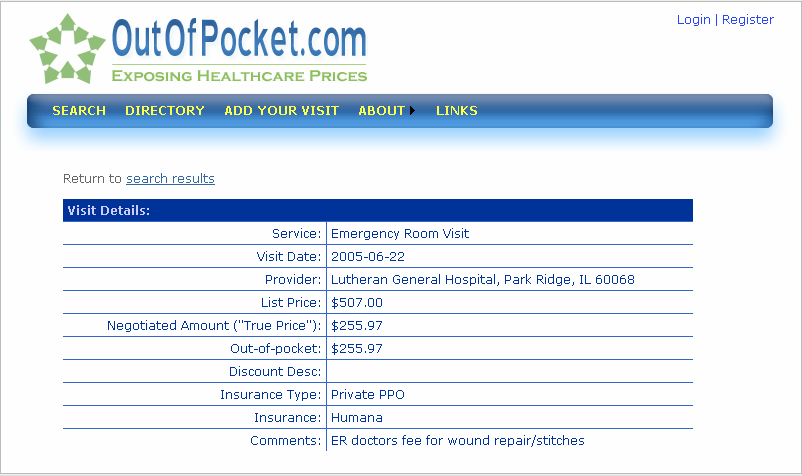
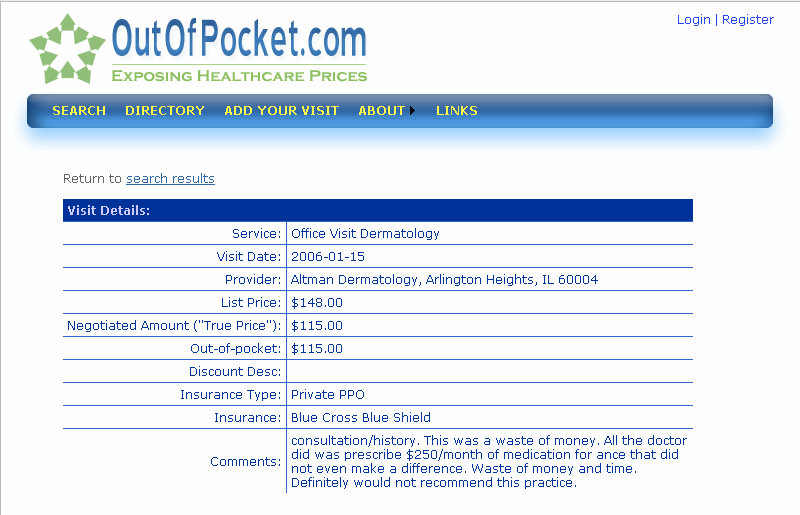
One new site that contacted me is OutOfPocket.com.  It is still very early stage, but it has the right concept.  You can go online and look up the comparative costs of a treatment or office visit in your area.  Below are two examples.  I like the second one where the patient cuts to the chase in the comments area.  The company also has started a blog recently which I look forward to being cutting edge and aggressively laying out cost data.

outofpocket-site1.png

outofpocket-site2.png

Other Blog Posts

Here are a few other posts of interest.

On InsureBlog, there is a good entry about the clinics popping up all over the country.  There is debate from physicians, and he cuts to the chase saying their claims are ridiculous.  I for one hear about all the inducement issues and steerage issues, but what is the prevalence.  How many docs own establishments that they push or get kickbacks?  Probably not something we will ever know, but something we should.

On Managed Care Matters, there is a debate about using claims data to evaluate physicians.  I haven’t studied the literature, but we need something to evaluate their behavior and successes.  If not this, what.

This is an older entry on Health Literacy, but it is a critical issue.  If those that most need information don’t use traditional sources, how do we reach them?

In another blog, I found the suggestion of using YouTube to post patient stories a good one.   It is a powerful tool to have people talk to people and share their ideas and experiences.  This would be great in healthcare.  I value that information.

I was also intrigued to see so many sites about pharmacy and most of them angry about the PBMs or large chains or customers.  Here are a few:

Some other recent blog entries

I always like to watch other blogs and look for interesting entries. Here are a few good ones that you might enjoy:

  1. Google and PHR
  2. Bluetooth heart monitor (exactly the type of idea I believe will be here soon)
  3. A list of sites really focused on patient advocacy (versus my site which is more about how healthcare institutions can focus on the patient)
  4. Medicare analogies (pretty direct criticism but I think you will enjoy Ezra’s entries)
  5. Some information on Microsoft’s Healthcare IT efforts
  6. Not sure this will affect your daily life but an interesting analysis on how to schedule doctor’s visits
  7. J&J suing American Red Cross (this was a mistake from the minute I saw it on the news)
  8. Brokers in Healthcare (an article on the Healthcare Blog)

Number 366

I mentioned the Top 100 Healthcare Blogs a few weeks ago.  Well, I made it to the honorable mention at number 366.  So, if you like what you read here, help me move up the rankings by:

  1. Subscribing to the blog
  2. Adding a link to my blog on your site or blog roll

Thanks.