Sicker Patients = More Rxs = Lower Adherence

What a vicious cycle. As patients get sicker, they get prescribed more and more medications which just leads to lower adherence which increases their total healthcare costs and the likelihood that their health will get worse.

A study released at the end of December by Medco Health Solutions highlighted some key issues:

  • 1 in 4 seniors take between 10 and 19 pills A DAY. [WOW]
  • 51% take at least 5 different prescriptions a day. [Not to mention vitamins, supplements, and other over-the-counter medications.]
  • 57% of those polled (1,000 people over 65) admit they forget to take their medication, BUT 63% of those with 5 or more medications said they forget.
  • 1/3rd of seniors using 5 or more prescriptions do not feel knowledgeable about the drugs their prescribed or their potential side effects.
  • 35% of the senior weren’t sure they could list all the medications they use.
  • The top concerns of those with 5 or more Rxs:
    • 40% – ability to afford their drugs
    • 23% – side effects
    • 17% – interactions
  • 49% of those polled that were in a Medicare Part D plan wanted to know how to delay or avoid falling into the donut hole.

“It’s usually the patients who are in worse health who are taking large numbers of prescription drugs. For these people, especially, taking their medications properly and regularly is critical,” said Dr. Woody Eisenberg, vice president and chief medical officer of Medco Retiree Solutions. “The problem is that the more medications prescribed, the harder it is for older people to manage them well and know essential information that can help prevent medication-related harm.”

What Do Plans Do To Address The “Donut Hole”?

As part of Medicare Part D, coverage for prescription drugs varies based on the total amount of money by participant. Participants have one amount of coverage until their costs (plan plus participant) reached $2,250 (2006 #s). Then, they don’t receive any coverage (i.e., pay full price) until their out-of-pocket costs reach $3,600. This gap is lovingly referred to as the donut hole.

Numerous studies have shown that adherence suffers when patients have to pay the full cost of their medications during this time period.

I haven’t seen a lot of programs focused on educating consumers about this (i.e., you’re about to reach the donut hole…here are some actions you can take). Consumers can save money (or delay hitting the donut hole) by using generic medications and mail order (among other strategies). There are also PAP (patient assistance programs) or other things that they can look into. [More info from the U.S. Centers for Medicare and Medicaid Services on this.]

In a survey by Medco Health Solutions, they found that 49% of the seniors polled that were enrolled in a Medicare Part D plan were worried about how to avoid the donut hole.

  • 60% of them had done something to avoid reaching the donut hole
    • 76% using generic medications
    • 39% asking for free samples
    • 27% using mail order

In the Medco survey, seniors estimated that using mail order saved them $540 a year and 19% estimated they saved at least $1,000 annually. [They provide information at http://www.medcomedicare.com.]

The Maturing of Social Media

I found some of the new stats from Pew very interesting.

  • Drop in blogging for people <30 and a rise above 30.  [Maturing?]
  • 47% of online adults now use social media sites – Facebook is the most common.

Maybe I’m reading too much into it, but as you look at the stats, it seems to me that some of the hype around things like Twitter and other uses have stabilized with usage outside of the teen groups.  I suspect a lot of that is the corporate world embracing some of these modes.

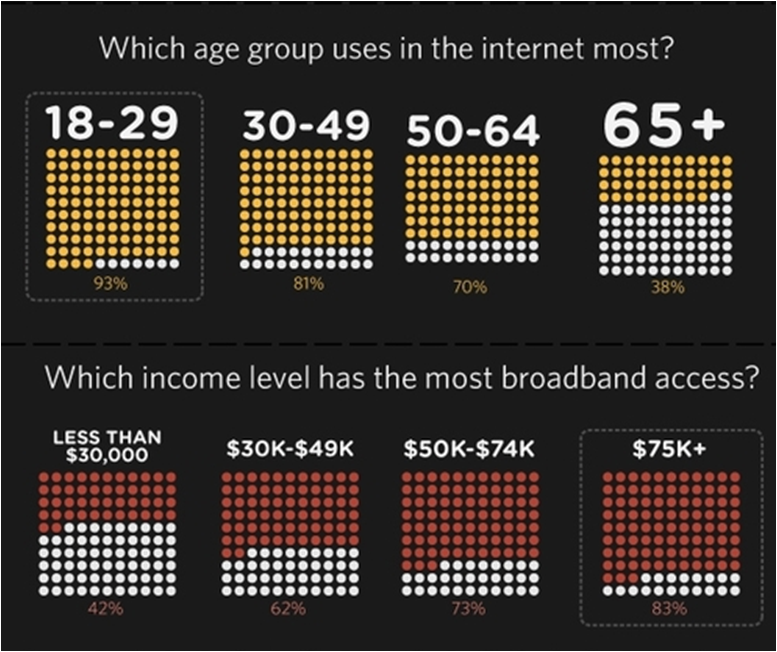
And, if you haven’t seen Paul Boag’s great graphics on Internet use (see example below), you should.

The Value of a Stamp

A seemingly random thing we observed years ago when we were doing some direct marketing was that we got a better response when we used a stamp placed at a slight angle.  We believed that stamps seemed to make the letters less “mass mailing”, but we also found that having the stamp not perfectly placed helped.  It looked like people had manually applied them.

It seems silly, but I bring it up to make the point that small things matter and in communications, you should be focused on the outcomes and ROI not simply on the cost.  I see so many times when people get so obsessed with saving pennies that they ignore the fact that a slightly higher cost service/solution/product has a better value.

I’ve observed that in things I buy also.  I might pay 2x what a normal pair of shoes cost, but my shoes last 3x as long as the cheaper shoes (so in the end they cost less).  This is true with furniture.  My question is why don’t people always apply that same logic when making other decisions.

I always try to help clients think about the result they are looking for and the cost per success not the cost per transaction.  For example:

Situation A:

  • 1,000 interventions
  • $0.60 per intervention
  • 4% success

Situation B:

  • 1,000 interventions
  • $0.75 per intervention
  • 7% success

Which would you buy?  The $0.60 service or the $0.75 service.  At first glance, you would gravitate toward the less expensive service, but if you don’t do the math, you’re making the wrong decision.

In Situation B, you have 70 successes at a cost of $750 (or $10.71 per success).  In Situation A, you have 40 successes at a cost of $600 (or $15.00 per success).

Implied Preferences / Educated Preferences

A few weeks ago, I was staying at a very nice hotel and was shocked to find out that they had cleaned my room while I had a do not disturb sign on the door. [My general mode when I travel is to just leave everything out in my room and not have them clean until I check out.] I immediately called downstairs to ask what the heck happened. They told me that they just assumed that I’d made a mistake and keyed themselves in.

I was honestly shocked. I’ve spent a lot of nights in hotels and never had this happen. They said that if the sign is up both in the morning and afternoon they assume that the guest had forgotten about it. They then offered to put me on the “honor the do not disturb sign list”. Are you kidding me?

I guess my argument (linking it back to healthcare and communications) is that aren’t there some implied preferences. Unless you tell me different, shouldn’t you honor my requests? If I sign up for e-mails, you should send me e-mails.

For example, if a consumer (member / patient) gives a company their mobile phone number, don’t they expect to receive calls on that phone? I think so. Now, I don’t think that giving a mobile phone number as a “phone number” implies that the consumer is saying it’s okay to send them text messages.

The other issue here is around “educated preferences”. If a company knows that the best way to get someone to stay adherent with their medications is to remind them to refill them, should they make it easy for consumers to opt-out of that program? I don’t think so. I think they have to offer that option, but why make it easy. Patients think they will be adherent. Heck, a lot of patients think they ARE adherent.

Don’t corporate entities have a role in leveraging their data and experience to help people even if people don’t know they need help.

Will Paying You To Be Adherent Work?

United Healthcare is launching a new program (Refill and Save) that is a different spin on the value-based designs we’ve typically seen. In a lot of value-based healthcare programs, companies lower copayments (or waive copayments) for patients in certain conditions to drive up adherence. This has been shown to work and improve results by about 10% which is great. [Although less than some of the adherence programs we’ve done at Silverlink.]

In this case, United is paying patients $20 for every refill they fill for certain medications starting with asthma and depression. I’m very interested to see the results. There continues to be no silver bullet for adherence which is a problem which drives $290B in cost per year and results in 100,000 deaths.

“Patients with chronic diseases such as asthma and depression who take their medicines regularly and who comply with prescribed treatments are likely to stay healthier. They not only feel better, they can potentially avoid costly medical problems that could result from delaying appropriate therapy,” said Tim Heady, CEO of UnitedHealth Pharmaceutical Solutions

Is Caring For Haitians In The US The Most Effective?

Of course, I think that we should be doing lots to help the Haitians with their crisis, but the immediate thing that came to my mind the other day when the medical evaluations were paused was – Health Tourism.  If it costs 1/2 to 1/3 as much to care for people outside the US, wouldn’t our money be better spend funding care for Haitians in other countries rather than bringing them here. 

I realize it’s not quite that straightforward, BUT I think there is something here.  If we know how much in terms of tax dollars and donations are going to cover the costs incurred by our hospitals and physicians, why not find a way to funnel that towards other locations.

Evolution Of How The Big 3 PBMs Describe Themselves

A few years ago, I think it was a lot harder to differentiate the positioning of the big 3 PBMs – Medco, Caremark, and Express Scripts. Over the past few years, I think they’ve taken different positioning paths.

Look at how their corporate descriptions how evolved over the past few years. They all used to focus on the PBM core services. Now, Medco talks about making medicine smarter; CVS Caremark talks about health services; and Express Scripts talks about Consumerology.

Medco 2010

Medco Health Solutions, Inc. (NYSE: MHS) is pioneering the world’s most advanced pharmacy(R) and its clinical research and innovations are part of Medco making medicine smarter(TM) for more than 60 million members.

With more than 20,000 employees dedicated to improving patient health and reducing costs for a wide range of public and private sector clients, and 2008 revenue exceeding $51 billion, Medco ranks 45th on the Fortune 500 list and is named among the world’s most innovative, most admired and most trustworthy companies.

For more information, go to http://www.medcohealth.com.

Medco 2006

Medco Health Solutions, Inc. (NYSE: MHS) is a leader in managing prescription drug benefit programs that are designed to drive down the cost of pharmacy healthcare for private and public employers, health plans, labor unions and government agencies of all sizes. With its technologically advanced mail-order pharmacies and its award-winning Internet pharmacy, Medco has been recognized for setting new industry benchmarks for pharmacy dispensing quality. Medco serves the needs of patients with complex conditions requiring sophisticated treatment through its specialty pharmacy operation, which became the nation’s largest with the 2005 acquisition of Accredo Health. Medco, the highest-ranked prescription drug benefit manager on Fortune magazine’s list of “America’s Most Admired Companies,” is a Fortune 50 company with 2004 revenues of $35 billion. On the Net: http://www.medco.com.

CVS Caremark 2010

CVS Caremark is the largest provider of prescriptions in the nation. The Company fills or manages more than 1 billion prescriptions annually. Through its unmatched breadth of service offerings, CVS Caremark is transforming the delivery of health care services in the U.S. The Company is uniquely positioned to effectively manage costs and improve health care outcomes through its more than 7,000 CVS/pharmacy and Longs Drugs stores; its Caremark Pharmacy Services division (pharmacy benefit management, mail order and specialty pharmacy); its retail-based health clinic subsidiary, MinuteClinic; and its online pharmacy, CVS.com. General information about CVS Caremark is available through the Investor Relations section of the Company’s Web site, at www.cvscaremark.com/investors, as well as through the press room section of the Company’s Web site, at www.cvscaremark.com/newsroom.

Caremark 2005 (pre-acquisition by CVS)

Caremark Rx, Inc. is a leading pharmaceutical services company, providing through its affiliates comprehensive drug benefit services to over 2,000 health plan sponsors and their plan participants throughout the U.S. Caremark’s clients include corporate health plans, managed care organizations, insurance companies, unions, government agencies and other funded benefit plans. The Company operates a national retail pharmacy network with over 60,000 participating pharmacies, seven mail service pharmacies, the industry’s only FDA-regulated repackaging plant and 21 licensed specialty pharmacies for delivery of advanced medications to individuals with chronic or genetic diseases and disorders.

Additional information about Caremark Rx is available on the World Wide Web at www.caremarkrx.com.

Express Scripts 2010

Express Scripts, Inc., one of the largest pharmacy benefit management companies in North America, is leading the way toward creating better health and value for patients through Consumerology(SM), the advanced application of the behavioral sciences to healthcare. This approach is helping millions of members realize greater healthcare outcomes and lowering cost by assisting in influencing their behavior. Headquartered in St. Louis, Express Scripts provides integrated PBM services including network-pharmacy claims processing, home delivery services, specialty benefit management, benefit-design consultation, drug-utilization review, formulary management, and medical and drug data analysis services. The company also distributes a full range of biopharmaceutical products and provides extensive cost-management and patient-care services. More information can be found at www.express-scripts.com and www.consumerology.org.

Express Scripts 2005

Express Scripts, Inc. (Nasdaq: ESRX) is one of the largest pharmacy benefit management (PBM) companies in North America, providing PBM services to over 55 million patients through facilities in 13 states and Canada. Express Scripts serves thousands of client groups, including managed-care organizations, insurance carriers, third-party administrators, employers and union-sponsored benefit plans.

Express Scripts provides integrated PBM services, including network pharmacy claims processing, mail pharmacy services, benefit design consultation, drug utilization review, formulary management, disease management, medical and drug data analysis services, and medical information management services. The Company also provides distribution services for specialty pharmaceuticals through its CuraScript specialty pharmacy. Express Scripts is headquartered in St. Louis, Missouri. More information can be found at http://www.express-scripts.com.

A Few Adherence Examples of Communications

Express Scripts has been using Consumerology as their framework for member communications.  I hadn’t heard much about what they were doing in the adherence area so I turned to the web.  I found a few things that I thought people might be interested in.  [Google is a wonderful tool.]

Last year, they had talked about the study in California with the power company and the influence that social norms had on power utilization.  They were testing this.  I found a presentation online that shows a cool graphic with some of the messaging.  I’m not really sure if patients will get the concept of medication possession ratio (MPR) so I’m anxiously awaiting the results.

I also found a screenshot of sample adherence report which they’re using in a pilot with Vitality.  [I’ll assume the data is mocked up and not real PHI.]  I really like the report.  I’m still torn on the GlowCaps concept in terms of whether consumers will use them, but they seem to have some good results.  [And, I always try to remember that I’m not the average consumer so my opinion is just my opinion.]

The last thing that I found which was interesting was some FAQs on their auto-refill program.  I remember pushing for this back when I was there, and I could never get the operations people and clinical people to approve it.  This type of program is becoming the norm now for many mail order and retail pharmacies so I’m glad to see they have it in place.

Military Families and Healthcare

There is an article in today’s USA Today about wounded veterans that got me thinking about where this falls on the healthcare reform priorities. As I’ve stated before, I completely agree that the US system needs reform. The question is whether to go “big bang” or focus on change in key areas. I continue to argue that focus on fixing one problem at a time is best. I would initially focus on the uninsured. This article made me realize that another area of focus should be on providing comprehensive coverage for those that serve our country.

While most of us enjoy our freedom, there are a select few which are willing to sacrifice their lives to protect us. We should never forget that. They should be cared for.

The State of Social Media Marketing

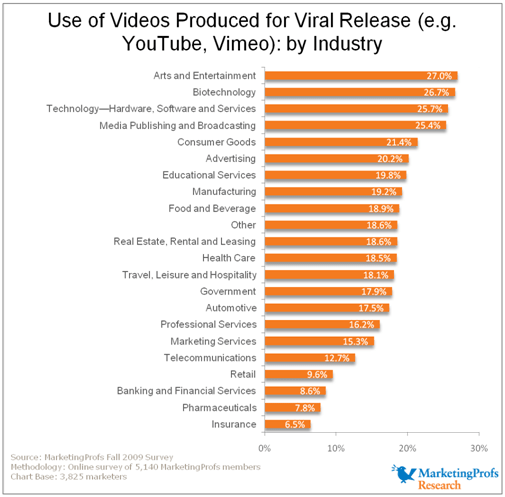
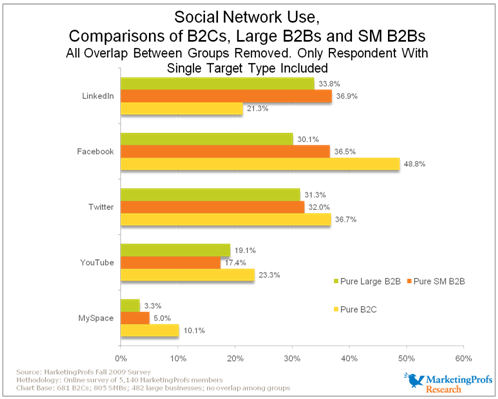
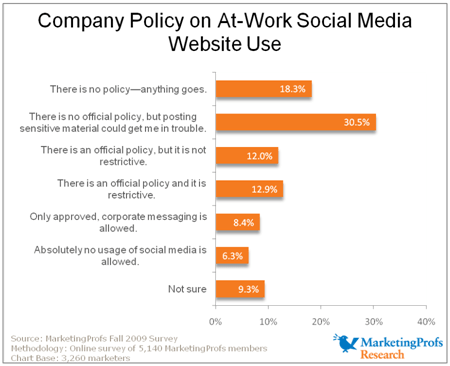
In a study by the MarketingProfs, they look at use of social media by industry which is interesting. The full report is something you have to pay for, but they give you a presentation you can download for free and allow us bloggers to use some of the charts.

  1. The first one shows users of videos for viral marketing. I was surprised to see healthcare at 18.5%, but this makes sense. There are lots of videos which can be educational.

  1. The next one shows social media use by company type. I certainly have seen a lot of companies putting LinkedIn and Facebook pages up. Additionally, a lot of companies are using Twitter for PR and other information. Since I don’t use MySpace that doesn’t surprise me that it’s so low.

  1. The last one isn’t shown by industry, but I think it’s interesting. I’d love to know if healthcare is more conservative than other industries. I would imagine they would be. [The other thing to know here is the mix by size.]

Book: The Checklist Manifesto

Reading a brief summary of this book caught my attention. The Checklist Manifesto hits on one of those sensitive areas in healthcare…can technology make physicians better? YES.

“Medicine today is so complex that even the sharpest doctors can no longer keep everything they need to know in their heads.” (Atul Gawande)

  • Only about ½ of heart attack patients get the best care within the recommended window.
  • It takes an average of 17 years for a new treatment to reach even ½ of the patients who would benefit.
  • Using a “safe-surgery checklist” reduced the number of complications and deaths by 1/3. (The New England Journal of Medicine)

Rock ‘n Roll Impact on Hearing Not As Significant As Expected

(Or at least that’s a good sensationalist title)

In a study in the American Journal of Epidemiology, it suggests that people who grew up in the Rock ‘n Roll generation are holding on to their hearing longer than their parents. (Will this continue for the iPod generation?)

The odds of having hearing impairments were 13% lower in men (and 6% in women) for every five-year increase in year of birth. (Based on study of 5,300 people born between 1902 and 1962.)

As the blurb in the USA Today mentions, there are other factors – ear protection, less noisy jobs, better treatment for conditions that led to hearing loss.

Pharmacists To Diagnose – Not The Right Answer For Pseudophedrine

In a letter to the editor, a consumer was suggesting that one answer for BTC (behind-the-counter) medications such as cold medications would be to require the pharmacist to determine who should get them. Certainly, we need to figure out a way for these medications not to be used to create methamphetamine (meth), but this won’t work (IMHO). On the flip side, requiring a prescription for patients to get these doesn’t make a lot of sense either. It would drive up physician visits and overall healthcare costs.

Why?

  • Pharmacists are already very busy (at most pharmacies).
  • The margin on these medications probably doesn’t justify applying high cost labor to them. Today, a pharmacy technician that makes significantly less does and can handle “filling” these. [Of course, if this argument worked, pharmacies would stop filling $4 generics and free antibiotics.]
  • What’s the proper diagnosis for a cold and how would you screen people?
  • If criminals wanted the drugs, wouldn’t they just get sick and come in to get them?

Splitting Up CVS Caremark – Stupid – Just Learn How To Compete

The fact that the NCPA [see their press release on this] and others in the pharmacy community have chosen to push for the FTC to investigate the CVS Caremark merger and continue to encourage this is ridiculous.  CVS has owned a PBM (Pharmacare) for years.  Walgreens has its own PBMLongs had a PBM (RxAmerica).  Kroger’s has a PBM.  Unless I’ve missed it, I don’t remember hearing about them not being able to own a PBM or seen complaints about their ownership.  [And, like Adam Fein – I didn’t know this retrospective breakup was even an option.]

So, I perceive this whole FTC issue as a backhanded strategy to gain a competitive advantage over a competitor that’s beating them in the market.  [Just imagine the distraction of having to split the companies up or the hassle of having to put in a bunch of additional limitations.]  We know that independent pharmacies have continued to lose marketshare for years to retail chains and mail order.  It’s no different than any other market where scale matters (e.g., hardware stores).  If small pharmacies can compete, they should figure out how to make money and demonstrate value that people will pay for and stop focusing on crying wolf about a successful competitor.  [More on what I would do another time.]

I’ve been a big believer of retail and PBM integration for years.  At Express Scripts, we only thought there were a few companies that could buy us – Walgreens, Wal-Mart, or United.  At this point, I don’t see that happening, but I see lots of efficiency in leveraging plan design, retail face-to-face counseling, pharmacy automation at mail, and other coordinated solutions.

Another issue that is raised [in complaining about the CVS Caremark integration] are patient complaints.  These are certainly possible, but isn’t that a BBB issue or someone else’s issue.  Unfortunately, I bet you can’t find a pharmacy or a PBM without some patient complaints.  People take their healthcare personally and hate change.  BUT, I can’t imagine that I would go to the government and point out that some clients of my competitor aren’t happy.  [And the fact that politicians believe the hype and try to push stupid legislation like HR 4489 makes a mockery of our government.]  I’ve talked about transparency before so I won’t harp on this here, but how many companies (in our capitalist society) are required to provide data about margins and forced into a certain business model. 

Another issue you hear is about CVS Caremark “steering” people to preferred pharmacies (CVS, mail, specialty).  First off, this is not a PBM decision.  Limited retail networks have been an option for ever.  Clients chose what plan designs to implement.  The PBM’s job is to implement these plans and manage them effectively.  PBMs and consultants (e.g., Hewitt, Mercer) often model out the options for the clients so they learn how to save money.  And, in many cases given the pace of cost increases, if these options didn’t exist, then employers would drop benefits quicker.

Finally, the data doesn’t lie.  Members are generally very happy with the PBMs and mail order (or as much as they are with any “managed care” type company).  PBMs save clients money (and make money doing it).  PBMs provide clients with data.  Clients have lots of options for “transparent” companies and there’s been no big movement of marketshare to them.  PBMs drive adherence.  Mail order patients are more adherent.  Specialty mail order pharmacies drive successful outcomes.  The point is that the model works…stop trying to fight the model and come up with a better mousetrap. 

[Enough ranting for the evening.]

Pharmacy Counseling – Mail vs. Retail Privacy

One of the other things that caught my eye in the USA Today article about the changing role of pharmacists were the comments about counseling.  I’m not sure if I see that as any change.  Isn’t that what most pharmacists go to school for?  They want to help patients.  They don’t go to school to count pills. 

A few years ago when I worked on my idea of a kiosk to dispense medications that was the big discussion I had with several pharmacy leaders.  I wanted to free up the counter time for counseling and let the kiosk hold the refills and acute medications which didn’t require as much pharmacist time. 

Today, when you go to most pharmacies, you talk with the pharmacy technicians which in some states don’t even have to be certified and can essentially be someone with only a high school education.  Not that there is anything wrong with not going to college, but I bet that most of us have high expectations for the person standing on the other side of the counter.

So, I think everyone would love the pharmacist role to evolve.  BUT, I think the other question this begs is whether this is a private setting to have that discussion.  Now, there are a few pharmacies that have created a quiet area for counseling, but let’s face it, the majority of the time, you’re standing at the counter with another patient right over your shoulder (or back at the yellow line 24″ behind you).  How many of us really want to talk about the rash that developed as a side effect or the new diagnosis that we got from our physician or the fact that we can’t afford the medication in front of our neighbor or some miscellaneous person that might be judging us?

So, I’m always amazed when people talk about mail order as this anonymous 800# for counseling.  Isn’t it more convenient to be able to call your pharmacy from your own home (or another private setting) at anytime of day or night and ask questions?  Isn’t it more private?

Since less than 20% of people can even tell you the name of their pharmacist (and probably an equally low percentage of patients are known by name by the pharmacist), does this face-to-face relationship really matter?

I won’t deny that the Ashville Project worked and that the cases where the pharmacist is engaged with the patient in a long-term, trusted care relationship that it makes a difference.  I only question whether that model exists, is scalable, is cost-effective, and can be staffed.  (Don’t forget that just a few years ago they were forecasting massive staffing shortages around pharmacists…I don’t think that’s been solved.)

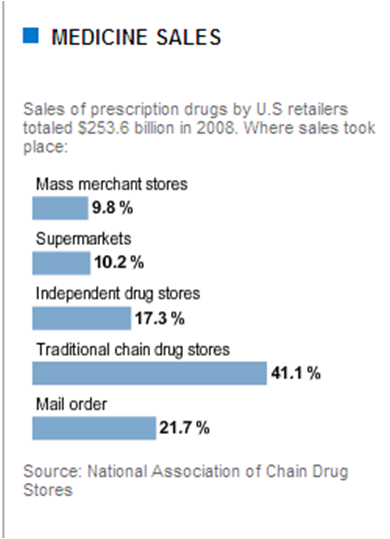
Where Do Prescriptions Get Filled?

I was reading the article in the USA Today about the changing role of pharmacists which had the following chart about where medications get filled. 

How Many Top Companies To Work For Are In Healthcare?

I always find the list of the top 100 companies to work for interesting.  It’s interesting to see who makes the list and what they do for their employees.  And, it always make me think back to 2004/2005 when Express Scripts set a goal of being on the list.  We took our initial internal survey and identified what we needed to do to improve.  And, part of our incentive compensation the next year became an improvement in our scores.

Now as I look at the 2010 list that just came out, I’m always interested to see what healthcare companies make the list.  This year there are 17.

# 17 – Methodist Hospital System

#19 – Genentech

#25 – Novo Nordisk

#26 – CHG Healthcare Services

#32 – Baptist Health South Florida

#40 – Scripps Health

#46 – Ohio Health

#50 – King’s Daughters Medical Center

#55 – Mayo Clinic

#60 – Indiana Regional Medical Center

#63 – Southern Ohio Medical Center

#74 – Children’s Healthcare of Atlanta

#79 – Meridian Health

#81 – Atlantic Health

#85 – Arkansas Children’s Hospital

#96 – LifeBridge Health

#99 – Winchester Hospital

Interview with Cyndy Nayer from the Center for Health Value Innovation

I had a chance yesterday to sit down and talk with Cyndy Nayer (President, CEO, and co-founder) from the Center For Health Value Innovation. For some of you, this is a new buzzword for others it has been around a while. I remember back in the early 2000s when stories of Pitney Bowes kept popping up and then working with a few of our clients (like Marriott) when I was at Express Scripts on what were being called “value-based designs”. [I even had an offer to go to ActiveHealth (now part of Aetna) and work on their Value Based offerings several years ago.]

And, it’s a small world. Several people from my past are involved: (1) Peter Hayes was a client at Express Scripts and (2) Roy Lamphier played soccer with me in high school.

What is the Center For Health Value Innovation?

The center is an “information exchange” for value based design which as she points out is much more than just a prescription benefit and not simply giving people free drugs to make them more compliant. [If only it were that easy!]

What do you mean by Information Exchange?

A place where people can share stories, trends, info, and research. They see their job as getting information out there and providing support around modeling, analysis, and identifying gaps. [And, I know they do a lot of education as you can see Cyndy at many conferences.] She talked about educating the marketplace on an “actionable format” for implementing value-based design.

Can you describe Value Based Design?

Value Based Design is a suite of insurance design, incentives, and disincentives that support prevention and wellness, chronic care management, and care delivery. It is focused on linking stakeholders across the care continuum and developing structures like outcomes-based contracting where all stakeholders benefit from better health outcomes.

She mentioned that in an upcoming edition of the Journal of Benefits and Compensation that there will be a paper that builds on some adherence concepts to discuss the 5 Cs of Value Based Design: [Noting that the first 3 come from some work from Merck.]

  • Commitment
  • Concern
  • Cost
  • Communication
  • Community

We talked about the need for communications to be multi-directional and include the patient, the physician, the pharmacy, and other caregivers. We talked about community needing to expand on that to include family, the employer, and other entities. [As we all know, health care is local and value based design is no different.]

We spent a little time here talking about community, and the need for this to happen at a community level. [Much like e-prescribing and other things have found out that localized momentum is important.] One question in my mind is who is the catalyst – the hospitals, the physicians, the local managed care companies, employers, grocery stores, wellness companies, pharmacies.

We talked about the fact that this isn’t the same as Accountable Care Organizations, but like that concept, this has to be developed as part of the fabric of the community not imposed on the community.

Being from Detroit, I asked if this was a model for them to help develop around. That is an area of focus and there has been some work done in the Battle Creek, Michigan area.

Why are employers so interested in Value Based Design?

Originally, employers were interested since it was something new, but the recession forced them to look at this more seriously. But, this is a long-term process and something which they benefit from. Better health lowers absenteeism, and businesses need health communities and healthy workers for growth.

Why don’t companies implement Value Based Design programs?

Companies don’t implement them because they’re not prepared for the amount of work needed to get started and it’s not a cheap fix. [If you want to save money, just drop the benefits…not that anyone really advocates that.] We talked about that lots of people react to the urban legends of just giving out free drugs [which isn’t Value Based Design] which would be easy. Companies need to realize there is work to be done to communicate this, design it, and manage the implementation across the community. BUT, once it’s installed, it’s completely sustainable.

Is there a certification (i.e., URAC) for value-based design?

She told me that nothing exists today and that it would be hard to do. Today, there isn’t alignment in the marketplace around incentives and a standard model. They spend a lot of time working with different groups to drive education and training to link health and productivity measurement with value and functional performance.

What’s next for 2010?

In 2010, they will be bringing much more information forward on how to support and extend the work done in the 1st book (Leveraging Health…which Dr. Jan Berger, Silverlink’s Chief Medical Officer co-authored with the Center) and the decision matrix that they recently published. They will continue to serve more as a guide helping interested parties in private, invitation only events to design solutions and then bring those solutions to market.

How does someone learn more about Value Based Design?

The simple answer is to go to the Center For Health Value Innovation website. They have a whole library of information there.

Scott Brown Quote

From the Corporate Research Group blog:

One thing is clear, voters do not want the trillion-dollar health care bill that is being forced on the American people.  This bill is not being debated openly and fairly. It will raise taxes, hurt Medicare, destroy jobs, and run our nation deeper into debt….I will work in the Senate with Democrats and Republicans to reform health care in an open and honest way. No more closed-door meetings or back room deals by an out of touch party leadership. No more hiding costs, concealing taxes, collaborating with special interests, and leaving more trillions in debt for our children to pay.

[BTW – On a personal note…It’s always fun to be onsite for big elections.  I was in Boston for this although I’d put it as my 3rd most interesting election.  I was in Brazil in 1989 for their 1st election in 30 years and I was in Prague for the vote to split Czechoslovakia into two countries.  Those were both a little more exciting…although not as relevant to my day-to-day life.]

Latest Data Shows Low % Of Seniors Online

Everyone always wants to move to electronic communications (e-mail, portal) in healthcare (along with other industries) based on cost and data availability.  Unfortunately, seniors aren’t online as much as we think.  Yes, there are exceptions.  We all have stories about our grandparents being online or some blogger whose 80 years old.

But, the latest data from Pew shows that they aren’t online.  Their not using high speed connections.  And, when they do go online, they’re dipping their toes in the water not jumping in the deep end to use all the cool tools. 

This is certainly reinforcing of the data we observe at Silverlink when we interact with Seniors.  They are used to the phone.  They like to talk on the phone.  They know how to navigate and interact with automated telephony (especially intelligent telephony not annoying IVR trees).  And, since we can provide similar data to the web and e-mail about how Seniors interact with the communications, it has been a growing area for healthcare companies.

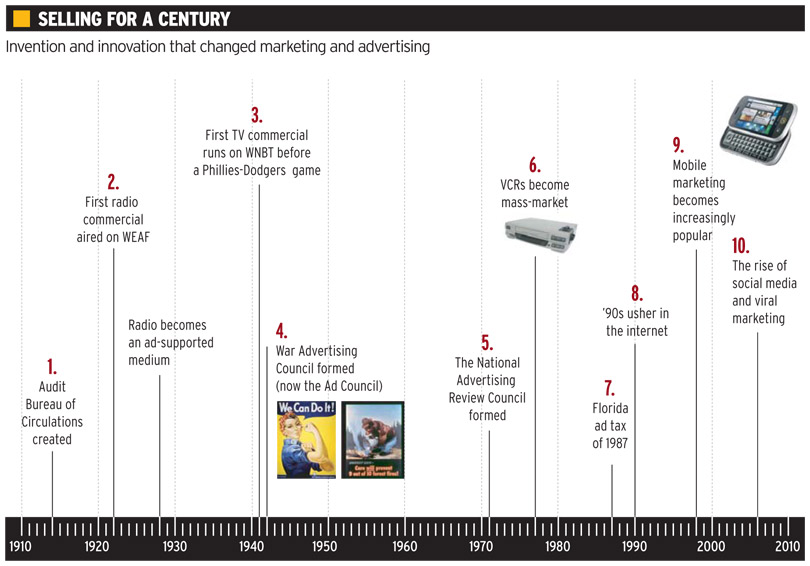
10 Events That Changed Marketing This Century

We all find lists and good graphics interesting.  This one caught my attention.  The article is in Advertising Age.  Their timeline is pictured below:

How Do Physicians Want To Hear From Their Pharmacy/PBM?

In the pharmacy and PBM business, there are lots of reasons to reach out to a physician:

  • Drug-drug interactions
  • A chemically equivalent version of the drug prescribed is available
  • A therapeutically equivalent version of the drug prescribed is available
  • The prescribed drug is not covered
  • A prior authorization is required
  • The patient is required to try an alternative drug first (step therapy)
  • The prescribed drug costs too much and the patient would like a new drug
  • The prescribed drug had unplanned side effects
  • The patient’s prescription has to be renewed
  • The patient is required to move to mail

The question is always how to best do this. Here are some options:

  1. Call the physician’s office.
    1. Using call center agents would be expensive, and after navigating an IVR tree and talking to the front office staff, they would simply leave a message. This would just lead to an ineffective back-and-forth in many cases.
    2. Automated technology won’t effectively navigate the IVR tree, sit on hold, and deliver a message.
  2. Send a letter to the physician.
    1. This allows for the proper level of information to be provided so the physician has time to look up the patient record and respond.
    2. For most of the cases above, the time lag on this would be unacceptable.
  3. Fax the physician.
    1. This is the default solution since you can deliver mail type content in a timely fashion.
    2. But, there is no great physician fax database.
    3. And, do physician’s read the faxes?
  4. E-mail the physician.
    1. This isn’t really an option since there’s no physician e-mail database (that I know of) and you can’t send PHI via e-mail.
    2. Your only option here would be to send e-mails that alerted the physician to log into a portal where all these messages were waiting for them.
  5. Use the EMR or eRx application.
    1. As physician’s get more automated and technology becomes the default workflow solution, everyone sees this as the holy grail. A pop-up can tell the physician about inbound messages for them to respond to.
    2. Some solutions hope to push this messaging to the time the prescription is written which I think is fascinating, but I don’t imagine a physician wants to deal with all that during the patient encounter. (Maybe I’m wrong.)

So, what I’m interested in hearing from physicians on is what works. I’m sure you want to say that most of these messages aren’t things you want to deal with, but plan design is here to stay and works to control costs. I’m sure some of you feel this is the “managed care system” telling you how to prescribe, but we know that the amount of information needed to keep current on everything is overwhelming. And, cost matters to patients which means getting them on the right drug that they can afford will impact adherence and ultimately outcomes.

So…How should PBMs and pharmacies communicate with physicians?

CxPi Scores For Healthcare Companies

CxPi is the Customer Experience Index from Forrester. 

The CxPi is based on consumer evaluations during November 2009 across three areas: 1) meeting needs; 2) being easy to work with; and 3) enjoyability.

As expected, pure healthcare companies fall towards the bottom here, but some of the retail pharmacies are much higher up.

There weren’t a lot of excellent scores in the survey, and I’m sure we can all debate where the companies fall.  But, I think the point that healthcare clusters at the bottom (and has since the beginning) is a problem.  How do we improve that consumer experience?

Sleep Deprivation No Longer A “Badge of Honor”

I would argue that for years many people bragged about how little sleep they got (as a proxy to show how hard they work).  Has that changed or will that change?  I’m not sure.  The whole concept of face time is often more normal than the work smarter not harder concept.

The question of course is whether research on the impact of sleep deprivation will change anyone’s mind.  In an article I just read, it has several key points from a recent study [by Daniel Cohen, Harvard Medical School, Science Translational Medicine journal]:

  • Studies estimate that almost 30% of Americans get less than 6 hours of sleep per night.
  • The circadian rhythm hides the effects of chronic sleep loss and gives people a second wind btwn 3-7 pm (before they fall off a cliff in terms of attention).
  • If you stay up all-night on top of sleeping less than 6 hours a night for the past 2-3 weeks, your reaction times are 10x worse than they would have been if you just pulled an all-nighter. 

“A large segment of the population may be at a high risk of committing catastrophic errors” (Eve Van Cauter, sleep researcher at the University of Chicago)

Given the risks of error, the impact on health, and other issues, it would seem like companies would want to discourage this “badge of honor” and encourage people to get appropriate sleep.

Medco: 6% of Seniors Take 20+ Rxs Per Day

From a Medco Health Solutions survey of seniors 65 and older who take medications.  [Note that 20% of insured seniors did not take any medication on a regular basis.]

(Note: Chart re-created by me based on appearance in USA Today Snapshots.)

Wal-Mart Home Delivery – Will It Make A Difference

Now that Wal-Mart is pushing their home delivery direct-to-consumers via TV commercials and the web, will that have an impact on the market?

I could see a few possible reactions.  The simple one would be that their investment simply proves to validate the mail pharmacy option (if that’s needed) and build more awareness of this as an option.

Another response could be that one of the big PBMs (Medco, CVS Caremark, Express Scripts) decides to compete in this “cash” or DTC market and tries to sell directly to consumers.  That has lots of implications. 

Like the $4 generics, it’s still limited to a small set of generic drugs that you get for $10 thru mail.  But, will that drive volume?  Are consumers “fooled” by the simplicity of the message or are they frustrated when they realize that their drugs aren’t $10?

Will safety groups or payors get involved to minimize to issues of having these scripts process outside the benefit and therefore not be in the member record for DUR (drug utilization review) – aka looking for drug-drug interactions?

Will PBMs change their contracts with retailers to strictly prohibit them from providing mail order DTC?

Will other retailers follow suit?

Transparency…Transparency – Enough

I was reading the NCPA blog this morning on PBM Transparency and the CVS Caremark Conundrum (more on that another time) and had to comment.  [Certainly not an unbiased blog.]

They talk about government intervention and transparency as:

“Small step toward reining in egregious and costly PBM practices like spread pricing (paying the pharmacy one price then quietly billing health plans much more) and rebate abuse (pocketing huge sums from drug makers before giving plan sponsors what’s left).”

Come on.  How many PBM clients don’t know that they have spread pricing?  Plus, don’t the retailers have spread pricing.  I’m pretty sure that consumers don’t know the acquisition cost of their drug compared to what they pay for it.  (There have been plenty of stories about the gouging at retail to cash patients using generics.)  There are plenty of PBM contracts today that are pass-through pricing meaning that the payor pays the PBM what they reimburse the retail pharmacy.  (I get so tired of people using arguements from the 1990’s and early 2000’s as fact.)

Then, let’s talk about rebates.  How many clients of PBMs today don’t know that rebates exist and don’t get most of the rebates passed on to them?  A lot of this data is available in general reports about the industry, from consultants, and thru surveys.  There aren’t a whole lot of mysteries in the PBM world.

The reality is that people get bitter because the PBMs continue to make money in a bad economy.  I don’t see what’s wrong with that.  They make money as they save clients money. 

  • More generics = more client savings and more PBM profit. 
  • More mail order = more client savings and more PBM profit. 
  • Lower trend (i.e., cost increases year-over-year) = more client savings and more PBM profit.

Some PBMs even take risk to put their money where their mouth is.  There have been numerous government and independent studies showing the value of PBMs.  There have also been enough “transparency” contracts out there from traditional PBMs and PBAs (Pharmacy Benefit Administrators) that there is proof that transparency doesn’t save money. 

I’ll talk more about why I think the CVS Caremark deal is good later.

Double Whammy: Lose Job and Become Sicker

A study released earlier this year suggests that losing your job can increase your odds of developing a new stress-related health problem by about 80%.  (read more)

The study also suggests that just the threat of losing your job can do this and that those that keep their job are also at risk.  Oh well…If you’re a fatalist (like Michelle Obama), then you’re pretty much doomed in this economy.  But the reality is that life is stacked against you.  You need to take the bull by the horns and be responsible for your healthcare otherwise you enter that death spiral (literally).  And, being unhealthy will cost you more – medicine, physician visits, life insurance premiums, individual health insurance costs, absenteeism, salary (see below).

“Economists Susan Averett and Sanders Korenman studied the effects of obesity on wages, using a sample consisting of individuals aged 16-24 in 1981 who were 23-31 in 1988. They showed that women who were obese according to their Body Mass Index (BMI) in both 1981 and 1988 earned 17 percent lower wages on average than women within their recommended BMI range.

Women are not the only ones to suffer discrimination based on appearance. While obesity had a slightly negative effect on a man’s earning power, height seems to play a much more significant role in determining a man’s salary, with shorter men getting the “short end of the stick.”

So, one of the important things to do is understand the impact of stress and focus on stress management (see tips).  Regular exercise is a good way to help with this (and helps with your overall health and weight management).

 “Stress can increase blood pressure and heart rate, which can tax the heart.  We’re seeing more people who are putting on weight because they aren’t eating well under stress.”  (Marc Eisenberg, MD, Columbia University)

[P.S., Don’t forget that if you like these blog postings that you can get them sent to you an e-mail every time I post.  To get that, simply sign up here.)

MOST People Happier On Days They Don’t Work – Really?

In one of the most stunning studies ever, the researchers show that people (not all just most) are happier on days that they don’t work. But, let’s drill in since I actually found the study interesting and began to wonder about implications that might have on when healthcare companies should communicate with people.

The study in the Journal of Social and Clinical Psychology showed that people are happier on weekends (when most aren’t working) due to “more connection with other people and more self-direction” (co-author Richard Ryan). (see article in USA Today)

One other aspect of the research was that people were happier when they were competent even if the task was difficult.

So, this brings up lots of questions:

  • Since we know that happy call center agents can influence customers, how do you increase their feelings of competency, autonomy, and connectedness?
  • Are you better off communicating with members/patients on the weekends when they are happier?
  • Who are the people that are happier at work than home?
  • Since the general stereotype is that men are less competent with household chores and raising kids, did gender matter? (The article said that age, education, salary, marital status, and # of hours didn’t matter.)