WSJ Healthcare Blog – Medical Records “Score”

I was reading through the WSJ blog on healthcare and found an interesting item around medical records being the new credit score. It’s a good point. With people’s sensitivity around getting insurance coverage, you certainly don’t want to have a mistake in your healthcare information (at least not one that makes you appear more sick).

With all the manual data entry in healthcare, I would not be surprised that this happens.

Here is the blog entry.

Alternative Dispensing

There are several models for dispensing drugs. I talked about kiosks the other day. Obviously, there is a physician dispensing also. In this case, the physician stocks and fills drugs for patients and collects cash payments. They can make good money, but it can represent a (perceived) conflict of interest and present some challenges (e.g., space, cash management, drug-drug interactions). Several companies that help this model are Allscripts, Dispensing Solutions, and Purkinje.

Another model which is very interesting, but it hasn’t taken off is generic sampling using physician kiosks like MedVantx. It is a cool technology. And, since generic manufacturers don’t provide samples, it is a good way of starting therapy on a generic drug. (The reason for pharma using samples is to get the patient started on their drug.)

medvantx.jpg

Some scary data and a good discussion on this topic can be found on the Medinnovationblog.

Each pharmacy call back costs physicians’ practices $5-$7. With the average physician writing 30 prescriptions a day and handling another 30 requests for refills, the costs escalate rapidly. The estimated 20 pharmacy related phone calls per day costs $20,000-$28,000 annually. In general, physicians are oblivious to this cost center. By moving dispensing into the physician’s office, this overhead can be cost shifted to better serve patients as well as create additional income.

Information Therapy Blog

I was looking at the Healthwise website and The Center for Information Therapy and came across a blog by the team there with some good discussion topics. It is definitely worth your read. Here were a few things that caught my eye:

  • Can we more effectively engage consumers in better managing their own health by learning from Hollywood or video games about how to draw people in through entertainment? By doing so, can we make health care “fun” or at least truly engaging? (entry)
  • Since research shows that 40%-80% of everything a doctor tells a patient in the office is forgotten, taking along a patient advocate is a great strategy. Unfortunately, it is not always an option or sufficient. In order to ensure effective communication, every patient should leave the doctor’s office with an information prescription (Ix). (entry)

Rant – Smoking

Excuse me while I rant for a moment.  I spent the night at a below average hotel last night.  The air quality was horrible.  At first they put me in a smoking room.  I didn’t even know they still existed in hotels.  I thought I would choke when I entered the hallway.  (If I hadn’t prepaid on Travelocity, I would have left.)

Even though they moved me, I think it is an issue throughout the hotel since I woke up with a sore throat and headache.  To top it off, the hotel doesn’t even have a workout facility.

In today’s wellness environment, I figured things like this didn’t exist (at least not at normal chain hotels).

Small Business Impact of Health Coverage

Wells Fargo and Gallup put out the results of a poll of small business owners last week that underscores just how challenging it is for them to provide healthcare coverage for their employees even though they clearly know this is an important benefit in attracting the right type of talent.

A few of the key facts from the study are:

  • 9 of 10 say the healthcare system needs to change
  • 6 of 10 say a complete overhaul is necessary
  • 81% said health insurance improves employee loyalty
  • 55% do not offer health insurance with 45% of those citing cost as the issue

Here is a good quote from a Wells Fargo executive:

“The majority of small business owners recognize the benefits of offering affordable healthcare coverage to their employees, but many feel they cannot afford to do so,” said Rebecca Macieira-Kaufmann, executive vice president and head of Wells Fargo’s small business segment. “A third of small business owners are cutting back on non-capital investments so they can provide healthcare for their employees. For several years health insurance has been a major concern for small business owners, and its impact is significant.”

Since small business is where much of our job growth has been over the past decade, this should raise flags for us.  I think it is critical that we find a solution that creates easily accessible healthcare for everyone, but I think it is ridiculous that working families can’t afford care or aren’t provided care.

Managing Medical Bills – Free Trial

As anyone who has done anything outside normal knows, getting and managing your medical claims can be very confusing.  When should you pay?  When should you resubmit?  When is it simply an error?

I was encouraged to learn about a new company MedBillManager which has recently secured some funding.  They have a blog where you can read some thoughts and you can read about them in a WSJ article.  The WSJ points out other companies such as WebMD, RevolutionHealth, and Intuit that provide tools to help get you organized and/or provide information.

Here is a screenshot.  The team there offered my readers a free one year subscription ($24.95 savings).  Go to  https://prod.medbillmanager.com/account/signup  and click on the “Got a free plan code? Claim it” link… enter in gvareader1.  I think they would welcome the feedback.

Much like the OutofPocket.com that I blogged about the other day, this is heavily dependent upon adoption to drive value.  Being able to compare costs by treatment, geography, insurer, and physician is valuable long-term in a consumer driven world, but it needs participation to have enough detail at at specific segment.

The other key for success will be integration of data directly from the payors.  I don’t mind entering a few EOBs and bills to see some data, but eventually, I want them to be pre-populated and then use the application for reporting and analysis.   Blend this with a technology such as that from ActiveHealth and a PHR and you have an integrated data selection that tracks costs, compares data, and pushes suggestions to you about wellness and health management.

This is probably what RevolutionHealth is doing.  I am sure we will see some more rollups over the next few years to pull all these solutions together.MedBillManager

20/20 view vs. Sicko

I enjoyed Sicko.  The movie made you think.  All information comes with perspective.

20/20 had a good piece the other night which showed John Stossel talking to Michael Moore and bringing up lots of interesting facts about Canada and Cuba and asking tough questions.  It was a good opposite view.

Rather than rehash, I will point you to Kevin MD’s Blog which has links and provides some other blog summaries.

Comparative Effectiveness vs. MicroSegmentation

In an interesting, if not over my head conversation, Robert Goldberg (VP of the Center for Medicine in the Public Interest) talks about comparative effectiveness which effectively looks at the costs of treatments versus the outcomes.  From a business perspective, this makes all the sense in the world.

On the flipside, I certainly understand his key arguement which points out that generalizations don’t work.  A drug that doesn’t work generally might work for a certain minority segment.  I pulled a few quotes below, but you can read the whole Washington Times editorial here.  This is why genomics is so important.  Once we understand how drugs and treatments vary by genes and understand what genes each person has, we will be much more effective at treatment and outcomes.  (I am not so sure about cost, but we will table that for now.)

  • “opposed approval of Bidil, which reduced deaths from stroke among blacks by 43 percent but is making money peddling the ALLHAT regimen to doctors even though it increases stroke related death among blacks by 40 percent”
  • “The comparative effectiveness crowd hates gene testing because it identifies individual differences that screw up their ability to make sweeping judgments about what’s best for everyone.”

Are Patients Ready for Kiosks?

Everyone is moving to self-service. Quicker. Cheaper. Privacy. Automated. Etc.

There are lots of benefits. Think about all the information which is needed in healthcare along with all the linked processes. If this can be simplified and some of the burden pushed to patients that is great.

Now, this will vary by age and demographic. Typically older people will be more hesitant to use automated technology. Just look at your self-service grocery lines. Additionally, you have to watch interpretation of questions. I will never forget the doctor asking my grandfather if he smoked and him saying yes. I asked for a point of clarification and found out he had smoked 35 years ago.

I couldn’t find all the examples, but I have talked with vendors using kiosks for checking in to an office or hospital, providing translation services, helping match basic needs with over-the-counter medications, simplifying basic services (e.g., picking up a refill prescription), or for pushing information to the patient.

Kiosks blend challenges with physical design (height, location, screen size) with application challenges (number of screens, simplicity, data entry) with business model challenges (costs, advertising (Y/N), patient utilization). But, done right, I clearly see this as key to the future of healthcare. It will help address staffing shortages, address data quality, and help patients take on more responsibility.

Imagine walking up to a kiosk and using biometrics (i.e., retinal scanner, fingerprints) to log-in. Once you log-in, your history (Rx, lab, medical) is all available via your personal health record. You register for your appointment and get pushed health and wellness information that you can print real-time. You can then chose to print information for discussion with your physician based on monitoring of your cholesterol, weight, and blood pressure for your home system. Finally, because you log-in, the system automatically queues up other events for the staff to initiate pending your visit with the doctor.

Here are a few examples of kiosks in healthcare:

And, if you’re really interested in kiosks, you could read Bill Gerba’s blog on kiosks.

Candidates on HC

Next year’s election for president should have healthcare as a key issue.  It has certainly become a front page issue.  Do you focus on universal coverage?  Do you focus on the uninsured?  Do you focus on errors?  Do you focus on quality?  Do you focus on consumerism?

It will be very interesting.  If interested, I am not going to summarize everyone’s opinions, but here are a few links that will provide you with more information:

Consumer Tips on Preventing Medical Errors

The Institute of Medicine published a report a few years ago called “To Err is Human” which should scare all of us.  There has been some debate on the facts, but here are a couple of critical findings:

  • As many as 44,000 to 98,000 people die in U.S. hospitals each year as the result of medical errors. This means that more people die from medical errors than from motor vehicle accidents, breast cancer, or AIDS.
  • Medication errors lead to 7,000 deaths per year and the cost of drug-related morbidity and mortality is estimated at $177 billion annually.

So, the question in my mind is what is being done to educate the consumer about how to avoid errors.  Systemically, I know there are several things being pursued.  But, it is easy to be the victim of an error.  I had two prescription errors in one year from my local Walgreens.  First, they gave me ear drops for my eyes.  Second, they gave me a antibiotic for my son which wasn’t filled with enough water.
When I was looking around for advice, I found these 20 tips from  the Agency for Healthcare Research and Design.  They highlight several things which in many cases boil down to asking questions:

  • Did you wash your hands?
  • Is this the medication that my doctor called in?
  • Do you know what I am allergic to?
  • Do you do this procedure often?
  • Can you write down the important instructions?
  • What does that word you used mean?

I also saw several other interesting things at the Agency’s website such as a Pocket Guide to Good Health for Adults.

You can also find more information about prescription safety from the Institute for Safe Medication Practices.

Google – Thoughts from another blogger

Anyone working in healthcare IT knows it is difficult to drive change – legacy systems, lots of constituents, no standards or years of trying to get one, regulatory issues, etc.

I liked Scott Shreeve’s letter to Marissa Mayer who is apparently taking over Google Health with Adam leaving.  As one might expect, Google‘s presence in healthcare leads to lots of rumors.  I saw one earlier today talking about them buying WebMD (rumor).

Scott hits on several things:

  1. Get ready to rumble (this won’t be easy)
  2. Get transparent (don’t get caught hiding something)
  3. Get a product out (act don’t simply plan – see what the patient’s say)
  4. Throw your weight around (we need big players to drive change)
  5. Start small then throw your weight around (I would have called it KISS – keep it simple stupid)

Patients Sharing HC Experiences & Cost

Obviously, a big part of true consumerism will be patients sharing information about their healthcare experiences (e.g., this doctor is great, you wait too long here, this drug gave me hives) and their costs (aka transparency).  There are several locations moving towards this especially around disease specific discussion groups.

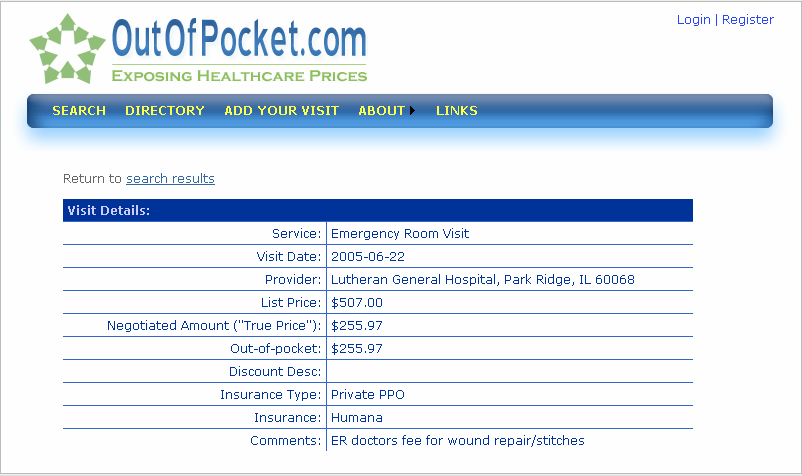
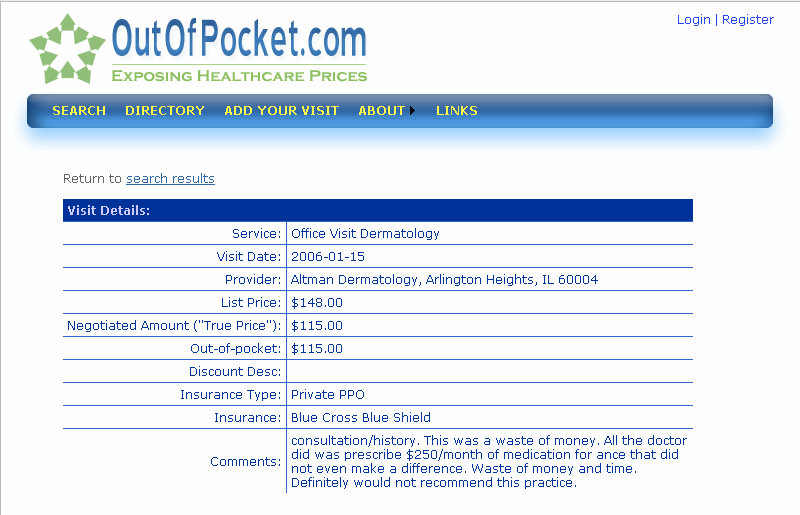
One new site that contacted me is OutOfPocket.com.  It is still very early stage, but it has the right concept.  You can go online and look up the comparative costs of a treatment or office visit in your area.  Below are two examples.  I like the second one where the patient cuts to the chase in the comments area.  The company also has started a blog recently which I look forward to being cutting edge and aggressively laying out cost data.

outofpocket-site1.png

outofpocket-site2.png

Healthcare – Financial or Service Oriented

I had an interesting discussion earlier this week.  The question was whether people view their healthcare companies as a financial company (i.e., cost is the dominant factor and/or the cost to value tradeoff) or as a service company (i.e., my experience at the doctor’s office, hospital, pharmacy, call center).

I am sure it is not universal, but it would be an important attribute to understand in driving communications with patients.  The easiest example I always use is the paper claims process.  Imagine getting rejected at the pharmacy and having to pay $200 for your prescription.  For some, $200 is a huge cash flow issue while for others it is simply a nuisance.  Where that person is coming from will vary their perception of that same experience dramatically.

For the person with the $200 cash flow issue, a reject forces them to either tradeoff medications versus food or heat.  Therefore, you are denying them care and possibly causing them harm.  For the other person, they pay the cash and are simply ticked off.  For them, it then becomes a customer service issue of how easy it is to submit a claim and how quickly they get reimbursed.

Customer Event

What a great week. I have been so busy that I haven’t had time to blog, but I will try to catch up over the next few days.

I always love to mingle with customers and talk to them about their experiences with a company. As a former client, a current consultant, and a future employee of Silverlink, I got to join their customer event this week where 40 customers talked about how they use the technology and services to lower costs, increase efficiency, and grow revenue. Talk about empowering.

Some of the key content / discussions revolved around the following:

  • JD Powers study on healthcare company satisfaction including a great non-healthcare example.
    • It showed how satisfaction with auto insurance actually went up and was higher when the company raised rates but pro-actively told the consumer versus when they lowered rates. Talk about the power of communications.
  • Lots of talk about how marketing and data analytics are going to drive healthcare and how non-healthcare companies are setting the expectations for patients very high compared to the current state.
  • How disjointed healthcare communications are – provider, pharmacy, PBM, MCO, DM companies. No consistency.
  • A great presentation by Liz Boehm from Forrester research which made a few key points:
    • She reinforced the loss avoidance point I blogged about the other day stating that savings is equal to one unit of happiness while loss is equal to two units of unhappiness. So, for many, losing money is a bigger factor than saving money.
    • She pointed out the fact that any healthcare site that quotes a price always has some disclaimer about the accuracy. Why can’t we simply guarantee a price (like any other industry)?
    • She showed that member services (IVR, web) are the 3 most important factor in chosing a carrier after price and network.
    • She showed research that consumers are generally dissatisfied with contacts across all channels from their health plan.
    • She talked about using a persona to design programs and prioritize efforts.
    • She compared channels across cost, reach, engagement, and immediacy.
    • It was obvious that we have a long way to go.
  • Heard from a few customers that talked about how they allow Customer Service Representatives (CSRs) to go “off the clock” to help patients so that they can still track average call time but allow for flexibility.
  • I talked about process innovation and how to apply that to your communication process. I also talked about business process outsourcing.
  • We heard about best practices in driving response rates. Everyone always seems so amazed when they hear about response rates of 50, 60, or 70%. Very difficult to get and/or measure that in other channels.
  • Talked about how MCOs are using the automated call technology – ANOC (Annual Notification of Change) for Medicare, Collections, Lead Management, COB, Missing Information, Wellness Program Recruitment, Reminders, Surveys, and many others.
  • We heard about calculating the ROI with a detailed methodology.
  • We talked a lot about models from other industries that could apply.
  • We talked about data mining and analytics.
  • We talked about member satisfaction, loyalty, and how to survey and capture that information.
  • An outside consultant talked about experience based branding and how sounds can be your brand – Harley‘s engine, Sprint‘s pin drop, Ford‘s door chime, AOL‘s “You’ve Got Mail”.
  • Had several clients talk about how they use Silverlink‘s technology to enhance their product suite

All of the conversations and presentations reinforced how critical successful communications are to healthcare and how big of a hill we have to climb. It was great to see how effective, timely, and personalized the Silverlink technology could make the process. It is worth looking into if you are a managed care company, a device supplier, a PBM, a pharmacy, or even a provider.

Other Blog Posts

Here are a few other posts of interest.

On InsureBlog, there is a good entry about the clinics popping up all over the country.  There is debate from physicians, and he cuts to the chase saying their claims are ridiculous.  I for one hear about all the inducement issues and steerage issues, but what is the prevalence.  How many docs own establishments that they push or get kickbacks?  Probably not something we will ever know, but something we should.

On Managed Care Matters, there is a debate about using claims data to evaluate physicians.  I haven’t studied the literature, but we need something to evaluate their behavior and successes.  If not this, what.

This is an older entry on Health Literacy, but it is a critical issue.  If those that most need information don’t use traditional sources, how do we reach them?

In another blog, I found the suggestion of using YouTube to post patient stories a good one.   It is a powerful tool to have people talk to people and share their ideas and experiences.  This would be great in healthcare.  I value that information.

I was also intrigued to see so many sites about pharmacy and most of them angry about the PBMs or large chains or customers.  Here are a few:

Fastest growing healthcare companies

Inc. always puts out their fastest growing company list. Sorting it for healthcare gives you an interesting list. Here are the top 20.

  1. MemberHealth
  2. Hospital Partners of America
  3. Genoptix Medical Laboratory
  4. BSN
  5. Xymogen
  6. Eyeonics
  7. Massage Envy
  8. WorldDoc
  9. Health Advocate
  10. Ancillary Care Management
  11. Sucampo Pharmaceuticals
  12. LifeGuard Medical Solutions
  13. Millennium Pharmacy Systems
  14. VMS Medical
  15. Talyst
  16. Trio Clinical Research
  17. TomoTherapy
  18. LabConnect
  19. WageWorks
  20. Accuray


 Another interesting way of looking at this is on a map. Unfortunately, none of these are near St. Louis, but the Midwest did better than I expected.

inc 500 hc map

Accenture Top Issues for Payors

Peter Kongstvedt is a partner at Accenture (and former colleague of mine from E&Y). He has always produced great articles and publications on healthcare. I was happy to have someone send me a link to one of his more recent publications on the Top Issues for Payors in 2007 and 2008.  It is certainly more interesting if you are a payor or consultant, but here were two things that I thought most people would find interesting.

Here is a quote which I think is really one of the core issues.  How to make data driven decisions versus experience to drive healthcare.  Not easy in a splintered industry with disparate data.

Promoting medical practice that is based on current scientific data rather than on habit or outdated information remains a top goal for every payer.

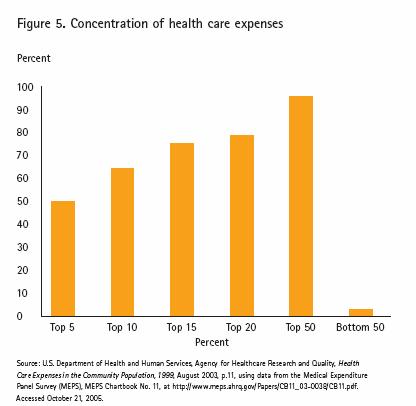
Another fact which I have always found very interesting is the chart below on the concentration of health care expenses.  Almost 80% of all healthcare expenses are from 15% of the population.  Amazing concentration.  Great from a marketing perspective but tough from a risk management perspective.

Healthcare costs concentrated

Healthy Behavior

I was reading a blog by the CEO of Harvard Pilgrim earlier and found the point below pretty interesting:

50% of health status is determined by healthy behavior. 4% of health care spending supports healthy behavior.

I think it leads to a critical issue which we all face (patients, providers, insurers) in healthcare which is how to drive healthy behavior.  Ideally, we would want to understand and have visibility to actions that could lead down the wrong path.

Not all very realistic, but imagine:

  • Buying groceries that aren’t good for you triggering a message.
  • Stopping at a fast food restaurant for drive-thru triggering a message using RFID or Bluetooth technology.
  • A reminder in your car before you leave for work that you need to take your prescription.
  • Exercise reminders pushed into your Outlook and linked to an online analysis tool.
  • Genetic based testing suggestions linked to a home based device which tracks blood pressure, blood sugar, and other key metrics.

I am sure there are a lot of innovative ideas, but the point here is that we need to think about how to create opt-in communication options or online tools or devices that integrate non-claims data with health suggestions to figure out how to prevent treatment.

Loss Aversion vs. Reward

I have had a note to write on this for a while and then read an entry on the Medical Connectivity Consulting blog about this.   It is a key point in understanding how to drive patient behavior.

Some people respond to rewards or positive motivation.  For example, this will save you money or this activity will make you healthier and extend your life.  Other people respond to negatives (i.e., loss aversion).  For example, you just wasted $20 by choosing this prescription or don’t forget to get your annual checkup.

This is where the real difficulties of communications occur.  How do you segment and target individuals to address messaging, medium, timing, frequency, etc.?  It isn’t easy and mostly comes through experimentation.

Consumer Reports on Drugs

This has been around for a few years, but if you don’t know it exists, then you would find it valuable.  Consumer Reports launched a website which offers you good, independent information on prescriptions (Consumer Reports Best Buy Drugs).  Medco was smart to partner up with them early on and make the content available to their members.
You get basic disease information, drug information, cost information, and some cost savings ideas (i.e., take generics). 

A good clinical site which is a partnership of Express Scripts and the St. Louis College of Pharmacy is called Drug Digest.  I have used it many times and know the pharmacists that create the collateral.

BCBS of MI also has a great site on generic drugs (or unadvertised brands as they call them) which allows you to calculate cost savings and learn more.

Healthcare IT – Gartner

I am listening to a Gartner webinar on Healthcare IT which is a pitch to vendors on sponsoring an upcoming event of theirs.  Here are a few comments which I thought were interesting and some of you might care about:

  • Innovation in IT is critical for healthcare.
  • Healthcare IT will be the fastest growing vertical through 2008.
  • Based on a live poll of the attendees on what companies are looking for in making technology decisions, the top 3 factors (which were my votes) were:
    • Ability to integrate w/ existing systems
    • Lowest total cost of ownership
    • High quality service
  • Healthcare providers buy based on references.  (more than others??)
  • Consumer confidence in online tools is very low.  Phone is #1 preferred mode of communication.  Relationship between payors and patients outside of phone is still limited with fear of lack of security.
  • Current pain points (insurers and providers):
    • Business intelligence – how to get quality information from all their data
    • Integration
    • Claims
    • Physicians – how to keep them happy
    • Agility
  • How to best engage prospects with an IT solution:
    • Case studies
    • Referrals
    • Demonstrate a good fit to them

Not too helpful for those of you that are consumers, but for those of you developing consumer solutions to address the market, this might be helpful.

Health 2.0 Conference

Are you going to the Health 2.0 Conference?  It has an impressive list of speakers and panelists from start-ups to established technology companies (e.g., Google) to big companies (e.g., McKesson).

If this is your space, this seems like the place to be in a few weeks.

Should FSA Use Tell Us Anything about CDHC

Flexible Spending Accounts (FSAs) have been around for several decades.  They let people set aside pre-tax dollars to pay for things such as daycare or healthcare.  An article in the Chicago Tribune says only about 20% of people use them, but only about 4% of dollars are forfeited per year.

It makes me wonder.  If I can save 30% on things that I spend money on, why wouldn’t I do it.  And, can I learn anything here that is relevant to how consumers view consumer driven healthcare?

Obviously, the use-it or lose-it concept scares people.  But, most of us should have access to data about our historical costs.  (Perhaps not easily, but what’s a hour of your time worth to research this.)  And, if only 4% of money is being lost then most people can plan appropriately (of those that use the benefit).

I think sometimes it could be cash flow for some people, but this is likely something that could be managed.  But, it is a real issue.  We saw it with mail-order pharmacy.  People couldn’t always manage to pay for a 90-day supply upfront.  Most of the executives that develop these benefits don’t think about cash flow issues from an average worker perspective.

Perhaps the plans are confusing or not being sold by HR to the employees.  I wouldn’t doubt this.  And, I am sure there are other reasons and a study out there somewhere that could give statistical data on this.

But, if employees can’t figure out and plan how to use their money in order to take advantage of pre-tax dollars, that tells me we need a lot more data, education, predictive tools, and general information to make CDHC successful.

PodCast with Silverlink CEO (from HC Blog)

I have not advanced my blogging as much as Matthew Holt has on the Healthcare Blog so I am going to “re-purpose” one of his interviews.  One of my consulting clients is a company called Silverlink (which was also a vendor of mine at Express Scripts).  I continue to be impressed with the technology and the ability to find more opportunities to use their voice technology to replace letters and increase response rates to communication programs.

In a meeting today with JD Powers, they revealed that almost 30% of the satisfaction scores for healthplans is attributed to communications.  That should make you research what you do and how to improve it.

So, if you are interested in a dialogue about Silverlink and what they do, read Matthew Holt’s interview with Stan Nowak (CEO of Silverlink).

for our flu shot reminder we’ll have a client tell us that it was as effective as using humans and saved them 65% of the cost. For health risk assessments it was two times as effective as their alternative mode of delivering those health risk assessments and it was 50% less cost”

Data Visualization

I remember when I graduated from business school one of my professors gave me a book on data visualization.  Given my architecture background, I always felt very strongly about this way of delivering information.

Guy Kawasaki mentioned a site in his blog which lays some of these visualization techniques out.  Here is the site.  There are some interesting examples which are well enabled by technology.  Here is one of my favorite.  I can easily image using this to map healthcare trends based on geography (for example).

Visualization

More Interesting Data

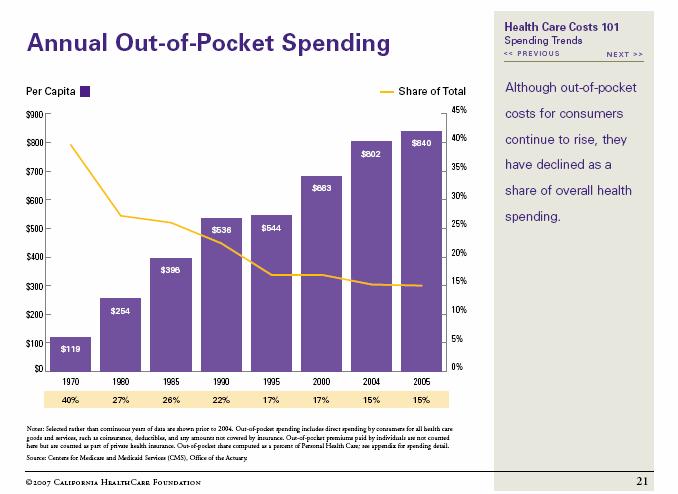
Here are a few charts from the California Healthcare Foundation 2007 report on healthcare costs. They show some interesting data.

This first one shows annual out-of-pocket spending by consumers on healthcare. As you would expect, it has gone up in real dollars, but it has gone down as a percentage. OOP Spend

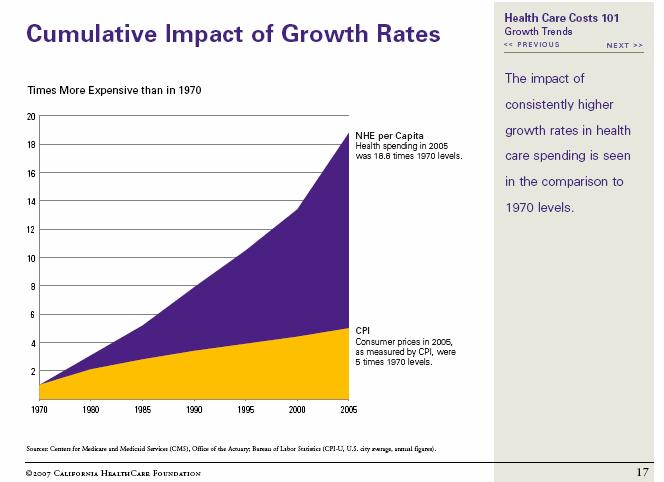
Here is a chart that shows how the yearly growth in healthcare costs has compounded itself over time compared to the CPI.

Cost Curve
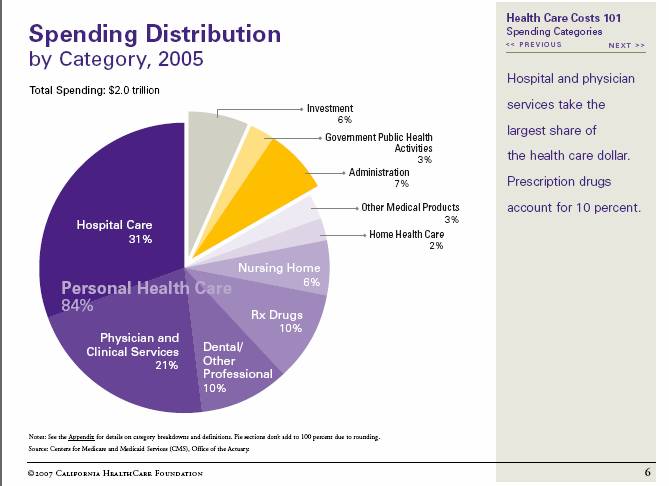
This next chart has always been interesting to me. When I was at the PBM, we talked so much about drug costs, but the reality is that they are a minority of the total costs.HC cost by category

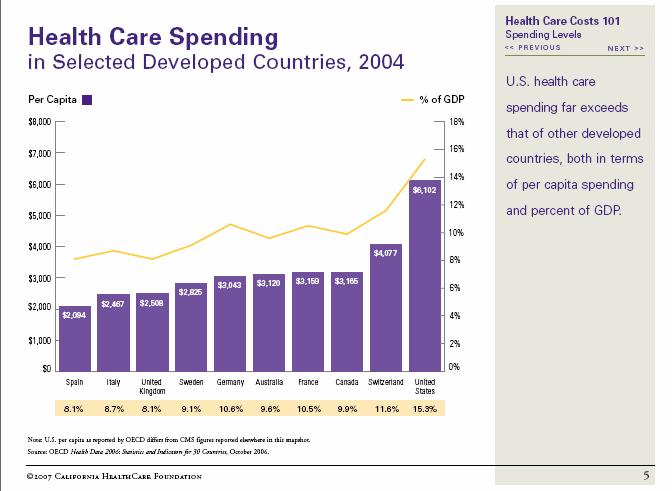
This chart comparing our spending to other countries is always a little scary since our average age and (I believe) our typical outcomes aren’t very different from these other countries. But, it is important to look at both together. Spending more if it made us live longer and healthier lives might be worth it.HC by country

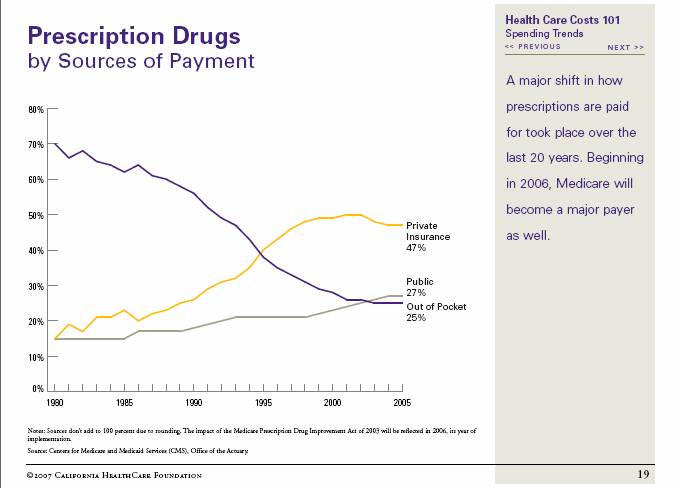
We used this chart several times in my past. It shows how private insurance has begun to pay for drugs compared with consumers over time.

Rx payment sources

Lance Armstrong Talks w/ Presidential Candidates on Health

I happened to have the chance to catch almost an hour of this forum the other day and see John Edwards and Hillary Clinton talk with Lance about Cancer and healthcare reform. It was pretty interesting.

There are several good blog entries covering this in more detail (see below):

Here are a few of the things I heard / noted:

  • Talk about mandating preventative care. Interesting. I never thought about this as a mandate. Could we really do this? Would it make a difference?
  • Clinton talked about EMRs (Electronic Medical Records) to help people like Katrina victims and others. Good compelling example. Horrible to have a loss and not know your medical history or what drugs / strengths you are on.
  • Debate about whether to include the HMOs at the table for healthcare reform or not. Is it possible to exclude them? Unless the government is going to force something down everyone’s throat, they need the current players to help them understand history and create a transition plan.
  • I think it was Edwards that made a point about universal healthcare not being free. I assumed he meant that the money came from somewhere, but I don’t remember him articulating anything specific.
  • They disagreed about whether to take money from the healthcare companies. Do any of us citizens really think they aren’t influenced by somebody (money or not)?
  • Both seemed focused on technology which I agree is important.
  • Lance asked a great question around why the cancer death rate is highest in 15-40 year olds. Great answer (I think by Edwards) pointing out that they don’t go for regular checkups and therefore the disease is often ignored until it is too late.
  • Some discussion about providing good care for veterans and the poor. Important point. Can we really have someone go off and fight for us and then not care for them when they come back? That is a shame. Plenty of us aren’t volunteering for the army.
  • Interesting discussion on ROI for cancer investment. I am not sure where the numbers came from by they were throwing around studies that $200B in productivity costs are incurred each year due to cancer. How much would we have to invest to recoup some of that?
  • Edwards made a point (that I always talk about).  He said that he and his wife while very educated can’t understand communications regarding their health benefits.  Simplicity people.  Clear messaging.  It seems so easy.
  • I was also surprised to hear Michael Moore’s movie Sicko brought up several times in the discussions.

McKinsey Survey on CDHC

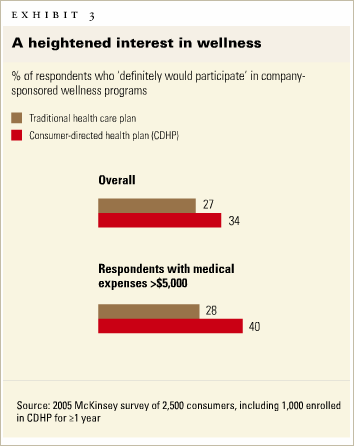
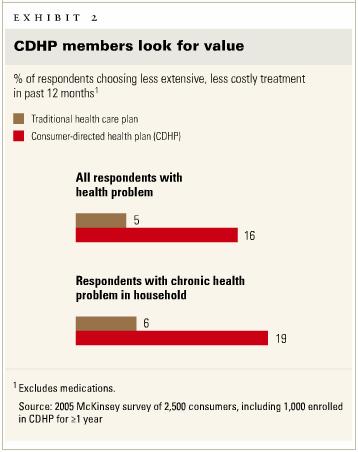
McKinsey did a survey of employees in CDHC plans versus those in traditional plans to compare their interest on a few points. Here was the key summary along with a few data points:

“We found that the plans encourage value-conscious behavior, increase the consumers’ level of engagement with their well-being, and may even promote behavior that leads to better long-term health.”

This is important since the [right] reason to engage the consumer with CDHC is to get them to make better decisions and become part of the solution (not simply to cost shift).

McKinsey CDHC

mckinsey-cdhc-1.jpg

Shortage of Pharmacists Continues

There was a study done a few years ago that showed that given the projected rates in prescription drug utilization there would be as many as 150,000 too few pharmacists by 2020.  The studies looked at automation as a solution.  They looked at opening more pharmacy schools.

But, there are numerous constraints.  Here are few links about the study.

It is an important issue since your prescription benefit is your most highly used benefit.  If you haven’t seen the 20/20 story on pharmacy errors from earlier this year, it is worth a read.  It is a little controversial since it shows a much higher error rate than I have ever seen and is certainly biased towards the negative.  But, it is an important discussion.

The question is how to leverage this important asset – pharmacists – as a key point in the patient care continuum without sacrificing quality.  Automation.  Virtualization.  Central Fill.  There are some options, but figuring out the new economics and division of labor to help open up time for more patient care will be a change.