December 27, 2007
Where your customer (or patient) has the ability to defect (i.e., chose another health plan, go to another PCP or hospital, chose another drug or pharmacy), what are you doing to predict this and act in advance. As the old saying goes, it is cheaper to keep a customer than to attract a new one.
In wondering what other industries do, I was a little discouraged to find the following in CSC’s 2004 Customer Intelligence Diagnostic Survey:
“half of the respondent firms never, or almost never, perform defection analysis to identify customers who are on the verge of defection. Nevertheless, over half of the respondents claim that they have developed targeted programs to prevent defection.”
Even companies that ask about your experience or satisfaction often don’t act on it. For example, I have stayed at the Detroit Ritz several times for personal travel. Each time, check-in has been bad. Every time I check out, they ask how my experience was. I say it was okay. They say great and move on. [Which shouldn’t be acceptable at a place like the Ritz that prides themselves on customer service.] Never have they asked me for feedback. So, instead, I complain to the national office and get a gift certificate which costs them money…simply for not acting on my lack of satisfaction.
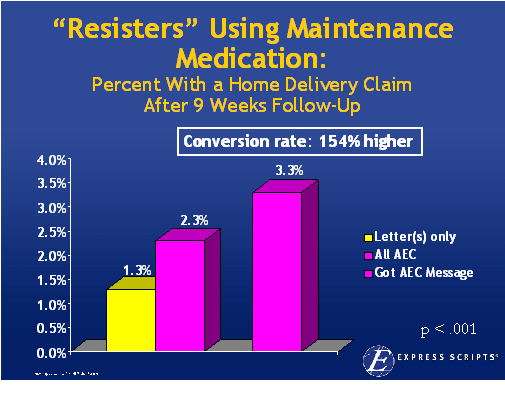
In healthcare, it may be a little harder to predict, but not filling a maintenance drug or not scheduling a follow-up appointment are definitely bad signs. A quick follow-up survey to any experience will tell you a lot. And, as I think I have mentioned before, for healthy people that never experience their healthplan, it makes a lot of sense to reach out to them prior to open enrollment when all they will see is another rate hike.
 some family objectives, a financial planning objective, and a few personal objectives (e.g., run a 1:40 half-marathon).
 I have a group of guys who I play poker with at least once a month. We play
 Getting back to the article…He offers several good examples of sticky messages which are primarily what I would call rallying calls for organizations. In healthcare, the key is to find these simple messages that compel people to act. So, bottom lining it, he gives six basic traits:
 [By the way, as I have previously disclosed, I own no ESRX stock or other stocks individually. I only invest in mutual funds…and do very well with it.]
 I don’t know the answer here, but I am sure someone out there does. The question is whether healthcare professionals are bigger utilizers of healthcare services (e.g., MRIs, prescriptions, well visits, etc.). I always want to know that from service providers. If you are selling me a CRM (
 In
In