Archive | Books / Articles RSS feed for this section

S.A.D., ADD, OCD – Are we all affected?

A friend from Europe pinged me a few months ago to see if I wanted to connect him with someone who could distribute SAD lighting here in the US.  (SAD apparently means Seasonal Affective Disorder.)  Before even responding, I talked to a chief medical officer I know to validate the condition and the effect of lighting.

But, it made me wonder…are there some diseases that many people have to a lesser degree that we rationalize in different ways.  If people with SAD are depressed and have less energy in the winter due to lack of lighting, is this what many others simply refer to as the winter blues and just take for granted?  I can think of lots of people who are different in the dark winter months when they are inside.

For that matter, for people with ADD (Attention Deficit Disorder), focus is a challenge, but many of our most creative and innovative people are people who thrive in some chaotic form and come up with new ideas (e.g., story about CEO with ADD).  Do they all have ADD or some mild form of ADD?  (CBS article)

I could go on, but let’s look at one more – OCD (Obsessive Compulsive Disorder).  People with this condition can’t help themselves with certain actions – e.g., washing their hands until they bleed.  But, there are lots of people who are considered meticulous or anal retentive who get rewarded for their focus on detail and ability to do mundane tasks repeditively with little error.  Do these people have a mild form of OCD?

60.7 miles a day for 51 consecutive days!!

Amazing is all I can say.  I can’t even believe that there is a 3,100 mile race in existence.  Obviously a very small number of annual participants – looks like 14 this year.

I thought it was impressive when Dean Karnazes did 50 marathons in 50 days a few years ago.  But, to have to do 2 marathons a day for the same period seems inconceivable.

Probably one thing (like running barefoot) that I am unlikely to try.

Communicating With Michelle Obama

First, congratulations to Barack Obama on getting the nomination.  He is a great orator and regardless of who I vote for I think he will be an exciting candidate.

From a healthcare communications perspective, I found an NBC Today Show interview with Michelle Obama very interesting yesterday.  She talked about three things that seem to be telling about her personality:

  • She said she was more of a fatalist than an optimist meaning that if Barack is meant to be president than he will be.
  • She said she was superstitious.
  • She talked about not believing that living in the White House will change their family dynamic.

So, I would suspect that trying to get her to change behavior would be very difficult as a fatalist.  If she believes that becoming sick is inevitable, why would you change your diet or habits.

If she is superstitious, I would suspect that there are actions, phrases, colors, or other queues that could encourage her to take action.  What those are…who knows?

And, if she doesn’t believe that the White House will change the family, it makes me think that she is very inwardly focused.  She admitted not watching TV or reading the paper.  But, as an ivy-league lawyer, I have to believe she does those things and reads aggressively.  So, I am confused as to why she wouldn’t believe history.  I haven’t read the history of presidential families, but I am pretty sure kids raised in the White House are very different.

My take would be that she would be a hard candidate to motivate to change and successfully communicate with.

Healthcare Reform Won’t Be That Easy Mr. Obama

Election campaigns typically feature pontificating politicians flashing silver bullets to painlessly slay the nation’s problems.

Just move some money from here to there, cut some government waste no one apparently ever noticed, and then fund an unattainable promise with an outlandish price tag.

Barack Obama’s healthcare reforms fit this model nicely. He bundles three evergreen feel-good concepts — electronic medical records (EMR), disease prevention and chronic-disease management — and totes up dubious savings to fund his ultimate goal of making health insurance affordable to everyone. (Article in Fort Worth Star-Telegram)

It sounds like Barack’s advisors read George Halvorson’s book on the healthcare system.  Maybe they skipped the sections on the difficulty of aligning incentives and driving change.  If he thinks he can make major changes in 4 years, good luck to him.  Maybe that is a sign of his inexperience.  I think we all want change, but we definitely need a person who understands how to make change happen given the fixed constraints that we have.

He reminds me of the new consultant who comes in fresh out of business school and sees all the changes the company should make.  They are so obvious.  But, without all the history and the ability to manipulate the political landscape and knowledge of what it takes to get things done, it just becomes the flavor of the month that no one takes seriously while they wait for the consultant to move on to their next project.

Great ideas (not that this is one) don’t by themselves guarantee success.  A good idea implemented well is a lot better than a great idea implemented poorly.

Less Sketchy: More Scary

When you think about identity theft you think of your credit card information being compromised and someone ringing up $1,000s of dollars worth of charges that ruin your credit history.  If I say medical identity theft, you probably think about your information being stolen and used to ring up fraudulent bills by crooked providers.

But, in an article on the topic in the Chicago Tribune, they introduce a much scarier concept.  What happens if someone who can’t afford care, steals your identity to get free care provided to them.  During that process what happens if information is added to your permanent health record which subsequently impacts your future care (e.g., a note saying you are not allergic to something, a pre-existing condition which impacts coverage).

No Pharmacy Coverage – I Doubt It

In the AIS e-mail on Friday, it had the following quote:

“If the economy remains weak over the long term, we could certainly see employers and government agencies looking to investigate cutbacks on the type of pharmacy benefit they are offering, or eliminate pharmacy as a benefit altogether [in commercial plans]….The problem with [this] is that if an individual is unable to obtain their necessary drug therapy, you will typically see an increase in the overall health care costs associated with an individual.”

— Mesfin Tegenu, president of PerformRx, the pharmacy benefit manager division of the AmeriHealth Mercy Family of Companies, told AIS’s Drug Benefit News.

I must admit that I am more than a little skeptical of this.  The pharmacy benefit is the most used part of a benefit plan (average of 14 times per year).  Don’t you think there would be lots of other things cut back first?  Heck…I even see them cutting out 401K matching before they cut out prescription drug coverage.

Sure, it might get scaled back in terms of cost sharing or # of drugs covered, but that’s been happening for years.  But, elimination seems unlikely in a society that is very prescription drug focused.

8 in 8: Michael Phelps Wins The Gold

What great motivation for a generation of people. First, you have Dara Torres winning 3 silver medals at the young age of 41. She shows us all how you can be a semi-normal person with a family and still compete at this level. (I say semi-normal since I don’t know if she has a nanny and other staff helping her or is independently wealthy and doesn’t need to work and can train all day…but I don’t think she is.)

Next, you have Michael Phelps winning 8 gold medals to increase his total and become the first one to win 8 golds in an single competition. (Not to mention the fact that he is a University of Michigan alumni like me.) I am sure a few people will be thrown off by the 12,000 calories he eats per day…don’t try this at home.

I think it’s also interesting that Michael has ADD/ADHD.  (Here’s a site that lists several famous people with ADD/ADHD.)  I think there is one good article which talks about his Hyper Focusing on swimming which is a common ability of people with this disease.  In this case, he has harnessed it very positively.

There are several motivations that people can take from the Olympics not least of which should be to get up and be active at any age.

Health Plan Week on Retention

I had an opportunity to get interviewed a few weeks ago by one of the contributors to Health Plan Week about retention within health plans.  With growth in the group market stagnant and ultra-competitive, the individual market offers lots of upside, but makes satisfaction and retention a much bigger issue.

You can read the article here where it discusses things like the “top box”, the importance of personalized communications, and champion / challenger processes to determine the best approach.

Skip The Patch…Send Them To Church

“Overall, 21% of Americans interviewed in our Gallup Daily tracking program this year say that they smoke.  (By the way, that’s down from an all-time high of 45% back in 1954).

But the percentage of smokers is only 12% among those who attend church once a week.  Smoking rises to 15% among those who attend almost every week.  Then 22% for those who attend once a month, 26% for those who seldom attend church, and finally 31% among those who never attend church.” (see 7/31 entry on USA Today Gallup blog)

I am always fascinated by correlations such as this.  Who thinks of the null hypothesis to look at this?  (Null hypothesis being that people who go to church smoke less which is what they collected the data to prove or disprove.)

With smoking being a huge health driver, what can you do with this information?  It’s hard to believe your employer or health plan could drive church attendance.  Perhaps this gets us back to social networking and your peer group.  Groups of friends or others coordinating and talking about quiting smoking may be more successful if someone active in a church was part of the team helping them.  (I am grasping at straws here.)

Smart People Doing Stupid Things

I was reading a post on the Foghound blog which made me think of an article I saw this morning on medical administrators using homeless people to defraud the government.  Lois points out eight things that smart people do that are stupid – impulsiveness, indulgence, and tempting fate (for example).

Why is it that seemingly intelligent people so easily and frequently seem to skirt the law to try to make money.  Do they think they are above the law?  Are they that greedy?  Do they believe (like the common criminal) that they won’t get caught?

It’s cases like this one with the homeless that cause distrust in the system.

Median US Age Now 37.9

The USA Today reports this morning on the shifting demographics of the US.  I found the map of the US showing the different variances from the median interesting.  (Note: Median means that half the people are below that age and half are above that age.)

It appears that some of the states like North Dakota, South Dakota, and Kansas are increasing their median age quicker than other states. (Source: Census Bureau, analysis by Paul Overberg, USA TODAY)

Compliance is complicated

I am going to try a posting from my blackberry.

I just read this in the AIS newsletter and was surprised that this was news.

“Personally, I believe the reasons people take prescription medications are quite complex. There are a lot of motivations and issues in that, and copays may not, in and of themselves, be enough to change adherence and compliance.”
— Keith Bruhnsen, manager of the University of Michigan, Ann Arbor, prescription drug program, told AIS’s Drug Benefit News when discussing the need for research and data to support the idea that lower copays for essential services actually remove barriers to their use.

Gas Prices Helping PBMs

Unfortunately, the WSJ Health Blog beat me to it, but I think it’s an interesting perspective that apparently David Snow (CEO of Medco) talked about.  High gas prices cause people to reconsider things…like driving to the pharmacy or paying for brand drugs.  That would mean that mail order penetration should go up and people should use more generics.

It seems logical, but I am trying to reconcile it with two other economic realities…people not filling their prescriptions or skipping doses to save money and the fact that mail order requires upfront payment for the longer supply.  I have always struggled with why someone doesn’t offer a credit card for their mail order pharmacy so that you can save money and spread the payment over three months.  In tough economic times, that cash flow can be an issue.

And, for the first time in over a decade, it appears that the growth in prescriptions actually fell as reported on the 16th in the WSJ.

The burden on consumers has increased sharply. The average copay for a preferred drug on an insurance company’s tiered system rose 67% to $25 in 2007 from $15 in 2000, according to the Kaiser Family Foundation. Out-of-pocket costs to cover family insurance premiums were $3,281 per employee last year, up nearly 84% from 2001.

Consumers appear to be skimping on medicines as a result. An April poll from the Kaiser foundation showed 23% of patients who responded didn’t fill a prescription in the last year because of cost, up from 20% in 2005; 19% split pills or skipped doses, up from 16% in 2005. A report last month from the nonpartisan Center for Studying Health System Change in Washington, D.C., said 20% of respondents in a 2007 survey of 18,000 people had put off or gone without medical treatment in the previous year, compared to 14% in 2003.

Data from IMS Health show growth in prescription volume for the first five months of this year slowed to 1.5%, the lowest rate at least since 1996. From 2003 to 2007, annual volume growth averaged 3%. In December 2007, total prescriptions dipped by 2.1%. The decline was 0.2% in April and 0.1% in May.

Traveling With Autistic Kids

After the incident a few weeks ago when a mother was kicked off a plane since her autistic child was uncontrollably upset, I was glad to see the article in USA Today about this challenge. It has some helpful information such as the fact that 1 in 150 kids have autism and 1 in 94 boys have autism.

The recommend the following:

  • The Autism Society of America sells wallet cards, left, that describe common characteristics of autism and tips for interacting with autistic children that parents can give to airline personnel.
  • Visit the Department of Transportation website to read the Air Carrier Access Act, which outlines the rights of disabled passengers.
  • Prepare for the trip by showing your child pictures of the airplane, the terminal and the destination.
  • Alert the airline that you will be traveling with an autistic child. Many airlines will allow you to board first.
  • Choose a vacation destination that will accommodate your needs. Many parents recommend Disney World, which is known for its disabilities services.

Since some of their reactions (to what most of us adults hate also) can look like misbehavior by children, I can only imagine the looks that the parents get.  As the article suggests, look and think about how you can help…don’t judge.

Cell Phones and Cancer…Cautious?

In another confusing story to us the public, everyone has picked up the story about the head of a prominent cancer research agency telling the employees to limit their mobile phone usage.

“Really at the heart of my concern is that we shouldn’t wait for a definitive study to come out, but err on the side of being safe rather than sorry later,” Herberman said.  [Dr. Ronald B. Herberman, director of the University of Pittsburgh Cancer Institute]

The suggestion is to limit use for children to emergencies, use hands-free devices, and use speaker phones.  The article cites several studies and the FDA saying that there are no issues.

Of course, this makes me think of autism and vaccines.  Is it an issue or not?  It also begs the question and the social responsibility of the health care system on whether to encourage us to be cautious or wait the decades for definitive research.

Love What You Do

We had an annual company event today, and I must admit that all day long I kept thinking about when can I get back to my hotel to work on several ideas that I have and get a couple of deliverables out the door.  Not that I wasn’t having fun since it was one of the best company events I have been to.  But, I love what I do.  And, since I have had the chance to work several places and even more as a consultant, I think being happy at work and enjoying your corporate culture is very important.

I love that fact that the company takes the time to celebrate and discuss the future.  And, it is great to be at a company that is still of a size that everyone can interact with each other, but big enough that you can make investments in the future.  Anyways, working on a few things for some of you clients and enjoying every minute of it.

But making it relevant for the rest of you…it made me think of the correlation between job satisfaction and health.  We all know the problems with stress and the impacts on health, but I found what looks like a good meta-study that shows the correlations.  Here is the abstract fromOccupational and Environmental Medicine 2005;62:105-112.

The relationship between job satisfaction and health: a meta-analysis

E B Faragher, M Cass, C L Cooper

Background: A vast number of published studies have suggested a link between job satisfaction levels and health. The sizes of the relationships reported vary widely. Narrative overviews of this relationship have been published, but no systematic meta-analysis review has been conducted.

Methods: A systematic review and meta-analysis of 485 studies with a combined sample size of 267 995 individuals was conducted, evaluating the research evidence linking self-report measures of job satisfaction to measures of physical and mental wellbeing.

Results: The overall correlation combined across all health measures was r = 0.312 (0.370 after Schmidt-Hunter adjustment). Job satisfaction was most strongly associated with mental/psychological problems; strongest relationships were found for burnout (corrected r = 0.478), self-esteem(r = 0.429), depression (r = 0.428), and anxiety(r = 0.420). The correlation with subjective physical illness was more modest (r = 0.287).

Conclusions: Correlations in excess of 0.3 are rare in this context. The relationships found suggest that job satisfaction level is an important factor influencing the health of workers. Organisations should include the development of stress management policies to identify and eradicate work practices that cause most job dissatisfaction as part of any exercise aimed at improving employee health. Occupational health clinicians should consider counselling employees diagnosed as having psychological problems to critically evaluate their work—and help them to explore ways of gaining greater satisfaction from this important aspect of their life.

Putting Your Kid On Cholesterol Drugs

I was a little surprised to see the news this morning claiming that it was okay to start putting kids as young as 8 years old on cholesterol lowering drugs and starting testing as early as 2 years old.  Talk about an obesity epidemic out of control.  I would think that there were lots of things we could be doing about diet and exercise to address this before setting kids up to be on these maintenance medications for the rest of their life.

Not a clinical opinion, but my personal opinion.  It makes me think of the social commentary delivered in the new movie – Wall-e – where the people don’t know how to walk anymore and just float around getting fatter and fatter.

Medical Bankruptcies

I will give credit to the Health Care Reform Now blog for leading me to this article in The Indianapolis Star, but I think it is a sad reality.

“More and more of the middle class is finding out that even if they have jobs and insurance, they can be wiped out by medical events that are not even catastrophic,” says Dr. Christopher Stack, a retired orthopedist and co-founder of Hoosiers for a Commonsense Health Plan, the state’s chapter of Physicians for a National Health Program. “You can run up a high five-figure bill real easily.”

A Harvard study published in 2005 estimated that about half of all bankruptcies filed in the U.S. have their origins in medical costs, a ratio that jibes with Silver’s and other bankruptcy veterans’ observations here in Indianapolis. While the rest of the world’s industrialized nations provide health coverage to all or nearly all of their populations, the U.S. mass-produces the distinctly American phenomenon of medical bankruptcies.

I am not a big fan of the donut hole in Medicare, but perhaps we need a donut hole type concept for health insurance where people have a maximum out-of-pocket in any one year.  Although I am sure that would beg the question of what was optional versus required surgeries and treatments.  It just seems a shame that we can bankruptcy hard working people with insurance over their medical bills.

Three Sad Healthcare Stories

First, I think this is a very disappointing article about workplace violence in the healthcare industry.  I certainly could believe (unfortunately) in the verbal violence since people are very emotional about their healthcare and often stressed over the financial implications and unintuitive processes.  But, this story has some scary statistics which are an issue at a time when we need more healthcare service workers.  [Ask your friends in the industry.  I plan to.]

  • Health care workers are 16 times more like to face violence at their job that workers in any other service-oriented profession.
  • More than 50 percent of reports of aggression in the workplace come from the health care sector.
  • Over 9,000 nurses and other health care workers are verbally or physically assaulted on the job every day, according to the National Institute of Occupational Safety and Health.
  • A 5-year survey of 170 university hospitals showed that over half of all emergency room employees had been threatened by weapons.
  • Almost 90 percent of nurses in every specialty said they were verbally assaulted during the past year and almost 75 percent claimed they were physically attacked, according to a study published in The Journal of Emergency Nursing, which related reports of 100 percent verbal and 80 percent physical assault rates for emergency room nurses.
  • Almost half of all psychiatric physician residents reported an assault during their career and other medical residents in the hospital setting reported a 16 percent assault incidence.

The second article which I read which I think is also sad is about the rise in seniors filing bankruptcy. Sometimes, seniors don’t even have enough resources to install stairlifts in their homes. Not only is it disappointing to see people reach retirement only to have their dreams dashed away from them with crashing house prices, rising food prices, rising gas prices, and lower return on their investments, but they are facing huge healthcare costs that are pushing them over the brink.  22.3% of the bankruptcy filings in 2007 were from seniors.  We also know that even without filing this stress can get people to skip medications or not take care of themselves only worsening their health.

The third story which I saw on CNN this morning was about a group of high school girls making a pregnancy pact.  Talk about a need for sex education and health literacy.  It’s one thing to happen by accident and quite another to intentionally put yourself in that challenging situation of getting a high school diploma and raising a child.

Brand Prices Up; Generics Down

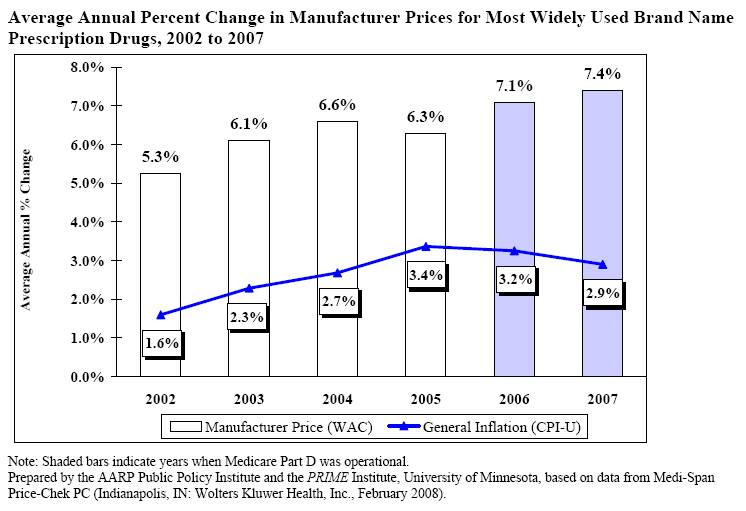
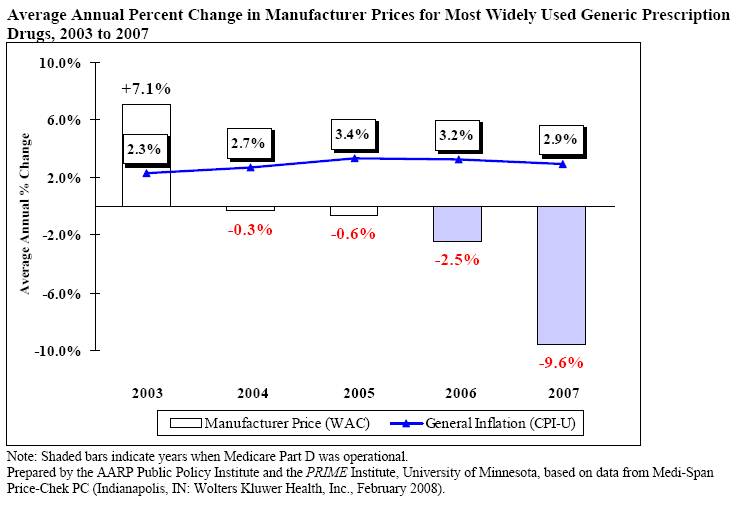
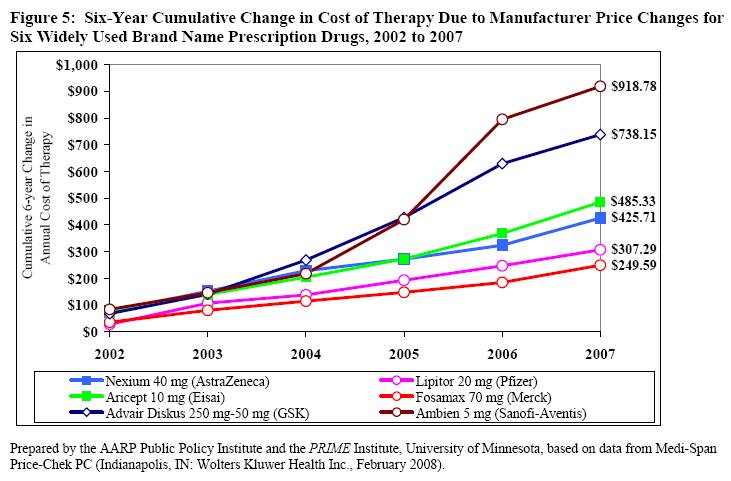
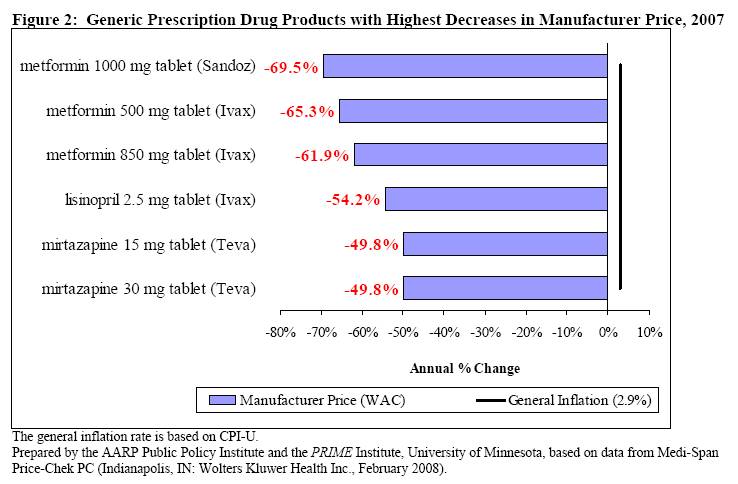
For those of you who are interested in this type of stuff, I think the AARP Watchdog reports (Brand Report, Generic Report) which track prescription drug prices over time are pretty interesting.  (Note: This is for drugs most commonly used by Medicare recipients, but I think you’ll get the point.)

Sell Your Captive PBM – Why?

I was a little surprised by the quote from Lisa Gill from JPMorgan Chase about why health plans should sell their in-house PBMs (Pharmacy Benefit Management):

“I think it makes a lot of sense for PBMs [pharmacy benefit managers] to be sold or spun off as a stand-alone business. The only time it will make sense for a managed care company to actually own a PBM is after they move to real-time [medical] claims processing. And that’s not going to happen near term.”

Maybe I am missing some context here, but I don’t understand.  Why would you have a “captive” PBM (i.e., owned by a managed care company)?

  • Able to align total healthcare interests (e.g., drive Rx usage up to manage ER visits)
  • No conflicts of interest (real or perceived)
  • Able to keep margins of the PBMs (look at the stocks of Medco, Express Scripts, and CVS Caremark)
  • Manage the customer service experience

What does any of this have to do with real-time claims access?

Why would you use a standalone PBM?  (Again an easy decision)

  • Economies of scale on rebates
  • Mail order pharmacy efficiencies
  • Manage capital outlays
  • Get a dedicated focus on pharmacy which as only 10% of the total healthcare spend will be a stepchild under a managed care plan no matter what
  • Best practices being leveraged across companies

And, we all know from bidding on RFPs that managed care companies use this service to win business talking about the integrated solution and underwriting pharmacy with medical.

If you understand the rationale here, help me out.

A Few AIS Quotes Of The Day

I have a few more to post, but I often find their quotes interesting (www.aispub.com).

“Specialty medications require significant education for patients to feel confident self-injecting and achieve a successful outcome. For many patients, injecting a medication into the skin or muscle can be very intimidating. Because of the expense and the complexity of the medication, we cannot assume that the patient is just going to figure it out on their own.” Kari Amundson, director of specialty pharmacy services at Fairview Pharmacy Services, LLC.

“I think it makes a lot of sense for PBMs [pharmacy benefit managers] to be sold or spun off as a stand-alone business. The only time it will make sense for a managed care company to actually own a PBM is after they move to real-time [medical] claims processing. And that’s not going to happen near term.” Lisa Gill, a JPMorgan Chase analyst, speaking with AIS’s Health Plan Week about why health plans should jettison their in-house PBM units to shore up ailing profits.

“We went back and asked the 37,000 consumers we surveyed how long they had been with their last health plan, and found that the plans with the highest levels of involuntary turnover had the lowest levels of customer satisfaction.” Jim Dougherty, health care practice leader at J.D. Power Associates.

“The hepatitis C medications are pretty effective, but patients will feel much more sick from the treatment than from the disease, [so] companies that make those drugs are very willing to education patients” to improve their chances of remaining on the medication.” Mark Rubino, chief pharmacy officer at Aetna Inc.

A Few Blog Entries About The Think Different Event

We wrapped up the road show this week in Hartford and NY.  I missed both events to be at client meetings on the west coast (and now down south).  But, one of the presenters and someone who was in the audience posted entries on their blogs about the event:

Giving Out Your CEO’s E-mail

From the perspective of soliciting feedback, how many companies post their CEO’s or anybody’s real e-mail these days? Sometimes you can’t even find a number to call on the website. You simply get some generic form to fill out and get feedback. You sent it into the black hole and wonder if you’ll ever hear.

So, given Sprint’s challenges over the years, I think it was (is) a bold move to post the new CEO’s (Dan Hesse) e-mail (dan@sprint.com) at the end of some of their television commercials. I have been using Sprint as a great example of a company building loyalty because they reached out to me recently to move me to a better plan which reduced their revenue in ½. So, to test this e-mail address, I just sent the following. I will let you know what happens.

Dan (or whoever answers these for you):

I have been a loyal customer for 15 years now with Sprint PCS. I am not sure if that puts me in a minority, but I bet it does.

I was recently impressed when you guys called me to make sure I knew about the all inclusive plan (not sure of the actual name) which was something like $99 per month. Especially, since I was spending about $200 per month before. I work for a healthcare technology company and have been using that as an example about how to build loyalty.

I would be very interested (if you can share) how you guys made the decision to “down-sell” people and whether it has had the desired effect (which I assume is less churn).

The NY Times had an article about this on 6/9/08. Apparently, the initial response is an automated reply from Sprint, but most people then hear from someone on his staff (or likely a group of dedicated customer service agents) to address their questions.

“Yeah, we were worried,” said Mike Goff, vice president of advertising and marketing communications for Sprint. The company had a reputation for poor customer service, and soliciting critiques for the new chief to read was a risk. But, Mr. Goff said, Sprint wanted to “show we were serious about our intent to improve our customer service. We knew this was happening at a time when the perception of our customer service in the market was poor, so this is a chance for Dan to hear back from the market.”

The question is whether bold tactics like this can work to help change their image. If so, maybe health plans and PBMs should start posting their Chief Medical Officer, SVP of Customer Service, and CEO’s e-mails and see what happens. I can only image the look on some of their faces of doing something like this. Even though I am sure the reality is that he has a confidential e-mail address that gets used for internal purposes and personal purposes. As the Times article says, I am sure shareholders don’t want to think that the CEO sits in front of his PC all day answering questions.

Wisdom Of The Crowd – Socializing Wellness

You probably caught the articles last year about how obesity seemed to spread throughout social networks. Now, in an article in the Washington Post (5/27/08), they talk about another example of research showing that smoking is similarly affected by social networks. Theoretically, this research could have significant implications for using social media (i.e., Facebook, MySpace, SecondLife). I can easily imagine blogs out there following people’s efforts to lose weight or quit smoking. I can see a Facebook “badge” or “sticker” congratulating someone for not smoking.

In a study published last week in the New England Journal of Medicine, the team [Nicholas A. Christakis, a medical sociologist at the Harvard Medical School, and James H. Fowler, a political scientist at the University of California at San Diego] found that a person’s decision to kick the habit is strongly affected by whether other people in their social network quit — even people they do not know. And, surprisingly, entire networks of smokers appear to quit virtually simultaneously.

Some of the observations that they found which seem interesting included the way non-smoking spread throughout a interrelated but not always directly related group. I don’t find that too surprising. If everyone quits and it is no longer “cool” or accepted you are marginalized and likely to feel pressure to quit. This was a concern that they noted which might lead to other negative health outcomes for the group that doesn’t change.

In a small group of my friends, I have seen one person’s efforts to lose weight (which included drinking less) impact the broader group. Others lost weight. Less beer is consumed when we get together. And, there is more discussion about the gym and running and other activities. For those who aren’t interested in those topics, they miss out on part of that dynamic.

  • A person whose spouse quit was 67 percent more likely to kick the habit.
  • If a friend gave it up, a person was 36 percent more likely to do so.
  • If a sibling quit, the chances increased by 25 percent.
  • A co-worker had an influence — 34 percent — only if the smoker worked at a small firm.

“It could be your co-worker’s spouse’s friend or your brother’s spouse’s co-worker or a friend of a friend of a friend. The point is, your behavior depends on people you don’t even know,” Christakis said. “Your actions are partially affected by the actions of people who are beyond your social horizon” — but in the broader network.

“People quit in droves — whole groups of people quit together at roughly the same time,” Christakis said. “You can see it ripple through a network. It’s sort of like an ant colony or a flock of birds. A single bird doesn’t decide to turn to the right or the left; the whole flock has mind of its own.”

From a employer, health plan, or even individual perspective, the question is how do we capitalize on this? How can we create wellness programs that leverage this “viral marketing” approach to drive behavior across the “colony or flock” to quickly and efficiently drive change. Certainly, this is where I see an opportunity for some of the Health 2.0 type of companies to play a role in creating communities and enhancing dialogues on key topics to enable this process faster and make the reach broader.

NCPA Survey on Adherence

I have been talking a lot about adherence lately (or lack of). A friend sent me the results of a survey of 1,000 adults by NCPA (National Community Pharmacy Association) from October 2006. This is now the 3rd study I have read this week with different results. Of course, they all used different channels – web, mail, and phone. And, I am sure that the questions asked were slightly different.

  • While most consumers believe they are highly compliant when it comes to taking their prescription medications (64% said they follow their physician’s instructions “extremely closely”), the survey found they are not as compliant as they believe.
  • Nearly three-fourths (74%) of respondents admitted to non-adherent behaviors in the past.
  • Nearly half (49%) said they had forgotten to take a prescribed medication.
  • Nearly one-third (31%) had not filled a prescription they were given.
  • More than one in 10 (13%) had taken someone else’s prescription medicine.
  • Nearly one-quarter (24%) had taken less than the recommended dosage.
  • Nearly three out of 10 (29%) had stopped taking a medication before the supply ran out.
  • More than one in 10 (11%) substituted an over-the-counter medication instead of filling the prescription they were given.
  • Nearly four out of 10 (38%) had forgotten whether they had taken a medication.
  • Less than half of respondents (48%) said they had consulted their doctor or pharmacist before making these changes.
  • An overwhelming 90% of respondents saw non-adherence as a serious problem.
  • More than eight out of 10 (83%) respondents agree that pharmacists can play a role in improving adherence by helping to make sure patients are taking their prescription medications correctly.
  • More than two-thirds (68%) believe pharmacists are more knowledgeable than other health care professionals when it comes to information about prescription medications.
  • Two-thirds (66%) go to one pharmacy for their prescription medications, which presents an opportunity for pharmacists to advise patients how to take their medications properly.
  • Nearly nine out of 10 (86%) say they would be likely to talk to their pharmacist about their medications.

Variance In Children’s Healthcare

I think state-by-state variance in basic statistics is fascinating. It seems like we should have standardized around some fundamentals by now, but the variances continue to be significant.

In a recent report out by The Commonwealth Fund, it showed some wide variation:

  • Only 46% of kids visit the doctor and dentist at least once a year in Idaho, but 75% of Massachusetts children do.
  • Infant mortality rates are 2.5 times higher in the District of Columbia than in Maine.
  • Kids in South Carolina are 5.7 times as likely to wind up in the hospital for asthma as those in Vermont.
  • The percentage of children who received five recommended vaccinations from ages 19 months to 35 months ranges from 94% in Massachusetts to 67% in Nevada.
  • Utah has the lowest spending per person at $3,972. The District of Columbia has the highest at $8,295.
State

Overall rank

Alabama

14

Alaska

41

Arizona

47

Arkansas

44

California

34

Colorado

34

Connecticut

14

Delaware

37

District of Columbia

31

Florida

50

Georgia

38

Hawaii

7

Idaho

33

Illinois

38

Indiana

22

Iowa

1

Kansas

10

Kentucky

9

Louisiana

48

Maine

3

Maryland

27

Massachusetts

4

Michigan

12

Minnesota

23

Mississippi

49

Missouri

28

Montana

28

Nebraska

13

Nevada

45

New Hampshire

5

New Jersey

42

New Mexico

40

New York

25

North Carolina

31

North Dakota

21

Ohio

6

Oklahoma

51

Oregon

43

Pennsylvania

19

Rhode Island

8

South Carolina

36

South Dakota

16

Tennessee

30

Texas

46

Utah

26

Vermont

2

Virginia

23

Washington

18

West Virginia

20

Wisconsin

11

Wyoming

16

Pavlovian Response To Sound

We recently got a new dog (a Tibetan Terrier), and we decided to start training the dog using the clicker method.  I kiddingly commented that it would be great to have something like this to train people.  Apparently there already is such a method, and it can be used as a teaching method for autistic children (for example) along with sports training.

Basically, clicker training is an audio reinforcement for positive behavior…think whistle with dolphins.  TAG Teach is a website where you can learn more.

What I found interesting is how to link this in with sonic branding and the Pavlovian response concept.  Could I create an audio sound that drove behavior?  For example, I have my dry cleaning dropped off and picked up at my house.  They use an automated call to remind me to set it out.  All I have to do is pick up the phone and hear the voice.  Once that happens, I know what to do and hang up on the call.

TAG stands for Teaching with Acoustical Guidance and uses a sound marker to indicate correct performance.

The TAG refers to the distinctive sound made to mark or “TAG” a moment in time. This sound becomes an acoustical binary message, a sort of “snapshot” that is quickly processed by the brain.

A TAG means “yes.” Absence of a TAG means “try again.”

The student no longer has to perform a time-consuming language analysis while attempting complicated movements. The immediacy and clarity of the feedback allows the student to form a mental picture of the movement or position.

TAG points are the individual pieces of a desired response action or position. Students receive a TAG (the click sound) when the points are correctly performed.

The set up for a golf swing may have TAG points for grip, body position, foot placement, and club placement. The swing component may have TAG points for hand, arm, and club position at the top and end of the swing, TAG points for leg position, arm position, and weight transfer during the swing. With a beginning golfer a limited set of key TAG points are defined and executed individually. With an experienced golfer a diagnosis is performed and TAG points are identified based on technique errors requiring correction.

Deloitte Survey Of Health Care Consumers II

I posted an entry about a month ago about the Deloitte study that was out about consumer segmentation. That was from reading their website.

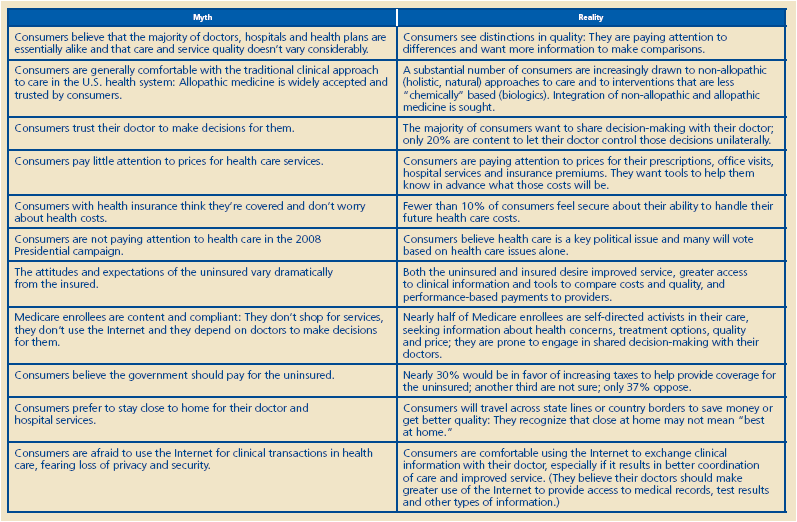
After someone sent me the PDF on their study, I finally read it on my flight to San Francisco today. It is full of lots of interesting facts based on their web survey of just over 3,000 adults in September 2007. Here are a few additional things that I pulled out (click on the tables to expand their size).

78% of consumers express a preference for customizing their insurance product by selecting the benefits and features they value and, in doing so, increasing or decreasing the overall cost of their coverage (Figure 18). Only 22% prefer selecting from a few pre-packaged products with defined benefits and features.