Archive | Healthcare RSS feed for this section

Top Predications for Healthcare from Columbia Business School

These are from Cliff Cramer, Director, Healthcare and Pharmaceutical Management Program at Columbia Business School
[with my comments in brackets].  

  1. Multi-national pharmaceutical and medical technology companies will increase their investments in emerging markets, notably China and India, to access cost effective human capital and a growing middle class of consumers better able to afford more advanced medical products. [Seems pretty logical. Global expansion. I expect pharma expansion will be much easier than technology expansion although SaaS (Software as a Service) my make it easier. I don’t see some of the “cool” Health 2.0 tools gaining traction and becoming viable businesses just because of broader reach.]


  2. Information technology will make greater strides in a healthcare industry which has been slow to adopt, driven by financial incentives (e.g., government subsidies) and employees and consumers demanding better and more accessible information (e.g., transportable e-records) as their share of healthcare spending increases. [Again, I think this is pretty logical and driven by some of the government initiatives. I expect healthcare technology and services will be a hot industry for the next 5 years. At the same time, there has been lots of carnage on the road to make EMRs and PHRs and other tools work over the years. Will this be the time? Maybe.]
  3. Healthcare reform will continue across developed (U.S. and EU countries) and developing (China) markets, focused on increasing access to affordable and quality patient care. These initiatives are likely to be incremental due to political and economic (budget) considerations. [I’m not so sure I see this. Other countries are down a very different path. I think they will wait a few years to see what our reform efforts bear before engaging on massive reform efforts.]
  4. Consolidation will be a major theme in 2010 as insurers and hospitals seek additional leverage in contract negotiations, and pharmaceutical companies explore transformational mergers to broaden product lines, strengthen geographic breadth (emerging markets) and seek to manage earnings given major patent expirations in the near term. [An economic certainty.]

These were definitely interesting, but it left me lacking. What about health reform – will anything change in 2010? What about personalized medicine? What about health 2.0? What about consumer engagement? What about chronic conditions like obesity and diabetes?

IT growth; reform; consolidation; and international investment could apply to almost any industry.


H1N1 – Trying To Match Supply And Demand

When there was a large demand several months ago, there wasn’t any supply.  Now there is adequate supply, but the demand has gone down.  Will there be another spike in demand in the Spring? 

With all the retail pharmacies and clinics having supply, we are now going to see the competition for the consumer.  (See WSJ story)

Some Foods And Drugs Don’t Mix

Without getting into all the clinical rules, I’ve always looked for a cut-to-the-chase consumer list of when to avoid what specific foods if you take certain medications.

Finally, in Real Simple magazine (pg. 74, Jan 2010), I found one.  Here it is:

  • Avoid grapefruit [including juice] if you’re taking a cholesterol lowering drug or a prescription sleep aid.
  • Avoid chocolate if your using an MAO-inhibiting antidepressant.
  • Avoid black licorice if you’re on heart medication.

I’m not sure of the science here, but I’m assuming that it’s real.  I’ve heard the grapefruit advice before, but never the others.  Do physicians and/or pharmacists tell you this?

The story also goes on to recommend a few foods:

  • Shiitake Mushrooms – help boost the immune system and prevent the growth of cancer cells
  • Brazil Nuts – may ward off colon, lung, and prostate cancer
  • Horseradish – increase the liver’s ability to fight carcinogens and suppress growth of cancerous tumors…and may help avoid urinary tract infections.
  • Walnuts – help reduce cholesterol and inflamation that may lead to high blood pressure and heart disease
  • Black rasperries – may retard the growth of precancerous cells

So…watch what you eat!

Why Didn’t I Know There Was A Generic Version

I got this question e-mailed to me today.  The patient has been using the same drug for years and it lost it’s patent about 6 months ago.  They just found out that they could have saved a lot of money and wondered who should have told them.  Here’s my thoughts.

  1. It’s the member’s responsibility ultimately to search for ways to save money and ask for generics.
  2. A lot of managed care companies and PBMs won’t reach out when patents expire because 90% of the time the drug is switched to the generic within 90-days by the pharmacy.
  3. The key players who would communicate are aligned – the pharmacy / PBM makes more money when generics are used and the managed care plan saves more money.
  4. BUT, sometimes managed care plans or individual employers (groups) will opt-out or never sign up for communication programs so their members don’t hear about ways to save money.
  5. BUT, sometimes consumers opt-out of communications from the PBM or managed care company and therefore miss out on opportunities.
  6. BUT, sometimes physicians won’t allow the prescription to be switched to the generic drug (even when chemically equivalent) and will write the prescription DAW (Dispense As Written) or say no substitution allowed.
  7. BUT, there have been a few instances when due to exclusivity on the generic that it actually costs more than the brand during the initial 6-months and people don’t move to the generic.

So, with lots of nuances, my reply was that no one had a legal obligation to tell her, but they all had good incentives to do it.  I suggest talking to the physician and/or the pharmacist.

FDA “Listed” Drugs – A New Hassle

As of 1/1/2010, Medicare beneficiares will face a new hassle at the pharmacy.  How big of a deal will this be?  I honestly don’t know.

But, from their site:

Starting January 1, 2010, if your pharmacy tries to sell you a version of a drug that isn’tlisted with the FDA, your Medicare drug plan might not pay for it. This means you mightgo to the pharmacy where you regularly get your Medicare-covered prescriptions filled, andif the pharmacy stocks only a version of the drug that isn’t listed (and, therefore, your planwon’t cover), the pharmacy may not be able to fill your prescription that day.

Since there are multiple manufacturers of a generic medication, multiple forms (capsule, tablet), and sometimes repackagers, this could complicate things for patients simply trying to fill their medications.  I’m not sure I understand what’s being addressed here.

Because People Are Different

I’ll borrow our tagline from Silverlink Communications Because People Are Different – to follow-up on my post on direct mail from yesterday.  The first commentor makes a good point.  Certainly e-mail doesn’t work for everyone.  Nor does the phone (although it is generally ubiquitous today). 

The reality is that different segments require different modes of communication.  The question is how to figure that out. 

  • Do you ask people for their preferences…realizing that many times people don’t know what they want or need?
  • Do you look at historical behavior to predict what will work best for people like them…realizing that healthcare is intensely personal and while predictive may not be indicative…and people’s healthcare behaviors change over time?
  • Do you pursue a cluster approach – i.e., send multiple modes simultaneously…realizing that this isn’t very cost effective?
  • Do you pursue a strategy of sequencing – i.e., call then e-mail then letter – and which pattern works best…and what spacing between modes works best?  (This will vary by message, objective, and audience.)

And, the question that I surprisingly don’t hear many people ask is why is there so much direct mail when we as a culture are generally more interested in being environmentally aware than ever (although we still have a long way to go).  Why kill a tree when other modes are more effective, less expensive, and offer better consumer insights?

Why Does Direct Mail Exist In Healthcare

Given all the progress we’ve made in the past 15 years around communications, I wonder why direct mail is still a primary component of communications. Obviously, there are some times when compliance requires a written notification, but considering you can’t tell if someone opened the mail and most companies don’t process return mail, you really have no visibility or ability to audit.

Written communications are also so static unlike a website or an automated call where a response can alter the next step in the communication.

Additionally, there is a time lag on written communications that you don’t have with e-mail or with an automated call.

I’ll break it out more in the table below, but in the end, direct mail costs the most yet gives you the least data, the worst customer experience, and is the least time sensitive. Seems like a problem to me.

Channel

Automated Call

Direct Mail

E-mail

Cost

Low – Medium

High

Low

Ability to Personalize

High

Medium

High

Dynamic Content

Yes

No

No

Know if received by consumer

Yes

No

Yes

Know how long consumer interacted

Yes

No

No

Time from event to consumer

Minutes

Days

Minutes

Response Rate

High

Low

Low

 Now, don’t get me wrong, there is a place for direct mail.

  • People who don’t respond to automated calls or e-mail.
  • People who request more information.
  • Communications which require detailed information to make a decision.

But, why is it that so many companies begin their communications to consumers with direct mail. Is it that people are simply stuck in a rut of what they’re used to and can’t embrace decade old technology? Or is it that people don’t believe the facts in front of them?

Should Rx Data Be Used By Pharma?

This is a great question as posed by numerous people (see WSJ blog).  Now, the one reality that most people don’t realize is that the data is only directionally correct.  Not everyone sells their data to the aggregators so depending on pharmacy (or PBM) marketshare the data could be close to significantly off.

Perhaps, that’s not the issue.  The question is whether pharma should have a right to see prescription data by physician to understand their behavior.  It’s not patient specific data so that alleviates what I think should be the big issue.

Between patients visiting healthcare sites, registering for coupons, buying disease specific publications or supplies, the individual data is probably a lot easier to get and use…and probably more accurate (at least at the household level). 

Assuming no one says that pharma can’t communicate with physicians, I think the data is relevant.  Certainly, they have an agenda – drive marketshare of their drugs.  I think we have to assume that physicians aren’t just guppies that hear the pharma rep talk and do whatever they say.  Physicians are smart, well-trained professionals that should be able to hear messaging about drug pros and cons; look at the research; talk to their peers; talk to their patients; and appropriately prescribe. 

I think the prescription data probably creates a more efficient system.  Physicians that use a drug frequently are visited less often by the rep and don’t spend time away from patients.  Physicians that don’t prescribe a drug frequently (and prescribe a high volume of competitive drugs) probably get more visits…BUT they have the choice of saying don’t come. 

[I’m taking a little extreme of a view here since nothing is black and white, but I’m not sure I see the privacy issue here.]

Lance Armstrong And Diabetes

Lance has decided to focus some of his passion and conviction on diabetes.  I think this is great.  Certainly, this is a condition which affects a lot of Americans and continues to get worse with the obesity epidemic. 

Given the focus on the pharmacies (CVS, Walgreens) and the PBMs (Caremark, Medco, Express Scripts) on management of this condition, I wonder who (if anyone) will get Lance Armstrong to be their sponsor or public face.  For the PBMs that traditional don’t have a consumer brand, I would think this is a great opportunity.  I compare it to Medco having Amy Tendrich from DiabetesMine promoting Liberty Medical.  While Amy might not be a household name, she is certainly a name in the diabetes community.

Hoarders – Scary Pictures; Big Health Consequences

Have you seen the show Hoarders?  Very scary.  It’s amazing that people can live like this.  Logically, it would appear that there is some type of additive or compulsive behavior issue here.  Go to the website and look at some of the pictures.

I can only imagine the social and health consequences of this on the entire family.

Band-Aid To Monitor Your Heart

Let’s stick with today’s examples that can be extrapolated to the future.  [Good Sunday am thinking]

I was reading in Fast Company [Dec 09 / Jan 10] about Corventis’ PiiX monitor. 

It’s a “wireless, water-resistant sensor that sticks to a patient’s chest like a large Band-Aid and monitors heart rate, respiratory rate, bodily fluids, and overall activity.”

Interesting!   I see an immediate use for this in team sports like the Tour de France where it can be monitored by a team manager and used to push fluids or encourage a change in pattern.  But, as the company talks about, imagine the power of using predictive algorithms here to know when someone may be in danger of a heart attack or some other medical issue. 

As devices like this become standard and are used to monitor our key bodily statistics and used, will we become healthier?  Again, will companies be able to use these to help guide our decisions through incentives – lower health care costs, lower life insurance costs?

I think as the data from these get transmitted electronically and populate PHRs and EMRs and get used by clinicians it will be very interesting to see how they change outcomes.

Blending Social Media and Healthcare

There is certainly lots of talk in healthcare around incentives.  What incentives will drive people to behave healthier – peer pressure, cash, non-monetary incentives, competitions (e.g., The Biggest Loser), or lower copays and deductibles.

There is also lots of talk about social media.  There have been lots of studies showing the power of your friends to influence your behavior – smoking, weight loss. 

Separately, I continue to hear more and more stories about agencies and lawyers using social media to find out about what people are really doing.  For example, my friend’s mom was recently on a jury of someone suing a physician for malpractice.  She claimed she had limited use of her legs.  But, the physician’s lawyer accessed her facebook page and saw her talking about all the stuff she was doing now that she felt better.  Oops.

Before I paint my future scenario, let me toss out one example that really got me thinking.  Burger King recently created the “Whopper Sacrifice” application for Facebook.  You received a free Whopper if you would delete 10 of your friends from your Facebook account.  23,000 users did it before they took it down.

So, if people would “sacrifice” their friends for a Whopper, what would people do for a 10% reduction in their premiums [or some siginificant savings on healthcare]?  Could companies get people [and use social media to track it] to spend more time with their thin friends that don’t drink or smoke and regularly exercise and get 8 hours of sleep a night?  Assuming the research is true, this would dramatically reduce costs and make those people healthier. 


Why Keep Covering PPIs?

I’m not a clinician so I’m sure there are some clinical exceptions to this general comment.  [For example, look at Aetna’s PPI Medicare information.]

But, with Prilosec available OTC (Over The Counter) both as a brand product and as a generic (omeprazole) and now Prevacid will also be available OTC, I wonder why PBMs and plan sponsors don’t stop covering this class of drugs.  [See here for CVS Caremark’s overview on this.]

BTW – PPIs (or Proton Pump Inhibitors) are generally used for acid reflux and some people can simply use other OTCs such as H2 Antagonists (e.g., Tagamet, Pepcid, Zantac).  [Consumers might also read Consumer Reports Best Buy Drugs report on PPIs.]

Traditionally, PPIs represented one of the higher cost drug categories (and also one of the most highly rebated).  In CVS Caremark’s BOB (book-of-business), it represented 7.3% of their spend according to their TrendsRx 2009 publication.

Plans have stopped covering NSA (non-sedating antihistamines) once Claritin went OTC.  This seems like the next natural category with perhaps some formulary override option for certain medical exceptions.

The Buy-ology Of Healthcare

Over the past few years, marketing has rapidly evolved with technology, social media, and neurosciences. As consumers are taking a more active role in their healthcare (both willingly and unwillingly), healthcare entities are scrambling to understand how they think, how they make decisions, and how to develop programs that effectively communicate with consumers to drive appropriate and cost-effective behaviors.

“The task of neural science is to explain behavior in terms of the activities of the brain. How does the brain marshal its millions of individual nerve cells to produce behavior, and how are these cells influenced by the environment…?”

To accomplish this, companies are integrating different data sources, leveraging behavior science methodologies like champion / challenger tests, and stepping outside of healthcare for best practices. Financial services (e.g. credit card companies) have been deploying these marketing sciences for years to improve yield, but healthcare companies are just beginning to realize that in order to influence the 50-70% of healthcare costs that are lifestyle related they will need to think differently. This new approach to marketing and healthcare communications blends the qualitative and quantitative aspects of marketing and looks to areas like linguistics and behavioral economics for insights.

“Genetics influence how a person makes a decision based on whether their options are presented to them in a positive or negative way (framing effect) — such as being told there is an 80 percent chance of surviving or a 20 percent chance of dying during an operation.”

One of the leading researchers in this area of neuromarketing is Martin Lindstrom who recently authored a book called “Buy-ology“. In the book, he walks through research where he uses fMRI (functional Magnetic Resonance Imaging) and SST (Steady-State Typography) to study the brain activity during multiple marketing experiments. This analysis reveals a series of insights including things like:

  1. Cigarette warning labels have the opposite effect on smokers.
  2. Logos have lost their importance, but branding matters immensely.
  3. The reason why people chose Coke over Pepsi is because of their branding not because of taste.

    “Our irrational minds, flooded with cultural biases rooted in our tradition, upbringing, and a whole lot of other subconscious factors, assert a powerful but hidden influence over the choices we make.”

Given the challenges that we all face in terms of branding and allocation of marketing dollars, these are important things to understand. We want to make sure that as consumers increasingly control their healthcare decisions that they choose our facilities, buy their health insurance from us, and/or view us as a trusted source of information. To achieve this, we have to get into their heads and understand how they make decisions and what will compel them to act. Since, as Martin Lindstrom points out, almost 90% of our buying behavior is subconscious, we have to better understand our consumers and provide them with value-added content that is tailored to their needs.


Eric Kandel, Principles of Neural Science, fourth edition


Wellcome Trust, news release, May 5, 2009

Martin Lindstrom, Buy-ology: Truth and Lies About Why We Buy (New York: Doubleday, 2008), p. 18

5 Prescription Myths That Cost Consumers Money

In these difficult economic times, saving money has become a way of life. Unfortunately, Americans have been trimming costs on items vital to their health. A Kaiser Family Foundation study found that 53% of Americans have cut back on healthcare over the past year because of cost concerns, with 21% cutting back by not filling a prescription.

There are ways to save money on prescription drugs without skimping on your health. It’s time to debunk the following prescription drug cost myths.


Myth #1:    “My physician would have told me if there was a lower-cost option.”

Physicians are focused on their patients’ health and often don’t have time to study the costs of the more than 10,000 prescription drugs currently on the market, let alone the ins and outs of each patient’s health plan. In one study, over 80% of physicians felt it was the pharmacist’s job to discuss costs with the patients.


What can you do? Talk to your pharmacist about therapeutic alternatives to your prescription drugs.


Myth #2:    “My pharmacist would have told me if there was a lower-cost option.”

There is currently a shortage of pharmacists in the U.S. and while they would like to consult with patients, many don’t have the time to help each person optimize their prescriptions. Also, at retail pharmacies, pharmacists are unlikely to encourage savings opportunities like mail order and may even be hesitant to encourage 90-day retail.


What can you do? Ask your pharmacist about lower-cost options for your drug plan design.


Myth #3:    “Prescription prices are the same everywhere.”

Prices can vary dramatically between pharmacies, especially for generics. In one study, prices varied as much as 1,000% for cash paying customers. Also, getting 90-day prescriptions through the mail or sometimes at your local pharmacy can save you money.


What can you do? Ask your health plan for an online comparison tool and research prescription drug costs in your area.


Myth #4:    “Generics aren’t as effective as brand name drugs.”

Generic drugs have the exact same active ingredients and side effects as brand drugs. They are less expensive than brand drugs because the manufacturers aren’t starting from scratch when it comes to the costs associated with developing and marketing a new drug. In addition, brand drug manufacturers make approximately 50% of the generic drugs themselves under other names.


What can you do? Go to the FDA website and read their educational materials about generic drugs and ask your doctor to prescribe.


Myth #5:    “My adherence to my medication doesn’t affect overall healthcare costs.”

In one study, the annual healthcare costs of a person with diabetes who didn’t take medications were twice that of a diabetic person who adhered to a medication plan. Non-adherence to medication is estimated to cost the healthcare system $290 billion a year. As many as 30% of people never fill their first prescription and more that 50% of people stop taking their long-term medications within 12 months.


What can you do? Research the medications that you are on and understand how other patients have used them and the time it takes for them to work. Never stop taking a medication without discussing it with your physician first.

Tips For A New Runner

I’m sure there are thousands of people more qualified to give these to you, but since I’ve run 3 marathons, I’ll assume that I have a little experience. Here are my basic tips going back to when I started running by run/walking one mile on my treadmill.

  1. Start small and build up – Start by walking and running short distances to build up some endurance. When you want to add mileage, only add about 10% per week. I made the mistake at one point of adding miles too quickly in my training (35 one week and 50 the next 2 weeks) and spent about a month on the disabled list (DL) due to shin splints.
  2. Get in a running group – After a few months of running, I was running 12 minute miles which I felt good about. My friends asked me to run with them and within a month, I had dropped my average times down below 10 minute miles. Plus, you feel that extra incentive to get up and meet them in the morning. Some of my friends have a penalty they pay if they don’t show up.
  3. Vary your routine – Don’t just run the same speed and same route each day. Do sprints. Do intervals. Run hard some days and easy other days.
  4. Have the right attitude – Find the time when your energy level is high and get in a routine. You have to feel excited about running or exercising and have a positive attitude to succeed. Setting a goal can help (i.e., I want to run a sub-25 minute 5K) or creating an incentive (e.g., I’ll buy myself a new iPod if I lose 10 lbs).
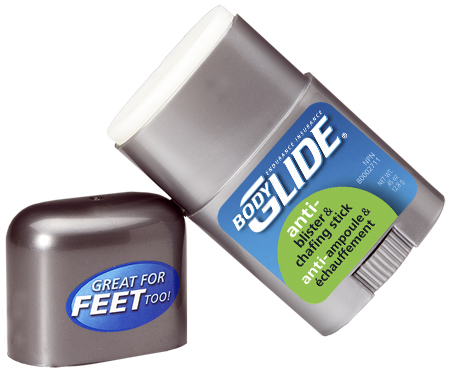
  5. Buy Glide – A lot of people think you can just walk out the door and start running. I disagree on a few fronts. First, I do think all the wicking clothes do help, but more importantly, I find Glide to be a must have. I won’t run without it. When I first started, no one explained to me about how much chaffing was possible. For months, I would come home looking like I was shot with blood running down my shirt from my bloody nipples. Some people try Vaseline to avoid this. Others use bandaids. Glide is the only thing I’ve found that works and holds up thru weather and distance.
  6. Buy the right shoes – This is another very painful memory. When you run, you need shoes that are ½ size larger than you normally wear. If you don’t, you will start finding that your toenails turn black and eventually you lose them. (Not as bad for men as I would expect this would be for a woman who likes to wear open toed shoes.) For my first marathon, I lost five toenails and had to learn to stick needles under my toenails and thru my toenails to pop the blood blisters under them.
  7. Drink lots of water – This was a beginner’s mistake that I sometimes continue to make. A lot of times, I just like to run without carrying a water bottle. But at different times, I’ve thought I had some type of stomach acid problem because I was so torn up after my runs. It took me a long time to figure out that it was just dehydration.

Unfortunately, I haven’t been as rigorous about my training lately, but running can be a lot more fun and social that you think. I would encourage it for everyone.

PBM Market Share

I was looking for something the other day and stumbled upon this survey from earlier this year. I modified it to add the Wellpoint NextRx lives to the Express Scripts lives, but I wasn’t sure how to reconcile the Walgreens numbers (they are listed twice) and didn’t see any lives for RxAmerica which is now part of CVS Caremark.

Company

Rx Covered Lives

Market Share

Express Scripts / CuraScript / Wellpoint NextRx

90,049,000

13.20%

CVS/Caremark Rx, Inc.

82,000,000

12.02%

Walgreens-OptionCare

75,000,000

10.99%

ICORE Healthcare, Inc.

60,000,000

8.79%

Medco Health Solutions, Inc.

60,000,000

8.79%

NovoLogix (formerly Ancillary Care Management)

40,000,000

5.86%

Argus Health Systems, Inc.

28,600,000

4.19%

MedImpact Healthcare Systems, Inc.

27,000,000

3.96%

HealthTrans

15,300,000

2.24%

Prime Therapeutics, LLC

14,700,000

2.15%


The other thing to note here that we always joke about is how 70% of the market is equal to almost 500M lives (more than the US population). It has to do with people who have mail with one PBM, specialty with another PBM, and claims processing with another PBM (for example).

It is an interesting space right now. Two of the top 10 PBMs are actively looking for a CEO/President – CVS Caremark and Prime Therapeutics. You have seen lots of press releases recently from companies like Express Scripts, Medco, and CVS Caremark on new partnerships and technologies that they are working with. I also think you’ve seen a shift in research from Express Scripts to Medco which has been publishing a lot more recently. And, you’ve also seen several Medco alumni go to CVS Caremark at very senior positions.

Different Camps – Healthcare Reform

I think it’s pretty clear that there are a few different camps here.  Hearing Rahm Emanual (Obama’s chief of staff) say that the goal is to pass a bill thru Congress not figure out what the ideal bill might look like is certainly one perspective.  (NYTimes, 11/11/09, Falling Far Short Of Reform)  There are many camps trying to find the ideal solution.  Other people are looking at it from a budget perspective.  Others from a moral perspective of the need to cover the uninsured.  Others from a business perspective.

Can these all be reconciled?  No.  Not and get anything done. 

Everyone agrees the current system is a problem.  Can’t someone prioritize the issues and focus us on being successful with one goal at a time and not trying to put pieces that appeal to everyone into one bill that therefore meets the needs of no one.  The goal should never be just to pass a bill to meet some artificial deadline set by a candidate to impress the people.  The mess after the fact will be too difficult to change.

Employers Use of Utilization Management Tools

Based on study by the Pharmacy Benefit Management Institute (PBMI) of 417 employers, here is a ranked list of Utilization Management (UM) tools used in 2009 for overall plan design.  The survey breaks it down further by class.

  • Refill Too Soon Supply Limit – 90%
  • Quantity Limits – 89%
  • Prior Authorization – 81%
  • Disease Management – 69%
  • Step Therapy – 59%
  • Therapeutic Substitution – 55%
  • Retrospective Drug Utilization Review (RDUR) – 47%
  • Outbound Telephone Calls – 44%
  • Dose Optimization – 44%
  • Face-to-Face Pharmacist Consults – 36%
  • Pill Splitting – 29%
  • Prescriber Profiling – 23%
  • Copayment Relief or Waivers – 20%
  • Generic Sampling – 16%
  • Academic Detailing of Prescribers – 11%

What I think would be interesting to know is which of these is provided by their PBM or managed care company versus which ones are they directly sourcing?

Influencing Behavior Thru Smell?

We’re always taught as kids to think about all the senses, but that seems to go out the window at an early age. We start focusing on print or TV or some limited set of modes.

I’ve started to see more things lately around smell. I saw a simple one yesterday that I thought I would highlight.

“What we wondered was whether you could regulate ethical behavior through cleanliness.  We found that you could.”  [Katie Liljenquist, asst professor at Brigham Young University]

In an experiment, people who sat is a room with citrus-scented Windex were more likely to act fairly and charitably than those in an unscented room.  In an experiment from last year, the researchers showed that people were more judmental and critical about certain moral issues when exposed to fart-scented spray.  [I’m not sure how people come up with these studies.]

Anyways, I doubt we’re going to start using scratch-n-sniff stickers or seeing TVs with scent dispensers, but I think it’s an interesting question to think about when trying to influence health behavior.  How should a doctor’s office smell?  Would your workplace be healthier if it smelled different?  Would I choose different foods at the cafeteria if it had a different scent?

Pharma Couponing

Using copay coupons in place of real samples is both cost effective and allows pharmaceutical manufacturers to get more patient specific information (since patients typically have to register to get the coupons). They can be short-term or long-term. The primary site to go to is InternetDrugCoupons.com.

Here’s my slides from the conference call I did the other day. Some of the quotes from the event are in the recent Drug Benefit News (11/13/09).

Repeat Shoppers Are Very Satisfied With Service

I always have a good laugh when I see how people use data in a way that frames something to be more than it really is. The title here is a made up scenario, but I can clearly see a retailer that sends out satisfaction surveys to people that shop at their store two or more times in a 60-day period. They then put out a report that shows that their customer satisfaction scores are 90%.

Of course, without understanding the selection bias, it sounds great. [This is not dramatically different than claiming outcomes that are simply regression to the mean which has been an issue for years across a lot of companies.]

In another example, a vendor talks about consumer reactions to their communications. They point out some great quotes that people say about their interactions. But, there’s a HUGE selection bias here. The people that make those comments are:

  • People who are willing to interact with the technology (i.e., pick up the phone and listen to the message);
  • People who spend time on the entire call and make it to the end of the call where there’s a survey; and
  • People who are willing to participate in an optional survey about the communication.

Should we be surprised that these people really like the technology? NO!

It’s like asking people in a web survey whether they frequently go online.

But, that’s the beauty of sharing pieces of data. And, it’s proof that words do matter.

IronMan for Sick and Injured People

robot suitironman-4
If you ever saw the movie Ironman, you will find this interesting.

Cyberdyne, a Japanese electronics company, has released a promotional video showing an elderly patient with Parkinson’s disease using a robotic skeleton to walk for the first time in two years. Of course, we have some skepticism and paranoia about robots which will have to be addressed (think iRobot), but the potential is significant. Here’s a picture of their HAL (Hybrid Assisted Limb) from their website. [Honestly, I would be fairly skeptical if this hadn’t appeared front page in the USA Today.]

Robot Suit - HAL

Diabetes Facts From The ADA

November is Diabetes Month from the American Diabetes Association. You can learn more at www.stopdiabetes.com.

From their fact sheet, here are some key facts.

Prevalence

  • Nearly 24 million people have type 1 or type 2 diabetes.
  • Another 57 million people have pre-diabetes and are at risk for developing type 2 diabetes.
  • One out of every 3 children will face a future with diabetes if current trends continue.

The Toll on Health

  • The death rate from diabetes continues to climb. Since 1987, the death rate due to diabetes has increased by 45%, while the death rates due to cancer, heart disease, and stroke have declined.
  • About 60-70% of people with diabetes have mild to severe forms of nerve damage that could result in pain in the feet or hands, slowed digestion, sexual dysfunction, and other nerve problems.
  • The rate of amputation for people with diabetes is 10 times higher than for people without diabetes.
  • Two out of three people with diabetes die from heart disease or stroke.
  • Diabetes is the leading cause of new cases of blindness among adults.
  • Diabetes is the leading cause of kidney failure.

Cost of Diabetes

  • The total national cost of diagnosed diabetes in the United States is $174 billion.
  • Direct medical costs reach $116 billion, and the average medical expenditure among people with diabetes is 2.3 times higher than those without the disease.
  • Indirect costs amount to $58 billion (disability, work loss, premature mortality).
  • The cost of caring for someone with diabetes is $1 out of every $5 in total healthcare costs.

Industries That People Trust

Given all the healthcare debate this year, it will be interesting to see how that influences the annual Harris Interactive poll on industries that people trust.  (They should include government as an industry to see how that stacks up.)

Let’s look back at the 2008 results to the two key questions (from a healthcare perspective):

“Which of these industries do you think should be more regulated by government – for example for health, safety or environmental reasons – than they are now?”

  • Pharmaceutical and drug companies – 49%
  • Health insurance companies – 49%
  • Managed care companies – 39%
  • Hospitals – 27%

“Which of these industries do you think are generally honest and trustworthy – so that you normally believe a statement by a company in that industry?”

  • Hospitals – 31%
  • Pharmaceutical and drug companies – 10%
  • Health insurance companies – 7%
  • Managed care companies – 5%

It seems strange to me that more people want the drug companies to be more regulated than managed care, but that they trust the drug companies more. 

I’d also love to know how many of those people had seen Sicko (the Michael Moore movie). 

I would suspect that 2009 will show a huge spike in regulation around banking and a lack of trust of wall street.

24 Hour Pharmacy – Yes or No

It’s interesting to watch one of the local Walgreens pharmacies go back and forth on this issue.  For years, it was a 24-hour pharmacy and a place that I admitted used several times at random hours.  It then went to normal pharmacy hours for less than 6 months.  It is now back to a 24-hour site.

I’d love to see the analysis on that.

  • Did customers complain?
  • How many scripts really get filled after hours?
  • Does it pay to stay open or is it a marketing strategy?
  • Alternatively, can they use it as a “central fill” and fill scripts to ship to other Walgreens that aren’t open overnight thereby reducing their workload during the day?
  • What percentage of their stores will be open 24-hours?
  • How many other stores did they convert from 24-hours?  Are they all moving back to 24-hours also?

Health Plans vs. Drugmakers: The Battle Over Copay Subsidies

Register today for …

Health Plans vs. Drugmakers:
The Battle Over Copay Subsidies


An Audioconference


Thursday, November 5, 2009

1:00 – 2:30 Eastern time

As more generic drugs eat into drugmaker profits from blockbuster medications, pharmaceutical manufacturers are using copayment subsidy programs to target patients with commercial insurance. Their strategy of paying the copays for members who take top-tier brand-name drugs, instead of less expensive generics, is drawing drugmakers into conflicts with health plans, and putting some patients in harm’s way as well.

  • How do these programs interfere with efforts by payers and PBMs to move patients to generics?
  • How much are they costing health plans?
  • How much risk are they creating for patients who may now have incentives to take less healthy medications?
  • What strategies are payers now using to fight back?

Dial in on Nov. 5 to hear Michael Cartier, chief clinical officer at Twinsburg, Ohio-based PBM Envision Pharmaceutical Services, Inc., and George Van Antwerp, general manager of pharmacy solutions at Silverlink Communications, Inc., provide valuable insights and practical advice on how health plans can track and counteract copay subsidy programs. You’ll get all the details on strategies you can design and implement immediately, including:

  • What types of drugs do copay subsidy programs target, and how do they work?
  • What is the impact on drug dispensing rates?
  • What are the differences between copay subsidy programs targeting specialty drugs versus those for other medications — and how should health plans respond?
  • How can health plans ensure that copay subsidy programs don’t compromise patient safety?
  • How can payers use step therapy, generic promotion and other programs to target classes that subsidies are focused on?
  • How can adjustments to tier structures make copay subsidies less attractive?
  • What operational issues must be considered when implementing such a tiered structure adjustment?

To register at a special discounted price or for more information, please visit http://www.aishealth.com/Products/C9P27_110509E740.html or call 800-521-4323.