Archive | Healthcare RSS feed for this section

Telling The World Your Status

Will the habit of “status updates” be a good thing for healthcare?  We are encouraged to keep food journals, to track medication, to track facts about our conditions, and to report on many other aspects of our life.  Those things can be very helpful for patients in their discussions with their physicians.

So, as people increasingly become used to track and reporting what their doing, will that make it more normal to track these healthcare statistics?

Here’s some recent facts from a Pew report on Twitter and Status Updating:

  • 19% of Internet users now do some type of status reporting
  • The more devices you own (laptop, Internet enabled phone, Kindle) the more likely you are to update your status…39% of those with four devices.
  • The average age of people using the following (and trend versus last year):

Waiting In Line For Flu Shots


waiting-in-line

Over the weekend, we went to get flu shots.  I was amazed at how many people showed up.  The flu shot clinic was supposed to open at 9am.  We got there at 8:30 to a line of at least 100 people.  Fortunately, they opened early and we got out by 9:00, but as we left there was a line of several hundred people out the door and down the sidewalk.  Amazing!

I saw a story on the news earlier showing a 3-hour line to get H1N1 shots in Michigan.  This is out of control.

Generational Differences On Health Reform

I heard it today from CNN and then separately from an analyst who covers Medicare.  They both were talking about the differences in support for health reform based on age.

The CNN reporter and interviewee were talking about how seniors see health reform as taking away from Medicare and are therefore not supportive.  Seniors are generally happy with what they have.  On the flipside, they were saying that younger people are skeptical that there will be a system there to support them so they want health reform.

It’s interesting since that was different than the research that the analyst shared with me.  She said that they found that seniors were from the generation that was saved by the government during the depression, and they trust the government.  On the flipside, she said that they found that those about to be seniors were from the generation that felt the government let them down in Vietnam and have little trust in a government solution. 

I think it just points to the need to understand the consumer and drive messaging that appeals to their different backgrounds.  Politics has done this for years.  Consumer products have done this for years.  Healthcare is now focused on it.  This is just another example of why it’s important.

What Does Your State Say About Your Health

Forbes recently had an article about the most medicated states.  There has always been wide variation which is the key point here.  Some of this is attibuted to health and some of it to physician behavior. 

  • First, let me point out a flaw.  The author assumes that 7% of claims are mail and aren’t meaningful.  Well, you have to adjust that by days supply which means its more like 18-20% of volume which is meaningful.
  • Second, I think it’d be interesting to include OTC (over-the-counter) information here especially with things like Claritin and Prilosec going OTC in the past 5 years.
  • Third, I think the following quote from the article is very scary.

“Heightened awareness of certain drugs and conditions may be another explanation. In 2005, pharmaceutical companies spent $122 million on direct-to-consumer antidepressant advertising–almost four times what they spent in 1999. A 2005 study in JAMA found that 55% of participants who requested a brand-name drug received an antidepressant; only 10% of patients who had similar symptoms but made no request received an antidepressant.”

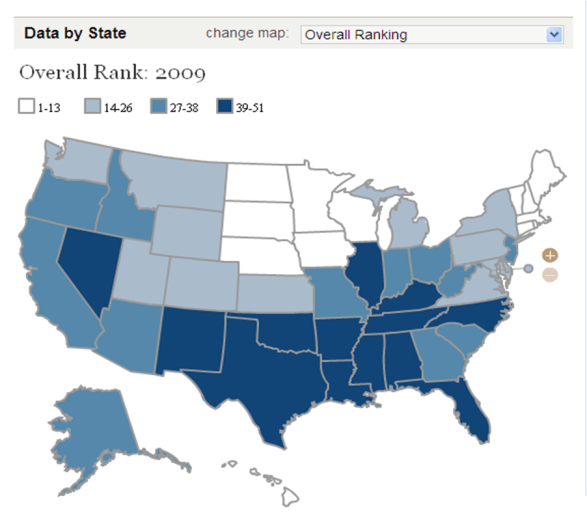
There is also another study out that ranks states – Commonwealth Fund State Scorecard on Health System Performance.

“Where you live matters for how long you live and how healthy you live”  (Cathy Schoen, VP, Commonwealth Fund)

State Health Rankings

Average Employee Healthcare Out-of-Pocket $1,938 (2010e)

In an article “It’s Health Enrollment Time” (10/6/09, USAToday), Hewitt is quoted as projecting that employee’s healthcare costs will increase by 10% in 2010 moving their costs up to $1,938.  The article also takes about 3 things you should expect:

  1. Continued movement to co-insurance versus co-payments. 
  2. More high-deductible plans.
  3. More dependent audits. (i.e., looking for kids that have graduated or others than can no longer be called dependents)

Consumer Preferences

The concept of preference-based marketing has been around for a long-time and continues to become a hotter issue especially in healthcare.  The challenge, of course, is balancing what consumers know they want versus what they actually use.  Ask anyone if they want an automated call, and the immediate answer is no.  People think about those annoying “robo-calls” that use text-to-speech (TTS), have a pause when you pick up the phone, and are not personalized at.

On the flipside, look at the data and outcomes which intelligence, voice-based call systems produce…it’s amazing.  People pick up the phone.  People interact with the technology.  And, the calls are highly personalized.

But, we are at an interesting crossroads about companies beginning to think thru and capture information about you.  Do you want to be called at home or on your mobile phone?  When is it okay to text you?  What communications should come in print versus e-mail?

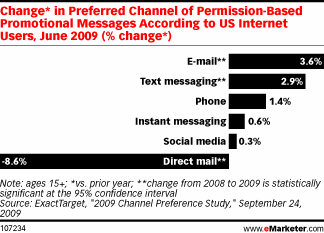
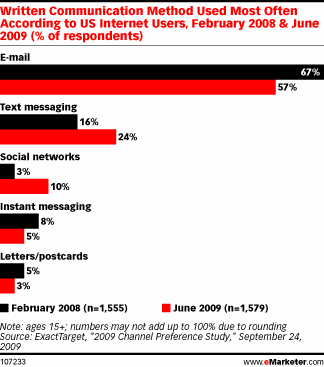
“Just 32% of marketing decision-makers surveyed in July 2009 said they knew how their customers behaved across channels, and only 37% were aware of consumers’ channel preferences.”  (ExactTarget 2009 Channel Preferences Survey)

The survey also showed changes in channel choice.

Change in preferences

Written format used

Top Drivers of Health Care Costs 2010

A recent Managed Healthcare Executive article (Oct 2009) provides survey data from 650 people at health plans, PBMs, disease management companies, and hospitals.  [As a side note, I was really surprised at how far off this group’s estimates were relative to the impact of prescription costs…which are generally in the 10-12% of total healthcare costs.]

Top Drivers of Cost 2010

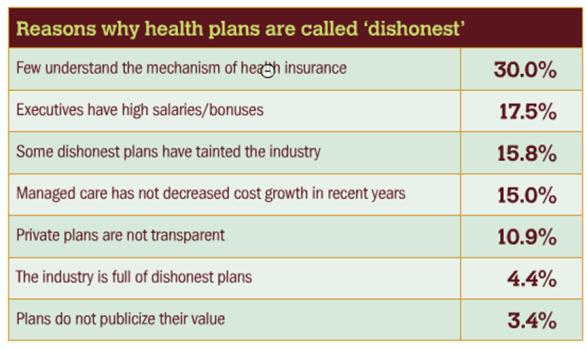
Another survey I found interesting in the article was why health plans are perceived as dishonest.

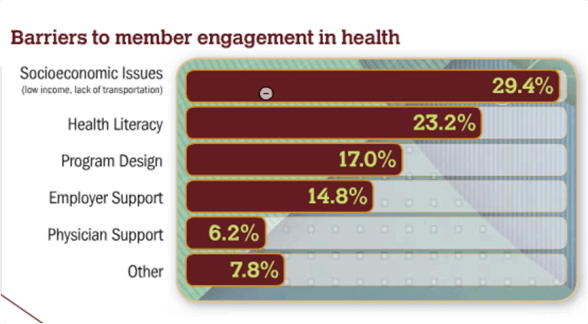
Why Healthplans Perceived DishonestAnother part of the survey had 7.8% of people saying that patients (consumers) are less interested in health and that the primary reasons for lack of engagement were:

Barriers to mbr engagement

Americans Don’t Expect Healthcare Changes To Be Positive

In the latest poll by USA Today and Gallup, the majority of people expect health care legislation to either have no change or make things worse.  (A $1T for neutral would be a problem.)

Here are the results from four questions:

  1. Quality of health care you and your family receive.  [19% get better; 40% no change; 39% get worse]
  2. Health care coverage you and your family receive.  [20% get better; 40% no change; 37% get worse]
  3. Insurance company requirements you have to meet to get certain treatments covered.  [25% get better; 25% no change; 46% get worse]
  4. Cost you and your family pay for health care.  [22% get better; 27% no change; 49% get worse]

Will Paying You To Be Adherent Matter

It’s an interesting question.  If I pay you $30 to take your medications every month, will you be more likely to actually take them or will you be more likely to tell me that you took them?  I was talking to someone about their program yesterday, and a lot of it comes down to measurement.  If, for example, I get paid if I open the pill bottle every day and that data is stored somewhere, I’m surely going to open it regardless of whether I take the drug.  (At least I think that’s what human nature would do.)

13 of Top 50 Jobs in Healthcare

guy kicking

CNNMoney published a survey on the Top 50 Jobs.  It looks at median pay, top pay, 10-year growth rate, total current employment, flexibility, benefit to society, personal satisfaction, and stress.

Of those 50 jobs, 13 of them are health related:

2 – Physician Assistant

4 – Nurse Practitioner

7 – Physical Therapist

11 – Anesthesiologist

13 – Pharmacist

14 – Occupational Therapist

15 – Nurse Anesthetist

19 – Physician / General Practice

22 – Physician / Ob-Gyn

23 – Clinical Psychologist

24 – Psychiatrist

25 – Veternarian

44 – Pharmaceutical Sales Rep (I thought this job was disappearing)

80% From Mandatory Mail – No Way

A PBM executive called me last week to ask about some information they got from one of the big strategy firms.  The PBM is trying to improve their mail order utilization.  They strategy firm said that 80% of mail order utilization is from mandatory mail…PLEASE.  I almost choked since I know the cost of that bad advice was more than they paid us last year to do some of these programs.  I was happy to help them understand the basic dynamics of how to encourage consumers to chose mail order and what factors contribute to utilization.

Wrong Way

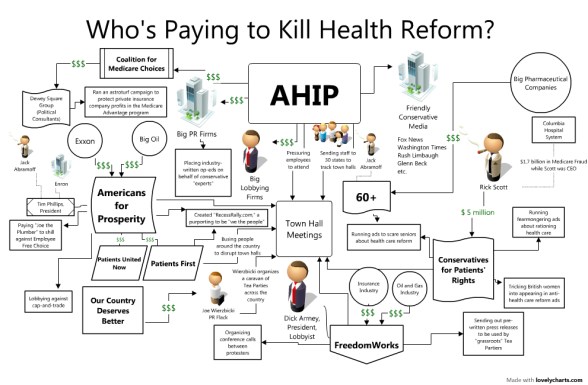
Blog Link – Who’s Paying To Kill Health Reform

As those of you that read this blog know, I certainly support reform, but I disagree with the approach the administration is taking.  That being said, I liked this graphic that I found on the Campaign For America’s Future blog.  Whether it’s true or not, I have no idea.  [But, it gives me a good list of companies to whom I might want to send donations!]

Who Paying To Kill Health Reform

1, 2, 3 of picking benefits

In the November 2009 Time magazine, they suggest three things you should do when picking benefits:

  1. Don’t just default to your current plan.  Spend the time to compare copays, premiums, deductibles, and estimate out-of-pocket costs.  [too bad most plans don’t give us an easy to use model of what you would have spent last year under the different plan options]  They also suggest opening a HSA (Health Savings Account) if you go with a high deductible plan.
  2. Fund your FSA (Flexible Spending Account).  They estimate that you save $350 for every $1,000 you deposit (and use).
  3. Test your wellness.  Many employers (and health plans) offer different forms or tools to test your wellness and health.  You should know the results and you may even get paid to do it.

Do You Have An Ethical Responsibility To Your Benefits?

In a recent Time magazine article around donating money, the author makes an interesting point.  He says that if you donate a small amount to a charity, but remain on their mailing list, you may actually cost them money.  They will call you and send you letters asking for money for years.  It poses (indirectly) an interesting question – “do you have an ethical responsibility to remove yourself from their mailing list?”

I think most of us would argue that they shouldn’t keep mailing us unless we opt-in.

But, it made me think about how people use their benefits.  If you’re offered $100 to take a Health Risk Assessment (HRA), but you know that you won’t change anything, is that ok?  If you buy an expensive medicine and know you won’t be adherent to the medication, you’re wasting money…is that ok?

Assuming there is some shared pool of resources that your employer funds for healthcare, what is your ethical responsibility for how that money is allocated?  Generally, they are going to want to spend as much money on prevention that they can…to improve your health.  BUT, everyone hates to spend money which they know is wasted.

Patient Choice in Health IT

If you don’t follow Susannah Fox‘s research and presentations, you should.  She works for the Pew Internet and American Life Project.  Here is a recent post about a recent presentation on Patient Choice in Health Information Technology (HIT).  Just pulling a few facts from it…

Our surveys find that the internet is increasingly helpful to American adults seeking health information.

  • 60% of e-patients (or 42% of all adults) say they or someone they know has been helped by following medical advice or health information found on the internet. That’s an increase from 2006 when 31% of e-patients (25% of all adults) said that.
  • 3% of e-patients say they or someone they know has been harmed by following medical advice or health information found on the internet, a number that has remained stable since 2006.

BUT, she also points out…

“There is no evidence that the internet is replacing health professionals, or Dr. Mom, but rather it is enabling a new way to connect to information and resources.”

“Insights” Gone Wrong

There is a great “cartoon” at the end of the recent Fast Company magazine that gives an example of how using information can lead you to a wrong decision.  It’s one of the reasons that I always point out the difference between someone who has provided services to an industry and someone who has worked in an industry.  It’s not the same.  Sometimes, you need to truly understand the nuances and how decisions are made.

It also made me think of a great Facebook example of how using social connections can lead to bad business decisions.  Given all the talk about making peer-to-peer recommendations based on your social network, this is a slippery slope to watch.  We are still new to this area and mistakes will happen.  One of the bigger ones that I have heard occurred in Facebook where they allowed advertisers to use member’s pictures.  Well, how do you think people felt when they saw the advertisements that say “Meet Singles In Your Neighborhood” with a picture of their spouse.  It didn’t go over well.

Great idea.  Interesting technology.  Bad application.

This will happen in healthcare.  The question is who will be first to stub their toe in the new world.

Mail Order Pharmacy – Good or Bad (Two Surveys)

I love when two parties (both with their own agenda) publish data that clearly shows that they are right.  Now, in this case, one quotes a 3rd party so I do give them more credibility.  And, the other (as I will show below) seems to not take the patient’s responsibility in mind.

First, PCMA (Pharmaceutical Care Management Association) publishes research from JD Power on pharmacy satisfaction.  It shows that insured and non-insured patients are generally satisfied with their pharmacy experience.  Mail order clearly came out on top of all types of pharmacies.  (Given that only 12% of people know the name of their pharmacist, I would expect them to be more closely clustered together.)

The J.D. Power and Associates study measured customer satisfaction with the pharmacy experience across major national retail drug store chains, mass merchandisers and supermarket stores, and mail-order channels. The study examines seven factors that contribute to consumer satisfaction with brick-and-mortar pharmacies and five factors that determine satisfaction with mail-order pharmacies. The average overall satisfaction index for each of the pharmacy distribution channels were:

  • Mail-order pharmacies: 834
  • Supermarket pharmacies: 820
  • Mass merchandiser pharmacies: 801
  • Retail chain pharmacies: 798

Then (no big surprise here) NCPA (National Community Pharmacy Association) puts out a survey of 400 patients showing how dissatisfied they are with mail order.

  • They are unhappy being forced to use a lower cost pharmacy.  (GVA – get used to it as part of healthcare reform)
  • They complain that their prescriptions don’t arrive on time (which could impact adherence).  (GVA – did they call in time or wait for the last minute…were they adherent to begin with)
  • They complain about their medications changing (i.e., titrating to a different strength).  (GVA – they shouldn’t move to mail until they’ve stabilized and any mandatory plan I’ve ever seen required at least 2 months as the same strength before requiring movement to mail)
  • They complain about getting different medications than what they ordered.  (GVA – I bet most of that was people getting the chemically equivalent generic.)

This isn’t something that will easily get solved.  The FUD (fear, uncertainty, and doubt) out there rules in many cases and statistical anomolies are what get discussed.  I would love to compare complaint rates, error rates, and satisfaction for patients that use both channels (retail and mail).

Mail Order Retention (or Churn)

It is fascinating how life comes full circle.  I remember when I worked on the Sprint Data Warehousing project back in the 90’s.  At the time, it was the first 1 terrabyte warehouse being built, and we were using some very cool technology from Microstrategy which offered the first web-based DSS (decision support system).  One of the key components of the reporting solution and business driver model we created was churn (or retention).  You can look at it either way.

But, this is a classic example of focusing on the right metric and that you have to measure what matters (to throw out a few oldies but goodies).  Retention is a pretty new concept within the pharmacy world especially within mail order pharmacy.  Growth has been pretty constant for the past decade until the past 18 months.  Now, everyone is trying to figure out what’s happening and why.

  • Are people going to Wal-Mart and paying cash?  (Or other similar card programs at Walgreen’s and CVS?)
  • Are people simply filling less prescriptions?
  • Are people skipping doses and doing other things to stretch out their prescriptions?
  • Are people trying over-the-counter medications or using samples?

There are lots of questions that matter here.  And, you have to think through the mail order process.  How do patients experience it?  Why do they leave?  There’s lot of research that’s been done by the different PBMs here.

I had a chance to talk with Drug Benefit News about this the other day.  You can read the story here.  Here’s a piece of what we discussed:

Depending on the payer, mail-order customer retention rates vary from 75% to 95%, according to Van Antwerp. “Very few people left because of service issues,” he explains. “The majority left because of refill issues. They got to the point where they forgot to refill an important medication and couldn’t get it within a 24-hour time period…or it was up for renewal and they needed to get the next prescription written.”

To address that, some PBMs are working to develop better refill-reminder programs, including moving some customers to auto-refill, Van Antwerp says. “When you look at refill patterns, some people chronically refill too early so they hit that ‘refill too soon’ reject ,” he explains. “Others chronically refill too late.”

“Secondarily, we look at the channel that they’re using to fill,” he adds. “Some people still mail in their refill via ‘snail mail.’ Others use IVR [i.e., an interactive voice-response system].” His firm is working with some PBMs to help them understand each enrollee’s historical behavior, and then customize a response that helps improve mail-order retention while moving the member to the lowest-cost channel for ordering refills — either IVR or the member portal, Van Antwerp says.

Why Wellness Matters

I’ve had an intense month so I’m hoping to catch up on my big pile of blogging ideas this week.  We’ll see.

Here’s one I pulled the other day.  I liked this graphic from MVP Healthcare in their corporate profile.

MVP Wellness Stats

It hammers home all the key points – regression to the mean, focus on the high cost individuals, and cost is avoidable if you focus on preventation and education and successfully engage the consumer.

Where’s the Mail Pharmacy Price Matching?

Given that people are leaving mail order pharmacy to go to places like Wal-Mart for $4 generics (which only applies to 300 of 10,000 drugs), I would think that mail pharmacy would employ a consumer pricing tactic like price matching.  Of course this is really hard due to plan designs and runs counter to everything the industry has done before, but it is a simple message.

Why is Wal-Mart (and others) getting people to leave their pharmacies (retail and mail)?  KISS (Keep It Simple Stupid)  They have an easy message “Get a 30-day supply for $4 or a 90-day supply for $10”.  It’s not this complicated message about formulary, copay, deductibles, percentage of costs, etc. 

So, why not respond in kind with a simple message like “We’ll meet any price you find at any other pharmacy for a similar quantity of drugs”.  Just a thought.

New Inc. 500/5000 Healthcare List

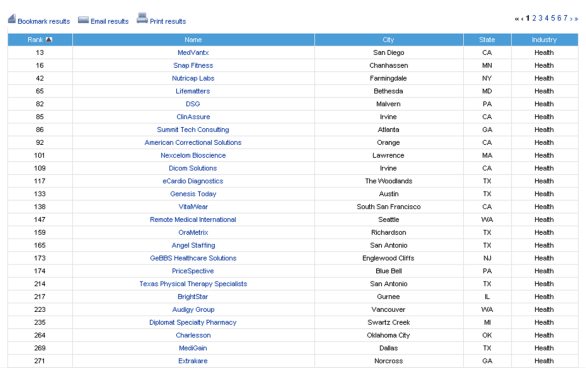
I always find the Inc. 500 (or 5,000) list interesting.  It shows you up and coming companies.  It can also show you some trends.  Well, if you sort the latest list by health care, you come up with 328 results. 

Here’s a screenshot of the top companies listed.  I’ll be the first to admit that I haven’t heard of many companies on this first page other than MedVantx at the top of the list.

Inc 500 2009 Healthcare

Phone Calls Improve Quality of Life

“Asking nurses to reach out to people who have advanced cancer – even if only by phone – can improve patients’ mood and quality of life” – Study in Journal of the American Medical Association

This program used nurses trained in palliative care and compared people with regular follow-up care with those that received these phone based interventions.  The nurses discussed issues such as coping, communication with their MD, finding support, managing symptoms, and planning for the end-of-life.

Again, a great reinforcement of the value of communications in healthcare.

My Healthcare Strategy For Obama

So, this is getting messy quickly.  Support is waning.  The public is confused.  It’s time to do something.

If I put myself in your shoes [President Obama] here’s how I would have proceeded:

  1. Make 2009 about the uninsured.  Focus on one problem which is achievable – coverage for all.  You would have people rallying around you.  And, if the numbers that I have seen are right, the net costs to the insured population would be the same.  Right now, they pay for the uninsured through higher bills from the providers who ultimately have to cover their bad debt. 
    • Challenge – getting the providers to agree to lower their rates once their bad debt dropped.
    • Financing – short-term coverage of the 12-18 month lag between coverage and rates dropping.  long-term mandate with costs covered by taxes for those who can’t pay.
  2. In 2010-2011, I would take on the issue of evidence-based medicine, comparative effectiveness, and health IT.  I would save health reform for my second term (if I got one). 

    Everyone knows the system is broken.  BUT, I would stop talking about a trillion dollars in cost to fix the system.  Think like when we stretched to put a man on the moon. 

    Set a goal of “designing a healthcare system in which the total cost per individual is no more in 2020 than it is in 2010.” 

    Now, you can get people to rally around your efforts to save a trillion dollars and get us out of debt as a country. 

    The goal of keeping everyone happy and taxing the rich plays well on TV, but it’s not reality.  People can’t have their cake and eat it to.  People are going to have to give up some of the luxuries in the healthcare system.  We can’t have defensive medicine.  We have to have some limits on litigation.  We have to have health IT to push evidence-based medicine.  We have to reward people for actively managing their health. 

One of the winning strategies for you in the campaign was a simple focus on change.  You can’t change everything at once.  People have limited capacity.  Think like a program manager – phased implementations; goals people call rally around; simple wins.  People don’t understand what a trillion dollars is.  People can’t focus on 10 year plans. 

Healthcare is complex.  Focus on making it simplier:

  • Get universal coverage.
  • Establish standards of care which are driven by technology.
  • Hold costs flat.

Pavlovian Caller ID

When the phone rings, what the first thing you do?

caller ID

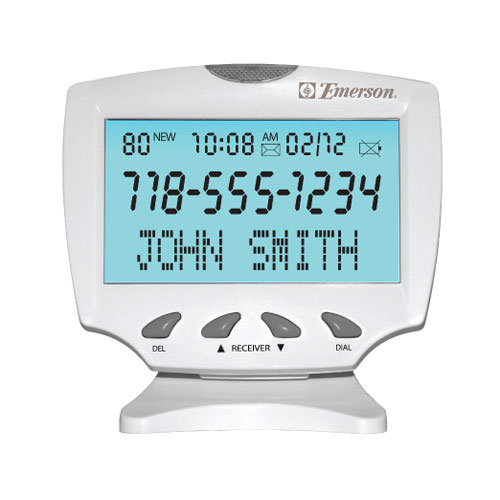
You look at the caller ID (or at least most people do).  A lot of people won’t answer the phone if they don’t recognize the caller or if there’s no caller ID.

Recently, I thought about how I was using caller ID at home.

  1. In one case, I used to use a service for my dry cleaning.  They would pick it up once a week and drop it off 48 hours later at my house.  The key was making sure I put it outside for them to pick it up.  It got to a point where I never even answered the phone.  I just looked at the caller ID and saw that they were calling.  That was enough to remind me to put the clothes out.
  2. In another case, I could tell how important it was for someone to reach me based on the number of attempts that they made to contact me and the frequency of their number on the caller ID.
  3. In a third case, I realized that I often called the caller ID on the phone rather than bothering to listen to the caller ID that was left in the message.

Certainly, these lessons apply across other channels (e.g., direct mail, e-mail).  The question is how do you incorporate them into your communication strategy and understand the magnitude to which they happen and influence results.

How to communicate with your members on flu 2010?

With H1N1 and the regular flu vaccines this fall, who really knows what to do?  Consumers are going to be looking for information and calling many of their providers and insurance carriers to ask the question.  Combine that management issue with the fact that only 40% of those that should get flu shots typically do, and you have a dilemna.  To hear more from Silverlink’s Chief Medical Officer (Dr. Jan Berger) and our lead for our Population Health solutions (Margot Walthall), clients and potential clients can attend our upcoming webinar on the topic.

Flu Program

How You Ask The Question Matters – Pre-Existing Conditions

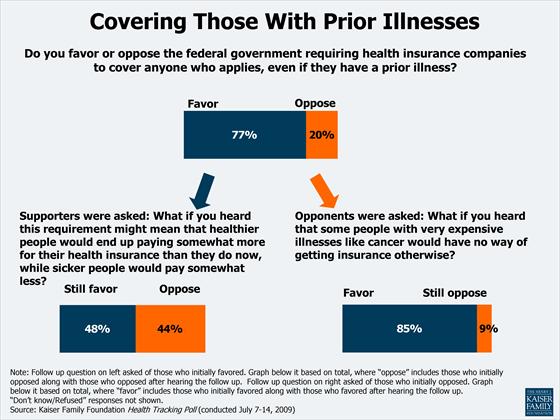
All of those in the communications space realize that linguistics do matter especially in certain healthcare situations.  I think this is a great example of how politics and healthcare are playing out.  No one really understands everything.  They understand and get excited (pro or con) based on the soundbite.

Covering_Those_With_Prior_Illness

Consumers Fear Gov’t Involvement More Than Insurers

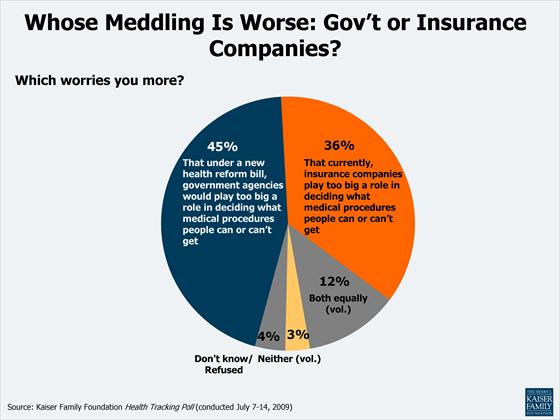
This was a pleasant surprise since I completely agree.  Based on this Kaiser survey, consumers worry more about the gov’t being involved in health care decisions than healthcare insurers.  Considering we always worry about consumer awareness and trust in healthcare entities, I think this is a positive.

Whose_Meddling_is_Worse_Govt_or_Insurance_Companies

22:1 ROI on Specialty Refills / Adherence

I always get very skeptical when an ROI goes above 3:1 so I was a little shocked to do some retrospective analysis with one of our Specialty Pharmacy clients at Silverlink and come up with an ROI that was 22:1 (or 2,200% ROI).  And, this was based on a pretty simple application.  (Of course it helps that specialty drugs are expensive and have a reasonable margin in some cases.)

But, for those of you interested, here are a few factoids:

  • A simple refill reminder program saved $12K per month in agents by automating the process
  • The program accelerated the refill timing within a 30-day period leading to less gaps-in-care
  • The program had almost a 20 percentage point jump in refill rates (a proxy for adherence)

It also validated a few things for us and the client:

  • As observed nationally, adherence has gone down over time (even on specialty medications) during this recession.
  • “I forgot” is still a common issue around adherence and solutions to address that should be the first thing that companies do.

Of course, the work doesn’t stop there.  We obviously want to continue our work on longitudinal analysis to look at MPR (Medication Possession Ratio) over time.  We also are working with them on addressing the other barriers on these medications (e.g., cost, side effects) by customizing communications by condition and based on the individual patient attributes.

If you’re interested in hearing more about how Silverlink works with clients on adherence (or tactically on refill automation), please feel free to reach out to me.

Time To Kill The “Clean Plate Club”

Dirty Dish

I always thought this was something that only my parents talked about until recently when I heard a few friends use the same term – “clean plate club”.  So, maybe more of you are familiar with these words:

“You have to finish what you were served.  Don’t you want to be part of the clean plate club?  People are starving around the world while you have all this food.”

I just assumed that my dad who was one of eleven kids who grew up in the Depression had this as a reality of limited food.  It took me years to realize that this framework was a recipe for disaster in today’s age.  When you go to restaurants that serve you huge plates of food and apply this mental framework, you are bound to over-eat site.

This is a great example of how something framed early in life can drive behavior.  That’s one of the key concepts when planning healthcare communications is understanding the frameworks that consumers / members / patients have about their physician, their health insurer, their pharmacist, generic drugs, mail order, and a variety of other healthcare topics.