Archive | Healthcare RSS feed for this section

Customer ROI

This is not a blog about my company – Silverlink, but I certainly am happy to share some of the learnings that we have.

We just put out a press release with one of our clients that has some great results. The client – Medica – is a non-profit, health insurance company with 1.3M members headquartered in Minneapolis.

A couple of the programs that they conducted with us include:

  • Welcome calls which increased member satisfaction while reducing costs by 90%. (Does your plan call you? I certainly never got welcomed to a plan.) They also were able to reduce their resolution time for resolving member issues by over 75%.
  • Coordination of benefits communications which led to a 32% increase in efficiency and less pended claims.

By using our automated outbound call technology, they saw response rate to surveys increase by 22%. (BTW – This is a great use of the technology. You send out calls until you hit your statistically significant N, and you can make real-time changes to survey questions if you see issues arising or need more information based on the answers you are getting.) In their case, they got surveys done in 5 days versus 24 days…and we process the responses to show real-time reports of status. (You can finally solve problems with real-time patient feedback to make critical decisions.)

And, communication costs were 8% below the costs of traditional mailers.

Obviously, there is a reason I choose Silverlink as the company I joined. It is great to see customer validated ROI (Return on Investment). In this world, focusing on your assets and how to maximize them (ROA) is critical.

(BTW – This is my first time writing a post in Word 2007 and sending it the blog.  It worked great.)

ConnectYourCare Acquired by Express Scripts

connectyourcare.jpg

I was glad to see my former employer – Express Scripts – jump into the CDHC space with an acquisition.  They bought ConnectYourCare which is a fairly new company that had jumped into the market over the past few years with money from RevolutionHealth.  It provides online tools and a card for managing your HSA / FSA type funds.  It will be interesting to see how this plays out.  It may be a little late in the selling season to affect 2008 but it could play prominently in the spring for renewals or new business.

As an aside, ConnectYourCare provides a nice glossary of terms you might here around consumerism and benefits.

You can also get access to some of the Forrester research through their site – here.

Medco Tour of Champions

I was surprised to see a full-page advertisement yesterday by Medco in USA Today about their Tour of Champions.  I knew they were focusing on therapeutic resource centers (i.e., pharmacies dedicated to specific disease states like diabetes).  It seems like a great idea.

tourofchampions.png

It was interesting to go to the website – www.tourofchampions.com.  One of my biggest surprises was the fact that they have made their therapeutic alternative tool called My Rx Choices (i.e., telling you lower cost options based on your current drugs) available to the general public.  Now, obviously, it can’t tell you your copay savings, but it may help you identify options.  For example, I put in Lipitor to see what it would offer me.  (see below)

myrxchoices-lipitor.png

From the website, this is what it says the specialist pharmacists do:

  • Cross-check your current medications with your health history and available lab work to help you stay safe.
  • Understand your overall health, not just treat your condition.
  • Let your doctor’s office know how your pharmacy program works so your doctor can help you save.

Going to a Clinic

Yesterday, I had my first opportunity to go to one of the many clinics out there.  I went to a TakeCare HealthClinic which was in the local Walgreens.  Here are some quick observations:

  1. Kiosk for check-in works great, but I don’t understand why it doesn’t take my insurance card and license right there.
  2. No line, but I have seen one there before.
  3. The nurse practitioner did a very thorough job although heavily aided by a workflow application that forced her to ask me dozens of questions.  (This would appear to be the secret sauce…other than the relationship with Walgreens.)
  4. Determined that I have allergies and wrote me several prescriptions. 
  5. Initially the prescriptions were off formulary, but the system flagged that and we found some with generics available. 
  6. No real pressure to fill them at Walgreens.  I felt some implicit pressure, but it was probably self-inflicted.
  7. No health information.  I think they missed an opportunity to provide me with information on seasonal allergies.

Overall, I was pleased.  It took longer (~30 minutes) than I expected, but I believe that was due to the thoroughness of the application.  I am not sure if (or how) that information gets to my primary care physician which would be a nice follow through.  I am also a little surprised they don’t offer to push the information to an Electronic Medical Record (EMR) or my Personal Health Record (PHR). 

The fact that I didn’t need an appointment and feel like the diagnosis was right was great.  I did ask her how many people came there inappropriately and she told me that they have had to call an ambulance and send people to the ER. 

FDA on Generics

The FDA has lots of information on generic drugs at their website. If you want to promote this to people, you can use their collateral. Here is a slide show of theirs (now that I know how to do this) and one of their educational PDFs.

FDA facts about generics

Learning about your pharmacy benefit or Medicare

I came across an interesting site today.  I went down a few paths and found good information so I thought I would mention it here.  The company is called Your Pharmacy Benefit and is available in Spanish and English.  Additionally, it directs people without coverage to the Partnership for Prescription Assistance which can help people get access to medications.

What is a PBM?

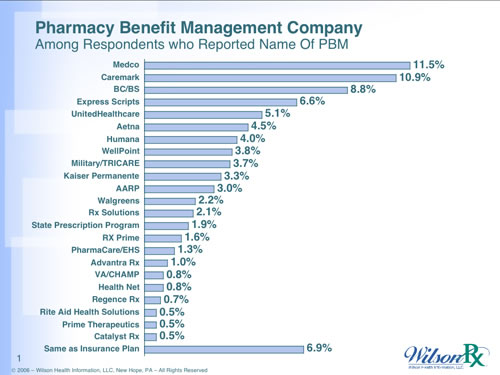
I realized yesterday that many consumers might not even know what a PBM is. PBM stands for pharmacy benefit manager. The market is dominated by 3 large players – Medco, Caremark, and Express Scripts. After that, you have several mid-sized players – Walgreens, Pharmacare (which is now being integrated into CVS/Caremark), Prime Therapeutics, MedImpact – and lots of captive (i.e., part of a managed care company) PBMs – Wellpoint, Aetna, Cigna. And, finally, you have PBMs like Argus that primarily process claims for companies like Humana. (Here is a directory of most of the PBMs.)

Typically, a PBM has the following functions:

  • Process pharmacy claims (i.e., when you go to your retail pharmacy, the pharmacist enters your prescription and electronically submits it for adjudication. The claim is routed to the PBM where it is checked for eligibility and then to see if it pays and what copayment you owe)
  • Set up pharmacy benefits (i.e., based on the plan selected by your employer or payor, the PBM codes what drugs are covered and the copayment structure)
  • Administer rebates…since large pharma companies (e.g., Pfizer) pay rebates for having their drugs on formulary (aka preferred drug list), someone has to manage the negotiations and billing of this.
  • Set up clinical programs (i.e., most PBMs have a clinical committee which evaluates new drugs and looks at market data to help employers choose coverage options)
  • Establish a retail pharmacy network (i.e., work with retailers to get them to agree to discounts on drugs)
  • Communicate with patients and physicians (i.e., look at pharmacy claims data and help find ways to save money or identify clinical issues to inform the patient or physician about)
  • Provide cross pharmacy data for drug-drug interactions…this is a critical function since many people use more than one pharmacy for claims
  • And, last but not least, most PBMs provide a mail order and often specialty pharmacy where they ship prescriptions to patients.

The PBM’s clients are employers who are self-insured, government entities (i.e., state employees, DoD), unions, TPAs (third party administrators), and managed care companies (i.e., BCBS of). Since healthcare has not traditionally been a consumer focused business especially in the PBM world, many of you might not know who your PBM is. In some cases, the managed care company may make it basically invisible to you.

The only people that likely have good awareness of their PBM are high utilizers who run into lots of claims questions and/or people who use the mail order service.

WilsonRx does surveys around PBMs Learn More. Here are two charts from their website about who people name as their PBM and satisfaction with their PBM.

2006pbm.jpg

impactofpharmacy.jpg

If you like this post and are interested in the topics here, don’t forget to sign up for my e-mail updates or add the RSS feed from the blog to your reader.

PBM / Pharmacy Benefits Data (Takeda)

Takeda publishes The Prescription Drug Benefit Cost and Plan Design Survey Report (free to order here). I read the 2006 edition last night. It is full of great data that I would want if I were a consultant, a HR representative, or responsible for my companies PBM relationship.

The document also points you to the American College of Occupational And Environmental Medicine for other information.

Here are some of the facts (based on respondents to their survey):

  • 69% of employers less that 5,000 employees are self-insured
  • 97% of plan sponsors chose to be self-insured so that they had the ability to customize their health plan to meet workforce needs
  • 68% of employers use separate vendors for medical and pharmacy of which 53% use a PBM
  • Average pricing was:
    • $1.88 in retail brand dispensing fees
    • 84.7% AWP reimbursement for retail brands (or AWP – 15.3%)
    • $0.24 in mail brand dispensing fees
    • 78.1% AWP reimbursement for mail brands (or AWP – 21.9%)
  • Formularies were used by almost everyone – 92%
  • Mail copayments were roughly 2x the retail copayment (for 3x the supply of medication)
  • Employer size appeared to matter for price negotiations (no kidding) and they showed that employers w/ over 20,000 members achieved a retail rate of 0.8% less that employers with less than 2,000 members
  • Sponsors who use mandatory mail got a lower reimbursement rate (77.1%) than those without mandatory mail (78.4%)
  • Only 2% of sponsors use a closed formulary where drugs not listed are not covered and the patient pays the cash price
  • It cites research on adherence (The Importance of Medication Adherence, Stambaugh, April 2006) which showed the following reasons for poor medication adherence:
    • 1% don’t know how to use the drug
    • 10% can’t get the Rx filled, picked up or delivered
    • 14% don’t think they need the drug
    • 17% said the drug costs too much
    • 20% don’t want the side effects
    • 24% sometimes forget to use or refill the prescription
    • 10% cited other reasons
  • 40% of employers who design their own plans use co-insurance as opposed to 13% of people who use other parties (i.e., consultant or managed care)
  • Mail service utilization ranged from 0.2% to 62% with 18.3% being the average
  • If a company had mandatory mail, their mail use was 32% versus 14% if voluntary mail
  • Generic dispensing rates ranged from 33% to 71% (51% average) at retail and 12% to 65% (39% average) at mail – which is due to the different mix of acute versus maintenance drugs typically
  • Talked about specialty drugs quoting cost to treat MS at $12K per year and hemophilia at $120K per year (Rx only)

Lots of good information to have.

Retention Bias

As people always say, it costs less to keep a “customer” than to attract a new customer.  Given that 69% of people (per AON 2006 survey) have an option of health plans to choose from, why don’t managed care companies reach out to you to encourage you to choose them?

For healthy patients, I would reach out to them to encourage them to choose you.  They have to be the most profitable customers to keep.   You would hate for them to have either no contact with you or one contact with might not be positive.

Additionally, for sick customers, wouldn’t you want to interact with them and understand their impression of you (via surveys) and determine how to influence their decision during open enrollment.  Depending on the relationship – risk versus ASO (administrative services only) – you may have different reason for influencing their decisions.

This points to several key issues which exist in healthcare:

  1. How to segment your population?
  2. How to motivate people?
  3. How should you communicate with people?
  4. How to track satisfaction?

Make More / Pay More

I never gave it whole lot of thought, but we had an interesting policy at Express Scripts.  The more money you made then the more you paid for your benefits.  It looked something like the following:

  • <$40,000 in salary – pay $150/mo.
  • $40,001 – $65,000 – pay $225/mo.
  • $65,001 – 85,000 – pay $300/mo.
  • $85,001 – $110,000 – pay $375/mo.
  • >$110,001 – pay $500/mo.

Although it is against my Republican tendencies about money, it made sense.  I think it is a reasonable strategy for companies.  Every time I bring it up, people think it is a novel idea so I thought I would mention it here.

Influencing the Next Generation

I am always so amazed at how much kids pick up.  They come to learn about companies and brands through advertising (something that has been proven many times through studies).

So, I began wondering what we are doing to influence our kids on wellness now.  Usually, patient programs are focused on sick people rarely on prevention for people that are healthy.  And, given childhood obesity issues, there is a lot we have to do although I found a lot of sites talking about this (e.g., Alliance for a Healthier Generation).

I see plenty of kids that don’t get out an exercise or eat all types of junk food.  My 6-year old has been running races with me since she was 2.  Just 1/2 mile or a mile, but it is great to see her excitement about this.  (Now, this can go too far.  I remember one race where the dad was pushing the little kid so hard that they were crying.)

It is also important that they understand healthy eating versus junk food.  Halloween is a good example.  My kids enjoy one day of candy and then they can trade their candy for a toy rather than eating it all.   It’s all about setting an example.

Since the 1970s, the percentage of overweight kids and adolescents in the United States has more than doubled. Today, 10% of 2- to 5-year-olds and more than 15% of children between the ages of 6 and 19 are overweight. If you combine the percent of kids who are overweight with the percent of kids who are at risk of becoming overweight, about one out of three children are affected.  (From KidsHealth)

Some childhood obesity facts (from the NIH):

  • Obese children and adolescents have shown an alarming increase in the incidence of type 2 diabetes.
  • Many obese children have high cholesterol and blood pressure levels, which are risk factors for heart disease.
  • One of the most severe problems for obese children is sleep apnea (interrupted breathing while sleeping). In some cases this can lead to problems with learning and memory.
  • Obese children have a high incidence of orthopedic problems, liver disease, and asthma.
  • Overweight adolescents have a 70 percent chance of becoming overweight or obese adults.

Microsoft’s HealthVault

health-vault-microsoft.jpghealth-vault-microsoft.jpg

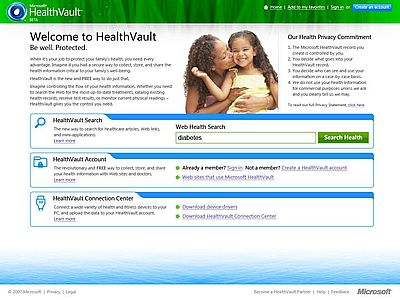
Microsoft has their new healthcare tool out – HealthVault.  It does three primary things – search, collect / store / share (i.e., PHR), and connect with devices.  The “connect with devices” concept seems pretty interesting especially as we get more intelligent home care devices that track blood pressure and other key metrics. 

Connect your HealthVault-compatible home health monitoring devices from partners, such as sport watches, blood glucose monitors, peak flow meters and blood pressure monitors to HealthVault Connection Center, and let our software copy your device data to your HealthVault record.

Given issues with Internet Explorer, will people worry about security – probably.  Given the challenge of connecting with numerous systems and devices, will Microsoft have a leg up – probably.  Will patients use these tools – definitely over the next 5 years.  Who will win – I don’t have a clue.

Here is their blog for developers.

There is lots of talk about this on blog sites:

Aetna CEO on Price Transparency

Here is a entry on the WSJ blog about Aetna’s new price transparency policy.  Conceptually, this is an important first step.  The next question of course is how do you get this to consumers in a timely and easy to digest manner.  Then, how does this correlate with outcomes (i.e., quality) and finally, how does this change people’s decisions.

It is great for planning.  It is great for benchmarking or negotiation.  But, I am waiting to see the impact.

Indu Subiaya with Health 2.0 quotes

Matthew Holt commented about his partner in the Health 2.0 conference – Indu Subaiya, MD.  I haven’t talked with her, but I didn’t want to ignore her.

Here is a link to her blog with a video summarizing some of the best quotes from their recent conference. 

  • People are the new algorhithm
  • P&G knows more about my laundry preferences than pharma knows about my drugs

BTW – I think they already announced that another Health 2.0 conference will be coming so you may want to register to get the notifications now. 

Health “Hints”

I am a big reader of Money and SmartMoney and all those other books that tell you how to save and optimize your money.  I found a few things the other day on savings money and what you should know about your dentist, etc.  Here are links to some of the articles:

money

  1.  
    1.  
      1.  
        1. Save money on prescriptions
        2. 10 Things Your dentist won’t tell you
        3. Better Health for Pennies a Day
        4. 10 Things Your Eye Doctor Won’t Tell You

Can Health Consumers Vote With Their Feet?

If you can’t satisfy multiple buyers, does the company buying health insurance matter more than the consumers?  It’s a difficult question.  The employer cares about the average employee being happy with the health benefits.  You can’t design it for everyone.  And, since we can only switch insurance on annual enrollment (or other life events such as marriage), you [the consumer] can’t do much immediately.

feet  Over time, consumers can vote with their feet especially at companies where multiple insurance offerings exist.  This takes away some consumer power since you can’t storm out saying that this horrible customer service means that I am going to stop using you.

Does this affect service attitudes?  I certainly think so.  I saw it on TV several weeks ago in a sitcom, but I believe it is prevalent.  In that case, the CSR (customer service representative) basically told the person challenging the claim to terminate their coverage if they don’t like it.

call center  Since the consumer is often not the buyer or influencer of the corporate decision, this is an unfortunate reality.  Maybe we need another “life event” to be poor customer service.  When this happens you can change carriers.

Of course, the company arguement would be that this complicates underwriting and raises costs, but why not simply tie customer satisfaction to their pay.  The only way consumerism really works is where the consumer has the ability to walk away.

Interestingly, for one of our biggest customers at a past employer, we got paid cost with a bonus payment that was tied to patient satisfaction.  It was risky, but it put the right pressure on to make sure the patients were satisfied.

Survival Guide for the Uninsured

This article on MSN Money has some good tips and links for things to do including:

  1. Places to go for information on free or low cost preventative care.
  2. Sites to access prescription assistance programs funded by the drug companies.
  3. Free eye exams.
  4. Going to dental schools for low cost dentist visits.

It also quotes a few scary facts from Kaiser:

  • People without health insurance receive less preventive care and are less likely to have major diseases detected early.
  • The uninsured are more likely to die prematurely than the insured, with various studies putting the mortality rate for the uninsured somewhere between 1.2 times to 1.6 times the rate for the insured.
  • Uninsured infants have relative odds of dying that are 1.5 times higher than infants with private insurance.
  • The poorer health associated with being uninsured depresses workers’ average lifetime earnings significantly. The commission estimated that better health would boost earnings by 10% to 30%.

Exercise Myths

I saw this article this morning on exercise myths which I thought was good.  Here are the myths (summarized):

  1. No pain; no gain.
  2. Stretching reduces risk of injury.
  3. The best time to work out is in the morning.
  4. If you’re not going to work out hard, don’t bother.
  5. Exercising the same each day is the best way to build up a muscle.
  6. Running is the best way to get in shape.
  7. Heavy weights create big muscles and small weights create lean muscles.

Companies from Health 2.0

I thought it was interesting to catalog the companies that were at Matthew Holt’s Health 2.0 conference. Many of which I was not familiar with.

MedHelp.org (interesting site which offers Q&A by disease topic with MDs and nurses)

ThinkHealth (medical management software)

Health Evolution Partners (a private equity firm)

Medstory (intelligent search for health)

Healia (health search engine)

Healthline Networks (health search engine)

WeGoHealth (disease specific communities)

Patients Like Me (patients sharing information with other patients)

Daily Strength (support groups)

Organized Wisdom (MD handcrafted search results)

Inspire (health and wellnes support networks)

DiabetesMine (site all about diabetes)

Enhanced Medical Decisions (uses natural language to look at drug interactions)

HealthEquity (health savings account software)

DNADirect (source for genetic testing)

Within3 (social networking tool for physicians)

Vimo (comparison shopping for healthcare)

Careseek (sharing information about physicians)

Health Hero – home health monitoring device

Additionally, John Sharp mentions a few other companies in his blog including:

Healthcare Guarantees

I needed a small break so I am dropping a few things from my head to paper (i.e., blog).

Wouldn’t it be nice to get guarantees in healthcare?  I was thinking about several that would be nice to have:

  1. Pay one price and get unlimited fertility treatments until they were successful.  (BTW – I have a physician friend who did offer this based on data knowing that most people were successful after 2 attempts and selling it for the price of 2.x attempts.  As long as you don’t take customers that have health problems, you should be good.)
  2. Pay one price to get diagnosed for a medical problem versus multiple office visits, numerous lab copays, and trying different medications.
  3. Obesity plan of diet, exercise, and drugs that lost weight or you got your money back.
  4. Quality guarantee (which I talked about before) on things like surgery which promise certain outcomes (or not getting some staph infection).

The key should be that we (consumers) don’t have to take risk (or only take calculated risks) when we make decisions that are presented to us by our care team and insurance company.  Healthcare is still not perfect, but it seems ridiculous when I talk to people that spend months trying to figure out what is wrong with them.  (Discovery Health had a scary story about a patient with lime disease on TV a few weeks ago.)

Can You Answer These Questions (healthcare company)?

These are more company focused although you can think about whether your healthcare company knows this about you.  To be truly effective at education or marketing to patients to drive behavior and outcomes, these are important.  Interestingly, I am not sure I (or you) could answer all these questions about myself (or yourself).

  1. What is your preferred medium – letter, call, fax, e-mail, text message?  And, does this vary based on the content?
  2. When is the best time to reach you?
  3. Would you prefer to talk or hear information delivered in a female voice or male voice?  Would you react differently if they had an accent?
  4. What would compel you to act – saving money or losing money?  Is there a specific amount?
  5. What makes you open an envelope?  (For example, we used to places stamps on intentionally crooked since people were less likely to think they were from a company.)
  6. Does color matter in materials?
  7. How many times do you need to hear a message before you respond or do you make up your mind the first time?
  8. Do you want to be healthy or simply minimize out-of-pocket costs?
  9. Do you trust physicians, pharmacists, insurance companies, hospitals?
  10. What information do you want to receive that you don’t?

I could go on, but I think the point is that today we (healthcare) don’t really understand patients.  What information they want, how to get it to them, when to deliver it, what makes it more effective, and how to drive action.  On the other hand, we may not know ourselves until “experimented” on with different variables.

Confusing Stock Market Reaction

So, Walgreens announced that they were going to miss earnings because of generics (oh and higher expenses).   All of a sudden, the PBM stocks (e.g., Medco and Express Scripts) took a hit which makes no sense to me.  [BTW – I own none of these individual stocks although they may be in mutual funds that I own.]

Walgreen Co., one of the nation’s biggest drugstore chain operators, said Monday its fourth-quarter profit dropped nearly 4 percent because of lower reimbursements for some popular generic drugs and increased store and staff costs.  (See all)

“If Walgreen is receiving lower reimbursement for some generics, it means that PBMs are paying the company less for generic drugs,” Wachovia analyst Matt Perry surmised on Tuesday. “In other words, the PBMs’ drug purchasing costs have gone down. We think the selloff in shares of Medco and Express Scripts is unwarranted.” (see entire article)

At least one analyst understood.  But, why would the market response this way.  There are only a few reasons that these could be correlated positively.  My hypothesis would have been that if Walgreens is getting less than the PBMs are making more or are neutral.  This would make sense because if the PBMs paid Walgreens less they wouldn’t immediately pass that on to their clients assuming they make spread on those claims and have multi-year contracts with employers and managed care companies.  And, if they simply passed on the retail costs to their clients, it would have no impact on them.

How could it be true that Walgreens and the PBMs made less?

  1. The acquisition cost of generics could have gone up which would likely only happen if the wholesalers (e.g., McKesson or Cardinal) changed their prices dramatically or the generic manufacturers increased their prices (not likely).
  2. A significant number of PBM clients (or major managed care companies with their own PBMs like Aetna, Cigna, Wellpoint, Humana) requested price concessions on generics which forced the reimbursement rates down for the retail pharmacies and the mail order pharmacies.  (possible, but clearly not what you hear from the other players)
  3. Costs for a specific generic (with material marketshare) changed dramatically from what was forecasted (shame on the planner).  The worse case here would be if they struck a sweetheart deal (i.e., guaranteed supply at a lower than market price) and then saw the price drop out with a new manufacturer come to the table.

Generics are definitely a key profit driver for the pharmacy industry.  The average AWP (average wholesale price) is $40 (for a 30-day supply).  Companies pay less than 50% of this.  The actual costs are typically less than 80%.  And cash customers pay greater than 100%.  Lots of spread.

Now, of course, there are costs to fill each prescription so it is not that simple.

Unified Communications

Those of you that know me (or follow the blog) know that one of my key issues is how to improve healthcare communications.  I think this is where we (as an industry) missed the boat.  I used to tease our VP of Call Centers that Dominos knew more about me when I called in than we did.

I was glad to see a blog entry from earlier this year by the physician that leads Microsoft’s healthcare group on this topic.

“Healthcare is a communication intensive business.  Good communication has a profound effect on the quality and safety of patient care.  Communication also has a huge bearing on patient satisfaction.  Yet historically, the options for how we communicate with each other in the healthcare industry have been somewhat limited.” 

Obviously, we have a long way to go.  Many times companies simply give up due to regulatory issues or the challenges of changing behavior.  The reality is that communications are difficult.  It is both an art (i.e., messaging, branding, design) and a science (i.e., linguistics, data mining, targeting, personalization).

Technology will drive a step change in the relationship between patients and providers and insurance companies.  This is the time to jump on board and figure out how to improve.

Does Technology Affect Awareness?

I remember when they first started letting us use calculators in school.  At the time, there was lots of discussion about whether this would impact people’s math skills.  I don’t hear much about this anymore.

But, if I think about it, there are many things I ignore because of technology.  I probably only know about 3 people’s phone numbers since they are all in Outlook and synched up with my Blackberry. 

What are the implications of consumer technology on our health awareness?  Once all my prescriptions are tracked in a PHR, will I forget what drugs I am on?  And, even if I do, do I care?  I don’t think I do as long as the PHR (or whatever tool) is always available to me and my care team. 

I certainly use a calculator today.  I depend upon my crackberry.  I can’t remember all my statistics since I can use Excel to calculate them and press help to find out what it means. 

But, literacy about healthcare and the ability to talk in a group (virtual or physical) about my condition or that of someone I care for is important.  I will certainly use technology as my crutch to store and remember information.  I only wonder how this will affect our long-term attitudes on health as things become abstracted. 

Regional Differences

I remember one of the first thing that healthcare peope used to tell me 10 years ago when I first began working in healthcare.  “Healthcare is local.”  At the time, I took this for granted.  Since then, I have seen all the data that shows how prescription utilization, spend per person, obesity, and many other variables vary by geography.

As I have been traveling, I was thinking about this as I noticed lots of anxillary things that vary dramatically state-to-state:

Boston and some eastern states have Dunken Donuts everywhere.  They went out of business in St. Louis.

In Michigan, everyone drives faster than any other state I have been in.  The other day, I was going 90 in the left hand lane and got waived out of the lane by a minivan and an SUV going about 100. 

In LA, people consider an hour drive nothing.  In some smaller areas, a 30 minute drive wouldn’t be considered for some normal task. 

Yet, from what I can tell, many national companies don’t vary their healthcare marketing and communications per region.  Why is that?  Is it simply a data sophistication question?  If attitudes are going to vary, have you taken that into account?

It makes me think of a project I did with a retailer years ago.  One of their questions was about stocking inventory and how to develop a model to optimize the mix based on location.  They had just gone through a season where some stores had excess shorts which they had to dramatically discount and some stores that ran out of shorts.  At the time, WalMart had just begun their CFAR (Collaborative Forecasting and Replenishment) initiative which created an integrated application for sharing data across stores and with suppliers to optimize mix and maximize inventory turns. 

That CFAR model has now become a default SAP module and created an industry association that uses the model.  Will healthcare do the same?  Not for a while from what I can see.

But, it is critical in communicating.  Attitudes towards preventative care vary.  Willingness to try and exercise and wellness vary.  Perceptions vary.  The most simplistic example I saw a few years back was the doubling of the success of a call campaign when the person calling [into the South] had a southern accent.  People weren’t as responsive without that familiar accent.

The website for Premier (a non-profit hospital association) had some good facts about localization (pros and cons):

“All healthcare is local”: Good for innovation and personalization of care

  • Widespread, local experimentation among U.S. healthcare providers prompts innovation, which as New York Times columnist, Tyler Cowen points out, makes the United States the world leader in new treatments and technologies. Innovations include the development of new drugs and devices and better treatment protocols.
  • The U.S. healthcare system is anchored by community hospitals and healthcare organizations. These local hospitals and organizations are rooted in the community and are able to shape care in accordance with the needs of their specific populations, making healthcare more personal and direct.
  • “Community-based approaches act as a reality check of what is doable and practical: They can provide an actual model of what works; they help identify promising practices in key areas; and they can provide lessons about how to address political issues.”[1]

But local orientation results in variation of care, uneven outcomes and high costs

  • In a national study on quality of care, RAND found that American adults receive just half of recommended evidence-based care services.
  • The National Committee for Quality Assurance’s recent scorecard, The State of Health Care Quality: 2006, reports huge variation in healthcare performance exists in every region of the country and in every clinical area.
  • “Despite the billions of U.S. tax dollars spent on research and the more than a trillion spent on service delivery, movement of evidence-based interventions into communities and health systems is often slow.”[2]
  • Lack of scale and connectedness (“buying clout”) and unnecessary duplication result in high healthcare costs.

[1] Debbie I. Chang, “Applying Lesson Learned in Communities To Programs and Policies at the Federal Level,” Health Affairs 25, no. 3 (2006): w192-w194.

[2] Jonathan E. Fielding and Peter A. Briss, “Promoting Evidence-Based Public Health Policy: Can We Have Better Evidence and More Action?,” Health Affairs, 25, no. 4 (2006): 969-978.

Health 3.0 – Ubiquitous Transparency

I was thinking about dieting over the weekend and thought back to an idea I had many years ago.  The concept then was to create a data integration layer for the smart house that integrated the data from your multiple devices.  Imagine the following:

You set a diet plan.  Your virtual health coach (think artificial intelligence) looks at your daily calendar and the food you have at home.  It proactively recommends what you should eat at the restaurant you are going to for lunch; orders a few items from the grocery store to be ready for pick-up on the way home; prints out the cooking instructions; and pre-heats the oven when you are 5 minutes away from home. 

Over time, it plots your caloric intake and suggests workouts based on your calendar and biorhythms. 

If I expand this concept, I would see this as a Health 3.0 type application.  Total integration of data (home, work, health).  Total transparency of information (healthcare, lab, medical, cost, quality, consumer goods).  And, availability of information anywhere and anytime.

I am sure there are definitions, but I think about Health 1.0 and Health 2.0 as the following:

  1. Health 1.0 was several things – workflow oriented applications (e.g., practice management systems), e-prescribing, online content (e.g., WebMD), and transaction hubs.  I saw the focus here on efficiency, quality, and connectivity.
  2. Health 2.0 is still developing and includes transparency and web tools.  I see the focus here on pushing information from companies into the hands of consumers. 

Surprising (or maybe not), there are several people using the term Health 3.0.  Here were a few things I found:

  1. Money magazine article about home monitoring and companies like Health Hero, NxStage, iCare, and CareMatix.
  2. This link which talks about the semantic web but has little other information.
  3. An article about the Health 2.0 conference which mentions Health 3.0:
    • Things start to change when the institutions don’t control all the information. Even though the largest flow of money will still be centralized and often mis-directed, the new user tools will make all the tangles more visible.

      At that point, the Health 3.0 conference will have to include folks from the establishment – government, large software vendors and entrenched health-care institutions.

 Who knows when and where Health 3.0 will really appear, but I generally disagree with the opinion that Health 2.0 isn’t real because there aren’t business models.  In the early dotcom days, the business models were limited.  Those that figured them out – WebMD, Amazon, eBay – survived.  First you figure out the concept and the value add.  Then, you figure out who can pay for it.