Archive | Managed Care RSS feed for this section

A few recent entries on other blogs

It is always important to see what others are writing about on their blogs. There are now almost 700 healthcare blogs tracked by eDrugSearch. (Just 6 months ago, I think it was only 400.) Here are a few recent posts worth reading.

The main value of transparency is not necessarily to enable easier consumer choice or to give a hospital a competitive edge. It is to provide creative tension within hospitals so that they hold themselves accountable. This accountability is what will drive doctors, nurses, and administrators to seek constant improvements in the quality and safety of patient care. So, even if we can’t compare hospital to hospital on several types of surgical procedures, we can still commend hospitals that publish their results as a sign that they are serious about self-improvement.

    • On DiabetesMine, there is a great summary of all the things that have happened around this disease in 2007.
    • It’s not healthcare specific, but Seth Godin’s entries are always interesting.  Read this one about what you did in the past and grabbing opportunity.  It should help you set a positive outlook for 2008.
    • A new blog that I recently started following is called Enterprise Decision Management.  Here is one entry on Business Intelligence 2.0.  He has lots of great entries that I will elaborate on later.  This approach is core to creating an intelligent healthcare communications strategy.
    • The Hospital Impact blog has a nice entry on 2007: A Year in Review.
    • On the Health Business Blog, David talks about “shopdropping” which is a retail activity where people leave things at stores (i.e., reverse shoplifting).  Interesting.
    • John quotes a study on the eHealth blog that says that 39% of physicians are e-mailing patients.  I find that amazing.  I have never heard of a physician doing this.
    • On Hospital Marketing, there is an entry on Hospitals in Facebook which makes the point about healthcare being behind and not thinking creatively about how to use new media.  I would like to see some discussion there on the topic, but there hasn’t been any yet.

    Just a few other blogs to check out.

      Setting Healthcare Goals

      I have always been a big believer in using New Years as an excuse to think about my goals – what did I accomplish last year, what do I hope to accomplish in 2008, and what are my 5 and 10-year goals. With the exception of a few years, I have done this for most of the past decade. It is a an interesting tale of how my priorities have evolved from very career oriented in the early years after business school to much more balanced now. My goals will now typically include a few career objectives, some family objectives, a financial planning objective, and a few personal objectives (e.g., run a 1:40 half-marathon).

      When I got ready to write this entry, I decided to try and find a story / study that I had heard referenced numerous times about an ivy league class where they tracked the success of people that wrote down their goals versus those that didn’t. Unfortunately, all I found was that it was a myth. I still believe it is a helpful process, and I think telling some of them to others so that they encourage you is also important.

      A good term to use in setting goals (work or personal) is S.M.A.R.T. which stands for Specific, Measurable, Attainable, Realistic, and Timely. Just Google “SMART goals” and you will find numerous links. It is often a good idea to have a specific objective or event and/or to reward yourself. (e.g., I want to lower my BMI by X points prior to my annual visit to the doctor and will upgrade the cabin on my next cruise if I achieve this.) And, don’t forget to set a baseline metric for where you are today so you know how much you have improved.

      So what goals should you have a health consumer…here are a few ideas:

      • Know your metrics (BMI, HDL/LDL)
      • Understand your family history and probability of diseases
      • Lose weight or improve your physical fitness
      • Take any preventative measures needed based on age or gender or other attributes
      • Take advantage of any wellness programs offered (wellness goal article)
      • Learn about the food you take into my body
      • Eliminate any unhealthy activities (e.g., smoking)

      And, what goals would we want our healthcare companies to have for the new year:

      • Understand me as an individual and how I want to be communicated with
      • Improve your customer service so it is proactive and I only have to tell you once who I am
      • Make your communications understandable to me not only to a medical professional
      • Help me manage my data
      • Give me tools to make decisions don’t just shift risk and responsibility to me
      • Help me with prevention and wellness and other long-term activities

      With that in mind, it should be interesting to see if Revolution Health gets some traction with their new offering – Resolutions 2.0. From what I have read and seen, it looks like they have created an online tool for setting and tracking goals and combined that with two things – social interaction to build encouragement and expert insight to provide hints and advice. It will be interesting to see the adoption and use. It would be great if they could track it versus a control group to see the improvement in achievement of goals.

      “The beginning of a new year always brings with it a fresh start and the best of intentions to change one’s life for the better,” said Steve Case, chairman and CEO of Revolution Health. “We all make New Year’s resolutions but going it alone can often make those good intentions a grind. By adding the power of friend-to-friend support along with expert information, RevolutionHealth.com is offering a simple, fun and free way for people to achieve goals they never have before.”

      The expert “groups” they have created include the following which although broader in scope than I expected seem to have something for all of us:

      1. Improve My Relationship/Marriage
      2. Keep My Family Active
      3. Take Charge of Your Life
      4. Become A Complaint Free Person
      5. Eat Right and Stay Slim
      6. Walk More to Lose Weight
      7. Sleep At Least 7 Hours A Night
      8. Have a Smoke Free Day
      9. Lose Up to 20 lbs By Spring
      10. De-stress

      US News and World Report Health Links

      If you haven’t been there, US News and World Report has a good site for healthcare rankings and other information. Here are a few of the things you will find there:

      1. A link to Healthline where you can get help with Medicare Part D
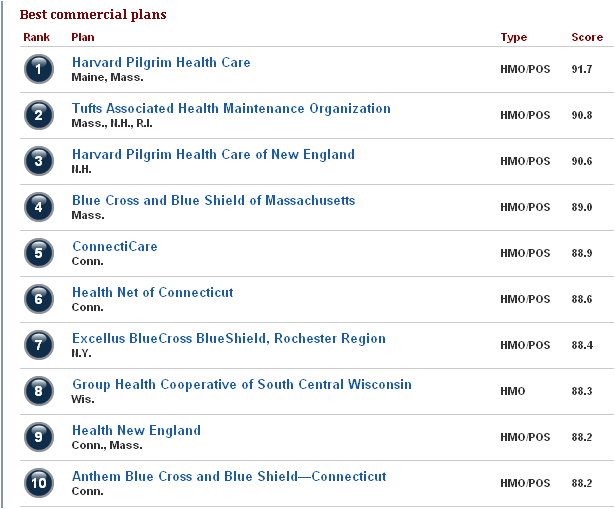
      2. A list of the top plans according to rankings by NCQA (National Committee for Quality Assurance)
      3. Risk assessment tools on things like heart disease
      4. Links to health centers on topics like Asthma

      Of course, the ranking are the most unique feature since the other health information is probably available on lots of other sites.  You can see some of the things that NCQA looked at in the rankings on the site also.

      us-news-rankings-of-plans.png

      Passing on the costs of unhealthy behavior

      I mentioned it in a blog post a few days ago, but apparently, companies can now screen employees for something like smoking if they have a published policy.  [I don’t know all the details.]

      The Cleveland Clinic won’t hire anyone who smokes anymore and Scott’s gives you six months to quit smoking or you get fired.  (Based on the fact that it costs about $3,400 more per year to employ someone who smokes.)

      I asked a friend of mine at a large insurer this week who verified that they are getting lots of requests from employers around smoking.  Most companies are trying to figure out whether they discourage smoking or simply pass on the costs to the smoker.  This begs the obvious carrot or stick discussion in terms of motivation.

      It made me wonder what would be next.  Obesity would seem like the condition that companies would want to address since it is tied to so many diseases and drives so much cost.  Maybe a BMI sliding scale for healthcare costs.  Of course, you would need to have some type of test to exclude people who were genetically pre-disposed or medically not able to control their weight. 

      Whatever approach was taken, there is a lot to driving positive behavior.  A blog entry on Consumer Focused Care does a great job of talking about this.  He talks about how a group of maids became healthier simply by being told that their work (e.g., scrubbing floors) was equal to the recommended daily exercise.  There is a power in being positive and helping people realize what they can do to make a difference. 

      If Trust is Important…What Do I Do With This?

      I don’t think anyone would argue that trust is one of the most important components of corporate branding especially if you are communicating with consumers.  How do you compel them to act (even if its in their self-interest) if they don’t trust you?

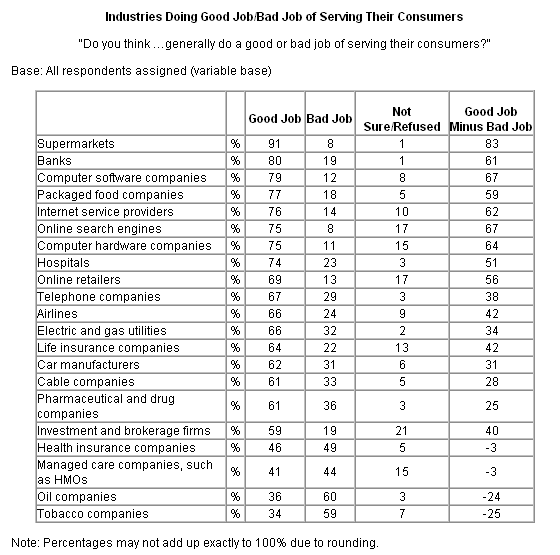
      That being said, what does it tell us that the healthcare industry ranks so low in the annual Harris Interactive survey which asks “Do you think <industry> generally do a good or bad job of serving their customers?”  Hospitals do okay with 74% of those surveyed saying yes.  Even drug companies rank okay at 61%.  [Cable is also at 61% and the phone company at 67%.]  Health insurance comes in at 46% with managed care at 41%.  The only lower companies are oil and tobacco companies.  We have to figure out how to fix this if we are going to successfully drive wellness and change healthcare in this country.

      harris-industry-survey.png

      Sticky Messaging

      We used to talk a lot about stickiness of websites and eyeballs back in the late 1990s. The word still has some attraction and is a key point in the recent McKinsey interview with Chip Heath. Chip is a professor of Organizational Behavior at Stanford University’s Graduate School of Business.

      “The key to effective communication: make it simple, make it concrete, and make it surprising.”

      Although the article is primarily around what executives need to do to make their messaging and ideas stick with diverse audiences, it has a lot of relevance for healthcare.

      “A sticky idea is one that people understand when they hear it, that they remember later on, and that changes something about the way they think or act.”

      Think about all the things you want to tell your patients or members or employees (or vice-versa all the things you patients want your healthcare companies to tell you):

      • There has been a change to your X (copay, formulary, network).
      • You have an opportunity to save money by doing X.
      • We are missing X data that will delay your coverage.
      • We see that X happened and wanted to gather data on your experience or proactively address your question.
      • Welcome to our plan. Have you registered on the website? Have you received your ID card?
      • Please take this Health Risk Assessment.
      • Your credit card has expired. Would you like to update it?
      • Your order is delayed. If this is an emergency, please do X?
      • We see you were on the website. Did you find what you needed?
      • Do you need a copy of your X (formulary, provider directory)?
      • You have not yet picked a Primary Care Physician. Would you like to do that now?
      • Did you receive the information that we sent you?
      • Are you following your physicians orders? Did you do X? Why or why not?
      • Our records show us that you are due for a X. (Flu shot, screening)
      • Are you using any over-the-counter products that we should have in our database to identify drug-drug interactions?
      • Please remember to refill your medication?
      • Are you having any side effects or complications associated with your recent medication or procedure?
      • Have you enrolled yet in our disease management (or incentive) program? Would you like more information?
      • Welcome to the plan.
      • We know it is time for open enrollment. We hope you will renew with us. We are offering a local meeting to help you learn more about your benefits. Would you like to attend?
      • X has changed with your drug, condition, etc. There is new information available at Y.
         

        Getting back to the article…He offers several good examples of sticky messages which are primarily what I would call rallying calls for organizations. In healthcare, the key is to find these simple messages that compel people to act. So, bottom lining it, he gives six basic traits:

      1. Simplicity – short and deep
      2. Unexpectedness – uncommon sense messages generate interest and curiosity
      3. Concreteness – his example is don’t say “seize leadership in the space race” but say “get an American on the moon in this decade”
      4. Credibility – this should be so easy in healthcare if you leverage all the people and stories out there
      5. Emotions
      6. Stories

      He has a few great stories such as:

      • A Nordstrom’s person wrapping something bought at Macy’s just to make the customer happy. [And probably without point it out.]
      • A FedEx driver who forgot the key to a box simply unbolting the box from the ground and throwing it in the truck so they weren’t late.

      These things reinforce the message while becoming a type of urban legend that stay with people. They evoke emotion in a simple way.

      One good example I have from Express Scripts was around trying to motivate people to change from one drug to another. When Zocor was going generic, we decided to launch a huge multi-modal campaign to drive down Lipitor marketshare and move people to Zocor so that when it went generic everyone would win. [Clients would save; patients would save; and we would make more money.] It worked. But, prior to the program, we worked with linguists and others to design and test a set of messages. The one that resided best was “we have a secret that can save you money”. People were intrigued and listened. They felt like they were being let in on something that was important. We ended up positioning it similar to a Consumer Reports Best Buy. It worked.

      Forrester on Individual Health Market

      It is a few months old, but Forrester put out a report called “The $115 Billion Individual Health Insurance Opportunity” back in October of this year that is packed with facts and a few interesting concepts. The key point is that established companies need to maintain success in the B2B world that we live in today while aggressively migrating processes, collateral, skills, and products to work in the B2C market.

      I was definitely surprised by their statistic that 9% of today’s market is made up of individuals purchasing their own insurance and that 20% of the population is either in a high deductible or CDHC plan. Their data also says that 31% of the uninsured are actively investigating insurance. Obviously, this means a lot of people looking for health information and taking more responsibility for their care.

      They offer 3 recommendations:

      1. Get ahead of the legislative curve. I would agree. Companies should be out testing models right now with the early adopters. [One of my favorite quotes from one of the founders of IDEO goes something like ‘fail early to succeed sooner’.]
      2. Develop and launch innovative plan designs. They talk about Prudential’s “pay-as-you-go” model in Europe and American Community Mutual Insurance in Michigan that has a buy-up plan that you can buy after you get sick. WOW!! I am not sure how you underwrite this, but it sounds very interesting.
      3. Invest in low cost distribution channels. They talk about Tonik which I mentioned before and the building of online presence. They also talk about outsourcing.

      One of the big things that this will all require is some rebuilding of infrastructure to support different sales processes, personalization, claims set-up, and customer support. Companies should also be looking at data and how they can better use and mine data to learn and improve.

      Applying Technology Trends to Healthcare

      McKinsey recently put out their 8 technology trends article (access available with free registration). I thought I would translate those to the topic of healthcare communications. Hopefully, we don’t have to be hit by a bolt of lightning to change, but we realize and can document the ROI of acting now and improving our system by involving and reacting out to patients.

      1. Distributing Cocreation – This is the trend which is happening in many industries where consumers (patients) and suppliers (providers) are taking more involvement in product design and even advertising. New media and technology have enabled this to happen. This is a big opportunity for healthcare. In general, I see companies doing focus groups, but not letting product design be driven by the consumer. I don’t see competitions to design the next advertisement for a managed care company happening today.

      “By distributing innovation through the value chain, companies may reduce their costs and usher new products to market faster by eliminating the bottlenecks that come with total control.”

      1. Using Consumers as Innovators – This conceptually seems similar to the first trend although there are likely more differences than semantics, but the value remains in letting consumers push healthcare. How do we capture what they want and the value associated with it? How do we create business models that allow companies to exist to provide that offering? It’s not easy for individuals to drive innovation since we are often tied to what we know.
      2. Tapping Into A World Of Talent – For the past few decades, many other industries have focused on getting their executives to gain multi-cultural experiences by working globally. There have also been studies that link innovation to diversity. With the exception of pharma, most healthcare companies aren’t global. Sure, all the big companies look outside the US for models and occasionally to sell to the government entities, but not much has taken off. The primary expansion in leadership that I have seen over the past five years is a lot more healthcare companies recruiting in executives from non-healthcare companies which will create some diversity and bring a new perspective to the table. Interestingly, I think this also is an issue in the patient outreach process. Are your communications taking into account the diversity of your patient population – e.g., language, messaging, channel, speed of voice?
      3. Extracting More Value From Interactions – This is very true for healthcare. I would bet that the majority of communications in healthcare are either reactive (you call them) or required by regulatory issues (e.g., explanation of benefits or annual notification of change). These programs were originally designed to cost as little as possible so that someone could check the box. Well, guess what. Over the past few years, companies are realizing that these communications are their best ability to influence patients. So, what are the “golden moments” that exist where an interaction can drive loyalty, satisfaction, wellness, etc. Companies need to figure out what the potential value is and how to capture it.
      4. Expanding The Frontiers Of Automation – Automation has been a focus for years. Healthcare is not an exception expect people struggle with how to provide care and a personalized experience while leveraging automation and technology. And, now with technologies such as web services, companies can be interlinked and automated which (when done right) can improve the consumer’s experience. Of course, the second challenge is that automation is best when it enables a process and people don’t often think, manage, or operate from a process perspective.
      5. Unbundling Production From Delivery – I think the whole concept of unbundling could be very interesting given consumerism. Unbundling has already happened for the corporate buyer…they can buy health insurance separate from pharmacy. So, could I (the consumer) one day buy long term insurance separate from prescription coverage separate from my provider network separate from customer support. Could I choose my disease management company? What would that mean for group discounts, bulk purchasing, underwriting models, etc.?
      6. Putting More Science Into Management – We are a lucky generation in that we have access to reams of data and information. Of course, the challenge is how to turn this into intelligence and use it. It is easy to get overwhelmed and frozen. But as managers, using information applying algorithms, linguistics, and neurosciences to it to create personalized communications that apply to each micro-segment of your population is a great opportunity. It translates success from luck to predictable outcomes.

      “From “ideagoras” (eBay-like marketplaces for ideas) to predictive markets to performance-management approaches, ubiquitous standards-based technologies promote aggregation, processing, and decision making based on the use of growing pools of rich data.”

      1. Making Businesses From Information – Healthcare has long embraced this trend. There are numerous companies (e.g., IMS) which are built around information. There are clinical companies that produce drug monographs for use by clinicians. There are aggregators of information (e.g., ePocrates). The point is that companies not only create data exhaust, but as they apply decision sciences, they become consumers of more and more data.

      “Creative leaders can use a broad spectrum of new, technology-enabled options to craft their strategies. These trends are best seen as emerging patterns that can be applied in a wide variety of businesses. Executives should reflect on which patterns may start to reshape their markets and industries next—and on whether they have opportunities to catalyze change and shape the outcome rather than merely react to it.”

      These seem like reasonable trend predictions that are applicable generally and make a lot of sense form a healthcare perspective.

      Is Healthcare Missing a Generational Opportunity?

      I think a lot about some of the new marketing tactics being used by consumer product companies – sponsorship (e.g., McDonalds Holiday Lights at the Beach Presented by Verizon Wireless), advertisements or product placement in video games, corporate tattoos, YouTube videos, MySpace personas, and Second Life avatars. Logically, who cares about most of these for healthcare. The primary users of healthcare are the senior population…and they aren’t being influenced by these channels. The corporate buyers are the HR or benefit professionals…many of whom have professional consultants (e.g., Hewitt, Mercer). Branding is often an afterthought within healthcare.  [Can you image a company working with the reality show Survivor to make sure that one of their competitions earned the winner a personal healthcare coach sponsored by Cigna (for example) for a year?]

      BUT, we all know that health insurance (or any insurance) company is not typically viewed as a trusted entity looking out for your best interest. (As one of my old bosses used to say…how many times are you going out to dinner with your health care broker each year?) I guess my point is why are some of the key players thinking out 20 years and trying to figure out how to influence the younger generation and show healthcare as an entity that works to make their life better (e.g., have a video game where buying health insurance makes your character recover faster from injuries).

      For example, I believe most people have a great impression of architects as humane people based on The Brady Bunch’s depiction of the father figure who was an architect. The lead character in Spike Lee‘s movie, Jungle Fever, was an architect. Have you ever seen a movie where the lead character was the VP of claims at a managed care company or the CEO of a PBM? There needs to be someone out there thinking big picture and looking at what it will take over time to change the perception of healthcare because perception is ultimately reality so we have to address both. Fix the problem and get people to believe that we fixed the problem.

      Medco on CDHC – Support Programs Are Important

      In Managed Healthcare Executive (12/1/07), there is a CDHC (Consumer Driven Healthcare) article by Medco which I found very interesting.

      • A survey by the Employee Benefit Research Institute found that 70% of those in consumer driven healthcare plans consider costs when deciding to see a doctor or fill a prescription (versus 40% in a comprehensive plan). [This seems like the premise of consumer driven healthcare…you will be more careful with the costs of healthcare when they come out of your pocket.]
      • The study also found that people were twice as likely (35% vs. 17%) to avoid, skip, or delay healthcare services. [I’m feeling better so I don’t need to finish taking that prescription or no reason to go for my screening until my cash flow is better…here is the problem.]
      • The problem is compounded as an employer. Not only can your costs go up but you could lose productivity of an employee.
      • The author talks about a 2005 Medco study which showed the medication adherence is associated with significant medical savings (e.g., $1 spent on Rxs for diabetes leads to $7 in medical savings)
      • The article says that the average number of Rxs per household was just more than 21 in 2003. [I have never seen it presented this way. I always use the number of 13.1 Rxs PMPY which is from 2005.]
      • The article talks about RationalMed which is Medco’s patient safety system that looks at integrated data (pharmacy, medical, lab, and patient self-reported). [I think that this type of data integration is critical to healthcare. The challenge is integration of the data and taking action on it. I would also like to know the predictive value of the system compared to other tools such as ActiveHealth.]
      • It points to some data on generic drugs that is great and which was new to me.

      “Generic drugs not only cost substantially less, but they also promote drug compliance. A recent study in The Archives of Internal Medicine found that patients who took a generic drug had close to a 13% increase in drug therapy adherence, compared with patients who took brand name third-tier drugs covered by their plan.”

      • The author goes on to talk about the need to provide patients with information and use tools to drive change. Here were a couple of the points being made:
        • People who used Savings Advisor (an online tool that compares costs) were 60% more likely to switch to a generic.
        • ¾ of people who discussed generics with their MD or pharmacist got a suggestion to use a generic. [I would like to see it for the percentage of people for which a generic was clinically appropriate. Was this 100% of the opportunities or 75% of the opportunities as implied?]
        • Direct mail about generics increased generic conversion by 22% at a savings of $88 per switch per year. [This seems low.]

      CDHC will only be successful when companies have figured out how to empower patients with information rather than simply shifting the burden of financial management to them.

      Bat Phones, Blue Phones, and On-Star

      I was listening to a GM commercial for their OnStar service earlier today, and it made me wonder.  If GM can design a service, staff a call center, and make money in the highly competitive car market, why can’t healthcare?

      Conceptually, it seems like such a great service.  No interactive voice response (IVR)…you actually get to a live agent right away.  You press a button and you are connected…no remembering numbers or having to find the right time to call.  They help you with any issue…rather than route you to some other person for follow-up.

      bat-phone.jpgMany of you will remember the “Bat Phone” from Batman where (if memory serves me) the Commissioner could pick up the phone and be instantly connected with Batman to ask for his help.  We tried a few programs to get at this at Express Scripts.  We worked with BCBS of Massachusetts to pilot the “Blue Phone” which was placed at certain high volume pharmacies and allowed patients to pick up the phone and talk directly to an agent that could address questions about their claim (i.e., why has my copay changed?  why isn’t this drug covered?  the claim got rejected, why?).

      “Customers seem to be willing to use the Blue Phone more each day,” said Jon Hersey, pharmacist at Stop & Shop. “The response from BCBSMA is routinely quick and customers don’t spend a lot of time waiting on the phone. This saves time for us and keeps the customers happy, because we can spend more time filling prescriptions and less time answering questions.”

      The other thing we tried was setting up a tiered customer service model where high utilizers of prescriptions were given a direct dial that took them directly to a group of skilled agents.  Patients loved both the Blue Phone and the tier service model.  The challenge of course is staffing appropriately and managing costs.  BUT, if companies were more proactive in call obviation, they could employ solutions like this.  If companies mined their data to identify when patients would call and reached out to them before they called to address their questions, then inbound call volume would drop dramatically and would be more the exception than the rule.

      Wellpoint Investor Presentation

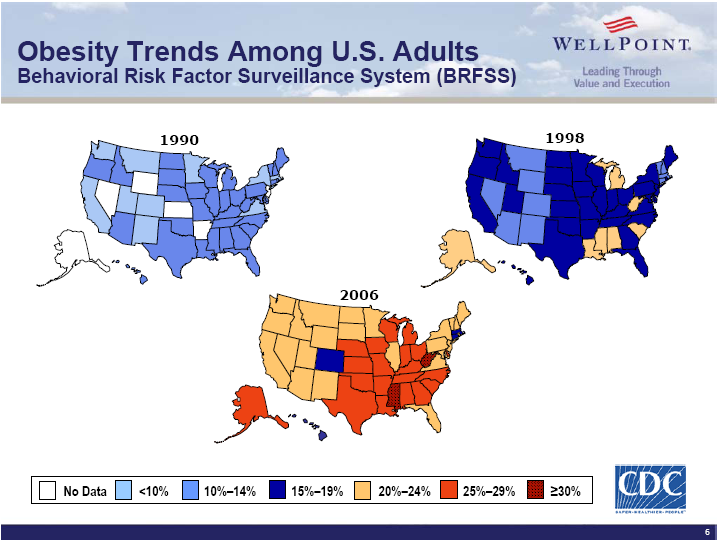
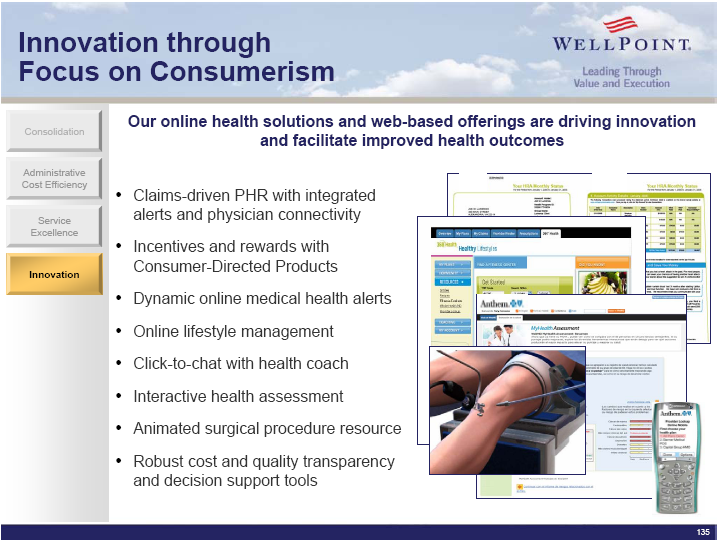
      I was looking at a Wellpoint investor presentation and picked a few slides to pull out. It is definitely an interesting read to see all the things they are doing and how they approach the market. The first one talks about the prevalence of chronic diseases. The second about the obesity trend, and the third about some of their activities around consumerism.

      wellpoint-chronic-disease.pngwellpoint-obesity.pngwellpoint-consumerism.png

      Are You Growing Your Vegetables

      I read this interesting analogy this morning about marketing and comparing it to gardening.  I think the author’s points are very relevant when you think about patient retention within healthcare.  A few of the points that come through in the blog entry are:

      1.  It takes effort.  (i.e., vegetables don’t just grow by themselves)
      2. You have to be consistent.  (i.e., you can’t overwater one day and not water for weeks)
      3. Not all vegetables are the same.  (e.g., some like more water or light than others)
      4. You do get better with practice. 
      5. There is lots of competition (e.g., bugs, animals), but it is healthy.  You can’t simply kill the competition with pesticide (i.e., price war).

      Two points that the author didn’t make which I think are relevant are:

      1. You can’t grow all vegetables at once.  (i.e., you have to focus on what will respond given your soil, environment, etc.)
      2. You have to plan long-term.  (e.g., some professional farmers rotate fields to optimize yield over multiple years)

      More From ESI Outcomes

      Continuing to pull some facts from the prior Outcomes conferences

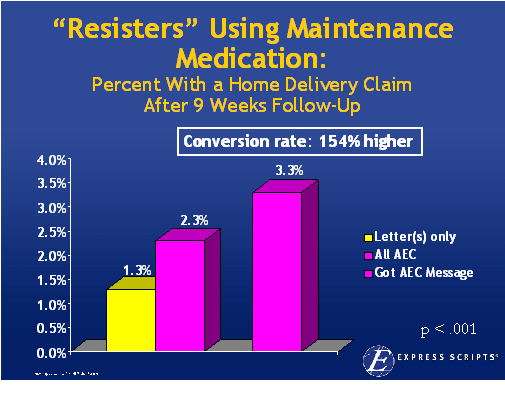
      When we first began using what we called AEC (Automated Educational Calls), we did a couple of quick pilots with control groups to see how they worked and if they increased lift in our existing programs. For one of my programs (retail-to-mail), we saw a boost on top of our direct mail program not only from those people that received a generic message but especially from those people who listened to the call. Here was a quick snapshot since over the course of multiple attempts we had a 5% success rate with direct mail and in certain programs had gotten our success rate as high as 16% in direct mail while still seeing additional “lift” in the success rate by coupling calls and letters together.

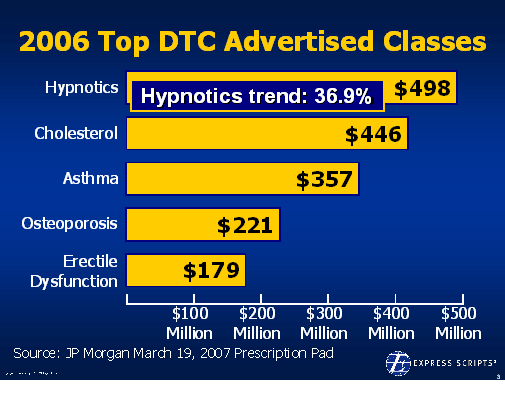
      Another question answered was whether DTC (direct-to-consumer) advertising worked. Here you see that the most heavily advertised space had significant trend. In other studies, we showed that although DTC may not grow the specific drug in a 1:1 correlation it did grow the total pie for that therapy class.

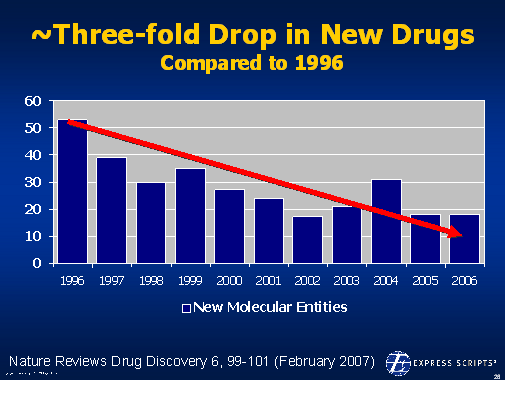
      As I mentioned yesterday in the entry about big pharma, the discovery of new products has dropped dramatically as shown here.

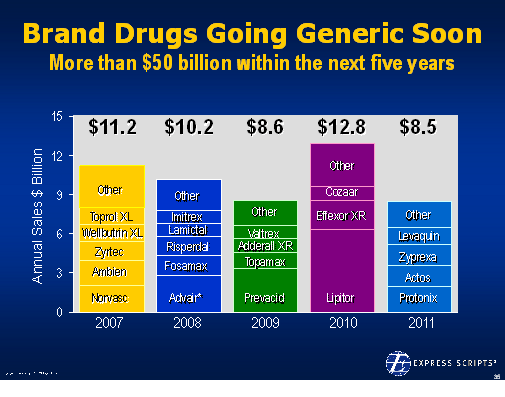
      If you are focused on what’s happening from a generic drug perspective, this chart is a good picture of what’s expected over the next few years.

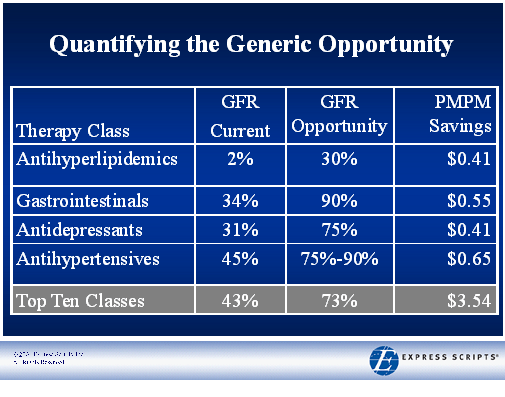
      This is a little old (2004), but based on order of magnitude, it is relevant. The question is what is a theoretical maximum generic fill rate for some of the high cost therapy classes and what is this worth to a plan sponsor in terms of savings.

      Another set of data that I always found interesting was the variation in use of generics by state.

      IBM HC 2015 – Win-Win or Lose-Lose

      I skimmed another IBM publication today which I thought was a great piece – IBM Healthcare 2015: Win-win or lose-lose?. (A little long at ~70 pages, but good with concise charts.) It talks about what healthcare has to do to survive and create a win-win model. It looks at it from multiple perspectives – payor, provider, consumer, and supplier. They also do a good job of describing several unique models around the world and talking about several trends here in the US.

      Here are a few quotes, facts, and charts from the publication which should tempt you to go read it…(note: I am not going to show all their sources, but you can get them from their publication.)

      “The United States spends 22 percent more than second-ranked Luxembourg, 49 percent more than third-ranked Switzerland on healthcare per capita, and 2.4 times the average of the other OECD countries. Yet, the World Health Organization ranks it 37th in overall health system performance.

      In Ontario, Canada’s most populous province, healthcare will account for 50 percent of governmental spending by 2011, two-thirds by 2017, and 100 percent by 2026.

      In China, 39 percent of the rural population and 36 percent of urban population cannot afford professional medical treatment despite the success of the country’s economic and social reforms over the past 25 years.

      Approximately 80 percent of coronary heart disease, up to 90 percent of type 2 diabetes, and more than half of cancers could be prevented through lifestyle changes, such as proper diet and exercise.

      Preventable medical errors kill the equivalent of more than a jumbo jet full of people every day in the US and about 25 people per day in Australia.”

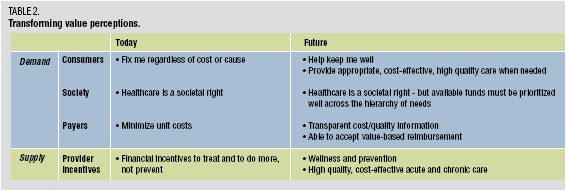
      Table on IBM’s recommendations by stakeholder for what has to happen to transform to a value-based healthcare system (win-win).

      ibm-table-1-on-change.png

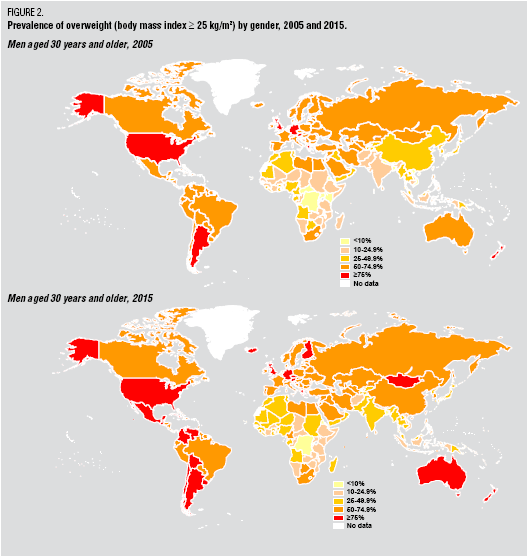
      IBM chart pointing out the obesity issue’s growth

      ibm-on-obesity-trend.png

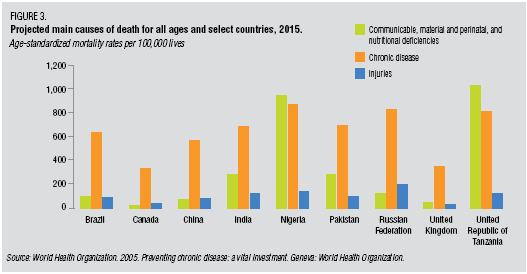
      They talk a lot about the current system’s focus on episodic care while the problem is chronic disease.

      ibm-3-chronic-disease.png

      You will see lots of the buzzwords we hear today (transparency, empowerment, consumerism, infomediary, value-based) throughout the article, but they are delivered with facts and anecdotes to support their perspective.

      ibm-4-transforming-health.png

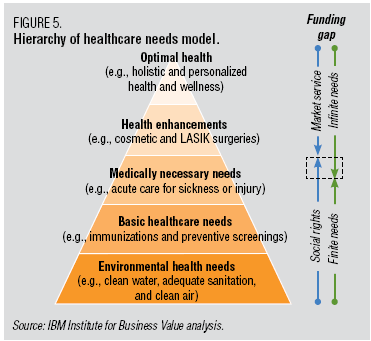
      I could go on, but I will leave it with a nice adaptation of Maslow’s Hierarchy of Needs which they present around healthcare.

      ibm-healthcare-hierarchy-of-needs.png

      You will find information in here around telemedicine, retail medicine, health tourism, and they tee up some of the hard discussions about when is it too much. How much should we spend (individually or as a society)? What expectations should we have? A lot of it requires a different mindset for all the constituents. This would be a good read for the presidential candidates.

      Incentives in Healthcare

      Will incentives be a focus in healthcare? Certainly in lots of other industries, they are a minimum requirement to play at the table – hotels, airlines, banking, consumer products, and casinos. Consumers expect them in many cases. One of the big challenges that any presidential candidate hoping to change healthcare will have to solve is alignment of incentives.

      There is lots of data out there validating this as a focus. In The Road Ahead: Emerging Trends in 2007
      by Hewitt Associates, they say that 48% of employers offer or plan to offer incentives to employees who participate in wellness or health related initiatives. Health plans have started to tier payments based on patient activities around wellness. Companies are paying patients to take HRAs (Health Risk Assessments) and results have shown that the more they pay the better the participation in taking HRAs.

      Wellpoint offers employers credits to offset deductibles when members engage in certain activities. Highmark has an outcomes program where members get points for taking classes and participating in other programs. And, IBM offers employees as much as $300 a year for exercising regularly and logging into the companies preventative-care website.

      On the other hand, companies like Target have used gift cards as an incentive to get patients to fill their prescriptions at the Target pharmacy for several years. Many companies have used copay waivers or $0 copay programs to encourage patients to try generic drugs. Earlier this year, Democrats in MN recommended giving publicly insured patients $20 gift cards for following their physician’s orders.

      Several traditional companies that have worked in other industries are focusing on healthcare. IncentOne is the one that appears to be the market leader with Hallmark Insights and Maritz quickly ramping up.

      So, when could you use an incentive:

      • If you’re an MCO, you could use incentives for:
        • Health Risk Assessments
        • Disease Management Program Engagement
        • Health Education Class Enrollment
        • Brand to Generic Programs
        • HEDIS Reminders
        • Multi-step Milestone-Oriented Wellness Programs (many employer-group driven)
        • Member Portal Registration or Utilization
        • Personal Health Record Registration
        • Product Design Surveys
        • Satisfaction Surveys
        • Refer a Friend Programs
      • And, if you’re a PBM, you could use incentives for:
        • Retail to Mail (or Specialty)
        • Retail to Retail (Limited Retail Network)
        • Brand to Generic
        • Brand to Preferred Brand
        • Rx to OTC
        • Dose Consolidation Programs
        • Pill Splitting
        • Cross Sell opportunities with supplies companies—transportation services, DME, etc
        • Refer a Friend

      Cariten Article on Silverlink

      There was a nice article in today’s Knoxville News Sentinel about a program that one of our clients did. The client is Cariten Healthcare, the insurance arm of Covenant Health. They used Silverlink to get a flu shot reminder out to their patients. The article includes several comments from Linda Lyle, VP of Operations.

      “The words may be recorded, but real thought went into the message.”

      “An effective way to get the message out in a timely manner.”

      She points out that it would have taken their live agents 100 days to get out the message which Silverlink did in six days. (contacting 44,000 people)

      The article also talks about the tweaking that they went through in trying to find the right voice. They are now using automated calls to seniors for other purposes (e.g., reminders for mammograms, cholesterol screenings and colonoscopies; brief information about diabetes and osteoporosis; a customer-satisfaction survey; and reminding patients with dual coverage to let them know).

      “There’s not currently a way to track how many members follow the messages’ advice, but numbers from another national company indicate Cariten is having a 73 percent “reach rate” among seniors, compared to a national average reach rate of around 40 percent.”

      Medicare Pilot Results

      I saw some amazing results the other day for a Medicare pilot program (not a Silverlink or automated call program). The company was showing us their analytical solution and how a health plan had used it to drive enrollment in a disease management program. They were targeting a Medicare population to get them enrolled to see if they could control spend around the disease.

      This vendor broke the population into 7 “clusters” based on similar attributes and then tested different messaging patterns (e.g., disease name then benefits then process versus benefit then process then disease) across 8 different messaging components. They were able to get an 83% enrollment rate within the population. From what I understand separately, several of the companies that signed up for the pilot dropped out since they couldn’t get any meaningful enrollment.

      In this case, they used lifestage, household type (e.g., single), household size, race, and income as the five variables that defined a cluster.

      And, you still wonder about the benefits of data-driven communications that use segmentation? As you append external data to your claims information, you can create a robust data set that allows you to create personalized messaging to a targeted niche of patients that is designed based on a predictive model of getting them to take action. That should be the key for your communications and marketing programs.

      Here is a good blog entry on e-CareManagement on the pilot program. My quick take is that the pilot won’t serve to prove the DM has an ROI, but that doesn’t discount the success that this company had using targeting to drive enrollment.

      Access, Price, Service…The Next Phase for MCOs

      It seems a logical evolution of the marketplace. Have we moved to a point where MCOs can really differentiate themselves based on their service? (The indicator for me on this would be whether consumers are willing to pay more out-of-pocket to have one plan versus another simply because of service.) It will certainly happen. Web tools. Pro-active communications. Personalized messaging. Educational programs. Friendly call center reps. Consumers care about these things.

      Coverage, the AHIP magazine, had a recent article called “Creating a Culture of Service” which is about this topic. It talks about a health plan where the average call is picked up in 12 seconds, the call abandonment rate is 2%, and 88% of questions are resolved on the first call. I am not sure this is a sustainable model of differentiation since there is a floor to improvement. It is similar to the Kano Model which is used in Six Sigma. This model points out that there are different curves of expectations. Initially, you can delight a customer with something new, but it quickly becomes a standard expectation in the marketplace.

      The article does point out a key point which is that patients expectations of service are not based on healthcare companies. They look at Starbucks, Nordstrom’s, Amazon, Dell, Disney, and other companies for what they expect in terms of online presence, response time, and service culture. In many companies, the call center agent is the first (and potentially only) point of contact for a patient (or member). They are not highly paid and often take the brunt of complaints all day long. Finding a way to make them happy and patient centric is essential.

      Another challenge which exists in any human centric function like customer service is consistency. As benefits get more complex and companies have huge turnover issues at their call center, getting the same answer every time is difficult. Which is massively frustrating as a consumer. We used to have to do “secret shopper” calls constantly to determine what parts needed more training. This is of course one area where automated voice solutions are being used both inbound (reactively) and outbound (proactively) to address consistency and timeliness. In many cases, you can predict events that will drive a call and see a patient’s history to understand their probability of calling (versus using the web). Why not launch a call to them before the call which is less expensive?

      One hiring model we saw work very well in specialty pharmacy was hiring people who had a family member with a chronic condition. They were empathetic. They understood the patient’s frustrations. And, they could project their family member’s experience. They were great.

      BTW – The article has a great sub-story about what Connecticare has done in their call center to address recruiting and turnover.

      Other things I have seen work are empowering the end agent to resolve an issue up to a certain level. If a person is complaining about a $5 copay change, it may be worth waiving it one time and sending them some information rather than taking 3 calls from them at $5 per call. Or, it may be worth providing a one-time override rather than spending 8 hours trying to resolve it.

      Incentives along with metrics are also another obvious tactic. Definitely don’t incent them to get off the phone quickly. That always creates issues. Look at ways of turning them into “sales agents” for the company and reward them for getting patients to change behavior or based on satisfaction scores.

      And, one thing to avoid that drives patients crazy is having different information on the web than at the call center. And, even worse is not letting the call center agents have Internet access so they can’t see what the patient sees.

      There are a few words on technology such as CRM (customer relationship management) and voice recognition software (e.g., routing to a different agent based on an angry voice). This surprises me a little since I think using data to segment and address different patients differently. Are they a frequent caller that we should route to a live agent without IVR (interactive voice response)? Do we know why they might be calling and have an answer?

      As I have talked about before, I believe MCOs and other healthcare companies will be differentiated based on communications. How do they use their data and a permission based marketing approach to understand the patient, push information to them at the right time using the right medium, and support their needs? That is what I am focused on building with clients.

      IBM on HC 2015 – Part II

      I think the entry got too long.  I got a system error that made me think I should split this up.  So, continuing on my review of the IBM publication on the future of healthcare, here are some additional notes I took:

      • They envision the growth of a “health infomediary” that helps people navigate their benefits and options within the healthcare marketplace:
        • A “health coach” – expert in lifestyle and behavioral change
        • A “value coach” – expert in benefits, pricing options, and cost-quality tradeoffs
        • A “wealth coach” – expert in financial planning for health related needs
      • They say that health plans as well as physicians could step into this role (along with new players).
        • 80% say hospitals are “doing a good job”
        • 60% say health plans are “doing a bad job” [which may challenge them in some of these future roles]

      “Today, healthcare delivery is overly focused on the episodic treatment of acute care.  However, the emphasis of the healthcare system will contine to expand from episodic acute care services to include prevention, chronic condition management and better care coordination.”

      value-based-ibm.png

      • There is good discussion about the needed change in the healthcare system to be more focused on wellness and greater alignment of incentives.  They say “today, there is more variability at the point of contact with the consumer (that is, the point of care) than in virtually any other industry.”
      • If you read the report, figure 8 summaries the current state versus future state that they envision along numerous dimensions – sponsorship, competition, innovation, revenues, networks, etc.  The things that captured my eye were:
        • Competition being based on information access [and in my opinion…easy of use of these tools across multiple channels]
        • Competition being drives by targeted products and services [one of my favorite topics…microsegmentation]
        • A wellness ROI
        • Value-based reimbursement [which I am sure is much more than P4P]
      • They talk about the blending of product and service (i.e., the offering as I would call it).  This has been a topic in other industries for years.  [Look at the book Blur from 1999.]
      • They layout four different roles for health plans:
        1. Health / Wealth Service Advisors – personal health concierges
        2. Health Services Optimizers – guide individuals to wellness and through healthcare maze
        3. Applied Research Advisors – aggregate knowledge to help patients
        4. Transaction Processors – clearinghouse
      • I didn’t know that the top 6 healthplans cover 60% of all insured Americans while their are another 500 plans.
      • They go on to propose some questions and sample indicators of readiness for the new healthcare environment.  Here are a few indicators:
        • single view of the member across products and business partners
        • proactive contact center
        • real-time analytics regarding wellness calls
        • member loyalty
        • value-based arrangement with providers
        • consistent answers across multiple channels

      Hopefully, this is a helpful summary and enough for you to read the document.  Is a quick 18 pages with good facts and realistic proposals for the future.

      IBM on HC 2015 – Part I

      I had a chance to catch up on a bunch of reading on the plane including an IBM brochure I picked up the other day on “Healthcare 2015 and US Health Plans“. I found it to be a good piece with several good frameworks although it doesn’t take any radical views on the future (which I would have liked to see).

      Here were a few of the facts / takeaways from the brochure:

      • US healthcare expenditures per capita are 2.3 times higher than other developed countries and projected to increase 83% over the next 10 years
      • Medical errors cause between 48,000 and 98,000 patient deaths per year
      • Medication errors cost the US over $3.5B per year
      • On top of the 47M uninsured, there are 15.6M underinsured
      • There are five issues that will make change difficult for healthcare:
        • Funding constraints
        • Societal expectations and norms
        • Lack of aligned incentives
        • Inability to balance ST and LT perspectives
        • Inability to access and share information

        “We believe that the U.S. healthcare system will not achieve a comprehensive “win-win” transformation by 2015 because of political gridlock and inability of key stakeholders to work collaboratively to reach solutions for the ‘greater good’.”

      • They do predict that some form of universal coverage will be enacted by 2015 and will be focused on the individual not the employer to address the “job lock” challenge.
      • They see a key role for health plans and call upon them to lead the transformation to a “more patient-centric, value-based, accountable, affordable and sustainable U.S. healthcare system”.
      • They predict that employer-sponsored health benefits for family coverage will increase from $8,167 in 2005 to $17,362 in 2015.
      • In 2006, PPOs (preferred provider organizations) accounted for 60% of private insurance enrollees (up from 41% in 2000).
      • Employers offering coverage has dropped from 69% in 2000 to 61% in 2006 and is predicted to go below 50% by 2015.
      • They talked about employers putting a lifetime cap on retiree benefits which was a new concept to me, but they said that 49% of employers polled in 2005 had a cap (of which 59% of those on the plan had already hit the cap).
      • They talk about lifestyle choices impacting premiums which would lead to increased wellness and preventative programs.
      • There is some scary data about money needed post retirement. They say that half of all bankruptcies are in part due to medical expense. They also say that “a couple retiring in 2016 at 65 years of age would need US$560,000 if they lived an average lifespan. They would need US$1.05 million if they lived to 95 years.” This is specific savings for healthcare costs in addition to Medicare. WOW!! And, they say that 40% of people over 55 have $50,000 or less saved.

      ibm-retirement-health-savings.png


      “The health–wealth intersection is already taking shape. Players from each sector are experimenting with offerings that cross the boundary between the two, such as reverse mortgages to finance nursing-home costs and arrangements that let individuals tap into their life insurance policies to cover medical costs. But the new health–wealth business will evolve and change shape for at least the next couple of decades, as the retail health-care market coalesces and consumers take on more responsibility for their medical needs.”

      HBR Health Consumer Segmentation

      Harvard Business Review has an article “What Health Consumers Want” by Caroline Calkins and John Sviokla (both from Diamond Consultants) in the December 2007 issue.  I think they sum up one of the problems that I talk about with a couple of quick comments in the beginning:

      “Yet the idea that companies might profit by segmenting customers to address their varied needs seems almost foreign to the health industry.”

      “Companies can uncover areas of untapped value by analyzing patterns in demand for health products and services.”

      They point out that looking at people from a health and wealth perspective at the same time is very revealing.  Which certainly makes sense as many people are predicting that these two markets will come together at some future stage.  Their research pulled out four consumer groups [with my summary of their text]:

      1. Healthy Worriers – receptive to new things, willing to change, look at dynamic between wage inflation and healthcare costs, look to employers for information, overwhelmed by choices
      2. Healthy, Wealthy, and Wise – fit, health conscious, financially confident, want choices, not scared of complexity, self-service tools important, service focused
      3. Unfit and Happy – manage own money but overconfident on health issues, don’t trust MDs, need tools and incentives to drive action
      4. Hapless Heavyweights – not particularly health or financially oriented, typically overweight, need support groups and penalties

      Personally, I find it nice that they point out the fact that some groups want incentives and some need penalties.  I have blogged about this a couple times as one of the simplest examples of why segmentation and message flexibility is so key.  I think the first two have a nice opposite with simplicity versus choice.

      More Clinic Information

      checkup.jpgThe AHIP magazine Coverage (Sep + Oct 2007) also has an article about retail clinics. There were a few takeaways here:

      • Someone is finally going to try and offer an airport based clinic (AeroClinic). This seems to make sense as some airports are basically shopping malls in disguise.
      • 5% of consumers know about retail clinics and have used them. Maybe I am too close to the space, but it seems like this is all I hear about.
      • 90% of consumers say they are satisfied with the quality of care…85% with the quality of staff…83% with the convenience. [Harris Interactive survey of 2,441 adults in March 2007 for the WSJ]
      • 42% of those that visited clinics were covered by insurance for some or all of the services provided.
      • Co-pays ranged from $15-$35.
      • 22% of those that visited clinics were uninsured. (which is a little more than the % of the general population that is uninsured – if my back of the envelope math is right)
      • The forecasted growth of clinics – 700 (2007); 1,500 (2008); 4,000 (2010). I am a little skeptical here, but I wouldn’t think you could have 3 Starbucks at one intersection or 6 pharmacies within a 3 mile stretch of one street. (both real examples)
      • There are some challenges around the model including from the AMA (American Medical Association) around conflicts of interest (i.e., clinics being owned by pharmacy chains) or the erosion of the “medical home” for the patient. Ultimately, there should be some health outcomes metric which is used – better compliance, more prevention, lower cost per disease state, etc.
      • BCBSMN found that members who were part of a consumer directed healthplan were twice as likely to use a retail clinic. They have been very closely involved with MinuteClinic from the beginning.
      • An individual from HealthPartners raises an interesting risk around provider capacity pointing out that if use of retail clinics increases provider capacity then it might actually increase total healthcare costs for the system. I guess this implies that the physician or hospital could charge more if they weren’t as busy. Not sure I buy the logic, but my micro-economics could be off.

      Several groups have come out with standards or guidelines including:

      PHR – Key for Improving Senior Care???

      In the AHIP (America’s Health Insurance Plans) magazine Coverage (Sept+Oct 2007), there is an article on using Personal Health Records to improve healthcare for seniors. I am reading it as I type my commentary here, but I start with some skepticism.

      • Apparently CMS (Centers for Medicare & Medicaid Services) commissioned a 18-month pilot to help design a user-friendly PHR for Medicare beneficiaries.
      • The article gives a good, simple definition of PHR as being “designed for use by individual consumers and contain a core set of medical information that includes physician office visits, medications, lab results, and general health information.”
      • It talks about advance PHRs having a care alert which is a signal to consumers that they are due for a treatment of test. [I have talked with a few PHR vendors about this. I can’t agree more. It is great to have the data, but the systems need a proactive communication mechanism to push timely content to consumers so that they take action. (shameless plug…what a great opportunity for someone like Silverlink to offer an automated call program that takes automated triggers from the PHR and launches a pre-defined, personalized call to the consumer)]
      • It offers an interesting statistic that I haven’t seen before – 100M people (of the 249M insured) have at least one chronic disease.
      • CMS previously rolled out a bare-bones PHR at www.MyMedicare.gov which had 2M of the 42M Medicare beneficiaries register. [Of course, registration means nothing. How many actively log-in, update information, and use the information?]
      • Plans participating in the pilot include HIP of NY, Arkansas BCBS, BCBSLA, Humana, Kaiser Permanente, UPMC Health Plan, Aetna, and Medcore Health Plan.

      “Health information technology will improve health outcomes and contain costs and help provide meaningful dialogue between members and providers so tests are not conducted unnecessarily.” (Laura Landry, Director of IT, BCBS Louisiana)

      • It talks about AHIP and the BCBSA (Blue Cross Blue Shield Association) collaborating to make PHRs transferable across plans which is vital for success.
      • Apparently, the groups have also collaborated to define a model PHR which would include physician encounters, names of clinicians and facilities, medications, lab results, family history, immunizations, health risk factors, advance directives, allergies, alerts, and physician directed plans of care.
      • The article also highlights another issue which is true for many solutions which is density of utilization by provider. For example, if the physician is expected to use a tool but only 5% of their patient base uses it, it will be hard to get them to change their workflow. If 90% of their patients use the same tool or a tool that provides a common interface to the physician, then they will be more likely to interact using the technology.
      • A representative from Humana says that seniors are using the data to enhance their dialogue with physicians. [I think this is a key point. I spearheaded the rollout of a “physician kit” at Express Scripts which was a set of forms that the patient could download to take to the physician’s office to discuss generics, mail order, and their condition. The key was that us communicating with either party was only so effective. We had to drive the two parties most involved in care to talk together with the facts in front of them.]
        • The article later talks about several of the demonstration projects that offer printouts for discussion or putting in the patient’s chart.
      • Humana members can also give access to family members and providers through their user names and eventually direct access.
      • Kaiser’s PHR allows the member to see when a lab was done, the results, and send questions to the physician directly through the tool.
      • It talks about one of the PHRs which automatically hides certain information from the provider but can be unhidden by the patient.
      • I thought the article was going to skip the subject of whether this population would adopt this technology, but towards the end it points out that according the US Census Bureau only 35% of people over age 65 have computers and only 29% have access to the Internet. [Of course, this will change as the Baby Boomers move into this phase of their life.]

      senior-w-computer.jpgThe other critical component in my mind is that these things have to be automatically populated. The patient can contribute family history, allergies, and OTC utilization, but why should I have to type in my physician visits or prescriptions. That should all come directly into a system. There is a lot to prove here. The concepts are sound and rationale, but it’s a complex system with limited historical adoption of consistent technologies. People won’t stand for having to rebuild a new PHR every year as vendors and companies cycle through trying to settle on a few core products.

      Patient (Customer) Value – Social Dimension?

      I was reading an interesting entry on Forrester’s Marketing Blog about redefining the value of your customer away from ROI to something that reflects their social value.  The author defines social value as:

      1) A customer’s knowledge and involvement – in short, his level of expertise and interest in the category and brand. 

      2)  How he participates, and the value of his connections – what social activities is he involved with (both on and offline) and where (on what networks is he active).  The value refers to the value of the connections themselves:  are the communities more tightly-knit or diffused, are they public or more intimite.

      3) The number of contacts the customer has in each network. 

      It made me think about two things: (1) how would we value a patient in healthcare and (2) how do we drive and evaluate social value.

      Different constituents would value patients differently [these represent logical hypotheses but not fact]:

      • To a pharmacy, it is the high utilizer that they want.  And, they make the most money off a cash paying customer who buys generic drugs at something close to their AWP (Average Wholesale Price) which is about 70-90% too high.
      • To a PBM, it is the chronically sick patient who fills lots of drugs but is very active in their healthcare so they use the website, use mail, use generics, and don’t call customer service very often.
      • To a managed care company, their highest value customer (or patient) is the healthy individual who is insured so that they collect the premium but don’t actually pay anything out.
      • To the physician, their highest value patient is the sick consumer who needs specialized care which they have to provide (e.g., injections done by the physician).  In a capitated model, this is different because they want to create healthy patients and are incented to promote wellness.
      • To the hospital, their highest value patient is the insured patient who has a complex illness that requires lots of tests or who has an elongated hospital stay.

      Driving and evaluating social value is a different animal.  I do believe that providers and insurers should be promoting communities of care where people with diseases can share experiences and information.  That will be a powerful tool in promoting consumerism.  A managed care company (e.g., United, Humana, Wellpoint, BCBS) has enough scale that they could create an anonymous discussion area for their covered lives which was moderated by an expert.  (Not too dissimilar to the disease specific pharmacies that Medco is creating with their Therapeutic Resource Centers.)

      Assigning value is more difficult, but it could be a composite score of activity on the web, registration in certain groups, etc. It won’t be perfect, but it is clear that some people are outspoken advocates which can promote or hurt your brand.

      It Seems So Simple…

      In the CVS/Caremark 2007 TrendsRx report, they present a compelling yet simple story about people with chronic diseases.

      “Increasing the effectiveness of adherence interventions may have a far greater impact on the health of the population than any improvement in specific medical treatments.” World Health Organization 2003 Special Report “Adherence to Long-Term Therapies: Evidence for Action

      If every four people at risk for a chronic condition such as diabetes, hypertension or stroke:

      • One is unaware that he/she is sick
      • Of those who are diagnosed, one in three doesn’t get the prescription filled
      • Of the two who begin therapy, one stops taking medications within six months.
      • One is compliant with prescribed treatment

      This clearly points to issues – the need for wellness programs and preventative medicine, the need to link compliance across MDs/Pharmacies/Patients, the need to drive adherence, and finally helping consumers understand why this important. It seems like simple problems to address, but if you’ve tried, you will realize it is a challenge and would be even if incentives were aligned.

      [Sources: Caremark data combined with third-party references including the US Census, Centers for Medicare and Medicaid Services (CMS), the World Health Organization (WHO) among others.  Compiled by Jan Berger, MD, Chief Clinical Officer at Caremark.]

      HC Stocks Over Time

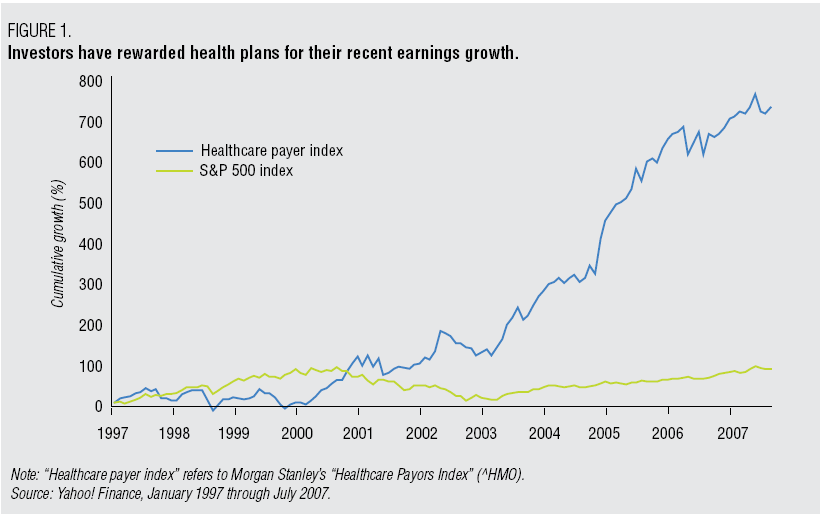
      When you are in healthcare, all you ever hear about is how tight the margins are and how important it is to manage costs.  Obviously, healthcare has produced a lot of wealth over the years for a lot of people.  In my time at Express Scripts, the stock when from $37 in 2001 to (split adjusted) about $180 when I left in 2006.  (Not bad)

      I thought this chart which I found in an IBM publication did a good job of portraying how the investment market has viewed and rewarded healthcare.  This is based on a payor (HMO) index.  The PBM index would probably be even higher over that same time period as Medco, Express Scripts, and Caremark have grown immensely over the past decade.

      hc-stock-market-growth.png

      Empty Every Chair

      It takes a lot for an advertisement to catch my eye, but “empty every chair” made me think.  Especially, when I see the word health in the text.  The text goes on…

      “Whose idea was it to build a room to house inefficiency?  The less time patients spend in the waiting room, the happier everyone will be.”

      It’s an interesting view.  I couldn’t agree more.  The advertisement ends up being for PWC (PriceWaterhouseCoopers) and their healthcare consulting practice.  A link takes you to their site with publications on P4P, presidential plans for healthcare, wellness, and lots of other topics.

      Insider’s View is Too Close

      As I think it can be in any industry, a big challenge is immersing yourself in your field while at the same time maintaining and outside-in perspective.  The challenge of losing that perspective is (A) using language that people don’t understand or (B) creating elequoent solutions that aren’t practical.

      (A) From a communication perspective, the issue of language is one where I am sure most of you could come up with examples.  There are numerous times when I have gotten something and had to read it a few times to understand whether it was an EOB (explanation of benefits) or a bill.  I remember trying to write letters to patients and having to re-write them numerous times to get them ready to be sent out.

      For example, in the PBM world, we would talk about refills versus renewals.  (e.g. glossary) I don’t think many consumers know what a “renewal script” is…but that wasn’t intuitive to us.  [BTW – It means your prescription has no more refills left.]  We would talk about DAW prescriptions [aka Dispense As Written].  Even worlds like formulary caused people problems when we used it on the website or in a letter [preferred drug list sometimes worked better].  Another one that threw everyone off was saying “this drug is not covered”.  Did that mean the patient couldn’t get the drug?  Did that mean the patient had to pay cash for the drug, and if they did, did they receive the client’s negotiated discount at the pharmacy?  Did that mean it required a Prior Authorization? 

      I think the point where this really threw people off was when we communicated to physicians.  In my job driving generics, I remember reviewing the physician letters and seeing that we always called the drugs by their generic name – omeprazole (Prilosec), fluoxetine (Prozac).  When I pointed out that physicians don’t always know the drug by its chemical name, people were shocked.  Sending a letter to a physician saying you should switch from Nexium to omeprazole was pretty ineffective if they didn’t know what drug we were recommending.  I always tried to get us to say “the generic version of Prilosec (omeprazole)”.

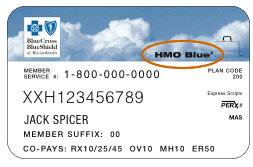
      hmo_blue_card.gif

      (B) On the side of an overly eloquent solution, I have been stymied by my insurance card.  It is a national coverage card from BCBSMA.  It may work great in Massachusetts, but in Missouri, the providers can’t find the group ID on the card.  This has happened everytime we use it.  If they hadn’t been a client at Express Scripts and I knew their group IDs by heart, then each provider would have to call them. 

      The other challenge with the card is that they give you one for each person in the family.  So, if you have 5 kids, you would have 7 cards (which you are expected to carry).  At the doctor for our kids the day, we simply tried to give them the patient IDs for the kids.  They were upset since apparently they have a swipe card system for the BCBS cards and don’t know how to manually enter the patient ID. 

      To me, this is a great example of something that has been totally reengineered and become less effective.  I am sure they were putting more information on the card and pushing the group number to a corner wasn’t a big deal.  I am sure individual cards is great for older kids that carry their own.  I am sure smart cards is a great thing.  Unfortunately, all it has done is make it harder not easier. 

      On the positive, I like BCBSMA’s general approach, service model, and many other things so the card is a hassle but not likely to impact my overall satisfaction.

      Literacy Adds Additional Challenges

      I have some other seniors statistics that I will add later, but this morning I was researching seniors and healthcare communications.  I was surprised to see some of the data around how literacy presents a big challenge for them.  Here are a few facts and some links for more information:

      • “People aged 70 years and older with limited literacy skills are one and one half [1.5x] to two [2x] times as likely to have poor health and poor health care access as people with adequate or higher reading ability, according to a study led by researchers at the San Francisco VA Medical Center and the University of California, San Francisco.” (source)
      • “One in four [seniors] had limited literacy. In practical terms, these elders ‘may have trouble reading basic health information or pill bottle instructions'” (source)
      • “Although only 12 percent of the U.S. population was age 65 and older in 2003, they accounted for one-third of all patients admitted to the nation’s community hospitals in that year – over 13 million hospital stays, according to the Agency for Healthcare Research…The elderly also accounted for 44 percent of all hospital charges  nearly $329 billion.” (source)

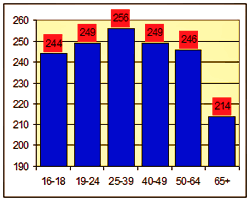
      • “Senior citizens (65+) scored far lower than younger people in a 2003 literacy test. The test had a maximum score of 500.” (source)

      literacyhlth-6-09-12.gif

      • “Less than one out of six U.S. adults have “proficient” health literacy, according to the report released this week, but for seniors it is only about three out of a hundred.  A staggering 29% of senior citizens do not even have “basic” health literacy.” (source)

      I think this is an interesting angle that you don’t hear much about.  We spend all this time trying to think about what to say and other creative aspects, but sometimes we have to simplify the story to get to the point of being usable.  Here are a few other links if interested in the topic: