Archive | Managed Care RSS feed for this section

Zyrtec to Go OTC

By now, everyone should be familiar with Claritin (loratadine) and Prilosec going OTC.  They were really the first two blockbuster drugs to go OTC (over-the-counter).  Motrin / Advil is available both as a prescription strength and OTC.  Zantac (ranitidine) is also available OTC.

From a personal perspective, I am happy.  I have two kids with allergies that are on Zyrtec (which is off formulary) and where I pay $50 / month per kid.  I also find this an interesting DTC (direct-to-consumer) challenge for managed care plans and PBMs.  I had the opportunity to run both of our programs (Claritin and Prilosec OTC) at Express Scripts for this which included coordinating with modeling and clinical teams, designing the communication strategy, talking with clients, and helping drive OTC utilization where clinically appropriate.

From some initial research, I found the following:

  • Zyrtec (5 and 10mg tablets and 5 and 10mg chewables) and Zyrtec-D (1mg syrup and extended release) were approved by the FDA to go OTC. (article)
  • McNeil Consumer Healthcare (subsidiary of J&J) will be responsible for the OTC products.
  • McNeil has said the products will be available in late January 2008 and will be less than 1/3 the price of the prescription.
  • Non-Sedating Antihistamines (NSAs) represent 7.8% of the commercial Rx market and Zyrtec had about 37% marketshare in 2006 (generics had greater than 50%) with a typical member using 3.65 Rxs per year (or 0.29 Rxs PMPY).  (per Express Scripts Drug Trend Report)

Taking common Rxs to OTC status makes a lot of sense, but also creates a lot of questions:

  • If there are interactions with the drug but it no longer shows up as a claim, does this create a DUR (drug utilization review) problem?
  • Do pharmacies make more money on the generic Allegra or on the OTC?
  • For PBMs that make spread on claims and/or get a claims administration fee, how do they align their incentives with their clients (employers, managed care) that would prefer to see the patient use the OTC?
  • Which costs less out-of-pocket…the generic Rx or the OTC?

So, what should you do?   If you’re a consumer, you will likely hear something from your employer, managed care company, PBM, or pharmacy.  If your a company, you need a creative plan to execute against.  Contact me to learn more about how we (Silverlink) are going to help our clients.  [I can’t give away all the secret sauce here.]

But, if you are generally interested in this topic, here are a few links for you:
WSJ on Texting in Healthcare

Obviously my entries about texting in healthcare are timely. Today’s WSJ includes an article (pg D1) by Rachel Zimmerman called “don’t 4get ur pills: Text messaging for Health”.

She points out several compliance type programs where this is being used (outside the US)…birth control pills (England), AIDS (Australia), psychological support for bulimics (Germany), and smoking cessation (New Zealand).

Apparently, the American Telemedicine Association is developing guidelines for the appropriate use of text messaging in healthcare (along with other new media). The executive director, Jonathan Linkous, was quoted as saying “There are obviously times when telemedicine is inappropriate. Texting someone to tell them they have cancer is one of them.” [I think we can all agree.]

Of course, with health costs being concentrated in a small percentage of the population which is typically older, can texting make a difference? It isn’t easy to type on those small mobile phones with arthritis. Lots of seniors don’t even carry mobile phones. Plus texting is a whole different message as the article points out. My kids will probably get it much better than me.

Plus, using condense information can be risky. We had this problem in sending messages to pharmacies where we had a finite amount of characters to say “Drug A is not covered but the following drugs are covered but if medically required then the physician has to call 800-xxx-xxxx to request a prior authorization”. Other than reminders or pushing them to a very specific action it may be a challenge.

I think sending links or phone numbers via text message could be helpful. For example, using co-browsing, a company could trigger a message a message suggesting the patient call-in for more information or also go to another site. [What is co-browsing…this is when a company (typically a call center agent) can see where an individual is on the web and what they are looking at to help them.]

She mentions a few companies:

There certainly is a need for something that is quick and ubiquitous around healthcare. For someone under 40, I think texting could work great. For people over 40 (an arbitrary line), I think automated voice is better. It is just as quick. It is ubiquitous. And, it can be personalized and change during the call versus going back and forth via text messages.

Reverse Auction for MDs / Hospitals

auction.jpgIn healthcare, you sometimes hear people talk about waiting (at the pharmacy, for an appointment) while other people seem to get right in.  A lot of this has to do with geography (remember ‘healthcare is local’) but it also has to do with cycles.  For example, Mondays are always busier after the weekends.  [I have heard ERs are often busier during a full moon, but I don’t have research on that (and didn’t look).]

Certainly, another driver of healthcare costs are some of the large capital purchases at hospitals for imaging or other diagnostics.  If every hospital has to have the latest and greatest but they are only use 20% of the time, that isn’t an efficient use of capital across the healthcare system.  If you have to spread that cost for the equipment across 1/5th of the potential patients, it means you are overcharging by 5x.

Reverse auctions wouldn’t be easy, but BidRx pulled it off in pharmacy.  [I am not sure how successfully.]  The reverse auction model would be consumerism at its best.  The consumer would post their needs – a CAT scan, a PCP, a neurosurgeon, open heart surgery.  Physicians or hospitals would bid on their business based on the parameters – timing, price, etc.

In a theoretical sense, it would be interesting to test and see if it would work.  But, my objective was not to sit in the ivory tower, but to look at a model that would improve healthcare capital efficiency by better utilizing fixed costs.  If hospitals and MDs could bid for patients to fill their slow times, wouldn’t the following be possible:

  • Less need for capital redundancy (i.e., every hospital would not need to have the same equipment)
  • Less wait times for patients since they would be slotted in to open times
  • Less peaks and valleys at doctor’s office and hospitals since they would be offering a “discount” for you to come on Wednesday versus everyone wanting to come on Monday

Participation wouldn’t be easy, but ultimately, changing our healthcare model won’t be easy.  Just an idea.  There is something here to make the system more efficient.

Mashing Two of My Posts

I was thinking about Google’s SMS service earlier today (see post on this).  Separately, I was thinking about my post on remembering health information (e.g., drugs, strength, previous lab values).

So I went to one of the Google Health Blogs to suggest the idea.  Unfortunately, the e-mail they list bounces back and you can’t leave comments…strange.  Why not combine the two comments from my earlier blogs was my suggestion?  Obviously, it only appeals to a piece of the population, but I would love to be able to text message my PHR (Personal Health Record) with “Rx name, strength” or “PCP name, phone” or “HCL scores and dates”.  [Look at myPHR, iHealthRecord, ActiveHealth, Microsoft, or Google for PHR solutions.]

It is always so difficult to remember that information, but if I could get it texted to me in a few seconds, it would be great.  I have to believe there is some unique code in my Blackberry that could serve as a unique identifier for security purposes.  Just a thought…

BTW – If you try to find Google blogs on health, you find out there are dozens of Google blogs:

“There’s all this hubub about what Google and Microsoft are doing,” Aetna CEO Ron Williams (pictured) said this afternoon on a visit to Health Blog HQ. “We’re perplexed by the fact that their vaporware gets all this attention and we get very little.” (comment on the WSJ Health Blog)

Don’t forget to add this blog to your reader or sign up for e-mail updates whenever a new entry is posted. 

New (to me) Blog – Consumer Focused Care

I found a new blog this morning called Consumer-Focused Healthcare written by an ex-McKinsey consultant which seems to have a very similar focus to my blog – “refocusing healthcare on serving consumer needs“.  [As a sidenote, the benefit here of LinkedIn was that I could quickly look him up and see that we have a mutual friend which instantly gives him some validation.]

Vijay has a lot of posts that I liked.  Here are a few exerpts:

  1. “the consumer often pays MORE for a visit to a retail clinic than a physician’s office. The implications are that they really prize the convenience and time taken far over the extra training provided by the physicians.”  In this blog entry, he shared some data about out-of-pocket expenses for clinic visits.
  2. “It is pretty clear that many doctors don’t know how to tell their patients that they have no idea”  In this blog entry, he talks about the inexact aspects of patient advice.  Determining a diagnosis or the right advice is very situational.
  3. “why are people willing to spend $3.50/ pill on sleep meds when they’re discouraged by $10 co-pays to take other, potentially life-saving medication?”  In this entry, he talks about consumerism.
  4. He also points out an assumption from Google that technology will push physicians to spend less time with patients which I think isn’t logical based on the work I did around e-prescribing.  I already put a comment in this blog entry this morning.

And, these are just his most recent entries.  I am interested to flow his blog more.

Tonik Health Insurance

I always smile when people ask about using SMS (or text) messaging to communicate with patients. Interesting. Perhaps even “cool”, but not real practical. You have limited message length. You have to have cell phones for people, and with all the privacy issues, can you control it.  There are a lot more opportunities to communicate better with patients than use SMS.

So, I was intrigued to find out about Tonik Health Insurance which is an offering by Wellpoint for the Generation X or Generation Y population. If you go to the site, you will see things like:

  • Edgy graphics
  • Slang / informal language (e.g., “Tonik offers three straight-up affordable health insurance plans to cover your A-Z
  • At one point, the site mentions Borat (not typical in a healthcare website)

I don’t know much about it, but it seems very interesting.  I am a little surprised to see it offered by such a mainstream company.
I even came across a publication called “NOT ur parents’ healthcare anymore: The 411 on selling health via new media” which is a 35-story report on targeting this young population. I have not read the report, but it sounds interesting. (Order Here)

Bing Blog – A Little Harse?

Stanley Bing has written for Fortune for a while and now has a blog.  One of his latest entries is about healthcare and insurance.  Obviously, we have problems with the system (as pointed out in Sicko), but I found some of the comments a little harse.

We can get better, but we should all be thankful for what we do have which allows us access to experts 24×7 using good technology.  We pay a lot per measure of clinical outcome but we have lots of options for how to get treated.  The system isn’t seamless, but it generally works.

I guess for all the criticism which is easy to lob sometimes it seems too harse when people focus only on the negative.  The more you work in healthcare the more you realize how difficult it is to find the right solution.  I don’t envy the politicians.

What Have You Failed At Today?

I caught this story on ABC last night about entrepreuners.  It made an interesting point about the need to fail and learn from your failure.  In summary, it was basically saying that people who took risks, failed, and spent the time to learn from their failures ended up more successful.

I think that is very relevant to the world of healthcare communications.  Any program should have a test plan of ideas that are constantly being varied to see what works best.  Each micro-niche of the population is going to respond differently.  If you aren’t out there trying different things, you won’t optimize the success of your programs.

Of course, this is easier said than done. You need a culture that believes in failure.  You need a way to learn from your mistakes.  You need people that are willing to admit they were wrong.  You need a measurement tool to document the success of one attempt versus the other.  And, you need to understand what can be varied to drive change.

Let’s take a simple example here.  In the world of automated voice communications, you can vary dozens of things:

  • Which voice should you use – gender, age, accent?
  • How should the voice speak – casually, formally, authoritarian, consultative?
  • What speed should the voice be at – normal pace, fast, slow?
  • What time of day should you call?
  • What day of the week should you call?
  • Should you leave a message or call back?
  • How many times should you attempt to reach the patient?  Within what window?
  • How long should the call be?
  • Should the call be complemented by letters or other outreach?
  • Should the call offer to connect them to a live agent?

I could go on, but I think you see the point.  Experimentation is key and makes a difference.  I am not even getting into the thousands of variables in the messages. 

So, go out and fail at some new program to communicate and engage with your patients.  Learning faster is your best way to succeed. 

P4P – Pharmacists vs. MDs

p4p.jpgI only heard a piece of the presentation yesterday at AHIP (America’s Health Insurance Plans), but I was a little surprised. They were talking about the topic of P4P (pay for performance). The survey population clearly supported P4P for MDs with the primary objective being preventative care and compliance. This focus did surprise me since I imagined it would have been more focused on cost management.

The survey population wasn’t interested in all at P4P for pharmacists. This surprised me a little bit especially given the access differences. Certainly, physicians can impact bigger dollar decisions (e.g., drugs vs wellness or surgery vs other options), but if the focus is on preventative care and compliance, they pharmacists have easy access to the patients.

Pharmacists are a walk-up option. No appointment is needed. Some pharmacists really know their patients. Both parties are really busy so rewarding them for the additional responsibility is appropriate.

I think it was about 20% that thought about rewarding pharmacists and clearly the focus (not surprisingly) was on driving formulary compliance and generics. In many cases, they have rewards to do this today.

If you’re interested in seeing one of the studies out there, here is one on Medicaid. The conclusion was:

“Medicaid directors and their staffs generally report positive feedback on their pay-for-performance programs and believe that the overall quality of care being provided is improving, although they have mixed opinions about cost savings resulting from the programs. Directors are considering changing some of the measures, incentives, and even the data collection strategies to improve their existing programs and to shape planned programs. Overall, they believe that pay-for-performance is adding to their repertoire of tools to improve the care provided to their Medicaid populations.” [K. Kuhmerker and T. Hartman, Pay-for-Performance in State Medicaid Programs: A Survey of State Medicaid Directors and Programs, The Commonwealth Fund, April 2007]

AHIP Panel

I am at the AHIP meeting here in Chicago. This morning, I had the opportunity to facilitate a panel which included three speakers on the topic of communicating with members:

It was a great discussion with strong attendance. I think we had 20 people standing in the hall outside the room listening for an hour. Here are some of the questions we discussed. Since I normally give my opinion (and couldn’t this morning), I will here. [And, since ½ the questions were ones that I thought of on the spot, the panel did great on their feet.]

  • How has Medicare Part D changed the way that healthcare companies interact with consumers?
    • It has forced them to think about members as consumers. They can vote 100% with their feet (within a window). And, this is the group with the most spend and highest utilization. They require segmentation and new services to drive behavior. All of this is new.
  • Healthcare is a front page topic in the news and the upcoming election. How has this changed consumer expectations for healthcare communications? And, what are the top 3 challenges for dealing with this consumer?
    • Consumers know what to expect and what to ask for. They want transparency (whatever that means to them). They want information. They expect companies to do more than simply react to claims. There is a proactive expectation and patients are comparing them not to healthcare companies but to retail companies like Nordstroms or Disney. (see blog entry on “If Disney Did Healthcare“)
    • The top challenges – understanding what is valuable to them, understanding how they digest and react to information, and providing them with a single face that isn’t disjoined across functional areas, business units, and external companies.
  • In most companies, there if no “patient ombudsman” that drives branding and message consistency. How can healthcare companies overcome this functional or process “silo” approach to communications?
    • Companies need to do a communication audit to understand how communications get out the door and how many communications a patient receives. They need to integrate their programs (inbound and outbound) and set a series of rules and triggers to manage communications across all medium. They also need to establish processes that are integrated cross-functionally to initiate communications but reference them back to a corporate set of rules.
  • Up until recently, much of the members experience with the plan was based on the service experience they got from the inbound call center. How has that changed and what are the elements in this new world that will drive satisfaction and loyalty?
    • I don’t think much has changed. The high utilizers of heathcare are still seniors. As someone else first said “pushing Health2.0 to a 1.0 population is difficult”.
    • But, I think that retention and loyalty are new and important. Most companies don’t understand satisfaction at an individual level. Nor have many health plans embraced loyalty type programs. Personalizing the value proposition, constant communications, and establishing incentives to drive healthy and cost effective behavior is essential.
  • Every company struggles with budget and ROI. The key is getting more for less. How are companies optimizing their communications and are they embracing a permission based approach as in the right message to the right person at the right time via the right channel?
    • Companies are aggressively looking at communication objectives and think through how to use multi-modal approaches. No one has really figured out permission based marketing (that I know of). Having a clear purpose for touching a patient and finding a metric to study the impact of that communication is essential to developing an ROI. Communications (and your vendors) have to have shared incentives that drive the right behavior which is focused on clear ROI.
  • Give me your craziest idea about how technology can change the healthcare communication framework over the next 5-10 years?
    • Integration of health, Rx, and lab data into a PHR that is embedded in a smartcard and which launches proactive communications to the health team using intelligent, learning algorithms which are personalized based on individual genetics
  • Since MDs, RPhs, and RNs are some of the front line contacts for patients, how do companies engage them to drive behavior?
    • This is still the problem. These people are so focused on care and so bombarded with information from multiple payors that unless there is a concentration from a single payor or technology that doesn’t impact their workflow it is hard to get them involved. And, in many cases, without P4P (pay for performance), there may not be much of an economic incentive for them to do things differently.
  • How will things like JD Powers and HEDIS focusing on communications and measuring satisfaction impact communications?
    • I think this is the key. Plans need to get scored, ranked, compared, and published relative to what they do, how they do it, effectiveness, cost per success, complaints, and patient satisfaction with the communications.

I am getting a little wordy here so let me move on. The point is that this is a great topic with lots of passionate people figuring it out. I have seen more consumer packaged goods people coming into healthcare over the past few years than anyone could have imagined a few years ago.

Patient Centric Healthcare

I changed the name of the blog last week. (I am still debating changing the URL since I don’t want to lose too much of the traffic I get today.)  It fits what I want to talk about (with the exception of some of my ramblings about technology, leadership, innovation, etc).

I was trying to describe this concept of patient centric healthcare to someone the other day when I realized that I have a deck I used over the summer that was a perfect fit.  When I was debating moving from a consultant back into a corporate role, I needed to tell people what I wanted to do and how I could help them.  So, I created a slide deck that I used with executives and recruiters.  It worked well.  I trimmed out the “why George” section, but the rest of this is a good summary of how I see the market evolving.

It is also exactly why I joined Silverlink Communications.  We share the same vision and dedication to process excellence.   Their technology already does what I think is critical:

  • Create personalized communications that target patients based on data driven models.
    • Push information
    • Collect information
    • Drive behavior
  • Use dynamic call algorithms that respond to patients words to take them down different paths is key.
  • Using technology to automate processes and augment your human capital based on proven value propositions.

Greedy – Your Friends or Your Managed Care Company

It is an interesting discussion to have with different people throughout the health value chain.  When I was 100% focused on driving generic utilization, I would hear questions about why do it.  Sure, I save a little on the copayment, but some consumers saw the copayment as a discount.

  • If I am paying $10 for a drug that cost $30, I am saving 66%.  Not bad.
  • If I am paying $25 for a drug that costs $125, I am saving 80%.  Great.   

People would say things like why should I save my employer or the managed care company (or the PBM) money.  I don’t get it back was their perception.  Unfortunately, that is sometimes true, but in general, in the long run, saving money on benefits should keep the costs down and reduce your premium increase year-to-year.  In a few cases, I worked with CFOs to look at how savings could be re-allocated to create shared incentives.  (For example, if we drive up generics 5 percentage points, we will save $10M.  We will use $3M of that to increase our 401K match by 10%.)

On the other hand, this is what one of the executives at Express Scripts termed The Diner’s Dilemna.  The concept is fairly simple.  If you go to dinner with 2 other couples and know you are going to split the bill, you probably order what everyone else orders so that their is some cost parity.  If you go to dinner with 10 other couples, there is always that person that gets the surf and turf and orders a bottle of really expensive wine.  When cost is divided equally, some people will abuse the system.  Just like health benefits.  Why should I get the generic if I only really pay a portion of the higher cost.  It is divided across the masses.  If you went to dinner with your whole company (especially if its big), you don’t know everyone and don’t mind using more then your fair share even if you only pay the same amount.

This overallocation is fine when needed (i.e., you are allergic to chicken and order beef) but simply for personal greed is wrong.  So, it puts us back to the premise…someone benefits from our actions to move to lower cost solutions.  Who?  And, how is that shared back so that we all have similar incentives to act in the greater good.

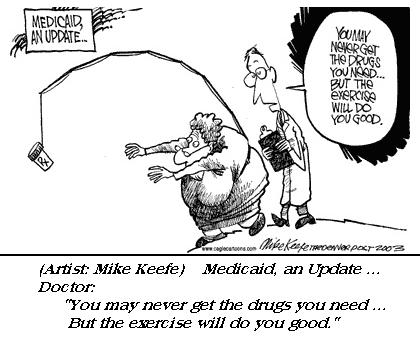
medicaredrugs.jpg

(Source)

Zagat Rating System for Doctors

A few weeks ago, Wellpoint revealed that they were going to work with Zagat’s to rate physicians.  I think any information with some benchmark is great.  Since it is patient driven, it also has the chance of being very subjective which is the risk. 

The talk about using trust, communications, cost, and availability.  I am not sure those would be my choice.

  • Trust: A great concept, but how can I be objective here. 
  • Communications: This one is critical.  Did they communicate well?  Did they write down any recommendations?  Do they call to remind me of appointments?  Were they timely in getting me follow-up appointments?  Do they remember who I am from my last visit?  Do they look at me?  If I bring in information, are they receptive to discussing what I found?  Are they straight or do they beat around the bush?  This should also include the office staff – are they friendly?  Bad office staff can blow it for a good physician very easily.
  • Cost: This is another critical one as long as it is not simply about the cost of the physician.  Did they take into account my formulary when writing prescriptions?  Did they make sure that physicians they referred were in network?  Did they prescribe generics or offer me samples?  Did they suggest non-invasive treatment options (e.g., diet)? 
  • Availability: Conceptually yes, but I am not sure your going to learn much here.  The best doctors should be the busiest doctor.  I wouldn’t want them to get a low rating simply because everyone goes to them.  Now, ability to stay on time would be good.  Ability to fit in sick patients within 48 hours would be good.  I might even include accessibility here.  Can I access the building easily if I am handicapped?  Does it have easy parking?  Does it have a place for my kids while I wait?
  • Technology: Why not measure how and if they use technology?  Online appointment setting.  Handheld prescribing.  Kiosks for signing into the office.  EMR. 
  • Outcomes: I hope that we get to a point where Wellpoint is complementing the patient data with outcomes type data or actual claims data.

Just a few thoughts.  You can find lots of blog entries about this.  Here are a few:

Aetna CEO on Price Transparency

Here is a entry on the WSJ blog about Aetna’s new price transparency policy.  Conceptually, this is an important first step.  The next question of course is how do you get this to consumers in a timely and easy to digest manner.  Then, how does this correlate with outcomes (i.e., quality) and finally, how does this change people’s decisions.

It is great for planning.  It is great for benchmarking or negotiation.  But, I am waiting to see the impact.

Can Health Consumers Vote With Their Feet?

If you can’t satisfy multiple buyers, does the company buying health insurance matter more than the consumers?  It’s a difficult question.  The employer cares about the average employee being happy with the health benefits.  You can’t design it for everyone.  And, since we can only switch insurance on annual enrollment (or other life events such as marriage), you [the consumer] can’t do much immediately.

feet  Over time, consumers can vote with their feet especially at companies where multiple insurance offerings exist.  This takes away some consumer power since you can’t storm out saying that this horrible customer service means that I am going to stop using you.

Does this affect service attitudes?  I certainly think so.  I saw it on TV several weeks ago in a sitcom, but I believe it is prevalent.  In that case, the CSR (customer service representative) basically told the person challenging the claim to terminate their coverage if they don’t like it.

call center  Since the consumer is often not the buyer or influencer of the corporate decision, this is an unfortunate reality.  Maybe we need another “life event” to be poor customer service.  When this happens you can change carriers.

Of course, the company arguement would be that this complicates underwriting and raises costs, but why not simply tie customer satisfaction to their pay.  The only way consumerism really works is where the consumer has the ability to walk away.

Interestingly, for one of our biggest customers at a past employer, we got paid cost with a bonus payment that was tied to patient satisfaction.  It was risky, but it put the right pressure on to make sure the patients were satisfied.

Can You Answer These Questions (healthcare company)?

These are more company focused although you can think about whether your healthcare company knows this about you.  To be truly effective at education or marketing to patients to drive behavior and outcomes, these are important.  Interestingly, I am not sure I (or you) could answer all these questions about myself (or yourself).

  1. What is your preferred medium – letter, call, fax, e-mail, text message?  And, does this vary based on the content?
  2. When is the best time to reach you?
  3. Would you prefer to talk or hear information delivered in a female voice or male voice?  Would you react differently if they had an accent?
  4. What would compel you to act – saving money or losing money?  Is there a specific amount?
  5. What makes you open an envelope?  (For example, we used to places stamps on intentionally crooked since people were less likely to think they were from a company.)
  6. Does color matter in materials?
  7. How many times do you need to hear a message before you respond or do you make up your mind the first time?
  8. Do you want to be healthy or simply minimize out-of-pocket costs?
  9. Do you trust physicians, pharmacists, insurance companies, hospitals?
  10. What information do you want to receive that you don’t?

I could go on, but I think the point is that today we (healthcare) don’t really understand patients.  What information they want, how to get it to them, when to deliver it, what makes it more effective, and how to drive action.  On the other hand, we may not know ourselves until “experimented” on with different variables.

Unified Communications

Those of you that know me (or follow the blog) know that one of my key issues is how to improve healthcare communications.  I think this is where we (as an industry) missed the boat.  I used to tease our VP of Call Centers that Dominos knew more about me when I called in than we did.

I was glad to see a blog entry from earlier this year by the physician that leads Microsoft’s healthcare group on this topic.

“Healthcare is a communication intensive business.  Good communication has a profound effect on the quality and safety of patient care.  Communication also has a huge bearing on patient satisfaction.  Yet historically, the options for how we communicate with each other in the healthcare industry have been somewhat limited.” 

Obviously, we have a long way to go.  Many times companies simply give up due to regulatory issues or the challenges of changing behavior.  The reality is that communications are difficult.  It is both an art (i.e., messaging, branding, design) and a science (i.e., linguistics, data mining, targeting, personalization).

Technology will drive a step change in the relationship between patients and providers and insurance companies.  This is the time to jump on board and figure out how to improve.

Sad Example of Poor Customer Service

Assuming it is real…This is one of the worst stories I have seen about claims denial.  Not only is it insulting, but it also shows how frustrating the process can be.  (BCBSKC complaint)

“we have had Blue Cross and Blue Shield of Kansas City for less than three months, they have denied every claim we have submitted to them. EVERYONE!”

BTW – The blog here (The Consumerist) is pretty interesting.  You might enjoy some of the entries:

  1. Launching an e-mail campaign to get something resolved at a company.  (I have done exactly what they describe numerous times with great success.)
  2. Saving money on prescriptions by paying cash.  (Yes this can work, but you lose visibility for drug-drug interactions if you use multiple pharmacies and a lot of pharmacies charge you more then the drug costs not less…but it can work.)
  3. Sample letter for appealing an insurance claim.  (Seems interesting.)

Paper Claims – Are You Kidding Me?

The more I use the healthcare system the more I realize the issues with the system.  While I was preparing to take my new job, I went temporarily on COBRA.  I ended up with a few paper claims while I waited for my new insurance cards and due to an eligibility file issue which the MCO or the TPA made.

Now, I am trying to get reimbursed for the 5 prescriptions for my family.  After filling out the forms and getting the pharmacist to sign them, I faxed them to my payor.  A month later, I have heard nothing so I called them.  They inform me that they have been processed, and I will get a check less my copay.  (Sounds great.)

Then, they walk me through the claims.  In one example, I paid $95 for a generic drug.  Well, their negotiated rate with the pharmacy for that drug is $22.  Taking out my $10 copay, they are sending me a check for $12.  WAIT!  What about the other $73 that I spent (times 5).  I got a nice lecture on negotiated rate versus retail which I explained to the woman that I knew.

(Here is a WSJ article on generic pricing.  This is where the margins exist.  Cash customers often pay the average wholesale price plus while the negotiated rates for the payors are usually 60% or more below the average wholesale price.  Here is a blog discussion in the Freakonomics area about prices ranging from $12 to $117 for the same generic prescription.)

All I care about is getting my cash back.  They can refund my premium, claw it back from the pharmacy, or write me a check.  They didn’t get me my cards or set me up right (or the Third Party Administrator (TPA) didn’t).  I don’t care.

After a second call, they inform me that I can appeal it and will hear in 30-days at which time I can appeal it again.  It makes me ask what the problem is and how this works for people with limited cash flow.  You have to pay and wait 3 months only to likely get turned down.  This seems like a major flaw in the process.  Why offer paper claims if you don’t get your money back? 

Healthcare – Financial or Service Oriented

I had an interesting discussion earlier this week.  The question was whether people view their healthcare companies as a financial company (i.e., cost is the dominant factor and/or the cost to value tradeoff) or as a service company (i.e., my experience at the doctor’s office, hospital, pharmacy, call center).

I am sure it is not universal, but it would be an important attribute to understand in driving communications with patients.  The easiest example I always use is the paper claims process.  Imagine getting rejected at the pharmacy and having to pay $200 for your prescription.  For some, $200 is a huge cash flow issue while for others it is simply a nuisance.  Where that person is coming from will vary their perception of that same experience dramatically.

For the person with the $200 cash flow issue, a reject forces them to either tradeoff medications versus food or heat.  Therefore, you are denying them care and possibly causing them harm.  For the other person, they pay the cash and are simply ticked off.  For them, it then becomes a customer service issue of how easy it is to submit a claim and how quickly they get reimbursed.

Accenture Top Issues for Payors

Peter Kongstvedt is a partner at Accenture (and former colleague of mine from E&Y). He has always produced great articles and publications on healthcare. I was happy to have someone send me a link to one of his more recent publications on the Top Issues for Payors in 2007 and 2008.  It is certainly more interesting if you are a payor or consultant, but here were two things that I thought most people would find interesting.

Here is a quote which I think is really one of the core issues.  How to make data driven decisions versus experience to drive healthcare.  Not easy in a splintered industry with disparate data.

Promoting medical practice that is based on current scientific data rather than on habit or outdated information remains a top goal for every payer.

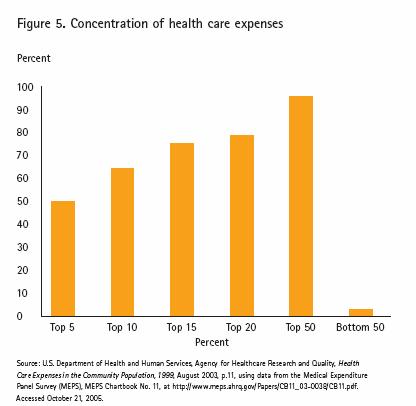
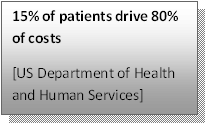
Another fact which I have always found very interesting is the chart below on the concentration of health care expenses.  Almost 80% of all healthcare expenses are from 15% of the population.  Amazing concentration.  Great from a marketing perspective but tough from a risk management perspective.

Healthcare costs concentrated

Sicko – Good Food For Thought

Have you seen Sicko? I got the management team from a healthcare client of mine to go see it with me last week in Boston. I thought it was great. If you know nothing about healthcare, you will think our system is the worse system in the world and be appalled. If you work in healthcare, you realize Michael found and did a great job of pointing out many of the weaknesses.

He also did a good job of identifying some interesting facts and showing us how healthcare works abroad. Without being a spoiler, here are some observations:

  • People without health insurance that get hurt face some very tough challenges. We need some type of care system that supports them.
  • Our processes should not interfere with care. Dropping people off in hospital gowns since they can’t pay their hospital bills is wrong.
  • Drugs are a lot cheaper outside the US.
  • The hypothesis that you wait for care outside the US seems to be a myth.
  • Running a company based on denial of care versus managing risk through wellness is a problem. This ties to bigger problems we have with the system design.

Before I go off as a liberal republican (or conservative democrat), my only recommendation is see the movie.

Sicko