Archive | Managed Care RSS feed for this section

Top Drivers of Health Care Costs 2010

A recent Managed Healthcare Executive article (Oct 2009) provides survey data from 650 people at health plans, PBMs, disease management companies, and hospitals.  [As a side note, I was really surprised at how far off this group’s estimates were relative to the impact of prescription costs…which are generally in the 10-12% of total healthcare costs.]

Top Drivers of Cost 2010

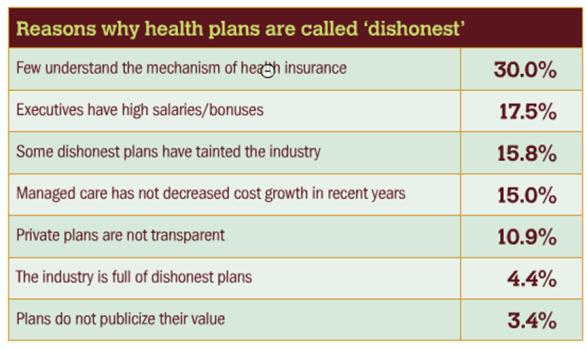
Another survey I found interesting in the article was why health plans are perceived as dishonest.

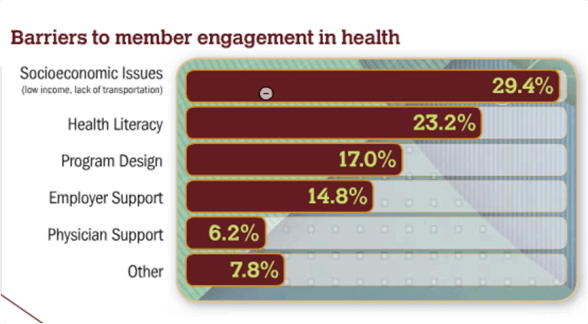
Why Healthplans Perceived DishonestAnother part of the survey had 7.8% of people saying that patients (consumers) are less interested in health and that the primary reasons for lack of engagement were:

Barriers to mbr engagement

Get Ready To Pay More For Healthcare

As expected, employers are going to push more cost to employees (those lucky to still have coverage) in 2010.  Everyone should have been expecting this.  In an article on CNNMoney.com, a consultant from Watson Wyatt predicts 10-20% increased cost.  A consultant from Mercer says the catch phrase will be “taking responsibility”.

If anything, this should help Obama and health reform.  Having a huge cost burden pushed to you in one of the worse economies will force people to make tougher decisions and could have a negative impact on overall health.  Additionally, it will push more people into high-deductible plans which require more transparency around cost and quality which while better these days still isn’t there for the masses.

broken piggy bank

Why Wellness Matters

I’ve had an intense month so I’m hoping to catch up on my big pile of blogging ideas this week.  We’ll see.

Here’s one I pulled the other day.  I liked this graphic from MVP Healthcare in their corporate profile.

MVP Wellness Stats

It hammers home all the key points – regression to the mean, focus on the high cost individuals, and cost is avoidable if you focus on preventation and education and successfully engage the consumer.

How to communicate with your members on flu 2010?

With H1N1 and the regular flu vaccines this fall, who really knows what to do?  Consumers are going to be looking for information and calling many of their providers and insurance carriers to ask the question.  Combine that management issue with the fact that only 40% of those that should get flu shots typically do, and you have a dilemna.  To hear more from Silverlink’s Chief Medical Officer (Dr. Jan Berger) and our lead for our Population Health solutions (Margot Walthall), clients and potential clients can attend our upcoming webinar on the topic.

Flu Program

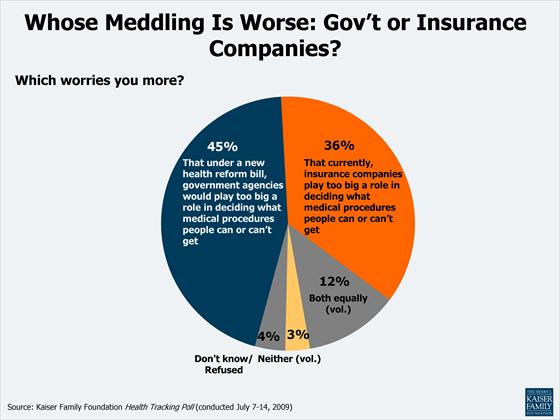
Consumers Fear Gov’t Involvement More Than Insurers

This was a pleasant surprise since I completely agree.  Based on this Kaiser survey, consumers worry more about the gov’t being involved in health care decisions than healthcare insurers.  Considering we always worry about consumer awareness and trust in healthcare entities, I think this is a positive.

Whose_Meddling_is_Worse_Govt_or_Insurance_Companies

The 5 Questions (Regence Group)

Regence Group recently put out an interesting website – www.whatstherealcost.org.  It takes an unorthodox (for a health plan) approach to delivering several important points.  It reminds me of what Wellpoint has done with Tonik or some of the things Humana is doing at HumanaGames.

One of the things I found interesting and very straightforward for patients to think about were their 5 questions:

  1. How much does that cost?
  2. Is that really necessary?
  3. Is there a cheaper option?
  4. Is there a generic for that?
  5. Has anyone out there had this before?

Imagine if every time we were asked to take a test or start a new therapy that we (patients) asked these five questions of our provider.

Deloitte 2009 Survey of Health Care Consumers

This is based on a Deloitte web-survey of 4,001 Americans in October 2008.

  • 73% are confused about how the US healthcare system works
  • Over 1/2 believe that 50% or more of healthcare dollars are wasted
  • 7 of 8 Americans believe themselves to be in good health
  • 1 in 3 are interested in working with a health “coach” to help them create and stick to a plan
  • 68% are interested in home monitoring devices that would check their condition and send results to their MD
  • 3 in 5 say financial penalties would improve their adherence
  • Only 1 in 3 Rx users say they compared treatment options
  • 22% say they looked or asked for information about a health insurance plan in the last 12 months
  • 9% have a PHR
  • Physicians who are more prescriptive (paternal) were preferred by a ratio of 2:1
  • 8 in 10 say they would consider switching from a physician recommended Rx if a pharmacist (RPh) indicated a cheaper alternative was available
  • Only 12% said they understood the term – biologics (should they?)
  • 35% are willing to accept a smaller provider network for a reduced premium and lower copayments
  • Only 25% favor increasing taxes to help cover the uninsured

Their major conclusions were:

  1. Health care is a consumer market
  2. The health care market is not homogeneous
  3. Cost concerns are changing behaviors
  4. Consumers want holistic care and resources to pursue wellness and healthy living
  5. Consumers embrace innovations that enhance self-care, convenience, personalization, and control of their personal health information

New Clinical Webinars – HEDIS, Adherence, Engagement

In June, we are offering three complimentary webinars to our clients and prospects on key topics of discussion.

Increasing the Effectiveness of Population Health Program Engagement
June 16th | 1:00 PM ET

Getting consumers to take charge of their healthcare behaviors and choices is critical to controlling costs and improving outcomes. Successfully welcoming and engaging consumers in DM and health management programs can be the toughest road for health plans and population health organizations. Strategies that motivate participatory engagement are key – but it takes more than a friendly voice and the right script.

Join Silverlink for a complimentary webinar where we will discuss the challenges of moving health behaviors and effective strategies organizations can implement to get ahead of the behavior change curve.

In addition, learn how to:

  • Leverage tailored messaging to drive high engagement rates
  • Enable continued engagement over time
  • Maximize buy-in and acceptance of health coaching
  • Combine multichannel approaches to elicit engagement and re-engagement
  • Optimize engagement campaigns through predictive analytics to drive results

Drive Positive Health Behaviors and Improve HEDIS Results

June 23rd | 1:00 PM ET

Whether your focus is on the HEDIS measures for women’s health, the diabetes metrics or a broad range of effectiveness of care measures, Silverlink can design communications strategies that increase your reach, motivate member action and improve HEDIS results.

With the backdrop of the economic slowdown, communicating with members about the importance of key preventive screenings is more critical than ever. Explore the many routes to break through health prevention challenges by tailoring communications interventions that work for your populations.

Join Silverlink for a complimentary webinar where we will present the results and lessons learned over several years in supporting HEDIS screenings including a recent campaign aimed at reducing health disparirities in African American and Hispanic populations related to colorectal cancer screenings.

In addition, learn how to:

  • Use a flexible framework that supports national teams in delivering effective outreach in local markets
  • Drive performance on high-profile HEDIS measures where plan performance has hit a plateau
  • Segment your membership to deliver highly personal messages using multiple levers
  • Design and target messages to help reduce health disparities
  • Combine multiple messages to support members with more than one gap
  • Leverage multichannel campaigns to maximize reach and action

Rethinking Medication Adherence

June 30th | 1:00 PM ET

More than 50% of consumers become nonadherent around their maintenance medications within the first 12 months of therapy. And, today’s economy is putting even more pressure on people to make economic tradeoffs that threaten their health. Several studies have shown that more people are skipping doses or not refilling medications. Non-adherence leads to $177B in direct and indirect costs to the healthcare system per year.

Silverlink provides a comprehensive suite of communications services to drive medication adherence from targeting and messaging to multi-channel campaign management and execution. Join Silverlink where we will discuss some of the common myths around and key strategies related to medication adherence.

In addition, you will learn about:

  • Critical success factors in designing adherence solutions
  • Important conditions to focus on for adherence
  • Success metrics and key measurements
  • Comprehensive solutions for all phases of the patient’s therapy from initiation through long term maintenance

Do Consumers Understand Cost of Individual Insurance?

In a study done by Kelton Research on behalf of eHealthinsurance.com, I found a few interesting data points:

  • 65% of people don’t think they could afford health insurance for more than 6 months if they lost their job.  (Since most Americans live paycheck-to-paycheck, that shouldn’t be surprising.)
  • Only 26% knew that individual health insurance is cheaper than COBRA although COBRA can be a lot less expensive with the Obama subsidiary.
  • 31% think that they would be denied coverage by another plan versus the actual denial rate which is closer to 11%.
  • To stay covered, only about 50% would be willing to spend less on cell phones or cable TV.
  • Only 40% would be willing to pay more than $200/ month.

Why Does WSJ Villanize CVS Caremark?

I was so annoyed when I read the WSJ this morning about CVS Caremark charging more for members that go outside the CVS store or mail order.  Come on guys.  This is a basic tiered network design.  It’s not unlike tiered formularies or preferred drug lists.

First, it’s a plan design that was created and offered to clients.  Some clients choose it.  That’s not CVS Caremark’s issue.  Anyone could do this and offer it.

Second, what’s different between this an mandatory mail or retail buy-up.  If you choose a higher cost location, you have to pay more.  You’re getting the same drug at a higher cost facility.

What frustrates me the most here is that we will never reform healthcare and drive out costs if people want to have their cake and eat it too.  You think you can have total flexibility and manage costs.  We have to make some hard decisions and push people to drugs, locations, treatments, etc. that offer similar quality at a lower cost.  That’s not going to be easy.

cake

Communication Strategy Regarding H1N1 (Swine) Flu

“There is a lot of media, a lot of news, a lot of rumor – the sooner you can get correct and accurate information to consumers, the better – otherwise people will look to other sources that may not always be accurate.”  (Jan Berger, President of Health Intelligence Partners on podcast)

We have been hearing a few things from our clients and have put some information up on the Silverlink website.  Some of the comments have been:

  1. I have seen a spike in call center volume about this topic.
  2. Clients want to change plan design to make sure Relenza and Tamiflu are covered and don’t require a prior authorization or have a quantity level limit on them.
  3. We want to proactively reach out to at risk populations – children, seniors, or people with a compromised immune system.
  4. We want to be able to flexibly target certain geographies.
  5. We want to remind people not to panic, drive them to quality information sources, and make sure they know the basics – wash your hands.

At a minimum, everyone is adding information to their websites.  Many consumers are Googling the topic or following updates from @CDCEmergency (on Twitter).

Healthplans, PBMs, and population health companies are at the heart of this.  They need a coordinated strategy to inform people appropriately as this issue continues to be top of mind.

We recorded a podcast last night with the Medical Director from Healthwise and Jan Berger who is the former Chief Medical Officer from CVS Caremark and is now president of Health Intelligence Partners.  In here, they answer some general questions about the situation and what companies should be doing to educate members.

The two standard solutions Silverlink is offering clients are:

  1. Offer an inbound FAQ (Frequently Asked Questions) line with CDC content and specifics about their plans.  This can help with overflow from their call center and/or be used as a direct line from their website or outbound communications.
  2. Selectively target populations (age, zip code, disease state) with a brief message reminding them to wash their hands and telling them where to get qualified information.

As with all our communications offerings, these can be customized (messaging, channel, targeting, etc.) to meet client requirements.  Additionally, since one of our technology advantages over others in the space is our flexibility, we can work with clients to keep these messages up-to-date as the situation changes and as new information has to be added.

Gov Leavitt On Gov’t Trojan Horse For Healthcare

In a piece that was posted on the AmericaSpeakOn.org website this morning and which I heard Governor Leavitt talk through last night, he lays out some of the illusions that we have around government run healthcare and reminds us that Medicare isn’t a model to emulate (in case you didn’t know that).  A few of the quotes from the piece:

  • Advocates of government-run health care suffer under the illusion that Medicare operates more efficiently than the private sector.
  • The efficiency of a health-care system isn’t measured by the volume of checks it issues, but the value it generates.  Medicare’s uncoordinated, quality-indifferent, more-more-more structure is moving it rapidly toward bankruptcy, and taking our nation with it.
  • Since 1970, the cost of these flagship government-run health-care programs has risen more than two-and-a-half times as much as the cost of all other health care in the United States, the vast majority of which is run by the private sector.
  • Medicare’s budget is projected to double within ten years, topping $1 trillion annually.  The number of workers per beneficiary will soon drop from almost four to just over two and a half.
  • This is like treating chronic obesity with a perpetual regimen of double calories.
  • Inevitably, government-run systems cut costs by cutting access to services.

There is another answer.  The government needs to promote value — to empower consumers to pursue the highest-quality care at the lowest-possible prices.  Strong government action is needed to organize an efficient market where consumers can choose insurance plans and medical practitioners who offer the best value.  What is not needed is to replace the private market with a government-run system in which only the truly rich have a choice.

Pharma Rx Costs Tied To Outcomes

Given our opinion that the PBM industry would be moving to more outcome based pricing, the articles today about Merck and Cigna‘s deal on pricing based on outcomes is very timely.  I “tweeted” about it early in the AM, but I have got the article sent to me by a lot of people.  So, here are a few of the things being said:

WSJ Blog

Now Merck and Cigna have announced what they’re calling a “performance-based contract” for Merck’s diabetes drug Januvia. But the deal is actually the reverse the pay-for-performance ideal: Merck will get paid less per pill, not more, if the drug works well.

Under the deal, Cigna will get a discount on the drug if patients’ blood sugar falls. Cigna will get additional discounts if patients faithfully take the drug when they’re supposed to. (These two variables often go together — taking the drug faithfully helps keep blood sugar down.)

Cigna PR

“Merck should be recognized as the first major pharmaceutical company to offer increased discounts on its oral anti-diabetic products, supporting CIGNA’s efforts to reduce A1C levels for individuals with diabetes, regardless of what medication they may be taking,” said Eric Elliott, president of CIGNA Pharmacy Management. “Improving people’s health comes first for both CIGNA and Merck. We hope this agreement will become a model in the industry.”

So…it seems like an aligned deal.  Merck and Cigna want adherence.  Employers want lower costs and better outcomes.

Whitepaper: The Future of the PBM (Pharmacy)

As we have been working with a lot of PBMs over the past year, the question has come up many times – “where do you see the industry going?” After bouncing some ideas off a few of you, we have pulled together a whitepaper with the Silverlink Communications perspective. Certainly, each area of the whitepaper could have been its own chapter, but rather than turn this into a thesis, we are publishing it.

As I have said in a few recent articles including the one in HCPro, I think the Express Scripts acquisition of NextRx will likely accelerate a few of our predictions here.

The executive summary of the whitepaper is below. The final whitepaper is available here.

I would welcome any comments you have…

Executive Summary

In the next several years, we believe that three changes will drive the pharmacy marketplace and ultimately change the business model for PBMs. These changes will be accelerated by the current financial crisis which may drive further consolidation in the short-term. Consolidation which we believe will accelerate the “race to the bottom” where the traditional model of scale has been maxed out with parity achieved among the large PBMs.

1. The need to better engage the consumer in understanding their benefits and ultimately responsibility for their care;
2. The effort to automate and integrate data across a fragmented system and across siloed organizations; and
3. The shift from trend management to being responsible for outcomes.

Consumer Engagement
The industry-wide movement to consumerism will continue to affect plan design, but it will also thrust PBMs and pharmacies into the critical path of member engagement. With pharmacy being the most used benefit as well as the volume and accessibility of retail pharmacies, they will play a critical role in driving adherence and helping consumers understand healthcare. This will renew the focus on cognitive skills, medication therapy management and ultimately drive the desire for a more traditional “corner store” approach that can be scaled using technology.

Combining this with the macro-economic forces that are driving ubiquity of technology through mobile media and the evolution of the Internet from a pull media to a push media will also challenge the PBMs and pharmacies to innovate. They will be required to look outside of healthcare models to identify the right communications to drive behavior. PBM’s and pharmacies will have to leverage behavioral economics and personalization technology to get the right message to the right consumer at the right time through the right medium.
Automation and Integration
The consumer engagement challenges will only exasperate some ongoing challenges within the PBM and pharmacy community. This will include the lack of staff to provide more cognitive services and the general fragmentation of data across organizations and functional silos. Figuring out an overall “single view of the patient” which shows all the touch points and offers a coordinated multi-channel strategy for inbound and outbound communications will become a major focus.

In addition, in order to make these solutions efficient, the development of predictive models, much like the clinical and underwriting solutions being used today, will become the norm across the industry. As these models are fine tuned and the promise of e-prescribing becomes more of a reality, the channel for engaging physicians in the member’s care will finally exist. PBMs and pharmacies will be able to use data to allow physicians to understand when patients aren’t being compliant and when there is an opportunity to drive change.

From Trend Management to Outcomes
The traditional business model for the PBMs has been based on large scale negotiations to drive rebates and efficiencies within mail service – cost to fill and acquisition costs. At the same time as those efficiencies reach a maximum discount, the traditional tools for managing trend will have run their course. Although plan design won’t “die”, comparative effectiveness may reduce (or eliminate) the need for formularies, and in general, the ability to shift cost to the consumer above the 25-30% level will be difficult.

Both of these challenges will push the PBMs and pharmacies into a role where they are focused on driving health outcomes and being part of the bigger solution across the industry. They have a strong footprint to drive this change and as theranostics (or personalized medicine) evolves there will be an opportunity to find cost effective solutions to change the prescription landscape.

The Innovator’s Prescription – Christensen Book

I haven’t had the chance to read the book yet, but for those of you interested, I thought I would point you to the review from a few months ago on The Health Care Blog.

The book is mistitled. It should have been titled “The Innovator’s Diagnosis”. The book does a fantastic job at diagnosis (Dx) of problems in the U.S. health care system. It presents many new, innovative analytical frameworks and lenses through which to view the U.S. health system.

However, it’s weak on prescription (Rx): many of the proposed solutions are speculative, ungrounded, and/or defy political reality.

Waxman at the AMA

I am finally catching up on some notes from Rep. Henry Waxman (D-CA) when he spoke to the AMA in March 2009.  (From “The Pink Sheet”, March 16, 2009, pg. 27)

“We all know we have to get costs under control, but the way to do that is not to tell physicians what they can and cannot do or put them in a position where they cannot put the needs of their patient first.”

“I am not interested in trying to put a public plan in place that would drive out competition.  I believe we must have a significant role for private insurers.  We must allow them a fair opportunity to compete.”

“We have to reward quality and outcomes, not just reward volume.”

The $40B HealthCare Opportunity Around Retention

It’s obvious to anyone close to it, but harder to align the goals to take advantage of it.  With people “aging-out” from group plans to Medicare and people leaving their employer coverage to go to the individual market, managed care has a huge opportunity to retain that business by providing them a transition path.  According to McKinsey (and from what we see), that’s generally not happening.

A few facts from their report:

  • 68 percent of all members aged 60 to 64 have never been approached by their current insurers to discuss retirement options.
  • more than 80 percent of respondents aged 60 to 64 said they would consider purchasing an individual product from their current carrier if they left their jobs or retired.
  • Only 33 percent of 60- to 64-year-olds thought that their insurers offered Medicare products, for example, when in fact almost all major carriers do.

It’s also a simple economic problem.  They are less expensive to retain and convert while their a member than once they are on the open market.  You may even save on broker fees.  Developing a data driven approach to create timely and personalized communications along with a service to transition them should be a priority.

mckinsey-conversion-opp

Upcoming Book By George Halvorson From Kaiser

I had the privledge of previewing George Halvorson‘s new book “Health Care Will Not Reform Itself” this week.  My book cover quote would go something like this:

“Opinions supported by facts all wrapped up in a narrative.  It’s like a fireside chat with one of the greatest leaders in healthcare.”

I won’t pull things from the book yet, but I found it a logical follow-up to his other book “Health Care Reform Now! A Prescription For Change“.  He talks about the need for bold goals and a clear set of metrics to drive change.  He talks about why healthcare costs go up and the fact that we need universal coverage.  And, he also hits on what seems to be the key theme of the day – reducing costs while improving outcomes.

While I was at the WHCC09, I got to sit down with George Halvorson and talk about healthcare for an hour.  It was a great privledge that I enjoyed a lot, and I could have talked for hours.  We hit on a bunch of topics so let me share some of them.

  • We talked about him writing books.  I was commenting on how much I like his writing style and was intrigued to learn that he said some professors don’t like using his books because they’re “too easy to read”.
  • We had a fascinating discussion around leadership and diversity and how he has created a very diverse leadership team at Kaiser.  I was also impressed to hear that one member of team does an international fellowship each year where they spend time abroad learning about how healthcare is delivered and managed in other countries.  [very progressive]
  • We talked about how healthcare was going to change.  He spent a lot of time on the need to create aggressive goals especially around the 10-20% of things that drive 80% of the costs.  For example, he asked why we don’t try to reduce asthma attacks or congestive heart failure by 90%.  And, he pointed out the fact that we don’t have a common set of goals that allows enterprises to reverse engineer the process and identify points of variance.  Without that process analysis and a specific goal, it is hard to drive improvements.

“We need to change our expectations of what is possible.”

  • We talked a little bit about where innovation will come from.  He talked about how Deming, a statistician, revolutionized manufacturing as a lead into the point that innovation will likely come from outside the industry.  [I think this is interesting as I have seen more and more executives at healthcare companies that are coming from outside of healthcare.  I also think things like the X-Prize may attract others to try their ideas.]
  • He gave some great examples of how Kaiser has deployed their 30 black belts.  The one I quickly jotted down had to do with how nurses change shifts.  This shift change is where all the information was exchanged about different patients and when accidents sometimes happened.  By changing the process, they dropped the accident rate and reduced the communication time from 40 minutes per shift to 12 minutes per shift.
  • We also talked about HIT (Healthcare Information Technology) and the need not only to drive utilization but to mandate system integration.  This tied in with an earlier conversation where we spoke about coordinated care versus uncoordinated care and the need to create a “virtual Kaiser”.  I think there is a lot to learn from the Kaiser model and some of the things they are doing with technology to drive care.  [I was pleasantly surprised that he believes physicians will embrace technology as a tool to help them standardize care.  I think that is critical path to successfully reducing costs while improving outcomes.]
  • I couldn’t jot down all the statistics fast enough, but he talked about how they were testing different “panel systems” in different geographies to see what the best process and technology solution would be.  They had had some great results.  [One fact he shared that jumped out at me was that 25% of people over 65 that break a bone die within a year.]
  • The last thing we talked about was probably the most insightful to me.  Given the amount of money spent in the last months of people’s lives, I was interested in his global perspective on whether that was a cultural issue.  He said that he thinks it is mostly that the care system in the US lacks honesty or the ability to be brutally honest.  We talked about one scenario where people who do nothing live an average of 140 days and those that get invasive surgery live an average of 100 days…but they are hoping to be that 1 in a 1,000 that live an extra year.  [Is it worth all that pain, surgery, and medicine for the last few months?]  We also talked about the new $100,000 breast surgery drug which extends the patient’s life on average for 1 month.  [Again, is that an appropriate use of money?  Would we spend it if it came out of our pockets?]

When the book comes out, I will try to pull out some of the key points, but I would recommend you pick it up and read it for yourself.  I think you will really enjoy it.

WHCC 09 Interview with Ed Batchelor (Humana)

I had an opportunity to sit down with Ed Batchelor from Humana yesterday.  He has an interesting role driving the Stay Smart / Stay Healthy program for them as part of his Corporate Web Strategy role.  From what I could tell, it’s a program done for the greater good of educating consumers about key healthcare topics.  To accomplish that, Ed has a direct reporting relationship to the operating committee at Humana and was brought in from outside the industry.

Here is an example of one of the videos that they are pushing out on YouTube.  I really like the whiteboard communication approach.

Some of the big takeaways from my discussion were:

  1. You have to meet the consumers where they are – Facebook, YouTube, Blogs.
  2. If you create a neutral educational message, consumers will trust information (even from health plans).
  3. You can only deliver information in “bits”.  Don’t overwhelm them.
  4. Fun is good.
  5. Regardless of what many (including myself) might think, seniors don’t all shy away from these social media.  [20% of the 1.1M views on YouTube have been from people over 55 years old]
  6. Success on YouTube doesn’t translate to blogs.

One question that I had was how to get away from the “healthcare speak” so that consumers could actually understand it.  He talked about 3 things:

  1. Bringing in an external person
  2. Using focus groups
  3. Using an outside agency

The other thing we talked about is that pull through that they are getting around employers and brokers.  They are pulling the videos in (like here) and re-using them.

This was a program they were highlighting in their booth and one of the public areas here so I appreciated the opportunity to sit down and learn more.

Selling NextRx to Express Scripts

I was hoping I might get a chance to sit down with Angela Braly (CEO at Wellpoint) at the WHCC 2009 in DC to talk about the sale they announced yesterday NextRx to Express Scripts).  I think it’s a very logical decision, and I think they got a good price.  For my old team at ESI, there is a huge opportunity for them to drive mail volume.

In her keynote discussion this morning, she briefly mentioned the sale saying that they sold it to help lower healthcare costs.  While I completely agree in the short-term (i.e., rebate contracting, network negotiations), I remain mixed in my long-term view.

I talked briefly with Les Masterson about this yesterday for the article he just published – “PBM Sale Highlights Dilemna for Health Plans“.  I do expect this will push for the development of a new business model which will highlight automation, member engagement, and a greater role in driving outcomes.

George Van Antwerp, vice president, solutions strategy, at Silverlink Communications, Inc., in Burlington, MA, says health plans can benefit from having their own PBMs if they use them properly.

“I think that it’s beneficial to plans to own their own PBM if they can integrate data and create a better member experience; make the tradeoff between increased pharmacy spend and lower medical loss ratio; and manage to get most of the economies of scale in terms of operations and negotiation. That has proven hard to do within health plans, and therefore, there will be short-term interest in capitalizing on the valuation of the PBM business,” says Van Antwerp.

With three large PBMs left after the pending purchase, Van Antwerp says the trio will “race to the bottom in terms of negotiating scale leverage.” Van Antwerp predicts the remaining PBMs will ultimately try to differentiate themselves by offering healthcare management through member engagement, greater transparency, and a renewed focus on health outcomes.

Medicaid Communications

Interested in hearing more about this topic.  You can hear Margot Walthall from my team talking about this on an upcoming webinar.

The Medicaid Communications Lifecycle:  From Onboarding through Redetermination
April 28, 2009 | 1:00 PM ET | 10:00 AM PT

Introducing your Medicaid members to your plan’s benefits as well as their responsibilities is critical to developing a successful member / health plan relationship. Sustaining positive impressions over the course of the member’s eligibility is equally important to retaining Medicaid members.

Silverlink has developed a broad set of communications outreach programs that have yielded strong results for Medicaid and CHIP populations. Join us for this complimentary webinar where we will explore how Silverlink can help you cost-efficiently support:

  • The Medicaid onboarding process with welcome/HRA outreach
  • Targeted messages about health screenings to drive HEDIS results
  • Communications approaches that can reduce health disparities
  • Effective methods for educating members about the redetermination process that can inspire loyalty

Register Here

Big Month For Vasectomies

Based on several articles over the past year, this should be a big month for vasectomies.

Last year, Forbes pointed out that the scheduling of vasectomies jumps dramatically before big sports events – The Masters, Final Four, Football.  Apparently, people want to get “snipped” on the Friday and have a good reason to sit around all weekend and recover while they watch their favorite sport.  Talk about planning.

And, last month, there was an article about the spike in vasectomies due to the economy.  No hard data about why, but the article hypothesizes that people are concerned about the additional costs of children and want to get the procedure done while they have health insurance.

Impact of Rising Health Care Costs

These are straight from the National Coalition on Health Care (NCHC), but they represent a sobering view of the impact of our rising costs. For the broader list of facts, you can go to their website.

  • In 2008, health care spending in the United States reached $2.4 trillion, and was projected to reach $3.1 trillion in 2012.1 Health care spending is projected to reach $4.3 trillion by 2016.1
  • Premiums for employer-based health insurance rose by 5.0 percent in 2008. In 2007, small employers saw their premiums, on average, increase 5.5 percent. Firms with less than 24 workers, experienced an increase of 6.8 percent.2
  • Health care spending is 4.3 times the amount spent on national defense.3
  • Health insurance expenses are the fastest growing cost component for employers. Unless something changes dramatically, health insurance costs will overtake profits by the end of 2008.4
  • The percentage of Americans under age 65 whose family-level, out-of-pocket spending for health care, including health insurance, that exceeds $2,000 a year, rose from 37.3 percent in 1996 to 43.1 percent in 2003 – a 16 percent increase.5
  • A recent study by Harvard University researchers found that the average out-of-pocket medical debt for those who filed for bankruptcy was $12,000. The study noted that 68 percent of those who filed for bankruptcy had health insurance. In addition, the study found that 50 percent of all bankruptcy filings were partly the result of medical expenses.6 Every 30 seconds in the United States someone files for bankruptcy in the aftermath of a serious health problem.
  • A new survey shows that more than 25 percent said that housing problems resulted from medical debt, including the inability to make rent or mortgage payments and the development of bad credit ratings.7
  • About 1.5 million families lose their homes to foreclosure every year due to unaffordable medical costs. 8
  • A survey of Iowa consumers found that in order to cope with rising health insurance costs, 86 percent said they had cut back on how much they could save, and 44 percent said that they have cut back on food and heating expenses.9

Notes

  1. Keehan, S. et al. “Health Spending Projections Through 2017, Health Affairs Web Exclusive W146: 21 February 2008.
  2. The Henry J. Kaiser Family Foundation. Employee Health Benefits: 2008 Annual Survey. September 2008.
  3. California Health Care Foundation. Health Care Costs 101 — 2005. 02 March 2005.
  4. McKinsey and Company. The McKinsey Quarterly Chart Focus Newsletter, “Will Health Benefit Costs Eclipse Profits,” September, 2004.
  5. Agency for Heathcare Research and Quality. Out-of-Pocket Expenditures on Health Care and Insurance Premiums Among the Non-elderly Population, 2003, March 2006.
  6. Himmelstein, D, E. Warren, D. Thorne, and S. Woolhander, “Illness and Injury as Contributors to Bankruptcy, ” Health Affairs Web Exclusive W5-63, 02 February , 2005.
  7. The Access Project. Home Sick: How Medical Debt Undermines Housing Security. Boston, MA, November 2005.
  8. Robertson, C.T., et al. “Get Sick, Get Out: The Medical Causes of Home Mortgage Foreclosures,” Health Matrix, 2008
  9. Selzer and Company Inc. Department of Public Health 2005 Survey of Iowa Consumers, September 2005.

Responsibility Based Healthcare

Are we finally to a point economically where healthy people will get tired of bearing the cost burden of supporting their sicker coworkers?  As costs continue to skyrocket, most people probably don’t realize that those are from a minority of their coworkers who have chronic conditions.  (Or in the case of Medicare, are from the costs incurred in the final year of life.)

If you’re like me, I generally don’t mind the risk pool concept (since I don’t know where I might end up any year).  And, I certainly don”t mind paying for people who are genetically pre-disposed to some condition (we all may be in that bucket someday), but I could take issue with paying for people who don’t comply with their physician’s recommendations (most of us), don’t act preventatively (most of us), abuse their body with things like smoking, and I could go on.

It got me thinking this morning about a model where we were able to push costs to people based on them taking responsibility for their care (i.e., “responsibility-based care”).  While we certainly won’t be at a place in the near future where genomics dominates and we can pull out people who can’t control their health, we can track things like compliance and adherence once we get an integrated HIT (healthcare information technology) system in place.

Additionally, we might get someday to a place where we can offer incentives based on active management and results which are self-reported by remote devices that track blood pressure, weight, cholesterol, etc.  But, many of these have issues around confidentiality and would challenge the risk pool process that we use today to underwrite medical costs.

I am not sure what the right answer is, but I think it’s about time for this debate to rear its head again with more energy.

$2.3T on Healthcare and 47M Uninsured – National Disgrace

Kaiser Permanente recently launched a series of advertisements that drive this message around health disparities home. It is (or should be) a concern for most of us.  Health outcomes and especially preventative care is driven by health literacy, our attitudes towards health, and our access to the healthcare system.  We should all be working with our families, our communities, and our country to try to make this better.

I am a firm believer that one of the best ways to start to manage cost is to find a viable strategy to get universal coverage.  The costs of emergency care and absenteeism all get passed on to us in one way or another.  And, as the government is the dominant payor of healthcare (Medicare, Medicaid), long term costs are a significant issue for our economy.  If there is a systemic way of improving it, we should seek that out.

So, a cause that is both moral and economical…what more do you need?

Today, more than 50 percent of Americans and 75 percent of Californians without health care coverage are people of color.  Uninsured men, women, and children are far more likely to get sick and forego care simply because they lack coverage.  This is a national disgrace. We spend 2.3 trillion dollars on care in this country. Securing health care coverage for every American is the next great civil rights issue of our time. We can and should achieve universal coverage.

kaiser-ad

Some of the facts highlighted on their new website about disparities include:

  1. Disparities in health and health care impact everyone. African Americans, American Indians, Alaska Natives, Asians, Pacific Islanders, and Hispanics are most affected.

  2. 27% of adults report having no usual source of care. African-American (28%), Hispanic (51%), and Asian (23%) adults are all more likely to report not having a usual doctor.

  3. Uninsured adults are disproportionately, young, and minorities; 82% are between 19-49 years of age, and 41% identified themselves as black, Hispanic, or other.

  4. American Indian and Alaskan Native death rates from sudden infant death syndrome are the highest of any population groups.

  5. Asian Americans have the highest tuberculosis case rates of any racial and ethnic population.

  6. During 1996-2000, Native Hawaiians were 2.5 times more likely to be diagnosed with diabetes than non-Hispanic white residents of Hawaii of similar age.

  7. In 2005, African Americans accounted for 18,121 (49%) of the estimated 37,331 new HIV/AIDS diagnoses in a national poll which encompassed 33 states.

  8. 21.9% of U.S. children live in poverty, far and away the worst in the industrialized world. Comparable figures for the Nordic countries are 4.2% and less.

  9. Adults who have not finished high school are almost two times more likely than college graduates to be obese.

To learn more about the topic, you can go to their community of information.

BioGenerics, Text Analysis, and Transparency

Here are a couple of blog posts from other blogs worth reading:

  • David Williams on the “Folly of BioGenerics” which talks about why they won’t be just like generic drugs.
  • James Taylor on Text Analysis which if ever figured out would be very helpful in taking inbound e-mails, letters, and call center notes and using them for customer relationship management.
  • Gilles Frydman on “Opaque Inc.” and how difficult it is to understand the US healthcare system.

Kaiser Family Foundation: Medicare 101 Webinar

I thought this sounded interesting so I thought I would post it for those of you that are interested…

********

On Monday, March 16 at 12:15 p.m. ET, the Kaiser Family Foundation and the Alliance for Health Reform will co-host a briefing with a panel of experts discussing the Medicare program. Medicare covers nearly 45 million beneficiaries, including 38 million seniors and 7 million younger adults with permanent disabilities. The program is expected to cost the federal government approximately $477 billion in 2009, accounting for 13 percent of federal spending and 19 percent of total national health expenditures.

Panelists will address questions such as:

  • Whom does Medicare serve and what services does it cover?
  • What are Medicare Parts A, B, C and D?
  • How is it structured and financed?
  • What drives Medicare’s costs?
  • How does Medicare reimburse providers and hospitals?
  • What future challenges face the program?

A live webcast of the discussion will be provided by kaisernetwork.org.

WHO: Ed Howard, JD, executive vice president of the Alliance for Health Reform and Diane Rowland, ScD, executive vice president, Kaiser Family Foundation and executive director, Kaiser Commission on Medicaid and the Uninsured will co-moderate the discussion with panelists:

  • Juliette Cubanski, PhD, principal policy analyst, Kaiser Family Foundation
  • Marilyn Moon, PhD, vice president and director, American Institutes for Research
  • Tom Gustafson, PhD, senior policy advisor, Arnold & Porter LLC